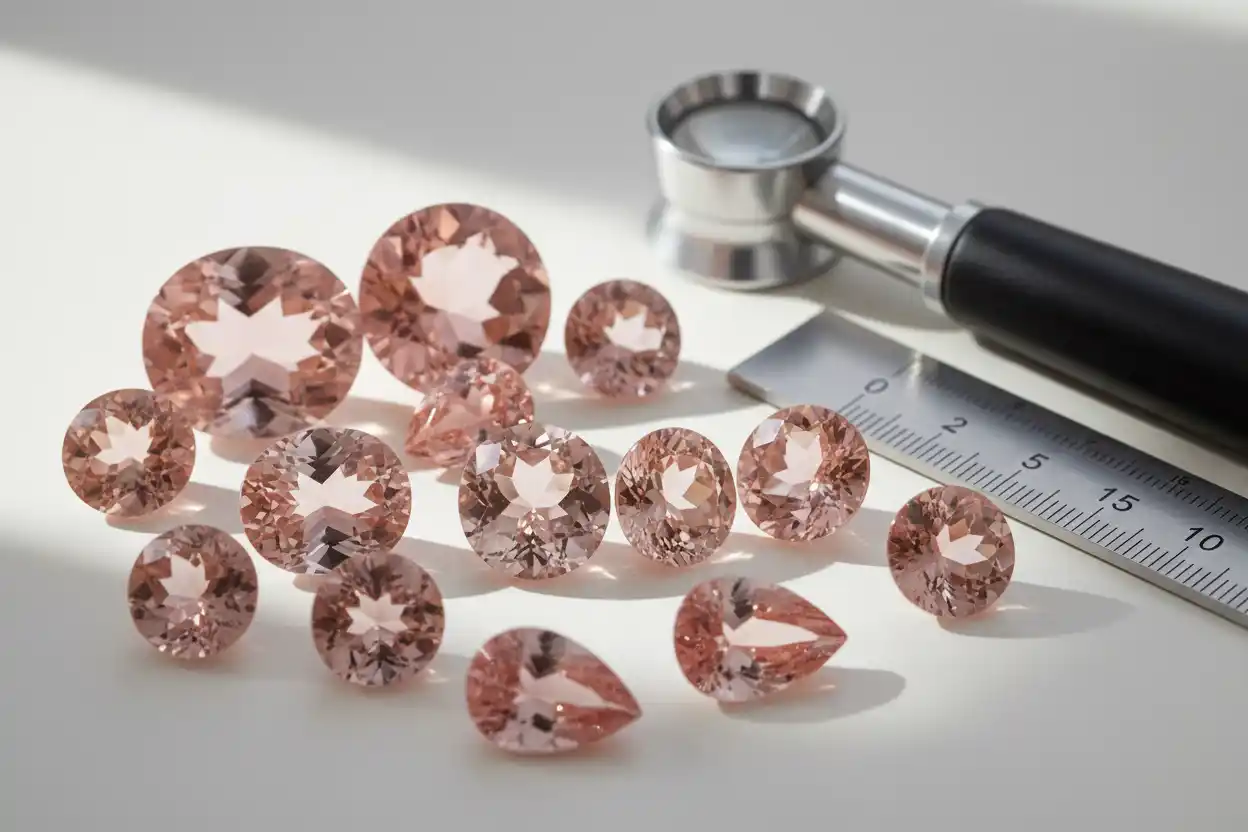
Buy Morganite: Smart Buying Tips & Red Flags
If you want to buy morganite intelligently, begin with face-up color and cut rather than carat weight. Morganite is the pink-to-orange-pink variety of beryl, the same mineral family that includes emerald and aquamarine, yet its market behaves very differently because clean crystals can grow large, pale color is common, and substantial faceted stones are much easier to obtain than equally large fine emeralds or intensely colored pink sapphires.
That combination creates a specific buying trap: a large, transparent morganite can look impressive on paper while appearing almost colorless once removed from warm photography or a rose-gold setting. Conversely, a smaller stone with stronger natural-looking pink, peach, or purplish-pink color, efficient proportions, and good orientation can have much greater visual impact. Heat treatment is also routine, additional color modification has been documented, and natural origin does not by itself prove that the color is untreated.
The strongest methodology when you buy morganite is therefore natural beryl identity first, face-up color second, cut and windowing third, transparency and clarity fourth, dimensions fifth, treatment disclosure sixth, structural condition seventh, report evidence eighth, setting influence ninth, and price last. Following that hierarchy prevents large carat numbers, rose-gold reflections, seller-created AAA grades, “pink emerald” terminology, or unsupported untreated claims from replacing the qualities that actually determine whether the stone is worth buying.
The broader Morganite properties guide explains its beryl identity, mineral properties, formation, color, localities, and symbolism. This page focuses specifically on how to buy morganite as a loose gemstone or finished jewel while separating meaningful quality from weak saturation, poor cutting, treatment ambiguity, imitation, and inflated rarity claims.
What to Judge First When You Buy Morganite
Morganite has the same fundamental beryl formula as aquamarine, emerald, heliodor, and goshenite:
Be₃Al₂Si₆O₁₈
Manganese is chiefly responsible for its pink-to-orange-pink coloration. Untreated material frequently contains peach, salmon, or orange components, while treatment can shift the appearance toward a purer pink.
When you buy morganite, use this quality hierarchy:
| Priority | What to evaluate | Why it matters |
|---|---|---|
| 1 | Natural morganite identity | Glass, CZ, synthetic spinel, other pink gems, and synthetic beryl can imitate it |
| 2 | Face-up color | Color is usually the strongest visible value factor |
| 3 | Tone and saturation | Pale material can become almost colorless despite impressive size |
| 4 | Cut quality | Windowing and excessive depth can severely weaken appearance |
| 5 | Transparency | Fine faceted morganite is normally expected to look clean and bright |
| 6 | Millimeter dimensions | Weight can be hidden in an unnecessarily deep pavilion |
| 7 | Treatment | Heat is routine; other color modification and filling need separate disclosure |
| 8 | Structural condition | Surface-reaching fractures matter more than tiny enclosed inclusions |
| 9 | Laboratory documentation | Important when untreated, synthetic, or unusual-color claims affect price |
| 10 | Setting influence | Rose gold can make pale morganite look much pinker |
| 11 | Origin | Locality is generally less important than color and cutting |
| 12 | Price | Price should follow actual gemstone quality rather than the marketing story |
When you buy morganite through this sequence, you compare what the gemstone genuinely offers rather than paying for characteristics created mostly by presentation.
Morganite Is Pink Beryl, Not Pink Emerald
Morganite and emerald are both members of the beryl mineral species, but they occupy separate gem varieties and completely different markets.
Emerald is green to bluish-green beryl whose color is associated mainly with chromium, vanadium, or both.
Morganite is pink to orange-pink beryl whose color is associated primarily with manganese.
When you buy morganite, phrases such as pink emerald should therefore be treated as promotional rather than gemologically precise.
The beryl family guide explains how morganite relates to aquamarine, emerald, heliodor, goshenite, and red beryl.
A seller should be able to make morganite attractive on its own merits without borrowing emerald’s rarity or prestige.
Color Is the First Visible Quality Factor
Morganite is generally a pastel gemstone.
Common colors include:
pink, rose pink, purplish pink, blush, peach, salmon, orangy pink, and intermediate combinations.
When you buy morganite, do not expect every fine stone to display vivid hot-pink saturation.
Strong color is comparatively uncommon.
The important question is whether the gemstone remains recognizably colored under neutral illumination rather than becoming almost colorless as soon as optimized photography disappears.
Pure Pink Usually Receives Strong Demand
Pink and purplish-pink morganite commonly attract strong buyer interest, particularly in bridal jewelry.
When you buy morganite in this color range, judge whether the pink remains visible:
face-up, away from rose gold, against neutral gray, and under ordinary indoor illumination.
A stone that looks strongly pink only when photographed inside a rose-gold ring may owe much of its apparent saturation to reflected metal color.
That can still create beautiful jewelry.
It should not be confused with inherently strong gemstone color.
Peach and Salmon Morganite Can Be Excellent
Untreated morganite commonly shows orange, peach, or salmon components, and those colors can be highly attractive.
When you buy morganite, do not automatically rank every peach gemstone below every pink gemstone.
A richly colored natural-looking peach stone can be more impressive than a pale supposedly pure-pink stone.
The strongest purchase should have a hue that you actually like, supported by good tone, saturation, brilliance, and cutting.
The broader pink gemstones guide helps place morganite alongside pink sapphire, tourmaline, spinel, kunzite, rose quartz, and other materials without turning one hue into a universal quality grade.
Untreated Peach Can Have Collector Appeal
Because conventional heating commonly reduces yellow and orange components, attractive peach or salmon morganite represented as untreated can appeal to collectors who value natural color.
When you buy morganite at a meaningful premium specifically for untreated peach color, however, demand stronger documentation than a seller saying the stone “looks natural.”
Treatment status and beauty are separate questions.
An untreated pale stone is not automatically worth more than a beautiful heated pink stone.
The untreated premium makes sense only when the natural color itself is desirable.
Strong Saturation Is More Important Than Maximum Darkness
A darker morganite can show stronger color than a pale stone, but darkness itself is not the goal.
When you buy morganite, avoid material that becomes:
brownish, grayish, muddy, excessively orange, or visually dull.
A strong medium-light pink can look much more elegant than a darker stone with unattractive modifiers.
The best tone gives the gemstone enough depth to display obvious color while retaining brightness.
Very Pale Morganite Is Common
This is one of the most important realities to understand when you buy morganite.
Large, clean, pale stones are relatively available.
That means a substantial carat weight should not automatically create a rarity premium.
A large gemstone can be nearly colorless in daylight yet look beautifully blush-colored after warm lighting, skin reflection, and rose gold are introduced.
The purchase is still valid if you like that final appearance.
Just make sure the price reflects the gemstone’s real body color rather than the enhanced presentation.
Evaluate Color Against White and Gray
When you buy morganite online, request photographs or video of the exact stone against both white and neutral-gray backgrounds.
Gray can be especially useful because it provides less strong reflection into a pale transparent gem.
Look at whether the stone remains:
pink, peach, salmon, or purplish pink.
Then compare it with the listing image.
If a richly saturated product photograph becomes nearly colorless against neutral gray, you have learned something important about the stone’s actual color.
Rose Gold Can Change the Appearance Dramatically
Morganite and rose gold are a popular pairing because the warm metal reflects pink and copper-colored light into the gemstone.
This can create an exceptionally harmonious design.
It can also complicate quality evaluation.
When you buy morganite already mounted in rose gold, inspect the stone from the side and, where possible, through an open pavilion.
Ask for loose-stone imagery if the center carries a substantial portion of the price.
The gemstone should be judged separately from the visual effect created by the complete ring.
Rose Gold Enhancement Is Not Dishonest by Itself
Gemstone and setting always interact optically.
Yellow gold warms diamonds.
White metal can cool blue stones.
Rose gold strengthens warm pink gems.
When you buy morganite, there is nothing inherently problematic about choosing a setting because it enhances the color.
The red flag appears when the retailer photographs the stone only in rose gold, describes the enhanced appearance as intrinsic vivid-pink quality, and prices the gem accordingly.
White Metal Reveals Inherent Color More Clearly
White gold and platinum contribute less pink reflection.
When you buy morganite and want to judge the gemstone’s inherent color, a white-metal or neutral comparison can therefore be highly informative.
Pale stones may look noticeably less saturated.
Strong stones will continue to show a clear pink or peach identity.
Yellow Gold Can Warm Peach Morganite
Yellow gold can strengthen orange and golden components within peach or salmon morganite.
When you buy morganite for yellow gold, compare the finished appearance with the loose gemstone so you understand what proportion of the warmth comes from the stone and what proportion comes from reflected metal.
The combination can be beautiful even if the gem would be described differently when loose.
Pleochroism Affects Face-Up Color
Morganite is pleochroic, meaning its color can vary with crystallographic direction.
It may display paler pink in one direction and a deeper bluish or purplish pink in another.
When you buy morganite, skilled orientation matters because the cutter chooses which direction will dominate the face-up appearance.
A good stone should display its strongest or most attractive color from the normal viewing position.
A poorly oriented stone may show richer color from the side than from the table.
Check Color From More Than One Direction
Ask the seller to rotate the loose gem slowly.
When you buy morganite, observe whether:
the center remains visibly colored, one end becomes washed out, the hue becomes much grayer, one side looks substantially darker, or stronger pink appears only from the pavilion.
Pleochroism does not automatically make uneven appearance a defect, but orientation should support the intended face-up view.
Cut Is Especially Important in Pale Morganite
Light-colored transparent stones reveal weak cutting immediately.
When you buy morganite, inspect the center carefully for windowing.
A window appears as a broad transparent area where you can see the background or skin through the gemstone rather than seeing useful reflections.
Because morganite is often pale, a window can make the center look virtually colorless.
A shallow stone may provide impressive face-up dimensions while sacrificing much of its visual quality.
Windowing Is One of the Biggest Morganite Buying Risks
Place the stone face-up over neutral printed material or a plain gray surface.
When you buy morganite, look through the center.
If the background remains plainly visible through a large area, the pavilion may be too shallow or poorly proportioned.
A small amount of transparency in a light-colored stone can be normal.
A broad dead window occupying much of the table is different.
The stone should return enough light to maintain brightness and color.
Deep Cutting Creates the Opposite Trade-Off
Morganite can be cut deeper to strengthen apparent saturation because light travels through more colored material.
That can be a sensible choice when the rough is very pale.
However, excessive depth reduces face-up spread.
When you buy morganite, compare the depth measurement with length and width.
A five-carat stone that looks like a well-proportioned three-and-a-half-carat stone from above may be carrying substantial weight beneath the girdle.
You should know whether the extra depth is improving color enough to justify that hidden mass.
Compare Carat Weight With Millimeter Dimensions
The carat-versus-millimeter size guide explains why weight and visible dimensions describe different properties.
When you buy morganite, ask for:
length, width, depth, carat weight, and face-up video.
Morganite belongs to the relatively lower-density beryl family, so it can provide attractive visible dimensions for its weight.
Cutting style still creates considerable variation.
Large Morganite Does Not Carry an Emerald-Like Size Premium
Beryl crystals can become substantial, and morganite rough can yield very large transparent faceted stones.
When you buy morganite, therefore, a ten-carat stone should not be treated automatically as an extreme rarity.
Large size becomes genuinely impressive when the stone also retains:
strong color, high transparency, efficient dimensions, excellent cutting, attractive pleochroic orientation, and sound structure.
A twenty-carat nearly colorless gem can be less desirable than a much smaller saturated pink stone.
Buy Morganite for Color Before Carat Thresholds
Round-number weights influence consumer psychology.
Three carats sounds more important than 2.86 carats.
Five sounds more important than 4.72.
When you buy morganite, do not sacrifice visible color or cutting merely to cross one of these thresholds.
A slightly lighter stone with stronger spread and better saturation can offer more visual gemstone for the money.
Ovals Are Common and Practical
Oval morganite preserves rough efficiently and creates an elongated face-up appearance that works well in rings and pendants.
When you buy morganite in an oval, inspect for:
bow-tie darkness, overly narrow ends, uneven shoulders, asymmetry, windowing, and excessive depth.
A slight bow tie can create attractive contrast.
A broad black center that persists through movement is less desirable.
Cushions Need Pattern and Depth Evaluation
Cushion-cut morganite can range from squarish to elongated and from chunky brilliant faceting to more fragmented patterns.
When you buy morganite in a cushion, make sure the center remains bright and the pavilion has not been deepened excessively merely to improve saturation.
Rounded corners can make cushions practical for rings, but weak symmetry is still visible in pale transparent material.
Pear Cuts Need Point Protection
Pear-shaped morganite can provide elegant length and strong visual spread.
When you buy morganite in a pear, inspect the pointed tip carefully for chips, fractures, and very thin girdle sections.
The bow-tie effect can also appear through the center.
For frequent ring wear, a V-prong or other protective design around the point is useful.
Emerald Cuts Expose Clarity and Color
Large step facets create broad flashes rather than fragmented brilliance.
When you buy morganite in an emerald cut, transparency becomes especially important because inclusions and windowing are easier to see.
A strong step-cut morganite should display:
clean open clarity, balanced steps, useful central reflections, attractive color, and reasonable depth.
Because step cuts expose the interior so clearly, they are poor places to hide a weak stone.
Rounds Can Show Excellent Brilliance
Round cuts generally require more rough removal than shapes that follow elongated beryl crystals efficiently.
When you buy morganite in a round, a well-cut example can provide particularly balanced brilliance and symmetry.
The additional cutting waste can contribute to price, but the stone should still be judged through actual light return rather than shape prestige.
Precision and Fantasy Cuts Can Add Real Value
Morganite is available in substantial clean rough, making it attractive for specialist lapidary designs.
When you buy morganite from an accomplished cutter, the premium may reflect:
precision symmetry, unusual facet architecture, excellent polish, better color orientation, or custom artistic work.
That premium can be completely rational.
It comes from craftsmanship rather than from raw morganite rarity alone.
Fine Faceted Morganite Should Usually Be Eye-Clean
Transparent rough is available in significant sizes, so visible inclusions generally deserve less tolerance than they might in emerald.
When you buy morganite for ordinary fine jewelry, expect an eye-clean appearance from normal viewing distance.
Possible natural inclusions include:
liquid inclusions, gas bubbles within fluid inclusions, solid phases, growth tubes, partially healed fractures, crystals, and reflective internal features.
A small inclusion visible only under magnification can be acceptable.
A large central dark inclusion should materially affect the price.
Do Not Pay a Huge Premium for “Flawless”
Eye-clean is usually enough.
When you buy morganite, moving from a stone that looks perfectly clean without magnification to one described as flawless under stronger magnification may produce no visible benefit.
The budget may be better spent on:
stronger color, superior cut, greater face-up spread, or a better setting.
Manufacturing-style clarity labels can distract buyers from the factors that actually make morganite beautiful.
Surface-Reaching Fractures Matter More
An enclosed liquid inclusion and an open fracture are different quality issues.
When you buy morganite, inspect:
the girdle, points, corners, table edges, pavilion, and areas that will contact prongs.
Surface-reaching fractures can collect dirt, create mechanical weakness, and occasionally be filled to reduce visibility.
A stone can be eye-clean while still containing a structurally important fracture.
Heat Treatment Is Routine
Heat treatment is one of the most important facts to understand when you buy morganite.
Natural material frequently contains stronger yellow, orange, peach, or salmon components.
Heating can reduce those modifiers and leave a purer pink appearance.
The resulting color is generally stable during normal wear.
Because heating is routine and may be difficult or impossible to detect after treatment, supply-chain disclosure often matters more than a simple loupe examination.
The treated morganite guide covers the treatment and synthetic-identification questions in greater depth.
Heated Morganite Can Still Be Fine Morganite
Treatment does not automatically make the gemstone low quality.
A heated stone with excellent pink color, transparency, cutting, and durability can be an outstanding jewelry purchase.
When you buy morganite, do not reject routine heat treatment automatically.
Instead, ask whether treatment is represented honestly and whether the price reflects the normal market category.
A beautiful heated stone can be a much stronger purchase than an unattractive untreated stone.
Untreated Claims Need a Higher Evidence Threshold
An untreated claim becomes commercially important only when it creates a meaningful price premium.
When you buy morganite advertised as untreated peach, untreated salmon, or natural-color pink, ask what supports the claim.
Because conventional heating can leave little or no detectable evidence, even a laboratory may not always be able to prove that no heat occurred.
Seller provenance and supply-chain documentation can therefore remain important.
“Looks untreated” is not a laboratory result.
Irradiation Has Also Been Used
Irradiation combined with heating has been documented as a way to produce or intensify strongly colored purplish-pink morganite.
When you buy morganite with unusually vivid color, treatment disclosure should therefore go beyond the simple question, “Was it heated?”
Ask whether the gemstone has been:
heated, irradiated, fracture filled, coated, or otherwise color modified.
The broader gemstone treatments guide explains why natural origin and treatment history are separate categories.
Unusually Vivid Purple-Pink Needs Better Documentation
Morganite can naturally show attractive purplish pink, and strongly colored material does exist.
However, when you buy morganite that looks dramatically more saturated than ordinary pastel material, raise the verification standard.
This is particularly sensible if the stone is:
very large, unusually inexpensive for its apparent quality, accompanied by vague treatment language, or supported only by a seller-issued card.
Exceptional appearance deserves exceptional clarity about what created it.
Fracture Filling Is Uncommon but Possible
Morganite can occasionally be fracture filled to reduce the visual prominence of a surface-reaching crack.
When you buy morganite containing an obvious fracture, ask whether any foreign substance has been introduced.
Possible filler affects:
value, care, cleaning, heat exposure, and repair.
A filled stone can remain attractive.
It simply belongs to a different condition and treatment category from an equivalent unfilled stone.
Coating Should Be Disclosed
A surface coating can modify color or apparent luster.
When you buy morganite with unusually concentrated pink surface color, inspect:
facet junctions, girdle areas, scratches, chips, and prong-contact points.
Do not scrape the stone to test it.
Professional non-destructive testing is safer.
The base gemstone can be natural beryl while the visible surface appearance is still modified.
Synthetic Morganite Exists
Laboratory-grown morganite or pink synthetic beryl has been produced, although it is not encountered in the same commercial quantities as synthetic sapphire or laboratory-grown emerald.
When you buy morganite at meaningful value, do not assume that large size and perfect clarity prove synthetic origin.
Natural morganite can also be very large and clean.
Likewise, inclusions do not automatically prove geological origin.
Professional testing can separate natural from laboratory-grown material when the distinction matters.
A Report Should State Natural or Laboratory-Grown Origin
When you buy morganite with an independent report, read the identification conclusion rather than relying on the retailer’s summary.
A useful report may include:
natural or laboratory-grown identity, weight, dimensions, shape, cutting style, color, and detectable treatment.
GIA evaluates morganite but does not assign it a universal commercial quality grade.
That distinction matters.
A laboratory can identify and describe the gemstone without declaring it AAAA.
Seller Certificates Are Not Automatically Independent
A retailer’s authenticity card can document what the seller promises.
It is not automatically independent evidence.
When you buy morganite at substantial cost, ask:
who issued the document, whether the issuer examined the exact gemstone, whether the report number can be verified, and what testing was performed.
The gemstone certification guide explains why identification reports, appraisals, and retailer certificates answer different questions.
Match the Report to the Exact Stone
A genuine report belonging to a different gem provides no protection.
When you buy morganite with documentation, compare:
carat weight, length, width, depth, shape, cutting style, color, photograph where supplied, and distinctive inclusions.
If the measurements differ materially, stop and resolve the discrepancy before paying.
An Appraisal Is Not Proof of Treatment Status
An appraisal estimates value for a defined purpose.
It does not automatically establish:
untreated color, natural origin, absence of irradiation, absence of filling, or geographic source.
When you buy morganite, use gemological evidence for gemological questions and market comparison for price.
A high replacement value should not be interpreted as proof that the gemstone is a bargain.
Morganite Can Be Confused With Rose Quartz
Rose quartz and morganite overlap strongly in pale pink color.
The morganite versus rose quartz comparison explains the mineral differences in detail.
When you buy morganite, remember that ordinary rose quartz is usually more translucent or cloudy and belongs to quartz rather than beryl.
Highly transparent material can make casual identification more difficult.
Color alone is insufficient.
Kunzite Can Resemble Morganite Closely
Kunzite is pink-to-violet spodumene and can occur as large clean faceted stones with pastel color.
The kunzite versus morganite comparison explains why the two differ in density, refractive properties, cleavage, pleochroism, and durability.
When you buy morganite, do not try to separate the two through color alone.
Professional identification is preferable for an expensive undocumented pink gemstone.
Pink Tourmaline Can Overlap in Color
Pink tourmaline can range from pale blush through vivid pink and reddish pink.
It may show stronger color zoning and can reach higher saturation than ordinary morganite.
When you buy morganite, a vivid transparent pink stone should not be assigned to one species simply because the seller says it looks like morganite.
Refractive index, density, crystal structure, optical behavior, and professional testing separate the materials more reliably.
Pink Sapphire Is Harder and Often More Saturated
Pink sapphire is corundum with Mohs hardness 9.
It can display stronger saturation in smaller sizes and may command substantially higher prices in fine qualities.
When you buy morganite, do not allow a seller to compare every large pale stone directly with expensive pink sapphire as though the two occupy equivalent rarity categories.
Morganite’s advantage is often larger size at a softer price.
That is a strength rather than a weakness.
Pink Glass and Cubic Zirconia Are Straightforward Simulants
Manufactured pink glass can reproduce color cheaply, while pink cubic zirconia can offer transparency and strong brilliance.
When you buy morganite, both should be treated as different substances rather than laboratory-grown versions of beryl.
The real versus fake morganite guide covers the material-identification process in detail.
Avoid scratch, flame, and improvised density tricks that can damage jewelry or produce misleading conclusions.
Pezzottaite Is Not Morganite
Pezzottaite is a distinct cesium- and lithium-rich beryl-group mineral that can occur in saturated pink to purplish-pink colors.
It has physical properties different from ordinary morganite.
When you buy morganite at the collector end of the market, this distinction is another reason professional testing can matter.
A rare pink beryl-group mineral should not be identified from appearance alone.
Do Not Use “Pink Emerald” as a Value Comparison
Morganite’s relationship to emerald is mineralogical rather than economic.
When you buy morganite, a seller saying “this would cost far more if it were emerald” is not providing meaningful value evidence.
Emerald has different color causes, geological supply, treatment patterns, inclusion expectations, and market demand.
A clean ten-carat morganite can be far more available than a fine ten-carat emerald.
Compare morganite with morganite.
Price Should Follow Color More Than Size
The morganite price guide explains the stone’s value structure in more detail.
When you buy morganite, the hierarchy generally favors:
strong attractive color, good transparency, efficient cutting, useful face-up dimensions, treatment clarity, and sound condition.
Weight comes after those factors.
A pale ten-carat stone may cost less than a richly colored smaller gem because size is not the principal scarcity constraint.
Do Not Pay a Large Premium for Ordinary Large Size
Large clean morganite is one of the gemstone’s natural market advantages.
When you buy morganite, enjoy that advantage rather than allowing a retailer to turn it into an artificial rarity narrative.
A large stone becomes premium when its color is unusually strong for its size and its cutting remains excellent.
Large Size Can Improve Apparent Saturation
Although size alone does not make morganite rare, larger gemstones can display stronger apparent color because light travels through more material.
When you buy morganite, this can create a useful trade-off.
A larger stone may show more satisfying pink than a small stone cut from similarly colored rough.
The key is making sure the cutter has not used unnecessary depth simply to strengthen that effect.
Precision Cutting Can Be Worth More Than Extra Carats
A beautifully cut morganite can return more light, spread weight more efficiently, and present its pleochroic color better than a heavier commercial stone.
When you buy morganite from a precision cutter, the premium may reflect real craftsmanship.
Evaluate:
symmetry, polish, facet alignment, center brightness, outline, pavilion depth, and visible spread.
The workmanship should be evident without needing a special label.
Origin Usually Matters Less Than Quality
Morganite has been associated with important pegmatite sources in Brazil, Madagascar, Mozambique, Afghanistan, Pakistan, Namibia, and other locations.
When you buy morganite, country of origin should generally come after color and cut.
A mediocre stone does not become fine because it comes from Brazil.
A beautiful Mozambican, Madagascan, Pakistani, or other stone can outperform it.
Do Not Buy Morganite From a Country Name Alone
Origin can interest collectors, particularly when rough crystal form, historic collection records, or specific pegmatite provenance is involved.
For ordinary faceted jewelry, however, source often contributes relatively little compared with visible quality.
When you buy morganite at a locality premium, ask what evidence supports the claim.
A color description cannot prove origin.
Pakistan and Afghanistan Can Produce Fine Pegmatite Beryl
Morganite and other beryl varieties can occur in pegmatite regions across South and Central Asia.
When you buy morganite represented as Pakistani or Afghan, treat the claim exactly as you would any other locality statement.
Ask for supplier provenance when origin materially affects price.
Do not assume that country automatically implies one specific hue or quality.
Seller Grades Such as AAAA Are Not Universal
Morganite listings commonly use:
AAA, AAAA, 5A, premium pink, royal pink, vivid pink, collector grade, investment grade, or top quality.
These labels do not belong to one universal independent grading system.
When you buy morganite with a seller-created grade, translate it into visible attributes.
How strong is the color?
How pink does it remain in neutral light?
Is the stone eye-clean?
Is there a window?
How deep is the pavilion?
What are the dimensions?
Was it treated?
Does a report identify it?
Once those questions are answered, the number of A’s adds little information.
“Flawless” Is Less Important Than Strong Color
Because clean rough is relatively available, high clarity is normal enough that it should not dominate the buying decision.
When you buy morganite, a nearly flawless stone with almost no color can remain ordinary.
A richly colored eye-clean stone will generally provide much greater visual value.
Rose-Gold Presentation Can Hide Windowing
This is a particularly important online-buying issue.
A rose-gold ring, warm background, and skin beneath a transparent pale stone can make a window look less obvious because the center fills with attractive pink reflections.
When you buy morganite, request loose-stone or neutral-background imagery so you can see whether the center is actually returning light.
The ring may still look beautiful.
You simply deserve to know how much of that beauty comes from the cut and how much comes from the environment.
Actual-Stone Video Matters Online
When you buy morganite remotely at meaningful value, request the exact gemstone rather than representative inventory photographs.
Useful media should show:
face-up neutral view, slow rotation, side profile, pavilion, windowing, bow tie where relevant, inclusion areas, and exact dimensions.
A strongly saturated stock photo does not prove that your stone has equivalent color.
Ask for a Neutral Background Before Rose Gold
The strongest presentation sequence when you buy morganite is:
neutral loose stone first, intended setting second.
That allows you to understand both intrinsic gemstone quality and the finished design.
A seller who refuses to show a loose high-value center outside rose gold is leaving an important question unresolved.
Compare Warm and Cool Lighting
Morganite can shift noticeably with illumination.
Warm light can emphasize peach and orange components.
Cooler light can make pink or purplish directions more prominent.
When you buy morganite, ask to see the stone under at least two ordinary lighting environments.
You are looking for consistency, not one perfect photograph.
Side Views Reveal Hidden Weight
A face-up image can conceal a very deep pavilion.
When you buy morganite, side imagery can reveal:
excessive depth, thick girdles, fractures, chips, uneven color, inclusions, and whether the setting reflects large amounts of rose color through the stone.
Side inspection is especially important with large ovals, cushions, pears, and step cuts.
Return Terms Are Part of the Decision
Color is subjective, and pale gemstones can look surprisingly different away from sales photography.
When you buy morganite online, a useful inspection period allows you to examine the stone:
under daylight-like illumination, warm indoor light, neutral backgrounds, the intended metal color, and normal viewing distances.
Do not resize, repolish, reset, engrave, or otherwise alter the piece before deciding to keep it.
Allow Independent Inspection for Expensive Stones
When you buy morganite at a price where treatment or material identity affects the decision, return terms should permit non-destructive professional examination.
A seller should not require you to accept an unusually vivid, supposedly untreated gemstone without reasonable verification.
The Invoice Should Identify Important Claims
Useful written information can include:
natural morganite, weight, dimensions, shape, treatment disclosure, report number, geographic origin where represented, metal purity, and side-stone identity.
When you buy morganite because the seller promises untreated natural peach material, that claim should not disappear from the final invoice.
Written consistency matters.
Morganite Is Durable Enough for Many Rings
Morganite ranks 7.5–8 on the Mohs scale, giving it useful scratch resistance for jewelry.
The Morganite ring guide covers setting choices in more detail.
When you buy morganite for a ring, still inspect:
girdle condition, pointed corners, surface-reaching fractures, setting height, prong placement, and metal strength.
Good hardness does not make the gemstone immune to hard impact.
Engagement Rings Need More Than a Large Center
Morganite has become a popular bridal option because it can provide substantial visible size at an accessible gemstone cost.
The Morganite engagement-ring guide covers wedding-band fit, setting construction, halo design, metal choice, and everyday wear.
When you buy morganite for an engagement ring, use some of the budget advantage to buy stronger metalwork rather than maximizing center size at the expense of the setting.
Large Morganite Rings Create Leverage
A large oval or pear sits farther from the finger and can apply greater force to the prongs if struck.
When you buy morganite for frequent ring wear, make sure the mounting is proportionate to the gemstone.
Very thin prongs and a lightweight shank can undermine the practical advantage of a durable center stone.
Rose Gold Is Beautiful but Needs Structural Evaluation Too
Do not judge the mounting only by how strongly it enhances pink color.
When you buy morganite in rose gold, inspect:
prong thickness, shank thickness, gallery construction, solder joints, hallmark, and setting security.
The prettiest color combination still needs competent jewelry construction.
Earrings Are a Lower-Risk Option
The Morganite earrings guide explains pair matching and setting choices.
When you buy morganite earrings, compare both stones for:
tone, saturation, pleochroic orientation, dimensions, cutting, and brightness.
Matching can be more important than microscopic clarity.
Two individually attractive stones may still look poorly matched if one appears pink and the other almost colorless.
Pendants Allow Large Morganite With Less Impact
A necklace can display a substantial gemstone without exposing it to the repeated contact experienced by rings and bracelets.
The Morganite necklace guide covers pendant size, bail strength, metal color, and chain selection.
When you buy morganite as a pendant, larger size can be particularly effective because the additional depth may strengthen the pastel body color.
Bracelets Need Stronger Construction
The wrist encounters desks, countertops, doors, and other jewelry frequently.
The Morganite bracelet guide explains why clasp strength, links, prongs, matching, and fit deserve close inspection.
When you buy morganite for a bracelet, avoid assuming that the gemstone’s hardness compensates for weak metalwork.
Morganite Shows Dirt Easily
Pale transparent gemstones lose brightness quickly when oil, lotion, soap, cosmetics, or skin residue coats the pavilion.
When you buy morganite, expect regular cleaning to be part of ownership, particularly for rings.
A dirty gemstone can look gray, brown, or cloudy even when its inherent clarity remains excellent.
Warm Soapy Water Is the Safest Routine Method
The Morganite jewelry cleaning guide provides detailed care instructions.
For ordinary cleaning, warm water, mild soap, and a soft brush are a conservative approach for a sound gemstone.
Pay particular attention to the underside of the pavilion because transparent pastel stones show contamination readily.
Ultrasonic and Steam Cleaning Need Condition Checks
Sound, unfilled morganite can usually tolerate ultrasonic and steam cleaning, but liquid inclusions, fractures, filling, glue, antique settings, or vulnerable accent materials can change that recommendation.
When you buy morganite with unknown internal condition, gentle hand cleaning is the safest default.
Fracture-filled material should receive particularly conservative treatment.
Avoid Unnecessary Heat
Morganite’s color is stable in ordinary light, but high heat is not recommended.
When you buy morganite jewelry, tell the jeweler what the center stone is before soldering or repair.
A filled or included stone may require additional precautions.
Major Red Flags When You Buy Morganite
| Red flag | Why it matters |
|---|---|
| Stone is shown only in rose gold | Metal reflection may be creating much of the visible pink |
| Neutral-background photos are refused | Inherent body color remains uncertain |
| Huge carat weight is used as the main rarity claim | Large clean morganite is relatively available |
| Large stone has unexpectedly small face-up dimensions | Excessive depth may be hiding weight |
| Center is completely transparent | Severe windowing may weaken color and brilliance |
| Strongest color appears only through the side | Pleochroic orientation may be poor |
| “Pink emerald” is treated as a formal gemological variety | The phrase is misleading |
| Pure pink is claimed to prove untreated origin | Heat commonly produces a purer pink |
| Untreated peach carries a major premium without support | Treatment can be difficult to establish visually |
| Unusually vivid purplish pink has no treatment disclosure | Irradiation combined with heat has been documented |
| “Natural” is used to imply no treatment | Natural origin and enhancement are separate questions |
| Fracture filling is ignored in a visibly cracked stone | Condition, durability, and care may differ |
| Synthetic morganite is said not to exist | Laboratory-grown pink beryl has been produced |
| Large clean size is called proof of synthetic origin | Natural morganite can also be large and eye-clean |
| Seller uses VVS or flawless as the main value argument | Fine morganite is commonly eye-clean |
| AAAA is presented as a universal independent grade | Seller grading is not standardized |
| Country of origin is treated as an automatic quality grade | Color and cut generally matter more |
| Report identifies only “pink gemstone” | Material identity remains incomplete |
| Seller certificate is represented as independent testing | It may simply repeat the retailer’s claim |
| Report measurements differ from the stone | Paperwork may belong to another gemstone |
| Appraisal is used as proof of untreated status | Valuation and gemological identification differ |
| Stock photographs are used for a premium center | Actual color, cut, and condition remain unknown |
| Return terms prevent professional inspection | Material or treatment uncertainty cannot be resolved safely |
Several of these warning signs together are a strong reason not to buy morganite until the seller provides clearer evidence.
A Practical Buy Morganite Decision Matrix
Strong premium purchase: The gemstone is confidently identified as natural morganite, displays strong attractive pink or purplish-pink color under neutral light, remains highly transparent, is eye-clean, has efficient proportions, minimal windowing, good face-up dimensions, and clear treatment disclosure.
Strong peach purchase: The stone shows attractive peach or salmon color, excellent transparency, good cutting, and believable treatment documentation. An untreated premium is paid only when the natural-color claim has meaningful support.
Strong value purchase: The gem is lighter pink or peach, conventionally heated, eye-clean, competently cut, and offered at a reasonable price without exaggerated rarity language.
Color-priority purchase: You choose a smaller stone because its pink or peach color remains much stronger than larger competitors. The visible color advantage matters more than the missed carat threshold.
Size-priority purchase: You intentionally want a large pastel center, accept lighter saturation, and make sure the stone is not hiding unnecessary depth merely to reach an impressive weight.
Rose-gold purchase: You like the finished warm-pink effect and understand that the metal contributes significantly to the appearance. The loose gemstone is still evaluated separately.
Precision-cut purchase: The premium comes from superior symmetry, polish, color orientation, reduced windowing, and efficient face-up spread rather than from raw size.
Treatment-dependent purchase: Heat, irradiation, filling, coating, or another modification is disclosed, and the price reflects the actual treatment category.
Documentation-dependent purchase: The stone is expensive, unusually vivid, supposedly untreated, of disputed natural origin, or represented with another premium claim that changes the financial outcome.
Engagement-ring purchase: The center is attractive and sound, while the setting has adequate metal, secure prongs, sensible height, repairability, and proper side-stone disclosure.
Poor purchase: The morganite is genuine but nearly colorless, heavily windowed, excessively deep, visibly fractured, poorly polished, weakly oriented, or overpriced through seller-created grading.
Walk away: Material identity is unclear, treatment claims change under questioning, a natural-color premium lacks support, report information conflicts with the gemstone, or the seller refuses realistic inspection.
Where the Best Value Often Appears
The strongest value when you buy morganite often appears in stones that are clearly pink or peach but not marketed as exceptional saturation, provided their cutting and transparency are strong.
A slightly lighter stone can become beautiful in rose gold without requiring you to pay the premium associated with highly saturated material. A tiny harmless inclusion can reduce price without affecting normal appearance. A stone slightly below a round carat threshold can offer nearly identical face-up dimensions.
Likewise, conventional heat treatment can provide attractive stable pink color at a rational price.
Value improves when you choose which compromises you genuinely do not mind.
Buy Morganite for Color Before Clarity Perfection
Fine faceted morganite is commonly clean enough that microscopic clarity differences often have little visual importance.
When you buy morganite, prioritize visible saturation and cutting before chasing a flawless label.
Buy Morganite for Face-Up Spread Before Carat Number
A well-proportioned four-carat stone can look larger than a badly proportioned five-carat stone.
When you buy morganite, dimensions tell you what the carat figure cannot.
Buy Morganite for Cutting Before a Famous Origin
A beautifully cut stone from an ordinary commercial source can outperform a poorly cut specimen carrying a prestigious locality.
When you buy morganite, origin should normally be a secondary consideration.
Buy Morganite for Honest Treatment Disclosure
Routine heat is not the problem.
Hidden treatment is the problem.
When you buy morganite, a seller who explains conventional heating accurately may be more trustworthy than one who insists every pink stone is completely untreated without evidence.
Buy Morganite for the Complete Jewelry, Not Just the Center
A large pastel center can be relatively affordable, so much of the finished ring’s cost may come from gold, platinum, accent stones, craftsmanship, branding, and after-sales service.
When you buy morganite jewelry, evaluate all of those components independently.
Final Buying Method
The smartest way to buy morganite is to judge color before size and the loose stone before the setting.
First establish that the gemstone is natural morganite rather than pink glass, cubic zirconia, synthetic spinel, rose quartz, kunzite, tourmaline, sapphire, synthetic beryl, or another pink material. For substantial purchases, use professional identification rather than assumptions based on size or clarity.
Next, examine color under neutral conditions. Decide whether you prefer pink, purplish pink, peach, salmon, or orangy pink and make sure that hue remains visible away from warm photography and rose-gold reflection.
Then evaluate cutting. Inspect the center for windowing, compare pavilion depth with face-up dimensions, watch for persistent bow ties in elongated cuts, and determine whether the cutter has oriented the stone’s pleochroism effectively.
After that, judge transparency, inclusions, and structural condition. Eye-clean appearance should be normal for much fine morganite, while surface-reaching fractures deserve closer scrutiny.
Next, establish treatment history. Heat treatment is routine and should not automatically reduce a beautiful gemstone’s appeal. Untreated peach or salmon color deserves a premium only when the claim is supported. Irradiation combined with heating has also been documented, and rare fracture filling or other modifications should be disclosed when present.
Then compare millimeter measurements, laboratory documentation, setting construction, side stones, return terms, and price.
When you buy morganite through this hierarchy, the strongest purchase is not simply the largest blush-colored gemstone in the display. It is the stone whose genuine beryl identity, face-up color, cut, transparency, dimensions, treatment history, condition, documentation, setting, and price all support the same credible quality level.
Frequently Asked Questions
What should I check first when I buy morganite?
Confirm natural beryl identity, then judge face-up pink or peach color under neutral lighting. Cutting, windowing, transparency, dimensions, treatment, and documentation should follow.
What is the best color when you buy morganite?
Strong pink and purplish-pink generally receive significant demand, while attractive peach and salmon stones can also be excellent. Saturation and visual balance matter more than the color name alone.
Is darker morganite always better?
No. Stronger saturation is valuable, but excessive gray, brown, or muddy orange can reduce beauty. A clean medium-light pink may be preferable to a darker but duller stone.
Is peach morganite valuable?
Yes. Fine peach and salmon material can be attractive, and well-documented untreated color may have additional collector appeal.
Why is morganite usually pale?
Morganite commonly occurs in light pastel tones. Strong color is less common, and larger stones often display greater apparent saturation because light travels through more colored material.
Why does morganite look pinker in rose gold?
Rose gold reflects warm pink and copper-colored light into the transparent gemstone, strengthening the apparent body color.
Should I avoid rose gold when I buy morganite?
No. Rose gold can be an excellent design choice. Evaluate the loose or neutrally presented stone first so you understand how much of the finished color comes from the gemstone itself.
Is white gold good for morganite?
Yes. White gold and platinum create stronger visual contrast and can reveal the stone’s inherent pink or peach color more clearly.
Is morganite pleochroic?
Yes. Morganite can show different pink intensities or slightly different hues along different crystallographic directions, making cutting orientation important.
What is windowing in morganite?
Windowing is a broad transparent area created by weak pavilion proportions. It can make a pale morganite appear almost colorless through the center.
Is a deep morganite cut better?
Some additional depth can strengthen pale body color, but excessive depth hides weight and reduces face-up size. The depth should produce a visible optical benefit.
Why should I check dimensions when I buy morganite?
Carat weight measures mass rather than visible size. Length, width, and depth reveal whether the stone spreads its weight efficiently.
Are large morganites rare?
Large transparent stones are considerably more available than large fine emeralds, rubies, or other scarce gems. Strong color and excellent cutting matter more than size alone.
Should morganite be eye-clean?
Most fine faceted morganite should appear eye-clean because transparent rough is available in useful sizes.
What inclusions occur in morganite?
Morganite can contain fluid inclusions, gas bubbles within liquids, solid phases, growth tubes, crystals, partially healed fractures, and other internal features.
Is flawless morganite worth more?
Microscopic perfection can add some appeal, but color and cut normally provide far greater visible value once the stone is already eye-clean.
Is morganite usually heat treated?
Heat treatment is routine. It commonly reduces yellow or orange components and leaves a purer pink color.
Is heated morganite bad?
No. A well-disclosed heated morganite can be an excellent gemstone. Treatment should be considered together with beauty, stability, and price.
Can you tell whether morganite has been heated?
Routine heating may leave little or no detectable evidence, so seller disclosure and supply-chain information can remain important.
Is untreated morganite worth more?
Untreated status can add value when the gemstone also has attractive natural peach, salmon, or pink color and the claim is well supported. Untreated but weakly colored material is not automatically valuable.
Can morganite be irradiated?
Yes. Irradiation combined with heat has been used to enhance color in some commercial morganite, including strongly colored purplish-pink material.
Can morganite be fracture filled?
Yes, although fracture filling is uncommon. Filled stones require more conservative cleaning and should be disclosed.
Can morganite be coated?
Surface coatings are possible and should be disclosed when present because they alter the finished appearance and care requirements.
Does synthetic morganite exist?
Yes. Laboratory-grown pink beryl has been produced, although it is not encountered in the same large quantities as some other synthetic gemstones.
Does large size mean morganite is synthetic?
No. Natural morganite crystals can be very large and transparent, so size alone does not prove laboratory-grown origin.
Does perfect clarity mean morganite is synthetic?
No. Natural morganite can be extremely clean. Clarity alone cannot establish geological or laboratory origin.
Is pink emerald the same as morganite?
Morganite and emerald are both beryl varieties, but pink emerald is considered misleading terminology. Morganite should be called morganite or pink beryl.
Can rose quartz look like morganite?
Yes. Pale pink color can overlap, although rose quartz is quartz and is usually more translucent or cloudy than faceted morganite.
Can kunzite look like morganite?
Yes. Kunzite can resemble morganite closely in pink and purplish-pink colors, but it is spodumene with different optical properties, cleavage, density, and durability.
Can pink tourmaline imitate morganite?
Yes. Pink tourmaline can overlap in hue, although its physical and optical properties differ. Professional identification is appropriate for valuable undocumented stones.
Can pink sapphire look like morganite?
Yes. Pink sapphire can overlap in color but is corundum, has Mohs hardness 9, and often shows stronger saturation in smaller sizes.
Can glass imitate morganite?
Yes. Pink glass can reproduce pale pink and peach colors easily. Material testing is more reliable than visual color comparison.
Does morganite need a laboratory report?
Many ordinary commercial stones do not. A report becomes useful when you buy morganite that is expensive, unusually vivid, supposedly untreated, disputed in natural origin, or represented with another premium claim.
Does GIA grade morganite?
GIA evaluates and identifies morganite but does not assign it a universal quality grade comparable with a diamond grading system.
What should a morganite report include?
Depending on the service, useful information can include natural or laboratory-grown identity, weight, measurements, shape, cutting style, color, and detectable treatments.
Is a seller certificate enough?
It records the seller’s representation but is not automatically independent evidence. Higher-value transactions justify stronger documentation.
Is an appraisal proof that morganite is untreated?
No. An appraisal estimates monetary value. Treatment and material identity require gemological analysis.
Does country of origin matter when you buy morganite?
Usually less than color, transparency, and cutting. Origin becomes more relevant for collector material or when a seller charges a substantial provenance premium.
Is Brazilian morganite automatically better?
No. Brazil is an important source, but the individual gemstone’s color, cut, transparency, condition, and treatment remain more important.
Can morganite come from Pakistan?
Yes. Morganite and other beryl varieties occur in pegmatite regions associated with Pakistan. Country alone does not determine quality.
What does AAA morganite mean?
AAA and similar labels are seller-defined grades rather than a universal independent system. Ask what the label represents in terms of actual color, clarity, cut, treatment, and dimensions.
Is morganite good for an engagement ring?
Yes. Its Mohs hardness of 7.5–8 makes it suitable for regular jewelry wear when the stone is sound and securely set.
Is morganite as durable as sapphire?
No. Sapphire is harder at Mohs 9 and generally more scratch resistant. Morganite still provides useful durability for jewelry with sensible care.
Is morganite better in a bezel?
A bezel can provide useful edge protection, particularly for large stones, but prongs and other settings can also work when properly constructed.
Are large morganite rings practical?
They can be, provided the setting is substantial enough to control the leverage created by a large center and the wearer avoids hard impacts.
Is morganite good for earrings?
Yes. Earrings are a lower-impact jewelry format and allow larger stones to be worn with relatively little mechanical risk.
Is morganite good for pendants?
Yes. Pendants are particularly well suited to large morganite because they display substantial pastel color with less impact exposure than rings.
What should I check in morganite bracelets?
Inspect stone matching, prongs, links, clasp strength, treatment, dimensions, and the condition of every gemstone because wrist jewelry receives frequent impact.
Why does morganite become cloudy-looking?
Skin oils, lotion, soap, cosmetics, and debris beneath the pavilion can reduce brilliance dramatically. Cleaning may restore the stone’s appearance.
How should morganite be cleaned?
Warm water, mild soap, and a soft brush provide a conservative routine method. The detailed Morganite cleaning guide covers ultrasonic, steam, fractures, filling, and setting-specific care.
Can morganite go in an ultrasonic cleaner?
Sound, unfilled morganite is usually suitable, but ultrasound should be avoided when liquid inclusions, fractures, filling, glue, loose settings, or vulnerable companion materials are present.
Can morganite be steam cleaned?
Steam is usually suitable for sound, unfilled material, but conservative hand cleaning is preferable when the internal condition or treatment is uncertain.
Is morganite color stable in light?
Normal light exposure does not generally cause the fading concern associated with some other pink gemstones. Excessive heat should still be avoided.
Does morganite hold its value?
Fine saturated stones, designer cuts, signed jewelry, and unusual collector material may attract stronger secondary demand, but ordinary morganite should be purchased primarily for beauty and use rather than guaranteed appreciation.
What is the biggest mistake when you buy morganite?
The biggest mistake is paying for carat weight and rose-gold presentation before evaluating the gemstone itself. When you buy morganite, verify natural beryl identity, judge color under neutral light, inspect windowing and depth, compare dimensions, understand treatment, check structural condition and documentation, and only then decide whether the price is justified.