Rhodonite Meaning, Healing Properties, Uses and Care
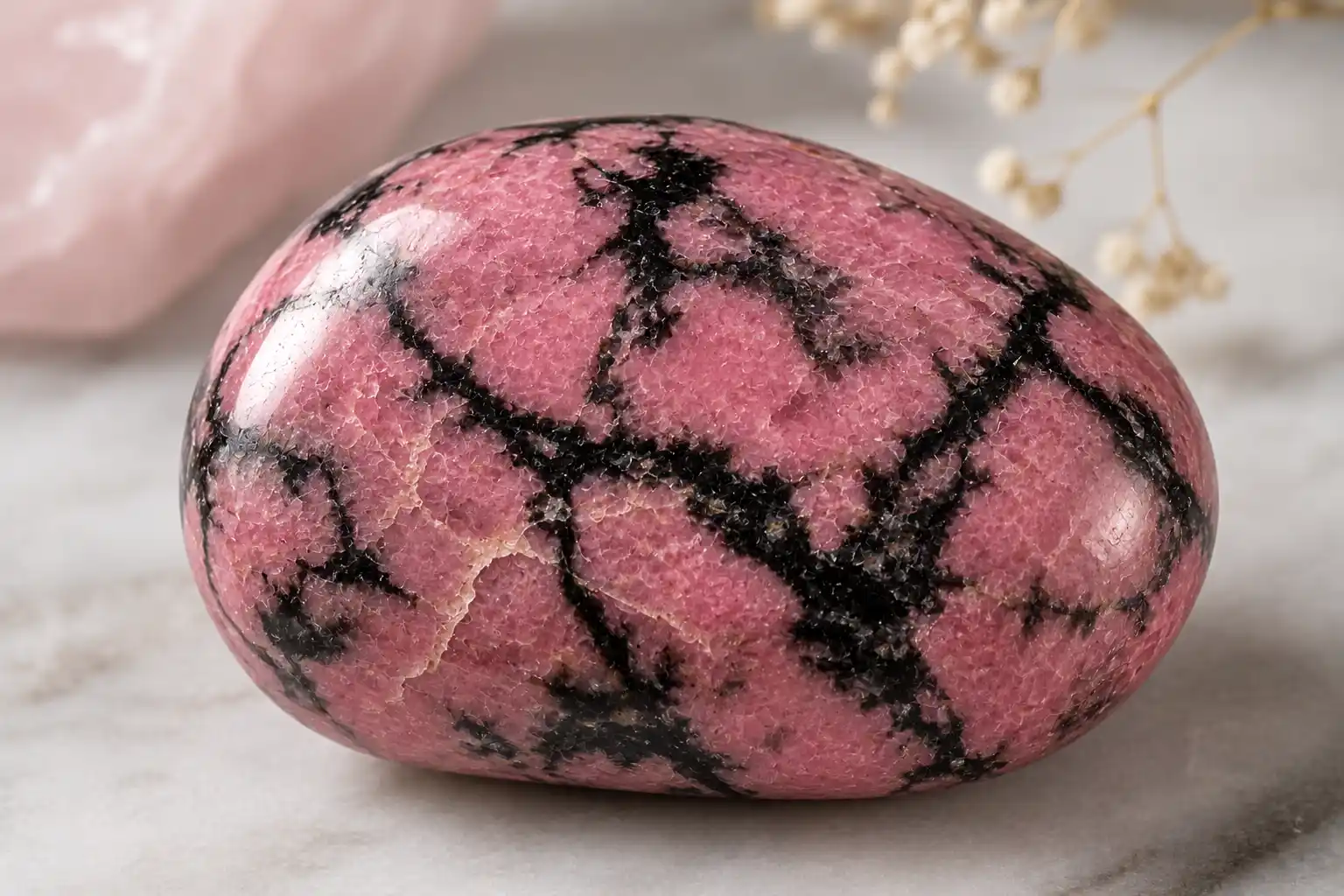
Rhodonite is a pink-to-red manganese-rich silicate commonly recognized by its contrasting black or dark-brown manganese-oxide veins. Most lapidary material occurs as opaque or translucent massive rock, although rare transparent red crystals can be faceted into valuable collector gems.
In modern crystal traditions, rhodonite symbolizes compassion supported by boundaries, emotional recovery, forgiveness and calm action after conflict. Its black-and-pink pattern is often interpreted as a visual reminder that care and self-protection can exist together.
Those associations are spiritual and personal rather than medical effects. Rhodonite does not treat trauma, anxiety, depression, heart disease or any other health condition. Professional medical and psychological care should not be replaced with crystal use.
Rhodonite at a Glance
| Property | Rhodonite |
|---|---|
| Mineral group | Pyroxenoid group |
| Simplified composition | Manganese-rich chain silicate, often represented near MnSiO₃ |
| Natural substitutions | Calcium, iron and magnesium commonly replace part of the manganese |
| Typical colors | Pink, rose-red, reddish pink, brownish red and orangish red |
| Common matrix | Black or dark-brown manganese oxides |
| Crystal system | Triclinic |
| Crystal habit | Massive, granular, compact, tabular or prismatic crystals |
| Transparency | Usually opaque to translucent; rarely transparent |
| Luster | Vitreous to pearly |
| Mohs hardness | Commonly about 5.5–6 |
| Cleavage | Perfect in two directions |
| Tenacity | Brittle |
| Specific gravity | Commonly around 3.4–3.7 |
| Common uses | Cabochons, beads, carvings, decorative objects and rare faceted collector gems |
| Main care concern | Cleavage, impact, scratches, fillers and manganese-oxide alteration |
| Traditional themes | Compassion, forgiveness, boundaries, emotional balance and constructive response |
What Is Rhodonite?
Rhodonite is the manganese-rich member of the pyroxenoid mineral group.
Its structure contains chains of silica tetrahedra associated principally with manganese. Natural material also contains varying calcium, iron and magnesium.
Pure ideal MnSiO₃ rhodonite is not the normal natural composition. Substitution among several elements creates a range of colors, densities and related minerals.
Rhodonite crystallizes in the triclinic system. Transparent crystals may be tabular or prismatic, but most commercial material is massive and fine-grained.
The name derives from a Greek word associated with rose color.
Rhodonite should not be confused with rhodochrosite simply because both names begin with rhodo. The completed rhodochrosite meaning guide explains the manganese carbonate, while rhodochrosite versus rhodonite provides the direct mineral comparison.
Why Rhodonite Is Pink
Manganese produces rhodonite’s characteristic pink, rose and red colors.
Iron, calcium, magnesium and structural variation can modify the hue. Some specimens lean purple, brown or orange.
Fresh interiors may appear brighter than weathered surfaces.
Black and brown manganese oxides commonly develop along fractures, grain boundaries and exposed surfaces. They may form irregular veins, patches or networks.
The contrast between pink rhodonite and dark oxide creates the familiar ornamental appearance.
A uniformly pink piece can still be genuine. Transparent crystals and selected compact material may contain little visible black matrix.
Black Veins in Rhodonite
The dark areas commonly consist of secondary manganese oxides produced as the original manganese-rich material alters.
Natural veins vary in width and direction. They may branch, end abruptly, cross pink grains or form broad black patches.
The pattern should have depth and mineral texture rather than appearing painted onto the polish.
Dyed howlite, resin and ceramic can imitate the pink-and-black appearance. Repeated patterns, mold seams, pigment pooling and a different-colored interior are warning signs.
Black veining supports rhodonite identification but does not prove it by itself.
How Rhodonite Forms
Rhodonite forms in manganese-rich geological environments.
It occurs in metamorphosed manganese deposits, hydrothermal veins and selected ore bodies.
Heat and pressure reorganize manganese, silica and associated elements into rhodonite and related minerals.
Common associates include spessartine garnet, rhodochrosite, calcite, quartz, galena, sphalerite, franklinite and manganese oxides.
Rhodonite can occur together with its closely related polymorph pyroxmangite. The two have similar appearance and composition but different silicate-chain structures.
In massive lapidary material, exact separation may require Raman spectroscopy, chemical analysis or X-ray diffraction.
Important Rhodonite Sources
The Ural Mountains of Russia are famous for massive decorative rhodonite used in carvings, architectural panels and historic objects.
Broken Hill in New South Wales, Australia, has produced notable transparent red crystals suitable for faceting.
Franklin, New Jersey, is a classic source of manganese minerals, including rhodonite and zinc-bearing fowlerite.
Massachusetts adopted rhodonite as its state gem and has important deposits.
Other documented sources include Peru, Brazil, Sweden, Canada, Switzerland and Japan.
A geographic label should be supported by provenance rather than inferred from color or black matrix.
Russian Rhodonite
Russian material is particularly associated with large massive pieces showing pink, red and black patterns.
It has been used for bowls, columns, boxes, decorative panels and carved objects.
Fine Russian material may display broad areas of saturated pink crossed by dark oxide veins.
The phrase Russian rhodonite does not define one grade. Color, compactness, pattern, polish and fractures still vary.
Modern provenance should be traceable. Historical style alone does not prove Russian origin.
Peruvian Rhodonite
Peruvian rhodonite is widely used for tumbled stones, beads and carvings.
It commonly displays rose-pink to reddish-pink color with black or brown veining.
Some commercial material may contain related manganese silicates or mixed rock rather than chemically uniform rhodonite.
This is not necessarily fraudulent when described as rhodonite-rich material, but purity claims should remain realistic.
The market value depends more on color, compactness and workmanship than on a country name alone.
Transparent Rhodonite
Transparent gem rhodonite is rare.
Fine material may show vivid pink, red or orangish-red color and can be faceted into small collector stones.
Perfect cleavage in two directions makes cutting difficult. A stone can split during preforming, faceting, polishing or setting.
Transparent rhodonite may contain curved needle-like inclusions, crystals and fractures.
Clarity enhancement has been documented. Transparent filler can enter fractures and may contain trapped gas bubbles.
A large vivid transparent rhodonite should receive professional identification and treatment disclosure because rarity creates a substantial value difference from common massive material.
Rhodonite and Pyroxmangite
Pyroxmangite is a polymorph related closely to rhodonite.
Both are manganese silicates with similar pink and red colors.
Their structures use different repeating sequences within the silicate chains. This distinction is not visible in most polished stones.
Some material sold historically as rhodonite may consist partly or mainly of pyroxmangite.
X-ray diffraction and chemical analysis provide the most reliable distinction.
For ordinary decorative material, a rhodonite-group description may be reasonable when exact species analysis is unavailable. A valuable transparent crystal deserves greater precision.
Rhodonite Meaning
Rhodonite’s central symbolic meaning is compassion joined with discernment.
Its pink color is associated with affection, empathy and emotional openness. The black manganese-oxide veins are interpreted as boundaries, realism and the parts of experience that cannot be resolved through optimism alone.
This combination makes rhodonite popular during relationship conflict, grief, resentment and emotional recovery.
The symbolism does not require a person to forgive immediately or reconcile with someone unsafe.
Instead, rhodonite can represent responding thoughtfully while protecting dignity, wellbeing and personal limits.
Rhodonite and Emotional Healing
Rhodonite is commonly called an emotional-healing stone.
A responsible interpretation treats it as a focus during reflection, journaling, therapy or communication practice.
It may be held while identifying anger, grief, embarrassment or disappointment without acting impulsively.
The mineral does not remove trauma or change brain chemistry.
When difficult memories interfere with daily life, qualified mental-health support provides assessment and evidence-based treatment.
A crystal can remain part of a personally meaningful ritual as long as it supports rather than replaces professional care.
Rhodonite and Forgiveness
Forgiveness is one of rhodonite’s most common spiritual themes.
However, forgiveness can mean releasing the need to rehearse an injury constantly. It does not necessarily mean restoring trust, dropping consequences or allowing renewed contact.
The stone’s black-and-pink appearance suits this more balanced interpretation.
Compassion can acknowledge another person’s complexity while still recognizing harm.
A practical rhodonite exercise may ask: What would help me move forward, and what boundary is still necessary?
Rhodonite and Boundaries
Rhodonite is especially associated with compassionate boundaries.
A boundary states what behavior a person will accept and what action will follow when that limit is crossed.
The stone can serve as a visual reminder to communicate calmly and consistently.
It should not become a substitute for clear language, safety planning or professional advice.
Useful intentions include declining an unreasonable request, limiting repeated conflict or asking for time before responding.
The symbolism emphasizes that kindness without limits can become self-neglect.
Rhodonite and Relationships
Rhodonite is used in practices involving reconciliation, communication and recurring relationship patterns.
A person may place it beside a journal while examining what created conflict, which needs were not expressed and what repair would require.
The stone can also symbolize reciprocal care. Healthy relationships should not depend on one person providing endless patience while the other avoids responsibility.
For symbolism centered more strongly on inward self-compassion, rhodochrosite may be a better fit.
For unconditional tenderness and gentle affection, rose quartz offers another traditional approach. Their mineral differences are explained in rose quartz versus rhodonite.
Rhodonite and the Heart Chakra
Rhodonite is frequently associated with the heart chakra.
Modern chakra traditions connect this center with love, grief, trust, compassion and emotional balance.
Rhodonite’s pink color fits the heart symbolism, while its black matrix introduces themes of protection and grounded response.
The complete heart-centered stone list appears in heart chakra crystals.
These associations are spiritual frameworks rather than structures established in medical anatomy.
Rhodonite and the Root Chakra
Some practitioners also connect rhodonite’s dark manganese-oxide matrix with the root chakra.
In that interpretation, the black areas symbolize physical safety and practical limits, while the pink body represents emotional openness.
The planned root chakra crystals guide retains the broader grounding list.
Rhodonite may therefore be used when someone wants to approach a relationship issue without losing practical stability.
No universal chakra system assigns the stone in exactly the same way.
Rhodonite for Confidence
Rhodonite’s confidence symbolism centers on calm self-respect.
It is not usually associated with commanding attention or dominating a room.
Instead, it represents speaking honestly, admitting mistakes without self-destruction and protecting personal dignity.
A person may carry a small polished piece before a difficult conversation.
The stone can act as a cue to slow down and choose language deliberately.
Confidence still develops through preparation, experience and support rather than through the mineral itself.
Rhodonite for Anger
Rhodonite is often used symbolically when anger has become repetitive or difficult to express constructively.
The stone’s meaning does not require suppressing anger. Anger can identify harm, violated boundaries and unmet needs.
A reflective practice can separate the signal from the response.
Hold the stone or keep it nearby while writing what happened, what the anger protects and which action would be proportional.
Persistent rage, aggressive impulses or danger to self or others requires professional intervention rather than relying on a crystal practice.
Rhodonite for Grief
Pink stones are frequently used in grief rituals because their colors are associated with care and remembrance.
Rhodonite’s darker matrix can symbolize the lasting marks left by loss.
It may be placed beside a photograph, letter or memorial object.
The practice can create a structured moment for remembrance without claiming that the mineral changes the grieving process biologically.
Grief has no fixed schedule. Professional support may be appropriate when loss causes prolonged inability to function or creates safety concerns.
Rhodonite for Meditation
Choose one emotional theme rather than attempting to resolve several issues at once.
Hold the stone gently or place it where the pattern remains visible.
Notice the boundary between pink and black areas. Use that contrast to reflect on where care is needed and where a limit is necessary.
Slow the breathing and identify one response that aligns with both compassion and self-respect.
End with a practical action such as writing a boundary, arranging support or delaying a reactive message.
The completed how to program crystals guide provides a structured intention-setting method.
Rhodonite Affirmations
Rhodonite affirmations should support realistic behavior.
Examples include:
“I can be compassionate without abandoning my boundaries.”
“I can acknowledge anger and choose my response.”
“Repair requires honesty, accountability and time.”
“I am allowed to protect my wellbeing.”
“I can learn from the past without living inside it.”
Affirmations are prompts for attention and action. Repeating them does not guarantee reconciliation or psychological change.
Rhodonite in the Home
Polished rhodonite adds strong pink-and-black contrast to a room.
A palm stone or freeform can be placed in a reflective space, home office or shared room where calm communication is valued.
Larger carvings should sit on stable surfaces because a fall can open cleavage or fracture planes.
Avoid kitchens and bathrooms where acids, moisture and cleaning chemicals are common.
Direct prolonged sunlight may heat display pieces unnecessarily and can affect dyes or fillers in treated material.
The object should be positioned as a symbolic and decorative stone rather than a device that alters relationships automatically.
Rhodonite Jewelry
Rhodonite is commonly fashioned into cabochons, beads, pendants and earrings.
Its hardness is adequate for occasional jewelry, but perfect cleavage and brittleness require protection.
Pendants and earrings are safer than exposed rings and bracelets.
A ring should use a bezel or another setting that protects the edge.
Beads should be checked for chips around drill holes and knotted or spaced to reduce impact.
Transparent faceted rhodonite is better treated as collector jewelry rather than a daily-wear gemstone.
Rhodonite Versus Rhodochrosite
Rhodochrosite is manganese carbonate and commonly displays white or cream bands.
Rhodonite is manganese silicate and commonly displays black manganese-oxide veins.
Rhodochrosite is softer and acid-sensitive. Rhodonite is harder but has perfect cleavage in two directions.
The direct comparison page retains the full test sequence rather than repeating every detail here.
Both stones carry modern themes involving compassion and emotional recovery, but symbolism cannot identify the mineral.
Rhodonite Versus Rose Quartz
Rose quartz is pink macrocrystalline quartz.
It commonly has cloudy, diffuse color rather than rhodonite’s black oxide network.
Quartz is harder and lacks rhodonite’s perfect cleavage.
Rhodonite tends to be more opaque and can show stronger rose-red color.
Dyed quartz and included rose quartz can create visual overlap, making instrumental identification useful.
Rhodonite Versus Mangano Calcite
Mangano calcite is pink calcite colored by manganese.
It is softer, usually paler and more strongly associated with fluorescence.
Rhodonite is a silicate and generally has greater hardness.
Black veins favor rhodonite, while soft pale-pink translucency favors mangano calcite.
A mixed or treated specimen may not follow those tendencies neatly.
Rhodonite in Pink and Red Stone Families
Rhodonite appears in pink crystals and pink gemstones when its bodycolor is predominantly rose or pink.
Stronger red specimens also fit within red crystals and red gemstones.
Color hubs group stones by appearance and symbolism. They do not replace mineral identification.
Rhodonite’s black matrix makes it visually distinct from many other pink stones, but that feature can be imitated.
Imitations and Treatments
Imitations include dyed howlite, dyed magnesite, resin, ceramic, glass and painted stone.
Pink resin with black pigment can reproduce the familiar pattern convincingly.
Dye often concentrates in cracks, pores and drill holes. Mold seams and casting bubbles suggest polymer.
Natural rhodonite can be waxed, coated, stabilized or fracture-filled.
Clarity enhancement has been documented in transparent material. Under magnification, filler may show gas bubbles and a different appearance within fractures.
The general gemstone treatments guide explains treatment categories.
For safe screening, use how to identify crystals, how to spot dyed crystals and how to spot fake crystals.
Hardness, Cleavage and Durability
Rhodonite commonly ranks about 5.5–6 on the gemstone hardness chart.
It scratches more easily than quartz, topaz, sapphire and diamond.
Perfect cleavage in two directions means a sharp impact can split the material even when the surface has not been heavily scratched.
The gemstone-cleavage guide and toughness-versus-hardness guide explain these separate risks.
Do not perform scratch or impact tests on a finished object.
Water and Safety
Brief contact with clean water may be acceptable for stable untreated massive material, but soaking is unnecessary.
Water can enter fractures, affect glue and interact with dye, wax or filler.
Do not place rhodonite directly in drinking water. Natural specimens can contain associated manganese oxides, sulfides, polishing residue and unknown treatments.
The crystal water-safety guide explains the distinction between washing a surface and preparing an elixir.
Normal handling of a polished piece differs from cutting or grinding. Avoid inhaling lapidary dust, and review the completed toxic-crystals safety list before working raw manganese-rich material.
Cleaning Rhodonite
Use a soft dry or slightly damp cloth.
For stable untreated material, a small amount of mild soap and brief lukewarm-water contact may be used, followed by immediate drying.
Avoid steam, ultrasonic vibration, acids, bleach and abrasive powder.
Store rhodonite in a separate pouch away from harder quartz, topaz and corundum.
Support large carvings evenly so pressure does not concentrate along a fracture.
Buying Rhodonite
Look for attractive pink or rose-red bodycolor, natural-looking black veining and a smooth polish.
Avoid stones dominated by fractures unless the price and intended use reflect the weakness.
Check drill holes and edges for pale interiors, resin and dye concentration.
Ask whether the object is solid natural rhodonite, stabilized, filled, dyed, reconstructed or composite.
The planned where to buy real rhodonite guide retains the complete seller and imitation workflow.
For online transactions, follow how to buy gemstones online and preserve enough time for inspection.
A valuable transparent stone may justify an independent report. The gemstone certification guide and gem-lab-report guide explain what such documentation should address.
Frequently Asked Questions
1. What is rhodonite made of?
Rhodonite is a manganese-rich chain silicate containing varying calcium, iron and magnesium.
2. Why does rhodonite have black veins?
The dark areas commonly consist of manganese oxides formed through alteration along fractures and grain boundaries.
3. What does rhodonite traditionally symbolize?
It is associated with compassion, forgiveness, emotional recovery, boundaries and calm response after conflict.
4. Is rhodonite a heart-chakra stone?
Yes. Modern chakra traditions commonly associate its pink color with heart-centered themes, although some also connect its black matrix with grounding.
5. Does rhodonite have scientifically proven healing powers?
No. Its healing associations belong to spiritual and symbolic practice rather than established medicine.
6. Is rhodonite the same as rhodochrosite?
No. Rhodonite is a manganese silicate, while rhodochrosite is a softer manganese carbonate.
7. Is rhodonite the same as rose quartz?
No. Rose quartz is pink quartz and is generally harder, cloudier and free from rhodonite’s characteristic manganese-oxide veining.
8. Can rhodonite occur without black veins?
Yes. Transparent crystals and selected massive material may contain little visible black oxide.
9. Is transparent rhodonite valuable?
Fine transparent red or pink material can be highly collectible because it is rare and difficult to facet.
10. Can rhodonite go in water?
Brief gentle cleaning may be possible, but soaking and direct drinking-water use are not recommended.
11. Is rhodonite suitable for daily jewelry?
Pendants and earrings are practical. Exposed daily rings and bracelets face greater scratching, cleavage and impact risks.
12. How can fake rhodonite be recognized?
Look for repeated patterns, mold seams, bubbles, surface paint and dye concentration, then confirm the mineral through professional testing when necessary.
Rhodonite is indexed in Crystals That Start With R and Gemstones That Start With R.
Rhodonite’s best-known appearance combines a compassionate pink body with dark mineral boundaries. That contrast explains much of its modern symbolism, but it also records real geological alteration. Respecting both aspects means using the stone as a reflective symbol while recognizing its cleavage, treatment risks and need for accurate mineral identification.
Rhodonite meanings, affirmations and chakra associations are spiritual and cultural beliefs, not medical or psychological treatment. Avoid inhaling dust produced during cutting or grinding, and do not use unknown specimens in drinking water.