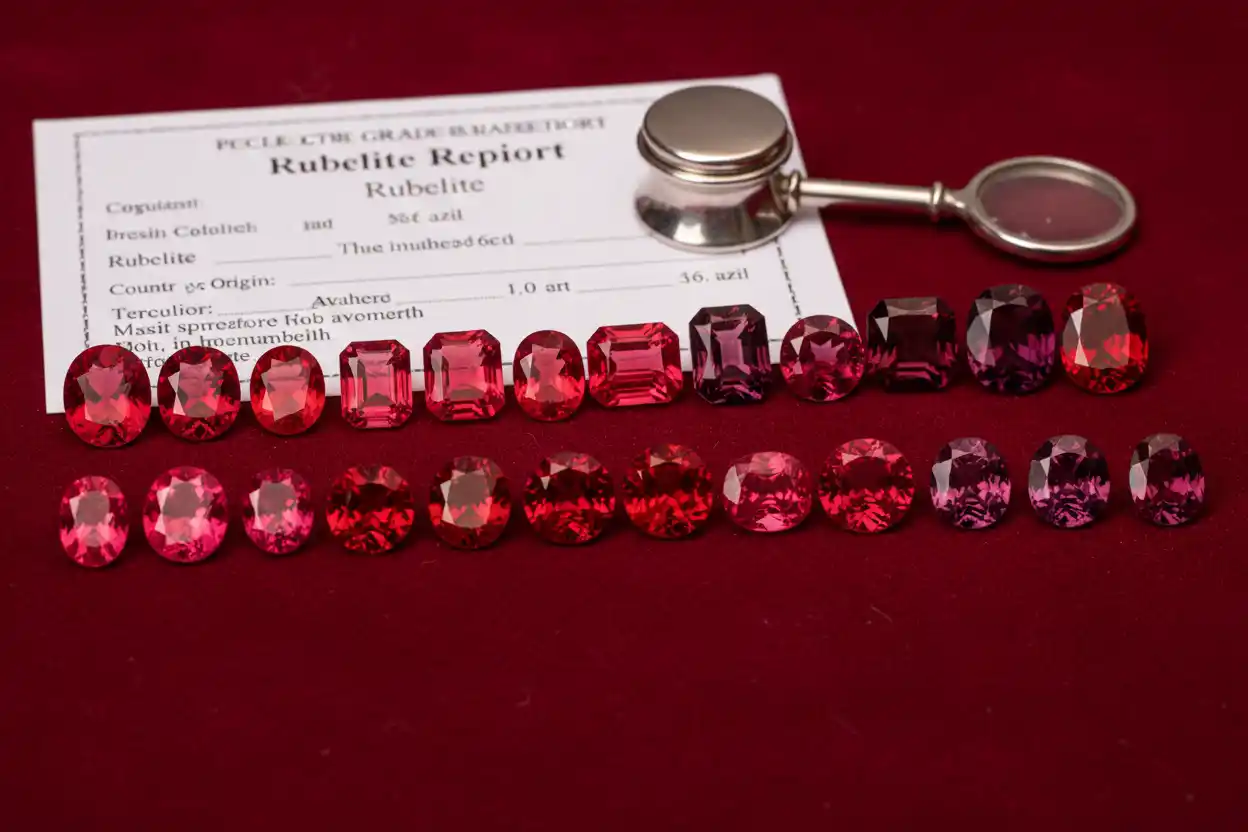
Rubellite Price: Cost Drivers, Condition, Quality & Rarity
Rubellite price is driven primarily by face-up color, saturation, tone, transparency, inclusion visibility, cutting, carat weight, treatment, condition, and market demand rather than by one standardized dollars-per-carat formula. Rubellite is the trade name applied to pink-to-red tourmaline, with GIA describing the category broadly enough to include red, purplish-red, orangy-red, brownish-red, and some pink material while acknowledging that the trade does not use the boundary between ordinary pink tourmaline and rubellite perfectly consistently. Color therefore matters more than the word printed on a sales tag: the strongest premiums normally attach to stones that look decisively vivid red, raspberry, pink-red, or attractive purplish-red rather than weak pink, muddy brown-red, or overly dark material.
Rubellite also follows a different clarity standard from many green and blue tourmalines. Pink and red tourmaline commonly contains liquid-rich cavities, growth tubes, healed fissures, and other inclusions, and GIA notes that knowledgeable dealers will tolerate some eye-visible inclusions when the color is strong enough to justify them. Surface-reaching fissures, prominent whitish inclusions, severe cloudiness, and durability-threatening fractures remain negative because they reduce transparency, interfere with polish, and can complicate setting and wear.
Rubellite Price At a Glance
| Value Factor | What Usually Raises Rubellite Price | What Can Lower Rubellite Price |
|---|---|---|
| Color | Vivid red, raspberry-red, pink-red, purplish-red | Weak pink, dull brown-red, muddy or grayish color |
| Saturation | Strong, lively color | Washed-out appearance |
| Tone | Medium to medium-dark while remaining bright | Excessively dark stone with black extinction |
| Clarity | Relatively transparent with manageable inclusions | Heavy clouds, white fractures, dark inclusions |
| Surface-Reaching Fissures | Few or minor | Large fissures affecting polish and durability |
| Cut | Even brilliance, strong color return, good symmetry | Windowing, severe extinction, poor polish |
| Pleochroic Orientation | Attractive face-up red | Orientation that makes the stone too dark or brown |
| Carat Weight | Larger gem retaining fine color and transparency | Added weight without equivalent face-up quality |
| Treatment | Clear disclosure | Undisclosed irradiation, heat, or fracture filling |
| Fracture Filling | None, or fully disclosed if present | Filling represented as natural clarity |
| Condition | Sharp facets and intact girdle | Chips, scratches, abrasion, repaired damage |
| Matching | Closely matched pairs and suites | Noticeable hue, tone, or size mismatch |
| Documentation | Independent identification for important stones | Seller-only quality claims |
| Seller Grade | Transparent quality description | Undefined AAA, AAAA, or “investment” labels |
Strong Red Color Creates the Highest Everyday Premium
GIA identifies bright pure red among the most valuable tourmaline colors and describes rubellite as one of the most sought-after pink-to-red tourmaline varieties. The best-priced stones usually show a clear red identity even when purple, pink, or orange modifies the hue slightly, while brown, gray, or excessive darkness pushes the material toward more commercial price levels. A saturated raspberry-red stone can therefore command considerably more than another tourmaline of the same size whose color looks weak, brick-like, or almost black in normal light.
The Gems Lore buy rubellite guide should be used before interpreting any rubellite price because color photographs can exaggerate saturation substantially. Strong spotlights, dark backgrounds, rose-gold reflections, and digital editing can make ordinary red tourmaline look much more vivid than it will during normal wear, so video under neutral lighting provides a better indication of how much color the stone actually carries.
Excessive Darkness Can Reduce Rubellite Price
Tourmaline is strongly pleochroic, and the same crystal can appear much darker in one optical direction than another. GIA explains that cutters orient tourmaline partly to manage those directional color differences, using orientation to lighten excessively dark rough or strengthen pale material. A badly oriented rubellite can therefore contain rich red color chemically yet present broad black areas face-up because too much light is absorbed.
Some extinction is normal and helps create contrast and scintillation, but a premium stone should remain recognizably red across movement rather than appearing black through most of the crown. A medium-toned raspberry stone with lively brightness can consequently be worth more than a nominally deeper-red stone whose darkness overwhelms its beauty.
Brown Modifiers Usually Push Value Down
Rubellite terminology can include brownish-red tourmaline, but inclusion within the variety name does not mean all brownish material occupies the same value tier. Buyers generally respond more strongly to cleaner red, raspberry, pink-red, and purplish-red colors because brown often makes the gem look subdued or earthy rather than vivid.
A warm orangy-red can still be attractive, especially when saturation and brightness remain strong, but a muddy brown-red stone should not command the same premium as a similarly sized transparent gem with cleaner red coloration. Seller descriptions such as mahogany, wine, imperial red, or royal raspberry should therefore be translated into the actual face-up hue rather than accepted as standardized quality terms.
Rubellite Has More Inclusion Tolerance Than Many Tourmalines
GIA states that pink and red tourmaline frequently contains more visible inclusions than green-to-blue varieties and that dealers commonly accept some eye-visible inclusions when color is strong. This affects price because an included rubellite can remain valuable if the inclusions are unobtrusive and the red color is exceptional.
The correct question is not simply whether inclusions exist, but whether they interfere with transparency, brilliance, surface polish, durability, or the viewer’s attention. Fine thread-like inclusions and healed internal features may have limited effect, whereas broad white fractures beneath the table can create a substantial discount even when the stone is richly colored.
Whitish Fractures Can Have a Large Negative Effect
GIA specifically notes that prominent whitish inclusions are undesirable in tourmaline, even when the color is vivid. Pale reflective fractures interrupt saturated red color and can become the first feature the eye notices rather than the gemstone’s hue.
A seller may photograph the stone against a dark background to minimize these features, so buyers should request images or video under diffuse lighting and from several angles. In high-value rubellite, magnified examination is especially useful because an apparently clean face-up stone can contain surface-reaching fissures hidden near facet junctions or along the girdle.
Surface-Reaching Fissures Affect Beauty and Durability
Inclusions that reach the surface can interfere with polish and make tourmalines harder to sell, according to GIA’s quality guidance. Their financial effect can be stronger than a fully enclosed internal inclusion because a surface fissure may trap dirt, expose filler, weaken an edge, or create a potential starting point for damage during setting.
Location matters. A fracture near a protected pavilion facet can have less practical impact than one crossing the table or reaching the girdle beside a prong. Expensive rubellite should therefore be inspected as both an optical object and a piece of jewelry material.
Fracture Filling Creates a Separate Value Category
Rubellite can be clarity enhanced through fracture filling. GIA has documented rubellite whose surface-reaching fissures were filled with oils or resins, making the fractures less visible and improving apparent clarity. The treatment does not remove the fracture; it reduces the optical contrast between the crack and the surrounding tourmaline.
A filled stone can still be attractive and marketable, especially when its natural color is strong, but it should be priced against similarly treated material rather than a naturally cleaner stone. Disclosure also matters for care because filler can respond differently to heat, chemicals, pressure, and aging than the tourmaline itself. GIA’s general treatment guidance confirms that fracture filling can use resin, oil, wax, or glass and that filler durability varies.
Heat Treatment Can Alter Tourmaline Color
GIA identifies heating as one of the two principal tourmaline color treatments and states that heat-related color changes are stable but can be undetectable. In rubellite, this means treatment status cannot always be established merely by examining color or ordinary inclusions.
An “unheated rubellite” premium should therefore have a credible evidentiary basis rather than depend only on a retailer’s visual opinion. Heating is not necessarily a defect; the relevant market issue is whether known treatment has been represented accurately and whether the resulting price reflects the actual rarity category.
Irradiation Can Intensify Pink and Red Tourmaline
Recent GIA research on tourmaline micro-features notes that pink tourmalines can be irradiated to increase color saturation and that heating and irradiation may be difficult to detect in some stones. GIA also warns that irradiation-induced tourmaline color can fade when exposed to heat or bright light.
This treatment possibility matters most when exceptional saturation is responsible for a substantial premium. Buyers should not assume that every intensely pink-red stone has untreated color, while sellers should avoid guaranteeing untreated status without adequate support.
Eye-Clean Rubellite Can Carry a Combined Premium
Because inclusions are relatively common in red tourmaline, a vivid stone that also appears eye-clean combines two desirable qualities. Larger eye-clean rubellites with rich red color can therefore move into a substantially stronger category than included commercial material.
The premium should remain balanced, however. Once a stone looks clean at ordinary viewing distance, paying much more for microscopic clarity may provide less visual improvement than choosing stronger color or better cutting. Rubellite is a colored gemstone first, not a diamond-style clarity contest.
Cut Can Change Rubellite Price Dramatically
GIA advises tourmaline buyers not to compromise on cut and states that poorly cut tourmalines sell at discounts because they return light unevenly and lose brilliance. Rubellite often occurs in elongated crystals, so emerald cuts, rectangular cushions, ovals, pears, and long custom shapes are common, but no shape is inherently superior if the stone displays color well.
A good cut should manage pleochroism, prevent excessive extinction, concentrate attractive red, minimize windowing, and provide efficient face-up dimensions. A heavier stone with a deep pavilion may carry more carats while appearing smaller than a lighter gem whose proportions are better.
Windowing Can Waste an Expensive Color
A large window appears as a transparent central area through which the observer can see the background or setting. In rubellite, windowing is particularly damaging because buyers are paying primarily for saturated red color, and a transparent center removes that saturation from the most visible part of the gemstone.
A shallow 8 ct rubellite can therefore be less desirable than a well-proportioned 6.5 ct stone whose face remains fully colored and brilliant. The right comparison should include millimeter dimensions and actual face-up appearance rather than carat weight alone.
Carat Weight Matters Strongly Above Fine Commercial Sizes
GIA states that fashioned tourmalines of similar color and clarity generally increase significantly in per-carat price as they pass roughly the five-carat level because availability of fine facet-quality rough decreases. Rubellite can certainly occur in stones much larger than five carats, but truly fine examples combining strong red, transparency, attractive cutting, and manageable inclusions become progressively more selective.
The increase is not automatic. A large dark or heavily fractured stone should not receive the same multiplier as a lively clean raspberry gem merely because both exceed the same weight threshold.
Fine Brazilian Rubellite Has Strong Market Recognition
Brazil is a major tourmaline-producing country and has supplied abundant pink and red material, including significant rubellite production from Minas Gerais. The country name can add commercial recognition, but GIA repeatedly cautions across colored-stone markets that mine or country origin does not guarantee quality.
A vivid transparent Brazilian rubellite can be exceptional, while a brownish heavily included Brazilian stone can remain commercial quality. Provenance should therefore support quality rather than replace it.
Afghanistan and Madagascar Can Produce Fine Material
Rubellite and red tourmaline also occur in Afghanistan, Madagascar, and other pegmatite regions. Fine stones from these areas can rival Brazilian material visually, and collectors may value documented source information when it is credible.
Country origin normally has less impact on rubellite price than it has on fine ruby, sapphire, or emerald. Color, clarity, cut, size, treatment, and condition usually dominate unless a specific historical mine or specimen provenance adds separate collecting interest.
Matching Can Increase Pair and Suite Prices
A closely matched pair requires two stones with similar hue, tone, saturation, size, shape, clarity, and cut, while larger jewelry suites require even more sorting. The resulting pair or suite can therefore command a premium over the sum of random unmatched stones.
This factor matters particularly in rubellite because color varies widely even within stones from the same parcel. Matching two vivid raspberry stones becomes more difficult as size and quality increase.
Rubellite Price Versus Rhodolite Garnet Price
Rubellite and rhodolite can occupy visually similar raspberry, magenta, and purplish-red ranges, but their markets differ. Gems Lore’s rhodolite garnet price guide covers a pyrope-almandine garnet market where eye-clean clarity is more routinely expected and treatment is less central, while rubellite accepts more inclusions when color is strong and requires greater attention to irradiation, heat, and fracture filling.
A direct dollars-per-carat comparison is therefore meaningful only after the buyer has identified the species and aligned quality.
Rubellite Price Versus Ruby Price
Rubellite can offer large rich red stones at substantially lower prices than fine ruby because ruby combines a deeper global luxury market with extreme scarcity of top color in larger sizes. Gems Lore’s ruby price guide covers that market separately.
A beautiful rubellite should therefore be purchased as tourmaline rather than as a supposed “cheap ruby.” Its value lies in its own raspberry-to-red color, crystal size, and visual character.
Rubellite Price Versus Paraiba Tourmaline Price
Both gems belong to tourmaline, yet GIA states that fine Paraíba tourmaline occupies a price class beyond other tourmalines because of its exceptional copper-caused colors and scarcity. Gems Lore’s Paraiba tourmaline price guide explains that separate market.
Rubellite can nevertheless become highly valuable when large, vivid, clean, and beautifully cut, especially because top red material is one of the tourmaline group’s most sought-after categories.
Condition Has a Direct Effect on Resale Value
Tourmaline ranks about 7–7.5 on the Mohs scale with fair toughness, and high heat or sudden temperature change can cause color alteration or fracturing. Older rubellite jewelry can therefore show chipped girdles, facet abrasion, scratches, enlarged fractures, or filler deterioration.
A recut may improve appearance but removes weight and can alter the face-up color orientation. High-value used stones should be examined under magnification before valuation because a small chip can become economically significant when correcting it requires crossing below an important carat threshold.
Cleaning Requirements Can Reveal Treatment Risk
GIA recommends warm soapy water as the best cleaning method for tourmaline and advises against ultrasonic and steam cleaners. This conservative approach is especially sensible for rubellite because liquid inclusions, fractures, and fracture filling can make the gemstone more sensitive to thermal shock or aggressive cleaning.
A seller claiming that an included rubellite can be steam cleaned without concern should therefore be treated cautiously.
GIA Reports Identify Rather Than Grade Rubellite
GIA evaluates tourmaline but does not assign an overall quality grade. Its Colored Stone Identification Report can record characteristics such as weight, measurements, shape, cutting style, color, natural-versus-laboratory-grown origin, and detectable treatments.
This means a GIA report can reduce identity and treatment uncertainty without stating whether the stone is “AAA,” whether its color is commercially top grade, or what its market price should be. Valuation still requires comparison with rubellites of similar quality.
AAA and AAAA Do Not Establish Rubellite Price
Retail labels such as AAA, AAAA, royal rubellite, pigeon-red tourmaline, investment grade, and museum quality are not universal laboratory standards. A seller can use a private grading system internally, but buyers should translate it into measurable characteristics before comparing prices.
Actual rubellite price is better explained through hue, saturation, tone, transparency, inclusion visibility, cut, dimensions, weight, treatment, condition, and provenance.
Retail Price and Immediate Resale Value Are Different
Retail rubellite price can include sourcing, cutting, laboratory reports, insurance, inventory holding time, jewelry setting, warranty, returns, photography, branding, and seller margin. A dealer purchasing the same stone from a consumer needs room for authentication, possible repolishing, remarketing, and future profit.
The resulting spread can be large even when the gemstone is genuinely high quality. Exceptional stones can attract collectors, but no fixed resale retention percentage applies.
What Usually Raises Rubellite Price?
Rubellite price generally rises when a stone combines vivid raspberry, red, pink-red, or purplish-red color with strong saturation, enough brightness to avoid black extinction, relatively high transparency, limited distracting inclusions, few surface-reaching fissures, lively cutting, efficient face-up dimensions, larger size with quality maintained, excellent condition, clear treatment disclosure, and credible independent identification.
What Usually Lowers Rubellite Price?
Weak pink color, muddy brown modifiers, overly dark tone, broad extinction, prominent white fractures, heavy cloudiness, surface-reaching fissures, fracture filling represented as natural clarity, large windowing, poor symmetry, excessive hidden depth, chips, abrasions, unsupported untreated claims, ambiguous origin stories, and seller-defined grades can all reduce value.
How to Compare Rubellite Prices Fairly
Compare natural tourmalines only after aligning hue, tone, saturation, red-versus-pink balance, brown or purple modifiers, transparency, inclusions, surface-reaching fractures, fracture filling, heat or irradiation status where known, cut, windowing, dimensions, carat weight, condition, origin evidence, documentation, and transaction context. A six-carat vivid eye-clean raspberry rubellite, ten-carat dark fractured stone, pale pink tourmaline, rhodolite garnet, synthetic red gem, and fracture-filled rubellite should never be averaged into one generic rubellite price-per-carat figure.
Conclusion
Rubellite price is fundamentally a color-driven tourmaline valuation refined by clarity, cut, size, treatment, and condition. GIA identifies pink-to-red rubellite as one of tourmaline’s most sought-after color categories and notes that some eye-visible inclusions are accepted when the color remains strong, while surface-reaching or prominent whitish inclusions reduce marketability.
Size becomes increasingly important once quality is established because fine tourmaline rough becomes less available as fashioned stones move beyond common sizes, but large weight without bright color and good cutting does not justify an automatic premium. Treatment also matters because rubellite may be heated, irradiated, or fracture filled, and GIA notes that some color treatments can be difficult to detect while filled fissures can materially alter apparent clarity.
The strongest valuation therefore ignores undefined grades and asks what the stone actually looks like, how it is cut, what treatments are known or detectable, how well it has survived wear, and how it compares with authenticated rubellites of similar size and quality.
Frequently Asked Questions
How much is rubellite worth per carat?
There is no universal rubellite price per carat because color, transparency, inclusions, cut, size, treatment, condition, and market channel vary widely. Larger fine stones can command higher per-carat prices, but quality must remain strong as weight rises.
What rubellite color is usually most valuable?
Strong vivid red, raspberry-red, pink-red, and attractive purplish-red generally receive the greatest demand, especially when saturation is high without excessive darkness. GIA identifies bright red among tourmaline’s most desirable colors.
Does dark rubellite cost more?
Not automatically. Excessive darkness can create black extinction and reduce face-up brilliance, so a brighter medium-toned stone can be more valuable than a darker gem of similar weight.
Does rubellite need to be eye-clean?
No. GIA notes that red tourmalines commonly contain visible inclusions and that some are accepted when the color is strong. Large whitish inclusions, severe fractures, or surface-reaching fissures can still lower value significantly.
Can rubellite be fracture filled?
Yes. GIA has documented rubellite whose surface-reaching fissures were filled with oil or resin to improve apparent clarity.
Can rubellite be heat treated?
Yes. Heating is one of the principal tourmaline color treatments, and GIA notes that heat-related changes can be stable and sometimes undetectable.
Can rubellite be irradiated?
Yes. Pink tourmaline can be irradiated to increase saturation, and irradiation-induced tourmaline color can be sensitive to heat or bright light.
Does larger rubellite become more valuable?
Fine tourmalines generally increase in per-carat price as fashioned stones pass approximately five carats, assuming color and clarity remain comparable.
Is Brazilian rubellite automatically better?
No. Brazil is an important tourmaline source, but quality varies within every deposit. Color, transparency, cutting, treatment, and condition normally matter more than country alone.
Is rubellite the same as ruby?
No. Rubellite is tourmaline, whereas ruby is chromium-bearing red corundum. Their chemistry, hardness, treatment markets, rarity, and value structures are different.
Does GIA grade rubellite AAA?
No. GIA evaluates tourmaline but does not issue an overall AAA-style quality grade.
How should rubellite be cleaned?
GIA recommends warm soapy water and advises against ultrasonic and steam cleaning for tourmaline.
Does rubellite hold its retail price?
There is no guaranteed retention percentage. Secondary-market value depends on color, size, treatment, condition, cutting, provenance, documentation, and dealer demand.
Is rubellite a guaranteed investment?
No. Exceptional large vivid stones can be collectible, but appreciation and resale liquidity cannot be guaranteed.