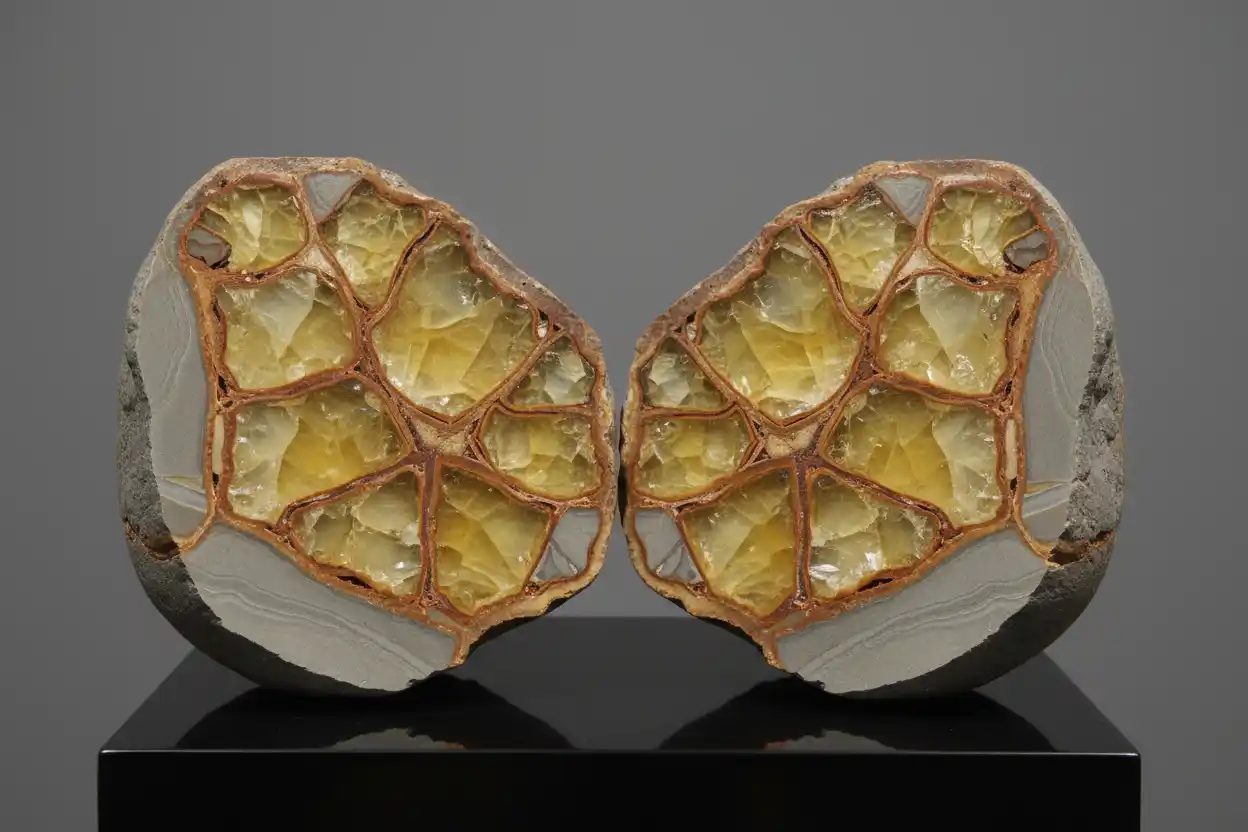
Septarian: Meaning, Properties & Symbolism
Septarian is a patterned sedimentary concretion rather than a single mineral species. Its characteristic web of angular cracks is commonly filled with calcite, aragonite, siderite, barite, quartz, or other minerals, creating yellow, brown, cream, grey, and black geometric patterns when the nodule is cut and polished.
Because each component has different hardness, cleavage, and chemical sensitivity, septarian should be evaluated and cared for as a composite rock.
Septarian at a Glance
| Property | Septarian |
|---|---|
| Composition | Variable; commonly limestone, mudstone, or clay-rich carbonate with calcite and aragonite-filled cracks |
| Group or type | Septarian concretion; multi-mineral sedimentary rock |
| Color | Grey, brown, cream, yellow, black, reddish brown, white |
| Crystal system or texture | Mixed mineral systems; cracked concretionary texture |
| Habit | Rounded, oval, irregular nodules with internal polygonal septa |
| Luster | Dull externally; waxy to vitreous on polished carbonate and crystal fillings |
| Transparency | Opaque, with translucent calcite or aragonite sections |
| Mohs hardness | Variable, commonly around 3–4 for carbonate-rich material |
| Cleavage | Variable; calcite and other fillings may cleave readily |
| Tenacity | Brittle to moderately tough as a composite rock |
| Common uses | Slabs, spheres, eggs, carvings, bookends, cabochons, display nodules |
| Primary care concern | Acid sensitivity, variable hardness, fractures, fillers, and impact damage |
What Is Septarian?
Septarian is a geological term for a concretion containing internal cracks or cavities known as septa. The word derives from a Latin root associated with partitions or divisions.
A concretion forms when mineral cement precipitates around a nucleus or within pore spaces in sediment. The resulting mass becomes harder and more compact than the surrounding rock.
Septarian concretions develop cracks during or after this cementation process. Later mineral-rich fluids enter the openings and deposit calcite, aragonite, siderite, barite, quartz, gypsum, pyrite, or other minerals.
Retail descriptions often call septarian a crystal, gemstone, or mineral. More accurately, it is a rock used as a gemstone because several minerals and sedimentary components occur together.
How Septarian Forms
Septarian nodules commonly originate in marine or lake sediments rich in mud, clay, carbonate, and organic matter. Chemical conditions promote early cementation around shells, fossils, organic remains, or local variations in sediment.
As the concretion grows, its interior may shrink, dehydrate, compact, or experience pressure changes. These processes create angular cracks that do not always extend to the outer surface.
Several mechanisms may contribute. Shrinkage, gas generation from decaying organic matter, compaction, chemical dehydration, and differential volume changes have all been proposed for various deposits.
Mineral-bearing groundwater later circulates through the cracks. Calcite commonly lines or fills the openings, while aragonite may form brown rims or bands.
The nodule can undergo several stages of mineralization. Consequently, one crack may contain multiple layers, crystals, or later repairs.
Septarian patterns are therefore records of sedimentary chemistry and fluid movement rather than fossilized lightning or simple dried mud.
Septarian Composition
Many commercial septarian pieces contain a grey limestone or mudstone body, brown aragonite-rich margins, and yellow or honey calcite filling the central cracks.
This simplified three-part description does not apply universally. Some nodules contain siderite, barite, quartz, pyrite, gypsum, celestine, or other minerals.
Calcite is commonly the softest prominent polished component. It has Mohs hardness 3, perfect rhombohedral cleavage, and strong sensitivity to acids.
Aragonite shares the same calcium carbonate chemistry as calcite but has an orthorhombic structure. It can form brown or cream bands around cracks.
The darker exterior may consist of clay-rich limestone, marl, shale, or mudstone. Iron oxides, organic matter, and sulfide minerals can deepen its color.
Septarian Colors and Patterns
Golden yellow is usually associated with calcite filling. Brown borders may contain aragonite, iron-stained carbonate, or other minerals.
Grey and black areas generally represent the original sedimentary matrix. Cream and white zones may consist of calcite, aragonite, or pale limestone.
Patterns range from fine spiderwebs to broad polygonal cells. Some nodules contain open crystal-lined cavities, while others are completely filled.
A highly symmetrical “dragon skin” appearance is visually desirable, but natural patterns remain irregular. Repeated identical cells or painted-looking borders may indicate an imitation or composite.
Color can also change with polishing, oiling, wax, or resin. A wet-looking surface may appear much darker and more saturated than untreated stone.
Important Septarian Localities
Madagascar supplies much of the polished septarian sold as spheres, eggs, freeforms, slabs, and carvings. Material commonly shows grey matrix with brown and yellow carbonate-filled cracks.
Utah is known for septarian nodules from the Orderville area and surrounding sedimentary formations. These are widely marketed as Utah septarian or lightning stones.
Michigan’s Lake Huron region has produced septarian concretions commonly called lightning stones. Their exterior patterns may remain visible without cutting.
England, New Zealand, Canada, Morocco, Mexico, Italy, Germany, Russia, and several regions of the United States contain septarian concretions.
Localities differ in geological age, matrix composition, crack minerals, fossil content, and pattern. A commercial name should not be treated as a universal geological formula.
Septarian Versus Similar Materials
Thunder eggs are volcanic nodules commonly filled with agate, chalcedony, quartz, or opal. Septarian concretions are sedimentary and usually carbonate-rich.
Geodes contain internal cavities lined with crystals. A septarian nodule can contain a crystal cavity, but the defining feature is its internal crack network.
Brecciated jasper consists of broken jasper fragments cemented by later minerals. Its fragments represent physical breakage, whereas septarian cracks formed within a concretion.
Dragon blood jasper and other patterned rocks may resemble septarian in color, yet their mineralogy and texture differ.
Painted resin or ceramic objects can imitate septarian patterns. Mold seams, bubbles, uniform repeated cells, low density, and plastic luster may reveal them.
How to Identify Septarian
Begin with structure rather than color. Genuine septarian should show a natural network of cracks or partitions within a rounded or irregular sedimentary concretion.
Different zones often vary in hardness and luster. Calcite-rich fillings may scratch easily and reflect light differently from the surrounding matrix.
A drop of dilute acid would normally react with carbonate components, but acid testing damages polished surfaces and should not be used on finished pieces.
Magnification may reveal calcite cleavage, natural crystal faces, sediment grains, fossils, mineral layering, or iron staining.
Ultraviolet fluorescence can occur in calcite-filled areas, although color and strength vary. Fluorescence alone does not prove that a piece is septarian.
The how to identify crystals framework applies particularly well because septarian requires identification of both the overall rock texture and its individual minerals.
Fossils and Inclusions
Some septarian concretions form around shells, ammonites, plant remains, organic fragments, or other fossil material. However, not every nodule contains a visible fossil.
Internal cavities may preserve crystal-lined surfaces, sedimentary textures, pyrite grains, or remnants of the original nucleus.
Dark specks can represent pyrite, organic matter, manganese oxides, or other mineral inclusions. Rusty staining may develop where iron-bearing minerals oxidize.
A fossil association can increase scientific or collector interest, but commercial claims should be documented. An irregular shape inside a polished stone is not automatically a fossil.
Treatments, Fillers, and Repairs
Polished septarian is commonly waxed or oiled to deepen color and improve luster. These treatments are generally minor but should be disclosed when relevant.
Resin may fill fractures, stabilize weak matrix, or create a smooth surface. Large carvings and spheres are more likely to contain filled pits or repaired cracks.
Broken nodules can be glued, recut, and polished. Skillful repairs may be difficult to see in photographs.
Artificial dye is less common than in agate, although porous carbonate and matrix can absorb color. Intensely saturated blue, green, purple, or red septarian should be treated with suspicion.
Some decorative pieces are assembled from fragments or backed with resin. The product can remain attractive, but it should not receive the same valuation as a naturally intact nodule.
Cutting and Polishing
Lapidaries typically saw septarian nodules to expose the interior crack pattern. Orientation determines whether the finished slab shows a broad central web, fine cells, or crystal cavity.
Different components grind at different rates. Soft calcite may undercut beside harder matrix or quartz-filled sections.
Fractures can open during sawing. Resin stabilization may reduce breakage, especially in large spheres, eggs, and bookends.
Polishing must preserve a flat or evenly curved surface across minerals with different hardness. Poor work produces pits, ripples, dull calcite zones, or rounded crack edges.
Open crystal cavities are often left unpolished to preserve natural crystal faces. Their edges require protection because thin calcite points can break easily.
Durability and Jewelry Suitability
Septarian has variable durability because its components differ. Carbonate-rich material commonly measures around 3–4 on the Mohs scale and scratches easily.
Filled cracks can represent both the stone’s visual appeal and its structural weakness. A hard impact may reopen a seam.
Pendants, brooches, beads, and occasional-wear cabochons are more practical than everyday rings. Protective settings reduce edge damage.
Large polished objects should be lifted from underneath rather than by narrow points. Spheres require stable stands because a fall can split them along a mineral-filled crack.
Acidic perspiration, perfume, household cleaners, and vinegar can etch calcite. Prolonged water exposure may also affect fillers, wax, porous matrix, or iron minerals.
Septarian Value and July 2026 Asking Prices
Septarian is generally valued by size, pattern, polish, shape, locality, crystal cavities, condition, and workmanship rather than carat weight.
As of July 2026, small tumbled stones, palm stones, and cabochons commonly carry asking prices around $5–$30. Medium freeforms, eggs, and smaller spheres often appear around $30–$100.
Large polished nodules, matched bookends, crystal-cavity pieces, and well-patterned display forms may ask approximately $100–$500.
Oversized décor specimens and exceptionally large intact nodules can reach several hundred to several thousand dollars, although shipping, workmanship, provenance, and structural condition strongly affect price.
High asking prices should reflect more than weight. Weak patterns, extensive resin filling, poor polish, or hidden repair can reduce value even in a large piece.
Purchasing channels, authenticity checks, and seller standards belong on the dedicated where to buy septarian guide.
Buying Septarian
Ask whether the piece is from Madagascar, Utah, Michigan, or another documented locality. Origin claims should be supported by supplier records.
Review photographs of every side. Dark studio lighting can exaggerate yellow and brown contrast while concealing repairs.
Inspect for resin-filled pits, open seams, glue lines, dull polishing, and undercut calcite. Large spheres should rotate evenly without visible wobble.
For crystal cavities, look for intact terminations and secure cavity walls. Loose crystals or powder inside the package may indicate recent damage.
A natural nodule should display geological irregularity. Excessively perfect repeating cells or identical painted borders deserve closer examination.
Cleaning and Storage
Dust polished septarian with a soft cloth. Clean stubborn dirt using a barely damp cloth and mild soap, then dry the stone immediately.
Avoid soaking, steam, ultrasonic equipment, vinegar, lemon juice, bleach, acids, and commercial jewelry dips. Calcite and aragonite can etch quickly.
Do not place septarian in outdoor fountains, aquariums, or continuously wet environments. Water may penetrate cracks, weaken fillers, or encourage staining.
Store small pieces separately from harder stones. Use stable stands for spheres and support heavy freeforms from the base.
The crystals you can put in water guide explains why a composite carbonate rock should not be treated like durable quartz.
Septarian Meaning and Symbolism
Septarian symbolism comes mainly from modern crystal culture rather than one continuous ancient tradition. Its interlocking crack network often inspires themes of unity, structure, resilience, and bringing separate parts together.
Golden calcite areas are commonly associated with confidence, warmth, and motivation. Brown zones may symbolize stability, while grey matrix is often interpreted as grounding or practicality.
Some practitioners use septarian as a symbol of communication, public speaking, patience, community, or balancing individuality with cooperation.
Its geological formation can also serve as a personal metaphor. A cracked structure later filled with new minerals may represent adaptation, repair, or visible growth after change.
These interpretations remain cultural and personal beliefs. Septarian has no scientifically proven ability to treat illness, alter organs, or guarantee emotional transformation.
Frequently Asked Questions
1. Is septarian a mineral?
No. It is a multi-mineral sedimentary concretion with internal cracks and mineral fillings.
2. What minerals are usually found in septarian?
Calcite, aragonite, limestone or mudstone are common, while siderite, barite, quartz, pyrite, and other minerals may also occur.
3. Why does septarian have polygonal cracks?
The cracks formed through shrinkage, compaction, dehydration, chemical changes, or related processes inside a cemented concretion.
4. Is septarian the same as a geode?
No. A geode is defined by a crystal-lined cavity, while septarian is defined by an internal network of cracks.
5. Is septarian the same as a thunder egg?
No. Thunder eggs are volcanic nodules, whereas septarian concretions form in sedimentary environments.
6. Is Utah septarian different from Madagascar septarian?
Yes. They come from different geological deposits and may differ in age, matrix, crack minerals, color, and pattern.
7. Can septarian contain fossils?
Yes. Some concretions form around shells, ammonites, organic remains, or other fossil material.
8. Can septarian go in water?
Brief wiping is usually acceptable, but soaking is not recommended because carbonate minerals, fractures, fillers, and matrix may be affected.
9. Why does septarian react to acid?
Calcite and aragonite are calcium carbonate minerals that dissolve and effervesce in acid.
10. Is septarian suitable for a daily ring?
Usually not. It scratches relatively easily and can split along filled cracks.
11. How can resin-filled septarian be recognized?
Glossy material inside pits, trapped bubbles, flat-filled cavities, glue lines, and different ultraviolet reactions may indicate resin.
12. What creates the yellow color in septarian?
Yellow and honey-colored zones are commonly calcite, sometimes influenced by iron staining or later polishing treatments.
The best septarian pieces preserve a readable geological sequence: original sedimentary matrix, naturally developed cracks, and later mineral filling presented with honest treatment disclosure and careful lapidary work.
Septarian commonly contains acid-sensitive carbonate minerals and may also include pyrite or other iron-bearing components. Avoid ingestion, acid exposure, prolonged soaking, and inhalation of cutting dust; use professional wet-cutting and respiratory protection for lapidary work.