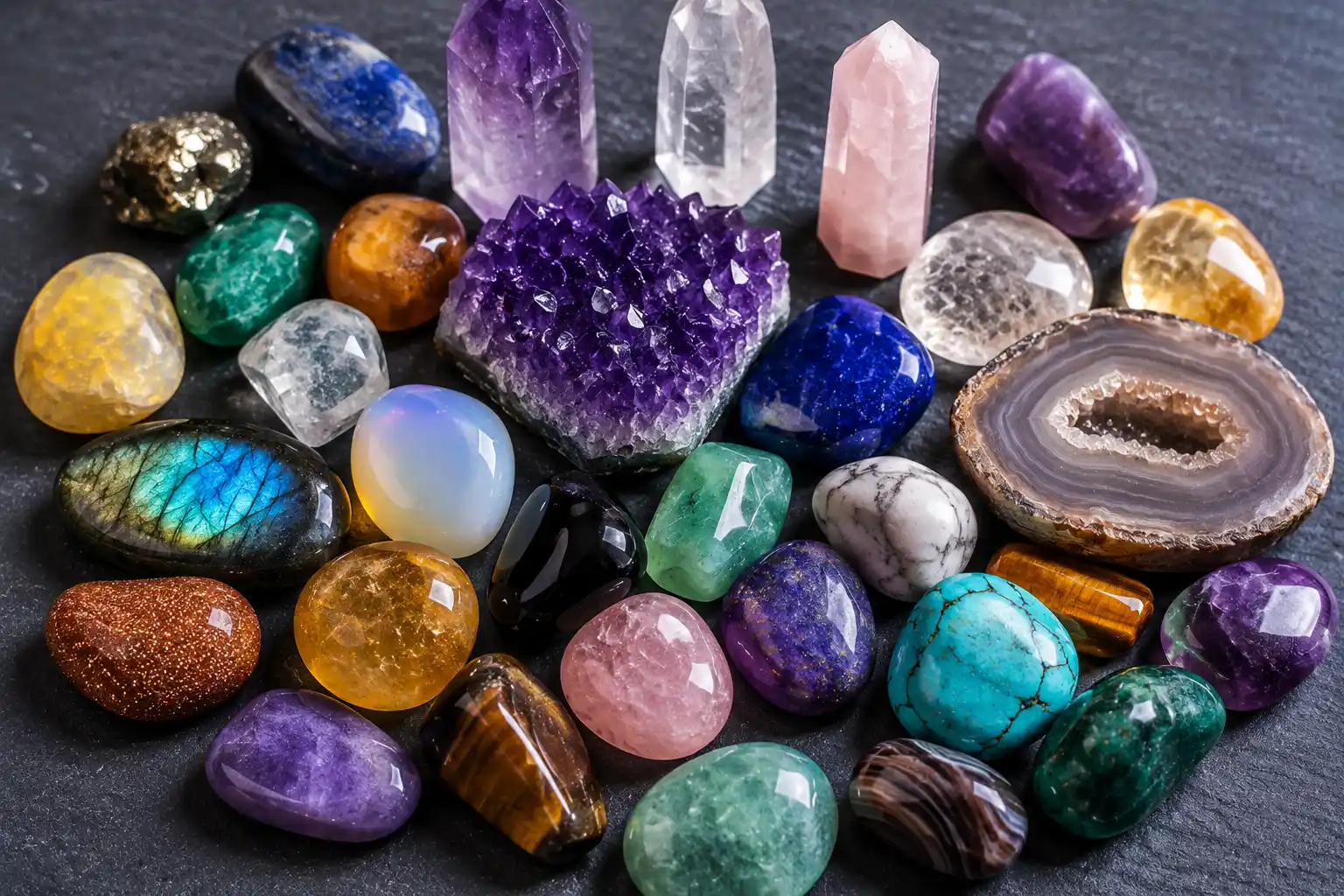
Types of Gemstones: The Complete Visual Guide
Gemstones include far more than transparent minerals cut into sparkling faceted shapes. The category also covers opaque ornamental minerals, rocks composed of several minerals, natural volcanic glass, organic materials such as Pearl and Amber, and laboratory-grown counterparts created with essentially the same structure as natural gems.
A practical classification system should answer several different questions. What is the material made from? Did it form naturally or in a laboratory? Is it one mineral, a rock, a glass or an organic substance? Was it treated? Is it transparent, translucent or opaque? Which cut best reveals its beauty?
These categories overlap. A Sapphire is a natural mineral gemstone, a variety of Corundum, usually transparent and normally faceted. Lapis Lazuli is a natural rock composed of several minerals, generally opaque and usually fashioned as a cabochon, bead or carving. A laboratory-grown Ruby is synthetic Corundum, while red glass is only an imitation.
Main Types of Gem Materials
| Category | Definition | Familiar examples |
|---|---|---|
| Natural mineral gemstone | Naturally formed crystalline mineral used for adornment | Diamond, Ruby, Sapphire, Emerald and Topaz |
| Natural mineral aggregate | Intergrown mineral grains used as one gem material | Chalcedony, Jade and some ornamental aggregates |
| Natural rock gemstone | Rock containing several mineral components | Lapis Lazuli, Unakite and some Jaspers |
| Natural glass | Non-crystalline material formed naturally | Obsidian and Moldavite |
| Organic or biogenic gem | Material produced by living or once-living organisms | Pearl, Coral, Amber, Jet and shell |
| Laboratory-grown gemstone | Artificially grown counterpart with corresponding structure and properties | Lab Diamond, synthetic Ruby and synthetic Emerald |
| Treated natural gemstone | Mined material altered to improve color, clarity or durability | Heated Sapphire, oiled Emerald and irradiated Blue Topaz |
| Composite gemstone | Product assembled from two or more parts | Doublets, triplets and reconstructed materials |
| Imitation or simulant | Different material made to resemble another gemstone | Glass imitating Emerald or cubic zirconia imitating Diamond |
What Is a Gemstone?
Gemstone is a practical cultural and commercial category rather than one mineralogical class.
A gem material is generally valued because it can be fashioned or presented attractively and has enough beauty, durability, rarity, tradition or personal significance for adornment or collection.
Most gemstones are minerals, but not every mineral becomes a gemstone. Feldspar is one of Earth’s most abundant mineral groups, yet only selected varieties such as Moonstone, Labradorite and Sunstone are widely used as gems.
Conversely, not every gemstone is a mineral. Obsidian is natural glass, Lapis Lazuli is a rock and Pearl is an organic gem produced by a mollusk.
Mineral Species, Groups and Varieties
Gemological terminology separates mineral groups, species and varieties.
A mineral group contains related species with a shared structural pattern. Garnet is a group containing pyrope, almandine, grossular, spessartine, andradite and uvarovite.
A mineral species has a defined structure and compositional range. Corundum and Beryl are species.
A variety is a recognizable form within a species. Ruby and Sapphire are varieties of Corundum. Emerald, Aquamarine and Morganite are varieties of Beryl.
Understanding this hierarchy prevents confusion between a true mineral species and a marketing name.
Crystalline Mineral Gemstones
Most familiar faceted gems are crystalline minerals.
Their atoms are arranged in repeating structures that determine crystal system, cleavage, optical behavior and hardness.
Diamond, Corundum, Beryl, Quartz, Topaz, Spinel, Tourmaline and Garnet all belong to this category.
Crystalline structure does not guarantee transparency. Hematite, Malachite, Turquoise and many Jade materials are crystalline or microcrystalline but normally opaque.
The crystal structure also affects how the material breaks, reacts to light and accepts cutting.
Diamond
Diamond is crystalline carbon and the hardest natural material on the Mohs scale.
Colorless Diamond is the most familiar form, but natural fancy-color material can be yellow, brown, pink, blue, green, red, orange, gray or black.
Diamonds may be natural or laboratory grown. Both have essentially the same crystal structure and properties, although their growth histories differ.
The guide to types of Diamond explains color, crystal type, natural formation and laboratory-grown categories.
Hardness does not make Diamond unbreakable. Its perfect cleavage can still produce chips after a correctly directed blow.
Corundum: Ruby and Sapphire
Corundum is aluminum oxide.
Red Corundum is Ruby, while other colors are classified as Sapphire. Blue remains the most familiar Sapphire color, but yellow, pink, orange, green, purple, colorless and color-change stones also occur.
Ruby and Sapphire rank 9 on the Mohs scale and have excellent toughness, making them important choices for frequently worn jewelry.
Heating is common, while diffusion, filling and other treatments also occur.
The guides to types of Ruby and types of Sapphire separate the major color and treatment categories.
Beryl Gemstones
Beryl is a beryllium-aluminum silicate mineral species.
Emerald is the green-to-bluish-green variety. Aquamarine is blue to greenish blue, Morganite is pink to orange-pink, Heliodor is yellow to golden and Goshenite is colorless.
Red Beryl is a rare red variety.
Beryl crystals can become large, but durability varies with inclusions. Emerald is frequently fractured and clarity enhanced, whereas Aquamarine is commonly cleaner.
The Beryl guide explains the family, while types of Emerald handles geographic and phenomenal categories.
Garnet Group
Garnet is a group rather than one red mineral.
Its major species include pyrope, almandine, spessartine, grossular, andradite and uvarovite.
Colors include red, purple, pink, orange, yellow, green, brown, black and rare color-changing combinations.
Rhodolite, Hessonite, Tsavorite, Demantoid, Mali and Malaya Garnet are important varieties or mixtures.
The guide to types of Garnet explains the species and trade varieties.
Quartz and Chalcedony
Quartz occurs as large crystals and as microcrystalline Chalcedony.
Rock-crystal Quartz, Amethyst, Citrine, Smoky Quartz and Prasiolite are familiar crystalline varieties.
Agate, Onyx, Carnelian, Chrysoprase and many Jaspers belong to or are closely associated with the Chalcedony side of the Quartz family.
Quartz ranks 7 on the Mohs scale and has no cleavage, making many forms durable enough for jewelry.
The Quartz guide explains the family and the distinction between macrocrystalline and microcrystalline material.
Feldspar Gemstones
Feldspar is a major mineral group containing several important gem materials.
Moonstone shows adularescence. Labradorite displays labradorescence, while Sunstone may show aventurescence from reflective inclusions.
Amazonite is blue-green Microcline, and transparent Orthoclase or Plagioclase can also be faceted.
Feldspar generally ranks around 6–6.5 and may have pronounced cleavage, requiring more care than Quartz.
Optical effects rather than strong transparency often provide the greatest visual appeal.
Tourmaline Group
Tourmaline is a complex group of borosilicate minerals.
Transparent gem material is commonly elbaite, while black Schorl, brown Dravite and green Uvite also appear in jewelry.
Tourmaline occurs in pink, red, green, blue, yellow, orange, black, colorless and multicolored crystals.
Strong pleochroism and color zoning influence cutting.
The guide to types of Tourmaline explains varieties such as Rubellite, Indicolite, Paraíba and Watermelon Tourmaline.
Spinel
Gem Spinel is usually magnesium-aluminum oxide and belongs to a wider mineral group.
Natural Spinel can be red, pink, orange, purple, violet, blue, gray, black and occasionally colorless or greenish.
It has strong durability and is rarely treated, although synthetic material is common.
For centuries, red Spinel was confused with Ruby because the two can occur in the same deposits.
The guide to types of Spinel separates colors, optical phenomena and synthetic categories.
Topaz
Topaz is an aluminum fluorosilicate with Mohs hardness 8.
It occurs naturally in colorless, yellow, orange, brown, pink, red, violet and rare blue material.
Most commercial Blue Topaz is produced by irradiating and heating colorless natural stone. Mystic Topaz receives a thin surface coating.
Topaz has strong cleavage despite its high hardness, showing why scratch resistance and impact resistance are not identical.
The guide to types of Topaz explains the principal colors and treatments.
Zircon
Zircon is a natural zirconium silicate and should not be confused with cubic zirconia.
It occurs in colorless, blue, yellow, orange, red, brown and green.
High Zircon can show strong brilliance and dispersion. Some crystals have experienced natural radiation damage over geological time, creating lower structural states.
Heat is commonly used to produce blue and colorless appearances.
The guide to types of Zircon separates color, structure and treatment categories.
Opal
Opal is hydrated amorphous silica rather than a conventionally crystalline mineral.
Precious Opal displays play-of-color, while common Opal lacks that shifting spectral effect.
Black, white, crystal, fire, boulder and matrix Opal are important categories.
Water content, porosity and internal stress affect durability.
Opal doublets and triplets combine layers to improve appearance or stability.
The guide to types of Opal explains body-color, structure and geographic categories.
Jade
Jade is a cultural and gemological term covering two principal materials: Jadeite and Nephrite.
Jadeite is a pyroxene mineral aggregate, while Nephrite is a tough fibrous amphibole aggregate.
Both can appear green, white, gray, yellow, brown, black and other colors.
Fine translucent green Jadeite occupies a different market from ordinary opaque carving material.
Dyeing, bleaching, polymer impregnation and assembly occur.
The guide to types of Jade explains the mineral and treatment categories.
Rocks Used as Gemstones
Some gem materials are rocks composed of more than one mineral.
Lapis Lazuli contains Lazurite and commonly includes Calcite, Pyrite and other minerals.
Unakite combines green Epidote, pink feldspar and Quartz. Certain Jaspers are technically mineral-rich rocks or aggregates rather than pure Chalcedony.
Granite, rhyolite, gabbro and other decorative rocks can also be cut into cabochons, beads and carvings.
A rock can be a legitimate gemstone even though it is not one mineral species.
Natural Glass Gemstones
Natural glass forms when molten or vaporized material cools too quickly to create a regular crystal structure.
Obsidian forms through volcanic processes. Moldavite is impact glass associated with a meteorite event.
Natural glass can be transparent, translucent or opaque.
It generally has lower hardness and toughness than Quartz and can form sharp conchoidal fractures.
Glass imitations are also widely manufactured, so natural origin requires more than a glassy appearance.
Organic and Biogenic Gemstones
Organic gems form through living organisms or biological processes.
Pearl forms when a mollusk deposits nacre or related material around an irritant or implanted nucleus. Amber is fossilized plant resin.
Coral consists of skeletal material produced by marine organisms, while shell and Mother of Pearl come from mollusks. Jet forms from altered ancient wood.
These materials have different structures and care requirements from mineral gemstones.
The guide to types of Pearl explains natural, cultured and saltwater or freshwater categories.
Pearls
Pearls may be natural or cultured.
Natural Pearls form without deliberate human initiation, while cultured Pearls develop after a person inserts tissue, a bead nucleus or both into a mollusk.
Akoya, South Sea, Tahitian and freshwater are major cultured categories.
Luster, surface, shape, size, nacre quality and matching influence value.
Pearl is comparatively soft and vulnerable to acids, perfume, dehydration and abrasion.
Amber
Amber is fossilized plant resin rather than tree sap or mineral crystal.
It occurs in yellow, orange, brown, red, greenish and rare blue-appearing forms.
Inclusions may preserve ancient plants, insects and other organisms.
Heating, pressing, clarification and reconstruction occur.
Copal is younger, less mature resin and should not automatically be sold as Amber.
Coral
Precious Coral is an organic gem material obtained from the skeletons of particular marine coral species.
Colors include red, pink, orange, white and other shades.
Dyeing, impregnation and reconstruction are common treatment concerns.
Coral trade is also connected with environmental protection, species regulation and responsible sourcing.
Imitation Coral may be made from glass, plastic, ceramic or dyed organic material.
Transparent, Translucent and Opaque Gemstones
Transparency describes how light travels through a material.
Transparent gems allow objects or light to be seen clearly through the stone. Diamond, Sapphire and Aquamarine are familiar examples.
Translucent material transmits light without providing a clear image. Moonstone, Chalcedony and some Jade fall within this category.
Opaque gemstones transmit little or no visible light. Turquoise, Lapis Lazuli, Malachite and most Black Onyx are examples.
Transparency can vary within one material according to quality, thickness and inclusions.
Faceted Gemstones
Faceting uses flat polished surfaces to reflect and refract light.
Transparent materials with suitable clarity and durability are the main candidates.
Brilliant cuts emphasize sparkle, while step cuts create broad flashes and clearer views into the interior. Mixed cuts combine elements of both.
Cutting proportions influence brightness, windowing, extinction and visible size.
A high carat weight does not compensate for a badly proportioned cut.
Cabochon Gemstones
A cabochon has a smooth rounded or domed surface rather than conventional facets.
Opaque and translucent materials commonly receive this cut.
Cabochons are also necessary for many optical phenomena. Cat’s-eye gems, star Sapphires, Moonstone and some Opals require curved surfaces to display their effects.
A well-made cabochon should have an even dome, sound base, smooth polish and correct optical orientation.
Beads, Carvings and Inlay
Gem materials can be drilled into beads, carved into decorative shapes or cut into thin pieces for inlay.
Bead quality depends on polish, drill-hole condition, matching and stringing.
Carving can reveal color zoning and natural form but may create vulnerable points.
Inlay relies on precise fitting, adhesive and backing, making construction as important as the stone itself.
Opaque materials such as Turquoise, Jade, Lapis Lazuli and Onyx are especially common in these formats.
Phenomenal Gemstones
Phenomenal gemstones display unusual optical effects.
Asterism creates a star, while chatoyancy produces a cat’s-eye band. Adularescence creates Moonstone’s floating glow.
Opal shows play-of-color, Labradorite displays labradorescence and Sunstone may show aventurescence.
Alexandrite and some Garnets exhibit color change under different lighting. Iridescence appears through surface or structural interference.
The effect must be evaluated in appropriate lighting and with correct cutting orientation.
Gemstones by Color
Color categories are useful for visual comparison but do not identify mineral species.
The red gemstones guide includes Ruby, Spinel and Garnet. The blue gemstones guide compares Sapphire, Aquamarine, Tanzanite and other materials.
Green choices appear in the green gemstones guide, while the pink gemstones guide covers Morganite, pink Sapphire, Spinel and Tourmaline.
The purple gemstones guide, orange gemstones guide and yellow gemstones guide provide additional color families.
Opaque and neutral options appear in the black gemstones guide, white gemstones guide, brown gemstones guide and gray gemstones guide.
Natural Gemstones
A natural gemstone formed through geological or biological processes without being grown by people.
Natural does not necessarily mean untreated.
A natural Sapphire may be heated, an Emerald may be filled with oil and a Turquoise may be stabilized with polymer.
The seller should disclose origin and treatment as separate facts.
Natural origin also does not guarantee rarity, quality or ethical sourcing.
Laboratory-Grown Gemstones
Laboratory-grown gemstones have essentially the same composition, structure and principal properties as their natural counterparts.
Examples include laboratory-grown Diamond, Ruby, Sapphire, Emerald, Alexandrite and Spinel.
Growth methods include flame fusion, flux, hydrothermal, Czochralski pulling, chemical vapor deposition and high-pressure high-temperature synthesis.
A laboratory-grown gem is not an imitation, but it must be disclosed clearly.
The lab-grown versus natural gemstones guide explains origin, value and identification.
Treated Gemstones
Treatments alter a natural gemstone after formation.
Heating can change color or clarity. Irradiation creates color centers, while diffusion introduces elements near the surface.
Oil, resin and glass can fill fractures. Dye alters color, and coatings create surface effects.
Treatment may be permanent, stable under normal wear, temporary or vulnerable.
The gemstone treatments guide explains the main processes and disclosure expectations.
Composite Gemstones
Composite gems contain two or more joined components.
A doublet has two layers, while a triplet normally has three.
Opal doublets, assembled Emeralds and glass-backed stones are common examples.
Reconstructed material combines fragments or powder with a binder.
Composite construction can be legitimate when disclosed, but it affects durability, cleaning and value.
The gemstone doublets and triplets guide explains joining planes, fillers and identification.
Imitations and Simulants
An imitation resembles another gemstone without sharing its composition and structure.
Cubic zirconia and Moissanite can imitate Diamond. Red glass can imitate Ruby, while dyed Howlite can imitate Turquoise.
A natural gem can also imitate another natural gem. Iolite may resemble Tanzanite, and Spinel may resemble Ruby.
Imitation is not automatically fraudulent. Misrepresentation occurs when the actual material is concealed.
Precious Versus Semi-Precious Stones
The traditional precious category usually includes Diamond, Ruby, Sapphire and Emerald.
All other gems have often been called semi-precious.
This division is historically familiar but scientifically weak. Fine Jadeite, Paraíba Tourmaline, Alexandrite, Demantoid or natural Pearl can be rarer and more valuable than ordinary examples of a so-called precious stone.
The precious versus semi-precious stones guide explains why species, quality and market factors provide better distinctions.
Gemstone Hardness
Hardness measures resistance to scratching.
Diamond ranks 10, Corundum 9 and Topaz 8. Quartz ranks 7, while Turquoise and Opal are softer.
The Mohs scale is ordinal rather than linear. Diamond is not merely a small step harder than Corundum.
Hardness does not measure resistance to breaking.
The gemstone hardness chart provides comparative values.
Toughness and Cleavage
Toughness describes resistance to chipping and breaking.
Jade can be exceptionally tough despite moderate hardness. Topaz is hard but has strong cleavage, while Emerald’s fractures can reduce toughness.
Cleavage is a structural tendency to split along particular directions.
The gemstone toughness-versus-hardness guide explains the distinction, while gemstone cleavage explained covers directional breakage.
These factors determine whether a gem suits a ring, bracelet, pendant or protected display.
Gemstone Value
Value depends on more than species.
Color, clarity, size, cutting, treatment, origin, rarity, market demand and documentation all contribute.
Two Sapphires of equal weight can occupy completely different price levels. A rare species can remain inexpensive when color and durability are poor.
A famous trade name should not replace evaluation of the individual stone.
Resale value also differs from retail replacement cost.
Gemstone Certification
A laboratory report identifies material, natural or laboratory-grown origin and detectable treatments.
Some laboratories also offer geographic-origin opinions for selected stones.
Reports do not provide a universal value or quality grade for every colored gem.
Seller-created AAA, AA and A labels are not standardized across the industry.
The gemstone certification guide explains report scope, laboratory selection and verification.
Birthstones
Birthstones organize gemstones by calendar month rather than mineral family.
January uses Garnet, while May is associated with Emerald. July uses Ruby, and September uses Sapphire.
Some months have several recognized alternatives.
The birthstones-by-month guide provides the complete chart and historical context.
A birthstone label does not prove quality, treatment or authenticity.
Choosing a Gemstone for Jewelry
Begin with the intended jewelry format.
Daily rings need strong hardness, toughness and stable treatment. Earrings and necklaces can accommodate softer, cleavage-prone or highly included material more safely.
Bracelets experience frequent desk contact, while beads introduce drill-hole and stringing concerns.
Then evaluate color, maintenance, budget and documentation.
The best gem is not always the rarest one. It is the material whose properties and care requirements fit the wearer’s actual routine.
Final Perspective
Gemstones can be classified by material, mineral family, formation, treatment, transparency, color, optical effect and cutting style.
No single system answers every question. Calling a gem “blue,” “natural” or “precious” communicates only one part of its identity.
A complete description should explain what the material is, whether it formed naturally or in a laboratory, whether it was treated or assembled and how its physical properties affect use.
Frequently Asked Questions
1. Are all gemstones minerals?
No. Many are minerals, but rocks, natural glass and organic materials such as Pearl and Amber are also used as gemstones.
2. What is the difference between a mineral species and a variety?
A species has a defined structure and compositional range. A variety is a recognizable color or form within that species.
3. Is a laboratory-grown gemstone fake?
No. It corresponds to a natural gemstone in composition and structure but formed in a laboratory and must be disclosed as such.
4. Is a treated gemstone still natural?
Yes. It formed naturally but was altered after mining.
5. What is a gemstone imitation?
It is a different material used to resemble another gem, such as glass imitating Emerald.
6. What is a composite gemstone?
It is assembled from two or more parts, such as an Opal doublet or triplet.
7. Are precious gemstones always more valuable?
No. The precious-versus-semi-precious division does not account reliably for quality, rarity or market value.
8. Which gemstones are organic?
Pearl, Amber, Coral, Jet, shell and Mother of Pearl are familiar organic or biogenic gem materials.
9. Which gemstones are best for everyday rings?
Diamond, Ruby, Sapphire, Spinel and several Garnets are practical choices, though individual treatment and setting still matter.
10. Why are some gemstones faceted and others cut as cabochons?
Facets enhance brilliance in transparent material, while cabochons display opaque color and effects such as stars, cat’s eyes and adularescence.
11. Does high hardness mean a gemstone cannot break?
No. Topaz and Diamond are hard but can still cleave or chip.
12. How can a gemstone type be confirmed?
Gemologists combine visual examination, refractive index, density, microscopy, spectroscopy and other non-destructive laboratory methods.