7 Smart Ways to Buy Smoky Quartz: Proven Quality Checks & Costly Red Flags
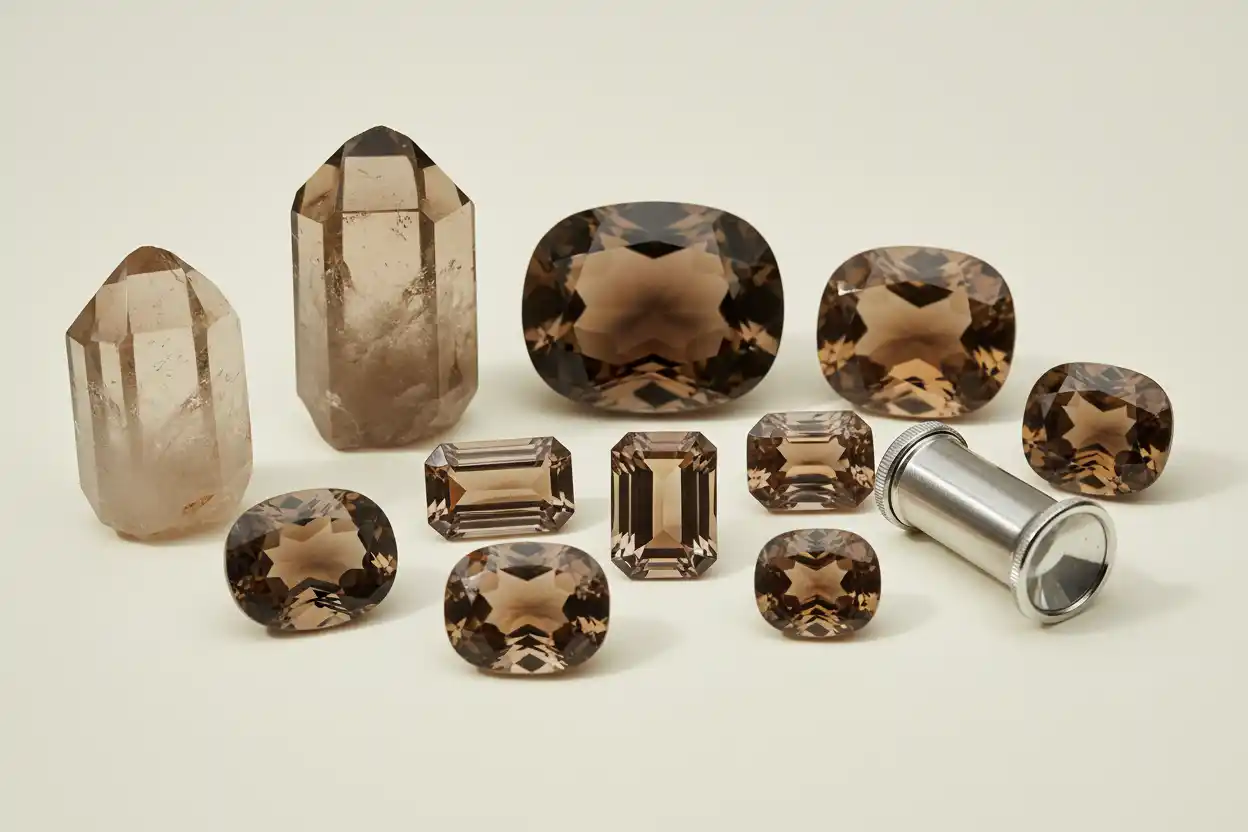
To buy Smoky Quartz confidently, focus on natural-looking brown color, transparency, cutting quality, treatment disclosure, useful face-up dimensions, condition, and a price that reflects the abundance of quartz rather than exaggerated rarity claims. Smoky Quartz can range from pale gray-brown through warm brown and deep coffee tones to almost black varieties often associated with the name Morion. Darker does not automatically mean finer. A stone that remains transparent, lively, and visibly brown in ordinary lighting will often be more attractive than one that appears nearly opaque.
Smoky Quartz is also generally affordable. Current loose retail examples reviewed for this article range from roughly $1.50 to $7 per carat, with many transparent faceted stones clustering around approximately $2.50 to $4 per carat. Custom cutting, historic provenance, exceptional crystal specimens, unusual color zoning, or finished jewelry can cost considerably more, but ordinary loose Smoky Quartz should not receive a huge premium merely because the stone is large. The Smoky Quartz price is closely tied to cutting, presentation, color preference, and seller positioning because clean large quartz is readily available.
1. Smoky Quartz Color Quality: Choose Brown That Stays Attractive in Normal Light
Smoky Quartz color develops when quartz containing aluminum-related defects is exposed to radiation. In nature, this irradiation occurs over geological time, while laboratory irradiation can also produce smoky color in suitable quartz. GIA research explains that the characteristic color results from radiation-related color centers and can range from light smoky gray through brown to extremely dark tones.
The best buying color depends partly on personal preference, but useful evaluation principles remain consistent. Pale smoky stones should show enough brown or gray-brown character to remain distinctive away from bright dealer lights, while medium and dark stones should preserve enough transparency to avoid looking dead or black across most of the face. Warm brown, cognac-like, gray-brown, and deep chocolate shades can all look attractive when the cut returns sufficient light.
The Smoky Quartz quality grading should therefore consider tone, evenness, transparency, brightness, and cutting together. A dark stone should not receive a higher grade simply because it contains more color, particularly when that darkness reduces visible brilliance.
Morion Smoky Quartz and Very Dark Color
Morion is commonly used for extremely dark brown to almost black Smoky Quartz. These stones can appeal to mineral collectors and buyers who prefer dramatic color, but darkness alone does not create a universally higher commercial value. Many very dark stones need strong backlighting before their brown color becomes clearly visible.
A large near-black gem sold as exceptionally rare should therefore be evaluated carefully. Its price may reflect locality, crystal form, provenance, carving quality, or collector interest, but ordinary dark color by itself is not enough to justify a substantial premium.
2. Smoky Quartz Clarity and Cut: Look for Transparency Without Paying for Empty Weight
Transparent Smoky Quartz is widely available, which means faceted gems should normally offer good visual clarity. Small internal features, natural veils, growth patterns, or minor inclusions can occur, but large distracting fractures and dense clouds should reduce value when the stone is intended as a transparent faceted gem.
Cut quality matters more than many buyers expect because inexpensive rough can encourage cutters to preserve weight rather than maximize visual performance. A deep pavilion may add several carats that remain hidden below the girdle, while a shallow cut can create a broad transparent window through the center. Both problems weaken the value of a stone even when the carat number looks impressive.
Compare length, width, and depth alongside weight. Current retail inventory includes Smoky Quartz in rounds, emerald cuts, marquises, flower cuts, cushions, pears, and concave designs. A 5-carat precision or concave cut can be more visually interesting than a much larger standard-cut stone, even though the larger gem contains more quartz.
The pale-to-medium brown color of many stones also makes cutting errors easy to see. Strong symmetry, crisp polish, even reflections, and a face-up shape that uses the weight efficiently are worth paying for when the difference is visible.
3. Natural Smoky Quartz vs Irradiated Quartz: Ask What Created the Color
Smoky Quartz can receive its brown color through natural radiation inside the earth, but colorless quartz can also be irradiated commercially to create a smoky appearance. GIA has documented both routes and notes that irradiated quartz has long been accepted in parts of the gem market when properly represented.
That means the word natural requires careful reading. A seller may mean naturally mined quartz while the color itself was produced later through irradiation. If untreated natural color matters to you, ask specifically whether the smoky color is naturally occurring or treatment-created.
Laboratory irradiation is not automatically a reason to reject an attractive stone. Smoky Quartz is usually purchased for appearance rather than extreme rarity, so a disclosed treated stone can still make appealing jewelry. The problem occurs when treated quartz is marketed with an unsupported premium for rare natural color.
Heat is also important because GIA research shows that smoky color centers can be removed by sufficient heating. A stone should therefore be kept away from strong heat during jewelry repair and other procedures.
The Smoky Quartz vs Citrine comparison is useful because heating can change the appearance of some quartz, while smoky and yellow-orange colors can overlap in naturally zoned or treated stones.
4. Smoky Quartz Price Per Carat: Large Stones Should Still Be Affordable
Current retail inventory shows why buyers should resist scarcity language applied to ordinary Smoky Quartz. A 4.99-carat untreated Brazilian flower-cut stone is currently offered for about $19, or roughly $3.80 per carat. A 12.50-carat emerald-cut stone costs about $21, or roughly $1.65 per carat, while a 9.78-carat round is about $32, or around $3.30 per carat.
Other current examples include a 6.22-carat pair of light brown concave-cut stones for about $37, equivalent to roughly $6 per carat, and a 43.78-carat group of transparent Brazilian spheres for about $70, around $1.60 per carat.
These prices demonstrate that larger weight does not create a steep rarity premium. Smoky Quartz price per carat can remain flat or even decline with size because large quartz crystals are widely available.
A higher rate can still make sense for superior precision cutting, unusually attractive color, a documented historic locality, exceptional crystal formation, or notable carving work. Buyers should be able to identify the specific feature that justifies the premium rather than accepting size or darkness as the explanation.
5. Smoky Quartz Origin: Brazil, Scotland, Switzerland, and Other Localities
Smoky Quartz occurs in many quartz-producing regions. Brazil supplies substantial quantities of commercial rough and dominates many current loose-gem listings, while other notable occurrences include Madagascar, the United States, Switzerland, Scotland, and numerous alpine localities.
The Smoky Quartz locations become particularly interesting for mineral collectors because crystal habit, associations with other minerals, locality history, and documented provenance can affect specimen desirability.
Scottish smoky quartz has a strong cultural association with the Cairngorm mountains, and the name Cairngorm is traditionally linked with brown to smoky quartz from Scotland. That history can add collector or jewelry interest, but the locality should be documented if it is being used to justify a substantial premium.
For ordinary faceted jewelry stones, origin is usually less important than attractive color, transparency, cut, dimensions, and price. A beautifully cut Brazilian stone can provide better visual value than a poorly cut gem carrying a more romantic locality description.
6. Smoky Quartz Durability: Check Scratches, Chips, and Heat Exposure
Quartz ranks 7 on the Mohs hardness scale and has good toughness, making Smoky Quartz suitable for rings, pendants, bracelets, earrings, and other jewelry. It is durable enough for frequent wear, but it can still scratch and chip, particularly along exposed facet edges.
The Smoky Quartz durability profile makes it practical for jewelry but not indestructible. Quartz can be scratched by harder gems such as Topaz, Sapphire, Ruby, and Diamond, so loose pieces should not be stored carelessly together.
Heat deserves special attention because GIA durability guidance notes that strong heat can remove smoky color and abrupt temperature changes can cause fractures. A jeweler working on a mounted stone should know what the gem is before applying heat nearby.
Warm soapy water is the safest routine approach for cleaning Smoky Quartz jewelry. Gentle brushing and careful drying are normally sufficient, especially when the stone contains fractures or its treatment history is uncertain.
7. Smoky Quartz Seller Claims: Avoid Rare, AAAA, and Investment Hype
Seller-created grades such as AAA, AAAA, premium, collector grade, and investment grade do not form a universal Smoky Quartz grading system. An ordinary clean brown stone can be marketed as top grade even though similar quartz is widely available.
The best defense is direct comparison. Examine color, transparency, cut, dimensions, treatment disclosure, origin evidence, condition, and actual price. A seller asking $50 per carat for an ordinary commercial stone should be able to show a meaningful difference from current examples selling for a few dollars per carat.
Large crystals also need context. Smoky Quartz can form substantial crystals, so impressive size does not automatically mean exceptional scarcity. Crystal specimens can still become expensive when they have outstanding termination, unusual associations, important locality, aesthetic formation, or documented collecting history.
For a normal loose gem costing tens of dollars, an expensive laboratory report may add little value. Gemstone certification becomes more relevant when a costly stone depends on a specific natural-color, treatment, identity, or provenance claim.
Smoky Quartz Jewelry Value: Gem Cost Is Often Only Part of the Price
Finished Smoky Quartz jewelry can cost far more than the loose center stone because precious metal, accent gems, labor, design, and brand positioning often outweigh the value of the quartz itself. A gold ring containing a large Smoky Quartz may therefore cost hundreds or thousands of dollars even when a comparable loose gem would cost only tens of dollars.
A Smoky Quartz ring should be evaluated as a complete piece of jewelry rather than dividing the retail price by the gem’s carat weight. Setting quality, metal weight, craftsmanship, comfort, condition, and design all contribute to what the buyer is actually purchasing.
Smoky Quartz Meaning and Market Quality Are Separate Questions
The Smoky Quartz meaning includes historical and modern symbolic associations, while crystal traditions often connect the stone with grounding, reflection, and emotional steadiness. These beliefs can have personal significance, but they do not determine gemological quality or prove therapeutic effects.
For buying purposes, the measurable factors remain identity, color, transparency, cut, treatment, dimensions, condition, provenance, and price.
Smoky Quartz Buying FAQs
What color Smoky Quartz should I buy?
Choose a brown or gray-brown tone that remains attractive in ordinary lighting. Medium tones often show more brilliance than extremely dark stones.
How much does Smoky Quartz cost per carat?
Many current ordinary loose examples sit around roughly $1.50 to $6 per carat, while custom cuts and collectible specimens can move higher.
Is darker Smoky Quartz more valuable?
Not automatically. Very dark stones can lose transparency, and ordinary near-black quartz is not necessarily rarer or more valuable than an attractive medium-brown stone.
Is Smoky Quartz naturally irradiated?
Natural smoky color develops through radiation acting on suitable quartz over geological time. Laboratory irradiation can also create smoky color.
Can Smoky Quartz lose its color?
Strong heat can remove smoky coloration, so exposure to high temperatures during repair or other processes should be avoided.
Should Smoky Quartz be eye-clean?
Transparent faceted stones are readily available, so obvious fractures and large distracting inclusions normally reduce value.
Is Brazilian Smoky Quartz valuable?
Brazil produces large quantities of attractive Smoky Quartz. Fine cutting and appearance usually matter more than Brazilian origin alone.
Is Cairngorm the same as Smoky Quartz?
Cairngorm is traditionally associated with brown to smoky quartz from Scotland, particularly the Cairngorm region. Documented Scottish provenance can add collector interest.
Is Smoky Quartz suitable for rings?
Yes. Quartz has a Mohs hardness of 7 and good toughness, although rings should still be protected from hard impacts and scratching.
Does Smoky Quartz need certification?
Most inexpensive stones do not. Independent identification becomes more useful when a high price depends on treatment, origin, or another uncommon claim.
Conclusion
Buying Smoky Quartz well is less about chasing rarity and more about choosing attractive brown color, good transparency, strong cutting, honest treatment disclosure, useful proportions, and sensible pricing. Current loose examples demonstrate that even large transparent stones remain affordable, so a major premium should be supported by exceptional craftsmanship, provenance, crystal form, or another clearly identifiable feature rather than weight or darkness alone.