
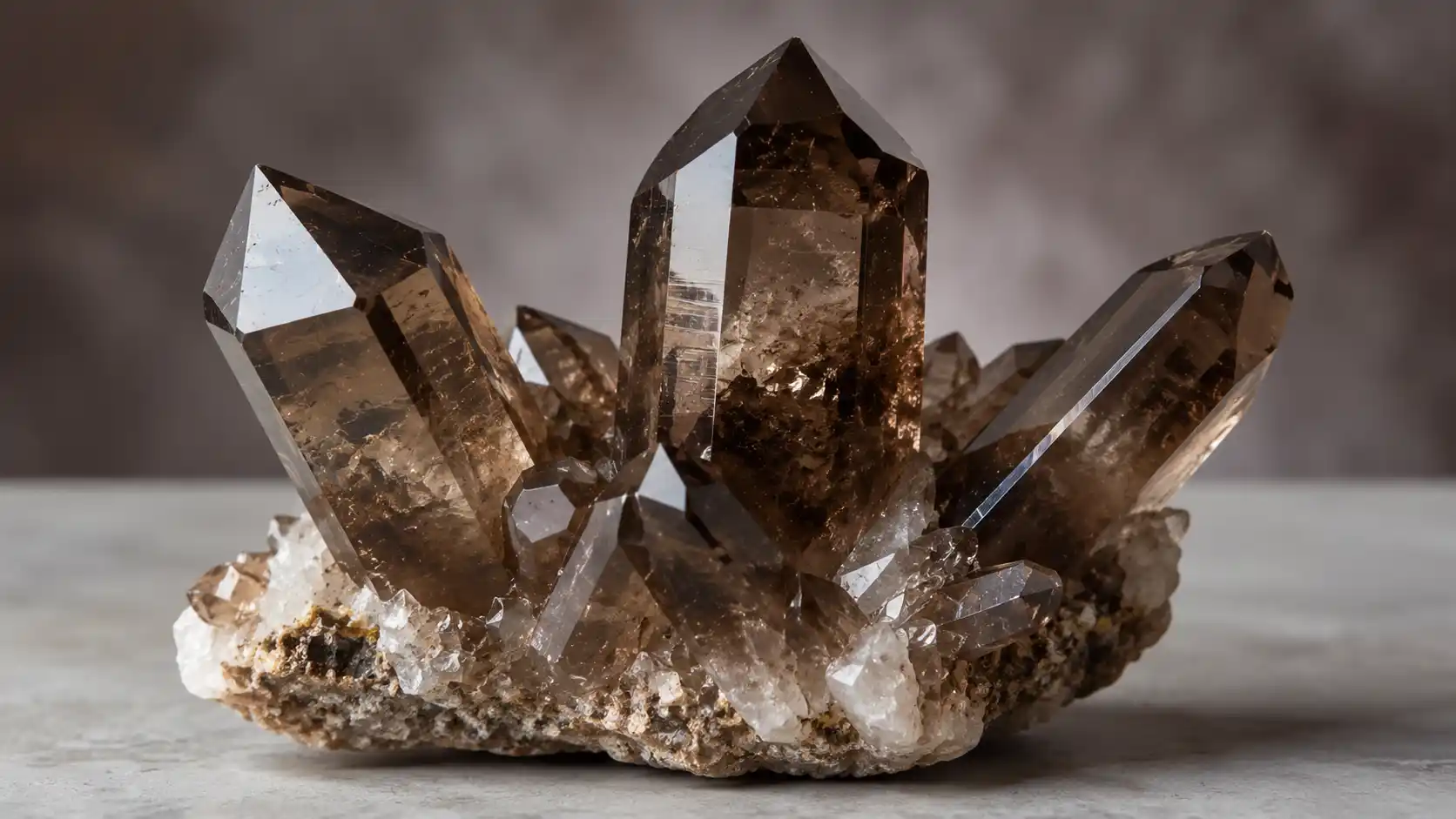

Smoky Quartz is the brown, gray-brown or nearly black variety of crystalline quartz. Its subdued color comes from changes within the crystal lattice rather than smoke, surface staining or a separate mineral ingredient.
Because it combines Quartz’s familiar crystal forms with earthy coloration, Smoky Quartz appears in mineral collections, faceted jewelry, carvings and contemporary spiritual practices. It is durable enough for most jewelry, yet its color, treatment history and internal fractures still deserve attention when choosing or caring for a piece.
Smoky Quartz at a Glance
| Property | Smoky Quartz |
|---|---|
| Mineral species | Quartz |
| Chemical composition | Silicon dioxide, SiO₂ |
| Color | Pale smoky gray to brown, dark brown and nearly black |
| Crystal system | Trigonal |
| Common habit | Six-sided prisms with pyramidal terminations |
| Luster | Vitreous |
| Transparency | Transparent to opaque |
| Mohs hardness | 7 |
| Cleavage | None |
| Fracture | Conchoidal |
| Specific gravity | Approximately 2.65 |
| Dark variety name | Morion |
| Common uses | Faceted gems, cabochons, beads, carvings and specimens |
| Main care concerns | Sharp impacts, strong heat and prolonged intense light |
What Is Smoky Quartz?
Smoky Quartz is a color variety of Quartz, one of the most abundant mineral species in Earth’s crust. Its basic composition is silicon dioxide, the same composition found in Clear Quartz, Amethyst and Citrine.
The smoky color develops when natural ionizing radiation interacts with trace aluminum-related defects in the quartz lattice. These changes create color centers that absorb portions of visible light, producing shades from pale champagne-gray to deep brown and almost opaque black.
Although radioactive processes can contribute to the formation of natural color underground, a finished Smoky Quartz crystal is not normally radioactive merely because it is smoky. Commercial material may also receive controlled irradiation to deepen or create the color. That treatment does not turn Quartz into a different mineral, but sellers should disclose it when known.
How Smoky Quartz Forms
Quartz crystallizes in many geological settings. Smoky Quartz is especially associated with cavities and pockets in granitic rocks, pegmatites, Alpine-type fissures and some metamorphic environments.
A Quartz crystal must contain suitable trace defects before irradiation can create a smoky color. Natural radiation from nearby potassium-, uranium- or thorium-bearing minerals may act over long periods. Consequently, Smoky Quartz commonly occurs with feldspar and mica in granite and pegmatite environments.
Crystals may grow as isolated prisms, clusters or combinations with other minerals. Some show alternating clear and smoky zones because the distribution of trace elements and radiation exposure differed as the crystal developed.
Quartz inclusions can create further variation. Smoky crystals may contain rutile needles, chlorite, mica, fluid inclusions or internal phantom-growth outlines. These included forms remain distinct from the broader guides to Rutilated Quartz, Garden Quartz and Phantom Quartz.
Smoky Quartz Colors and Varieties
Smoky Quartz forms a continuous range rather than a series of sharply separated mineral varieties. Pale crystals can look gray, beige or champagne-colored. Medium material often shows tea-brown, cognac or coffee tones, while dark crystals may appear black until held against a strong light.
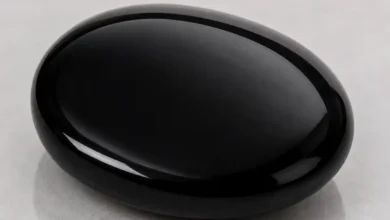
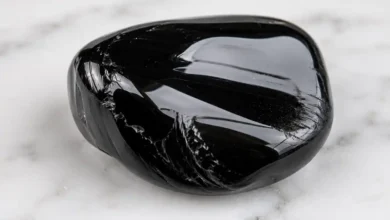
Morion is the traditional name for extremely dark brown to nearly black Smoky Quartz. Some pieces transmit reddish brown light around thin edges, whereas others appear almost opaque.
Cairngorm traditionally refers to yellowish brown or smoky Quartz associated with Scotland, particularly the Cairngorm region. The name has cultural and locality significance but should not be applied automatically to brown Quartz from unrelated sources.
Smoky Citrine describes material that displays both smoky brown and yellow-to-orange zones. Color boundaries may arise naturally or through heat and irradiation. The guide to Smoky Quartz versus Citrine explains how these related Quartz colors overlap and differ.
The complete types of Smoky Quartz guide covers Morion, Cairngorm, zoned crystals, included material and common commercial descriptions without treating every shade as a separate mineral.
Notable Sources
Brazil supplies substantial quantities of Smoky Quartz for carving, faceting and decorative objects. Large crystals may show good transparency, even brown color and relatively clean interiors, although commercial quality varies widely.
Madagascar also produces crystals, polished freeforms and included Smoky Quartz. Material ranges from pale translucent brown to dark crystals with fractures, phantoms or mineral inclusions.
The European Alps are known for sharp Smoky Quartz crystals from fissures in mountainous rocks. Fine Alpine specimens may display strong luster, clear terminations and attractive associations with feldspar, adularia, hematite or other minerals.
Scotland has an important historical relationship with smoky brown Quartz, while Colorado is known for Smoky Quartz associated with Amazonite and other feldspars. Additional occurrences appear throughout the United States, Africa, Australia, Russia and other quartz-bearing regions.
A locality name can add collector interest, but provenance should come from credible records rather than color alone.
Smoky Quartz Meaning and Symbolism
Modern crystal traditions commonly associate Smoky Quartz with grounding, steadiness, protection and the release of emotional tension. Its brown and gray colors encourage symbolic connections with soil, stone, stability and practical awareness.
Some practitioners use it as a reminder to remain present during periods of uncertainty. Others keep it near a desk, carry a tumbled stone or hold a crystal during reflective exercises.
In spiritual traditions, Smoky Quartz is frequently linked with the Root Chakra, an energy-center concept associated with stability, physical security and belonging. The broader guide to Root Chakra crystals places it among several stones used symbolically for grounding practices.
These meanings are cultural and personal interpretations. They do not arise from a medically active ingredient in the Quartz.
Smoky Quartz Healing Properties in Crystal Traditions
Practitioners often describe Smoky Quartz as a supportive stone for emotional grounding. During meditation, its dark transparent appearance may provide a visual focus for noticing worries without becoming absorbed in them.
Some traditions associate the stone with resilience and practical decision-making. A person might hold it while writing priorities, planning a difficult conversation or separating controllable issues from circumstances outside personal control.
Other users place Smoky Quartz near an entrance, computer or workspace as a symbolic boundary. Such placement reflects intention and environmental ritual rather than a scientifically demonstrated protective field.
Within energy practices, the crystal may be moved downward along the body or positioned near the feet to represent releasing tension and reconnecting with the present moment. No crystal-healing practice should replace qualified mental-health or medical care.
Meditation and Reflective Uses
Smoky Quartz works well as a tactile meditation object because polished pieces feel substantial without being excessively heavy. A transparent crystal can also provide a gradual shift from light to shadow that supports visual concentration.
One simple reflective practice involves holding the stone while naming a current concern, identifying one realistic action and consciously setting aside what cannot be resolved immediately. The crystal functions as a physical prompt rather than the source of the change.
A larger crystal cluster may serve as a fixed focal object in a quiet room. Tumbled stones are easier to carry, while a flat palm stone may feel more comfortable during breathing exercises.
Readers who combine several stones can consult the guide to Crystal pairings for a broader discussion of symbolic combinations and practical material compatibility.
Common Smoky Quartz Uses
Faceted Smoky Quartz appears in rings, earrings, pendants and statement jewelry. Its moderate refractive index produces a glassy brilliance, while dark material often benefits from cuts that permit sufficient light to return through the crown.
Large crystals are commonly cut into substantial gems because suitable rough can be available in generous sizes. However, a large carat weight does not automatically indicate rarity or high value.
Lapidaries also carve Smoky Quartz into spheres, obelisks, animals, bowls and freeform sculptures. Internal fractures, color zoning and inclusions may become intentional design features rather than flaws.
Natural crystal clusters remain popular with mineral collectors. Collector value depends on crystal form, luster, damage, locality, associations and documentation rather than weight alone.
Smoky Quartz in Jewelry
At Mohs 7, Smoky Quartz resists many ordinary scratches and can be worn in most jewelry formats. It has no cleavage, so it does not split along a single preferred plane in the way Topaz or Selenite can.
Nevertheless, Quartz remains brittle. A sharp impact can chip a facet junction, break a crystal point or expand an existing internal fracture. Rings and bracelets therefore need more protection than pendants and earrings.
Medium-brown stones often show more brilliance than extremely dark examples. Near-black material may appear flat when set over a closed or dark backing, so open-backed settings and thoughtful cutting can improve its appearance.
Warm yellow or rose gold emphasizes brown tones, whereas silver, white gold and platinum create a cooler contrast. The best metal depends on the stone’s undertone and the wearer’s style rather than a fixed rule.
The dedicated guide to cleaning Smoky Quartz jewelry covers settings, accent stones and treatment-sensitive cleaning in more detail.
Identification
Natural Smoky Quartz has the physical properties of macrocrystalline Quartz. It should rank near 7 on the Mohs scale, show vitreous luster and break with conchoidal fracture rather than obvious cleavage.
Well-formed crystals usually display a six-sided prism and pyramidal termination. Horizontal growth lines may cross prism faces. Internal veils, fluid inclusions, mineral needles and color zoning can occur naturally, although their presence does not prove that a stone is untreated.
Brown glass is a common visual imitation. Glass may contain rounded gas bubbles, flow lines or molded surfaces, and it generally lacks Quartz’s characteristic crystal form. Some glass pieces are sufficiently convincing that gemological testing is necessary.
Brown Topaz can also be confused with Smoky Quartz, especially when sellers use the misleading terms “smoky topaz” or “quartz topaz.” Topaz and Quartz are different mineral species with different hardness, density, cleavage and optical properties.
The general guide to identifying crystals explains why several observations should be combined rather than relying on color or a destructive scratch test.
Natural Versus Irradiated Color
Irradiation treatment is used commercially to darken pale or colorless Quartz that contains the necessary trace defects. The resulting stone remains genuine Quartz, but its color was induced or strengthened after mining.
Very dark, evenly black crystals sold in large quantities at low prices may be irradiated, although appearance alone cannot confirm treatment. Natural material can also become extremely dark, and treated crystals may retain natural-looking zoning or inclusions.
Laboratory testing cannot always separate natural irradiation from artificial irradiation with certainty because both processes create similar color centers. Consequently, seller disclosure, mine-to-market documentation and realistic representation matter.
Strong heat can lighten or remove smoky color, and controlled heating is sometimes used to modify brown Quartz. Additional irradiation may restore color in suitable material. These reversible color-center processes explain why cutting, repair and high-temperature jewelry work require care.
Smoky Quartz and Citrine
Smoky Quartz and Citrine are both crystalline Quartz varieties. Some specimens contain brown and yellow zones, creating names such as smoky Citrine or Smoky Quartz–Citrine.
Color alone can be difficult to interpret because natural processes and treatments can produce overlapping shades. Brown Quartz should not automatically be marketed as rare Citrine, and orange-brown material should be evaluated under neutral lighting.
The dedicated comparison between Smoky Quartz and Citrine handles identification details, color boundaries and misleading trade descriptions without requiring this broader meaning guide to repeat the full comparison.
Value Factors
Smoky Quartz is generally affordable because Quartz is abundant and large pieces are available. Nevertheless, exceptional mineral specimens, historic locality pieces and unusually fine carvings can command stronger prices.
For faceted material, attractive color is more important than maximum darkness. A medium smoky brown with good transparency and lively cutting may be more appealing than an almost black stone that returns little light.
Collector specimens gain value from sharp terminations, strong luster, minimal damage, interesting inclusions, uncommon associations and reliable locality information. Repairs, glued points and artificial darkening should be disclosed.
Current price ranges and the distinction between commercial carvings, faceted gems and collector specimens appear in the Smoky Quartz price guide. Practical selection advice belongs in the Smoky Quartz buying guide.
Care and Cleaning
Wash loose or securely set Smoky Quartz with lukewarm water, mild soap and a soft brush. Rinse thoroughly and dry with a lint-free cloth.
Avoid sudden temperature changes, steam cleaning and prolonged exposure to high heat. Internal fractures can expand under thermal shock, while excessive heat may lighten the smoky color.
Ultrasonic cleaning may be safe for an untreated, unfractured stone in a durable setting, but it is not appropriate for heavily included, fracture-filled, glued or structurally uncertain pieces.
Prolonged exposure to strong sunlight may gradually affect some smoky color centers, particularly in treated or unusually sensitive material. Display valuable specimens away from intense windows and heat sources.
For spiritual maintenance methods, use material-safe options such as sound, brief moonlight, visualization or placement near a dry companion stone. The general guide to cleansing crystals explains these approaches without requiring water, salt or smoke.
Smoky Quartz Within the Quartz Family
Smoky Quartz differs from Snow Quartz, which is white and cloudy because of microscopic inclusions and structural features. Both are Quartz, but their visual identity and commercial use differ.
Quartz-family names can refer to color, inclusions, growth structures or crystal habit. Understanding the parent mineral helps prevent every visual variation from being treated as an unrelated species.
Smoky Quartz appears in both the S crystal directory and S gemstone directory. The broader family is also represented in the Q crystal directory and Q gemstone directory.
Final Perspective
Smoky Quartz is ordinary Quartz transformed visually by subtle defects, trace elements and radiation-related color centers. That scientific explanation does not diminish its appeal; instead, it connects the stone’s smoky depth with the geological environment in which it formed.
Choose a specimen for balanced color, sound structure and honest disclosure. Whether it becomes a faceted ring, a mountain-locality crystal or a personal meditation object, its best qualities remain visible when the material is understood rather than surrounded by exaggerated claims.
Frequently Asked Questions
1. What gives Smoky Quartz its brown color?
Its color develops when radiation interacts with aluminum-related defects in the Quartz crystal lattice, creating color centers that absorb visible light.
2. Is Smoky Quartz naturally radioactive?
Normal Smoky Quartz jewelry and specimens are not considered radioactive merely because natural radiation helped create their color underground.
3. Is black Smoky Quartz the same as Morion?
Morion is the traditional name for extremely dark brown to nearly black Smoky Quartz. The boundary between dark Smoky Quartz and Morion is descriptive rather than a separate mineral classification.
4. Is Smoky Quartz a type of Topaz?
No. “Smoky Topaz” is a misleading trade term for brown Quartz. Topaz is a different mineral with greater hardness, higher density and distinct cleavage.
5. Can Smoky Quartz be artificially colored?
Yes. Suitable pale or colorless Quartz can be irradiated to produce or deepen smoky color. Treated material remains Quartz but should be disclosed.
6. Can Smoky Quartz fade in sunlight?
Some material may fade after prolonged intense light or heat exposure, especially if its color was artificially induced. Normal brief wear is less concerning than permanent display in direct sun.
7. Is Smoky Quartz suitable for everyday rings?
Its hardness of 7 and lack of cleavage make it reasonably suitable, but sharp blows can still chip it. A protective setting is advisable for active wear.
8. Can Smoky Quartz go in water?
A sound, untreated piece can tolerate brief washing in lukewarm water. Avoid prolonged soaking when the specimen contains unstable fractures, coatings, glue or attached matrix.
9. How can I tell Smoky Quartz from brown glass?
Look for natural crystal form, Quartz-like inclusions, conchoidal fracture and the absence of molded seams or rounded gas bubbles. Professional testing provides greater certainty.
10. What does Smoky Quartz symbolize?
Crystal traditions commonly associate it with grounding, stability, protection and releasing emotional tension. These meanings are symbolic rather than scientifically measurable effects.
11. Where is Smoky Quartz found?
Important material comes from Brazil, Madagascar, the European Alps, Scotland and several parts of the United States, including Colorado and Arkansas.
12. Is darker Smoky Quartz more valuable?
Not automatically. Extremely dark stones can appear lifeless. Attractive transparency, even color, cutting, crystal form, locality and condition usually matter more than darkness alone.
Smoky Quartz’s grounding, protection and healing associations come from spiritual traditions and are not scientifically established medical effects. Do not use crystals in place of professional healthcare. Handle fractured crystals carefully, avoid extreme heat and seek treatment disclosure when color origin matters.