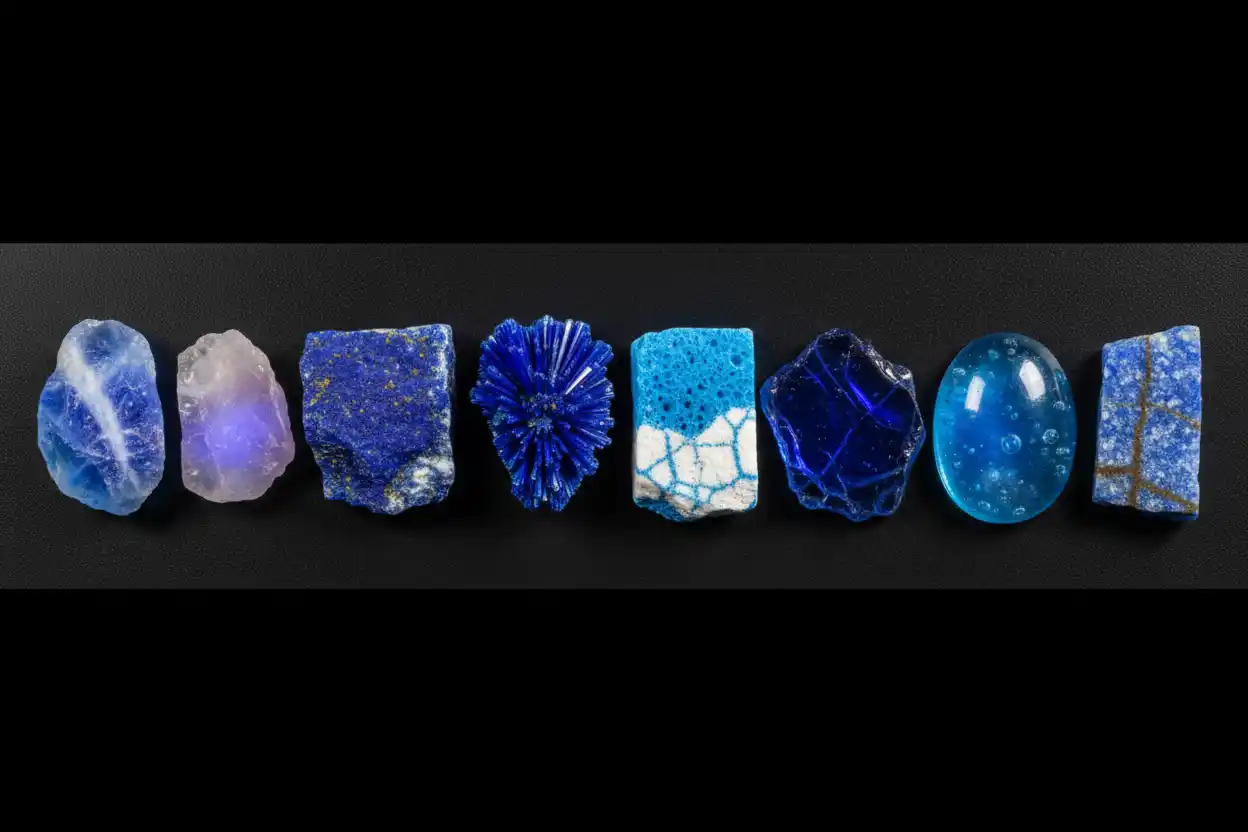
Real vs Fake Sodalite: Stone, Dye and Imitation Tests
Real sodalite is a sodium-rich feldspathoid mineral best known for its royal-blue to violet-blue color and irregular white or gray veining. Most jewelry and carving material occurs as a massive aggregate rather than as transparent individual crystals.
Fake sodalite is not one standardized product. Common substitutes include dyed howlite, dyed magnesite, dyed calcite, blue glass, resin, ceramic and other blue stones. Lapis lazuli and azurite may also be mislabeled as sodalite, even though both are genuine natural materials with different compositions.
Treatment creates another layer of complexity. Pale sodalite can be dyed, waxed, filled or coated. Therefore, the identification process should distinguish the underlying mineral from the origin of its blue color and from any reconstructed or assembled construction.
This page owns the direct authenticity workflow. The planned treated and synthetic sodalite guide retains detailed dyeing, coating, impregnation, synthetic-material and stability boundaries.
Genuine Sodalite vs Common Lookalikes
| Feature | Genuine sodalite | Lapis lazuli | Dyed howlite or magnesite | Blue glass | Resin or composite |
|---|---|---|---|---|---|
| Material | Sodium-rich feldspathoid mineral | Lazurite-rich metamorphic rock | Different porous minerals | Manufactured glass | Polymer or bonded fragments |
| Typical blue | Royal blue, violet-blue, gray-blue or uneven medium blue | Royal to violetish blue, often deeper | Dye-controlled blue or turquoise | Any selected shade | Any manufactured shade |
| White areas | Calcite or associated pale minerals | Calcite commonly occurs | Natural veins or porous host structure | Added pigment or inclusions | Poured or printed white swirls |
| Metallic grains | Usually absent | Pyrite commonly occurs | Artificial glitter may be added | Metallic particles may be embedded | Glitter or foil may be added |
| Internal texture | Massive granular or mineral aggregate | Multi-mineral aggregate | Porous, chalky or web-veined | Homogeneous or flowing glass | Molded, poured or fragment-bound |
| Mohs hardness | About 5.5–6 | Variable, commonly around 5–6 | Often softer | Commonly about 5–6 | Usually softer |
| Refractive index | Approximately 1.48–1.49 | Variable aggregate reading | Host-dependent | Glass-dependent | Polymer-dependent |
| Specific gravity | Commonly about 2.2–2.3 | Commonly higher and variable | Host-dependent | Variable | Commonly lower |
| Best confirmation | Microscopy, RI, density, Raman or XRD | Aggregate mineral analysis | Mineral and dye identification | Optical testing | Microscopy and polymer analysis |
A single color or vein pattern cannot settle the identification. Several materials overlap visually, especially after polishing.
What Is Genuine Sodalite?
The planned sodalite meaning guide owns the mineral’s geology, symbolism, localities and general properties.
Sodalite belongs to the feldspathoid family. Feldspathoids form in sodium-rich, silica-poor igneous environments where ordinary quartz is generally absent.
Its ideal composition is commonly expressed as Na₈(Al₆Si₆O₂₄)Cl₂. Sulfur-related species and structural defects contribute to familiar blue and violet colors.
Although sodalite crystallizes in the cubic system, ornamental material generally appears as massive blue rock containing calcite, nepheline and other associated minerals. Transparent crystals exist but are far less common than opaque carvings and beads.
This aggregate appearance means genuine sodalite can vary substantially from one piece to another. Some material is almost uniformly blue, while other pieces contain extensive white, gray or black matrix.
Natural Sodalite Color
Familiar sodalite ranges from pale gray-blue to medium royal blue, violet-blue and deep navy.
Some stones contain several shades in one object. Darker patches may follow mineral-rich areas, while pale regions can consist of calcite or less intensely colored sodalite.
Natural color is not always vivid. A muted or grayish piece can be genuine, particularly when it contains abundant matrix.
Conversely, brilliant color does not automatically prove treatment. Fine natural sodalite can be strongly saturated.
Suspicion increases when a group of inexpensive beads displays an identical neon blue with no internal variation, especially when dye concentrates around drill holes or fractures.
White Veins in Real Sodalite
White areas commonly consist of calcite or another pale associated mineral.
Natural veins generally vary in width, direction and depth. They may branch, disappear into the blue body, cross one another or become broad cloudy patches.
The pattern should continue beneath the polish. Examine the edge and back rather than judging only the most attractive face.
Painted or molded veins can stop abruptly at an edge, sit entirely on the surface or repeat precisely across several objects.
However, white veining alone does not prove sodalite. Dyed howlite, magnesite, lapis lazuli, blue calcite and resin can all display pale lines.
Does Real Sodalite Contain Pyrite?
Ordinary sodalite usually lacks the brass-yellow pyrite flecks associated with lapis lazuli.
A few metallic particles do not make sodalite impossible because commercial material may contain mixed rock, attached matrix or artificial additions. Nevertheless, abundant naturally embedded pyrite strongly favors lapis lazuli over typical sodalite.
Gold-colored glitter lying flat on the surface suggests an imitation or decorative coating.
The completed lapis lazuli versus sodalite guide owns the full comparison. The recently drafted real-versus-fake lapis lazuli guide covers lapis-specific dye, glass and reconstructed-material identification.
Sodalite Versus Lapis Lazuli
Lapis lazuli is a rock dominated by lazurite with calcite, pyrite and other minerals.
Sodalite is a mineral, although commercial objects may consist of sodalite-rich rock rather than one pure crystal.
Lapis commonly displays deeper violetish blue and may contain pyrite. Sodalite often appears somewhat lighter, grayer or more violet and commonly contains white calcite without metallic grains.
Those tendencies overlap. A pyrite-free lapis and a dark saturated sodalite can look nearly identical.
Raman spectroscopy can identify sodalite, lazurite, calcite and pyrite directly, making it more reliable than color comparison.
Sodalite Versus Azurite
Azurite is a copper carbonate mineral with intense blue color.
It commonly occurs beside malachite, chrysocolla and other copper minerals. Its blue may look richer and more electric than sodalite.
Azurite is softer, denser and chemically different. It may show crystal faces, botryoidal surfaces or blue powdery areas unlike massive sodalite.
The completed sodalite versus azurite guide owns the direct comparison.
Do not use acid or deliberate scratching to distinguish them. Both tests can damage the specimen.
Sodalite Versus Blue Calcite
Blue calcite commonly appears pale blue, cloudy, waxy or translucent.
It is much softer than sodalite and possesses perfect cleavage. Thick pieces may show broad internal planes or rhombohedral breaks.
Sodalite is generally darker and more opaque, with a finer aggregate texture.
Dyed calcite can become vivid enough to resemble royal-blue sodalite. Dye may concentrate along cleavage planes and surface cracks.
A gemologist can separate the materials through refractive properties, density and Raman spectroscopy without applying destructive acid.
Sodalite Versus Dyed Howlite
Howlite is normally white with gray or black web-like veins.
Its porosity makes it easy to dye blue. The result is more commonly sold as turquoise imitation, but it can also appear under the sodalite name.
Howlite’s dark spiderweb lines differ from sodalite’s more typical pale calcite veins. Nevertheless, strong dye can conceal the host pattern.
Inspect drill holes and chips. Dye may accumulate in the veins or reveal a pale interior.
Howlite is softer and has different optical properties, although scratch testing a finished bead is unnecessary.
Sodalite Versus Dyed Magnesite
Magnesite is another porous pale mineral used for dyed beads and carvings.
Its texture may appear chalky, granular or irregularly veined. Color commonly gathers in pores and around holes.
A polished dyed magnesite object remains genuine natural magnesite, but it is not sodalite.
The seller should identify both the host mineral and artificial color rather than relying on vague descriptions such as natural blue stone.
Blue Glass Imitations
Blue glass can imitate sodalite in beads, spheres, towers and carvings.
Look for round gas bubbles, curved flow lines, mold seams and a homogeneous interior.
Opaque glass can be harder to diagnose because the body conceals bubbles. White pigment or differently colored glass can create convincing veins.
A chipped edge may reveal a smooth glassy fracture rather than mineral grains.
High-quality glass can lack obvious bubbles, so ordinary visual inspection should be combined with refractive-index and density measurements.
The planned glass-versus-crystal guide owns the broader natural-crystal versus manufactured-glass comparison.
Resin and Plastic Imitations
Resin can reproduce royal-blue color, white veining and even metallic glitter.
Mold seams, casting bubbles, soft scratches, repeated patterns and low weight provide useful clues.
Some products contain crushed sodalite or other mineral fragments suspended in polymer. These are composites rather than solid natural sodalite.
Dense filler may make resin feel stone-like, so temperature and hand weight remain weak tests.
A hot needle should not be used. It permanently damages the object and may release irritating fumes.
Ceramic Imitations
Ceramic can be glazed or painted to resemble blue-and-white stone.
A chip may reveal a pale clay or granular body beneath the colored surface.
The glaze may display tiny bubbles, unusually smooth shine or color confined to the exterior.
Ceramic objects can feel cool and substantial, which makes touch-based testing unreliable.
Microscopy and Raman analysis generally separate ceramic material from sodalite readily.
Dyed Sodalite
Pale natural sodalite may be dyed to strengthen its blue.
Dye can collect in fractures, drill holes, calcite boundaries, porous zones and pits. A pale chip beneath an intense surface is another warning sign.
Modern dye may penetrate deeply and remain stable, leaving few obvious traces.
A dyed specimen is still sodalite if the underlying mineral is genuine. Its color is treated and should be disclosed.
The completed gemstone treatments guide explains why dyeing differs from coating, impregnation and reconstruction.
Waxed and Filled Sodalite
Wax or oil can deepen blue color and improve polish.
Resin may fill fractures, pores and granular regions, making low-quality material look smoother and more durable.
Under magnification, filler can appear as transparent material between grains, bubbles inside fractures or areas with a different luster.
Heat, solvents and aggressive cleaning can alter the treatment.
A filled natural stone is not the same product as solid untreated sodalite, even though both contain genuine mineral material.
Reconstructed Sodalite
Fragments or powder can be mixed with resin and molded into blocks, beads or carvings.
Magnification may reveal angular chips, transparent binder, bubbles and color that flows around fragments.
A reconstructed object may contain genuine sodalite but lacks the continuous structure of one natural stone.
Terms such as pressed sodalite, stabilized sodalite and composite sodalite should be clarified because sellers use them inconsistently.
Does Synthetic Sodalite Exist?
Sodalite-type materials can be synthesized for scientific, industrial and pigment-related purposes.
True laboratory-grown sodalite is not a dominant mainstream jewelry product.
Many retail items described as synthetic sodalite are actually glass, resin, ceramic or reconstructed stone.
The accurate label should state the material and construction rather than using synthetic as a general synonym for fake.
The completed lab-grown-versus-natural gemstone guide explains the distinction.
Hackmanite and Color Change
Hackmanite is a tenebrescent variety within the sodalite group.
Its color can intensify or change after ultraviolet exposure and fade again under visible light or darkness, depending on the specimen.
Ordinary blue sodalite should not be required to show this response.
A color change can support hackmanite identification but does not prove every aspect of origin or treatment.
Manufactured photochromic material can imitate changing color, while some natural hackmanite reacts weakly.
Ultraviolet Fluorescence
Sodalite can fluoresce orange, yellow, white or other colors depending on composition and associated minerals.
Some specimens remain weak or uneven.
Calcite, hackmanite, resin, dye and glass can all contribute separate reactions.
Therefore, orange fluorescence does not prove sodalite, and lack of fluorescence does not prove an imitation.
Use UV as a mapping tool for inconsistent materials rather than a pass-or-fail test.
Hardness and Scratch Tests
Sodalite generally ranks about 5.5–6 on the gemstone hardness chart.
It can be scratched by quartz and harder materials. Calcite, howlite and many polymers are softer.
A deliberate scratch test damages the polish and may test only a coating or filler.
Hardness also cannot distinguish sodalite from every glass formulation.
The completed gemstone toughness-versus-hardness guide explains why fractures and aggregate texture affect durability separately.
Refractive Index and Density
Sodalite is singly refractive because it crystallizes in the cubic system.
Its refractive index commonly falls around 1.48–1.49, while specific gravity is often approximately 2.2–2.3.
Lapis, azurite, calcite, howlite, magnesite and glass provide different combinations of properties.
Opaque curved surfaces usually produce only a spot refractive-index reading.
Associated minerals can shift the apparent density and surface result, particularly in a sodalite-rich rock rather than a pure crystal.
Magnification
Use a 10× loupe under neutral reflected light.
Inspect white veins, drill holes, chipped edges and transitions between blue shades.
Look for mineral grains, dye concentration, bubbles, mold seams, resin, paint and repeated pattern details.
Natural sodalite commonly shows an uneven aggregate texture rather than one perfectly homogeneous blue body.
Clean the surface first because dried polishing compound can resemble pale mineral grains.
Raman and X-Ray Identification
Raman spectroscopy can confirm sodalite and distinguish calcite, howlite, magnesite, azurite, glass and resin.
X-ray diffraction identifies the crystalline phases within opaque aggregates and reconstructed material.
Chemical analysis can confirm sodium–aluminum–silicate composition and identify pigments or unexpected fillers.
These methods are useful for high-value carvings, transparent crystals, unusual hackmanite claims and disputed composite material.
The completed gemstone-certification guide explains report scope. Use how to read a gem-lab report to determine whether the report identifies only one surface mineral or the entire object.
A Safe Home Inspection Sequence
Observe the object under neutral daylight and warm indoor light.
Inspect the front, back and edges to determine whether veins possess depth.
Use a loupe around holes, fractures and chips. Look for dye, bubbles, paint and binder.
Compare the pattern with lapis, azurite, howlite and blue calcite rather than relying on a single blue-stone chart.
Use ultraviolet light only as supporting evidence.
Do not scratch, acid-test, burn or soak the stone in solvent.
When the identity affects value, obtain professional refractive-index, density or Raman testing through the general crystal-identification workflow.
Buying Genuine Sodalite
The planned where-to-buy-real-sodalite guide owns seller selection.
Ask whether the material is solid sodalite, dyed, filled, reconstructed or composite.
Request photographs of the exact item’s back, edges and drill holes.
A seller should distinguish sodalite from lapis lazuli and avoid using the two names interchangeably.
For remote transactions, follow how to buy gemstones online and preserve a return period long enough for inspection.
Cleaning and Care
Sodalite is less hard and more chemically variable than quartz.
Avoid acids because calcite and associated minerals may react. Prolonged soaking can also affect dyes, fillers, glue and porous areas.
Use a soft damp cloth or brief gentle washing when treatment is known to be stable.
Belief-based practices belong in how to cleanse and charge sodalite and should avoid saltwater, acids and abrasive methods.
Frequently Asked Questions
1. What is genuine sodalite?
Genuine sodalite is a sodium-rich feldspathoid mineral, commonly blue and associated with white calcite or other pale minerals.
2. Does real sodalite always contain white veins?
No. White veining is common but not required. Some genuine material is comparatively even blue.
3. Does pyrite prove a stone is lapis rather than sodalite?
Abundant naturally embedded pyrite strongly favors lapis lazuli, although one metallic grain is not conclusive.
4. Is sodalite the same as lapis lazuli?
No. Sodalite is a mineral, while lapis lazuli is a lazurite-rich rock containing several minerals.
5. Is dyed sodalite fake?
It remains genuine sodalite if the underlying mineral is authentic, but its color is treated.
6. What is commonly sold as fake sodalite?
Dyed howlite, magnesite, calcite, blue glass, resin and ceramic are common substitutes.
7. Does orange fluorescence prove sodalite?
No. Sodalite can fluoresce orange, but calcite, hackmanite, resin and other materials can also react.
8. Can real sodalite change color?
Hackmanite, a sodalite-group variety, can show reversible tenebrescence. Ordinary blue sodalite may not.
9. Can I scratch-test sodalite?
No. Scratch testing damages the stone and cannot separate every glass or mineral imitation reliably.
10. Can acetone reveal dyed sodalite?
It may affect some surface dyes, but stable treatment can resist it and solvents can damage fillers, glue and coatings.
11. Which laboratory tests identify sodalite?
Refractive index, density, Raman spectroscopy, X-ray diffraction and chemical analysis provide useful evidence.
12. When should sodalite receive professional testing?
Testing is worthwhile for expensive carvings, transparent crystals, important hackmanite claims or disputed reconstructed material.
Sodalite authentication requires more than finding blue stone crossed by white lines. Genuine material should show feldspathoid properties and a believable mineral aggregate, while dye, resin and glass may imitate its pattern. The strongest conclusion combines microscopic structure, optical measurements and accurate seller disclosure rather than one fluorescence or scratch test.
Sodalite appears in Crystals That Start With S and Gemstones That Start With S.