11 Real Sunstone Benefits: Deep Traditions, Evidence, Safe Use & Clear Limits
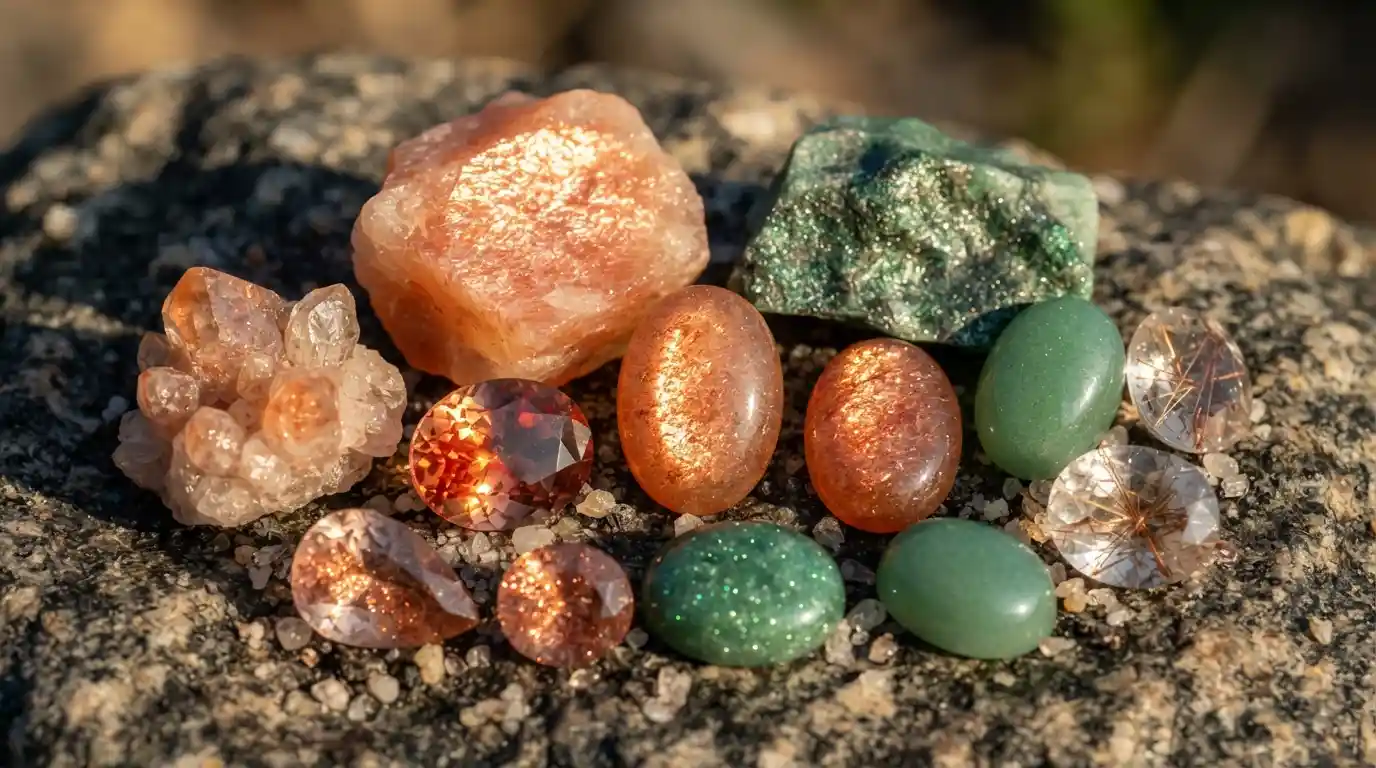
Sunstone benefits begin with one of the most visually distinctive members of the feldspar family. The term sunstone describes feldspar that can show warm yellow, orange, red, brown, or green bodycolor and, in many specimens, a glittering optical effect called aventurescence. Reflective mineral or metal platelets inside the feldspar catch light and produce the sparkling flashes that inspired the sun-related name.
Sunstone is not limited to one feldspar species. GIA notes that both orthoclase and plagioclase feldspars can produce sunstone, while Oregon sunstone is especially famous for transparent labradorite feldspar containing native copper inclusions. Many sunstones from other regions obtain their aventurescence from hematite rather than copper, so two gems carrying the same commercial name may differ significantly in chemistry and inclusion type.
Modern crystal traditions connect sunstone benefits with confidence, optimism, motivation, creativity, independence, leadership, and personal warmth. Those meanings can be useful personal symbols, but feldspar has not been shown to treat depression, regulate hormones, increase metabolism, improve fertility, or transfer solar energy into the body.
11 Sunstone Benefits at a Glance
The eleven points below combine real gemological advantages with responsible symbolic traditions. Sunstone’s color, inclusions, optical effects, and geological variety already provide substantial value without medical or supernatural claims.
- Aventurescence creates lively metallic-looking sparkle that gives phenomenal sunstone exceptional visual appeal.
- Oregon sunstone can contain natural native-copper platelets that create distinctive schiller and add collector interest.
- Yellow, peach, orange, red, green, blue-green, colorless, bicolored, and tricolored examples provide remarkable natural color variety.
- Feldspar hardness gives sunstone enough durability for many jewelry designs when cleavage and impact risk are respected.
- Transparent material can be faceted, while aventurescent stones can be cabochon cut or artistically oriented to emphasize reflective inclusions.
- Differences between orthoclase, oligoclase, and labradorite sunstone provide useful lessons in feldspar mineralogy.
- Natural inclusions can increase beauty rather than automatically lowering quality, especially when they create attractive aventurescence.
- Modern confidence and optimism symbolism can represent deliberate action without implying neurological or hormonal effects.
- Creativity and independence can become personal reminders connected with work, art, education, or life transitions.
- Buying awareness helps distinguish desirable natural schiller from poor transparency, weak cutting, artificial treatments, or misleading origin claims.
- Personal sunstone benefits can come from jewelry, collecting, Oregon provenance, artistic cutting, gifts, travel, or meaningful personal milestones.
Sunstone Is a Feldspar Trade Variety, Not One Fixed Species
One of the most important sunstone benefits is educational because the name describes appearance rather than one exact mineral composition. The feldspar family divides into potassium-rich feldspars and the sodium-calcium plagioclase series, and sunstone varieties occur in more than one part of that family.
GIA identifies orthoclase sunstone as well as oligoclase and labradorite varieties. Oregon sunstone belongs to plagioclase feldspar, and famous Oregon gems include labradorite compositions containing copper.
This means the word sunstone should not be treated like the name ruby, which refers to a particular gem variety of corundum. A sunstone’s precise feldspar identity can influence refractive index, specific gravity, color, inclusions, and geological origin.
Professional identification therefore combines optical properties, chemistry, microscopy, and inclusion study rather than relying only on sparkle.
Sunstone Technical Properties
Because sunstone can belong to different feldspar species, some physical properties fall within ranges rather than one fixed value.
| Property | Sunstone |
|---|---|
| Mineral family | Feldspar |
| Common host species | Orthoclase, oligoclase, labradorite |
| Mohs hardness | Roughly 6–7 depending on feldspar type |
| Cleavage | Present, typical of feldspar |
| Common colors | Yellow, orange, peach, red, brown, green, blue-green, colorless |
| Optical phenomenon | Aventurescence or schiller in many specimens |
| Common reflective inclusions | Copper in Oregon material; hematite in many other sunstones |
| Oregon sunstone host | Commonly labradorite plagioclase |
| Common uses | Faceted gems, cabochons, carvings, designer jewelry |
| Main practical caution | Cleavage and moderate hardness make strong impacts undesirable |
These properties explain why sunstone can be practical in jewelry but still needs more care than spinel, sapphire, or ruby. Hardness protects against many scratches, while cleavage remains a separate durability concern.
Aventurescence Is Sunstone’s Signature Optical Benefit
The glittering effect in phenomenal sunstone is called aventurescence. GIA describes it as a sparkly, metallic-looking luster caused by flat reflective inclusions inside the feldspar. Gem dealers also commonly use the word schiller for this effect.
The inclusions act like tiny mirrors. When their orientation aligns with the observer and light source, they flash brightly; when the stone moves away from that angle, the reflections weaken or disappear.
This directional behavior makes cutting important. A lapidary can orient the gem so the strongest schiller appears across the face rather than hiding near the edge or pavilion.
The effect is entirely optical. Bright sparkle does not demonstrate that the stone stores solar power or emits biological energy.
Oregon Sunstone Is Famous for Native Copper
Oregon sunstone has become one of the best-known forms because its aventurescence is created by native copper inclusions. GIA research on material from the Ponderosa Mine identified the reflective inclusions as copper, and later research has shown how copper particles also relate to several unusual bodycolors in Oregon feldspar.
The copper occurs as thin platelets or particles within the feldspar. When those inclusions become large and reflective enough, they create obvious schiller, while smaller copper particles can influence color without producing strong visible aventurescence.
This gives Oregon sunstone an unusual combination of inclusion beauty and bodycolor. Some stones appear nearly colorless, while others show peach, pink, orange, vivid red, green, blue-green, or striking combinations of several colors.
Copper inside the gemstone does not provide nutritional copper through skin contact. Its importance is mineralogical and optical.
Not Every Sunstone Uses Copper to Create Sparkle
A common misconception is that all sunstone aventurescence comes from copper. GIA notes that sunstones from India, Norway, Tanzania, and other sources commonly owe their glitter to hematite inclusions rather than native copper.
This is an important distinction because inclusion type can help explain both appearance and origin. A reddish-brown Indian aventurine feldspar may look very different from a transparent Oregon stone with discrete copper platelets.
Neither type is inherently “realer” than the other. Both can legitimately belong to the sunstone category when their feldspar identity and optical characteristics fit the trade use.
Collectors benefit from knowing which effect they are buying rather than assuming every glittering feldspar shares the same internal mineralogy.
Sunstone Offers an Exceptional Natural Color Range
Color is another major sunstone benefit. GIA lists yellow, green, red, reddish-brown, and colorless among important sunstone colors, while Oregon material can also produce peach, pink, orange, blue-green, bicolored, and tricolored gems.
Fine Oregon green and red stones are especially sought after, while strongly contrasting bicolored or tricolored gems can attract collectors because the zoning creates a distinctive face-up appearance.
Color and schiller do not always occur together at maximum intensity. A stone may have excellent bodycolor but limited aventurescence, while another may show abundant copper platelets but a lighter or less valuable background color.
The principles behind sunstone quality grading therefore need to consider color, clarity, cut, aventurescence, inclusion orientation, size, origin, damage, and overall appearance rather than one quality factor alone.
Inclusions Can Increase Rather Than Reduce Beauty
In many transparent gemstones, visible inclusions lower value because buyers prefer greater clarity. Sunstone demonstrates why that rule cannot be applied mechanically.
Copper or hematite inclusions can be precisely the feature that creates aventurescence, so removing every visible inclusion would also remove much of the stone’s distinctive optical identity.
The most attractive pattern depends on the individual gem. Fine evenly distributed platelets may create a soft glitter, while larger copper inclusions can produce bold flashes. Too many inclusions may reduce transparency, so the best balance depends on color and cutting style.
This makes sunstone useful for learning that gem quality depends on whether inclusions improve or harm the intended appearance.
Cutting Style Can Transform the Appearance
Transparent sunstone with little visible schiller may be faceted to emphasize brilliance and bodycolor, while strongly aventurescent rough may be cut as a cabochon or with specially oriented facets that place reflective platelets where they remain visible.
GIA notes that sunstone appears in conventional calibrated cuts as well as elaborate fantasy designs created by specialist gem artists.
This flexibility gives cutters substantial creative freedom. A stone with strong copper inclusions may benefit from a design that deliberately displays those platelets, while a clean red or green Oregon sunstone may perform beautifully as a conventional faceted gem.
The cut should respond to the individual rough rather than forcing every sunstone into the same shape.
Feldspar Durability Requires Respect for Cleavage
Sunstone generally falls around Mohs 6 to 7 depending on the exact feldspar species. This gives useful scratch resistance for earrings, pendants, brooches, beads, and many rings.
Feldspar cleavage is more important than hardness alone suggests. A sufficiently strong impact in an unfavorable direction can chip or split a stone along structural planes, particularly if the gem already contains fractures.
Rings therefore deserve protective settings and realistic wear habits. Removing jewelry before heavy manual work, sports, or impact-prone activities reduces unnecessary risk.
The same principle applies during cutting and repair. Hardness and toughness are different properties, and sunstone should not be handled as though feldspar were as impact-resistant as sapphire.
Confidence as a Modern Sunstone Symbol
Confidence is one of the most common modern symbolic sunstone benefits. Warm yellow, orange, and red colors naturally suggest sunlight, activity, visibility, and warmth to many people.
A person might wear sunstone during an important presentation, job interview, performance, or personal milestone because the gem has become associated with preparation and action.
The gemstone does not increase adrenaline, testosterone, dopamine, or neurological confidence. Any practical effect comes from the person’s preparation, experience, expectations, and personal association with the jewelry.
Used responsibly, sunstone becomes a reminder to act rather than a substitute for the work needed to become confident.
Optimism Without Magical Positivity
Optimism is another intuitive sunstone benefit because its warm colors and reflective flashes resemble sunlight. A polished gem can become associated with hope, celebration, or returning attention to possibilities after disappointment.
Healthy optimism does not mean denying serious problems. It means recognizing difficulty while remaining open to actions or outcomes that may still improve a situation.
Sunstone cannot medically treat depression, grief, anxiety, or another psychological condition. Those experiences may require social support, therapy, medication, medical evaluation, or time.
The stone can represent hope while real care remains grounded in appropriate support.
Creativity and Independence as Personal Traditions
Creativity fits sunstone because the gemstone’s changing reflections reward movement and experimentation. Designers can orient copper platelets, play with color zoning, or use fantasy cutting to produce highly individual finished stones.
A person may connect this appearance with artistic work, entrepreneurship, study, or another project requiring experimentation. The gemstone provides a visual reminder of the creative process.
Independence can be interpreted similarly. A sunstone ring might mark moving to a new city, opening a business, completing education, or making an important personal decision.
The feldspar does not create independence. The symbolism belongs to the event and the owner’s choices.
Healing Claims Need Clear Boundaries
Claims surrounding sunstone healing properties sometimes include depression relief, increased metabolism, improved digestion, hormonal regulation, fertility support, cardiovascular effects, pain reduction, or greater physical vitality. These are not established medical effects of feldspar.
Copper-bearing Oregon sunstone does not supply a useful dietary copper dose through the skin. Hematite-bearing sunstone likewise does not work as an iron supplement.
A meaningful gemstone can accompany meditation, journaling, exercise planning, or another personal routine without replacing healthcare.
The optical sparkle is real. Medical treatment claims require a completely different standard of evidence.
Sunstone Value Depends on the Individual Gem
The sunstone price can vary greatly according to bodycolor, aventurescence, clarity, size, cut, origin, zoning, treatment status, and market demand.
GIA identifies deep green, deep red, and intensely bicolored Oregon sunstones as especially fine qualities. Large attractive stones can also become valuable when they preserve good transparency and color.
Schiller itself is not automatically a premium at every level. The inclusions need to improve the stone’s appearance rather than simply making it cloudy.
Commercial value comes from rarity, beauty, workmanship, and demand. It does not measure spiritual energy or emotional effectiveness.
Buying Sunstone Requires Attention to Origin and Treatment
Anyone planning to buy sunstone should ask what feldspar variety is being sold, whether the origin is known, whether the stone shows natural aventurescence, and whether any treatment has been disclosed.
Oregon origin can be especially important because copper-bearing material from the region has a strong collector identity. GIA notes that artificial copper diffusion in feldspar creates additional identification challenges, so high-value stones may justify independent laboratory testing.
Magnification can also reveal cleavage fractures, surface-reaching inclusions, platelet orientation, polish quality, and other features that affect both appearance and durability.
A transparent seller should explain what is known and what remains uncertain instead of relying only on marketing labels such as premium, AAA, or rare.
Cleaning and Long-Term Care
Lukewarm water, mild soap, and a soft brush or cloth are suitable for most sound sunstone jewelry. Gentle cleaning removes skin oils and dust without introducing unnecessary heat or vibration.
Ultrasonic or steam cleaning should not be the default when a gem contains fractures or when treatment history is uncertain. Feldspar cleavage makes conservative handling sensible even when the stone appears clean and durable.
Store sunstone away from harder gems such as quartz, topaz, spinel, sapphire, ruby, and diamond. Those stones can scratch feldspar if jewelry pieces rub together.
Good care preserves both surface polish and the reflective inclusions that make phenomenal sunstone distinctive.
Conclusion
Sunstone benefits include attractive aventurescence, remarkable natural color variation, copper or hematite inclusions, feldspar mineralogy, cutting versatility, collector appeal, and practical use in many jewelry designs. Confidence, optimism, creativity, independence, and vitality can provide meaningful personal symbolism, but sunstone should not be treated as a medical source of copper or iron or as a treatment for psychological, hormonal, digestive, or cardiovascular conditions.
FAQs
What are the main sunstone benefits?
Sunstone benefits include attractive aventurescence, varied natural colors, jewelry versatility, interesting feldspar mineralogy, collector appeal, and distinctive natural inclusions. Modern traditions also associate the gemstone with confidence, optimism, creativity, and independence.
What causes sunstone to sparkle?
Flat reflective inclusions create aventurescence or schiller. Oregon sunstone is famous for native copper platelets, while many other sunstones contain hematite inclusions.
Is all sunstone the same feldspar?
No. Sunstone can occur in both potassium feldspar and plagioclase feldspar species. Orthoclase, oligoclase, and labradorite can all occur as sunstone varieties.
What is special about Oregon sunstone?
Oregon sunstone is famous for natural copper-bearing feldspar, unusual colors, copper schiller, and attractive bicolored or tricolored gems. Many Oregon stones are labradorite feldspar.
Is sunstone durable enough for rings?
It can be suitable for rings with reasonable protection. Feldspar has moderate hardness but also cleavage, so strong impacts should be avoided.
Does sunstone increase confidence?
There is no scientific evidence that sunstone changes confidence neurologically. It can still serve as a personal reminder connected with preparation, courage, or an important goal.
Does sunstone help depression?
Sunstone is not a treatment for depression or another psychological condition. Warm color and personal symbolism may be meaningful, but professional healthcare should not be replaced by gemstone use.
Does Oregon sunstone give the body copper?
No. Copper inclusions inside feldspar do not provide a useful nutritional dose through ordinary skin contact.
Is aventurescence a sign of good sunstone?
Aventurescence can increase beauty when the reflective inclusions are attractively distributed, but quality also depends on color, transparency, cut, size, durability, and overall appearance.
Is sunstone naturally red or green?
Yes. Natural Oregon sunstone can occur in red, green, and several other colors, including bicolored and tricolored combinations. Copper chemistry is closely connected with many of these colors.
Can sunstone benefits be personal?
Yes. Sunstone can represent an achievement, creative project, journey, relationship, independent decision, collection milestone, or important personal transition without requiring one universal metaphysical explanation.
Disclaimer: Confidence, optimism, creativity, independence, vitality, healing, chakra, abundance, and energetic descriptions of sunstone reflect spiritual beliefs and personal practices. Sunstone is not a medical, nutritional, hormonal, or psychological treatment and should not replace professional healthcare.