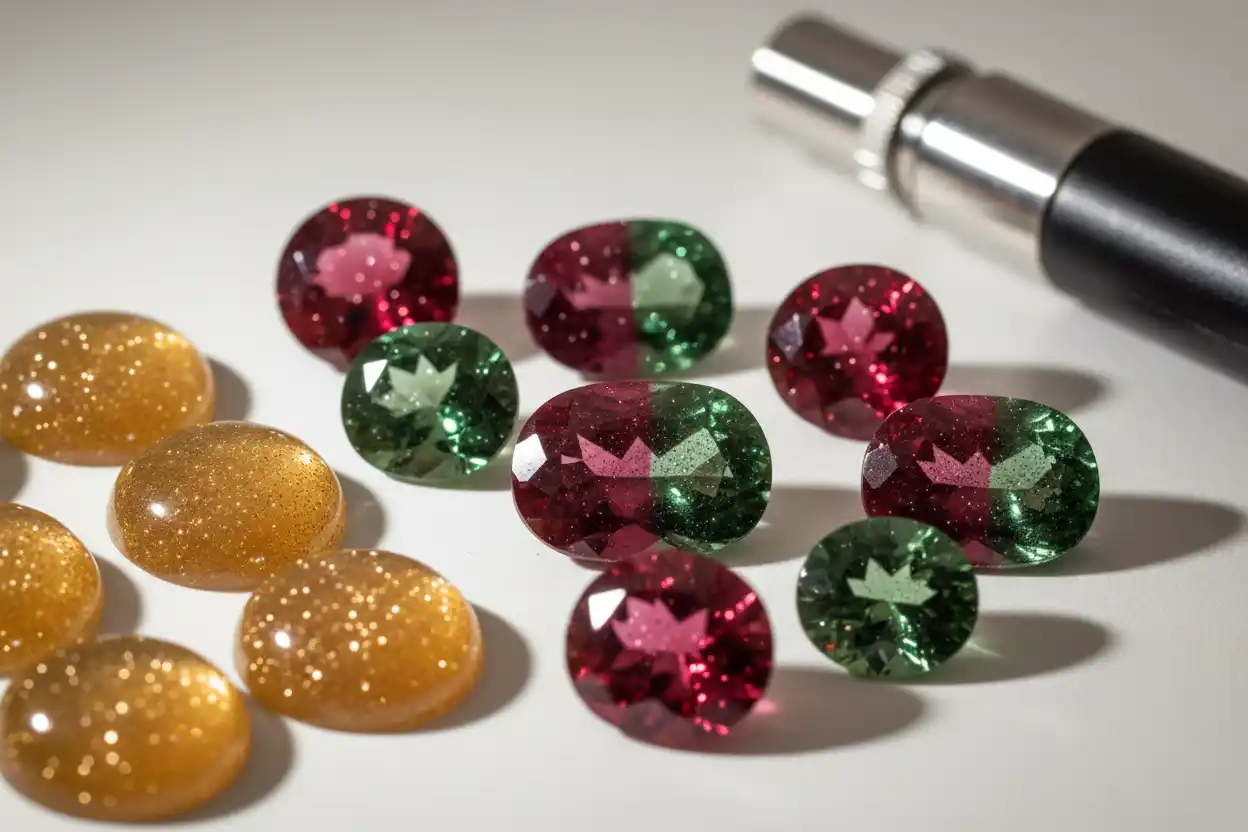
Buy Sunstone: Smart Buying Tips & Red Flags
When you buy sunstone, do not begin by asking which stone has the most glitter. Sunstone is a broader feldspar category than many retail listings suggest, encompassing different feldspar compositions, inclusion types, colors, transparency levels, and geographic sources. Some stones contain dense reflective platelets that create obvious aventurescence, while others are transparent faceting material whose value comes primarily from body color, pleochroism, zoning, or exceptional cutting rather than from visible sparkle.
That distinction becomes especially important when you buy sunstone because inexpensive peach-colored commercial material, strongly aventurescent Indian stones, historic Scandinavian feldspar, and fine copper-bearing Oregon sunstone occupy very different markets. A heavily glittering cabochon can be genuine and attractive without being comparable in value to a transparent red, green, teal, or bicolored Oregon gem, while an Oregon stone can be highly desirable even when it contains relatively little visible schiller.
Treatment and origin deserve similar precision. Copper occurs naturally in Oregon sunstone and can influence both its body color and reflective inclusions, yet copper diffusion treatment of plagioclase feldspar has also been documented elsewhere in the gem trade. Therefore, vivid red or green color should not be used by itself to prove Oregon origin or natural-color status. When you buy sunstone at a substantial premium, the strength of the evidence should rise with the rarity of the claim.
The most reliable way to buy sunstone is to establish the feldspar category and intended use first, then evaluate color, transparency, aventurescence, inclusion orientation, cutting, structural condition, treatment, dimensions, provenance, documentation, and return rights. Size and seller-created grades should come later.
What Should You Judge First When You Buy Sunstone?
A practical buy sunstone hierarchy begins with material identity and category because the word sunstone does not identify one single feldspar species. Different commercial sunstones can occur in plagioclase or potassium feldspar and can contain copper, hematite, goethite, ilmenite-related, or other reflective inclusions.
The broader mineral family is explained in sunstone meaning, while types of sunstone separates the major color, locality, and phenomenal categories. Understanding that range is important before you buy sunstone because the same quality hierarchy cannot be applied to every specimen.
For a transparent faceted gem, prioritize color, transparency, cut, and dimensions. For an aventurescent cabochon, prioritize the schiller pattern and orientation. For a natural crystal or locality specimen, provenance, crystal condition, repairs, and associations may matter more than faceted brilliance.
| Priority | What to evaluate | Stronger choice | Main concern |
|---|---|---|---|
| 1 | Identity and category | Feldspar type and sunstone category represented accurately | Every glittering orange material called sunstone |
| 2 | Color | Attractive hue that remains lively in ordinary light | Muddy brown, gray, or overly dark appearance |
| 3 | Transparency | Appropriate to faceted or phenomenal category | Cloudiness priced as fine transparent material |
| 4 | Aventurescence | Attractive directional reflections | Random weak glitter or completely obscured interior |
| 5 | Cut and orientation | Design supports color and schiller | Windowing, extinction, poorly oriented platelets |
| 6 | Structural condition | Sound girdle and manageable inclusions | Cleavage chips or open fractures |
| 7 | Treatment | Specific disclosure when known | Vague natural-color claim |
| 8 | Dimensions | Useful visible spread for weight | Excessive hidden pavilion mass |
| 9 | Provenance | Supported when locality increases price | Oregon or famous mine claimed from color alone |
| 10 | Documentation | Appropriate to value and uncertainty | Generic seller certificate treated as conclusive proof |
Use this order when you buy sunstone so that one dramatic copper flash does not distract from a poorly cut or structurally weak gemstone.
Sunstone Is a Feldspar Category, Not One Fixed Mineral Formula
One of the first concepts to understand before you buy sunstone is that the trade name crosses more than one feldspar composition. Sunstone can occur in oligoclase, labradorite, orthoclase, and related feldspar material depending on the deposit.
That mineralogical variation affects refractive properties, density, crystal system, inclusion type, coloration, and geographic associations. Nevertheless, the various stones share the broader feldspar characteristics of moderate hardness, prominent cleavage, and a need for impact-conscious jewelry design.
The larger feldspar family includes sunstone alongside moonstone, labradorite, amazonite, and other gem varieties. When you buy sunstone, the correct question is therefore not simply “Is it feldspar?” but “Which kind of feldspar is this, what creates its appearance, and is the seller representing that category accurately?”
Decide Which Type You Want Before You Buy Sunstone
A buyer looking for a peach bead strand should not evaluate the product like someone seeking a precision-cut red-green Oregon collector gem.
Before you buy sunstone, decide whether your target is:
- Transparent faceted material.
- Copper-schiller Oregon sunstone.
- Hematite-rich aventurescent material.
- Cabochon or bead-grade peach sunstone.
- Red, green, teal, or bicolored Oregon sunstone.
- Rainbow lattice or another specialized phenomenal type.
- Natural crystal or locality specimen.
- Designer or precision-cut gemstone.
Each category has a different reason for value.
A transparent gem is judged partly by brilliance and cutting. A dense aventurescent cabochon can sacrifice transparency because the reflective inclusion pattern is the attraction. A locality specimen might remain rough because polishing would destroy much of what makes it collectible.
Aventurescence Is the Defining Sparkle
The glitter associated with sunstone is called aventurescence, and many dealers refer to the same visible effect as schiller. Flat reflective inclusions catch light at favorable angles and produce individual metallic-looking flashes, broad reflective patches, or glittering clouds.
When you buy sunstone, examine whether the phenomenon comes from inside the feldspar and changes naturally as the stone rotates. The effect should not behave like glitter painted onto the surface.
Different sunstones can contain different reflective materials. Many traditional examples owe their aventurescence to iron-bearing platelets such as hematite or related minerals, whereas Oregon sunstone is especially important for native copper inclusions.
This difference matters commercially. A copper-rich Oregon stone and a common peach hematite-bearing sunstone can both display legitimate aventurescence without belonging to the same value category.
More Glitter Does Not Automatically Mean Better Quality
A dense concentration of reflective inclusions can create spectacular sparkle, but it can also reduce transparency and obscure the stone’s internal color.
When you buy sunstone, ask whether the schiller supports the design or overwhelms it.
For a cabochon, abundant copper or hematite flashes can be desirable because the phenomenon is intended to dominate. For a transparent faceted gemstone, excessive inclusions can block light, reduce brilliance, and hide color zoning.
A stone with fewer but well-oriented reflective platelets may therefore be worth more than a heavily glittering specimen.
The quality factor is not simply quantity. Distribution, orientation, brightness, body color, transparency, and cut all interact.
Direction Matters When You Buy Sunstone With Schiller
Aventurescence is highly directional. A stone can show a broad copper flash in one orientation and almost no visible sparkle when tilted slightly away.
That means you should never buy sunstone with a meaningful schiller premium from one still photograph.
Request continuous rotating video under a fixed light source. The video should show where the flash appears, how broadly it spreads, whether it disappears abruptly, and whether the gemstone remains attractive when the reflection is not at its strongest.
This is particularly important for rings because the stone will be viewed from changing angles rather than held permanently at the ideal display position.
A phenomenal stone should provide an interesting visual experience through movement, not just one perfect camera frame.
Oregon Sunstone Is a Distinct Premium Category
Oregon sunstone is copper-bearing plagioclase feldspar, commonly within the labradorite compositional range, and it has developed a distinct collector and jewelry market.
When you buy sunstone from Oregon, possible colors include colorless, pale yellow, champagne, peach, orange, pink, red, green, blue-green or teal, and multicolored combinations. Some stones contain conspicuous copper platelets, while others can display highly valuable body color with relatively little visible schiller.
This last point is crucial. A transparent red or green Oregon sunstone does not need a dense field of copper glitter to be high quality.
Fine color and transparency can carry the stone independently.
Red Oregon Sunstone Should Remain Bright
Red is among the most sought-after Oregon sunstone colors, but saturation needs to remain balanced with transparency and light return.
When you buy sunstone in red, examine whether the stone maintains a vivid red, orange-red, or red-pink appearance without becoming muddy, brown, or excessively dark through the center.
A seller may use descriptions such as spinel red or ruby red. Those phrases describe visual resemblance rather than converting feldspar into spinel or ruby.
Judge the exact body color instead of paying for the comparison term.
Strong ordinary-light video is especially valuable because concentrated illumination can make a darker red stone appear much more vivid than it will in normal wear.
Green and Teal Oregon Sunstone Need Stronger Evidence
Natural green and blue-green Oregon sunstone is much less common than pale or champagne material, which makes these colors attractive targets for collectors.
When you buy sunstone represented as strong natural green, teal, or blue-green Oregon material, require proportionately better evidence because the rarity premium can be substantial.
Evaluate hue first. Grayness, muddiness, or excessive darkness should reduce the premium even if the color category itself is rare.
Then evaluate transparency, zoning, orientation, and treatment disclosure.
A rare color name should increase the amount of verification you perform rather than encouraging you to lower your standards.
Bicolor and Tricolor Sunstone Should Show a Deliberate Pattern
Some Oregon sunstone contains distinct red, green, yellow, or related color zones within one crystal. Properly cut bicolor and multicolored stones can be visually extraordinary.
When you buy sunstone with zoning, evaluate how the cutter used it.
The strongest stones display intentional-looking color placement rather than one tiny green corner being used to advertise the entire gem as red-green bicolor. Each major color should be visible from a practical face-up position.
A cutter can orient facets to emphasize directional color and copper-related optical effects, so video becomes more useful than static photography.
Ask yourself whether the zoning strengthens the gemstone as a composition.
Copper Schiller and Body Color Are Different Quality Factors
Copper in Oregon sunstone can affect both body color and reflective optical behavior, but the two should still be evaluated separately.
When you buy sunstone with obvious copper platelets, first judge the underlying red, peach, green, yellow, or other body color under diffuse light.
Then move the stone beneath a more directional light source and judge the schiller.
This two-stage evaluation prevents a dramatic copper reflection from hiding a weak body color. It also prevents a fine transparent colored gemstone from being undervalued simply because its copper platelets are too small to create obvious glitter.
Ordinary Commercial Sunstone Has a Different Hierarchy
A large part of the market consists of peach, orange, reddish, or golden material cut into beads, cabochons, palm stones, carvings, and inexpensive jewelry.
When you buy sunstone in this category, precise faceted-gem clarity is less important.
Look instead for attractive body color, visible natural-looking sparkle, smooth polish, absence of major cracks, consistent bead drilling, and good workmanship.
A highly transparent appearance is not necessary in a bead strand whose visual identity comes from warm body color and aventurescence.
Do not compare a commercial peach bead on a per-carat basis with a transparent green Oregon gemstone. They are serving different markets.
Indian Sunstone Often Emphasizes Aventurescence
India is an important commercial source of warm-toned aventurescent feldspar, frequently showing peach, orange, reddish-brown, or golden coloration.
When you buy sunstone represented as Indian material, expect the visual emphasis often to be on reflective iron-bearing inclusions rather than on rare transparent red-green copper-related color.
Fine Indian material can make beautiful cabochons, beads, and carvings. The source does not make it inferior; it simply belongs to a different commercial category from Oregon’s premium copper-bearing transparent gems.
Country names should clarify provenance rather than imply a universal grade.
Norwegian Sunstone Can Have Historical Collector Appeal
Norway has a long mineralogical association with aventurescent feldspar, and documented Scandinavian material can appeal to locality collectors.
When you buy sunstone represented as Norwegian, ask whether the stone is being sold because of its visual quality, its historic locality, or both.
A provenance premium makes the documentation more important. An attractive reddish feldspar cannot be assigned confidently to Norway merely because it resembles traditional material.
For an ordinary finished cabochon, geographic origin may matter less than color and phenomenon. For a labeled mineral specimen, exact locality can become central.
Color Should Be Evaluated Before the Sparkle
Sunstone occurs across warm yellow, peach, orange, pink, red, brown, and other colors, while premium Oregon material expands the range into green, teal, and multicolored combinations.
When you buy sunstone, evaluate body color under diffuse neutral-looking illumination before positioning the gem to maximize schiller.
This reveals whether the stone remains attractive when the glitter is temporarily absent.
A good body color should not rely entirely on warm lamps or dark backgrounds.
The brightest copper flash in the world cannot permanently compensate for a muddy stone if you intend to wear it under ordinary conditions.
White Balance Can Seriously Distort Sunstone
Warm gemstones are easy to exaggerate digitally.
When you buy sunstone online, inspect the color of the background, tweezers, seller’s fingers, and metal settings. If everything in the image carries an orange, pink, or yellow cast, the gemstone may also appear more saturated than it actually is.
Green Oregon sunstone creates the opposite risk because editing can strengthen subtle green or teal sections until they appear much rarer.
Request a neutral white or gray reference in at least one image.
Good photography should document the color rather than improve it.
Transparency Matters Most in Faceted Sunstone
Fine faceted sunstone benefits from transparency because light must travel through the gemstone to produce brilliance, reveal zoning, and interact with reflective inclusions.
When you buy sunstone intended for faceting-quality jewelry, inspect whether haze, dense clouds, or broad fractures reduce the open appearance.
Small inclusions and some copper platelets can be completely desirable. The issue is whether they enhance the gem or block its optical performance.
A heavily included transparent-cut stone can lose much of its advantage over a cabochon, particularly if the facets cannot generate useful brilliance.
Inclusions Are Not Automatically Defects
This material demonstrates why gemstone clarity cannot be reduced to “fewer inclusions equals better.”
Copper platelets can create the very phenomenon for which Oregon sunstone is valued. Hematite or related platelets can make ordinary sunstone glitter attractively.
When you buy sunstone, therefore, classify inclusions according to function.
Reflective platelets may add value. A dark crystal could be neutral or distracting. A healed internal fissure may have little practical importance. A large open crack near the girdle can threaten durability.
Do not pay for theoretical clarity at the expense of the feature that makes the stone interesting.
Surface-Reaching Fractures Need Extra Attention
Feldspar has prominent cleavage, which means structural weaknesses matter.
When you buy sunstone, inspect any fracture that reaches the crown, table, girdle, pavilion, drill hole, or exposed corner. Such a fracture may extend under impact or during setting.
A surface-reaching fissure can also contain resin or another filler.
Ask for close photographs and side views when a questionable line appears in the stone.
The broader mechanics of preferred breakage directions are explained in gemstone cleavage, which is especially relevant when evaluating feldspar jewelry.
Cut Orientation Can Make or Break the Phenomenon
A cutter working with phenomenal sunstone needs to orient the reflective inclusions correctly. If the platelets are viewed edge-on, the best aventurescence may largely disappear.
When you buy sunstone, examine whether the cut displays the schiller across an intentional face or dome rather than hiding it near the side.
Cabochons need their dome orientation chosen around the inclusion plane. Faceted gems need a more complex compromise among body color, pleochroism, zoning, sparkle, cleavage, and brilliance.
A precision-cut Oregon sunstone can therefore deserve a craftsmanship premium even if two pieces of rough originally looked similar.
Windowing Is a Major Cut Weakness
A window is a pale or transparent face-up area where light passes through the pavilion rather than returning efficiently toward the viewer.
When you buy sunstone in transparent faceted form, place the stone over a neutral background and look through the center.
If the background remains clearly visible across a broad area, the cut may be too shallow.
Windowing weakens brilliance and can also make central body color appear less saturated than the edges.
A small amount of leakage at certain viewing angles is ordinary. A broad stationary window should reduce the price.
Extinction Can Hide Premium Color
Extinction occurs when sections of a gemstone return very little light and appear dark or nearly black.
When you buy sunstone in strong red, green, or darker orange, rotate it and watch whether those dark areas move through the facet pattern.
Some contrast is necessary for brilliance. A large dead region that remains dark can suppress rare color rather than enhance it.
This becomes particularly important when cutters retain significant depth to preserve expensive Oregon rough.
A slightly smaller bright gemstone can outperform a heavier stone whose center remains closed.
Compare Millimeter Dimensions With Carat Weight
Carat weight measures mass, not visible size.
When you buy sunstone, obtain length, width, and depth alongside the carat figure. A deep pavilion can retain weight while producing surprisingly little additional face-up area.
This matters far more in premium transparent Oregon material than in inexpensive beads because price per carat can increase substantially with fine color and size.
If two stones look almost the same from above but one weighs much more, ask what the extra depth contributes.
Pay for useful optical performance rather than hidden weight.
Large Size Is Valuable Only When Fine Quality Survives
Sunstone can occur in substantial sizes, particularly in common commercial qualities. Therefore, size by itself should not create a dramatic rarity premium.
When you buy sunstone in a large faceted form, ask whether the color remains attractive, transparency remains high, the cut remains lively, and structural condition remains sound.
A large pale windowed stone may provide less value than a smaller saturated gem.
Fine large red, green, teal, or bicolored Oregon sunstone belongs to a different rarity category because strong color and quality have survived into the larger finished size.
The combination matters more than the carat number.
Copper Diffusion Is a Critical Treatment Issue
One of the most important treatment concerns when you buy sunstone involves copper-diffused plagioclase feldspar.
Gemological investigations have documented methods for introducing copper into pale feldspar to create red or green color. Treated material historically entered the market with questionable origin descriptions, creating major controversy around red feldspar sold under names associated with andesine and alleged Asian or African sources.
The lesson is highly relevant to sunstone buyers: vivid copper-related color does not by itself prove natural Oregon material.
When you buy sunstone at a significant red, green, teal, or bicolor premium, documentation and provenance become substantially more important.
Copper Diffusion Can Be Difficult to Evaluate
Artificial copper diffusion is not a treatment that every consumer can diagnose through magnification or a simple home test.
Natural and treated feldspars can require examination of trace chemistry, zoning patterns, fluorescence, inclusions, spectroscopy, and other advanced characteristics.
When you buy sunstone whose value depends heavily on natural copper-related color, avoid overconfidence.
A seller stating that a stone “looks natural” is not equivalent to a laboratory conclusion. Conversely, unusual zoning should not be treated automatically as proof of treatment.
For expensive material, uncertainty is better resolved through competent analysis than through internet tricks.
Dye Can Concentrate in Cracks and Drill Holes
Low-cost feldspar can be dyed to strengthen peach, orange, red, or other colors.
When you buy sunstone beads, cabochons, or carvings, inspect drill holes, fractures, pits, and surface-reaching lines for unusually concentrated color.
Dye often follows the easiest path into porous or fractured areas, creating darker halos around openings.
That observation can raise suspicion, but it is not definitive. Natural iron staining or inclusions can also create localized color.
Ask for treatment disclosure rather than relying only on one visual sign.
Coatings Can Create Artificial Color or Sheen
A thin surface coating can modify color, luster, or iridescence without changing the underlying feldspar.
When you buy sunstone with unusually uniform metallic sheen, inspect facet edges, scratches, chips, girdles, and the underside for discontinuities.
A coating may look perfectly attractive as a decorative product when accurately disclosed. It simply should not be represented as natural internal aventurescence.
Do not scratch the stone deliberately in an attempt to expose a coating. Professional examination is a safer approach for valuable pieces.
Resin Filling Can Hide Fractures
Surface-reaching cracks in feldspar can potentially contain resin or another filler that reduces their visibility.
When you buy sunstone with a fracture network, ask specifically whether filling or stabilization is present.
Filler can improve apparent transparency while introducing additional care concerns. Heat, solvents, ultrasonic vibration, and repair procedures may affect the filler differently from the host feldspar.
A filled stone can remain usable and attractive, but its price and care instructions should reflect the treatment.
Goldstone Is Manufactured Glass, Not Natural Sunstone
Goldstone is one of the most common sources of confusion because it contains dense metallic-looking sparkle and is often sold in orange-brown colors.
However, goldstone is manufactured glass containing reflective particles. It is not feldspar.
When you buy sunstone, compare the character of the sparkle. Goldstone often shows a highly uniform field of glitter distributed throughout a similarly uniform glass body, whereas natural sunstone commonly displays more irregular orientation, density, color zoning, and inclusion patterns.
Bubbles and glass-like flow features may provide additional clues under magnification, but the absence of obvious bubbles does not prove natural feldspar.
Never pay a natural gemstone premium simply because manufactured goldstone sparkles strongly.
Aventurine Is Also Different From Sunstone
Both materials can display aventurescence, which causes understandable confusion.
Aventurine is quartz-rich material whose sparkle commonly comes from mica or iron-bearing inclusions, whereas sunstone is feldspar.
When you buy sunstone, remember that an optical-effect word does not identify the host mineral.
Quartz and feldspar differ in hardness, cleavage, refractive behavior, textures, and typical inclusion structures.
The distinction becomes particularly useful when orange or red aventurescent stones are sold under vague names.
Moonstone and Sunstone Should Not Be Treated as the Same Phenomenon
Sunstone and moonstone both belong to the feldspar family, yet their familiar optical effects are different.
Sunstone’s aventurescence consists of distinct reflective flashes from plate-like inclusions. Moonstone’s adularescence appears more like a soft floating glow produced by internal feldspar structures.
When you buy sunstone, a broad white or blue floating sheen may therefore suggest that the material belongs closer to a moonstone or labradorite-related optical category.
Some feldspars can show more than one optical effect, so the categories can overlap in unusual material.
The correct trade description should reflect what the stone actually does.
A Laboratory Report Is Most Valuable for Premium Oregon Material
Ordinary peach commercial sunstone does not usually justify expensive individual testing.
The situation changes when you buy sunstone with a substantial price because of transparent red, green, teal, bicolor, unusual copper effects, exceptional size, or documented Oregon provenance.
A competent report can help establish feldspar identity, characterize the material, address detectable treatments within the laboratory’s capabilities, and sometimes support geographic-origin conclusions where sufficient evidence exists.
The lab-report threshold should therefore follow the financial consequence of being wrong.
If the price would collapse substantially if the stone were copper-diffused feldspar rather than natural premium Oregon material, independent evidence becomes much easier to justify.
A Report Is Not an Appraisal
A gemological report and an appraisal perform different jobs.
When you buy sunstone, a report addresses material identity, characteristics, and detectable treatment. An appraisal estimates monetary value for a particular purpose.
A large insurance replacement figure does not prove that a red feldspar is untreated Oregon sunstone.
Likewise, an identification report does not establish that the retailer’s asking price is competitive.
Separate the question “What is this stone?” from the question “What should I pay for it?”
Match the Report to the Exact Gemstone
Documentation only helps when it belongs to the stone being offered.
Before you buy sunstone with a laboratory report, compare the weight, dimensions, shape, cutting style, color description, photograph where available, and report number with the exact gemstone.
If the stone was recut after examination, the measurements and weight may no longer match and the history should be explained.
A report for another gem from the same mining parcel does not prove the treatment status of yours.
Origin Claims Should Be Specific and Proportionate
When you buy sunstone, the words Oregon, India, Norway, Tanzania, or another source should be treated as provenance claims rather than quality grades.
For common inexpensive material, broad country-level provenance may be sufficient if it does not materially change the price.
For expensive Oregon sunstone, mine-level traceability can add collector interest and strengthen confidence in natural copper-related origin.
However, a famous mine name cannot compensate for poor color, weak transparency, severe fractures, or poor cutting.
Quality still belongs to the gemstone.
Mine Names Should Not Become Automatic Grades
Oregon contains multiple important sunstone mining areas and individual operations. Different deposits can produce pale, schiller-rich, red, green, bicolored, and other material.
When you buy sunstone from a named mine, do not assume every stone from that source has the same quality.
A mine name can provide provenance. It cannot guarantee color or cutting.
If a seller charges a premium for a specific source, preserve the provenance in writing and ask whether the connection to the rough is traceable.
Actual-Stone Photography Is Essential
Stock photographs are inadequate when you buy sunstone at an individually determined price because no two phenomenal stones show exactly the same color zoning or schiller.
Request face-up images, a side profile, a pavilion or back view, and close photographs of visible inclusions or fractures.
Then request continuous rotating video.
The still photographs show structure. The video shows whether the aventurescence, pleochroism, and color zoning actually perform as advertised.
One perfect copper-flash photograph should never be the entire evidence package.
Request Diffuse and Directional Lighting
Different lighting reveals different sunstone qualities.
When you buy sunstone, diffuse neutral light helps you evaluate body color, transparency, zoning, and darkness without a dominant metallic reflection.
A smaller directional light source helps reveal aventurescence.
Ask for both.
This prevents a heavily schillered stone from hiding poor body color and prevents a fine transparent gem from being judged unfairly because its subtle inclusions are not oriented toward the camera.
Side Views Reveal Hidden Depth and Cleavage Damage
A straight top photograph cannot show the complete structure of a faceted sunstone.
When you buy sunstone, a side view can reveal excessive pavilion depth, a very thick girdle, cleavage cracks, surface-reaching fractures, or chips hidden beneath the crown.
This information matters particularly with expensive transparent Oregon material because a cutter may retain depth to preserve rare color zones.
Extra depth can be reasonable. It simply needs to accomplish something useful.
Return Terms Are Part of the Evaluation Method
Sunstone can change appearance dramatically with angle and illumination. A meaningful return period therefore becomes an important part of remote purchasing.
Before you buy sunstone online, determine whether you can inspect it under ordinary light, whether independent examination is permitted, whether removing tags affects eligibility, and whether setting a loose gem ends return rights.
Also check restocking charges and insured return-shipping requirements.
A seller making strong natural Oregon, untreated, green, or bicolor claims while allowing virtually no verification deserves additional caution.
Put Important Claims in Writing
If you buy sunstone partly because of an important claim, preserve that representation on the invoice or sales record.
Useful documentation can state the feldspar identity, natural origin, disclosed treatment, Oregon provenance, mine information where appropriate, carat weight, dimensions, and laboratory-report number.
The same applies to repairs or filling in a finished stone.
Written claims do not replace scientific evidence, but they establish what you paid for.
Sunstone Has Moderate Hardness
Sunstone typically falls around Mohs 6–6.5 depending on its feldspar composition.
That is sufficient for earrings, pendants, necklaces, and carefully worn rings, yet it is softer than quartz and substantially softer than topaz, spinel, sapphire, ruby, or diamond.
When you buy sunstone for frequent wear, the distinction between surface hardness and resistance to breaking becomes especially important. The gemstone toughness versus hardness comparison helps explain why a feldspar stone can both scratch and chip even though it is much harder than many household materials.
Cleavage Is the Larger Ring-Wear Concern
Feldspar has two prominent cleavage directions, creating preferred planes along which a hard impact can chip or split the stone.
When you buy sunstone for a ring, inspect the girdle carefully and look for existing flat fractures that may follow these structural directions.
A protective setting can reduce impact risk.
However, the setter also needs to avoid applying excessive pressure to a cleavage-sensitive edge. Durability depends on the individual stone and mounting rather than on the mineral name alone.
Earrings and Pendants Are Lower-Risk Choices
When you buy sunstone primarily because of color or schiller, earrings and pendants often allow the phenomenon to remain visible without subjecting the gem to constant hand impact.
They are particularly practical for large or strongly included cabochons.
Rings and bracelets experience more contact with hard objects and therefore require stronger protection.
A beautiful phenomenal gem does not need to become a ring to be useful jewelry.
Ring Buyers Should Favor Protective Geometry
If you buy sunstone for a ring, rounded shapes such as ovals and cushions can be somewhat easier to protect than exposed pointed pears or marquises.
A low-profile bezel or substantial partial bezel can shield the girdle. Carefully positioned prongs can also work when the stone is structurally sound.
The best design is one that keeps vulnerable edges away from direct impact without forcing metal against a pre-existing fracture.
High exposed cocktail settings create more risk regardless of how attractive they look in photographs.
Cleaning Should Be Conservative
Sunstone does not require aggressive cleaning.
For sound untreated material, lukewarm water, mild soap, and a soft cloth or brush provide a practical approach. Cleavage, fractures, filler, coatings, glue, and delicate settings are all reasons to remain cautious.
Avoid routine steam and ultrasonic cleaning, especially when treatment or structural condition is uncertain.
The safest maintenance method is usually the simplest one.
Value Trade-Off: Color Versus Schiller
Suppose one Oregon sunstone has exceptional transparent red color with very little visible copper sparkle, while another is pale peach but contains dramatic broad schiller.
Which should you buy sunstone?
There is no universal answer.
A color-focused collector may prefer the transparent red gem because rare body color drives much of Oregon sunstone’s premium market. A phenomenon-focused collector may choose the schiller-rich stone because the copper reflections are the reason for the purchase.
The important step is recognizing that color and aventurescence are separate value factors.
Value Trade-Off: Transparency Versus Copper Density
Dense copper platelets can create remarkable flashes while simultaneously reducing transparency.
When you buy sunstone, decide how much internal openness you want.
A collector seeking dramatic schiller may accept a dense copper cloud. Someone purchasing a fine faceted stone may prefer fewer platelets so brilliance and zoning remain visible.
Neither choice is wrong when the price reflects the category.
Value Trade-Off: Better Cut Versus More Carats
A heavy sunstone with a broad window or excessive depth can look less impressive than a lighter precision-cut gem.
When you buy sunstone, compare face-up dimensions and rotating video before deciding that the larger carat figure represents better value.
Skilled cutting can display copper, color zoning, pleochroism, and brilliance simultaneously.
That craftsmanship can legitimately be worth more than extra hidden weight.
Value Trade-Off: Oregon Provenance Versus Better Appearance
A documented Oregon stone can command more than visually similar commercial feldspar because its natural copper-bearing origin has collector significance.
However, when you buy sunstone primarily for jewelry, ask whether a large provenance premium is more important to you than stronger color, better cutting, or greater transparency in another stone.
A collector may prioritize source. A jewelry buyer may prioritize appearance.
Make that decision consciously.
Practical Buy Sunstone Decision Matrix
| Factor | Strong candidate | Reasonable compromise | Serious concern |
|---|---|---|---|
| Identity | Feldspar/sunstone category described accurately | Broad commercial identification at modest price | Glitter alone used as proof |
| Color | Attractive under neutral ordinary light | Pale or darker color that suits the design | Muddy, gray, or artificially intensified appearance |
| Transparency | Appropriate to intended cut | Included material with excellent schiller | Cloudy stone priced as fine transparent material |
| Aventurescence | Directional, lively, well oriented | Subtle or localized flash | Uniform artificial-looking glitter or phenomenon only in one staged frame |
| Oregon claim | Credible provenance | Origin not central to price | Oregon assigned from red or green color alone |
| Copper-related color | Strong documentation when premium is large | Ordinary commercial uncertainty at low price | Natural-color premium without treatment consideration |
| Cut | Balanced brightness and phenomenon | Minor asymmetry preserving color | Broad window or severe extinction |
| Dimensions | Good visible spread | Some depth supporting orientation | Excessive hidden weight |
| Fractures | Sound stone with manageable inclusions | Minor enclosed features | Open cleavage crack or chipped girdle |
| Filling/coating | None or clearly disclosed | Minor treatment reflected in price | Enhancement concealed |
| Photos | Exact stone in several lighting conditions | Clear actual-item imagery | Stock photography or only one schiller angle |
| Report | Appropriate for premium stone | No report for inexpensive commercial piece | Generic certificate used as proof of rare Oregon origin |
| Setting | Protective design matched to stone | Careful occasional-wear ring | Exposed fragile stone marketed for unrestricted daily wear |
| Returns | Meaningful inspection period | Reasonable disclosed restrictions | High-value final sale with no verification path |
The matrix does not create a universal sunstone grade. It makes the individual buy sunstone trade-offs visible.
Stone-Specific Red Flags When You Buy Sunstone
One of the clearest red flags is a seller claiming that every sparkly orange feldspar is premium Oregon sunstone. Different localities and feldspar types can produce legitimate aventurescence, and Oregon origin requires more than appearance.
Another warning is a vivid red, green, teal, or bicolored feldspar carrying a substantial natural-color premium while copper diffusion is never addressed. Treated plagioclase has existed in the market, so unusually valuable copper-related color deserves stronger verification.
Be cautious with stones photographed only at the exact angle where schiller is strongest. Aventurescence is directional, and you should understand what the gemstone looks like when that flash disappears.
Goldstone or another manufactured glass sold as natural sunstone is another major concern. Extremely uniform glitter, bubbles, molded construction, and glass-like homogeneity can justify further examination.
Other red flags include undefined AAAA grades, large carat weight without dimensions, broad windowing hidden by a dark background, severe extinction described as deep color, Oregon mine names without provenance, obvious cleavage cracks, treatment-sensitive stones paired with no care disclosure, and seller certificates presented as though they were independent laboratory reports.
A Better Way to Buy Sunstone
Start your buy sunstone comparison by separating the stones into the same commercial category. Do not compare inexpensive peach bead material directly with fine transparent Oregon gems.
For faceted stones, judge color first under diffuse neutral illumination. Remove candidates that look muddy, heavily gray, or excessively dark.
Then inspect transparency and inclusions. Decide whether the copper or hematite platelets create attractive character or obstruct the interior excessively.
Next, rotate each gemstone beneath a directional light and evaluate aventurescence. Look for useful visibility across multiple angles rather than one isolated perfect reflection.
Study the cut afterward. Check windowing, extinction, symmetry, girdle condition, polish, and millimeter spread. Compare those dimensions with the weight.
For premium Oregon material, move treatment, origin, and documentation much higher in the decision hierarchy. Strong red, green, teal, or bicolor claims deserve correspondingly strong evidence.
Finally, evaluate setting protection, actual-stone imagery, written disclosures, and return terms. The broader Buying & Value collection follows the same evidence-first philosophy, but the best way to buy sunstone is specifically to separate feldspar identity, body color, aventurescence, treatment, and provenance rather than treating all sparkle as equivalent.
Frequently Asked Questions
What should I prioritize when I buy sunstone?
When you buy sunstone, first establish the feldspar category and whether you are purchasing transparent faceted material, an aventurescent cabochon, premium Oregon sunstone, beads, or a collector specimen. Then prioritize color, phenomenon, transparency, cut, condition, treatment, and provenance.
What mineral is sunstone?
Sunstone is feldspar rather than one single fixed mineral species. Depending on the source, it can occur in oligoclase, labradorite, orthoclase, and related feldspar compositions.
What causes sunstone to sparkle?
Flat reflective inclusions create aventurescence. Many sunstones contain iron-bearing platelets, while Oregon sunstone is especially known for native copper inclusions.
Is more sparkle better when I buy sunstone?
Not always. Dense inclusions can create strong sparkle while reducing transparency. When you buy sunstone, evaluate whether the schiller improves the stone’s appearance rather than merely measuring how much glitter it contains.
Is Oregon sunstone different from ordinary sunstone?
Yes. Oregon sunstone is copper-bearing plagioclase feldspar, commonly labradorite-range material, with distinctive transparent colors and copper-related optical effects.
Is all Oregon sunstone sparkly?
No. When you buy sunstone from Oregon, some fine stones may have excellent red, green, teal, or multicolored body color without obvious large copper platelets.
What color Oregon sunstone is most valuable?
Strong transparent red, green, teal, and attractive red-green bicolor material generally belongs to premium categories, although cutting, clarity, size, copper effects, provenance, and condition also matter.
Is green sunstone natural?
Natural green Oregon sunstone exists. Because fine green material can command a premium and copper diffusion has been documented in plagioclase feldspar, high-value examples deserve strong treatment and origin evidence.
Can sunstone be treated?
Yes. Copper diffusion has affected parts of the plagioclase feldspar market, while dyeing, coatings, filling, and other modifications can also occur.
What is copper diffusion?
Copper diffusion is a treatment in which copper is introduced into feldspar under controlled conditions to create or alter red, green, or related coloration. When you buy sunstone with expensive copper-related color, treatment questions are important.
Can I identify copper diffusion at home?
Not reliably. Advanced gemological examination may be required. When you buy sunstone at substantial value, professional analysis is more useful than visual shortcuts.
Is sunstone the same as goldstone?
No. Sunstone is natural feldspar. Goldstone is manufactured glass containing reflective metallic particles.
How can goldstone imitate sunstone?
Goldstone can show dense copper-colored sparkle. Its glitter is often highly uniform, whereas natural sunstone commonly shows directional and uneven inclusion patterns. Professional testing provides stronger separation when needed.
Is sunstone the same as aventurine?
No. Aventurine is generally quartz-rich material, while sunstone is feldspar. Both can show aventurescence because the optical term describes the sparkling effect rather than one mineral species.
Is sunstone the same as moonstone?
No. Both are feldspar gems, but sunstone generally shows reflective aventurescence, while moonstone is best known for a floating adularescent glow.
Should transparent sunstone be eye-clean?
Fine transparent material benefits from good clarity, but copper platelets and other inclusions can add desirable optical effects. When you buy sunstone, judge whether inclusions enhance or obscure the gemstone.
What is schiller in sunstone?
Schiller is a commonly used trade term for reflective metallic-looking flashes or aventurescence produced by oriented inclusions.
Why does sunstone sparkle only at certain angles?
The reflective platelets are directional. When you buy sunstone with a schiller premium, rotating video is therefore much more informative than one still photograph.
What is windowing in sunstone?
Windowing is a pale or transparent face-up region where light escapes through the pavilion. When you buy sunstone in faceted form, a large window reduces brilliance and apparent color.
What is extinction in sunstone?
Extinction creates dark or black-looking sections where little light returns to the viewer. Excessive extinction can hide attractive red, green, or orange color.
Should I buy sunstone based on carat weight?
No. When you buy sunstone, compare the weight with millimeter dimensions, color, transparency, schiller, cut, and condition. Large commercial material is not automatically rare.
Is large sunstone rare?
Large sunstone exists, but large fine transparent red, green, teal, or bicolored Oregon material is much scarcer than ordinary pale or included feldspar.
Is Indian sunstone valuable?
Indian sunstone can be attractive, particularly when its aventurescence and polish are strong. It generally occupies a different commercial category from premium transparent Oregon material.
Does Norwegian sunstone have collector value?
Documented historic Norwegian aventurescent feldspar can interest locality collectors. When you buy sunstone with a Norwegian premium, provenance should support the claim.
Can color prove Oregon origin?
No. Red, green, peach, or copper-looking color alone does not prove Oregon provenance. When you buy sunstone at a significant Oregon premium, supporting documentation becomes more important.
Do I need a laboratory report when I buy sunstone?
Most inexpensive commercial material does not require one. When you buy sunstone of substantial value because it is transparent red, green, teal, bicolored, unusually large, or represented as premium Oregon material, independent documentation becomes more useful.
Is an appraisal proof of Oregon origin?
No. An appraisal estimates value. It does not automatically establish feldspar identity, treatment, or geographic origin.
What photographs should I request before I buy sunstone online?
Ask for actual-stone images under diffuse neutral lighting, directional lighting that shows schiller, side and pavilion views, inclusion close-ups, and continuous rotating video.
Is sunstone suitable for rings?
Sunstone can be used in rings, but feldspar has moderate hardness and prominent cleavage. When you buy sunstone for a ring, choose a sound stone and protective setting.
What jewelry is safest for sunstone?
Earrings and pendants generally expose the stone to less impact than rings and bracelets, making them practical choices for included or strongly phenomenal material.
How should sunstone be cleaned?
Use lukewarm water, mild soap, and gentle manual cleaning for sound material. Avoid aggressive steam or ultrasonic cleaning, especially when fractures, filling, coatings, glue, or treatment uncertainty are present.
Does sunstone have good resale value?
Exceptional Oregon gems and important collector specimens can have specialist demand, but ordinary sunstone is widely available. When you buy sunstone, do not assume rarity language guarantees appreciation or quick resale.
What is the biggest red flag when I buy sunstone?
A major warning is an expensive rarity claim based only on appearance—for example, vivid red or green feldspar called untreated Oregon sunstone without meaningful provenance or treatment evidence.
Final Buy Sunstone Checklist
Before you buy sunstone, determine exactly which category of feldspar you are purchasing. Transparent Oregon gems, copper-schiller stones, hematite-bearing commercial sunstone, cabochons, beads, natural crystals, and specialized phenomenal material should not be valued through one universal hierarchy.
Judge body color under neutral diffuse light before evaluating the sparkle. Fine color should remain attractive without warm photography, intense spotlights, or digital saturation. For premium Oregon material, red, green, teal, and multicolored appearances should be assessed for saturation, transparency, zoning, and ordinary-light performance.
Then evaluate aventurescence separately. When you buy sunstone with a schiller premium, request continuous rotating video beneath a fixed directional light and determine whether the reflection is bright, well positioned, and visible across useful angles. Dense glitter is not automatically better if it destroys transparency.
Inspect inclusions according to their function. Copper and hematite platelets can add value, while major surface-reaching fractures, cleavage cracks, chips, and unstable fissures reduce durability. Examine the girdle, side, and pavilion rather than relying solely on a top photograph.
Study the cut carefully. Look for sensible orientation of color and reflective inclusions, balanced brilliance, limited windowing, manageable extinction, good polish, and useful face-up dimensions. Compare millimeter spread with carat weight so that excessive hidden depth does not create an artificial size premium.
Ask specific treatment questions. Copper diffusion has affected plagioclase feldspar markets, while dye, coating, filling, and other modifications can occur. When you buy sunstone whose high price depends on natural copper-related color, laboratory evidence and credible provenance become substantially more valuable.
Treat Oregon and mine-level origin as separate claims from gemstone quality. A documented source can add collector interest, but it cannot make a muddy, fractured, badly windowed stone fine. Likewise, appearance alone should not be used to prove a locality.
For significant transactions, match any report to the exact gemstone and understand that an identification report is different from an appraisal. Preserve important origin, treatment, dimensions, and condition claims in writing.
Finally, make jewelry use part of the purchase decision. Feldspar’s moderate hardness and prominent cleavage make protective settings and sensible wear important, particularly for rings and bracelets.
The strongest way to buy sunstone is to pay first for accurately represented feldspar identity, attractive body color, an optical effect appropriate to the category, useful transparency, skilled orientation and cutting, sound structural condition, and clear treatment disclosure. Copper intensity, large carat weight, Oregon terminology, named mines, proprietary grades, and rarity stories should increase the price only after the individual gemstone—and the evidence supporting it—has earned that premium.