17 Watermelon Tourmaline Benefits for Joy, Love & Heart Alignment
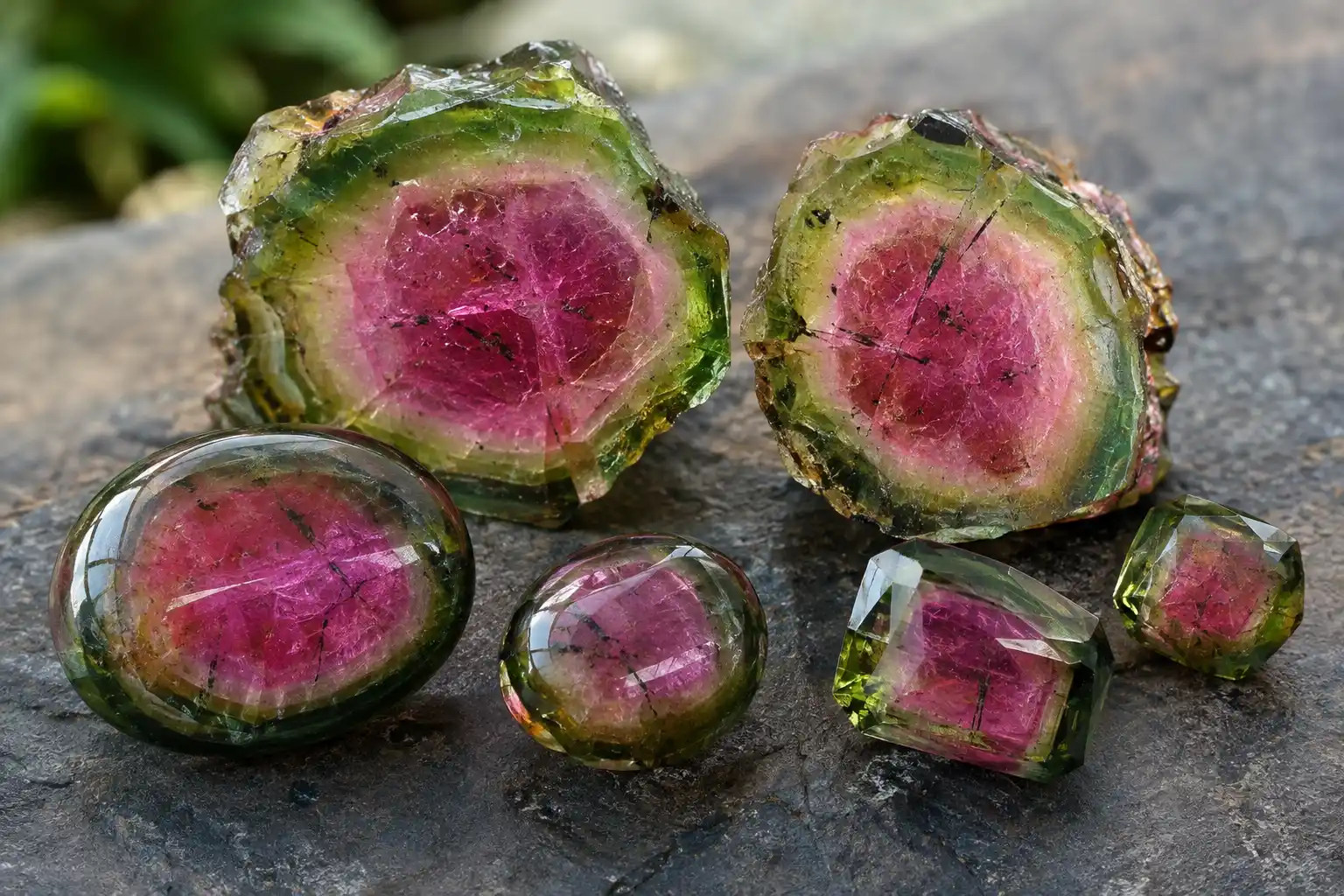
Watermelon tourmaline benefits are commonly associated with joy, affection, emotional balance, relationship awareness, gratitude, compassion, creativity, and what modern crystal traditions describe as heart alignment. Its appearance makes these interpretations easy to understand. Classic watermelon tourmaline shows a pink or red interior surrounded by a green outer zone, creating a natural resemblance to a sliced watermelon.
Mineralogically, watermelon tourmaline is a color-zoned variety of tourmaline rather than a separate mineral species. Mindat describes the classic form as concentrically zoned tourmaline with a pink core and green rim, most commonly involving elbaite, fluor-elbaite, or liddicoatite. GIA likewise identifies watermelon tourmaline by its green exterior and pink interior.
Its spiritual reputation should be kept separate from its physical properties. Watermelon tourmaline does not scientifically heal emotional trauma, regulate the heart, activate chakras, repair relationships, or transmit love energy. It can still become a meaningful visual reminder of affection, emotional honesty, boundaries, gratitude, and deliberate relationship care.
17 Watermelon Tourmaline Benefits at a Glance
- Joy: appreciating positive experiences.
- Love: expressing affection thoughtfully.
- Compassion: kindness with discernment.
- Emotional balance: pausing before reacting.
- Gratitude: recognizing meaningful relationships.
- Relationship awareness: noticing communication patterns.
- Self-respect: maintaining healthy boundaries.
- Growth: adapting constructively.
- Forgiveness: releasing without excusing harm.
- Creativity: drawing inspiration from natural color.
- Confidence: expressing feelings honestly.
- Hope: remaining open to improvement.
- Integration: accepting contrasting emotions.
- Reflection: examining motives carefully.
- Jewelry appeal: distinctive natural color zoning.
- Collector interest: unusual concentric growth patterns.
- Responsible spiritual practice: symbolism without medical claims.
What Watermelon Tourmaline Really Is
Watermelon tourmaline develops when the chemistry of a growing tourmaline crystal changes over time. Instead of forming one uniform color, different stages of growth produce distinct zones. In the classic form, a pink to red interior is surrounded by green growth toward the outside.
This zoning is not the same as an ordinary two-color crystal divided from one end to the other. Mindat specifically distinguishes watermelon tourmaline from longitudinal bicolor or polychrome zoning because the traditional watermelon appearance is concentric, with colored zones growing around the crystal core.
| Gemological Characteristic | Watermelon Tourmaline |
|---|---|
| Gem family | Tourmaline |
| Typical mineral species | Often elbaite, fluor-elbaite, or liddicoatite |
| Crystal system | Trigonal |
| Classic color pattern | Pink or red core with green rim |
| Zoning style | Concentric |
| Mohs hardness | About 7 to 7.5 |
| Luster | Vitreous to sub-vitreous |
| Transparency | Commonly transparent to translucent |
| Common cutting | Cross-section slices, cabochons, beads, custom faceting |
| Major appeal | Natural multicolor zoning |
The unusual appearance creates genuine lapidary value because cutters may preserve the entire cross-section instead of eliminating the zoning. GIA notes that crystal slices can display the pink center and green outer growth particularly effectively, making watermelon tourmaline suitable for distinctive one-of-a-kind jewelry.
Joy Without Pretending Life Must Always Feel Positive
Joy is among the most natural watermelon tourmaline benefits because its vivid pink and green combination appears lively and playful. The fruit-like color pattern gives the gemstone a visual warmth that many people immediately associate with happiness.
Joy becomes less useful when crystal traditions suggest that a gemstone should eliminate sadness or keep someone permanently positive. Human emotional life does not work that way.
A more realistic interpretation treats joy as the ability to notice positive experiences without denying difficult ones. Someone can appreciate a friendship while still dealing with professional stress. A person can enjoy an accomplishment while recognizing unresolved problems elsewhere.
Watermelon tourmaline may serve as a reminder to notice what is going well without using positivity to avoid what needs attention.
Love as Behavior Rather Than an Invisible Force
Pink tourmaline has long been linked in modern crystal culture with love, affection, tenderness, and relationship awareness. The pink center of watermelon tourmaline naturally brings those associations into the multicolored stone.
Love becomes most meaningful when translated into behavior.
A gemstone cannot force affection, attract a specific person, make another person stay, or guarantee reconciliation. It can symbolize qualities that make relationships healthier, such as reliability, communication, kindness, attention, consent, and respect.
The wider symbolism associated with tourmaline benefits also varies by color, with pink and red stones commonly emphasizing affection while green varieties lean toward renewal and growth.
Watermelon tourmaline combines both themes visually, making it especially suitable as a symbol of relationships that need both warmth and development.
Heart Alignment as Values and Relationships
Heart alignment is a phrase frequently used in modern crystal traditions. It may sound supernatural, but it can be interpreted more practically as living in a way that reflects one’s stated emotional values.
Someone who values family but never makes time for family may feel misaligned. Someone who values honesty while repeatedly avoiding an important conversation may experience the same tension.
Watermelon tourmaline can symbolize closing that gap.
The useful question becomes: Do my actions support what I claim matters emotionally?
That form of heart alignment depends on behavior rather than an invisible energy center.
Pink and Green as a Symbol of Emotional Integration
The defining visual feature of watermelon tourmaline is the coexistence of pink and green in one crystal.
These colors often receive different symbolic meanings. Pink may represent affection, tenderness, friendship, and emotional openness, while green may represent growth, renewal, patience, gratitude, and prosperity.
The colors do not compete for control of the crystal. They record different stages of growth.
That makes the stone an effective metaphor for emotional integration. People can experience love and disappointment simultaneously. They can care about someone while maintaining a boundary. They can grieve a change while recognizing that the change was necessary.
Emotional maturity does not require choosing one feeling and pretending the others do not exist.
Relationship Growth and the Need for Change
Watermelon tourmaline’s concentric growth structure makes relationship development another appropriate symbolic theme.
Healthy relationships change. Friendships adjust when people move, marry, become parents, change careers, or develop different interests. Long-term romantic relationships also require repeated negotiation as circumstances change.
Growth does not always mean becoming closer. Sometimes a healthier relationship requires more independence, clearer expectations, or reduced contact.
Watermelon tourmaline may symbolize the willingness to let relationships develop rather than demanding that they remain exactly as they were.
The gemstone cannot create that growth. Communication and behavior do.
Forgiveness Without Removing Boundaries
Forgiveness appears frequently in heart-centered crystal traditions, but it should not be treated as an obligation.
A person can forgive while maintaining distance. They can understand why someone behaved badly without restoring trust. They can release repetitive anger without returning to an unsafe relationship.
Watermelon tourmaline’s combination of pink and green can symbolize compassion together with continued growth.
That interpretation is healthier than using spiritual language to pressure someone into reconciliation.
Love and boundaries are not opposites.
Gratitude and Relationship Maintenance
Gratitude is another useful watermelon tourmaline benefit because positive relationships are easy to take for granted when they become familiar.
A stone associated with affection can become a reminder to express appreciation while the relationship is active rather than only after something changes.
That may mean acknowledging someone’s effort, making time for a friend, thanking a family member, or recognizing support that has become so consistent it is barely noticed.
Gratitude works best when it becomes visible through behavior.
The gemstone can hold the symbolism, but the relationship receives the benefit only when appreciation is communicated.
Emotional Healing Claims Need Clear Limits
Watermelon tourmaline is frequently described online as a crystal for emotional healing, trauma release, heart repair, nervous-system balance, or anxiety reduction.
Reliable scientific evidence does not establish these effects.
The beliefs collected under watermelon tourmaline healing properties are better understood as spiritual practices rather than clinical treatment.
A meaningful gemstone may provide comfort because of memory, appearance, ritual, or personal association. That emotional experience can be real without demonstrating a medical mechanism.
Persistent anxiety, depression, trauma symptoms, severe grief, or relationship distress may require qualified professional support rather than crystal use alone.
Creativity and Natural Color Design
Some watermelon tourmaline benefits are completely non-metaphysical. The gemstone offers exceptional creative possibilities because each crystal can display a different arrangement of pink, red, green, colorless, and transitional zones.
Cutters sometimes slice crystals across their width so the concentric structure remains visible. Others use cabochons or custom faceting to highlight several colors within one stone.
GIA notes that tourmaline crystals may show dramatic color zoning and that watermelon specimens are particularly effective when cut to display both the pink center and green exterior.
This makes the gemstone appealing to jewelry designers who want the natural growth pattern itself to become part of the design rather than cutting only for uniform color.
Collector Interest and Growth Patterns
Watermelon tourmaline provides genuine educational value because the zoning records changes in chemistry during crystal development.
The mineral did not begin pink and later have green paint added. The zones developed naturally as the crystal continued growing under changing geochemical conditions.
Collectors may evaluate the symmetry of the zoning, contrast between colors, transparency, crystal completeness, locality, size, fractures, and how clearly the concentric pattern is preserved.
A complete crystal showing several zones can be valuable even without faceting because the natural structure itself is the attraction.
This is one of the strongest reasons watermelon tourmaline deserves attention independently of spiritual claims.
Buying Watermelon Tourmaline With Realistic Expectations
Color-zoned tourmaline can vary greatly in commercial quality.
Some pieces show a vivid pink center surrounded by a clean green rim. Others contain pale colors, irregular zoning, cloudy areas, abundant fractures, dark zones, or only partial watermelon patterns.
Anyone planning to buy watermelon tourmaline should judge the actual stone rather than relying on the name alone. Color contrast, transparency, zoning, durability, cutting quality, treatment disclosure, and seller credibility all deserve attention.
Strong visual zoning can increase desirability, but an attractive photograph does not prove natural origin or quality.
Price Depends on More Than the Watermelon Pattern
The watermelon name can make buyers assume that every pink-and-green tourmaline commands a premium, but value varies widely.
Fine stones with strong color contrast, attractive transparency, balanced zoning, desirable size, and good cutting can be significantly more sought after than commercial slices with pale color or extensive damage.
The factors affecting watermelon tourmaline price therefore include much more than the presence of two colors.
Collector crystals and finished jewelry may also be valued differently. A natural intact crystal with exceptional zoning can appeal to mineral collectors, while a transparent slice with excellent symmetry may appeal more strongly to jewelry buyers.
Durability and Everyday Jewelry Use
Tourmaline ranks around 7 to 7.5 on the Mohs scale, which gives it reasonable scratch resistance for jewelry. GIA considers its toughness fair and warns that high heat or rapid temperature changes can damage the gem. Warm soapy water is the recommended cleaning method, while steam and ultrasonic cleaning are not advised.
Watermelon tourmaline slices can require additional care because thin sections may be more vulnerable to impact than thick faceted stones.
Some tourmalines also contain liquid-filled inclusions and fractures, which can make aggressive cleaning especially risky.
Pendants and earrings generally experience fewer impacts than frequently worn rings or bracelets.
Watermelon Tourmaline for Meditation and Reflection
The gemstone’s two dominant colors lend themselves naturally to a simple reflective exercise.
Pink can represent how someone gives and receives affection. Green can represent how relationships are changing.
A person might ask whether a relationship contains warmth but no growth, or growth but insufficient communication. Another useful question is whether boundaries have become too weak or unnecessarily rigid.
The purpose is not to receive answers from the gemstone.
Its visual structure simply creates a memorable framework for asking better questions.
Conclusion
Watermelon tourmaline benefits combine genuine mineralogical and artistic appeal with modern symbolism involving joy, love, emotional balance, relationship growth, gratitude, creativity, compassion, and heart alignment. Its characteristic pink center and green exterior record real changes during crystal growth, making integration and development particularly natural symbolic themes.
The gemstone cannot medically heal emotions, activate the heart, or guarantee successful relationships. Its strongest spiritual use is as a reminder to express affection honestly, maintain appropriate boundaries, appreciate meaningful relationships, and allow emotional growth to occur through deliberate choices.
FAQs
What are the main watermelon tourmaline benefits?
Practical benefits include distinctive natural color zoning, jewelry appeal, collector interest, and educational value. Modern spiritual traditions additionally associate watermelon tourmaline with joy, love, emotional balance, compassion, gratitude, relationship growth, and heart-centered reflection.
Is watermelon tourmaline a separate mineral?
No. It is a color-zoned variety of tourmaline, commonly involving elbaite, fluor-elbaite, or liddicoatite. The classic pattern has a pink or red center surrounded by a green outer zone.
Why does watermelon tourmaline have two colors?
Its colors develop because the chemistry available to the growing crystal changes over time. Different growth zones therefore develop different coloration.
Does watermelon tourmaline heal emotional pain?
There is no reliable scientific evidence that it treats trauma, depression, anxiety, grief, or other psychological conditions. It may be used as a personally meaningful reflection object alongside appropriate professional support.
Is watermelon tourmaline connected with love?
Yes, in modern crystal symbolism. The pink zones commonly represent affection and emotional openness, while the green areas are often associated with growth and renewal.
Is watermelon tourmaline a heart chakra stone?
It is widely associated with heart-chakra practices because of its pink and green colors. Chakra associations belong to spiritual tradition rather than established anatomy or medical science.
Is watermelon tourmaline durable?
Tourmaline has hardness around 7 to 7.5, but toughness is considered fair. Thin slices and highly included stones should be protected from impacts and sudden temperature changes.
How should watermelon tourmaline be cleaned?
Warm, soapy water and gentle cleaning are recommended. Steam and ultrasonic cleaners are best avoided, particularly in included or fractured gems.
Is natural watermelon tourmaline valuable?
Fine examples can be valuable when they show strong pink-green contrast, attractive transparency, desirable zoning, good size, and skillful cutting. Commercial-quality pieces with pale colors or heavy fracturing may be much more affordable.
Disclaimer: Spiritual, emotional, energetic, heart-centered, chakra, manifestation, protective, and healing interpretations associated with watermelon tourmaline reflect beliefs and personal practices rather than established medical or psychological effects. Watermelon tourmaline should not replace professional healthcare, diagnosis, therapy, prescribed treatment, or practical relationship and safety decisions.