7 Popular Snowflake Obsidian Benefits: Helpful Uses, Verified Facts, Important Cautions
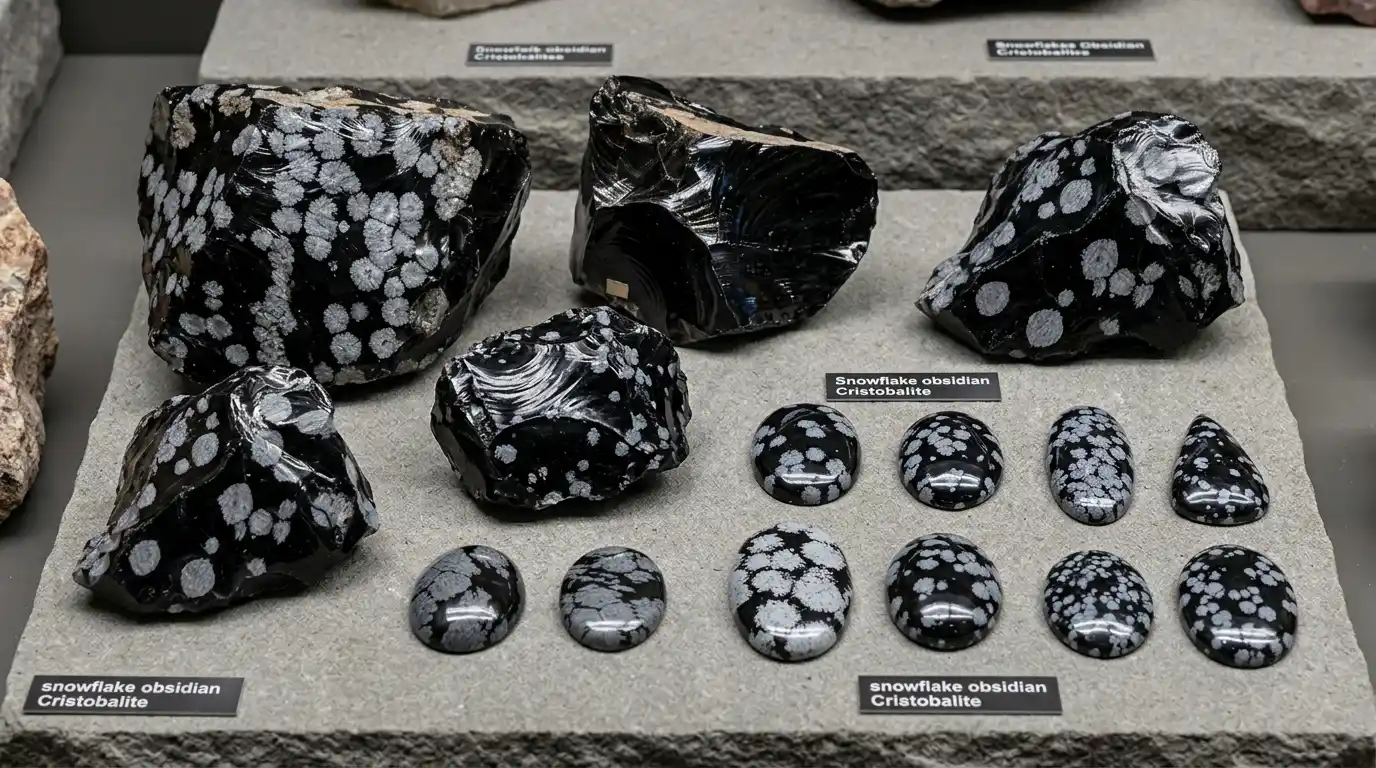
Snowflake obsidian benefits begin with a geological feature that makes this stone genuinely distinctive: white to gray cristobalite structures growing inside black volcanic glass. Obsidian forms when silica-rich lava cools so rapidly that most of the melt does not have enough time to crystallize, leaving an amorphous natural glass. Snowflake obsidian represents a stage in which parts of that glass have begun to devitrify, allowing crystalline silica structures to grow into the familiar pale “snowflakes.”
This means snowflake obsidian is not simply black obsidian with white mineral spots trapped accidentally inside it. The snowflakes develop as part of the glass changes from an amorphous state toward crystalline forms, most commonly cristobalite. Their circular, radiating, or flower-like appearance records a genuine transformation within the volcanic glass and makes each polished piece visually individual.
Modern crystal traditions add balance, grounding, protection, emotional reflection, perseverance, and release of unwanted habits to snowflake obsidian benefits. These uses can work as personal symbolism, but the stone does not medically regulate emotions, remove toxins, treat trauma, absorb negative energy, or create a measurable protective field around the wearer.
7 Snowflake Obsidian Benefits at a Glance
The seven benefits below separate real geological and practical qualities from modern symbolic uses. This approach keeps the cultural and personal side of the stone intact while avoiding claims that go beyond its physical properties.
- White cristobalite snowflakes give every specimen a naturally individual pattern.
- Volcanic-glass formation provides a useful example of rapid cooling followed by partial devitrification.
- Conchoidal fracture makes obsidian important for understanding why volcanic glass can form extremely sharp edges.
- Black-and-white contrast gives snowflake obsidian strong ornamental, carving, cabochon, and collector appeal.
- Modern balance and grounding traditions can serve as personal reminders to slow down and consider competing priorities.
- Symbolism involving change and perseverance fits the real transformation from volcanic glass toward crystalline silica structures.
- Responsible handling recognizes that obsidian is brittle, can produce extremely sharp broken edges, and should not be treated as a medical or supernatural protective tool.
Snowflake Obsidian Is Natural Volcanic Glass
The strongest snowflake obsidian benefits begin with its volcanic origin. Obsidian forms when silica-rich lava reaches the surface or a shallow volcanic environment and cools quickly enough that atoms cannot organize into the large crystal structures typical of slower-cooled igneous rocks. The resulting substance is amorphous volcanic glass rather than a crystalline mineral.
This distinction matters because obsidian is frequently called a crystal in spiritual discussions even though it lacks the long-range ordered crystal structure required for strict mineral classification. The familiar obsidian benefits therefore come from a natural volcanic glass whose chemistry can vary between flows and whose physical behavior differs from that of crystalline quartz, feldspar, or corundum.
Snowflake obsidian develops when parts of the glass begin to crystallize. GIA describes the white blooms in snowflake obsidian as cristobalite crystals created through devitrification, while Mindat likewise identifies the stone as natural volcanic glass containing white cristobalite patterns produced by partial crystallization.
What the Snowflakes Actually Are
The pale snowflakes are the feature that gives snowflake obsidian its name, and a simple technical comparison makes their identity clearer.
| Feature | Snowflake Obsidian |
|---|---|
| Host | Natural volcanic glass |
| Typical background | Black to dark gray |
| White “snowflakes” | Cristobalite-rich crystalline structures |
| How they form | Partial devitrification of volcanic glass |
| Crystal structure of host | Amorphous, not a true crystal |
| Fracture | Strongly conchoidal |
| Mohs hardness | Commonly around 5 to 5.5 |
| Main lapidary uses | Cabochons, beads, carvings, spheres, decorative objects |
| Main physical caution | Brittle glass can chip and form extremely sharp edges |
Cristobalite is a crystalline polymorph of SiO2, meaning it has the same basic chemical formula as quartz but a different crystal structure. Its development inside an originally glassy host illustrates how volcanic glass can gradually become more crystalline after solidification.
This process is especially valuable for geological education because the stone visibly records two states of silica in one object: an amorphous glassy host and crystalline structures that formed as the glass partially devitrified.
Natural Pattern Makes Every Piece Individual
Visual individuality is one of the most obvious snowflake obsidian benefits. Some stones contain sparse white spots against a broad black background, while others show dense gray-white rosettes, circular blooms, or overlapping spherulitic patterns covering much of the polished surface.
The distribution depends on where cristobalite nucleated and how far crystallization progressed within the glass. The size and density of the snowflakes can therefore change substantially within the same volcanic flow or even within one piece of rough.
Lapidaries can use these variations deliberately. A broad cabochon may highlight several large snowflakes, while a smaller bead may show only fragments of larger structures. Freeform cuts, spheres, palm stones, and slabs can reveal patterns that would be lost if every piece were forced into a standardized shape.
The attraction lies in the geology itself. A dense snowflake pattern is visually different from plain black obsidian, even though both share the same basic volcanic-glass origin.
Obsidian Fracture Has Real Historical Importance
Obsidian’s conchoidal fracture is one of its most important practical properties. When broken correctly, volcanic glass can produce exceptionally sharp edges because fractures propagate smoothly through the amorphous structure rather than being diverted by crystal grains.
This property made obsidian valuable for cutting tools, projectile points, blades, and other sharp implements in many societies where suitable volcanic sources were available. GIA notes that obsidian has been used for cutting tools since the Neolithic because of this highly conchoidal fracture.
Snowflake obsidian retains that same fundamental glassy fracture behavior even though cristobalite has developed in portions of the stone. The visual snowflakes do not turn the host into a tough crystalline rock, and polished pieces should still be protected from hard impact.
For modern owners, the historical importance of obsidian provides a stronger and more interesting story than unsupported claims that every snowflake specimen was used for ancient crystal healing.
Durability Is Useful but More Limited Than Quartz
Snowflake obsidian is commonly around Mohs 5 to 5.5, making it softer than quartz and significantly softer than sapphire or ruby. It can work well in pendants, earrings, beads, brooches, carvings, and protected cabochons, but exposed rings and bracelets receive enough impact and abrasion that greater care is sensible.
Hardness is only part of the issue. Obsidian is brittle, and a direct blow can chip an edge or produce a conchoidal break whose newly exposed surface may be extremely sharp. This means a damaged stone should be handled cautiously rather than rubbed with bare fingers to test whether an edge feels smooth.
The same sharpness that made obsidian useful as a cutting substance becomes a safety concern when jewelry breaks. Responsible ownership therefore includes checking damaged beads, pendants, and carvings for sharp fractures and replacing pieces that cannot be handled safely.
Balance as a Helpful Modern Symbol
Balance is one of the most familiar modern snowflake obsidian benefits because the black host and white cristobalite patterns create a strong visual contrast. People may interpret that contrast as a reminder that difficult and positive experiences can exist at the same time or that several competing priorities need to be considered together.
A person could use snowflake obsidian during journaling by dividing a difficult decision into advantages, disadvantages, known facts, and unresolved questions. The stone does not create better judgment, but its black-and-white appearance can provide a memorable symbol for considering more than one side of a situation.
This kind of use keeps symbolism connected with an actual behavior. Instead of expecting the stone to balance emotions chemically, the person uses it as a prompt to slow down, examine competing information, and decide what action is most reasonable.
Grounding Means Returning to Immediate Reality
Grounding is another popular snowflake obsidian benefit. Black stones are frequently associated with stability and practical awareness in modern crystal traditions, and snowflake obsidian adds white patterns that can symbolize clarity within that darker background.
A practical grounding routine might involve using a smooth stone while identifying five things that can be seen, several sounds that can be heard, or the next task that genuinely needs attention. These techniques work through attention to the present environment rather than through an energetic property of volcanic glass.
Snowflake obsidian does not discharge anxiety into the Earth, regulate the nervous system through skin contact, or create a scientifically measurable grounding field. It can still become a useful reminder for a practice that returns attention to current surroundings and immediate responsibilities.
Change and Perseverance Fit the Real Geology
Transformation symbolism fits snowflake obsidian more naturally than many vague metaphysical claims because the stone contains visible evidence of physical change. The original volcanic glass began partly transforming into crystalline silica structures, creating the cristobalite snowflakes that define the variety.
A person may use that real geological change as a metaphor for gradual personal development. New habits, education, recovery from disappointment, or a change in career direction can also emerge slowly rather than through one dramatic moment.
The analogy should remain symbolic. Volcanic devitrification and human psychological development are completely different processes, but a visible natural transformation can still provide a thoughtful personal metaphor.
Perseverance is especially appropriate when the stone is used to represent staying with a long process while accepting that change may not happen evenly. The pattern itself shows that transformation can occur in some areas before others.
Emotional Reflection Without Healing Claims
Modern crystal traditions often connect snowflake obsidian with emotional reflection, recognizing unhealthy patterns, and releasing unwanted habits. These ideas can be used carefully when they refer to journaling, self-observation, communication, or intentional changes in behavior.
Claims surrounding snowflake obsidian healing properties may extend much further into anxiety treatment, trauma release, pain relief, circulation, detoxification, sleep improvement, or immune support. Volcanic glass has not been shown to provide those medical effects simply through wearing or holding it.
Someone processing serious trauma, depression, panic, grief, self-harm thoughts, or another significant psychological concern needs appropriate professional support. A gemstone may remain part of a personal ritual without carrying responsibility for treatment.
This distinction respects both the person and the stone. Snowflake obsidian can symbolize reflection without being asked to perform medical functions that glass cannot provide.
Protection Should Be Understood Symbolically
Protection is often included among obsidian traditions because dark glass, sharp historical tools, and the dramatic appearance of obsidian make defensive symbolism intuitive. Snowflake obsidian may therefore be used to represent personal boundaries, careful decision-making, or awareness of situations that deserve caution.
The stone does not create an invisible shield against accidents, illness, electromagnetic fields, harmful intentions, or bad luck. Protection still depends on practical measures such as boundaries, safe environments, medical care, cybersecurity, protective equipment, and informed choices.
Used responsibly, a polished stone can become a reminder to protect time, attention, finances, or emotional space. This gives the symbolism a concrete purpose without claiming supernatural shielding.
Snowflake Obsidian and Plain Black Obsidian Are Related but Distinct
Snowflake obsidian and plain black obsidian share a volcanic-glass origin, but their internal development differs. Plain black obsidian remains predominantly glassy, while snowflake obsidian contains visible regions where crystallization has progressed enough to form pale cristobalite-rich patterns.
This difference does not make one variety spiritually stronger than the other. The physical distinction is geological, involving the extent and pattern of devitrification rather than a measurable change in metaphysical energy.
Collectors may prefer one for visual reasons. Plain black obsidian offers a uniform glossy appearance, while snowflake obsidian provides contrast and visible evidence of crystallization. Both can preserve useful information about silica-rich volcanic systems.
Care Requires Respect for Brittle Volcanic Glass
Snowflake obsidian is relatively easy to clean but should not be treated as though it were a tough crystalline gemstone. Lukewarm water, mild soap, and a soft cloth are suitable for most intact polished pieces, while harsh abrasives are unnecessary and may dull the surface.
Sudden temperature changes and strong impacts should be avoided because brittle volcanic glass can fracture. Jewelry should also be stored away from harder gemstones such as quartz, topaz, corundum, and diamond, which can scratch polished obsidian.
If a piece breaks, sharp fragments deserve particular caution. Conchoidal obsidian edges can be exceptionally sharp even when the original object was a smooth sphere, bead, or cabochon.
Safe handling is more important than elaborate cleansing rituals. The practical condition of the glass deserves attention before any symbolic use.
Collecting Snowflake Obsidian for Geology Rather Than Metaphysics
A good specimen can be appreciated entirely through geology. Spherulite size, cristobalite distribution, glass color, fracture surfaces, flow texture, associated volcanic rock, and locality can all make one piece more interesting than another.
Collectors may also compare snowflake obsidian with other visually distinctive obsidian varieties. The reddish-brown iron-rich patterns in mahogany obsidian arise differently from the cristobalite snowflakes in this variety, showing how one volcanic-glass family can develop several recognizable appearances through different geological processes.
This comparison is more useful than treating each color variety as a separate crystal species. The shared volcanic origin remains central, while inclusions, oxidation, flow structures, bubbles, and partial crystallization create the differences people see.
Conclusion
Snowflake obsidian benefits include distinctive cristobalite snowflakes, visible evidence of devitrification, strong ornamental appeal, geological educational value, historical insight into obsidian fracture, and meaningful symbolism involving balance, grounding, change, and perseverance. Its black-and-white pattern can support reflection, but volcanic glass does not medically heal emotions, remove toxins, or create supernatural protection, and its brittle conchoidal fracture deserves practical care.
FAQs
What are the main snowflake obsidian benefits?
Snowflake obsidian benefits include unique cristobalite patterns, collector appeal, carving and jewelry use, geological insight into volcanic glass and devitrification, and historical interest in obsidian fracture. Modern traditions also associate the stone with balance, grounding, reflection, and perseverance.
What causes the white snowflakes in snowflake obsidian?
The pale patterns are cristobalite-rich crystalline structures that develop as parts of the volcanic glass undergo devitrification. They are natural products of partial crystallization rather than paint or ordinary white spots.
Is snowflake obsidian a crystal?
The host is natural volcanic glass and therefore amorphous rather than crystalline. The white snowflake structures contain crystalline cristobalite, so the stone combines an amorphous glassy host with crystalline regions.
Is snowflake obsidian durable?
It has moderate hardness, commonly around Mohs 5 to 5.5, but it is brittle. Strong blows can chip or break the glass and produce extremely sharp conchoidal edges.
Does snowflake obsidian help with emotional balance?
There is no scientific evidence that the stone directly regulates emotions or brain chemistry. It can be used symbolically during journaling, meditation, or other reflective routines focused on considering competing thoughts or priorities.
Does snowflake obsidian provide protection?
Protection is a spiritual or personal symbol rather than a measurable shield produced by volcanic glass. The stone can represent practical boundaries or careful decision-making without guaranteeing physical or supernatural safety.
Can snowflake obsidian have personal meaning?
Yes. Snowflake obsidian can represent balance, perseverance, personal change, a geological interest, journey, family gift, or important period of reflection. Personal symbolism does not require a universal metaphysical explanation.
Disclaimer: Balance, grounding, protection, emotional-healing, chakra, cleansing, and energetic descriptions of snowflake obsidian reflect spiritual beliefs and personal practices. Snowflake obsidian is not a medical or psychological treatment and cannot guarantee emotional balance, detoxification, supernatural protection, or health outcomes.