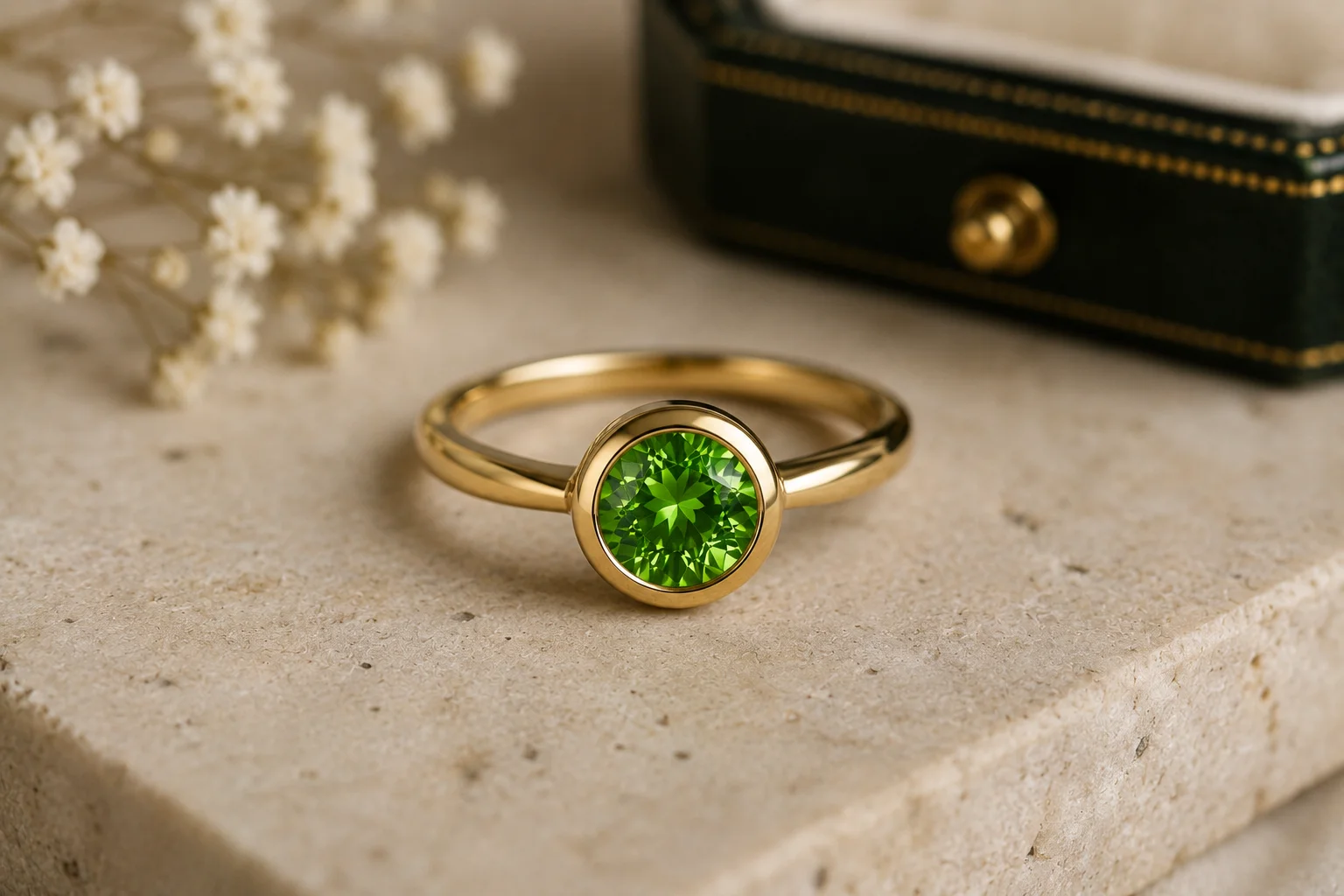
Demantoid Garnet Rings: Styles, Settings and Buying Tips
A demantoid garnet ring showcases one of the garnet family’s rarest and most brilliant green gemstones. Fine demantoid combines vivid green color with unusually strong dispersion, so a well-cut stone can display flashes of spectral fire that stand out even at modest sizes.
Rings also expose demantoid to more impacts and abrasion than earrings or pendants. Therefore, the best design balances beauty with protection through a secure setting, sensible profile and wearing habits suited to demantoid’s approximately 6.5 Mohs hardness.
Demantoid Garnet Rings at a Glance
| Factor | What to look for |
|---|---|
| Gem identity | Natural demantoid, the green variety of andradite garnet |
| Best color | Lively yellowish green to vivid green with good brightness |
| Cut | Strong light return with limited windowing or extinction |
| Clarity | Attractive transparency; inclusions should not threaten durability |
| Ring setting | Bezel, low-profile halo or well-protected prong setting |
| Metal | Gold or platinum with strong construction |
| Best wear style | Careful regular wear or special-occasion wear |
| Main durability issue | Abrasion and hard impacts |
| Collector feature | Attractive horsetail inclusions |
| Buying priority | Color and cut before marketing grades |
Is Demantoid Garnet Suitable for a Ring?
Yes, but demantoid requires more care than harder ring stones such as diamond, sapphire or ruby.
Demantoid belongs to the andradite garnet species and sits toward the softer side of the garnet group. It has no cleavage, which is helpful, but hard knocks can still chip a stone, while repeated contact with abrasive surfaces can dull facet edges.
A ring intended for occasional dinners, events or careful office wear can suit demantoid very well. Someone who works regularly with tools, machinery, stone, metal or other hard materials may prefer demantoid garnet earrings or a demantoid garnet necklace instead.
Solitaire Demantoid Rings
A solitaire gives one demantoid complete visual attention.
Round brilliant cuts are especially effective because they can emphasize the gem’s exceptional fire. Ovals and cushions may offer a larger apparent face-up size, while pears and marquises create a distinctive silhouette but need additional point protection.
Choose a stone that looks bright across most of its face. A large transparent area through the center may indicate windowing, while broad dark regions can reduce the visual effect of the green color.
A low-set solitaire is usually more practical than a tall setting that projects far above the finger.
Bezel-Set Demantoid Rings
A bezel surrounds most or all of the gem’s girdle with metal.
This is one of the strongest choices for a demantoid ring because it protects the stone’s edge from direct knocks. Bezels also create a clean modern appearance and reduce the number of exposed prongs that can snag.
A well-made bezel should follow the stone’s outline evenly without covering an excessive amount of the face.
Open-backed construction can make cleaning easier, although the opening should not leave fragile portions of the pavilion exposed to impact.
Halo Rings
Halo rings surround the demantoid with smaller accent stones, commonly diamonds.
A halo can increase apparent size and provide some physical protection around the center stone. White diamond accents also contrast strongly with demantoid’s green body color.
However, the center demantoid should still be evaluated independently. A large halo cannot correct weak color, obvious windowing or poor cutting.
Closely packed accent settings create additional maintenance points. Inspect prongs regularly, especially when the ring is worn frequently.
Three-Stone Rings
A three-stone ring may pair a central demantoid with diamonds, additional demantoids or other complementary gems.
Diamond side stones create brightness without competing strongly with green. Matching three demantoids produces a richer color statement but requires careful selection for tone and saturation.
The center stone does not need to be dramatically larger than the sides. Balanced proportions often create a more wearable profile.
Protect any exposed outer corners because side stones frequently receive knocks against doors, furniture and neighboring fingers.
Cluster and Floral Rings
Demantoid frequently occurs in smaller fine-quality sizes, making clusters particularly suitable.
Several small stones can form leaves, flowers or geometric motifs while producing a larger overall green surface. Antique-inspired designs may combine demantoid with diamonds and engraved yellow gold.
Check each stone individually. One brownish or poorly cut demantoid can interrupt an otherwise well-matched cluster.
The settings must also remain accessible enough for cleaning. Dense clusters can collect lotion, soap and skin oils behind the stones.
Vintage and Antique Demantoid Rings
Demantoid became important in late nineteenth- and early twentieth-century jewelry, particularly in Russian and European work.
Antique rings may contain small demantoids arranged with diamonds, enamel or detailed goldwork. Their value may involve historical craftsmanship as much as gemstone weight.
Have older rings examined for worn prongs, thin shanks, previous soldering and replacement stones.
A green gemstone in an antique ring should not automatically be assumed to be demantoid. Emerald, peridot, glass and other green garnets may appear similar without testing.
How to Judge Demantoid Color
Color is one of demantoid’s principal quality factors.
The range extends from pale yellowish green to vivid saturated green. Strong green usually commands greater interest, although excessively dark stones may lose brightness and hide the dispersion that makes demantoid distinctive.
Lighter stones can show exceptional rainbow fire. Therefore, the darkest green is not automatically the best.
Examine the ring in several lighting environments. Warm illumination may emphasize yellow tones, while cool light may make the stone look greener.
Choose the balance of color and fire that is most attractive in ordinary wear.
Cut and Fire
Demantoid has higher dispersion than most colored gemstones, producing strong flashes of spectral color.
A successful cut allows that fire to remain visible while preserving desirable green body color. Poor proportions can produce a dead center, excessive darkness or weak symmetry.
Round brilliant cuts often perform exceptionally well. Ovals and cushions can also be lively when their centers do not window.
The completed demantoid garnet buying guide provides a broader checklist for evaluating color, cut, clarity and provenance.
Clarity and Horsetail Inclusions
Demantoid may contain crystals, fractures and characteristic radiating inclusions called horsetails.
Fine horsetails can increase collector interest rather than reduce value, particularly when they remain attractive and do not interfere heavily with transparency.
However, a horsetail does not prove Russian origin. Similar inclusions have been documented from some other deposits, while many Russian demantoids do not show obvious horsetails.
Surface-reaching fractures require more caution because they can create potential durability problems in a ring.
The drafted demantoid meaning and properties guide covers these inclusions and the gem’s mineralogy more fully.
Russian Demantoid and Origin Premiums
Russian demantoid from the Ural Mountains holds a prestigious position in the market because of its history, rarity and association with fine imperial-era jewelry.
Other important sources include Namibia, Madagascar, Italy, Iran and Pakistan.
Origin alone does not determine quality. A bright, well-cut non-Russian demantoid can outperform a dark or poorly cut Russian stone visually.
When a seller charges a significant Russian-origin premium, independent laboratory documentation is preferable to conclusions based only on color or horsetail inclusions.
Demantoid Ring Size and Carat Weight
Fine demantoid becomes significantly rarer in larger sizes.
A well-cut sub-carat stone may display enough brilliance to create strong visual presence, particularly with a halo or contrasting metal.
Face-up dimensions matter alongside carat weight. A deep stone may retain weight below the setting while appearing comparatively small from above.
Request millimeter measurements and inspect actual proportions rather than purchasing by carat number alone.
The completed demantoid garnet price guide explains why size premiums increase sharply when fine color and cutting remain consistent.
Choosing a Protective Setting
For frequent wear, prioritize settings in roughly this order:
| Setting | Protection | Visual openness | Best use |
|---|---|---|---|
| Full bezel | Excellent | Moderate | Most protective everyday option |
| Partial bezel | Very good | Good | Balance of protection and visibility |
| Low halo | Very good | High | Added size and edge protection |
| Six-prong solitaire | Good | High | Traditional round-stone design |
| Four-prong solitaire | Moderate | Very high | Careful wear |
| High cathedral setting | Lower for impact | Very high | Occasional wear |
The exact craftsmanship matters more than the setting name. A poorly executed bezel is not safer than strong, properly positioned prongs.
Prong Inspection
Prongs should sit firmly over the stone without visible gaps.
Run a soft cloth gently around the setting. If fibers catch repeatedly, a prong may be lifted or rough.
The gem should not click or rotate when the ring is moved gently near the ear. Any movement requires professional attention.
Do not bend prongs at home. Metal fatigue or an incorrect repair can increase the risk of losing the stone.
Choosing the Metal
Yellow gold creates a warm contrast with demantoid and works particularly well with yellowish-green stones or antique-inspired designs.
White gold and platinum make vivid green appear crisp and pair naturally with diamond accents. Rose gold can create attractive contrast but may compete with softer yellow-green stones.
The metal should be sturdy enough for the setting style. Very thin shanks and lightweight prongs may reduce long-term security.
Ask for precise fineness and alloy information, especially when nickel sensitivity is a concern.
Demantoid Engagement Rings
Demantoid can serve as an unconventional engagement-ring center stone when the wearer understands its care requirements.
A low bezel, protective halo or sturdy six-prong setting is more appropriate than a tall exposed design.
The ring should be removed before gym sessions, gardening, cleaning, cooking, home repairs and other activities involving hard contact.
For someone who expects a ring to remain on through nearly every activity, sapphire or diamond may provide greater practical durability.
Symbolic suitability does not remove physical limitations.
Demantoid vs Tsavorite Rings
Demantoid is green andradite garnet, while tsavorite is green grossular garnet.
Tsavorite is generally somewhat harder and often provides a rich, pure green appearance. Demantoid is softer but offers much stronger dispersion.
For frequent ring wear, tsavorite may have a modest practical advantage. For buyers who value rainbow fire, historical rarity and a more unusual gemstone, demantoid can be especially compelling.
Neither should be identified solely from color.
Demantoid vs Emerald Rings
Emerald belongs to the beryl family and is generally harder than demantoid but often heavily included and may be treated with oil or resin.
Demantoid normally produces much stronger spectral fire. Its green may lean more yellowish, while fine emerald often trends toward saturated green or bluish green.
Both require careful ring wear for different reasons.
Choose according to visual preference, treatment expectations and lifestyle rather than assuming one green gem is automatically superior.
Demantoid vs Sphene Rings
Sphene can show extraordinary dispersion, sometimes creating even more fire than demantoid.
However, sphene is substantially softer and less suitable for exposed rings.
The completed sphene versus demantoid garnet comparison explains their gemological differences.
For a green ring intended to be worn beyond rare special occasions, demantoid is generally the more practical of the two.
How to Buy a Demantoid Garnet Ring
Begin with natural gemstone identity and full treatment disclosure.
Review color in ordinary light, inspect the cut for windowing and darkness, then examine inclusions for both beauty and durability.
Next, evaluate the ring as a piece of engineering. Check prongs, bezel edges, shank thickness and comfort.
For a substantial purchase, laboratory documentation may be worthwhile, especially when Russian origin materially affects price.
Avoid relying on labels such as AAA. The garnet market does not have a universal standardized AAA grading scale.
Wearing a Demantoid Ring
Put the ring on after applying cosmetics, lotions and perfume.
Remove it before housework, gardening, exercise, sports, swimming, showering and manual tasks.
Avoid stacking demantoid directly beside diamond or sapphire rings because harder gemstones can abrade its facets.
A fitted ring is less likely to spin and strike surfaces. However, it should remain comfortable and never restrict circulation.
Cleaning a Demantoid Garnet Ring
Warm water, mild soap and a soft brush provide the safest general cleaning method.
Use a bowl rather than an open drain. Brush gently beneath the stone and around the setting, rinse briefly and dry with a lint-free cloth.
Steam cleaning should be avoided. Ultrasonic cleaning may be inappropriate for fractured, filled, antique or delicately mounted demantoid.
The completed guide to cleaning demantoid garnet jewelry safely provides detailed care instructions.
Storage
Store the ring separately in a padded compartment.
Do not allow diamonds, sapphires or other harder stones to rub against the demantoid.
Keep the ring box dry and away from extreme temperature changes. Documentation should be stored separately in a secure location.
Periodic photographs may also help document condition for insurance or maintenance records.
When a Ring Needs Professional Attention
Stop wearing the ring when the stone moves, a prong catches, the shank becomes distorted or a visible fracture develops.
A jeweler can examine the setting under magnification and determine whether tightening, rebuilding or other repair is appropriate.
Do not wait for a visibly loose stone to become more unstable.
Regular inspection is especially important for antique rings and pieces worn several times each week.
Conclusion
Demantoid garnet rings reward careful buyers with intense green color and exceptional fire. The strongest stones combine lively color, balanced cutting and attractive clarity rather than simply the darkest possible green.
Because demantoid is softer than many traditional ring gems, setting protection matters. Bezels, low halos and sturdy prong designs improve practicality, while thoughtful wearing habits prevent unnecessary abrasion and impact.
For significant purchases, prioritize disclosure and independent evidence over origin stories or unstandardized quality labels.
Frequently Asked Questions
1. Is demantoid garnet good for rings?
Yes, when the stone is securely set and worn with care. Demantoid is more vulnerable to abrasion than harder ring gems.
2. Can a demantoid ring be worn every day?
Careful regular wear is possible, but the ring should be removed for manual work, exercise, cleaning and other high-impact activities.
3. What setting is best for a demantoid ring?
A bezel or low protective halo provides excellent protection. Sturdy prongs can also work for careful wear.
4. What color demantoid is most valuable?
Lively saturated green generally attracts strong demand, although enough lightness should remain to display brilliance and fire.
5. Are horsetail inclusions desirable?
Attractive horsetails may add collector interest, but surface-reaching fractures deserve more concern in a ring.
6. Do horsetails prove Russian demantoid?
No. Some non-Russian demantoids contain horsetails, while many Russian stones do not.
7. Is demantoid harder than emerald?
No. Demantoid is around 6.5 on the Mohs scale, while emerald is approximately 7.5 to 8.
8. Is demantoid or tsavorite better for a ring?
Tsavorite is somewhat harder, while demantoid offers stronger dispersion. Lifestyle and visual preference should determine the choice.
9. Can demantoid be an engagement-ring stone?
Yes, for a wearer prepared to use a protective setting and remove the ring during rough activity.
10. How should a demantoid ring be cleaned?
Use warm mild soapy water and a soft brush. Avoid steam and seek professional advice before ultrasonic cleaning.
11. Can demantoid garnet go in water?
A brief rinse is usually suitable for an untreated intact stone, but prolonged soaking is unnecessary.
12. Should an expensive demantoid ring have a laboratory report?
Yes, when natural identity, treatment or claimed geographic origin materially affects the purchase price.