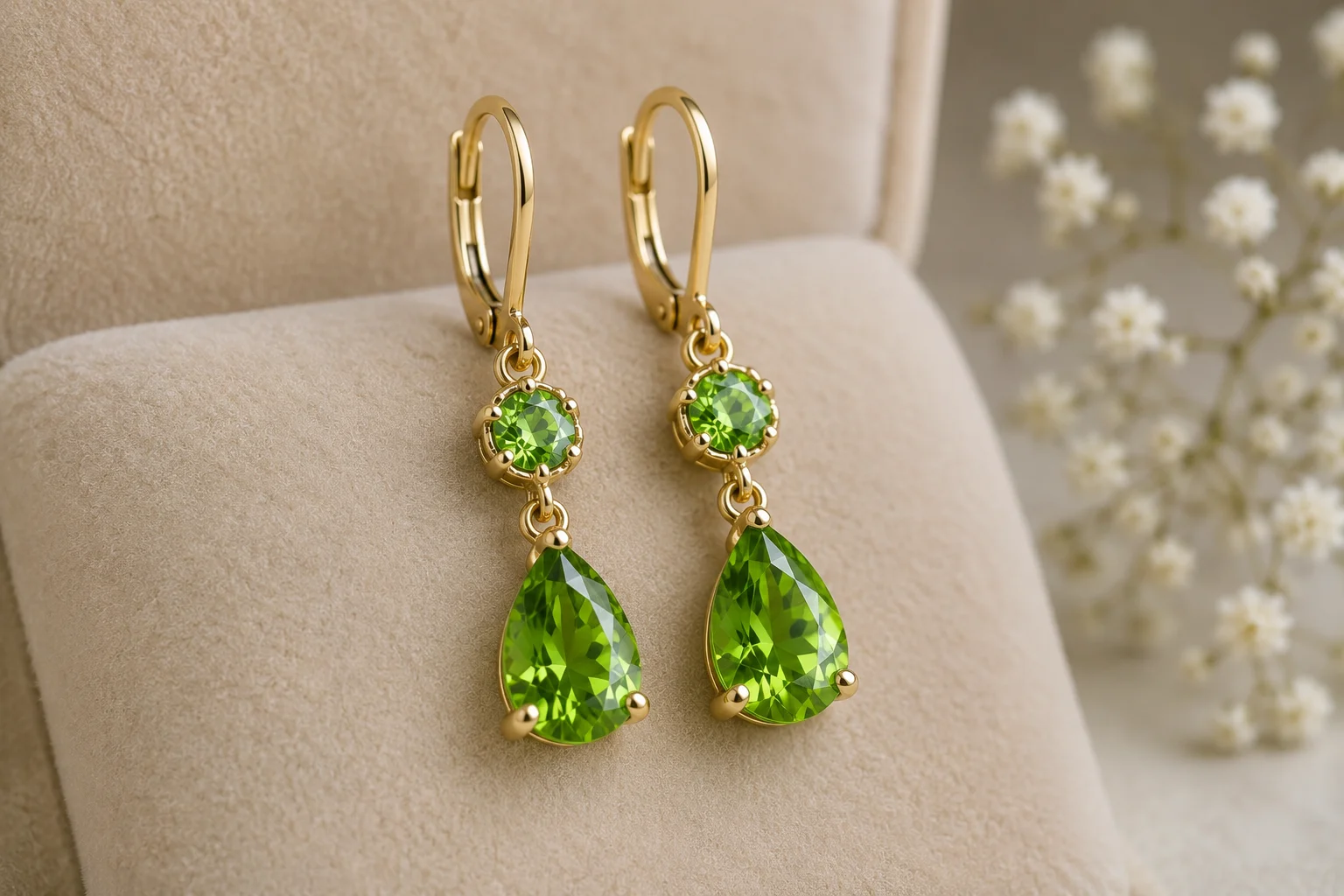
Demantoid Garnet Earrings: Styles, Quality and Buying Guide
Demantoid garnet earrings combine vivid green color with exceptional brilliance and flashes of spectral fire. Because earrings receive fewer impacts than rings and bracelets, they are one of the safest jewelry formats for showcasing this comparatively rare green garnet.
Studs offer the greatest practicality, while drops and halo earrings create more movement and visual presence. Regardless of style, the strongest pair should show balanced color, compatible cutting, secure settings and comfortable backs.
Demantoid Garnet Earrings at a Glance
| Factor | What to look for |
|---|---|
| Gem identity | Natural demantoid, the green variety of andradite garnet |
| Color | Lively yellowish green to vivid green without excessive darkness |
| Matching | Similar tone, saturation, size and brightness across both earrings |
| Cut | Symmetrical stones with strong light return and limited windowing |
| Clarity | Attractive transparency; inclusions should not weaken the gems |
| Setting | Secure prongs, bezels or protective halos |
| Earring backs | Friction, screw or locking backs suited to the earring weight |
| Metal | Gold, platinum or a clearly disclosed alternative alloy |
| Best everyday format | Low-profile studs or compact hoops |
| Main care issue | Abrasion, hard impacts and loose settings |
Why Demantoid Works Especially Well in Earrings
Demantoid has unusually high dispersion, which separates white light into spectral colors. Even small stones can produce lively flashes when their body color is not too dark and the cutting proportions return light effectively.
This optical character makes earrings a strong use of limited gem weight. A pair of small rounds may appear brighter and more distinctive than larger but poorly cut stones.
Earrings also remain above most work surfaces. Therefore, they receive fewer repeated blows than a demantoid garnet bracelet or an exposed ring.
However, earrings still need secure settings. Hair, scarves, headphones and clothing can catch drops or loosen poorly maintained prongs.
Demantoid Garnet Stud Earrings
Studs are the most versatile demantoid earring style.
Round brilliant cuts work particularly well because their symmetry emphasizes brilliance and makes pair matching easier. Ovals and cushions can also form attractive studs, although differences in outline become more noticeable across a pair.
Low-profile basket settings keep the stones close to the ear. Four or six prongs may maximize visibility, while a bezel provides additional edge protection.
Check that the post sits near the visual center of the earring. Poorly positioned posts may cause the stone to tilt downward.
Studs containing valuable demantoids should use backs that fit firmly without requiring excessive force.
Halo Earrings
A halo surrounds each demantoid with smaller accent stones, often diamonds.
The frame can make modestly sized demantoids appear larger and increase overall sparkle. White diamonds create crisp contrast, while yellow-gold halos may emphasize warmer green tones.
Inspect the center stones first. A halo should complement good demantoid rather than distract from weak color or obvious windowing.
The completed demantoid garnet price guide explains why strongly colored, well-cut and larger stones command substantial premiums.
Every accent stone and prong adds another maintenance point. Examine the halo regularly for catches or movement.
Drop and Dangle Earrings
Drop earrings display demantoid through movement and changing light angles.
A single green stone beneath a small diamond creates a classic design, while graduated drops may combine several demantoids. Longer designs should remain light enough for comfortable wear.
Check the articulation between components. Links should move freely without opening, twisting or allowing the stones to strike one another.
Dangles can catch in long hair, collars and scarves. They are better for deliberate wear than situations involving sports, children, machinery or crowded travel.
Hoop and Huggie Earrings
Small demantoids may be set along the front of a hoop or huggie.
Huggies remain close to the ear and may provide greater everyday practicality than long drops. The stones should face forward when the hoop closes.
Inspect the hinge and closure carefully. A beautiful row of demantoids offers little value when the mechanism opens too easily.
Inside-out hoops place gems along the outer front and inner back surfaces to maximize visible sparkle. However, the additional settings increase both cost and maintenance.
Cluster Earrings
Cluster designs arrange several small demantoids into floral, geometric or asymmetrical forms.
This approach can create a strong color impression without requiring one large stone. It also allows slight natural color variation to become part of the design.
Check that no single gem appears noticeably brown, dark or lifeless compared with the others. The cluster should look intentional rather than assembled from mismatched leftovers.
Closely packed settings can trap cosmetics and skin oils. Accessible open backs make gentle cleaning easier.
Vintage and Antique-Inspired Earrings
Demantoid became particularly admired in Russian and European jewelry around the late nineteenth and early twentieth centuries. Antique-inspired earrings may use milgrain, engraving, platinum, yellow gold or diamond accents.
A genuine period piece requires careful inspection of settings, solder repairs, replacement stones and earring conversions.
Older earrings may originally have used screw backs, clips or wires. A later post conversion can improve wearability, but workmanship and documentation matter.
Do not assume that every green stone in antique jewelry is demantoid. Emerald, peridot, green glass and other garnets may create similar visual impressions.
How to Judge Demantoid Color
Fine demantoid ranges from yellowish green to vivid green. Strong saturation with enough lightness to display fire usually creates the most desirable balance.
Very dark stones may look impressive under concentrated retail lighting but appear nearly black in ordinary rooms. Brownish or muddy tones generally reduce visual appeal.
Examine the earrings together under several lighting conditions. Color temperatures can make one stone appear yellower or cooler than its partner.
Matching does not require microscopic uniformity. However, obvious differences in tone or saturation become distracting when the stones sit on opposite sides of the face.
Matching a Pair
Pair matching is one of the most important quality factors in gemstone earrings.
Compare:
- Face-up dimensions
- Shape and outline
- Color tone
- Saturation
- Brightness
- Cut pattern
- Visible inclusions
- Apparent depth
Carat weights may differ slightly when the stones have matching dimensions and appearance. Visual balance matters more than identical numbers.
A seller should provide measurements for both stones rather than only a combined total weight.
Brilliance and Cut Quality
Demantoid’s high dispersion creates colorful flashes, but poor cutting can suppress that advantage.
Look for even brightness across the face of each stone. A large transparent area through the center may indicate windowing, while extensive black regions may reflect extinction or lighting effects.
Rounds commonly provide the strongest and most easily matched brilliance. Ovals, cushions and pears can be attractive when their ends remain lively.
The completed demantoid garnet buying guide provides a broader examination of color, cut, clarity, origin and documentation.
Clarity and Horsetail Inclusions
Some demantoids contain radiating fibrous inclusions called horsetails. Attractive examples may increase collector interest rather than reduce value.
Horsetails do not automatically prove Russian origin. Similar inclusions have been documented in demantoids from additional localities, while many genuine Russian stones do not contain them.
In earrings, the pair should remain bright and visually compatible. One heavily included stone beside a clean gem may appear unbalanced unless the contrast is an intentional part of the design.
Surface-reaching fractures deserve greater concern than an attractive internal inclusion because they may affect durability.
The complete demantoid garnet meaning and properties guide covers its mineralogy, sources and inclusions in greater depth.
Demantoid Origins
Russia’s Ural region is the classic source and remains strongly associated with fine vivid color and historic jewelry.
Other sources include Namibia, Madagascar, Iran, Italy and Pakistan. Different deposits may produce variations in color, saturation, inclusions and crystal size.
Origin can influence collector demand, but visual quality still matters. A lively non-Russian pair may be more attractive than weak stones carrying a prestigious location name.
When a seller charges a meaningful origin premium, request an independent laboratory report rather than relying on appearance or a verbal claim.
Demantoid vs Tsavorite Earrings
Demantoid is green andradite garnet, while tsavorite is green grossular garnet.
Tsavorite is generally harder and often displays a rich, comparatively pure green. Demantoid is somewhat softer but has higher refractive index and dispersion, producing stronger fire.
For frequent wear, tsavorite may offer a modest durability advantage. Demantoid provides a more distinctive combination of green color and rainbow flashes.
The completed types of garnet guide explains how these garnet species fit within the larger group.
Demantoid vs Emerald Earrings
Emerald usually displays a bluish to slightly yellowish green and often contains visible inclusions. Demantoid may show more yellow-green color and stronger fire.
Emerald frequently receives oil or resin treatment, while demantoid is more commonly sold untreated, although rare treatments have been reported.
Both stones can work well in earrings because the format limits impact. The choice depends on preferred color, optical character, treatment expectations and budget.
Demantoid should not be marketed merely as an emerald substitute. It has a separate mineral identity and jewelry history.
Demantoid vs Sphene Earrings
Sphene can display even stronger dispersion but is significantly softer and more vulnerable to abrasion.
The completed comparison of sphene and demantoid garnet explains their visual and gemological differences.
Sphene earrings can be beautiful special-occasion pieces. Demantoid generally provides greater practicality while retaining remarkable fire.
Neither gem should be subjected to rough handling or unsuitable mechanical cleaning.
Choosing the Metal
Yellow gold complements yellowish-green demantoid and can create a warm historical appearance.
White gold and platinum emphasize cooler green and provide crisp contrast with diamond accents. Rose gold may suit stones with warmer undertones but can compete with pale yellow-green gems.
Metal choice also affects weight, price and allergy considerations. Ask for the exact alloy and fineness.
White-gold earrings may contain nickel unless the seller confirms another formulation. Metal sensitivity relates to the alloy rather than the demantoid.
Prong, Bezel and Basket Settings
Prong settings expose more of the gem and allow strong light performance. The prongs should be even, smooth and firmly seated over the stone.
Bezels offer greater girdle protection and a clean modern look. They may reduce some edge visibility but do not automatically make a well-cut gem appear dull.
Basket settings should allow cleaning access behind the stone without leaving sharp edges against the ear.
Shared prongs in clusters or hoops require particular attention because wear in one component may affect neighboring gems.
Choosing Earring Backs
Friction backs are convenient and suitable for lightweight studs when they fit securely.
Screw backs provide additional reassurance for expensive earrings, although some wearers find them slower or less comfortable. Locking backs combine convenience with a mechanical security feature.
Lever backs and secure hooks suit many drop styles. Open French wires are less secure unless they include a stopper.
The back should match the weight of the front. Tiny backs may allow a heavier earring to droop or pull through an enlarged piercing.
Styling Demantoid Earrings
Small studs pair easily with workwear, evening clothing and understated everyday outfits.
Halo earrings create a more formal look, while drops add movement beside open necklines or swept-back hair. Yellow-gold demantoid complements cream, navy, brown and warm neutrals.
Green does not need to match the clothing exactly. Contrast with black, burgundy, violet or white may make the stones more visible.
When wearing additional jewelry, repeat the metal or general scale rather than combining several large competing gemstones.
How to Wear Demantoid Earrings Safely
Put earrings on after applying perfume, hairspray, makeup and skincare products.
Remove them before sleeping, bathing, swimming, exercising or using headphones that press against the settings.
Long drops should also be removed around young children or activities where they may be pulled.
Check that each back closes correctly before leaving home. When a post bends or a clasp becomes loose, stop wearing the pair until it is repaired.
Cleaning Demantoid Earrings
Warm water, mild soap and a soft brush provide the safest general cleaning approach.
Clean over a bowl rather than an open drain. Brush gently behind the stones, around the posts and within open settings.
Rinse briefly and dry completely with a lint-free cloth. Steam cleaning is not recommended.
Ultrasonic cleaning may be unsuitable when stones contain fractures, have received fracture filling or sit in delicate vintage settings. The completed guide to cleaning demantoid garnet jewelry safely provides a more detailed process.
Storage
Fasten the earrings before storage and place them in separate padded compartments.
Do not allow demantoid to rub against diamonds, sapphires or harder gemstones. Likewise, keep posts from scratching the partner stone.
Store laboratory reports, receipts and appraisal documents separately from the jewelry.
A travel case should prevent movement. Loose earrings inside a handbag or cosmetic pouch may be scratched, bent or lost.
When to Seek Professional Inspection
Have the earrings examined when a stone moves, a prong catches fabric, a post bends or the back no longer fits securely.
Vintage and high-value pieces deserve periodic inspection even when no problem is obvious.
A jeweler can check prongs, solder joints, hinges and backs under magnification. Cleaning alone cannot repair worn metal.
Prompt maintenance generally costs less than replacing a lost matched demantoid.
Conclusion
Demantoid garnet earrings are among the most practical ways to wear this brilliant green gem. Studs maximize security, halos emphasize presence and drops display changing flashes of fire.
Choose a pair with balanced color, compatible cutting and secure settings. Horsetail inclusions may add collector appeal, but they do not prove origin, while craftsmanship and matching matter more than unstandardized quality labels.
With gentle cleaning, protected storage and occasional professional inspection, demantoid earrings can remain distinctive pieces for many years.
Frequently Asked Questions
1. Is demantoid garnet suitable for earrings?
Yes. Earrings receive fewer impacts than rings and bracelets, making them one of the safest formats for demantoid.
2. What color is best for demantoid earrings?
Lively green with strong saturation and enough lightness to show brilliance and fire generally receives the strongest demand.
3. Should demantoid earrings match exactly?
They should appear balanced in color, dimensions, cut and brightness. Minor natural differences are acceptable when they are not visually distracting.
4. Are horsetail inclusions valuable?
Attractive horsetail inclusions may increase collector interest, especially when they do not reduce transparency excessively.
5. Do horsetails prove Russian origin?
No. Not every Russian demantoid contains horsetails, and similar inclusions occur in stones from some other locations.
6. Which is better for earrings, demantoid or tsavorite?
Tsavorite is somewhat harder, while demantoid generally has stronger dispersion and fire. Both work well in secure earring settings.
7. Are demantoid studs suitable for everyday wear?
Low-profile studs can be worn regularly with appropriate care, although they should be removed during sleep, bathing and physical activity.
8. Which metal looks best with demantoid?
Yellow gold creates warm contrast, while white gold and platinum emphasize a cooler, crisper green. Personal preference should guide the choice.
9. Are screw backs necessary?
They are not mandatory, but screw or locking backs may provide additional security for valuable earrings.
10. How should demantoid earrings be cleaned?
Use warm mild soapy water and a soft brush. Avoid steam and use ultrasonic cleaning only after professional evaluation.
11. Can demantoid earrings go in water?
A brief rinse is usually acceptable for untreated intact stones, but soaking is unnecessary and the complete setting must be considered.
12. Should expensive demantoid earrings have laboratory reports?
Independent reports are advisable when identity, treatment or claimed geographic origin materially affects the price.