
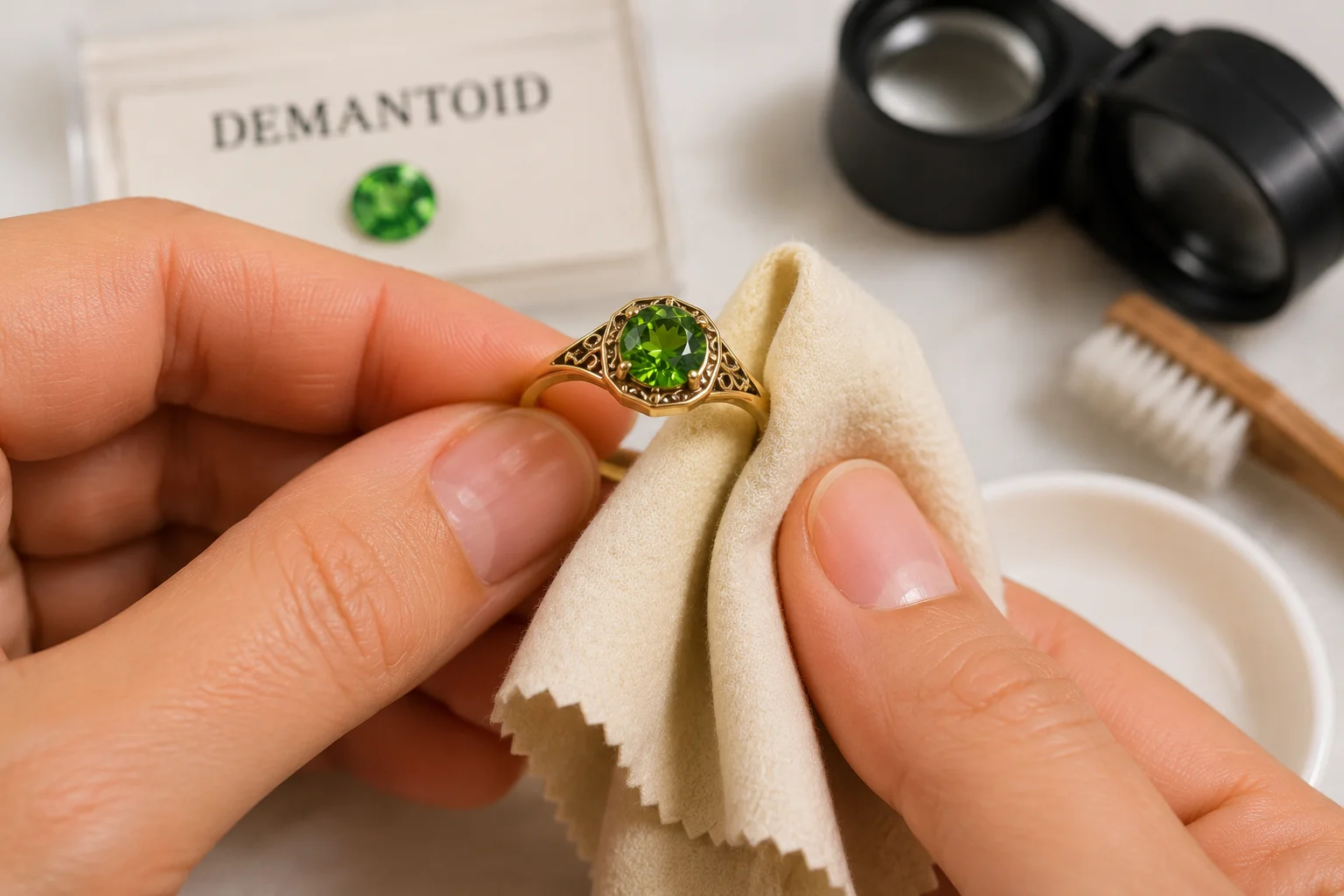

Clean demantoid with lukewarm water, a drop of mild dish soap, and a very soft brush, then rinse and pat dry. Two cautions matter more here than for any other garnet: never use an ultrasonic or steam cleaner, because horsetail inclusions can propagate into cracks, and handle it more gently overall, since demantoid is softer than its relatives at 6.5 to 7 rather than 7 to 7.5.
This guide covers demantoid care from every angle. You’ll learn the safe method, why the usual garnet advice doesn’t apply, storage, and when to involve a professional. At Gems Lore, we want your jewelry to last.
A quick note first. This is general educational information, not appraisal advice.
Demantoid Care at a Glance
- Lukewarm water, mild soap, soft brush. The only method you need.
- Never ultrasonic or steam. Horsetails are genuine stress points.
- Softer than other garnets. 6.5 to 7, so dust can abrade it.
- Sun-safe. The color is stable in light.
Why Demantoid Needs More Care Than Other Garnets
Generic garnet advice will steer you wrong here, so it’s worth understanding why demantoid is the exception.
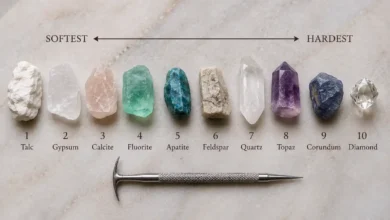
It’s softer. Most garnets are 7 to 7.5 on the Mohs scale. Demantoid is 6.5 to 7, because andradite is a softer species than pyrope or almandine. Our gemstone hardness chart puts this in context.
That number has a practical consequence people miss: ordinary household dust contains quartz, which sits at 7. A material softer than 7 can be abraded by dust. Wiping a dusty demantoid with a dry cloth is essentially sanding it, very slowly. Always clean it wet.
It’s often included. Russian demantoid frequently contains horsetail inclusions, which our demantoid garnet meaning guide explains actually raise value. But an inclusion is an internal discontinuity, and discontinuities are stress points.
It’s expensive. At $1,000 to $8,000+ per carat, the cost of a mistake is real.
The one thing working in your favor: demantoid has no cleavage, like the rest of the family, as our is garnet durable guide covers. It won’t split along a plane.
The Ultrasonic Rule: Just Don’t
For most garnets, ultrasonic cleaners are a “probably avoid if included” situation. For demantoid, it’s a firm no.
Ultrasonic cleaners work by vibrating liquid violently. That vibration propagates through the stone and concentrates at any internal discontinuity. A horsetail is precisely that: a fan of fine fibers radiating through the crystal.
Steam cleaners are equally unwise, applying thermal shock that stresses inclusions through differential expansion.
The horsetail that adds thousands to your stone’s value is exactly the feature most vulnerable to these machines. Soap and water achieves the same cleaning result with zero risk. There’s no upside to the gamble.
Tell your jeweler explicitly. Dropping rings in the ultrasonic tank is routine practice during servicing, often without asking. Say “this is demantoid, please clean it by hand.”
The Step-by-Step Method
Five minutes, nothing special required.
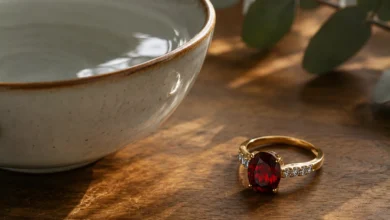
Fill a bowl with lukewarm water, not hot, and add a few drops of mild dish soap. Thermal shock is a genuine risk with included stones, so avoid temperature extremes and never run hot water over a cold stone.
Let the piece soak a few minutes to loosen oils. Take a very soft brush, a soft toothbrush or a baby toothbrush, and work gently over the stone and setting.
Concentrate on the back of the stone, underneath the setting. This is where lotion, soap film, and skin oils accumulate, and it’s the single biggest reason a gem looks dull. Light enters through the pavilion; block it with grime and even a demantoid loses its fire. Most people clean the top and wonder why the sparkle hasn’t returned.
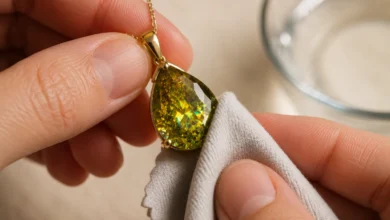
Rinse in clean lukewarm water, holding the piece over a bowl rather than an open drain. Pat dry with a soft, lint-free cloth, then let it air-dry fully.
What to Avoid
Ultrasonic and steam cleaners. The firm rule, as above.
Dry wiping. With a stone softer than quartz, dry dust becomes an abrasive. Clean wet or not at all.
Harsh chemicals. Bleach, chlorine, and household cleaners pit metal settings and can dull polish. Take rings off before cleaning the house.
Sudden temperature changes. Thermal shock stresses inclusions.
Prolonged soaking. A brief bath is fine; hours can loosen glued components.
Hard knocks. At 6.5 to 7, facet edges chip more readily than on a harder garnet.
Sunlight: No Problem
A genuine relief among the cautions.
Demantoid’s green comes from chromium in the crystal structure, and it’s stable in light. It will not fade, unlike amethyst, rose quartz, or citrine, which lose color with prolonged sun exposure.
Wear it in bright sun. Store it near a window. The color is permanent. The only heat caution is the extreme kind: don’t leave jewelry baking on a car dashboard, which stresses settings and included stones.
Everyday Wear Reality
Let’s be honest about what demantoid suits.
At 6.5 to 7 with real value at stake, demantoid makes a magnificent pendant, earring, or cocktail ring, and a questionable daily-wear engagement stone unless you’re genuinely careful. It isn’t fragile, but it’s softer than sapphire, softer than tsavorite, softer than its own garnet relatives.
If you do wear a demantoid ring regularly, choose a protective bezel setting, keep the profile low, and take it off for gardening, gym work, washing up, and heavy cleaning. Our demantoid garnet ring guide covers settings.
Take it off before showering and swimming. Not because demantoid minds water, but because soap film dulls fire and chlorine attacks settings.
Cleaning vs Cleansing
Two different ideas worth separating.
Cleaning is physical: removing dirt and oils so the stone looks bright. It demonstrably works, and it’s what this guide covers.
Cleansing is a spiritual ritual based on the belief that stones hold energy. There’s no scientific evidence for that, though many people find the ritual meaningful. If you practice it with demantoid, favor dry methods like moonlight or sound rather than water rituals or salt, given the stone’s value and inclusions. Our how to cleanse garnet guide covers the practice, and our garnet healing properties guide covers the lore honestly.
Storing Demantoid
Storage matters more for a soft, expensive stone.
Store each piece in its own soft pouch or lined box compartment. This cuts both ways: harder stones like sapphire, tsavorite, and diamond will scratch demantoid readily at 6.5 to 7, and demantoid will scratch softer stones like opal and pearl.
Keep it away from heat sources and harsh chemicals. Given the value, a proper box rather than a jumbled dish is a sensible investment.
When to See a Jeweler
Home cleaning handles appearance. A jeweler handles security, and with demantoid the stakes are high.
Have prongs and settings checked annually on anything worn regularly. A loose demantoid is a genuinely expensive loss, and replacing one in matching color, origin, and horsetail character may be impossible rather than merely costly.
Always tell them it’s demantoid and ask for hand cleaning only. Many jewelers will reflexively use the ultrasonic tank. Our how to clean garnet jewelry guide covers the family more broadly.
Consider insurance. At demantoid’s prices, it’s worth the conversation.
Frequently Asked Questions
How do you clean demantoid garnet jewelry?
Soak briefly in lukewarm water with a few drops of mild dish soap, brush gently with a very soft brush, concentrating on the back of the stone where grime collects, then rinse and pat dry. Never use ultrasonic or steam cleaners, and never wipe it dry when dusty.
Can I use an ultrasonic cleaner on demantoid?
No. Demantoid frequently contains horsetail inclusions, and ultrasonic vibration concentrates at those internal discontinuities and can propagate them into cracks. Steam is equally unwise due to thermal shock. Tell your jeweler explicitly, since tank cleaning is routine practice during servicing.
Is demantoid softer than other garnets?
Yes. Most garnets are 7 to 7.5 on the Mohs scale, but demantoid is 6.5 to 7, because andradite is a softer species. Since household dust contains quartz at 7, demantoid can be abraded by dry dust, which is why you should always clean it wet rather than wiping it.
Does demantoid fade in sunlight?
No. Its green comes from chromium in the crystal structure and is stable in light, unlike amethyst, rose quartz, or citrine, which fade with prolonged exposure. You can wear and store demantoid in bright light without concern. Only extreme heat, like a car dashboard, should be avoided.
Is demantoid suitable for an everyday ring?
It can be with care, but it’s a compromise. At 6.5 to 7 it’s softer than sapphire, tsavorite, and even other garnets, and it carries real value. Use a protective bezel setting, keep the profile low, and remove it for chores. It excels as a pendant or cocktail ring.
Why does my demantoid look dull?
Almost always a film of skin oil, lotion, and soap on the back of the stone, blocking the light path that produces its fire. Cleaning only the top won’t help. Brush gently underneath the setting with lukewarm soapy water, and the dispersion usually returns immediately.
Where to Go From Here
Demantoid asks for more care than its relatives, and it’s worth giving: lukewarm soapy water and a soft brush only, never the ultrasonic tank, never a dry wipe, and a protective setting if you wear it often. Respect the softness and the horsetail, and the family’s most fiery stone will keep flashing for generations.
Learn about the stone in our demantoid meaning guide, linked above, choose one with our buy demantoid garnet guide, or see values in our demantoid garnet price guide.
Have a demantoid care question? Ask us in the comments.
This guide is for general educational purposes and is not appraisal advice.