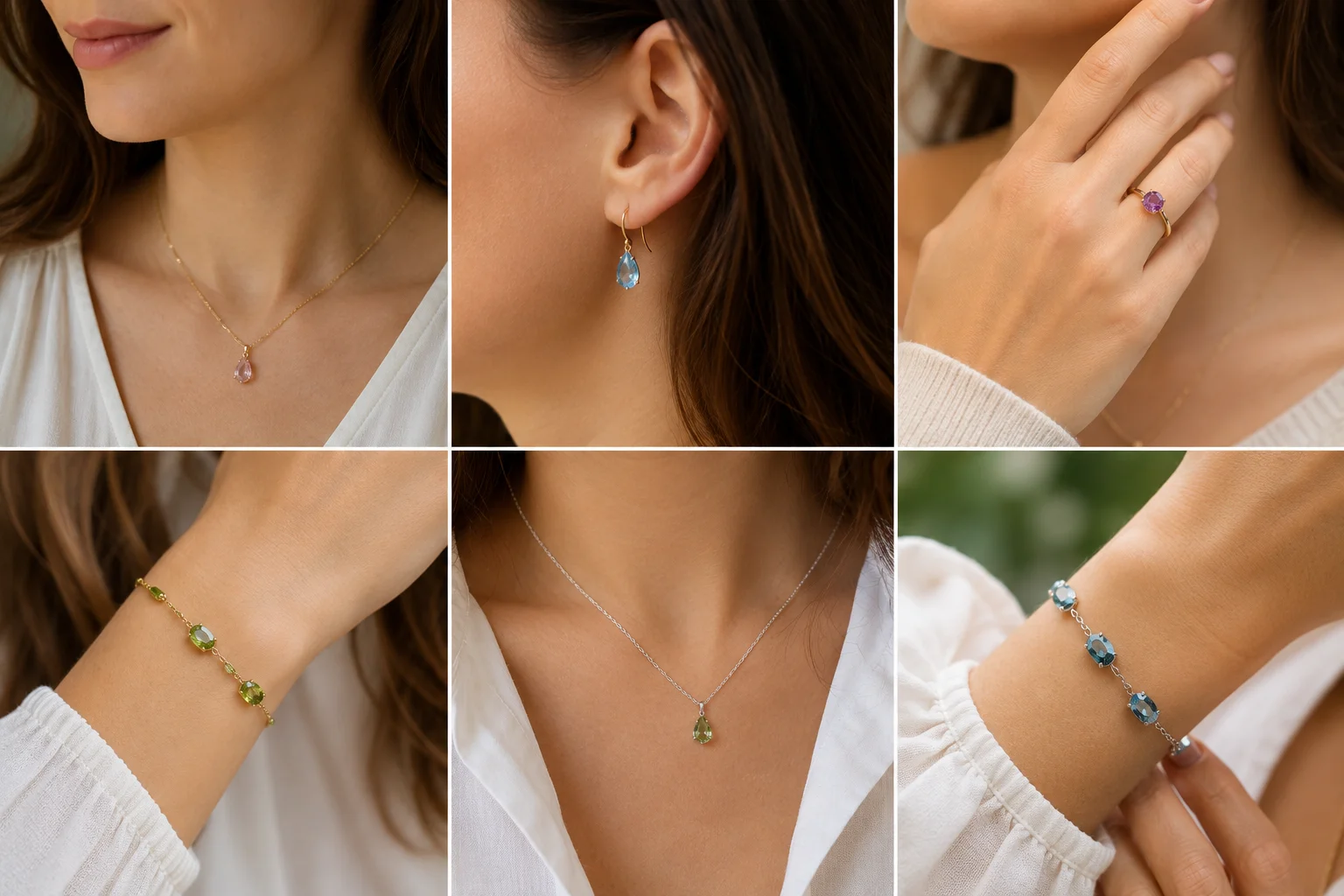
Best Gemstones for Everyday Wear: Value & Buying Guide
The best gemstones for everyday wear combine scratch resistance, toughness, structural stability and realistic maintenance rather than relying on a high Mohs number alone. Sapphire and ruby are outstanding natural colored-gem choices because corundum ranks Mohs 9, has excellent toughness and lacks cleavage, while diamond offers unmatched scratch resistance, moissanite provides exceptional durability with strong brilliance, and spinel or alexandrite can deliver unusual color without demanding the level of caution required by emerald, tanzanite or opal.
What counts as everyday wear also depends on the jewelry. A gemstone in earrings can survive conditions that would quickly damage the same material in an exposed ring, while bracelets experience repeated contact with desks, watches, metal links and hard surfaces. Pendants generally receive fewer impacts but still encounter cosmetics, perfume, clothing and cleaning products.
The best gemstones for everyday wear should therefore be chosen by combining the gemstone’s physical properties with jewelry format, setting design, treatment history and the wearer’s routine. “Everyday” should never mean wearing valuable jewelry through every possible activity without maintenance or removal.
Best Gemstones for Everyday Wear at a Glance
| Gemstone | Mohs hardness | Toughness / structural concern | Daily ring | Bracelet | Earrings / pendant |
|---|---|---|---|---|---|
| Diamond | 10 | Good toughness; cleavage | Excellent | Excellent with secure setting | Excellent |
| Sapphire | 9 | Excellent toughness; no cleavage | Excellent | Excellent | Excellent |
| Ruby | 9 | Excellent toughness; no cleavage | Excellent | Excellent | Excellent |
| Moissanite | About 9.25 | Strong practical durability | Excellent | Excellent | Excellent |
| Alexandrite | 8.5 | Excellent toughness; no cleavage | Excellent | Excellent | Excellent |
| Spinel | 8 | Good toughness | Excellent | Very good | Excellent |
| Chrysoberyl | 8.5 | Excellent practical durability | Excellent | Excellent | Excellent |
| Jadeite / nephrite | About 6–7 | Exceptional toughness; lower scratch resistance | Very good in suitable designs | Excellent | Excellent |
| Garnet | About 6.5–7.5 | Generally fair-to-good toughness | Good to very good | Good | Excellent |
| Aquamarine | 7.5–8 | Brittle; protect from hard knocks | Good | Good with care | Excellent |
| Morganite | 7.5–8 | Brittle; shows abrasion/dirt more readily | Good with care | Good with care | Excellent |
| Tourmaline | 7–7.5 | Fair toughness; heat/impact considerations | Good with protection | Good with care | Excellent |
| Quartz varieties | 7 | Reasonable durability | Good with care | Good | Excellent |
| Peridot | 6.5–7 | Moderate abrasion and impact resistance | Good with protection | Moderate | Excellent |
| Emerald | 7.5–8 | Common fissures and clarity filling | Conditional | Conditional | Very good |
| Topaz | 8 | Perfect cleavage | Conditional | Conditional | Very good |
| Zircon | About 6–7.5 | Brittle; facet-edge abrasion | Conditional | Moderate | Very good |
| Tanzanite | 6–7 | Cleavage; impact-sensitive | Higher-care | Higher-care | Very good |
| Moonstone | 6–6.5 | Cleavage and poor toughness | Higher-care | Higher-care | Good |
| Opal | About 5–6.5 | Variable stability, scratching and impact concerns | Higher-care | Higher-care | Good to very good |
| Turquoise | About 5–6 | Porosity and treatment vary | Higher-care | Moderate | Very good |
| Pearl | Relatively soft | Surface abrasion and chemical sensitivity | Higher-care | Higher-care | Excellent with proper care |
This table is a practical starting point rather than a guarantee. Fractures, treatment, setting condition and craftsmanship can make an individual stone more vulnerable than its species normally suggests.
What “Everyday Wear” Actually Means
The best gemstones for everyday wear are materials capable of tolerating routine jewelry use without requiring constant anxiety, but even highly durable stones should not be expected to survive unlimited abuse.
A sapphire ring can be worn to an office, restaurant, ordinary social activities and most routine daily situations. That does not mean it should remain on while using power tools, lifting heavy gym equipment, moving furniture, working with machinery or exposing the ring to aggressive household chemicals.
In many of those situations, the mounting is actually more vulnerable than the gemstone.
Prongs can bend.
A thin shank can distort.
Pavé stones can loosen.
A hard impact can chip an exposed gemstone edge even when the material has excellent overall durability.
The best gemstones for everyday wear therefore reduce maintenance risk; they do not eliminate the need for sensible jewelry habits.
Hardness Is Only One Part of Durability
The most common mistake when choosing the best gemstones for everyday wear is using the Mohs scale as though it were a complete durability ranking.
It is not.
Hardness measures resistance to scratching.
Toughness describes resistance to chipping and breaking.
Cleavage describes a structural tendency to split along particular crystallographic planes.
Stability describes resistance to effects such as heat, light and chemicals.
GIA treats all three—hardness, toughness and stability—as central components of gemstone durability.
The Gems Lore explanation of gemstone toughness vs hardness shows why jade can be exceptionally tough despite moderate hardness, while a harder mineral such as topaz can remain vulnerable to a concentrated blow because of cleavage.
That distinction is fundamental when comparing the best gemstones for everyday wear.
1. Sapphire: Best Overall Natural Colored Gemstone
Sapphire is one of the best gemstones for everyday wear because it combines Mohs hardness 9 with excellent toughness and no cleavage.
It is corundum, the same mineral species as ruby.
That durability means a sound sapphire can perform extremely well in rings, bracelets, necklaces and earrings without requiring the degree of caution associated with many other colored gemstones.
Color choice is another advantage.
Sapphire can be blue, pink, yellow, orange, green, teal, violet, colorless, gray, parti-colored and several intermediate shades. Red corundum is classified separately as ruby.
This makes sapphire unusually flexible for someone who wants durability without committing to one visual style.
Treatment Still Matters
Heat treatment is common and generally stable under normal wear.
Other treatment categories include lattice diffusion, filling and dyeing, and those should be described accurately because treatment can influence value and sometimes care.
A fracture-filled sapphire deserves more conservative cleaning than a sound untreated or conventionally heated stone.
The comparison of sapphire vs emerald vs ruby shows why sapphire and ruby generally demand less maintenance than fissure-rich emerald.
For buyers wanting natural color plus low-maintenance wear, sapphire remains one of the strongest best gemstones for everyday wear.
2. Ruby: Best Everyday Red Gemstone
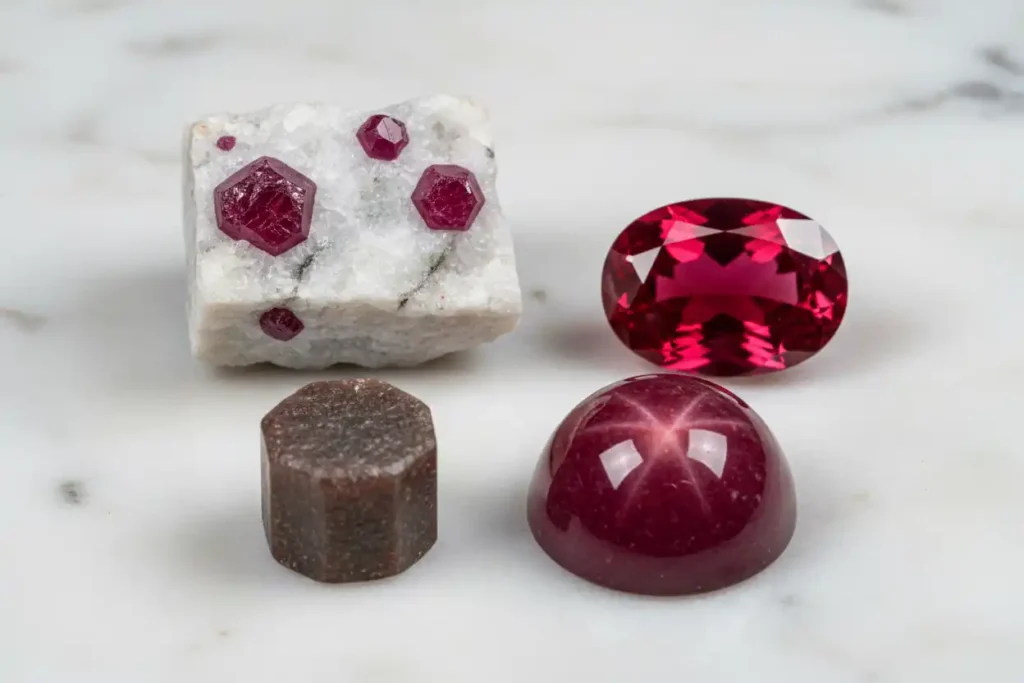
Ruby shares sapphire’s corundum structure, Mohs hardness 9, excellent toughness and absence of cleavage.
That combination makes ruby one of the best gemstones for everyday wear when saturated red is the goal.
A ruby can perform extremely well as a ring center, bracelet stone, pendant or pair of earrings when the individual gem is structurally sound.
The important complication is treatment.
Conventional heat-treated ruby remains highly durable, while glass-filled ruby requires significantly more caution because the glass within surface-reaching fractures does not share corundum’s resistance to heat and chemicals.
A ring labeled simply “ruby” therefore does not tell you enough.
Ask whether the gemstone is natural or laboratory grown and whether it has been heated, diffusion treated, fracture filled or subjected to another enhancement.
The underlying ruby properties explain why sound corundum itself performs so well in frequently worn jewelry.
3. Moissanite: Best Durable Non-Diamond Colorless Gem
Moissanite is one of the best gemstones for everyday wear for someone who wants a colorless or near-colorless center stone with high brilliance and excellent abrasion resistance.
Commercial jewelry moissanite is laboratory-created silicon carbide.
Its hardness of about 9.25 places it below diamond but above corundum on the conventional Mohs scale.
The stone also has strong practical durability, making it particularly suitable for rings.
Its visual behavior differs from diamond.
Moissanite’s much stronger dispersion produces abundant rainbow-colored flashes, especially in larger brilliant cuts and concentrated lighting. Some people prefer that appearance; others prefer diamond’s more restrained balance of white brightness and fire.
The detailed moissanite guide explains why the stone should be appreciated as silicon carbide rather than described as a synthetic diamond.
Among the best gemstones for everyday wear, moissanite is particularly compelling when durable performance and visible size matter more than natural geological origin.
4. Diamond: Best for Scratch Resistance
Diamond has the greatest scratch resistance of any standard jewelry gemstone, ranking Mohs 10.
That makes it an obvious inclusion among the best gemstones for everyday wear.
However, diamond is not indestructible.
Its crystal structure contains cleavage directions, which means a sufficiently hard impact in an unfavorable direction can chip or split the material.
Exposed girdles and pointed shapes such as pear, marquise and princess cuts deserve proper setting protection.
The broader diamond properties guide explains how mineral identity, cut, treatment and laboratory-grown origin affect the material beyond hardness alone.
A diamond worn every day still depends on the ring around it. Loose prongs can allow an undamaged stone to fall out, while worn metal can fail long before the center diamond shows substantial abrasion.
5. Alexandrite and Chrysoberyl: Exceptional Durability With Rarity
Chrysoberyl ranks Mohs 8.5 and offers excellent toughness, making it one of the strongest natural colored-gem materials used in jewelry.
Alexandrite is the color-changing chromium-bearing variety of chrysoberyl.
Its durability is unusually favorable: high scratch resistance, excellent toughness and no cleavage.
That places alexandrite among the best gemstones for everyday wear mechanically, although fine natural material can be expensive and difficult to replace.
The alexandrite guide explains why its greenish-to-reddish light-dependent color change is different from simple pleochroism or a permanent color treatment.
Replacement difficulty deserves consideration.
A common calibrated sapphire may be easier to match after accidental loss than a natural alexandrite with a distinctive color-change pattern.
For very valuable jewelry, documentation and insurance become part of practical everyday ownership.
6. Spinel: One of the Best Underappreciated Daily-Wear Gems
Spinel ranks Mohs 8 and has good toughness, making it suitable for rings and other frequently worn jewelry.
This combination places it firmly among the best gemstones for everyday wear.
Natural spinel also offers red, pink, orange, purple, blue, gray, black and near-colorless material.
The variety provides far more design flexibility than its historical association with ruby might suggest.
The spinel guide explains the mineral’s magnesium-aluminum oxide composition and why modern gemology separates it clearly from corundum.
Treatment is comparatively limited in much of the spinel market, although heated and fracture-filled material can occur and synthetic spinel is widely available.
For a natural colored gemstone that combines unusual identity, strong durability and broad color choice, spinel deserves serious consideration.
7. Jade: Moderate Hardness, Extraordinary Toughness
Jade demonstrates why the best gemstones for everyday wear cannot be ranked by hardness alone.
Jadeite generally sits around Mohs 6.5–7, while nephrite is around 6–6.5.
Those figures are modest compared with sapphire.
Yet both materials possess exceptional toughness because of their interlocking structures.
This is why jade can perform so impressively in bangles, cabochons and carvings.
A well-made jade bangle can tolerate impacts that might fracture a harder but more brittle crystal.
The trade-off is surface abrasion.
Quartz, sapphire, diamond and other harder materials can scratch jade, so stacking a valuable jade bangle directly beside harder gemstones or abrasive metal edges can gradually damage its polish.
Jade is therefore one of the best gemstones for everyday wear when impact resistance matters, particularly in substantial smooth forms, but it still benefits from thoughtful storage and treatment disclosure.
8. Garnet: Strong Everyday Value Across Many Colors
Garnet represents a mineral group rather than one identical red gemstone.
Different garnets can range roughly from the mid-6s into the mid-7s on the Mohs scale, with many varieties offering fair-to-good toughness and no prominent cleavage.
That makes garnet one of the more practical best gemstones for everyday wear at a broad range of budgets.
Red almandine and pyrope can provide affordable traditional jewelry.
Rhodolite offers raspberry-to-purple-red color.
Spessartine can be orange.
Tsavorite and demantoid create very different green choices.
Some garnets even show color change.
A ring still deserves greater caution than sapphire because garnet’s scratch resistance is lower, but well-cut, structurally sound stones can give many years of regular wear.
For earrings and pendants, garnet is especially easy to recommend.
9. Aquamarine and Morganite: Good, but Not Corundum-Level
Aquamarine and morganite are beryl varieties with hardness around 7.5–8.
That provides respectable scratch resistance, and both can work well in regular jewelry when protected from hard knocks.
They are nevertheless more brittle than sapphire and ruby.
Large stones deserve particular attention because aquamarine and morganite commonly occur in sizes that would be extremely expensive in ruby, sapphire or alexandrite.
A ten-millimeter stone presents a larger target for impact than a small gem, regardless of hardness.
A low setting can therefore improve the everyday practicality of large beryl jewelry.
Aquamarine is particularly strong in earrings, pendants and carefully designed rings.
Morganite performs similarly but can show surface dirt and oil quickly because its pale body color depends on clean light return.
These are good best gemstones for everyday wear for people willing to remove rings during impact-prone activity.
10. Tourmaline: Excellent Color, Moderate Maintenance
Tourmaline’s greatest advantage is color diversity.
Pink, red, green, blue, teal, yellow, orange, brown, black and multicolored crystals all occur.
At approximately Mohs 7–7.5, tourmaline offers useful resistance to everyday scratching but does not reach the low-maintenance level of sapphire or spinel.
Its toughness is generally fair, and sudden temperature changes can present an additional concern.
Tourmaline rings can work well with sensible wear and a protective setting.
Earrings and pendants are easier.
When choosing the best gemstones for everyday wear by color rather than by gem name, tourmaline becomes particularly attractive because unusual shades may be difficult to find in more durable materials.
Quartz: Practical for Everyday Jewelry With Realistic Expectations
Amethyst, citrine, smoky quartz and rock crystal all belong to the quartz species and rank Mohs 7.
That hardness is sufficient for many forms of regular jewelry.
Earrings and pendants are particularly practical.
Bracelets and rings can also work, but surface abrasion accumulates faster than it would on corundum, moissanite or diamond.
Quartz has no cleavage, which helps its structural behavior, though individual stones can still contain fractures.
Its abundance also offers a practical advantage: replacement is generally easier than with scarce collector gems.
Among affordable best gemstones for everyday wear, quartz varieties provide an excellent balance of color, size and replaceability when sapphire-level abrasion resistance is unnecessary.
Emerald: Hard Enough, but Often Fracture-Limited
Emerald illustrates why hardness cannot answer the everyday-wear question by itself.
It is beryl and ranks Mohs 7.5–8.
That sounds strong.
However, natural emerald commonly contains fissures, and many fashioned stones are clarity enhanced with oil, resin or polymer.
GIA rates emerald’s toughness as fair to good and recommends more careful wear than ruby or sapphire.
A well-chosen emerald can absolutely remain beautiful for generations, but it is not one of the lowest-maintenance best gemstones for everyday wear.
Rings benefit from protective settings and a wearer who removes them before heavy physical tasks.
Earrings and necklaces provide an easier way to wear valuable emerald frequently because they receive fewer impacts.
Steam and ultrasonic cleaning are poor default choices for clarity-enhanced emerald. Gentle warm soapy water is safer.
Topaz: Why Mohs 8 Can Still Be Misleading
Topaz is hard.
At Mohs 8, it resists scratches reasonably well.
It also has perfect basal cleavage.
That cleavage means an impact in the wrong direction can split the gem despite its high hardness.
This makes topaz one of the clearest examples of why the best gemstones for everyday wear should not be chosen from a hardness chart alone.
The mechanism is explained in gemstone cleavage.
Blue topaz, imperial-type colors and colorless topaz can all make excellent jewelry, particularly in earrings and pendants.
A ring can also work with protection and sensible habits.
It is simply not as forgiving as sapphire, spinel or chrysoberyl.
Zircon: Beautiful Fire With More Surface Wear
Natural zircon is not cubic zirconia.
Zircon is zirconium silicate and can produce intense brilliance and dispersion when transparent material is cut well.
Its durability varies with structural condition, but jewelry zircon generally has substantially lower scratch resistance than sapphire and is brittle.
Facet junctions can develop abrasion, particularly in rings.
This makes zircon much easier to recommend for earrings and pendants than for a ring expected to remain on continuously.
A protected occasional-to-regular ring can still work.
Among the best gemstones for everyday wear, zircon is a better choice for someone who values natural fire and accepts maintenance rather than someone who wants a stone that looks newly polished with minimal care for decades.
Peridot: Wearable but Better With Protection
Peridot generally ranks Mohs 6.5–7.
Its bright yellow-green to green color is natural to the iron-bearing olivine structure and provides an appearance that is difficult to duplicate exactly with other gemstones.
It is practical for earrings and pendants.
Rings can also work, especially in low settings, although the surface will accumulate wear more readily than sapphire or spinel.
Large exposed peridot rings should be removed during manual tasks.
Peridot therefore sits in the middle of a best gemstones for everyday wear ranking: genuinely wearable, but not a gemstone for someone who refuses to modify any daily habits.
Tanzanite: Better for Frequent Earrings Than Frequent Rings
Tanzanite is a blue-violet variety of zoisite with moderate hardness and important cleavage.
Its appearance can be exceptional, but the physical profile is less forgiving than sapphire.
A concentrated blow can exploit cleavage, while long-term ring wear can gradually abrade the surface.
Tanzanite can still be worn regularly.
The jewelry format should simply reflect its limitations.
Earrings and pendants are excellent choices because they minimize impact.
A protected ring is suitable for a careful wearer.
An exposed tanzanite ring worn through gym sessions, household work and physical labor is a much less convincing everyday proposition.
The best gemstones for everyday wear should reduce the need to constantly worry about the jewelry, which is why tanzanite sits below corundum, spinel and chrysoberyl for demanding rings.
Moonstone, Opal, Turquoise and Pearl Need More Care
Some beautiful gem materials are better described as frequent-wear choices in the right jewelry than unrestricted everyday stones.
Moonstone
Moonstone generally ranks Mohs 6–6.5 and has cleavage.
A low bezel can protect a cabochon, but an exposed ring will scratch and chip more readily than sapphire or garnet.
The practical limits of moonstone rings illustrate why adularescence does not compensate for structural vulnerability.
Opal
Opal varies widely.
Precious opal can be vulnerable to scratching, hard impact and, depending on type and construction, environmental changes or liquid absorption.
Doublets and triplets introduce additional bonding and care considerations.
It is outstanding in earrings and pendants and workable in protected rings for informed wearers.
Turquoise
Turquoise usually falls around Mohs 5–6 and can be porous.
Stabilization is common and can improve wearability, but dyes, polymers, cosmetics, skin oils and chemicals complicate care.
Pearl
Pearl has a relatively soft surface that can be damaged by abrasive contact, perfume, hairspray and cosmetics.
Pearl earrings and necklaces can be worn extremely often when cared for properly.
An everyday pearl ring is much more exposed.
The best gemstones for everyday wear should always be ranked according to the actual jewelry format.
Everyday Rings Have the Toughest Requirements
A ring is usually the most demanding environment for a gemstone.
Hands strike countertops, handles, furniture and tools throughout the day. Rings also encounter soap, lotion, sanitizer, water and metal objects.
For unrestricted-to-low-maintenance daily rings, begin with:
Sapphire, ruby, diamond, moissanite, alexandrite, chrysoberyl and spinel.
Jade can also perform very well in appropriately designed cabochon or hololith rings because of its exceptional toughness, though it scratches more readily.
Garnet, aquamarine, morganite and tourmaline can work successfully when the wearer accepts some care.
Emerald, topaz, tanzanite, moonstone and opal require progressively more informed protection.
The best gemstones for everyday wear in rings are therefore a much shorter list than the best stones for everyday earrings.
Everyday Bracelets Need Both Stone and Construction Durability
Bracelets encounter desks, laptop edges, doorways, watches and other jewelry throughout the day.
Beaded bracelets introduce another issue: neighboring stones repeatedly rub or knock against each other.
Hard sapphire beads can scratch softer materials.
Jade bangles are extraordinarily tough but can still suffer surface abrasion when stacked with diamond or harder abrasive components.
Links, clasps, elastic, wire and string may fail before the gemstones themselves.
Consequently, evaluating the best gemstones for everyday wear in bracelets means checking the entire object rather than only the stone.
A durable gemstone on weakened elastic is not a durable bracelet.
Earrings Are the Easiest Format for Delicate Gems
Earrings experience relatively little impact.
That makes them an excellent format for materials that would require too much caution in rings.
Pearl, opal, turquoise, tanzanite, moonstone, lapis lazuli and other moderate-durability gems can all be worn frequently in earrings when the settings and posts are secure.
Weight becomes more important than hardness for large earrings.
A heavy pair can stretch piercings or tilt forward even when the stones themselves are extremely durable.
For many people, the best gemstones for everyday wear in earrings are simply the gems they enjoy most, provided the material is stable against cosmetics and the metal components are suitable.
Pendants and Necklaces Expand the Choices Further
Pendants generally receive less abrasion than rings and bracelets, although long chains can allow a gemstone to strike desks or other objects.
The bail, chain and clasp deserve as much attention as the stone.
Emerald, opal, turquoise, moonstone, tanzanite and pearl become much easier everyday options when moved away from the hand.
Large stones are also more comfortable to wear at the neck than on a finger.
This is why a broad list of the best gemstones for everyday wear should never rate a material as simply “good” or “bad.” Jewelry position changes the answer.
Setting Design Can Upgrade Practical Wearability
A setting cannot change a gemstone’s physical properties, but it can reduce exposure.
A low full bezel gives strong perimeter protection.
Partial bezels can protect vulnerable sides without hiding as much of the stone.
A halo can create a buffer around a center gemstone, although it introduces additional small stones and prongs requiring maintenance.
Substantial prongs work well for durable materials when their contact points are positioned correctly.
V-prongs are useful for protecting pointed pears and marquises.
High open settings create greater exposure and leverage.
For the best gemstones for everyday wear, good setting design matters most when the stone sits in the middle durability range rather than at either extreme.
Shape Affects Everyday Durability
Rounded shapes eliminate vulnerable tips.
Round and oval stones therefore tend to be mechanically forgiving.
Cushions can also perform well when corners are not excessively thin.
Pear, marquise and heart shapes contain points requiring protection.
Princess and other square cuts can expose corners.
Emerald cuts do not have sharp needle-like points but still need secure corner support, especially when the individual stone contains fissures.
A beautiful cut is not automatically a practical everyday cut if the mounting leaves its weakest areas exposed.
Treatment Can Change the Care Answer
Treatment is one of the most important reasons two gemstones of the same species may require different maintenance.
An untreated or conventionally heated ruby is extremely durable.
A lead-glass-filled ruby requires far more cautious handling.
A sound sapphire can tolerate normal jewelry use very well, while a filled or dyed sapphire may have stricter cleaning limits.
Emerald fillers can be affected by heat and chemicals.
Turquoise stabilization can improve practical strength, while dye or surface coatings introduce different concerns.
The best gemstones for everyday wear should therefore be purchased with written treatment disclosure rather than broad statements such as “natural stone.”
Natural origin and treatment status are separate facts.
Lab-Grown Stones Can Be Excellent for Everyday Wear
Laboratory growth does not automatically reduce durability.
A laboratory-grown sapphire has corundum’s fundamental crystal structure.
A laboratory-grown ruby is corundum.
A laboratory-grown diamond is diamond.
Commercial moissanite is laboratory-created silicon carbide and performs exceptionally well in daily jewelry.
The important questions are material identity, treatments or coatings, manufacturing quality and accurate disclosure.
A lower purchase price can even make laboratory-grown material attractive for daily jewelry because replacement may be less financially painful after accidental loss.
The best gemstones for everyday wear do not have to be geologically rare.
Value Means More Than Purchase Price
The cheapest stone is not automatically the best value for jewelry worn constantly.
Consider:
purchase cost + maintenance + setting cost + replacement difficulty + expected surface wear
A relatively inexpensive stone that needs repolishing or replacement after heavy wear may become less economical than a more durable initial purchase.
On the other hand, geological rarity does not automatically improve durability.
A very expensive opal remains an opal.
A rare emerald with significant fissures can remain more vulnerable than a modest sapphire.
The best gemstones for everyday wear provide value when the material’s actual performance matches what the wearer is paying for.
Replaceability Matters
A gemstone can be physically durable yet difficult to replace.
Fine natural alexandrite is an example.
An unusual parti sapphire, rare spinel color or precision-cut collector gemstone may also be difficult to match if lost.
Everyday jewelry containing rare material should have accurate measurements, photographs and documentation.
Insurance can be sensible for high-value pieces.
For common commercial stones, replacement may be easier and cheaper than extensive insurance.
This practical replacement question often matters more than a small difference in hardness.
Buying the Best Gemstones for Everyday Wear Online
Online photographs cannot show durability.
Ask for the exact gemstone identity, natural or laboratory-grown origin, treatment, dimensions and condition.
For rings, request side views showing setting height and girdle exposure.
Look closely for surface-reaching fractures, chips, abraded facet junctions and thin corners.
Confirm what the seller recommends for cleaning.
A valuable stone should come with appropriate independent documentation when identity, treatment or origin materially affects the price.
Do not rely on destructive scratch tests after purchase.
The strongest best gemstones for everyday wear are still better evaluated through gemological information than home damage experiments.
Best Gemstones for Everyday Wear by Lifestyle
Minimal-Removal Wearer
If you want jewelry that requires the least thought during ordinary daily life, begin with sapphire, ruby, diamond, moissanite, spinel or chrysoberyl.
You should still remove valuable rings for heavy mechanical activity.
Office and Light-Activity Wearer
The options expand to garnet, aquamarine, morganite, tourmaline, quartz and carefully selected jade.
A protected setting makes the middle-durability stones much easier to live with.
Careful Jewelry Wearer
If you routinely remove rings for cooking, cleaning, exercise, bathing and manual work, emerald, topaz, tanzanite, moonstone and opal become much more realistic.
The best gemstones for everyday wear depend partly on how willing you are to modify habits.
How to Clean Everyday Gemstone Jewelry
Warm water, mild soap and a soft brush are the safest general starting point for many durable gemstones.
That does not mean every stone should be soaked or mechanically cleaned.
Emerald fillers require caution.
Pearls and porous materials have different needs.
Opal type and construction matter.
Turquoise treatments matter.
Fracture-filled gemstones should not be treated like sound untreated crystals.
GIA specifically recommends learning the treatment history before choosing aggressive cleaners, steam or ultrasonics.
When in doubt, use the gentlest effective method and have valuable jewelry inspected professionally.
Storage Is Part of Everyday Wear
Durable gemstones can damage one another when stored carelessly.
Diamond can scratch nearly every other jewelry stone.
Sapphire and ruby can scratch quartz, jade, tourmaline, garnet and softer materials.
A hard gemstone ring tossed into a container with pearl jewelry can damage the pearl surface.
Use individual compartments or soft pouches.
Storage matters especially for the best gemstones for everyday wear because frequently worn pieces are handled and removed more often, increasing the number of opportunities for accidental contact.
Frequently Asked Questions
What are the best gemstones for everyday wear?
The best gemstones for everyday wear include sapphire, ruby, diamond, moissanite, alexandrite, chrysoberyl and spinel. They combine strong scratch resistance with good-to-excellent practical toughness, although every gemstone still requires sensible jewelry care.
What is the best colored gemstone for everyday wear?
Sapphire is one of the strongest overall choices. Corundum ranks Mohs 9, has excellent toughness and no cleavage, and sapphire occurs in a very broad range of colors.
Is ruby good for everyday wear?
Yes. Ruby is corundum and combines Mohs hardness 9, excellent toughness and no cleavage. Untreated and conventionally heated ruby are highly durable, while glass-filled material requires additional care.
Is moissanite good for everyday wear?
Yes. Moissanite’s hardness of approximately 9.25 and strong practical durability make it particularly suitable for frequently worn rings and other jewelry.
Is spinel suitable for everyday jewelry?
Yes. Spinel ranks Mohs 8 and has good toughness, making it durable enough for rings and other jewelry subject to regular wear.
Is alexandrite durable enough for daily wear?
Yes. Alexandrite is chrysoberyl, with Mohs hardness around 8.5, excellent toughness and no cleavage. Fine natural material can be difficult to replace, so valuable pieces deserve careful documentation.
Is jade one of the best gemstones for everyday wear?
Jade can be excellent for everyday wear because jadeite and nephrite have exceptional toughness. Their moderate hardness means the polish can still be scratched by quartz, sapphire and harder materials.
Is emerald suitable for everyday wear?
Emerald can be worn regularly, but it requires more care than sapphire or ruby because natural emerald commonly contains fissures and clarity enhancement. Protective settings and gentle cleaning are advisable.
Is topaz good for everyday wear?
Topaz has Mohs hardness 8 but perfect cleavage, so it is not as impact-resistant as its hardness number might suggest. Earrings and pendants are easy choices; rings require more thoughtful protection.
Can opal be worn every day?
Some people wear opal frequently, particularly in protected settings, but it is a higher-maintenance choice. Scratching, impact, crazing, porosity and assembled construction can all affect the correct care strategy.
Is moonstone suitable for daily rings?
Moonstone can work for a careful wearer in a protective bezel, but cleavage and moderate hardness make it much less forgiving than sapphire, spinel or chrysoberyl.
Are pearls suitable for everyday wear?
Pearl earrings and necklaces can be worn very frequently with proper care. Pearl rings and bracelets receive more abrasion and chemical exposure, so they require greater caution.
Does Mohs 7 mean a gemstone is safe for everyday wear?
Not automatically. Mohs 7 describes scratch resistance, while toughness, cleavage, fractures, treatment and jewelry format also affect durability. Quartz is much more suitable for many everyday applications than a cleavage-sensitive material with a similar hardness.
What is the best everyday gemstone for an active lifestyle?
Sapphire, ruby, diamond, moissanite, spinel and chrysoberyl are the strongest general candidates. Even these should be removed during heavy lifting, machinery use and activities likely to bend or crush the setting.
Which gemstones are best for everyday earrings?
Almost every stable jewelry gemstone becomes easier to wear in earrings because impact exposure is low. Durable options include sapphire, ruby, spinel and garnet, while more delicate materials such as pearl, opal, tanzanite and moonstone also perform far better in earrings than exposed rings.
Which gemstones are best for everyday bracelets?
Sapphire, ruby, diamond, moissanite, spinel and jade are strong options when the bracelet construction is robust. Bracelets receive more abrasion than necklaces, and stacking harder stones against softer materials can create wear.
Do lab-grown gemstones work for everyday jewelry?
Yes. Properly disclosed laboratory-grown diamond, ruby and sapphire have the essential material properties of their respective gem species. Commercial moissanite is also laboratory-created and is one of the most durable jewelry choices.
Does gemstone treatment affect everyday durability?
It can. Conventional heating may leave ruby and sapphire highly durable, while glass filling, resin filling, dyeing, coating or other treatments can introduce stricter cleaning and repair limitations.
What is the best setting for a gemstone worn every day?
A low bezel offers excellent perimeter protection. Secure low prong settings can also work very well for durable gems. Vulnerable points, corners and fractured stones require additional protection.
What matters most when choosing the best gemstones for everyday wear?
Evaluate hardness, toughness, cleavage, stability, fractures, treatment, jewelry format, setting design and your actual lifestyle together. The best everyday gemstone is not simply the hardest material—it is the one whose complete durability profile matches how the jewelry will really be worn.