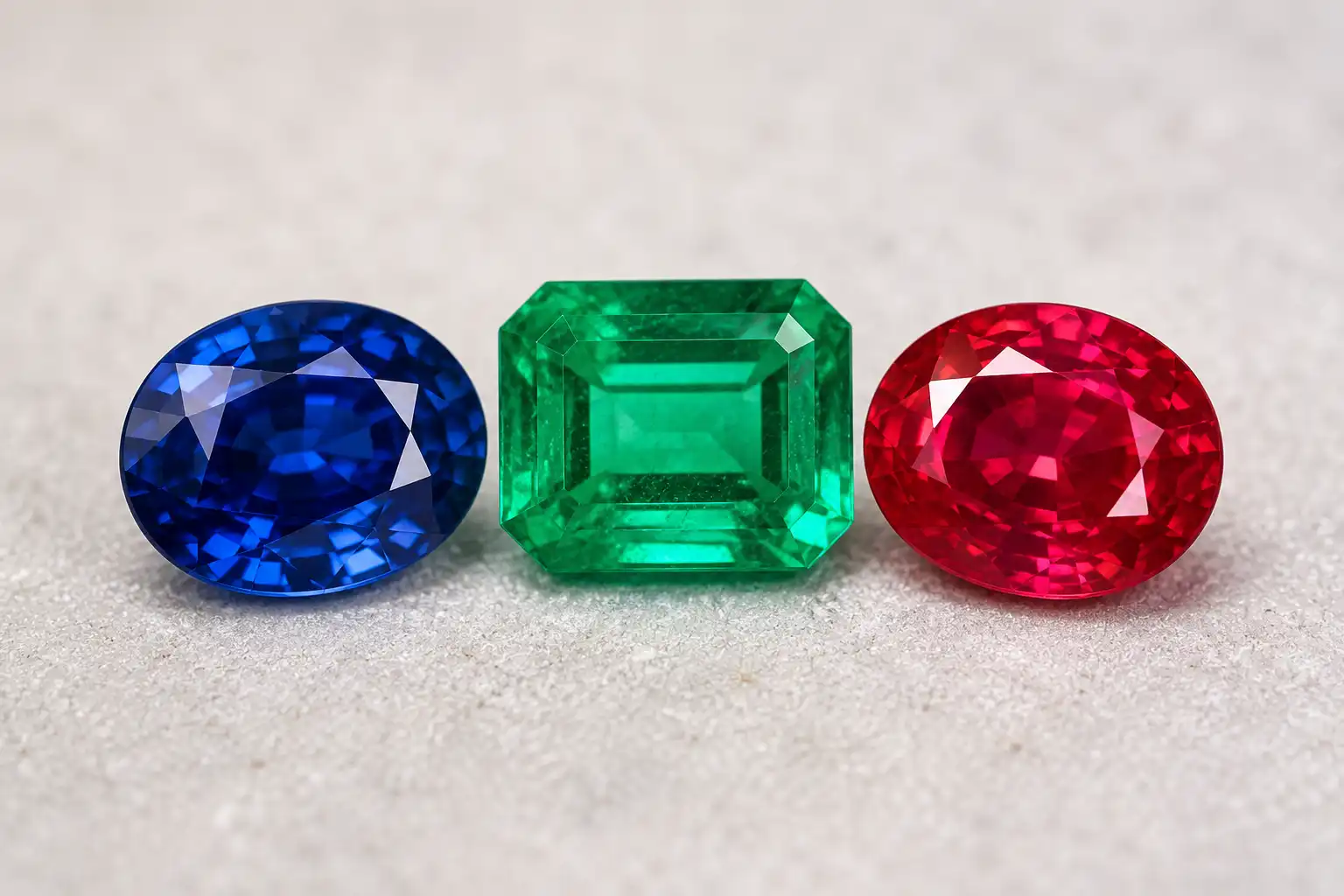
Sapphire vs Emerald vs Ruby: Durability, Value and Buying Guide
Sapphire, emerald and ruby form the traditional “Big Three” of colored gemstones. Each can produce exceptional jewelry, yet they differ sharply in color range, durability, inclusion patterns, treatments, rarity and long-term maintenance.
Ruby and sapphire are both corundum. Ruby is the red variety, while sapphire includes blue and nearly every other corundum color. Both rank 9 on the Mohs scale and lack perfect cleavage, making them strong choices for rings, bracelets and jewelry worn frequently.
Emerald is the bluish-green to green variety of beryl. It ranks 7.5–8, but its typical internal fissures make it less tolerant of impact than ruby or sapphire. Emerald can last for generations when selected carefully and worn responsibly, though it requires a more protective setting and gentler cleaning.
The best choice is therefore not simply the most expensive stone. It is the gemstone whose color, treatment history, maintenance needs and budget fit the intended jewelry.
Sapphire vs Emerald vs Ruby at a Glance
| Factor | Sapphire | Emerald | Ruby |
|---|---|---|---|
| Mineral species | Corundum | Beryl | Corundum |
| Main color | Best known for blue; also pink, yellow, green, white, purple and more | Bluish green to green | Red to slightly purplish red |
| Mohs hardness | 9 | 7.5–8 | 9 |
| Cleavage | None | Indistinct basal cleavage; fractures are more important in practice | None |
| Practical toughness | Excellent in sound material | Fair to good; commonly fracture-limited | Excellent in sound material |
| Typical clarity | Often included but may be eye-clean | Eye-visible inclusions are common and accepted | Inclusions are common; fine eye-clean stones are rare |
| Most important quality factor | Color | Color | Color |
| Common treatment | Heat and lattice diffusion | Oil, resin or other fracture filling | Heat; diffusion and glass filling also occur |
| Common lab-grown version | Yes | Yes | Yes |
| Best daily-wear use | Rings, bracelets, earrings and necklaces | Protected rings, earrings and necklaces | Rings, bracelets, earrings and necklaces |
| Typical rarity pattern | Fine unheated blue and rare fancy colors command premiums | Fine vivid, transparent, lightly enhanced stones are scarce | Fine vivid red over one carat is exceptionally scarce |
| Birthstone month | September | May | July |
| Traditional symbolism | Wisdom, loyalty and truth | Renewal, love and insight | Vitality, courage and devotion |
The Fundamental Difference
Sapphire and ruby are two color categories within corundum.
Chemically pure corundum is colorless aluminum oxide. Trace elements create its colors. Iron and titanium commonly contribute to blue sapphire, while chromium produces red ruby and pink sapphire.
Emerald belongs to beryl, a beryllium aluminum silicate family that also includes aquamarine and morganite. Chromium, vanadium or both contribute to its green color.
Consequently, ruby and sapphire share almost identical basic physical properties. Emerald differs in structure, density, refractive index, typical crystal habit and response to impact.
Which Stone Has the Best Color?
Color preference is personal, but each gemstone has a recognized quality range.
Fine blue sapphire generally shows strong-to-vivid blue or violetish blue at a medium to medium-dark tone. The color should remain visible under ordinary indoor light rather than appearing black.
Fine emerald shows vivid bluish green to pure green without becoming excessively dark. High transparency and evenly distributed color are especially prized, although natural inclusions are expected.
Fine ruby shows vivid red to slightly purplish red. The best stones avoid excessive orange, purple, darkness or paleness.
Color should be examined under daylight-equivalent and warm indoor light. Retail spotlights can make dark stones look brighter and can conceal zoning or extinction.
Which Gemstone Offers the Widest Color Range?
Sapphire offers the widest range.
In addition to blue, sapphire occurs in pink, yellow, orange, green, purple, white, gray, black, parti-colored and color-changing varieties. Red corundum is separated as ruby.
The major sapphire shades are explained in Sapphire Color Meaning and Symbolism and Types of Sapphire.
Ruby remains within the red family, although its undertones can include pink, purple, orange and brown.
Emerald occupies a narrower green range. Beryl that is too pale, too blue or outside accepted emerald color may be classified as green beryl or another beryl variety rather than emerald.
Choose sapphire when color flexibility is the priority. Choose ruby or emerald when a classic saturated red or green is central to the design.
Durability: Which Is Best for Everyday Wear?
Sapphire and ruby are the strongest choices for frequent wear.
Both rank 9 on the gemstone hardness chart. Their lack of perfect cleavage also reduces the chance of splitting along one structural plane.
Emerald ranks lower at 7.5–8 and is typically more fractured. Those fissures make it vulnerable to impact even though its surface hardness appears respectable.
The difference between resistance to scratching and resistance to breaking is explained in Gemstone Toughness vs Hardness. The structural role of cleavage and parting appears in Gemstone Cleavage Explained.
For a ring worn every day, sapphire or ruby generally requires less caution. Emerald remains possible, but a low bezel, protective halo or substantial corner prongs are preferable.
Which Stone Is Best for an Engagement Ring?
Sapphire and ruby are excellent engagement-ring stones.
Their hardness, toughness and treatment stability—when the material is untreated or conventionally heated—support decades of wear.
A sapphire engagement ring provides the widest color selection. Blue offers a classic alternative to diamond, while pink, yellow, white, parti and padparadscha sapphires create very different designs.
A ruby engagement ring offers vivid red and strong symbolism involving devotion and courage. Fine natural ruby can cost more than comparable sapphire because high-quality stones become exceptionally rare at larger sizes.
An emerald engagement ring offers an appearance that ruby and sapphire cannot reproduce. However, the wearer must accept greater care, periodic filler assessment and a protective setting.
Someone who works with tools, equipment or frequent hand contact may find sapphire or ruby more practical.
Clarity: Which Stone Should Look Cleanest?
Sapphire can range from visibly included to eye-clean. Extremely clean natural blue sapphire is uncommon and may carry a premium.
Ruby normally contains at least some inclusions. Fine silk, mineral crystals and healed fissures can support natural origin, while large fractures or obvious glass filling reduce value and durability.
Emerald is expected to contain visible inclusions. The internal landscape is sometimes described as a jardin, or garden. An eye-clean natural emerald is exceptionally rare.
The standards are therefore different. An emerald should not be rejected merely because it contains visible inclusions, and a clean ruby or sapphire should not be assumed laboratory-grown without evidence.
In every case, inclusions become problematic when they threaten structural integrity, dominate the appearance or conceal extensive treatment.
Cut and Light Performance
Sapphire and ruby have relatively high refractive indices and can display strong luster and brilliance.
However, saturated color absorbs light. Deep stones may show black extinction, while shallow stones develop pale windows.
Emerald has a lower refractive index and a different visual character. Its attraction centers on vivid green color and internal glow rather than intense diamond-like scintillation.
The rectangular emerald cut was developed partly to protect vulnerable crystal corners and manage the material’s fissures. Ovals, rounds, cushions and pears are also used.
Ruby and sapphire are commonly cut as ovals and cushions because those shapes preserve weight from tabular or barrel-shaped rough.
Good cutting should produce visible color and balanced brightness rather than maximizing carat weight alone.
Carat Weight and Visible Size
Emerald is less dense than corundum, so an emerald can appear larger than an equal-weight ruby or sapphire when proportions are comparable.
Ruby and sapphire have specific gravity near 4.00, while emerald is closer to 2.7–2.8.
However, cutting depth can reverse expectations. A deep sapphire may face up smaller than a well-proportioned emerald, while a shallow stone may look large but display a window.
Use millimeter dimensions with carat weight. The Carat vs Millimeter Size Chart explains why equal weights do not guarantee equal visible size.
Which Is Rarest?
Fine ruby is generally the rarest of the three when comparing top color, transparency and meaningful size.
High-quality natural rubies over one carat become scarce quickly. Untreated vivid stones with respected origin documentation can command exceptional premiums.
Fine emerald is also rare, especially when it combines vivid color, high transparency, limited fracture filling and larger size.
Sapphire is more widely available in larger sizes, although the finest unheated stones from historically prized deposits can be extremely rare.
Rarity should be evaluated at a specific quality level. A commercial opaque ruby is not rarer or more valuable than a fine transparent sapphire merely because it carries the ruby name.
Which Is Most Expensive?
Fine ruby often reaches the highest per-carat prices.
Exceptional emerald can also command very high prices, particularly when vivid, transparent, large and only lightly enhanced.
Fine sapphire ranges from accessible commercial material to exceptional unheated blue or padparadscha stones with major premiums.
The dedicated Ruby Price Guide, Emerald Price Guide and Sapphire Price Guide explain their separate markets.
Avoid comparing average price-per-carat figures without controlling for color, treatment, size, origin and cut. A smaller top-quality stone can cost more than a much larger commercial example.
Sapphire Treatments
Conventional heat treatment is widespread in sapphire.
Heating can improve color, alter inclusions and reduce unwanted modifiers. A heated natural sapphire remains natural corundum.
Lattice diffusion introduces color-causing elements during high-temperature treatment. The added color may remain near the surface or penetrate more deeply.
Fracture filling, cavity filling, dyeing and coating also occur.
The complete distinctions appear in How to Spot Treated or Synthetic Sapphire.
Treatment affects price and repair decisions. A diffusion-treated stone is generally less valuable than a comparable conventionally heated or unheated sapphire.
Ruby Treatments
Most natural ruby has undergone heat treatment.
Heating can improve red color, reduce blue or brown modifiers and alter inclusions.
Lead-rich or other glass may be introduced into heavily fractured ruby, producing a much more fragile composite-like product.
Glass-filled material can be damaged by acids, heat, ultrasonic cleaning and jeweler’s repair work.
Diffusion and synthetic overgrowth also occur.
For the full treatment boundary, see How to Spot Treated or Synthetic Ruby.
A conventionally heated ruby and an extensively glass-filled ruby should not be treated as equivalent products.
Emerald Treatments
Fracture filling is routine in the emerald market.
Oil, resin, wax or other substances may reduce the visibility of surface-reaching fissures.
A laboratory report may describe the degree of clarity enhancement as minor, moderate or significant.
Filler can dry out, discolor, leak or be damaged by heat and chemicals. Emerald may therefore need re-treatment during its lifetime.
The completed How to Spot Treated or Synthetic Emerald guide explains oiling, resin filling, dyeing, coating and laboratory growth.
An untreated emerald is possible, but fine untreated stones command premiums because visible fissures are so common naturally.
Natural Versus Lab-Grown Stones
Laboratory-grown sapphire, ruby and emerald have essentially the same crystal structures and compositions as their natural counterparts.
They are not glass imitations.
Lab ruby and sapphire can provide vivid color, high clarity and large size at a substantially lower price. Lab emerald can reproduce green beryl growth while containing inclusions that resemble natural features.
The difference is origin and rarity.
The completed Lab-Grown vs Natural Gemstones guide explains how to compare value, disclosure and environmental claims.
A laboratory-grown stone should be identified explicitly on the invoice and report. Its price should not be based on natural geological scarcity.
Imitations and Misidentification
Red spinel and garnet can imitate ruby visually.
Green glass, green beryl, synthetic spinel and assembled stones can imitate emerald.
Blue glass, synthetic spinel, kyanite and tanzanite may be confused with sapphire.
Use the dedicated Real vs Fake Ruby, Real vs Fake Emerald and Real vs Fake Sapphire guides for non-destructive identification workflows.
Color alone never proves species or natural origin.
Geographic Origin
Myanmar, Mozambique, Sri Lanka, Madagascar, Vietnam and other regions produce ruby.
Colombia, Zambia, Brazil, Ethiopia and several additional countries produce emerald.
Sri Lanka, Madagascar, Australia, Myanmar, Montana, Thailand, Cambodia and historic Kashmir produce sapphire.
Origin can influence market value when a respected laboratory supports the conclusion and the stone has exceptional quality.
No mine produces only fine material. A famous locality does not compensate for poor color, weak cut or extensive treatment.
Pay an origin premium only when the report and provenance support it.
Laboratory Reports
A significant natural sapphire, emerald or ruby should have an independent identification report when origin or treatment affects price.
The document should identify the material as natural or laboratory-grown and disclose detectable treatment.
Emerald reports may quantify the degree of clarity enhancement. Ruby and sapphire reports may state evidence of heat, diffusion or filling.
Geographic origin is a separate opinion and may remain inconclusive.
The Gemstone Certification Labs Compared guide explains report choices, while How to Read a Gem Lab Report helps match dimensions, weight and report numbers to the stone.
Which Is Easiest to Maintain?
Sound sapphire is generally the easiest.
Ruby provides similarly strong durability, though glass-filled ruby requires exceptional caution.
Emerald demands the most care because fractures and filler are common.
For cleaning, follow How to Clean Sapphire Jewelry, How to Clean Ruby Jewelry and How to Clean Emerald Jewelry.
Warm soapy water suits sound untreated or conventionally heated corundum. Emerald should receive brief gentle cleaning without steam, ultrasonic equipment or harsh chemicals.
A jeweler must know the treatment before applying heat, solvents or repair procedures.
Which Stone Should You Choose?
Choose sapphire when you want the widest color range, strong daily-wear durability and broad budget flexibility.
Choose ruby when vivid red, rarity and intense symbolism matter most and the budget supports the desired quality.
Choose emerald when saturated green and its distinctive internal character outweigh the need for additional maintenance.
For a daily ring, sapphire and ruby are the safer general choices.
For earrings and pendants, all three work well because those positions receive less impact.
For a significant online purchase, follow How to Buy Gemstones Online and obtain written origin, treatment and return information before altering or resizing the jewelry.
Frequently Asked Questions
1. Are sapphire and ruby the same mineral?
Yes. Both are corundum. Dominant red corundum is ruby, while other colors are sapphire.
2. Is emerald harder than sapphire?
No. Emerald ranks 7.5–8, while sapphire ranks 9.
3. Which is best for everyday rings?
Sapphire and ruby are generally more practical because they are harder, tougher and less fracture-prone than typical emerald.
4. Which gemstone is usually most expensive?
Fine natural ruby often reaches the highest per-carat prices, although exceptional emerald and sapphire can also be extremely valuable.
5. Which gemstone looks largest per carat?
Emerald often appears larger because it is less dense than corundum, but cut proportions can change the result.
6. Are inclusions acceptable in emerald?
Yes. Eye-visible inclusions are expected, though fractures that threaten durability or require significant filling reduce desirability.
7. Is heated sapphire or ruby still natural?
Yes. Conventional heating does not change geological origin, but the treatment must be disclosed.
8. Why are emeralds commonly oiled?
Oil or resin reduces the visibility of surface-reaching fissures and improves apparent clarity.
9. Are lab-grown ruby, sapphire and emerald real gemstones?
They have the corresponding mineral compositions and structures but were manufactured rather than formed geologically.
10. Which gemstone has the widest color range?
Sapphire, because it occurs in nearly every color except the red classified as ruby.
11. Do all three require laboratory reports?
Reports are most important when natural origin, treatment, locality or substantial value depends on the claim.
12. Which stone is easiest to clean?
Sound untreated or conventionally heated sapphire is generally the least complicated, followed closely by comparable ruby. Emerald needs the gentlest care.
Sapphire, emerald and ruby do not form a simple ranking from best to worst. Sapphire offers versatility and durability, ruby concentrates rarity and saturated red, while emerald provides an unmistakable green appearance with greater maintenance. The right choice is the stone whose documented identity and physical behavior fit the jewelry that will actually be worn.