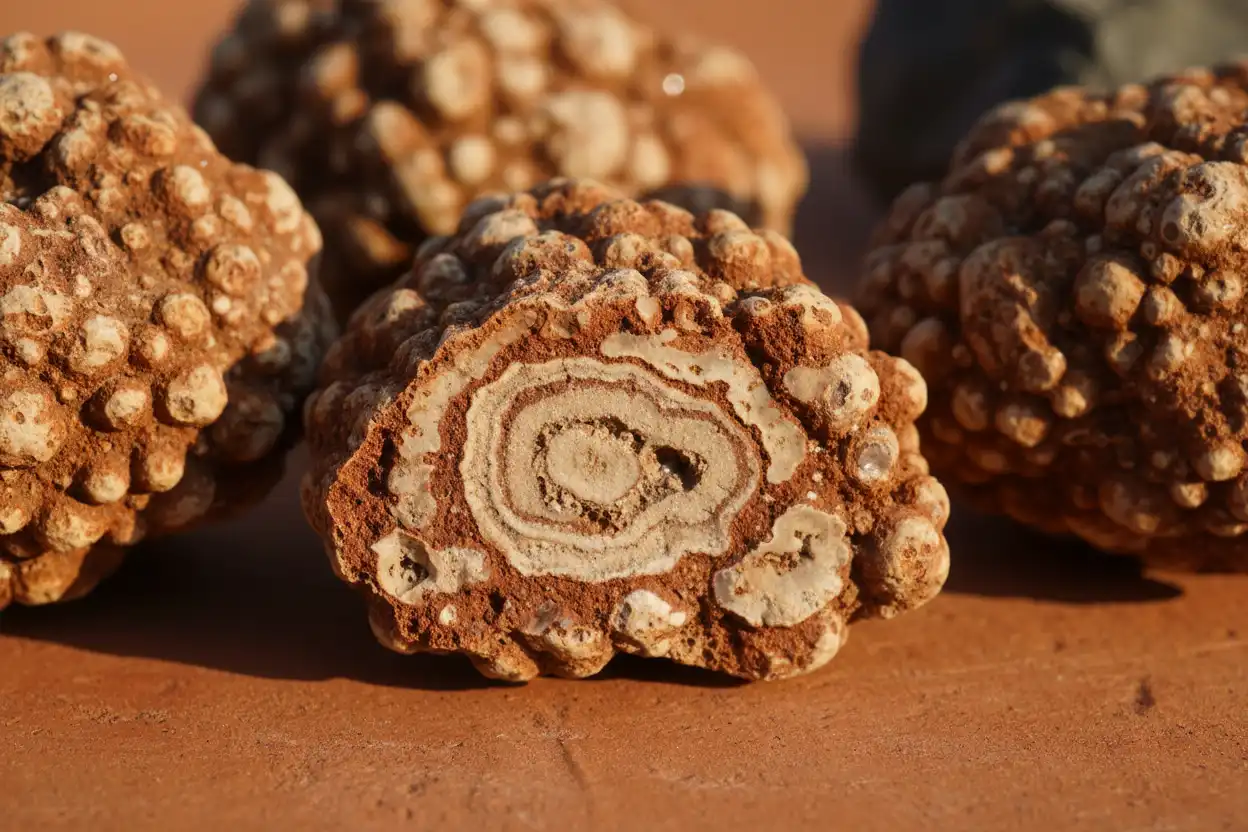
Bauxite Meaning: Rock Identity, History & Symbolism
Bauxite meaning begins with a classification point that separates it from most entries in a gemstone collection: bauxite is a rock and an aluminum ore, not a single mineral species. It is composed primarily of aluminum-bearing minerals such as gibbsite, boehmite, and diaspore, commonly mixed with iron oxides and hydroxides, clay minerals, titanium-bearing phases, quartz, and other minor components. The exact proportions vary from deposit to deposit, which is why two genuine bauxite specimens can differ substantially in color, density, texture, hardness, and mineral composition.
Most bauxite forms through intense chemical weathering that removes more soluble elements from pre-existing rocks while concentrating relatively immobile aluminum compounds. In some environments, this produces thick lateritic profiles rich in aluminum hydroxides; in others, bauxite accumulates in depressions, cavities, or weathered surfaces associated with carbonate rocks. The familiar reddish-brown appearance commonly reflects iron minerals such as hematite and goethite, while lower-iron material may appear cream, pale gray, buff, yellowish, or nearly white.
Bauxite is therefore more important economically and geologically than gemologically. It is the principal raw material from which most aluminum is produced, linking an earthy, often unremarkable-looking rock with aircraft, buildings, electrical infrastructure, packaging, transportation, machinery, electronics, and countless other manufactured objects. Modern bauxite meaning sometimes extends this transformation into symbolism involving potential, usefulness, resilience, development, or turning ordinary material into something valuable. Those themes can work as metaphors, but bauxite itself has not been shown to heal illness, increase energy, improve mental function, attract wealth, or transfer aluminum to the body through contact.
Readers exploring mineral and rock identities can browse the broader Gemstone Guides.
Bauxite Identity at a Glance
| Property | Bauxite |
|---|---|
| Material classification | Rock and aluminum ore |
| Single mineral species? | No |
| Principal aluminum minerals | Gibbsite, boehmite, diaspore |
| Common iron minerals | Hematite, goethite |
| Common accessory phases | Kaolinite and other clays, anatase and other titanium minerals, quartz, minor impurities |
| Typical colors | Red-brown, brown, yellow, buff, cream, gray, white |
| Common textures | Earthy, massive, granular, pisolitic, nodular, brecciated, porous |
| Crystal system | Not applicable to bauxite as a rock; constituent minerals have their own structures |
| Hardness | Variable because mineral composition and texture vary |
| Specific gravity | Variable; commonly moderate for a porous aluminum-rich rock |
| Transparency | Generally opaque |
| Luster | Commonly dull to earthy; local mineral surfaces may differ |
| Major geological setting | Deep chemical weathering and lateritic profiles; also karst-related deposits |
| Main economic role | Primary ore for aluminum production |
| Main identification limitation | Color and pisolitic texture alone do not prove ore grade or exact mineral composition |
The most important row is the first. Bauxite is defined by its geological and economic composition rather than by one repeating atomic structure.
Bauxite Is a Rock, Not a Mineral
A mineral species has a defined crystal structure and constrained chemical composition. Quartz, for example, is SiO₂ with a characteristic crystalline structure. Calcite is CaCO₃. Azurite is Cu₃(CO₃)₂(OH)₂.
Bauxite does not fit that model.
A bauxite specimen may contain gibbsite as the dominant aluminum mineral while another is richer in boehmite or diaspore. Both may contain varying proportions of hematite, goethite, kaolinite, anatase, quartz, and other components. The rock name remains useful because the mixture has a shared geological origin and economic role even though its exact mineralogy varies.
This distinction prevents an especially common error in bauxite meaning articles: assigning one formula, one hardness, or one crystal system to “bauxite” as though it were a chemically uniform gemstone.
It is not.
The correct question is what minerals make up the individual bauxite.
Gibbsite, Boehmite, and Diaspore Are the Main Aluminum Minerals
Gibbsite, boehmite, and diaspore contain aluminum in hydroxide or oxyhydroxide structures and are the most important aluminum-bearing phases in bauxite deposits.
Gibbsite has the composition Al(OH)₃.
Boehmite and diaspore both have the composition AlO(OH), but they possess different crystal structures and are therefore distinct mineral species despite sharing the same ideal chemistry.
Their relative abundance affects how a bauxite deposit behaves during processing. Gibbsite-rich ores generally respond differently to alumina extraction conditions than boehmite- or diaspore-rich ores because the minerals have different structural stability.
A hand specimen rarely reveals these proportions reliably by appearance alone.
Analytical methods such as X-ray diffraction are far more useful when exact mineralogy matters.
Why Bauxite Is Often Red
The aluminum minerals that dominate many bauxites are commonly pale or colorless in pure form. The strong red, reddish-brown, orange-brown, or yellow-brown colors familiar in bauxite generally come from iron-bearing minerals.
Hematite tends to contribute red and red-brown coloration.
Goethite commonly contributes yellow-brown, ochre, and brown tones.
Mixtures of these minerals with pale aluminum hydroxides and clays produce the broad earthy palette seen across natural deposits.
Color therefore tells a geological story about accessory minerals, oxidation, hydration, and weathering, but it does not determine aluminum content precisely. A vivid red bauxite is not necessarily richer in aluminum than a cream-colored specimen. In fact, strong iron coloration can reflect a larger proportion of non-aluminum material.
Detailed mineral-specific color behavior and the limitations of visual interpretation are explored in Bauxite optical properties and color behavior.
White or Pale Bauxite Can Be Completely Natural
Bauxite is frequently imagined as red rock because many major deposits are iron-rich. Lower-iron material can instead appear pale cream, gray, white, buff, or light yellow.
These colors can reflect greater proportions of gibbsite, boehmite, kaolinite, or other pale phases relative to hematite and goethite.
A pale specimen should therefore not automatically be dismissed as clay, chalk, or altered limestone simply because it lacks strong red coloration.
Conversely, white color does not prove high-grade bauxite.
Mineralogical and chemical analysis determine composition more reliably than shade.
Pisolitic Bauxite Has a Distinctive Pea-Like Texture
One of the best-known bauxite textures is pisolitic structure, where rounded to subrounded bodies occur within a finer matrix. These pisoids may range from small pellets to larger pea-like forms and can develop through repeated precipitation, accretion, alteration, transport, reworking, or combinations of weathering-related processes.
When cut or broken, some specimens show concentric internal structures inside individual pisoids.
The texture is geologically informative but not unique to bauxite. Pisolitic and oolitic structures occur in other sedimentary and weathering materials as well.
A red-brown pisolitic rock is therefore compatible with bauxite, not automatically proven to be bauxite.
The composition of both pisoids and matrix still matters.
How Bauxite Forms Through Intense Weathering
Many bauxite deposits begin with rocks containing feldspar, mica, clay-forming minerals, or other aluminum-bearing silicates. In warm, wet, chemically active weathering environments, groundwater repeatedly moves through the rock and carries away relatively soluble elements.
Sodium, potassium, calcium, magnesium, and portions of silica can be removed progressively.
Aluminum and iron are comparatively less mobile under appropriate conditions and become concentrated in the weathering profile.
Over sufficient weathering intensity, the original rock can lose most of its recognizable mineral texture and become an aluminum-rich residual material. Gibbsite, boehmite, iron oxides, clays, and titanium minerals can dominate what remains.
This is not simply “rotted rock.” It is a chemically differentiated weathering product created through prolonged interaction among climate, drainage, parent rock, groundwater, vegetation, topography, and geochemical conditions.
The detailed mineral transitions and deposit architecture are covered in Bauxite formation and deposit geology.
Lateritic Bauxite and Karst Bauxite Form Differently
Bauxite deposits are often grouped broadly into lateritic and karst-related types.
Lateritic bauxite develops through intense weathering of aluminosilicate rocks at or near the land surface. Thick weathering profiles can form where drainage and climate allow strong leaching and residual enrichment.
Karst bauxite is associated with carbonate terrains such as limestone and dolomite. Aluminum-rich material can accumulate in depressions, sink-like features, irregular surfaces, or cavities developed on carbonate rocks. The source of the aluminum may involve transported weathering products, insoluble residues, volcanic material, or mixed sedimentary inputs depending on the deposit.
Both can produce economically important ore.
Their geological histories differ enough that the word bauxite should not be treated as one universal formation process.
Bauxite Can Preserve the History of an Older Landscape
A bauxite body can record conditions that existed when a landscape underwent strong weathering, even if the modern environment is very different.
The thickness, mineralogy, layering, pisolitic texture, iron distribution, underlying weathered rock, and overlying sediments can provide evidence about drainage, climate, erosion, surface stability, and chemical weathering.
This gives bauxite value beyond mining.
Geologists can use lateritic profiles and associated sediments to reconstruct aspects of past landscape evolution.
A hand specimen may therefore represent a small piece of a much larger weathering system rather than an isolated mineral occurrence.
Bauxite Is an Ore Because It Can Be Economically Processed
The word ore has an economic component.
A rock can contain aluminum minerals without automatically qualifying as useful bauxite ore. Mining value depends on aluminum-bearing mineral content, silica, iron, titanium, mineralogy, processing requirements, deposit size, thickness, accessibility, environmental constraints, infrastructure, and market conditions.
Two visually similar specimens can therefore have different industrial value.
One may contain enough extractable alumina to be economically important.
Another may be mineralogically interesting but chemically unsuitable for efficient processing.
Calling a hand specimen “high-grade bauxite” from color alone is therefore unsupported.
Ore grade requires analysis.
From Bauxite to Aluminum
Bauxite itself is not metallic aluminum. The rock must undergo substantial processing before aluminum metal is produced.
Industrial processing first separates aluminum oxide-rich material, commonly called alumina, from much of the iron, silica, titanium, and other components in the ore. The Bayer process is widely associated with this refining stage.
The resulting alumina is then used as feed for electrolytic aluminum production through the Hall-Héroult process.
This sequence explains one of the strongest symbolic themes people may reasonably draw from bauxite: the starting material can look earthy, dull, porous, and ordinary, yet it contains the raw ingredients for one of the world’s most important engineering metals.
That transformation is technological.
It is not a metaphysical property of a hand specimen.
Red Mud Is Part of the Industrial Story
Refining bauxite generates a substantial alkaline residue commonly called bauxite residue or red mud. Its red color usually reflects iron oxides remaining after much of the aluminum-bearing material has been extracted.
The residue can also contain titanium minerals, sodium-bearing process products, silica-bearing phases, trace elements, and other components depending on the original ore and refining conditions.
Managing this material responsibly is an important part of aluminum production because large volumes require secure storage, water management, environmental monitoring, and increasingly, efforts toward reuse or recovery.
This industrial issue belongs to bauxite’s real-world significance and gives the material a more complex story than simply “the stone aluminum comes from.”
Bauxite Is Not Metallic
A fresh bauxite specimen may contain enough aluminum-bearing material to serve as ore, but it should not look like polished aluminum metal.
Most bauxite is dull, earthy, granular, porous, or compact.
Metallic silver-gray material marketed as “raw aluminum bauxite crystal” should therefore be approached cautiously unless the description clearly separates natural bauxite from processed metal.
The aluminum atoms in gibbsite, boehmite, or diaspore are chemically bonded with oxygen and hydroxyl groups.
They do not exist as native metallic aluminum inside the rock.
Industrial processing is required to produce the metal.
Bauxite Does Not Have One Hardness
Because bauxite is a rock composed of several minerals, a single Mohs hardness value is misleading.
Gibbsite is soft.
Boehmite and diaspore differ from gibbsite.
Iron oxides, quartz, clays, and titanium minerals each contribute their own hardness and texture.
A compact diaspore-rich bauxite may therefore resist scratching differently from a porous gibbsite-rich specimen.
Hardness can also vary across one hand sample as the proportions of pisolites, matrix, veins, and accessory minerals change.
This is one reason cutting and polishing bauxite can produce uneven surfaces.
Bauxite Does Not Have One Specific Gravity Either
Bulk density varies with mineral composition and porosity.
Iron-rich bauxite can be noticeably denser than highly porous, clay-rich, or gibbsite-dominant material. Voids and pisolitic texture can further reduce bulk density even when individual constituent minerals are relatively dense.
A specific-gravity measurement can therefore characterize the specimen without serving as a universal bauxite fingerprint.
The result should be interpreted alongside mineralogy and texture.
Unlike barite or barytocalcite, where unusually high density is a strong species-level clue, bauxite requires a rock-level interpretation.
Original Bauxite Specimen and Photo Checklist
| Observation | What it may reasonably support | What it cannot prove alone |
|---|---|---|
| Red-brown earthy rock | Compatible with iron-rich bauxite | Aluminum ore grade |
| Cream or pale massive rock | Compatible with low-iron bauxite | Gibbsite dominance automatically |
| Rounded pisolites | Characteristic bauxite texture | Bauxite identity by itself |
| Concentric pisoid structures | Weathering or accretion history | Exact formation pathway |
| Porous texture | Common lateritic feature | Deposit type |
| White clay-rich areas | Possible kaolinite or aluminum-rich material | Exact mineral identity |
| Yellow-brown staining | Possible goethite-rich component | Iron concentration |
| Deep red zones | Compatible with hematite enrichment | High aluminum content |
| Irregular hardness across specimen | Consistent with multi-mineral rock | Individual mineral identification |
| Mine label identifying bauxite | Useful provenance evidence | Ore grade |
| XRD showing gibbsite/boehmite/diaspore | Strong mineralogical support | Commercial profitability |
| Chemical analysis showing high Al₂O₃ | Strong ore-composition evidence | Exact aluminum mineral |
| Microscopy showing pisolitic matrix | Strong textural documentation | Regional origin |
| Original stratigraphic label | Valuable geological provenance | Treatment or processing history |
This checklist separates appearance, mineralogy, chemistry, and economics. Bauxite can be obvious geologically while its processing quality remains unknown.
Detailed grain relationships, pisolite structures, clays, iron oxides, pores, veins, and weathering textures are explored in the Bauxite microscope inclusion notebook.
Claims About Bauxite That Need Qualification
| Claim | More accurate interpretation |
|---|---|
| “Bauxite is a mineral” | Bauxite is a rock composed of several minerals |
| “Bauxite has one chemical formula” | No single formula represents the complete rock |
| “Bauxite is metallic aluminum” | It is aluminum ore that must be processed to produce metal |
| “All bauxite is red” | Pale, gray, white, yellow, and brown material also occurs |
| “Redder bauxite contains more aluminum” | Strong red often reflects iron and does not directly indicate aluminum grade |
| “Pisolitic texture proves high-grade ore” | Texture does not establish chemical quality |
| “All bauxite forms the same way” | Lateritic and karst-related deposits can have different geological histories |
| “Bauxite is always safe to grind” | Dust exposure depends on quartz, mineralogy, trace elements, and processing conditions |
| “Aluminum in bauxite strengthens the body” | Wearing ore does not provide a controlled biological aluminum dose |
| “Bauxite detoxifies metals” | No established medical mechanism supports this claim |
| “Bauxite attracts wealth because aluminum is valuable” | Economic symbolism is not a mechanism for financial outcomes |
| “Ore means every specimen is commercially valuable” | Economic value depends on composition, deposit scale, processing, and market conditions |
Bauxite meaning becomes much more useful once rock classification, industrial value, symbolism, and health claims are kept separate.
Bauxite and Bastnasite Are Both Ores but Not the Same Kind of Material
Bastnasite meaning concerns a defined rare-earth fluorocarbonate mineral. Bastnasite can itself be an economically important ore mineral because rare-earth elements occur directly within its crystal structure.
Bauxite is different.
It is a rock containing several aluminum minerals plus iron oxides, clays, titanium phases, and other constituents.
The comparison demonstrates the difference between an ore mineral and an ore rock. Both can feed industrial extraction, but one is a specific mineral species or group while the other is a geological mixture.
Bauxite and Barytocalcite Differ at the Most Basic Classification Level
Barytocalcite meaning concerns a specific monoclinic barium-calcium carbonate mineral with the formula BaCa(CO₃)₂.
Bauxite has no equivalent single formula.
A barytocalcite crystal can be analyzed as one mineral species, whereas a bauxite sample must often be described by the percentages and textures of several minerals.
This distinction is fundamental to mineral collecting and geology.
Not every named natural solid is a mineral.
Bauxite and Benitoite Are Opposite Collector Experiences
Benitoite meaning concerns a defined blue barium-titanium silicate gemstone known for transparent crystals and distinctive optical behavior. Bauxite is usually opaque, earthy, massive, and valued primarily as an industrial ore rock.
One is commonly appreciated for individual crystal quality.
The other is usually evaluated through bulk geology, chemical composition, and processing potential.
Both are geologically meaningful, but for very different reasons.
Bauxite and Beryl Both Contain Aluminum
Beryl meaning concerns Be₃Al₂Si₆O₁₈, a defined beryllium-aluminum silicate mineral whose varieties include emerald and aquamarine.
Bauxite also contains abundant aluminum, but the element occurs chiefly in hydroxide and oxyhydroxide minerals rather than within one beryl-like silicate structure.
This illustrates an important chemistry principle: sharing one element does not make two geological materials closely related.
Aluminum occurs in a huge range of minerals.
The complete structure determines mineral identity.
Bauxite Is Usually Better as a Geological Specimen Than Jewelry
Bauxite can be cut, polished, carved, or incorporated into educational and ornamental objects, but it is not a conventional gemstone.
Variable hardness, porosity, clay-rich areas, iron staining, pits, and mixed mineralogy can complicate polishing. A surface may undercut where soft material wears faster than harder grains.
Dense pisolitic material can produce attractive polished patterns, especially when rounded structures contrast with iron-rich matrix. These pieces are best understood as decorative rock rather than faceted gem material.
Cut orientation, stabilization, porosity, abrasive behavior, and polishing choices are covered in Bauxite cutting, orientation and polish.
The mechanical practicality of settings, backing, abrasion, porous surfaces, and wearable objects is treated separately in Bauxite setting and wear engineering.
Normal Handling Is Different From Industrial Dust Exposure
A clean, intact hand specimen can generally be handled with ordinary geological-collection hygiene.
Cutting, crushing, drilling, dry sanding, or mechanically processing bauxite creates a different exposure situation because dust can contain aluminum minerals, iron oxides, clays, titanium phases, and—depending on the deposit—quartz or other accessory materials.
Crystalline silica is especially relevant when present because fine respirable silica dust should be controlled appropriately.
Wet processing where practical, local extraction, eye protection, suitable respiratory protection, and careful cleanup are sensible workshop measures.
The complete mineralogy matters more than the word bauxite alone.
Do Not Use Bauxite as a Mineral Supplement
The fact that bauxite is rich in aluminum does not make it a nutritional source.
Aluminum-bearing minerals in an ore rock are not absorbed beneficially through the skin, and wearing a piece of bauxite does not provide a controlled biological dose.
Likewise, iron-rich red material should not be treated as an iron supplement.
Natural ore specimens should not be ground into powders for ingestion or added to drinking water as wellness remedies.
Industrial ores are raw geological materials.
They are not medicines or foods.
Provenance Can Make an Ordinary-Looking Sample Important
A visually modest bauxite specimen can carry significant geological value if its exact position within a weathering profile, mine, stratigraphic layer, or research locality is documented.
A labeled sample from the top of a lateritic profile may differ systematically from material collected near the underlying weathered parent rock. Losing the label removes much of that context.
Color alone cannot reconstruct provenance.
A red pisolitic sample from one region can closely resemble material from another continent because similar weathering processes produce similar textures.
Original collection information, mine records, stratigraphic notes, and analytical data therefore deserve preservation.
The Bauxite provenance and disclosure checklist provides a structured way to evaluate source claims and documentation.
Preserve Geological Texture Before Polishing Everything
Pisolites, pore networks, iron-rich zones, clay bands, weathering fronts, brecciation, veins, and remnants of parent-rock texture can all preserve geological information.
Polishing a surface can make those patterns easier to see in some cases.
Aggressively cutting away the surrounding material can also destroy context.
For scientifically interesting specimens, documenting the natural surface before trimming or polishing is useful. Photographs, dimensions, labels, orientation, and location within a larger sample can preserve information even when a small piece is removed for analysis.
Long-term storage, friable material, labeling, matrix stabilization, and specimen records are addressed in the Bauxite specimen conservation record.
Modern Bauxite Meaning and Hidden Potential
Hidden potential is one of the most natural symbolic themes associated with bauxite. A dull red or cream rock does not visually resemble the lightweight metallic aluminum ultimately produced from it.
The transformation requires mineral processing, chemical separation, energy, engineering, and manufacturing.
As metaphor, bauxite can represent resources or abilities whose usefulness is not obvious from outward appearance.
Someone may use a bauxite specimen as a reminder that raw potential still requires work.
The stone itself does not activate hidden talents or guarantee success.
Bauxite Meaning and Transformation
Bauxite undergoes a profound industrial transformation before it becomes aluminum metal. This can support symbolism around refinement, development, or moving through several stages before reaching a finished result.
The useful metaphor lies in the process.
Raw ore is not instantly converted into metal.
Material must be characterized, mined, beneficiated where necessary, refined into alumina, and then reduced to aluminum before manufacturing begins.
Someone may interpret this as a reminder that difficult projects often require several distinct stages rather than one dramatic breakthrough.
That lesson comes from human interpretation of a real industrial sequence.
Bauxite Meaning and Resilience
Bauxite frequently forms through extreme chemical weathering. Much of the original rock is altered or removed while aluminum- and iron-rich components remain concentrated.
This geological history can inspire symbolism involving persistence or resilience.
The comparison should remain metaphorical.
A rock does not transmit psychological resilience simply because it survives a weathering profile. A person can nevertheless choose the specimen as a reminder that difficult conditions sometimes produce a different form rather than simple destruction.
The meaning lies in the geological analogy.
Bauxite Meaning and Practical Value
Bauxite also lends itself to symbolism involving practical usefulness. It is rarely among the most visually spectacular materials in a mineral collection, yet its economic importance is enormous because of its role in aluminum production.
That contrast can represent the difference between appearance and utility.
A person might keep a specimen as a reminder to evaluate people, materials, or ideas by more than surface attractiveness.
This is a stronger and more specific interpretation than assigning generic “abundance energy” to the rock.
Bauxite Does Not Have Established Healing Properties
There is no established scientific evidence that holding, wearing, or meditating with bauxite treats medical or psychological conditions.
Claims involving detoxification, bone health, energy, blood, metabolism, inflammation, concentration, emotional balance, or protection from environmental toxins should not be inferred from the rock’s aluminum, iron, or clay content.
Mineral composition is not a treatment mechanism.
A specimen can have educational, historical, industrial, or personal significance without functioning as medicine.
The wider distinction between symbolic use and health claims is explained in the Gems Lore Disclaimer.
Original Evidence Ladder for Bauxite Claims
Direct observation can establish color, texture, porosity, pisolites, nodules, matrix, fractures, weathering surfaces, staining, and visible layering.
Basic geological examination can establish bulk hardness variation, density, streak behavior, grain relationships, and field context.
Microscopy can reveal pisolite structures, iron-rich coatings, clay-rich matrix, pore textures, weathering fronts, and relationships among visible grains.
X-ray diffraction can identify major crystalline mineral phases such as gibbsite, boehmite, diaspore, hematite, goethite, kaolinite, quartz, and anatase.
Chemical analysis can establish alumina, silica, iron, titanium, and trace-element content relevant to ore characterization.
Ore-grade interpretation requires both chemistry and mineralogy because equal bulk aluminum values may behave differently during processing depending on which minerals contain the aluminum and silica.
Deposit interpretation requires stratigraphy, parent rock, weathering profile, geomorphology, drainage, and regional geological context.
Provenance requires labels, mine records, stratigraphic information, collection history, or other traceable documentation.
Historical and industrial claims require evidence tied to actual mining, processing, trade, technology, or documented human use.
Metaphysical claims remain symbolic beliefs even when they are culturally repeated. No mineralogical test demonstrates that bauxite emits transformation, abundance, or grounding energy.
This hierarchy reflects bauxite’s unusual status as a rock whose importance depends as much on bulk composition and geological context as on individual mineral phases.
What Bauxite Meaning Can Responsibly Represent
Bauxite offers unusually practical symbolism because its documented geological and industrial history already contains strong themes. Deep weathering can represent persistence through changing conditions. Residual concentration can represent focusing what remains after less useful material is removed. The transformation from earthy ore to refined aluminum can represent development through multiple stages, while its industrial importance can symbolize usefulness that is not obvious from appearance.
These ideas are metaphors grounded in real characteristics.
They do not require claims that bauxite heals the body, supplies beneficial aluminum, attracts money, or alters human energy.
The evidence-led approach used throughout Gems Lore is described on About Gems Lore. Questions about an individual bauxite specimen can be submitted through Contact Gems Lore.
Frequently Asked Questions
What is bauxite?
Bauxite is an aluminum-rich rock and the principal ore used for producing aluminum. It is not a single mineral species.
What minerals make up bauxite?
Important aluminum minerals include gibbsite, boehmite, and diaspore. Bauxite can also contain hematite, goethite, clays such as kaolinite, titanium minerals, quartz, and other components.
Does bauxite have a chemical formula?
No single chemical formula represents bauxite because it is a rock made from several minerals.
Is bauxite a crystal?
Bauxite as a whole is not one crystal. Its constituent minerals possess their own crystal structures, but most bauxite occurs as massive, earthy, pisolitic, nodular, or granular rock.
Why is bauxite red?
Red and reddish-brown colors commonly come from iron oxides such as hematite.
Can bauxite be white?
Yes. Low-iron bauxite may be cream, gray, buff, yellowish, or nearly white.
What is pisolitic bauxite?
Pisolitic bauxite contains rounded pea-like structures called pisoids within a finer matrix. These structures develop through complex weathering and depositional processes.
How does bauxite form?
Many deposits form through intense chemical weathering that removes more soluble components from rocks while concentrating aluminum and iron minerals.
What is lateritic bauxite?
Lateritic bauxite forms within deeply weathered profiles developed on aluminosilicate rocks under conditions favoring strong chemical leaching.
What is karst bauxite?
Karst bauxite occurs in depressions, irregular surfaces, and cavities associated with carbonate terrains such as limestone and dolomite.
Is bauxite the same as aluminum?
No. Bauxite is an ore rock. Aluminum metal must be produced from aluminum-bearing compounds extracted from the ore.
What is alumina?
Alumina is aluminum oxide-rich material refined from bauxite and used as feedstock for aluminum production.
Why is bauxite economically important?
It is the world’s principal raw material for producing aluminum, a metal used extensively in transportation, construction, packaging, electrical systems, machinery, and manufacturing.
Is bauxite hard?
There is no single hardness because bauxite contains several minerals and textures. Different parts of the same specimen can behave differently.
Is bauxite heavy?
Bulk density varies with mineralogy and porosity. Iron-rich compact material may be noticeably denser than porous or clay-rich bauxite.
Can bauxite be polished?
Yes. Dense material, especially attractive pisolitic bauxite, can be polished or carved, although variable hardness and porosity can complicate finishing.
Is bauxite a gemstone?
It is not generally classified as a conventional gemstone. It is primarily an ore rock and geological specimen.
Can a photograph prove bauxite?
A photograph can strongly suggest bauxite from color and texture, particularly with pisolitic material, but mineralogical and chemical testing provide stronger confirmation.
How is bauxite analyzed?
Useful methods include petrographic examination, X-ray diffraction, chemical analysis, microscopy, and geological field interpretation.
Does redder bauxite contain more aluminum?
Not necessarily. Strong red color usually reflects iron minerals rather than directly indicating aluminum grade.
Can bauxite contain quartz?
Yes. Quartz and other silica-bearing phases can occur depending on deposit geology and weathering history.
Is bauxite dust safe?
Dust-generating work should be controlled because mineral composition can include respirable silica and other fine particles. Intact specimen handling is a different exposure situation.
Can bauxite go in drinking water?
Natural bauxite should not be used to prepare ingestible crystal remedies. It is an ore rock rather than food or medicine.
Does bauxite provide aluminum to the body?
Wearing or holding bauxite does not provide a controlled beneficial aluminum dose.
What does bauxite symbolize?
Modern bauxite meaning can include hidden potential, transformation, resilience, development, practical value, and refinement.
Does bauxite have healing properties?
There is no established scientific evidence that bauxite treats medical or psychological conditions.
Is bauxite a grounding stone?
It can be used symbolically as a reminder of physical materials, geology, persistence, or practical work, but no measurable metaphysical grounding effect has been established.
Why can bauxite symbolize hidden potential?
Its earthy appearance contrasts strongly with the lightweight, highly useful aluminum ultimately produced after extensive refining and processing.
Why is provenance important for bauxite?
A specimen’s exact mine, layer, weathering profile, and geological position can provide information that color and texture alone cannot reconstruct.
How should a bauxite specimen be stored?
Keep friable material in a stable container, preserve locality and stratigraphic labels, avoid unnecessary dust generation, and document any polished or cut surfaces.
Bauxite meaning becomes more accurate when the material is understood as a rock before it is treated as a symbol. Bauxite is an aluminum-rich weathering product composed principally of gibbsite, boehmite, diaspore, iron minerals, clays, titanium-bearing phases, and variable accessory minerals. Its red, cream, yellow, brown, and gray colors reflect changes in those components rather than one uniform crystal chemistry.
Its real history also provides unusually strong symbolism. Intense weathering concentrates aluminum-bearing material, while industrial processing transforms an earthy ore into alumina and eventually aluminum metal. That sequence can represent hidden potential, persistence, refinement, and the difference between outward appearance and practical usefulness.
These meanings remain human interpretations rather than physical powers. Bauxite does not need unsupported healing claims or invented spiritual traditions to be significant; its role in landscape evolution, economic geology, aluminum production, and modern material technology already makes it one of the most consequential rocks in everyday life.