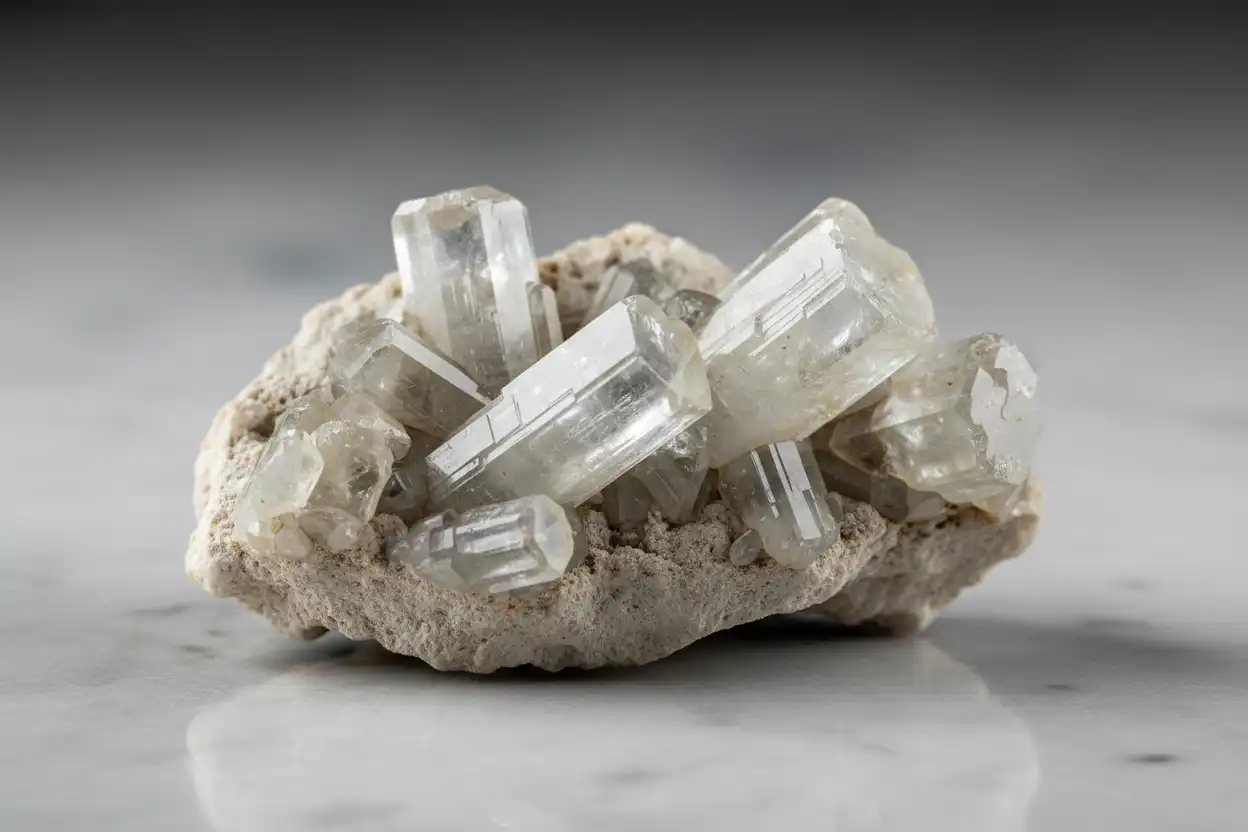
Barytocalcite Meaning: Mineral Identity & Symbolism
Barytocalcite meaning begins with a relatively uncommon barium-calcium carbonate mineral rather than with a broad list of crystal-healing claims. Barytocalcite has the formula BaCa(CO₃)₂, crystallizes in the monoclinic system, and commonly occurs as colorless, white, pale gray, light yellow, greenish, pinkish, or pale brown transparent-to-translucent material. Its hardness is about 3.5–4 on the Mohs scale, while its measured specific gravity is roughly 3.66–3.71—unusually high for a pale nonmetallic carbonate because nearly half of the ideal mineral’s mass comes from barium.
The material commonly develops short-to-long prismatic crystals, equant forms, striated faces, and massive cleavable aggregates. Perfect cleavage in one important direction, imperfect cleavage in another, brittle behavior, and uneven-to-subconchoidal fracture make barytocalcite noticeably more delicate than quartz-rich ornamental stones. Its combination of relatively modest hardness and high density is one of its most useful physical signatures.
Modern barytocalcite meaning may include stability, grounding, balance, structure, integration, patience, or clarity. Those associations can work as personal symbolism, particularly because the mineral combines calcium and barium within one ordered carbonate structure, yet they remain interpretations rather than measurable effects. Barytocalcite has not been demonstrated to heal illness, regulate calcium or barium in the body, remove toxins, balance emotions through mineral energy, protect against radiation, or alter external events.
Readers exploring other fact-led mineral references can browse the wider Gemstone Guides.
Barytocalcite Identity at a Glance
| Property | Barytocalcite |
|---|---|
| Mineral species | Barytocalcite |
| Chemical formula | BaCa(CO₃)₂ |
| Mineral class | Carbonate |
| Essential major elements | Barium, calcium, carbon, oxygen |
| Crystal system | Monoclinic |
| Common habits | Short-to-long prismatic, equant, striated, massive, cleavable |
| Common colors | Colorless, white, grayish, pale yellow, greenish, pinkish, pale brown |
| Transparency | Transparent to translucent |
| Luster | Vitreous to resinous |
| Mohs hardness | Approximately 3.5–4 |
| Specific gravity | Approximately 3.66–3.71 |
| Cleavage | Perfect in one important direction; weaker in another |
| Tenacity | Brittle |
| Fracture | Uneven to subconchoidal |
| Optical character | Biaxial negative |
| Major geological setting | Hydrothermal metallic veins reacting with carbonate-rich rocks |
| Less common settings | Carbonatites and Alpine-type veins |
| Closely related structural alternatives | Alstonite and paralstonite |
| Main identification limit | Density and pale color support identification but do not prove the species alone |
Barytocalcite’s identity is therefore defined by the combination of carbonate chemistry, barium and calcium occupancy, monoclinic structure, high specific gravity, cleavage, and optical behavior. No single color or crystal shape is sufficiently unique to establish it by itself.
Barytocalcite Is a Barium-Calcium Carbonate
The formula BaCa(CO₃)₂ shows that barium and calcium are both essential structural components of barytocalcite. This makes the mineral chemically different from calcite, CaCO₃, and from barite, BaSO₄, even though its name visibly echoes both barium and calcite.
The distinction is important because the elements alone do not define the mineral. Barytocalcite is not simply a physical mixture of calcite and a barium mineral. Barium and calcium occupy ordered positions within one crystalline carbonate structure, producing characteristic symmetry, density, optical properties, and cleavage.
Natural specimens can contain minor substitutions such as strontium, magnesium, or other elements without ceasing to be barytocalcite so long as the defining structural chemistry remains dominant. Mineral formulas describe idealized end-member composition, while real crystals may contain smaller amounts of additional constituents.
This distinction between ideal formula and natural composition helps prevent two common mistakes: treating every specimen as chemically pure and assuming that any carbonate containing both calcium and barium must be barytocalcite.
Barytocalcite Has the Same Formula as Two Other Minerals
Barytocalcite is particularly interesting because BaCa(CO₃)₂ can occur in more than one crystal structure. Barytocalcite, alstonite, and paralstonite share the same ideal chemical formula but differ structurally, making them polymorphs—more precisely, three structural forms of the same bulk composition.
This is a valuable mineralogical lesson. Chemical formula alone is not always enough to identify a species.
The arrangement of atoms matters.
A specimen containing barium, calcium, and carbonate in the expected proportions could still require crystallographic or spectroscopic examination before its exact species is established. Barytocalcite’s monoclinic structure distinguishes it from the alternative structural arrangements represented by alstonite and paralstonite.
This is also why mineral identification should not rely exclusively on chemical element lists generated by handheld instruments. Chemistry can narrow the possibilities, while structural analysis may be necessary to distinguish polymorphs.
Why Barytocalcite Feels Heavy
Barytocalcite’s specific gravity of roughly 3.66–3.71 makes it considerably denser than calcite, quartz, or many pale silicate minerals. The reason is the presence of barium, a heavy element incorporated into the crystal lattice.
A barytocalcite crystal and calcite crystal of approximately the same volume therefore should not feel equally heavy.
This physical difference can be useful as a preliminary identification clue, particularly when pale carbonate minerals look similar. Barytocalcite feels substantially denser than calcite, whose specific gravity is only around 2.71.
Hand-heft remains qualitative, however. Crystal size, cavities, attached matrix, fractures, and associated heavy minerals can distort perception. Hydrostatic specific-gravity measurement provides much stronger evidence because it relates measured mass directly to displaced volume.
Density is an identification tool.
It is not evidence of metaphysical “strong energy.”
How Barytocalcite Forms
Barytocalcite is best known as a relatively uncommon accessory mineral in metallic hydrothermal veins where mineral-bearing fluids react with limestone or other carbonate-rich rocks. It can occur alongside barite, calcite, strontianite, siderite, alstonite, witherite, fluorite, sphalerite, quartz, and related hydrothermal minerals. Less commonly, barytocalcite occurs in carbonatites and Alpine-type mineral veins.
The process requires the right combination of barium, calcium, carbonate, fluid chemistry, temperature, pressure, and available space for crystallization. Hydrothermal fluids moving through fractures can transport dissolved components until changes in chemistry cause barytocalcite to precipitate. Interaction with carbonate host rocks is especially important because those rocks can alter fluid composition and provide calcium and carbonate-related chemical conditions.
Open cavities can allow recognizable prismatic crystals to grow, whereas confined replacement zones may produce massive or cleavable material. Changes in fluid chemistry over time can also create complicated specimens in which several carbonate, sulfate, sulfide, and fluorine-bearing minerals record different stages of mineral deposition.
Those geological relationships are treated in greater depth in Barytocalcite formation and deposit geology.
Crystal Shape Is Useful but Not Unique
Barytocalcite typically forms short-to-long prismatic crystals, sometimes appearing nearly equant. Natural faces can show pronounced striations, and massive cleavable material also occurs.
These forms can provide useful clues when combined with density and associated minerals, but they are not visually exclusive.
Calcite can occur in numerous crystal shapes. Strontianite, witherite, aragonite-group minerals, and other carbonates can also form pale prismatic or bladed crystals, while barite can appear as pale heavy crystals in some of the same mineralized environments.
A specimen photograph therefore should be treated as a starting point rather than a complete identification.
Preserving natural crystal faces is valuable because polishing or cutting removes precisely the morphological information that can help distinguish unusual collector minerals.
Barytocalcite’s Cleavage Matters in Handling
Barytocalcite has prominent cleavage, including a perfect cleavage direction. Combined with brittleness and hardness around 3.5–4, this makes crystal edges and natural terminations vulnerable to mechanical damage.
The stone can split along structural planes even though its high density makes it feel substantial in the hand.
This distinction between weight and toughness is important. A heavy mineral is not necessarily a strong mineral.
Collectors should support matrix specimens from below rather than gripping projecting crystals. Individual crystals should be stored where harder minerals cannot strike or scrape their surfaces. Even ordinary quartz can scratch barytocalcite because quartz is substantially harder.
The same weakness influences lapidary use. Cutting can be technically possible, but cleavage and low hardness mean polished or faceted material is generally better suited to collection and occasional display than demanding everyday jewelry.
Barytocalcite’s Optical Properties Are Unusual
Transparent barytocalcite is biaxial negative and has a particularly wide spread among its principal refractive indices, approximately 1.525, 1.684, and 1.686. That large difference creates very strong birefringence compared with many familiar transparent gem materials.
This optical behavior can become useful in thin crystals, polished sections, or suitably fashioned material. Doubling effects may be visible under favorable conditions because light traveling through the anisotropic crystal can split into rays experiencing different refractive indices.
The low alpha value and much higher beta and gamma values also demonstrate why one isolated refractive-index measurement should be interpreted carefully. Crystal orientation influences what measurement is obtained.
The detailed relationship among refractive indices, optic character, birefringence, dispersion, transmitted-light behavior, and specimen orientation is covered in Barytocalcite optical properties and color behavior.
Color Is Usually a Secondary Feature
Ideal barytocalcite can be colorless. Natural specimens may instead appear white, pale gray, greenish, yellow, pinkish, or pale brown due to trace substitutions, defects, microscopic inclusions, alteration, staining, or other local factors.
Color therefore contributes less to identification than density, chemistry, structure, cleavage, and optical behavior.
A pale green barytocalcite should not automatically be assigned one specific trace element based on color alone. Likewise, a yellow crystal should not be described as iron-colored without evidence from the specimen itself.
In transmitted light, thin material can appear substantially less colored than it does against a dark matrix or under reflected light.
That difference reinforces a useful rule: describe the observed hue confidently, but identify the exact color mechanism only when suitable analytical evidence exists.
Fluorescence Can Occur but Is Not a Standalone Test
Some barytocalcite specimens can fluoresce under ultraviolet illumination, with reported responses including pale yellowish to reddish colors. Fluorescence varies with composition, trace activators, impurities, wavelength, and specimen history, so the response is not universal.
A specimen that fluoresces is therefore not automatically barytocalcite.
A specimen that does not fluoresce is not automatically excluded.
Ultraviolet response is most useful as one observation within a larger identification sequence. The wavelength used should also be recorded because shortwave and longwave UV can produce different reactions.
Bright fluorescence photographs should not be confused with the mineral’s ordinary visible-light appearance.
Original Barytocalcite Specimen and Photo Checklist
| Observation | What it may reasonably support | What it cannot prove alone |
|---|---|---|
| Pale transparent prismatic crystal | Appearance compatible with barytocalcite | Exact species |
| Noticeable longitudinal striations | Useful morphological support | Chemical composition |
| Unusually heavy pale crystal | Strong clue for a barium-rich mineral | Barytocalcite specifically |
| Vitreous-to-resinous luster | Compatible appearance | Geographic origin |
| Perfect existing cleavage surface | Strong structural clue | Reason to break an intact crystal |
| Pale green or yellow coloration | Known natural appearance | Exact color-causing element |
| Fluorescence under UV | Possible supporting characteristic | Species identity |
| Calcite and fluorite association | Plausible hydrothermal context | Exact formation sequence |
| Barite or witherite association | Plausible barium-rich environment | Barytocalcite identity |
| Limestone or carbonate host | Compatible geological setting | Exact locality |
| Specific gravity near 3.7 | Strong physical evidence | Distinction from every polymorph |
| Ba-Ca carbonate chemistry | Strong chemical evidence | Barytocalcite rather than alstonite or paralstonite |
| X-ray diffraction matching barytocalcite | Strong structural identification | Geographic provenance |
| Raman result compatible with barytocalcite | Strong mineral evidence | Full specimen composition |
| Original mine label | Valuable provenance evidence | Independent species confirmation |
The most important row is the chemical one. Detecting barium, calcium, and carbonate can establish the correct chemical family without necessarily distinguishing barytocalcite from structurally different minerals with the same formula.
For detailed examination of inclusions, cleavage features, intergrowths, coatings, repairs, and growth textures, see the Barytocalcite microscope inclusion notebook.
Claims About Barytocalcite That Need Qualification
| Claim | More accurate interpretation |
|---|---|
| “Barytocalcite is calcite with barium added” | It is a distinct mineral species with its own ordered structure |
| “Barytocalcite and barite are the same” | False; barytocalcite is a carbonate, while barite is barium sulfate |
| “BaCa(CO₃)₂ chemistry proves barytocalcite” | Not by itself; alstonite and paralstonite share the same ideal formula |
| “Every heavy pale carbonate is barytocalcite” | Several other dense carbonate minerals exist |
| “Every green barytocalcite has the same color cause” | Exact coloration requires specimen-specific evidence |
| “Barytocalcite is tough because it feels heavy” | False; it is relatively soft, brittle, and cleavable |
| “Barytocalcite gives the body calcium” | Wearing a crystal does not deliver a controlled nutritional calcium dose |
| “Its barium protects against radiation” | A loose mineral specimen is not an engineered radiation shield |
| “The mineral detoxifies heavy metals” | No established medical mechanism supports this claim |
| “It balances the body because it contains two metals” | Structural chemistry does not establish biological balancing |
| “Rare means extremely valuable” | Demand, condition, locality, crystal quality, size, and provenance still matter |
| “A famous locality can be recognized from color” | Provenance requires documentation |
This distinction between what can be measured and what is merely inferred is particularly important for uncommon minerals, where unfamiliarity can make unsupported descriptions sound more authoritative than they are.
The Name Describes Its Chemistry
Barytocalcite was named in reference to its composition: barium, calcium, and carbonate chemistry. The name is therefore descriptive rather than mystical.
Its documented type locality is the Blagill Mine area of Alston Moor in Cumbria, England, a region associated with mineralized veins and several unusual barium-bearing carbonate species.
The name does not encode an ancient healing tradition, spiritual doctrine, or symbolic association.
Modern interpretations involving balance or integration may be inspired by the presence of both barium and calcium, but those interpretations came from people rather than from the historical naming process.
That distinction allows etymology to remain accurate while symbolism develops separately.
Barytocalcite, Barite, and Barium Chemistry
Barite meaning concerns BaSO₄, barium sulfate. Barytocalcite instead contains barium and calcium within a carbonate structure.
Both minerals can feel unusually heavy because barium contributes significant mass.
Their chemical behavior differs because sulfate and carbonate groups respond differently to geological and chemical conditions. Barite is notably resistant to many ordinary chemical reactions, whereas carbonate minerals require more caution around acids.
The shared presence of barium therefore creates one similarity—high density—but does not make the minerals interchangeable.
Barytocalcite and Azurite Are Both Carbonates With Very Different Identities
Azurite meaning concerns Cu₃(CO₃)₂(OH)₂, a vivid blue copper carbonate. Barytocalcite is generally pale and obtains its unusual density from barium rather than copper.
Both belong broadly to carbonate mineralogy, yet their crystal structures, colors, geological environments, chemical behavior, and collector appearance differ dramatically.
This illustrates why a mineral class such as “carbonate” is only one level of identification.
Species-level structure and chemistry remain essential.
Barytocalcite and Bastnasite Should Not Be Grouped by Density
Bastnasite meaning concerns rare-earth fluorocarbonate minerals rather than barium-calcium carbonate. Bastnasite can also be relatively dense and occur in pale yellow, brownish, or reddish material, creating superficial overlap with some barytocalcite specimens.
The heavy elements responsible are different.
The structures are different.
The deposit types are different.
Density becomes most useful when combined with optical and chemical evidence rather than treated as a species name.
Barytocalcite and Bauxite Are Entirely Different Materials
Bauxite meaning concerns a rock and aluminium ore composed of variable proportions of aluminium hydroxide minerals plus iron oxides, clay minerals, and other constituents. It is not a single crystalline carbonate species.
Barytocalcite is therefore much more narrowly defined mineralogically.
The comparison is useful because mineral and rock names often appear together in gemstone and collector discussions even though they represent different levels of geological classification.
Safe Cleaning Starts With Carbonate Chemistry
Because barytocalcite is a carbonate, acidic cleaning products should be avoided. Vinegar, acidic descaling agents, and unnecessary chemical tests can attack carbonate surfaces and permanently alter crystal luster.
A soft brush, careful dust removal, and conservative use of clean water are more appropriate for sound specimens when the matrix and repairs allow it.
Ultrasonic and steam cleaning are poor general defaults because cleavage, fractures, mineral associations, repairs, and matrix instability may create risks that are not visible from the exterior.
Important specimens should be cleaned only as much as necessary.
Natural patina and mineral associations can carry geological information that aggressive cleaning removes permanently.
Barytocalcite Is Better Suited to Collections Than Daily Jewelry
Transparent barytocalcite can be cut, but hardness around 3.5–4 and prominent cleavage make it poorly suited to exposed everyday jewelry.
Facet junctions can abrade.
Edges can chip.
A hard knock can exploit cleavage.
Collector faceting can still demonstrate the mineral’s unusual optical properties, particularly its strong birefringence, but rarity and fragility often make preserving a sharp natural crystal the better choice.
If ornamental use is desired, pendants, protected display pieces, or collector jewelry are generally more practical than exposed rings.
Orientation, cleavage management, polish behavior, and preservation of unusual rough are examined in Barytocalcite cutting, orientation and polish, while setting pressure, edge protection, and wear exposure belong in Barytocalcite setting and wear engineering.
Weight Creates Its Own Storage Risk
Barytocalcite’s high specific gravity means even a modest specimen can place substantial stress on fragile crystal contact points if stored poorly.
A matrix specimen should rest on its stable base rather than on projecting crystals. Storage boxes should prevent movement during transport, and cushioning should support the matrix without pressing directly against cleavage-sensitive crystal faces.
Keep barytocalcite away from quartz and harder specimens that can scratch it.
Older collection labels should remain with the specimen even when the mineral has been reidentified or its locality terminology has changed.
Repair records, stable storage, matrix support, and label preservation are addressed in the Barytocalcite specimen conservation record.
Barium Requires Nuance, Not Alarm
The presence of barium in barytocalcite should neither be ignored nor exaggerated.
Different barium compounds have very different solubilities and biological behavior. A natural barytocalcite crystal is not equivalent to a soluble laboratory barium salt, and casual contact with an intact mineral specimen is not the same exposure situation as ingesting soluble barium compounds.
At the same time, a geological specimen is not a pharmaceutical or food-grade substance.
Its precise impurities, associated minerals, alteration products, surface contamination, and treatments may be unknown.
The sensible approach is ordinary mineral hygiene: do not ingest the specimen, avoid deliberately producing dust, and wash hands before eating after extensive handling of rough mineral material.
Do Not Prepare Barytocalcite Crystal Water
Barytocalcite should not be placed in drinking water for supposed medicinal benefits or ground into powders for ingestion.
Its calcium content does not make it a calcium supplement.
Its barium content does not provide a therapeutic benefit.
Its carbonate composition does not create a detoxifying mechanism.
A natural specimen can contain materials that are not represented by the ideal formula, and no controlled dose is established through soaking a stone in water.
Personal symbolism works without ingestion.
Cutting and Grinding Require Normal Mineral Controls
Sawing, sanding, drilling, or polishing barytocalcite creates fine particles that present a different exposure situation from normal handling of an intact specimen.
Use wet working where appropriate, suitable local extraction, eye protection, respiratory protection matched to the operation, and careful cleanup.
Associated minerals matter because a barytocalcite specimen from a metallic vein can include sulfides, quartz, fluorite, other carbonates, or altered matrix. Dust from the complete rock should therefore be treated according to the materials actually present rather than the headline specimen name alone.
These are normal workshop precautions, not evidence that simply owning barytocalcite is unusually hazardous.
Provenance Matters With an Uncommon Species
Barytocalcite occurs at a more restricted range of localities than abundant minerals such as quartz or calcite. Location can therefore contribute meaningfully to collector interest.
Appearance alone cannot establish that locality.
Colorless, white, yellowish, or greenish barytocalcite crystals from separate regions can overlap strongly in appearance. Original collection labels, mine records, dealer documentation, and established specimen history are much stronger evidence.
This becomes particularly important when a famous locality contributes materially to price.
A structured approach to locality, species claims, repairs, and seller disclosure is provided in the Barytocalcite provenance and disclosure checklist.
Modern Barytocalcite Meaning and Balance
Balance is an understandable modern barytocalcite meaning because the mineral contains two different major metal cations—barium and calcium—ordered within one carbonate structure.
That physical fact can support a metaphor about holding different priorities together without implying that the crystal automatically balances human physiology or emotions.
Someone might keep barytocalcite near a workspace as a reminder to balance precision with flexibility, work with rest, or short-term obligations with longer-term goals.
The reminder may be useful.
The mineral itself does not regulate the nervous system, hormones, blood chemistry, or emotional state.
Barytocalcite Meaning and Grounding
High density naturally invites grounding symbolism. A barytocalcite specimen feels unexpectedly heavy for its appearance, giving it a strong tactile presence.
Someone may interpret that sensation as a reminder to focus on immediate surroundings, observable facts, practical responsibilities, or physical routines.
This is symbolic grounding.
It is not electrical grounding, and there is no established evidence that barytocalcite drains invisible negative energy from the body into the Earth.
The real weight can inspire the metaphor without proving a supernatural mechanism.
Barytocalcite Meaning and Structure
The fact that barytocalcite, alstonite, and paralstonite can share the same overall chemical formula while possessing different crystal structures offers an unusually useful metaphor for structure.
The same ingredients can be arranged differently and produce different minerals.
Applied symbolically, this can represent the importance of organization, context, or how components are put together rather than merely what components are present.
That interpretation is particularly appropriate because it comes from a genuine crystallographic relationship.
It remains metaphorical rather than biological.
Barytocalcite Does Not Have Established Healing Properties
There is no established scientific evidence that barytocalcite treats physical or psychological illness.
Claims involving bones, calcium metabolism, detoxification, circulation, nervous-system function, emotional balance, or protection from environmental exposure should not be inferred from the elements present in the mineral.
Calcium inside a crystal is not delivered to the body as a nutritional supplement through skin contact.
Barium inside the mineral does not create a protective field.
A stone can be meaningful during reflection or recovery without functioning as medical treatment.
The wider boundary between mineral symbolism and health claims is described in the Gems Lore Disclaimer.
Original Evidence Ladder for Barytocalcite Claims
Direct observation can establish color, transparency, crystal shape, luster, striations, matrix, visible cleavage, fractures, repairs, and condition.
Basic physical examination can establish unusually high specific gravity, modest hardness, cleavage behavior, fluorescence, and conventional optical properties.
Microscopy can reveal inclusions, intergrowths, growth zoning, cleavage features, coatings, alteration, repair materials, and relationships with associated minerals.
Chemical analysis can demonstrate a barium-calcium carbonate composition and identify minor substitutions.
Structural analysis is especially important because the same ideal BaCa(CO₃)₂ composition can occur as barytocalcite, alstonite, or paralstonite. X-ray diffraction or comparable crystallographic methods can resolve that distinction.
Geological interpretation requires host-rock relationships, mineral associations, vein textures, fluid evidence, and deposit context.
Provenance requires labels, supplier records, collection history, or reliable field information.
Historical claims require documentary or collection evidence rather than assumptions generated from the mineral’s modern name.
Metaphysical claims remain belief-based even if a symbolic tradition can be documented. Evidence that someone attributed grounding or balance to barytocalcite is not evidence that the mineral produces those effects physically.
This evidence hierarchy is especially useful for barytocalcite because chemical confirmation alone may still leave a structural identification problem unresolved.
What Barytocalcite Meaning Can Responsibly Represent
Barytocalcite’s genuine mineral properties already offer several distinctive metaphors. Its high density can symbolize giving appropriate weight to important matters. Its ordered combination of barium and calcium can represent integration. Its polymorphic relationship with alstonite and paralstonite can symbolize how structure changes outcomes even when the ingredients remain the same. Its formation through hydrothermal reaction with carbonate-rich rocks can represent change through interaction rather than isolation.
A person can choose any of those ideas as a personal reminder.
The stone does not need to heal the body, alter probability, neutralize radiation, or transmit energy for the symbolism to remain meaningful.
The evidence-led approach used throughout Gems Lore is described on About Gems Lore. Questions about an individual specimen can be submitted through Contact Gems Lore.
Frequently Asked Questions
What is barytocalcite?
Barytocalcite is a monoclinic barium-calcium carbonate mineral with the formula BaCa(CO₃)₂.
What does barytocalcite look like?
It commonly forms colorless, white, pale gray, yellowish, greenish, pinkish, or pale brown transparent-to-translucent prismatic crystals and massive cleavable material.
Why is barytocalcite heavy?
Barium is an essential component of its crystal structure, giving barytocalcite a specific gravity of roughly 3.66–3.71.
How hard is barytocalcite?
Its Mohs hardness is approximately 3.5–4.
Is barytocalcite fragile?
Yes. It is brittle, relatively soft, and has prominent cleavage.
Is barytocalcite a type of calcite?
No. Although both are carbonates containing calcium, barytocalcite is a distinct barium-calcium carbonate mineral.
Is barytocalcite the same as barite?
No. Barite is BaSO₄, while barytocalcite is BaCa(CO₃)₂.
What is the relationship between barytocalcite and alstonite?
They share the same ideal chemical formula but have different crystal structures, making them polymorphs.
What is paralstonite?
Paralstonite is another mineral with the ideal formula BaCa(CO₃)₂ but a different crystal structure from barytocalcite.
Can chemistry alone identify barytocalcite?
Not always. BaCa(CO₃)₂ chemistry can also correspond to alstonite or paralstonite, so crystallographic evidence may be required.
What crystal system is barytocalcite?
Barytocalcite crystallizes in the monoclinic system.
Where does barytocalcite form?
It occurs particularly in metallic hydrothermal veins where fluids interact with limestone or other carbonate-rich rocks. Less common occurrences include carbonatites and Alpine-type veins.
What minerals occur with barytocalcite?
Associations can include barite, calcite, strontianite, siderite, alstonite, witherite, fluorite, sphalerite, quartz, and other hydrothermal minerals.
Does barytocalcite fluoresce?
Some specimens can show pale yellowish to reddish fluorescence under ultraviolet light, but fluorescence is variable and not a standalone identification test.
Is barytocalcite transparent?
Well-formed crystals can be transparent to translucent.
Does barytocalcite have strong birefringence?
Yes. Its refractive-index spread is unusually large, producing strong birefringence in suitable transparent material.
Can barytocalcite be faceted?
Transparent crystals can be faceted for collector purposes, but softness, cleavage, and rarity make it poorly suited to demanding everyday jewelry.
Is barytocalcite good for rings?
It is generally not an ideal daily-wear ring stone because it scratches and cleaves relatively easily.
Can a photograph identify barytocalcite?
A photograph can support a preliminary identification through crystal form, color, luster, and matrix, but exact identification may require density, optical, chemical, and structural testing.
What is the best diagnostic clue?
Its unusually high density for a pale carbonate is an important clue, but species identification should combine density with crystallography, chemistry, optical properties, and geological context.
Should barytocalcite be acid-tested?
Direct acid testing can damage carbonate minerals. Nondestructive analytical methods are preferable for valuable specimens.
Can barytocalcite be cleaned with vinegar?
No. Vinegar is acidic and can attack carbonate mineral surfaces.
Does barytocalcite contain barium?
Yes. Barium is an essential component of the mineral’s formula.
Does barytocalcite provide calcium to the body?
No established mechanism shows that wearing or holding barytocalcite supplies nutritionally useful calcium.
Is barytocalcite safe to handle?
Normal handling of an intact specimen is different from ingestion or dust-generating work. Use ordinary mineral hygiene and avoid unnecessary grinding or ingestion.
Can barytocalcite go in drinking water?
It should not be used to prepare ingestible crystal remedies. Natural mineral specimens are not food or pharmaceutical preparations.
What does barytocalcite symbolize?
Modern barytocalcite meaning can include grounding, balance, stability, integration, structure, patience, and clarity.
Is barytocalcite a grounding stone?
It may be used symbolically as one, particularly because of its unusual physical density. No measurable metaphysical grounding field has been established.
Does barytocalcite have healing properties?
There is no established scientific evidence that barytocalcite treats disease or produces physiological healing.
Why is provenance important for barytocalcite?
The mineral is uncommon and locality can contribute scientific and collector value. Appearance alone cannot reliably establish geographic origin.
How should barytocalcite be stored?
Support heavy matrix specimens securely, protect crystals from impact and harder minerals, avoid acidic substances, and preserve original collection labels.
Barytocalcite meaning becomes much more distinctive when its real mineral identity is understood first. It is a dense monoclinic barium-calcium carbonate whose chemistry is shared with alstonite and paralstonite but whose crystal structure makes it a separate mineral species. Its high specific gravity, strong optical anisotropy, prominent cleavage, hydrothermal formation, and uncommon geological associations provide far more specific information than a generic description such as “grounding crystal.”
Those same properties can support thoughtful symbolism without being converted into physical claims. Density can represent giving weight to important decisions, the ordered combination of barium and calcium can represent integration, and the existence of several structures with the same chemical formula can symbolize how arrangement and context change outcomes.
Barytocalcite does not need unsupported healing claims to be meaningful. Its unusual chemistry, crystallography, geological formation, physical weight, and structural relationship with chemically identical polymorphs already make it one of the more intellectually interesting carbonate minerals in a collection.