Bastnasite Meaning: Rare-Earth Mineral & Symbolism
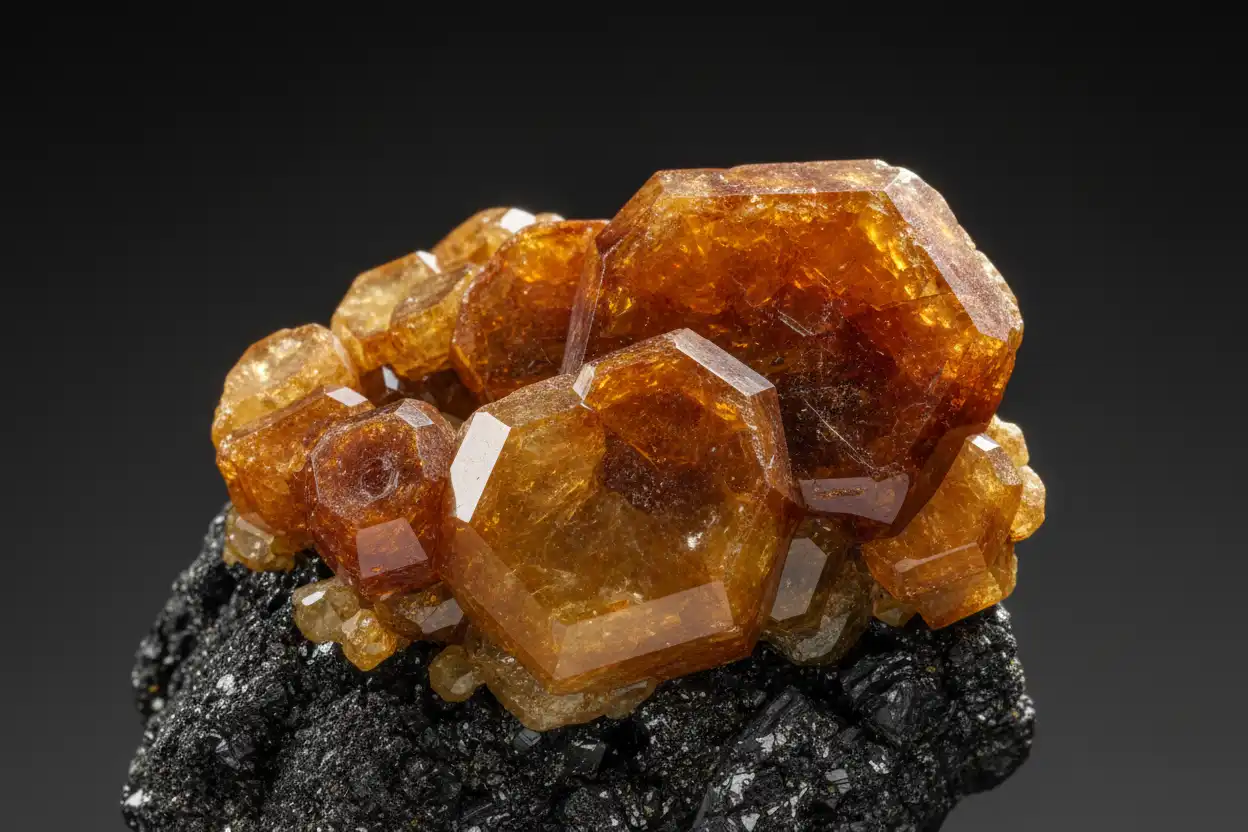
Bastnasite meaning begins with rare-earth mineralogy. The name bastnasite is commonly used for a closely related group of rare-earth fluorocarbonate minerals, especially bastnasite-(Ce), whose simplified formula is CeCO₃F. Natural material commonly contains substantial lanthanum, neodymium, and other rare-earth elements in addition to cerium, so the chemistry of an individual crystal can vary while retaining the same basic structural family. The mineral usually crystallizes in the hexagonal system and occurs in yellow, honey, brown, reddish-brown, orange, pale red, or occasionally lighter-colored crystals and massive aggregates.
Bastnasite is significantly denser than most familiar silicate gemstones, commonly with specific gravity near 4.9–5.2 depending on composition, yet it is only moderately hard at roughly 4–4.5 on the Mohs scale. It is brittle, has noticeable cleavage, and can display vitreous, resinous, or slightly greasy luster. These properties make good natural crystals important collector specimens but limit their practicality for exposed everyday jewelry.
The mineral’s importance extends far beyond collecting. Bastnasite-bearing deposits are major geological sources of light rare-earth elements such as cerium, lanthanum, neodymium, and praseodymium. Those elements are technologically important, but that industrial role should not be confused with the physical effect of carrying a crystal. Modern bastnasite meaning sometimes includes adaptability, confidence, personal growth, focus, transformation, or recognizing hidden potential. These are symbolic interpretations rather than measurable properties of a rare-earth fluorocarbonate.
Bastnasite has not been demonstrated to increase intelligence, regulate the nervous system, transmit rare-earth elements through skin, attract opportunities, protect against environmental hazards, or produce medical healing. Its genuine chemistry, unusual geological settings, economic importance, and rare-earth composition already give the mineral a substantial identity.
Readers exploring other mineral profiles can browse the broader Gemstone Guides.
Bastnasite Identity at a Glance
| Property | Bastnasite |
|---|---|
| Material identity | Rare-earth fluorocarbonate mineral group |
| Common principal species | Bastnasite-(Ce) |
| Simplified formula | CeCO₃F, with substantial rare-earth substitution common |
| Major elements | Rare-earth elements, carbon, oxygen, fluorine |
| Crystal system | Hexagonal |
| Common crystal habit | Tabular, short prismatic, platy, granular, massive |
| Typical colors | Yellow, honey, brown, reddish-brown, orange, pale red |
| Transparency | Transparent in exceptional thin crystals; commonly translucent to opaque |
| Luster | Vitreous, resinous to slightly greasy |
| Mohs hardness | Approximately 4–4.5 |
| Specific gravity | Commonly about 4.9–5.2 |
| Cleavage | Distinct to good |
| Tenacity | Brittle |
| Typical geological settings | Carbonatites, alkaline igneous complexes, hydrothermal systems and related rare-earth deposits |
| Important economic role | Major source mineral for light rare-earth elements |
| Main ownership concern | Softness, brittleness, cleavage and unknown associated minerals |
| Main identification limit | Yellow-brown color and high density alone do not prove bastnasite |
Bastnasite meaning becomes more precise once this combination is understood. It is neither a generic yellow crystal nor a single perfectly uniform chemical compound. Its identity sits at the intersection of crystal structure, rare-earth chemistry, carbonate and fluorine components, and specialized geological environments.
Bastnasite Is Better Understood as a Mineral Group
The word bastnasite often appears without a suffix in jewelry, collector, and industrial discussions, but modern mineral nomenclature distinguishes several members according to which rare-earth element dominates a particular structural position.
Bastnasite-(Ce) is the most familiar member and is cerium-dominant. Bastnasite-(La) is lanthanum-dominant, while bastnasite-(Y) is yttrium-dominant. Natural crystals can contain mixtures of cerium, lanthanum, neodymium, praseodymium, and other rare-earth elements, so chemical analysis is sometimes needed before assigning the most precise species name.
This compositional variation does not make the material artificial or impure. Substitution is a normal feature of mineral chemistry, especially among rare-earth elements whose ionic sizes and chemical behavior can be similar enough for them to occupy comparable structural sites.
A specimen labeled simply “bastnasite” may therefore be perfectly reasonable at the group level when exact rare-earth dominance has not been established.
Rare-Earth Does Not Mean Rare in Every Sense
The term rare-earth element can be misleading. It does not mean that every rare-earth element is extraordinarily scarce in Earth’s crust, nor does it mean that every mineral containing them is automatically valuable.
The group includes chemically related metallic elements such as cerium, lanthanum, neodymium, praseodymium, samarium, europium, and others. Many occur widely in trace amounts but are rarely concentrated enough in economically workable minerals and deposits.
Bastnasite matters because certain geological systems can concentrate light rare-earth elements sufficiently for the mineral to become a significant ore.
This distinction separates geological abundance from economic concentration.
A mineral can contain technologically important elements without every hand specimen being valuable ore.
How Bastnasite Forms
Bastnasite is particularly associated with carbonatites and alkaline igneous complexes, geological systems capable of concentrating unusual elements that remain dispersed at much lower levels in common crustal rocks. Carbonatites are unusual igneous rocks rich in carbonate minerals rather than ordinary silicate minerals, and they can host rare-earth mineralization alongside calcite, dolomite, barite, fluorite, apatite, magnetite, and other specialized minerals.
As magma evolves, rare-earth elements can become increasingly concentrated in residual melts and fluids. Fluorine and carbonate chemistry can help transport or stabilize those elements, eventually allowing bastnasite and related minerals to crystallize.
Hydrothermal fluids can further redistribute rare-earth elements through fractures, replacement zones, veins, and altered rock. This means bastnasite may form during primary magmatic crystallization, later fluid activity, or a combination of processes depending on the deposit.
The precise relationship among carbonatite magmatism, alkaline rocks, fluid evolution, replacement textures, associated minerals, and rare-earth enrichment is explored in Bastnasite formation and deposit geology.
Why Bastnasite Can Be Yellow, Brown, or Reddish
Bastnasite commonly appears yellow, honey-colored, orange-brown, reddish-brown, or pale red. Its body color reflects a combination of rare-earth composition, trace impurities, structural defects, inclusions, oxidation state, weathering, and optical absorption.
Cerium-bearing minerals often occupy yellow-to-brown visual ranges, but color cannot be converted directly into a reliable cerium percentage. Iron staining may deepen brown or red tones, while microscopic inclusions and alteration products can affect both saturation and transparency.
A clear honey-yellow crystal and a dark reddish-brown massive specimen can therefore belong to the same mineral group.
Color should be described confidently as an observation while the exact mechanism remains tied to specimen-specific chemistry.
Detailed refractive behavior, absorption, birefringence, transmitted-light effects, and color mechanisms belong in Bastnasite optical properties and color behavior.
Bastnasite’s High Density Is an Important Clue
Specific gravity near 5 is unusual for a nonmetallic-looking yellow or brown mineral. A compact bastnasite crystal can therefore feel surprisingly heavy compared with quartz, calcite, feldspar, or fluorite of similar size.
The reason lies in its rare-earth chemistry. Elements such as cerium and lanthanum have relatively high atomic masses, placing substantial mass within the crystal structure.
Density becomes especially useful when a specimen has lost its natural crystal form through cutting or breakage. A pale yellow stone that looks vaguely like calcite or fluorite but has much greater measured density deserves different possibilities.
Hand-heft alone is still insufficient. Matrix, cavities, attached heavy minerals, and object geometry can distort perception.
Measured specific gravity is stronger evidence than the sensation of heaviness.
Crystal Habit Can Be Distinctive but Is Not Enough
Bastnasite commonly forms tabular, platy, or short-prismatic hexagonal crystals. Some specimens develop well-defined six-sided outlines, while others occur as granular, compact, or massive material without obvious crystal faces.
Crystal morphology is useful because it can narrow identification possibilities, particularly when good terminations are preserved.
It cannot establish species alone.
Other hexagonal or pseudohexagonal minerals can overlap visually, and heavily altered bastnasite may preserve only fragments of its original morphology. Once a specimen is cut and polished, much of the natural crystal evidence disappears entirely.
Collector crystals therefore preserve information that a polished stone does not.
Bastnasite Is Softer Than Its Dense Appearance Suggests
A heavy mineral often feels mechanically robust, but bastnasite is only around 4–4.5 on the Mohs scale. Quartz can scratch it easily, and ordinary environmental grit can gradually abrade a polished surface.
Cleavage and brittleness add further vulnerability. A sharp crystal can chip or split after impact even though its high density gives it a solid tactile impression.
This is the same general lesson seen in other dense collector minerals: weight and toughness measure different things.
A specimen should be handled according to hardness, cleavage, fracture condition, and crystal geometry rather than assuming that heaviness equals durability.
Diagnostic Traits of Bastnasite
Bastnasite identification becomes much stronger when several properties agree: high density, modest hardness, hexagonal crystal form, rare-earth fluorocarbonate chemistry, appropriate refractive behavior, characteristic geological association, and suitable spectroscopy or diffraction data.
Natural specimens can be difficult to identify visually because monazite, synchysite-group minerals, parisite-group minerals, calcite stained by iron, fluorite, apatite, and several other rare-earth or carbonate minerals may occur in the same deposits.
Chemical analysis can demonstrate that rare-earth elements dominate the specimen, but chemistry alone may still need structural interpretation because multiple rare-earth carbonate and fluorocarbonate minerals share related elemental compositions.
Raman spectroscopy, X-ray diffraction, electron-microprobe analysis, and other mineralogical methods provide substantially stronger evidence than color or density alone.
Microscopic growth zoning, inclusions, alteration, cleavage, coatings, intergrowths, and associated phases are examined more closely in the Bastnasite microscope inclusion notebook.
Original Bastnasite Specimen and Photo Checklist
| Observation | What it may reasonably support | What it cannot prove alone |
|---|---|---|
| Honey-yellow hexagonal crystal | Appearance compatible with bastnasite | Exact species |
| Brown or reddish short prism | Common bastnasite appearance | Rare-earth composition |
| Unusually heavy nonmetallic crystal | Strong clue for a heavy-element mineral | Bastnasite specifically |
| Vitreous-to-greasy luster | Compatible appearance | Geographic origin |
| Tabular six-sided habit | Useful morphological support | Bastnasite without further testing |
| Distinct natural cleavage | Strong physical clue | Reason to break a crystal |
| Carbonatite matrix | Highly plausible geological context | Exact rare-earth mineral |
| Barite or fluorite association | Plausible rare-earth deposit association | Species identity |
| Iron-stained surface | Possible natural alteration | Original body color |
| High measured SG near 5 | Strong supporting evidence | Exact bastnasite member |
| Rare-earth-rich chemical result | Strong chemical evidence | Crystal structure |
| Raman spectrum matching bastnasite | Strong species evidence | Exact locality |
| X-ray diffraction match | Strong structural identification | Treatment history |
| Microprobe showing Ce dominance | Strong support for bastnasite-(Ce) | Provenance |
| Original mine label | Important provenance evidence | Independent chemical confirmation |
This checklist is deliberately conservative because rare-earth mineral assemblages can contain several visually similar species within the same hand specimen.
Bastnasite Claims That Need Qualification
| Claim | More accurate interpretation |
|---|---|
| “Bastnasite is one mineral with one exact composition” | The name commonly refers to a group with Ce-, La-, or Y-dominant members |
| “Rare-earth means extremely rare” | The term describes an element group, not guaranteed scarcity |
| “Every yellow rare-earth mineral is bastnasite” | False; several REE minerals overlap in color |
| “Hexagonal shape proves bastnasite” | Useful clue, not definitive identification |
| “Heavy means durable” | False; bastnasite is relatively soft, brittle, and cleavable |
| “Bastnasite is radioactive” | Radioactivity depends on actual associated and trace elements; the mineral name alone does not establish a hazardous level |
| “Rare-earth content boosts the body” | Wearing the mineral does not deliver a controlled nutritional or therapeutic dose |
| “Cerium in the stone increases energy” | No established biological mechanism supports this claim through contact |
| “Bastnasite protects from electromagnetic radiation” | No general shielding effect is established for a loose crystal |
| “Bastnasite detoxifies heavy metals” | No established medical mechanism supports this claim |
| “Industrial importance makes every specimen valuable” | Collector and ore value depend on entirely different criteria |
| “Color proves locality” | Geographic origin requires documentation |
These distinctions are particularly important because terms such as rare-earth, strategic mineral, critical material, and high-tech element can make a mineral sound biologically or metaphysically powerful even when those categories describe economics and technology rather than human physiology.
Bastnasite and Barytocalcite Are Both Heavy but Chemically Different
Barytocalcite meaning concerns BaCa(CO₃)₂, a barium-calcium carbonate. Both barytocalcite and bastnasite can feel unusually heavy and occur in pale yellow or brownish crystals.
The cause is different.
Barytocalcite derives much of its mass from barium.
Bastnasite derives its high density from rare-earth elements such as cerium and lanthanum.
Their structures, chemistry, geological associations, and optical properties therefore differ substantially despite the shared tactile impression.
Bastnasite and Barite Share Density, Not Identity
Barite meaning concerns barium sulfate, BaSO₄. Barite can be similarly heavy and may occur in the same broad mineralized systems as bastnasite.
A pale yellow heavy crystal therefore cannot be identified simply by heft.
Barite is generally softer and belongs to the orthorhombic system, while bastnasite has rare-earth fluorocarbonate chemistry and typically hexagonal symmetry.
In some rare-earth deposits, the minerals occur together, making matrix-level identification even more important.
Bastnasite and Bauxite Are Not Comparable Mineral Species
Bauxite meaning concerns an aluminium ore rock composed of varying proportions of aluminium hydroxide minerals, iron oxides, clays, and other phases.
Bastnasite is a defined crystalline rare-earth mineral.
This difference highlights the distinction between a mineral species and an ore rock. Both can be economically important, but they occupy different levels of geological classification.
An ore name describes material valuable for extraction.
A mineral species describes a specific crystalline substance.
Bastnasite and Benitoite Are Different Collector Materials
Benitoite meaning concerns a blue barium-titanium silicate gemstone with dramatically different chemistry and optical behavior. Bastnasite is a rare-earth fluorocarbonate usually encountered in yellow-to-brown collector crystals and ore mineralization.
Both can be uncommon collector minerals with technologically interesting elements, but this shared novelty does not create a mineralogical relationship.
The distinction reinforces why color, rarity, and collector status should never replace chemical identity.
Bastnasite’s Economic Importance Comes From Rare-Earth Elements
Bastnasite-bearing ores have played a major role in rare-earth production because they can contain substantial concentrations of light rare-earth elements.
Cerium has uses in catalysts, polishing compounds, metallurgy, glass, and other technologies.
Lanthanum appears in catalysts, optical materials, battery-related applications, and specialized glass.
Neodymium and praseodymium are particularly important in high-performance permanent magnets used in motors, generators, electronics, and numerous advanced technologies.
The industrial value resides in extracting, separating, purifying, and processing those elements under controlled conditions.
A mineral specimen on a shelf does not reproduce the technological function of purified rare-earth materials.
“Critical Mineral” Does Not Mean Healing Mineral
Terms such as critical mineral or strategic resource refer to supply chains, manufacturing importance, economic security, technological demand, and difficulty of substitution.
They are not medical classifications.
A rare-earth-bearing mineral may be critical to an industrial economy because it supplies elements needed for magnets, catalysts, electronics, or energy technologies. That does not mean the crystal is biologically essential when worn against skin.
This distinction is particularly useful for bastnasite because modern technology gives the mineral genuine global significance without requiring exaggerated metaphysical claims.
Bastnasite and Radioactivity Require Specimen-Specific Judgment
Rare-earth deposits can contain uranium- or thorium-bearing accessory minerals, and some bastnasite specimens may contain minor thorium or occur beside minerals that contribute measurable radioactivity.
That does not justify describing every bastnasite crystal as dangerously radioactive.
Radioactivity is measurable. If a specimen comes from a deposit known for radioactive associates, is unusually mineralogically complex, or will be stored in a large collection, an appropriate radiation survey can provide actual information.
A Geiger counter response from the entire specimen also does not prove that bastnasite itself is the sole source because matrix minerals may contribute.
The sensible approach is measurement rather than alarm.
Safe Ownership Starts With Preserving the Specimen
For an intact bastnasite crystal, the main routine concerns are mechanical. Protect it from harder minerals, impact, abrasion, and unnecessary pressure on cleavage-sensitive edges.
Dust can be removed gently with an appropriate soft brush when the matrix is stable. Aggressive scrubbing is unnecessary because a hardness around 4–4.5 makes polished and natural surfaces easier to scratch than quartz.
Chemical cleaning should be conservative because associated carbonates, fluorides, iron oxides, sulfides, repairs, or matrix minerals may react differently. A cleaning method suitable for one phase may damage another.
Rare-earth collector specimens are often more valuable with natural matrix and surface relationships preserved than aggressively cleaned to maximum brightness.
Cutting Bastnasite Is Primarily a Collector Exercise
Transparent bastnasite can be fashioned, but relatively low hardness, cleavage, brittleness, high density, and limited clean rough make it an unusual collector gem rather than a practical mainstream jewelry stone.
A cutter must balance transparency, color, cleavage orientation, inclusions, crystal thickness, and yield. The strongest yellow or reddish color may occur in an orientation that produces a darker face-up gem, while removing fractures can consume a large percentage of an already uncommon crystal.
Natural crystals may also have greater mineralogical value than the finished stone.
Orientation, polishing behavior, edge durability, and preservation of rare rough are explored in Bastnasite cutting, orientation and polish.
For jewelry, setting pressure, edge protection, occasional-wear design, and mechanical exposure are covered in Bastnasite setting and wear engineering.
Everyday Jewelry Is Usually Not the Best Use
Bastnasite’s hardness is below that of quartz, and its brittle cleavable structure makes exposed rings especially demanding.
A protected pendant, collector brooch, display gem, or carefully mounted specimen may be reasonable when the material is stable and appropriately identified.
Daily rings and bracelets expose the stone to abrasion, knocks, soap, cosmetics, temperature changes, and repeated contact with harder materials.
A rare mineral does not become more durable because it has collector value.
For many fine crystals, leaving the specimen uncut and unmounted preserves more information and value than converting it into jewelry.
Cutting and Grinding Change the Exposure Situation
Normal handling of an intact specimen is different from sawing, grinding, drilling, crushing, or polishing mineral-bearing rock.
Mechanical processing creates fine particles not only from bastnasite but also from all matrix minerals present. Rare-earth deposits can contain carbonates, fluorite, barite, silica-bearing minerals, iron oxides, phosphates, sulfides, and locally radioactive accessory phases.
Wet methods where suitable, local extraction, eye protection, respiratory protection matched to the task, and careful cleanup are therefore sensible workshop controls.
Unknown ore material should not be dry-ground casually in an enclosed room.
Bastnasite Should Not Be Used in Drinking Water
The rare-earth elements inside bastnasite are part of a crystalline fluorocarbonate structure.
They are not nutritional supplements.
Do not grind bastnasite into powders, consume fragments, or deliberately soak rough mineral specimens in drinking water for supposed healing or detoxification.
Natural specimens can contain additional minerals and trace elements not represented by the simplified formula. Their mining, storage, repair, and cleaning histories may also be unknown.
Mineralogical importance does not establish food or medical safety.
The Name Bastnasite Comes From a Mining Locality
The mineral’s name is derived from the Bastnäs mining district in Sweden, an important historical mineral locality associated with rare-earth mineralogy.
This naming history is geological and geographic.
The word does not mean transformation, manifestation, higher consciousness, rare energy, or technological power.
The historical connection is especially appropriate because rare-earth minerals from Swedish mining districts played an important part in the development of knowledge about rare-earth chemistry.
That scientific history provides a much stronger foundation than an invented ancient spiritual tradition.
Rare-Earth Science Gives Bastnasite a Distinctive History
The history of rare-earth elements is unusually complicated because the elements have similar chemical properties and were difficult to separate from one another using early analytical methods.
Minerals containing mixtures of rare-earth elements repeatedly challenged chemists, leading to the recognition of multiple new elements from materials that initially appeared chemically similar.
Bastnasite later became economically important because large deposits offered a concentrated source of light rare-earth elements.
Its historical significance therefore sits at the intersection of mineralogy, analytical chemistry, mining, metallurgy, and modern technology.
There is no need to claim that ancient societies understood rare-earth crystal energies for the mineral to have an important human history.
Modern Bastnasite Meaning and Adaptability
Adaptability is a plausible modern symbolic theme because bastnasite accommodates several chemically similar rare-earth elements within related structural positions.
A person can interpret this as a metaphor for maintaining an underlying structure while adjusting to changing circumstances.
The crystal does not physically transfer adaptability.
Someone might keep bastnasite as a reminder to preserve core priorities while changing methods, schedules, or strategies when new information appears.
The action and adjustment remain human.
Bastnasite Meaning and Hidden Potential
The mineral’s industrial role also invites symbolism around hidden potential. A modest brown or yellow crystal can contain elements that become extraordinarily useful after complex extraction and purification.
As metaphor, this can represent abilities or resources that are not obvious from outward appearance.
That does not mean the mineral identifies a person’s hidden talents, increases intelligence, or activates unused parts of the brain.
The symbolic lesson comes from the contrast between appearance and technological importance.
Bastnasite Meaning and Transformation
Bastnasite-bearing ore undergoes substantial physical and chemical processing before rare-earth elements become purified industrial materials. This provides another natural metaphor for transformation through stages rather than instant change.
Someone may use that idea as a reminder that difficult skills, projects, or personal changes often require separation, refinement, repetition, and time.
The stone itself does not cause life transformation or guarantee an outcome.
Using a real industrial process as metaphor is more grounded than attributing invisible transformational energy to the crystal.
Bastnasite Meaning and Focus
Rare-earth minerals are chemically complex enough that precise identification frequently requires separating subtle differences rather than relying on color. That scientific context can make bastnasite a useful personal symbol for focus, careful observation, or resisting simplistic conclusions.
A person might keep a specimen near a workspace as a reminder to check assumptions and distinguish evidence from first impressions.
There is no established evidence that bastnasite alters concentration, memory, attention, or neurological function.
The object can cue a behavior without creating the cognitive capacity itself.
Bastnasite Does Not Have Established Healing Properties
There is no established scientific evidence that holding or wearing bastnasite treats physical or psychological conditions.
Its cerium, lanthanum, neodymium, or other rare-earth content does not provide a demonstrated therapeutic pathway through skin.
Its fluorine-bearing chemistry does not strengthen teeth.
Its density does not ground bodily energy.
Its technological importance does not imply biological benefit.
A mineral can remain personally meaningful without being presented as medicine.
The wider distinction between symbolic use and health claims is explained in the Gems Lore Disclaimer.
Provenance Matters With Rare-Earth Minerals
Bastnasite occurs in several geologically important deposits, and locality can affect crystal habit, associated minerals, chemical composition, collector interest, and historical significance.
Color cannot establish provenance.
A honey-yellow crystal cannot be assigned to a particular carbonatite or mine merely because similar specimens appear online. Original labels, collection records, mine documentation, supplier history, and analytical relationships with matrix minerals provide stronger evidence.
Rare-earth ore samples also deserve clear differentiation from aesthetic collector crystals. A specimen collected for geological study may be visually ordinary but scientifically important because its matrix preserves relationships erased in cut or cleaned material.
The Bastnasite provenance and disclosure checklist provides a structured approach to locality claims, species naming, repairs, matrix information, and seller disclosures.
Collector Preservation Favors Context
A natural bastnasite specimen can preserve crystal morphology, replacement textures, growth zoning, contacts with carbonates, associated rare-earth minerals, weathering, and matrix relationships.
Aggressive trimming may improve visual presentation while removing geological information.
Original labels can be equally important, particularly for older samples from classic mining districts or historically significant rare-earth deposits.
Support dense matrix pieces securely, protect projecting crystals from impact, separate them from harder specimens, and record any repairs or stabilization.
Long-term specimen care and documentation are covered in the Bastnasite specimen conservation record.
Original Evidence Ladder for Bastnasite Claims
Direct observation can establish color, transparency, habit, luster, cleavage, matrix, fractures, alteration, surface condition, and visible associated minerals.
Basic physical examination can add specific gravity, hardness context, conventional optical properties, and crystal symmetry.
Microscopy can reveal zoning, inclusions, intergrowths, fracture fillings, coatings, weathering, repairs, and relationships between bastnasite and matrix phases.
Spectroscopic or diffraction analysis can provide strong mineral identification when visually similar rare-earth carbonates and fluorocarbonates are possible.
Chemical analysis can establish the rare-earth distribution and determine whether Ce, La, Y, or another element dominates the relevant structural site.
Geological interpretation requires host-rock relationships, carbonatite or alkaline-rock context, alteration textures, mineral associations, and evidence concerning fluid evolution.
Radioactivity claims require actual measurement rather than inference from the phrase rare-earth mineral.
Provenance requires labels, mine records, collection history, supplier documentation, or other traceable evidence.
Historical symbolism requires documentary evidence that a cultural interpretation actually existed.
Metaphysical effects remain belief-based even if a modern symbolic tradition is well documented.
This hierarchy prevents a visually ordinary yellow-brown crystal from being asked to prove exact species, elemental composition, mine origin, radioactivity, technological grade, and healing power simultaneously.
What Bastnasite Meaning Can Responsibly Represent
Bastnasite’s real characteristics offer unusually specific symbolic possibilities. Its mixture of closely related rare-earth elements can represent adaptability within a stable framework. Its industrial role can symbolize hidden value that is not obvious from appearance. Its geological concentration from otherwise dispersed elements can represent focus, while the extensive processing required to separate rare-earth elements can represent gradual refinement.
These interpretations are human metaphors.
They do not require the crystal to alter biology, produce luck, shield radiation, or transmit invisible energy.
Someone can use bastnasite as a reminder that important distinctions sometimes require careful analysis and that useful potential often becomes visible only after sustained work.
The evidence-led principles used across Gems Lore are described on About Gems Lore. Questions about a particular specimen can be submitted through Contact Gems Lore.
Frequently Asked Questions
What is bastnasite?
Bastnasite is a group of rare-earth fluorocarbonate minerals. Bastnasite-(Ce), commonly represented as CeCO₃F, is the best-known member.
Is bastnasite one mineral?
The name is often used broadly, but the group includes members distinguished by which rare-earth element dominates, including bastnasite-(Ce), bastnasite-(La), and bastnasite-(Y).
What color is bastnasite?
Common colors include yellow, honey, brown, reddish-brown, orange, and pale red.
Why is bastnasite heavy?
Rare-earth elements such as cerium and lanthanum have high atomic masses, giving bastnasite a specific gravity commonly near 5.
How hard is bastnasite?
Bastnasite is approximately 4–4.5 on the Mohs hardness scale.
Is bastnasite fragile?
It is relatively soft, brittle, and cleavable, so sharp crystals can chip or split after impact.
What crystal system is bastnasite?
Common bastnasite species crystallize in the hexagonal system.
Where does bastnasite form?
It is particularly associated with carbonatites, alkaline igneous complexes, hydrothermal alteration, and related rare-earth mineral deposits.
What minerals occur with bastnasite?
Depending on locality, associations can include calcite, barite, fluorite, apatite, quartz, iron oxides, and other rare-earth minerals.
Why is bastnasite economically important?
Some bastnasite-bearing ores are major sources of light rare-earth elements such as cerium, lanthanum, neodymium, and praseodymium.
What are rare-earth elements?
They are a chemically related group of metallic elements that includes the lanthanides along with yttrium and, in many classifications, scandium.
Does rare-earth mean bastnasite is extremely rare?
No. “Rare-earth” is the name of an element group. Economic importance depends on concentration, mineralogy, deposit size, processing, and demand.
Is bastnasite radioactive?
The mineral name alone does not establish a significant radioactive level. Some rare-earth deposits contain thorium- or uranium-bearing accessory minerals, so actual measurement is preferable when radioactivity is a concern.
Can a Geiger counter identify bastnasite?
No. A radiation response can indicate radioactive material somewhere in the specimen but does not identify bastnasite or establish which mineral produces the signal.
Can bastnasite be transparent?
Some small or high-quality crystals can be transparent or strongly translucent, while much material is translucent to opaque.
Can bastnasite be faceted?
Transparent material can be faceted as a collector gem, but softness, cleavage, rarity, and limited clean rough make faceted bastnasite unusual.
Is bastnasite good for rings?
It is poorly suited to exposed everyday rings because it scratches and chips more easily than conventional jewelry gemstones.
How can bastnasite be identified?
Useful evidence includes density, hardness, crystal habit, optical properties, spectroscopy, X-ray diffraction, and chemical analysis of its rare-earth composition.
Can color identify bastnasite?
No. Yellow and brown occur in many minerals. Color is an initial observation rather than definitive evidence.
Can chemistry identify the exact bastnasite member?
Chemical analysis can show which rare-earth element dominates and therefore support a precise species name such as bastnasite-(Ce) or bastnasite-(La).
Does bastnasite contain cerium?
Bastnasite-(Ce) does, and cerium is commonly important in natural bastnasite-group material. Other rare-earth elements can substitute substantially.
Does bastnasite contain neodymium?
Natural bastnasite can contain neodymium along with several other rare-earth elements, although concentration varies by specimen and deposit.
Can the rare-earth elements in bastnasite benefit the body?
Wearing or holding the mineral does not provide a controlled nutritional or therapeutic rare-earth dose.
Can bastnasite be placed in drinking water?
Raw bastnasite specimens should not be used to prepare ingestible remedies. Their complete composition, matrix, impurities, and exposure characteristics may be unknown.
Is bastnasite safe to handle?
Normal handling of an intact, stable specimen is different from grinding or ingesting it. Use ordinary mineral hygiene, avoid unnecessary dust, and investigate radioactivity when a particular specimen or locality warrants it.
What does bastnasite symbolize?
Modern bastnasite meaning can include adaptability, hidden potential, focus, refinement, transformation, and personal growth.
Does bastnasite have healing properties?
There is no established scientific evidence that bastnasite treats medical or psychological conditions.
Does bastnasite protect against radiation?
A loose crystal should not be treated as a radiation shield. Effective shielding requires appropriate materials, geometry, thickness, and engineering.
Does bastnasite increase focus?
It may serve as a personal reminder to concentrate or examine evidence carefully, but no established neurological effect has been demonstrated.
Why is provenance important for bastnasite?
Locality can affect species composition, associated minerals, collector significance, geological interpretation, and possible safety considerations. Appearance alone cannot establish origin.
How should bastnasite be stored?
Protect it from harder minerals, impact, unstable matrix, and unnecessary handling. Preserve original labels and document repairs or analytical results.
Bastnasite meaning becomes much more substantial once the mineral’s rare-earth identity is understood. Bastnasite is a dense, comparatively soft fluorocarbonate associated especially with carbonatites, alkaline igneous systems, and rare-earth mineralization. Its cerium-, lanthanum-, neodymium-, and praseodymium-rich compositions help explain why bastnasite-bearing deposits became technologically important sources of light rare-earth elements.
Those real characteristics also provide more distinctive symbolism than generic crystal claims. Rare-earth substitution can represent adaptability, geological concentration can represent focus, and the contrast between an ordinary-looking brown-yellow mineral and its technological importance can represent hidden potential.
These meanings remain metaphors rather than physical powers. Bastnasite does not need unsupported healing claims, guaranteed transformation, or exaggerated ideas about rare-earth energy to be significant; its mineral chemistry, geology, industrial role, and place in the history of rare-earth science already make it unusual.