
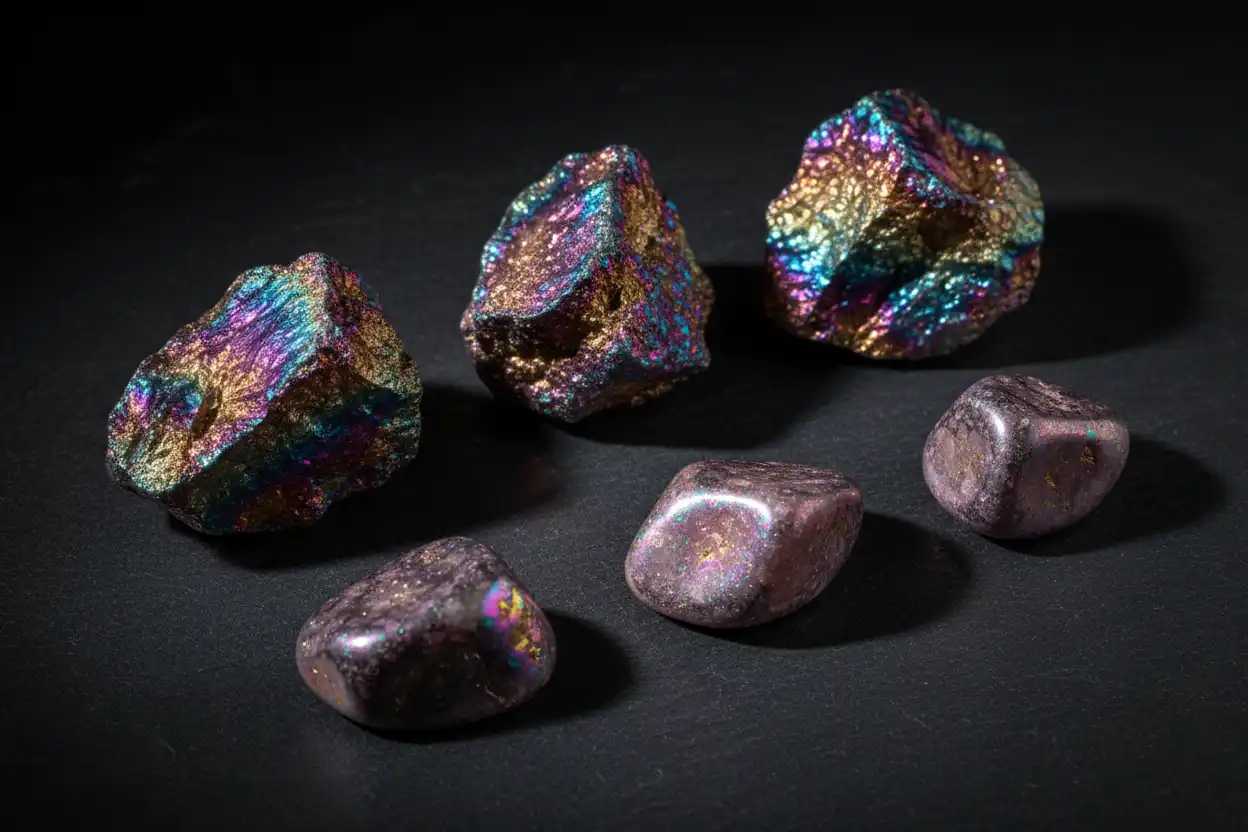

Bornite is an opaque copper-iron sulfide mineral with a fresh bronze-brown surface that quickly develops purple, blue and reddish tarnish. It belongs to the sulfide mineral class and commonly appears in copper deposits as massive ore, disseminated grains or uncommon pseudocubic crystals.
Bornite at a Glance
| Property | Bornite |
|---|---|
| Mineral group | Copper-iron sulfide |
| Composition | Cu₅FeS₄ |
| Colors | Copper-red, bronze-brown and pinkish brown when fresh; purple, blue, red and black after tarnishing |
| Crystal system | Orthorhombic at ordinary temperatures; commonly pseudocubic |
| Habit | Massive, granular, compact, disseminated, pseudocubic, dodecahedral and octahedral |
| Luster | Metallic |
| Transparency | Opaque |
| Mohs hardness | Approximately 3–3.25 |
| Cleavage | Only traces |
| Tenacity | Brittle |
| Common use | Copper ore, mineral specimens, educational collections and occasional ornamental pieces |
| Main care concern | Tarnish alteration, softness, sulfide oxidation, copper-bearing dust and confusion with treated chalcopyrite |
What Is Bornite?
Bornite consists principally of copper, iron and sulfur.
Its ideal composition contains more than 60% copper by weight, which makes it an important copper-ore mineral when deposits contain sufficient volume and favorable processing conditions.
Fresh bornite does not usually show the intense rainbow appearance seen in many crystal-shop baskets. Instead, a newly broken surface looks bronze, copper-red or pinkish brown.
Air gradually reacts with that surface. Consequently, thin alteration films create purple, blue, red and eventually darker colors.
Why Is Bornite Called Peacock Ore?
Collectors use the name peacock ore for metallic copper minerals with vivid iridescent tarnish.
Historically, the term has referred to both bornite and tarnished chalcopyrite. However, modern commercial sellers frequently apply it to acid-treated chalcopyrite rather than natural bornite.
The distinction matters because:
- Bornite starts bronze-brown.
- Chalcopyrite starts brassy yellow.
- Bornite can tarnish naturally.
- Sellers often chemically enhance chalcopyrite.
- Both may show blue, purple and gold surfaces after alteration.
- Neither color pattern alone confirms the underlying mineral.
Therefore, “peacock ore” describes appearance more reliably than mineral species.
How Bornite Tarnish Forms
Bornite reacts with oxygen, moisture and other environmental chemicals at its surface.
As the outermost layer changes, very thin films of copper- and iron-bearing compounds develop. Light reflects from the top and lower boundaries of those films, producing interference colors.
Film thickness controls the visible hue. For example, one area may appear purple while a slightly thicker region looks blue or green.
The color can continue changing as oxidation progresses. Accordingly, a bright specimen may become dull brown or black over time.
Natural tarnish does not guarantee stability. In fact, the most colorful surface may represent an early stage in an ongoing alteration process.
Bornite Meaning and Symbolism
Modern crystal traditions associate bornite with adaptability, recognizing opportunity and allowing plans to change when new information appears.
Its shifting surface colors may symbolize the difference between an object’s underlying identity and its temporary appearance. Meanwhile, its copper content often inspires themes of connection and practical resourcefulness.
Some people display bornite as a reminder to remain open to evidence without abandoning careful judgment.
These interpretations reflect personal and cultural symbolism rather than scientifically proven effects.
How Bornite Forms
Bornite develops across several copper-rich geological environments.
Hydrothermal Deposits
Hot mineral-bearing fluids can deposit bornite in veins, fractures and replacement zones.
Within these systems, it often occurs beside chalcopyrite, pyrite, chalcocite, quartz, calcite and other copper minerals.
Porphyry Copper Deposits
Large porphyry systems may contain disseminated bornite and chalcopyrite across enormous volumes of altered rock.
Although individual grains can appear small, their combined copper content may support major mining operations.
Skarn Deposits
When intrusive magma interacts with carbonate rock, chemical reactions can produce copper-bearing skarns.
Bornite may occur with garnet, wollastonite, calcite and other high-temperature minerals in these environments.
Mafic Igneous and Magmatic Deposits
Some mafic igneous rocks contain disseminated bornite with other sulfides.
Sedimentary Copper Deposits
Copper-bearing fluids can also introduce bornite into sedimentary rocks, including cupriferous shale sequences.
Important Bornite Localities
Dzhezkazgan, Kazakhstan
Dzhezkazgan has produced notable bornite specimens and important copper mineralization.
Collectors value sharp crystals and well-documented combinations, although much of the deposit consists of ore rather than aesthetic display material.
Butte, Montana
Butte’s polymetallic veins contain bornite with chalcopyrite, enargite, chalcocite and other copper minerals.
Historic mine labels add value because precise underground locations may no longer remain accessible.
Bristol, Connecticut
Bristol produced some of the classic crystallized bornite specimens from the United States.
Well-formed examples remain uncommon because bornite more often occurs as massive or granular material.
Cornwall, England
Cornish copper mines produced bornite together with chalcopyrite and other sulfides.
Older specimens may carry strong mining-history value when they retain original mine and collection labels.
Mangula Mine, Zimbabwe
The Mangula Mine became known for unusually large bornite crystals.
Complete crystals remain highly collectible because natural bornite rarely develops into prominent display forms.
Arizona Copper Districts
Bisbee, Superior and other Arizona districts contain bornite in important copper deposits.
The mineral often appears with chalcopyrite, chalcocite, azurite, malachite and additional secondary copper minerals.
Olympic Dam, Australia
Olympic Dam contains bornite within a large iron-oxide copper-gold system.
Industrial ore specimens differ from the colorful treated peacock ore sold through many retail shops.
Bornite vs. Chalcopyrite
Chalcopyrite is CuFeS₂, while bornite has the ideal formula Cu₅FeS₄.
Fresh surfaces provide one useful distinction:
| Feature | Bornite | Chalcopyrite |
|---|---|---|
| Fresh color | Bronze-brown to copper-red | Brassy yellow |
| Hardness | About 3–3.25 | About 3.5–4 |
| Streak | Pale grayish black | Greenish black |
| Natural tarnish | Common purple-blue alteration | Can tarnish but retail rainbow color often receives chemical enhancement |
| Crystal habit | Usually massive; uncommon pseudocubic crystals | Tetragonal crystals and massive ore |
A bright rainbow surface cannot separate the minerals. Therefore, buyers should request an untreated area, locality information or laboratory confirmation.
Bornite vs. Pyrite
Pyrite has the formula FeS₂ and contains no essential copper.
Its fresh color appears pale brass-yellow, while bornite looks darker and more coppery. Pyrite also reaches hardness 6–6.5, making it substantially harder than bornite.
Both minerals can form cubic-looking crystals. However, bornite’s crystals remain much less common and often show pseudocubic modifications.
Bornite vs. Bismuth
Bornite and bismuth can both show rainbow surface colors.
Bismuth is an elemental metal with a silver-pink fresh surface. Additionally, sellers commonly grow its geometric hopper crystals from molten refined metal.
Bornite, by contrast, is a natural copper-iron sulfide and generally occurs as massive ore or uncommon crystals.
Surface color alone cannot distinguish them, but density, fresh color, structure and geological context provide useful evidence.
Is Bornite a Gemstone?
Bornite is an ore mineral and collector specimen rather than a conventional gemstone.
Several properties limit jewelry use:
- Low hardness.
- Brittle fracture.
- Unstable tarnish.
- Opaque appearance.
- Potential oxidation residue.
- Copper- and sulfur-bearing cutting dust.
Lapidaries occasionally polish stable massive material into cabochons or free forms. Nevertheless, such pieces can lose color or develop dull surfaces during wear.
Pendants and protected display items offer more realistic uses than rings or bracelets.
Industrial Importance
Bornite can serve as a valuable copper ore because its ideal composition contains a high proportion of copper.
Mining companies rarely process isolated bornite crystals. Instead, they crush mixed ore containing bornite, chalcopyrite, chalcocite and gangue minerals.
Concentration methods separate much of the copper sulfide from waste rock. Subsequently, smelting and refining recover copper for electrical, construction, transportation and industrial applications.
A colorful retail specimen has no direct value relationship with bulk copper ore. Collector quality and industrial grade follow different pricing systems.
How Bornite Is Sold
| Commercial form | Typical market |
|---|---|
| Small massive fragment | Educational collection |
| Naturally tarnished specimen | Mineral collection |
| Bornite in ore matrix | Mining or locality collection |
| Rare crystal | Advanced systematic collection |
| “Peacock ore” basket piece | Often treated chalcopyrite |
| Polished free form | Ornamental or metaphysical market |
Dealers should state whether the material is bornite, chalcopyrite or simply unidentified peacock ore.
Bornite Price and Value
Indicative July 2026 retail asking-price ranges are:
| Bornite form | Approximate retail range |
|---|---|
| Small commercial peacock-ore piece | $3–$15 |
| Treated chalcopyrite display specimen | $10–$50 |
| Small verified natural bornite specimen | $20–$100 |
| Attractive documented locality piece | $75–$300 |
| Fine crystallized bornite | $250–$1,000+ |
| Historic or exceptional cabinet specimen | $1,000–$5,000+ |
| Polished cabochon or free form | $10–$75 |
| Faceted stone | No established market |
Most inexpensive rainbow pieces do not represent rare crystallized bornite. Instead, treatment, size and bright color drive their retail appeal.
Fine verified crystals follow a different market. Locality, crystal form, provenance and condition can raise their value dramatically.
Treatments and Misrepresentation
Chemical treatment creates the largest consumer issue.
Retailers may expose chalcopyrite to acid or oxidizing solutions, producing strong blue, purple, gold and green colors. Some shops then label the product bornite without testing.
Additional concerns include:
- Clear coatings that preserve artificial color.
- Resin stabilization.
- Surface oil.
- Titanium-coated rocks.
- Metallic paint.
- Slag.
- Composite specimens.
- False locality labels.
Treatment should not automatically make a decorative piece undesirable. However, the seller should identify the underlying mineral and disclose the alteration.
How to Identify Bornite
Useful clues include:
- Bronze-brown fresh color.
- Purple or blue natural tarnish.
- Metallic luster.
- Hardness near 3.
- Pale grayish-black streak.
- High density.
- Copper-mineral associations.
- Pseudocubic or massive habit.
Do not chip an expensive specimen merely to expose a fresh surface.
Instead, a mineralogist may use reflected-light microscopy, X-ray diffraction, Raman spectroscopy or chemical analysis.
Follow the general observation process in How to Identify Crystals.
Bornite Hardness and Durability
Bornite’s hardness of 3–3.25 makes it vulnerable to ordinary abrasion.
Glass, steel, quartz and most jewelry gems can scratch it. Furthermore, brittle material may chip after a minor impact.
The Gemstone Hardness Chart provides useful comparisons, although bornite does not qualify as a practical daily-wear gem.
Can Bornite Go in Water?
Do not soak bornite.
Water and oxygen can alter sulfide surfaces, change tarnish and create copper-bearing residue. Moreover, acidic cleaning products can dissolve or restructure the outer layer.
A quick accidental splash does not necessarily destroy the specimen. Nevertheless, dry cleaning offers the safer routine.
Never place bornite directly in drinking water.
How to Clean Bornite
Use a soft, dry brush or air blower.
Avoid rubbing the iridescent surface because friction can remove thin tarnish films. Similarly, do not apply vinegar, lemon juice, metal polish, bleach or commercial jewelry dip.
If powder, green residue or active deterioration appears, isolate the specimen and consult a mineral conservator.
How to Store Bornite
Store bornite in a dry, stable environment away from direct sunlight and rapid humidity changes.
An inert box can protect the surface from dust and abrasion. However, do not seal a damp specimen inside an airtight container.
Keep it away from delicate silver objects and reactive minerals because sulfide products may contribute to tarnishing.
Buying Bornite
Ask the seller:
- Is the piece verified bornite or treated chalcopyrite?
- Does it contain an exposed fresh surface?
- Has acid, heat, coating or oil altered it?
- What is the exact locality?
- Does the specimen have repairs?
- Will the seller accept independent testing?
- Do photographs show normal light rather than extreme saturation?
Listings that describe every rainbow sulfide as rare natural bornite deserve caution.
Frequently Asked Questions
Is bornite naturally rainbow-colored?
Bornite can develop natural purple and blue tarnish. However, many bright retail peacock-ore specimens consist of chemically treated chalcopyrite.
What color is fresh bornite?
A fresh surface appears copper-red, bronze-brown or pinkish brown.
Is bornite an important copper ore?
Yes. Its ideal composition contains a high percentage of copper, and it contributes to several major copper deposits.
Can bornite be worn as jewelry?
Occasional protected use is possible, although softness, brittleness and surface alteration make it impractical for daily wear.
Does bornite contain arsenic?
Arsenic does not belong to the ideal bornite formula. Nevertheless, associated ore minerals may contain arsenic, lead or other hazardous elements.
Why did my bornite turn dark?
Continued oxidation can change colorful tarnish into darker brown or black surface products.
Explore other metallic minerals through Crystals That Start With B or browse the Gemstone Guides collection.
Disclaimer: Bornite symbolism reflects personal or cultural traditions rather than scientifically proven medical or psychological effects. Do not ingest bornite, place it in drinking water, expose it to acids or inhale copper- and sulfur-bearing dust created during cutting or deterioration.