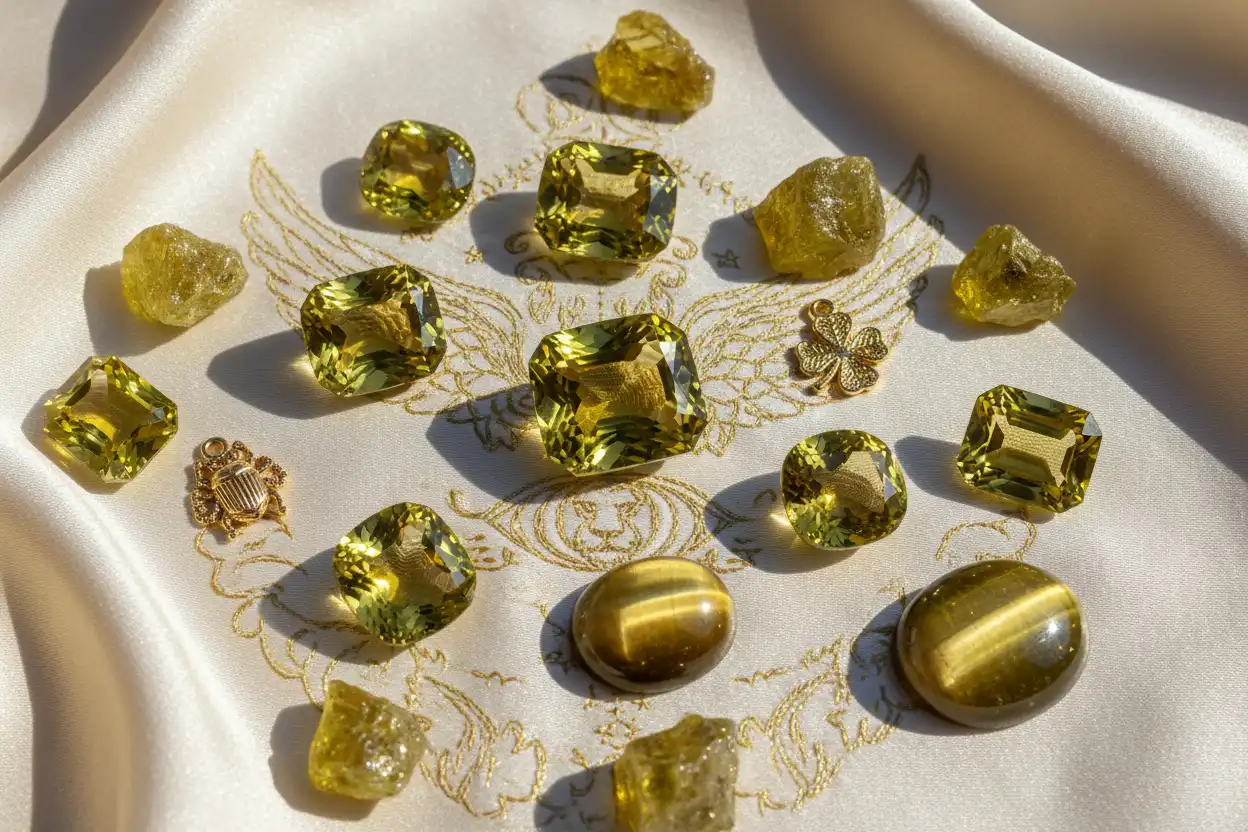
Chrysoberyl Meaning: Mineral Facts, Color & Symbolism
Chrysoberyl meaning is commonly associated in modern gemstone and crystal traditions with resilience, clarity, disciplined growth, adaptability, confidence, and maintaining direction when circumstances change, yet those ideas belong to symbolic interpretation rather than to measurable effects produced by the mineral. Materially, chrysoberyl is a distinct beryllium aluminum oxide mineral with the formula BeAl₂O₄, an orthorhombic crystal structure, exceptional hardness of about 8.5 on the Mohs scale, specific gravity commonly near 3.7, and a combination of optical and structural properties that distinguish it clearly from beryl despite the similarity between their names. The chrysoberyl family is also important because it includes two of the most recognizable gem phenomena in mineralogy: chromium-bearing alexandrite, famous for color change under different illumination, and chatoyant chrysoberyl, commonly called cat’s-eye chrysoberyl when a sharp moving eye is produced by aligned internal structures.
A material-first understanding of chrysoberyl meaning therefore begins with the mineral itself rather than with claims about luck, prosperity, energetic protection, emotional healing, manifestation, or chakra activation, because the real mineralogy already explains why chrysoberyl has remained important to gem collectors and jewelry buyers. Its combination of high hardness, attractive yellow-to-green coloration, excellent polish, distinctive twinning, relatively high refractive index, occasional chatoyancy, and extraordinary alexandrite variety makes chrysoberyl scientifically and commercially significant without requiring unsupported supernatural explanations, and readers looking for comparable mineral-centered references can explore the wider Gemstone Guides collection.
What Chrysoberyl Actually Is
Chrysoberyl is a mineral species rather than a variety of beryl, and this distinction is one of the first points that should be established because the names are similar enough to cause repeated confusion. Chrysoberyl has the formula BeAl₂O₄, whereas beryl has the fundamentally different formula Be₃Al₂Si₆O₁₈, meaning the two minerals differ in chemistry, crystal structure, optical properties, density, cleavage behavior, and hardness even though both contain beryllium. Chrysoberyl crystallizes in the orthorhombic system and commonly occurs as tabular, prismatic, pseudohexagonal-looking twinned, or otherwise well-developed crystals, while transparent gem material can range from nearly colorless through yellow, golden yellow, yellow-green, brownish green, olive, and green depending on composition and trace-element chemistry.
Its gemological properties make identification comparatively robust when several observations are combined, because chrysoberyl typically has Mohs hardness around 8.5, making it harder than quartz and beryl but softer than corundum and diamond, while its specific gravity commonly lies near 3.7 and its refractive indices fall roughly in the mid-1.74 to mid-1.75 range with modest but measurable birefringence. These characteristics help separate ordinary chrysoberyl from superficially similar yellow or green gemstones, although exact identification should still use an appropriate combination of refractive testing, density, optical character, microscopy, spectroscopy, and crystal morphology rather than one visual feature alone.
Why Chrysoberyl Is So Hard
Chrysoberyl’s hardness is one of its most important practical properties because a Mohs value near 8.5 gives the mineral strong resistance to ordinary scratching and makes well-cut material particularly suitable for jewelry compared with softer stones such as fluorite, apatite, calcite, or many ornamental rocks. Hardness does not mean that the mineral cannot break, however, because resistance to scratching and resistance to impact describe different mechanical properties, and a sufficiently forceful blow can still fracture a chrysoberyl even when its polished surface resists abrasion exceptionally well.
This difference becomes important in jewelry design because the high hardness allows facet junctions and polished surfaces to remain crisp through repeated wear, while internal fractures, cleavage tendencies, girdle thickness, mounting pressure, and stone shape still determine how well an individual gem survives impact. The detailed engineering questions involving exposed corners, bezel protection, prongs, ring wear, pendant use, and mounting pressure are treated separately in chrysoberyl setting and wear engineering, leaving this meaning reference focused on the broader physical identity of the stone.
Chrysoberyl Color and the Role of Trace Elements
Ordinary chrysoberyl commonly appears yellow, golden, yellow-green, greenish yellow, brownish yellow, or olive because small amounts of iron can influence visible-light absorption within the crystal, while more unusual trace-element substitutions produce some of the family’s most famous colors and optical phenomena. Chromium is especially important because chromium-bearing chrysoberyl can produce alexandrite behavior, where the balance of absorbed and transmitted wavelengths causes the stone to appear greener under one illumination and redder or purplish under another, yet ordinary green chrysoberyl should not automatically be called alexandrite simply because chromium is present or because photographs show slightly different colors under different lights.
The complete relationship among iron, chromium, absorption spectra, pleochroism, refractive behavior, birefringence, lighting, thickness, cut orientation, and alexandrite-type color change belongs on chrysoberyl optical properties and color behavior, where those issues can be treated at the level of detail they require. For identification on this page, the essential point is that chrysoberyl color is a consequence of mineral chemistry and light interaction, while symbolic meanings attached to yellow, green, or changing color are cultural interpretations rather than explanations of the physical mechanism.
Ordinary Chrysoberyl, Alexandrite, and Cat’s-Eye Chrysoberyl
Chrysoberyl is the mineral species, while alexandrite and cat’s-eye chrysoberyl describe more specific gem varieties or optical expressions within that mineral family. Alexandrite is chromium-bearing chrysoberyl showing a meaningful color change under different illumination, so not every green chrysoberyl qualifies merely because its hue shifts slightly with camera white balance or lighting intensity. Cat’s-eye chrysoberyl, traditionally called cymophane in older gemological usage, contains aligned internal structures capable of producing a concentrated band of reflected light when the material is fashioned with the correct cabochon orientation, and the eye should move across the surface as the light or stone is moved.
These varieties demonstrate why one mineral species can produce dramatically different market categories without changing its fundamental BeAl₂O₄ structure. A yellow transparent faceted chrysoberyl, a color-changing alexandrite, and a silky cat’s-eye cabochon remain members of the same mineral species, while their trace chemistry, inclusions, optical phenomena, cutting choices, rarity, and commercial demand create distinct gemological identities within the broader chrysoberyl family.
Why Cat’s-Eye Chrysoberyl Shows a Moving Eye
Chatoyancy develops when light reflects from numerous fine, similarly oriented internal features within the stone, and when the rough is cut as a cabochon with those structures oriented appropriately, the reflections concentrate into a bright line across the dome. The eye is strongest when the inclusions or channels are sufficiently parallel, the cabochon is correctly oriented, the dome has suitable curvature, and one relatively small light source is used, while poor orientation can turn potentially valuable chatoyant rough into a stone with diffuse silky reflection rather than a sharp eye.
The phenomenon is physical rather than energetic, and a moving line of reflected light does not demonstrate that the gem is opening perception, transmitting consciousness, or protecting the wearer from unseen forces. It does, however, provide a striking example of how internal microstructure becomes visible through lapidary orientation, which is why the detailed examination of needles, growth features, fractures, channels, and other internal characteristics belongs in the chrysoberyl microscope inclusion notebook.
Chrysoberyl Twinning and Pseudohexagonal Crystals
Chrysoberyl is well known for twinning, and repeated or cyclic twins can create external forms that look approximately six-sided even though the underlying mineral remains orthorhombic. This apparent increase in symmetry occurs because several crystal individuals are joined according to specific crystallographic relationships, so the overall aggregate can resemble a hexagonal rosette or six-rayed form while each constituent retains the orthorhombic structure of chrysoberyl.
This feature provides a useful mineralogical lesson because external shape should not always be interpreted as direct evidence of crystal system without examining whether twinning is present. The same principle appears in several other minerals where repeated twins create apparently higher symmetry than a single crystal possesses, and chrysoberyl’s distinctive twinned forms can support identification when combined with hardness, density, optical measurements, and geological context rather than being treated as a one-feature diagnostic.
How Chrysoberyl Forms
Chrysoberyl develops in geological environments where beryllium and aluminum become available under conditions capable of stabilizing BeAl₂O₄, particularly in granitic pegmatites, high-grade metamorphic settings, and reaction zones where beryllium-bearing fluids or melts interact with aluminum-rich rocks. The mineral can occur with quartz, feldspar, mica, garnet, spinel, corundum, and other minerals depending on the deposit, while gem-quality crystals require an unusually favorable combination of chemical composition, space for crystal development, low enough inclusion density for transparency, and preservation from later alteration or mechanical damage.
The detailed deposit-level discussion of pegmatitic fluids, metamorphism, beryllium mobility, aluminum-rich host rocks, associated minerals, reaction zones, and gem-bearing occurrences is reserved for chrysoberyl formation and deposit geology, because this page only needs enough formation context to establish that chrysoberyl is the result of specific geological conditions rather than a generic green or yellow stone category. A specimen represented as coming from a famous gem deposit therefore requires evidence of provenance beyond visual appearance, because similar colors and crystal habits can develop in more than one geological region.
Why Beryllium Does Not Make Chrysoberyl a Beryl
Mineral names can be misleading when they share linguistic roots, and chrysoberyl provides one of the clearest examples because both chrysoberyl and beryl contain beryllium but are otherwise structurally and chemically distinct. Beryl is a ring silicate whose familiar gem varieties include emerald and aquamarine, while chrysoberyl is an oxide mineral in which beryllium and aluminum occupy a very different crystal framework, producing different density, hardness, refractive properties, cleavage, and characteristic habits.
A useful mineralogical principle follows from this comparison: sharing one element does not establish mineral family. Copper appears in many unrelated minerals, iron occurs across enormous portions of the mineral kingdom, and chromium colors several gems without making them structurally related, so the correct classification always depends on the complete chemical and crystallographic system rather than the presence of one memorable element.
An Original Chrysoberyl Specimen and Photo Evaluation
A careful examination of suspected chrysoberyl should begin by asking whether the material presents a physically coherent combination of high hardness, vitreous luster, appropriate transparency, plausible yellow-to-green coloration, orthorhombic or twinned crystal morphology where rough surfaces survive, and internal features consistent with natural crystal growth, while photographs should be assessed for realistic saturation, consistent color under more than one lighting condition, believable facet wear, natural inclusions, and absence of obvious surface coatings. A rough crystal should be examined for genuine growth faces and plausible twin boundaries rather than molded seams, while a polished gemstone should be checked for refractive behavior and density compatible with chrysoberyl instead of being accepted merely because the seller calls it golden chrysoberyl, green chrysoberyl, alexandrite, or cat’s eye. In chatoyant material, the eye should be evaluated under a single directional light to determine whether it arises from coherent internal orientation rather than from a painted or surface-applied line, and in material represented as alexandrite, the color response should be observed under controlled illumination instead of relying on two photographs processed independently.
The same examination should preserve uncertainty where visual evidence cannot answer the question, because a photograph can show a yellow-green transparent stone that looks consistent with chrysoberyl without proving BeAl₂O₄ chemistry, and a green-to-reddish color shift can look impressive without establishing that the stone meets the gemological expectations for alexandrite. When commercial value depends heavily on variety, natural origin, treatment status, or provenance, refractive index, specific gravity, spectroscopy, microscopy, and appropriate laboratory testing carry much more evidentiary weight than marketing terminology.
Chrysoberyl Versus Chrome Diopside
The mapped chrome diopside meaning reference provides a useful green-gem comparison because chrome diopside can show vivid chromium-related green color while remaining substantially softer and more cleavable than chrysoberyl. Chrome diopside belongs to the pyroxene group, usually has Mohs hardness around 5.5–6.5, and commonly displays strong green saturation that can become excessively dark in larger stones, whereas chrysoberyl reaches about 8.5 in hardness and generally provides greater abrasion resistance for frequent jewelry wear.
The shared possibility of chromium-related green color demonstrates why hue alone cannot establish mineral identity, because chromium can participate in emerald, alexandrite, chrome diopside, ruby, some garnets, and other gemstones while the host mineral structures remain completely different. Identification must therefore ask what mineral the chromium is entering rather than assuming that all chromium-green gems belong to one family.
Chrysoberyl Versus Chrysanthemum Stone
The preceding chrysanthemum stone meaning reference represents an entirely different classification problem because chrysanthemum stone is an ornamental rock name defined principally by radiating flower-like mineral patterns within a contrasting host, while chrysoberyl is a true mineral species with a fixed fundamental crystal structure and chemistry. A polished chrysanthemum stone may contain several mineral phases whose bulk hardness and density vary across the object, whereas a clean chrysoberyl crystal can be investigated using species-level physical and optical properties that are much more consistent.
This contrast is particularly useful because similar names can suggest relationships that do not exist, and a disciplined mineral reference should always establish whether a term names a species, variety, rock, pattern, treatment, or commercial category before discussing value or symbolism.
Chrysoberyl Versus Cinnabar
The cinnabar meaning reference provides an even stronger contrast because cinnabar is mercury sulfide, HgS, with very different color, density, hardness, structure, formation, and handling considerations. Chrysoberyl is much harder, generally transparent to translucent in gem-quality material, and commonly yellow-to-green rather than cinnabar red, while cinnabar’s mercury chemistry requires substantially different safety considerations during handling and processing.
The comparison reinforces why a meaning page should begin with chemistry and mineral identity, because the symbolic categories assigned to stones in modern crystal markets often place physically unrelated minerals beside one another even when their actual material behavior differs profoundly.
Chrysoberyl Versus Clinochlore
The mapped clinochlore meaning reference concerns a chlorite-group mineral that is much softer than chrysoberyl and commonly forms platy, foliated, or micaceous material rather than highly durable transparent gems. Both can show green coloration, but their hardness, crystal structures, cleavage, density, optical behavior, and geological environments differ enough that confusion should disappear once physical properties are considered.
This again demonstrates that green is a visual observation rather than a mineral category, and the most useful identification method is to combine several independent characteristics rather than to search for one color match.
Cutting Chrysoberyl
Chrysoberyl’s hardness allows it to accept an excellent polish, but cutting strategy still needs to account for pleochroism, color distribution, inclusions, fractures, potential chatoyancy, rough shape, and the value of retaining weight. Transparent faceting rough should be oriented to balance attractive color with brilliance and yield, while chatoyant rough requires a fundamentally different approach because the internal structures responsible for the eye must be aligned relative to the base and dome of the cabochon.
The detailed decisions involving crystal orientation, twinning, inclusion direction, sawing, preforming, facet placement, cabochon curvature, polishing, and preservation of rare natural crystals are covered in chrysoberyl cutting, orientation and polish, leaving this page to establish only the broader point that cutting can reveal or destroy optical phenomena without changing the underlying mineral species.
Provenance and Famous Locality Claims
Chrysoberyl occurs in multiple gem-producing regions, and particular localities can develop strong reputations for alexandrite, cat’s-eye material, crystal morphology, color, or historical importance, but appearance alone cannot demonstrate geographic source. A bright yellow-green faceted stone, a strongly chatoyant cabochon, or a color-changing crystal may be visually consistent with a celebrated deposit while originating elsewhere, and the market premium attached to a locality should increase the standard of evidence rather than encourage more confident guesswork.
Original mine labels, documented rough parcels, collection records, invoices, chain-of-custody information, credible laboratory reports where origin determination is possible, and other traceable records provide far stronger support than comparison with photographs. The chrysoberyl provenance disclosure checklist provides a structured way to distinguish documented origin from seller-reported origin or appearance-based inference so that uncertainty remains visible.
Conserving Important Chrysoberyl Specimens
A fine chrysoberyl crystal can preserve natural faces, striations, twin relationships, matrix contacts, inclusions, alteration, old labels, and provenance that disappear permanently when the specimen is faceted, repolished, separated from matrix, or aggressively cleaned. High hardness can create a false sense that conservation does not matter, yet a mineral can resist scratching while still losing scientific and collector information through unnecessary intervention.
Before modifying an important specimen, its dimensions, orientation, crystal surfaces, existing chips, fractures, twinning, attached matrix, prior repairs, labels, and provenance should be documented under consistent lighting, and the chrysoberyl specimen conservation record provides a more formal framework for preserving those observations. A complete natural twin with modest transparency may have greater mineralogical value than the small polished gem that could be recovered from it, so cutting decisions should reflect the type of value being preserved rather than assuming that faceting always improves the object.
Documented Human History
Chrysoberyl has a legitimate gemological and jewelry history, particularly through the recognition and use of yellow-green chrysoberyl, chatoyant cat’s-eye material, and alexandrite, but historical references need to be interpreted according to the terminology and identification capabilities available in their own contexts. Older names for yellow, green, or chatoyant gems were not always used with modern mineralogical precision, and a historical description of a cat’s-eye stone does not automatically establish chrysoberyl unless the material itself can be identified or the documentation is sufficiently specific.
This caution becomes even more important with modern symbolic claims because references to prosperity, protection, fortune, insight, or royal association are sometimes projected backward as though the entire chrysoberyl species possessed one universal ancient meaning. Documented use can establish that people valued, traded, cut, wore, or interpreted particular chrysoberyl gems, while claims about exactly what every historical community believed require separate cultural evidence rather than repetition from later crystal literature.
Chrysoberyl Meaning in Modern Symbolism
Modern chrysoberyl meaning commonly emphasizes resilience, discipline, adaptability, clear decision-making, confidence, and maintaining direction through changing circumstances, and several physical features make those themes intuitive even though they do not prove supernatural effects. The mineral’s high hardness can inspire resilience symbolism, its alexandrite variety can suggest adaptability because the same crystal presents different colors under changing illumination, and the moving eye of chatoyant chrysoberyl can provide a visual metaphor for maintaining focus while the surrounding viewing conditions shift.
A grounded symbolic practice can therefore treat chrysoberyl as a reminder to distinguish changing circumstances from changing principles, to revise tactics without abandoning a valid objective, or to evaluate whether a problem looks different because the situation actually changed or because the viewing conditions changed. These interpretations gain usefulness when they prompt reasoning or action, while they become misleading if they are described as invisible physical forces emitted by BeAl₂O₄.
Resilience as a Practical Symbol
Chrysoberyl’s exceptional hardness provides a natural metaphor for persistence, yet hardness itself should not be confused with psychological or biological resilience because a mineral property measured by scratch resistance cannot transfer directly into a person’s nervous system, immune function, or emotional state. A more defensible interpretation uses the stone as a cue for behaviors associated with resilience, such as reviewing what failed, preserving what still works, adjusting the approach, completing the next manageable task, or allowing temporary setbacks without redefining the entire goal.
This symbolic approach also recognizes that even a hard mineral can fracture under the wrong force, which produces a more realistic metaphor than simplistic claims of invulnerability. Resilience does not mean that nothing causes damage; it means that strength, context, structure, and appropriate handling all matter.
Adaptability and Alexandrite-Type Color Change
Alexandrite provides perhaps the most obvious symbolic bridge between chrysoberyl and adaptability because a single crystal can show dramatically different colors under different illumination without changing its chemical identity. The underlying structure remains chrysoberyl while the light environment changes which wavelengths dominate perception, creating a useful metaphor for situations in which outward appearance changes while core identity remains stable.
Someone might therefore use chrysoberyl meaning as a prompt to ask whether a changing environment requires a different response, whether an apparently inconsistent result can be explained by altered conditions, or whether flexibility can occur without abandoning core values. The physical color change belongs to optical absorption and illumination, while the personal lesson belongs to interpretation.
Focus and the Cat’s-Eye Effect
The concentrated line in cat’s-eye chrysoberyl can inspire symbolism around focus because one bright feature remains visually organized as the stone is moved, yet the effect depends on numerous aligned microscopic structures rather than on one isolated internal object. A grounded interpretation can therefore connect focus with alignment, suggesting that many small decisions, routines, and priorities can reinforce one visible direction when they are organized coherently.
That symbolism does not mean a cat’s-eye gem improves attention medically or neurologically, but it can serve as a memorable object-based prompt to reduce distraction, identify one priority, or review whether daily actions actually align with the stated objective.
Prosperity and Luck Claims
Chrysoberyl, especially cat’s-eye varieties, is sometimes associated in modern and regional traditions with prosperity, good fortune, protection, financial stability, or the preservation of wealth, but possession of a gemstone does not provide a scientifically established mechanism for increasing income, preventing investment losses, attracting business opportunities, or changing random outcomes. A more practical interpretation treats prosperity symbolism as a reminder to protect resources, examine risks, maintain disciplined financial habits, avoid impulsive decisions, or recognize that long-term value often depends on consistent management rather than dramatic luck.
The difference is important because a symbolic object can support a chosen routine without guaranteeing external results, and responsible gemstone writing should never imply that buying a mineral is a substitute for financial judgment.
Chrysoberyl and Chakra Interpretations
Modern crystal systems may associate yellow chrysoberyl with the solar plexus chakra, green material with the heart chakra, and color-changing or cat’s-eye varieties with broader intuition or awareness themes, yet these assignments belong to metaphysical frameworks rather than to gemology. Laboratory instruments can measure refractive indices, density, birefringence, absorption, chemical composition, crystal structure, inclusions, and color change, but they cannot determine whether a chakra is blocked, open, activated, balanced, aligned, or cleansed.
A person may still include chrysoberyl within a private symbolic or spiritual practice as long as the interpretation is presented accurately as belief rather than as an experimentally established property, which reflects the material-first boundary explained on the Gems Lore About page.
Does Chrysoberyl Have Healing Properties?
Chrysoberyl should not be presented as a medical treatment because claims that it treats eye disorders, anxiety, neurological illness, digestive problems, cardiovascular conditions, hormonal imbalance, inflammation, chronic pain, immune problems, or other diseases are not established by its BeAl₂O₄ chemistry, hardness, optical behavior, or trace-element content. A polished gemstone may be personally meaningful during reflection, meditation, journaling, or a calming routine, but those uses do not demonstrate therapeutic action through ordinary skin contact or proximity.
The broader limits applying to health, metaphysical, and informational claims are explained in the Gems Lore Disclaimer, and those boundaries are particularly important whenever a symbolic association is described using medical language that could otherwise make a personal practice sound like treatment.
Beryllium in Chrysoberyl Is Not a Supplement
Chrysoberyl contains beryllium as an essential structural element, yet the presence of an element in a mineral formula does not imply that ordinary contact provides a useful or harmful biological dose because chemical form, solubility, particle size, concentration, exposure route, and actual processing conditions determine exposure. Beryllium locked within a stable crystalline oxide structure is not equivalent to an industrial soluble compound or airborne occupational particulate, and simply wearing an intact polished chrysoberyl should not be described as either nutritional supplementation or deliberate beryllium therapy.
Different considerations apply when mineral material is ground, cut, drilled, pulverized, or otherwise converted into fine dust, because processing can create inhalable particulate matter and may also involve matrix or associated minerals whose composition differs from clean chrysoberyl. Safe lapidary practice therefore requires appropriate dust control regardless of the reassuring appearance of the finished gemstone.
Safe Ownership and Processing
Normal handling of intact chrysoberyl jewelry or collector material is generally straightforward, particularly because the mineral is hard and chemically stable under ordinary conditions, yet responsible processing should still use suitable wet methods where appropriate, effective local extraction, eye protection, and appropriate respiratory protection rather than uncontrolled dry grinding. Cutting debris should not be intentionally inhaled or ingested, and geological specimens should not be pulverized for ritual powders or placed directly into drinking water merely because symbolic traditions associate the gemstone with strength, fortune, or healing.
Safe ownership also includes physical preservation because a hard gem can still chip or fracture if struck sharply, while alexandrite, cat’s-eye chrysoberyl, unusual twins, and documented locality specimens may carry enough collector value that conservative handling is preferable to casual experimentation with cleaning, heat, chemicals, or repolishing.
A Practical Evidence Boundary for Chrysoberyl Meaning
The strongest chrysoberyl meaning reference keeps each claim matched to the type of evidence capable of supporting it, so direct observation can establish color, transparency, crystal habit, twinning, surface condition, and visible optical phenomena, while refractive testing and density can support mineral identity, microscopy can examine inclusions and chatoyant structures, spectroscopy can investigate chromium and iron-related absorption, structural methods can confirm chrysoberyl when necessary, geological context can explain formation, and provenance documents can support a particular locality or collection history. Cultural documentation can establish historical use or later symbolic associations, but none of those mineralogical techniques measures luck, prosperity, emotional healing, chakra state, spiritual protection, or guaranteed personal resilience.
Readers who possess specimen records, analytical data, corrections, or other evidence relevant to chrysoberyl can provide it through Contact, allowing factual claims to be strengthened through the kind of documentation appropriate to the question rather than through repetition of unsupported source-style language.
What Chrysoberyl Meaning Can Reliably Include
Chrysoberyl meaning can reliably begin with the fact that chrysoberyl is BeAl₂O₄, an orthorhombic beryllium aluminum oxide mineral whose hardness near 8.5 makes it one of the more durable naturally occurring transparent gem materials, while its relatively high refractive index, modest birefringence, characteristic twinning, attractive yellow-to-green colors, and capacity for chatoyancy or alexandrite-type color change give the species exceptional gemological range. Ordinary chrysoberyl, cat’s-eye chrysoberyl, and alexandrite belong to the same mineral species even though trace chemistry, internal structures, optical phenomena, cutting orientation, rarity, and commercial value can make them look dramatically different.
Geologically, chrysoberyl forms only where the right combination of beryllium, aluminum, temperature, pressure, fluid or melt chemistry, and host-rock conditions allows BeAl₂O₄ to become stable, which explains why its occurrence is much more specialized than the simple presence of yellow or green color might suggest. Provenance must therefore be supported independently when a famous locality adds substantial value, while specimen conservation should preserve twinning, matrix contacts, natural crystal surfaces, and documentation rather than assuming that every rough crystal is improved by faceting.
Historically, chrysoberyl has a legitimate place in gem and jewelry culture, but claims about universal ancient meanings should remain limited to what specific evidence supports. Modern symbolism can reasonably use the mineral’s hardness as a metaphor for resilience, alexandrite-type color response as a metaphor for adaptability, and cat’s-eye structure as a metaphor for focus, while those associations should remain human interpretations rather than claims that the gemstone medically changes the body, guarantees prosperity, alters chance, activates chakras scientifically, or transmits beneficial beryllium through the skin.
Chrysoberyl does not need exaggerated mythology to be exceptional, because one mineral species can combine remarkable hardness, distinctive twinning, brilliant yellow-green transparency, a moving cat’s-eye effect, and one of gemology’s most famous color-change varieties while remaining structurally identifiable as BeAl₂O₄. Chrysoberyl meaning is strongest when those real mineral properties remain the foundation and symbolism is allowed to remain the thoughtful human layer built upon them.