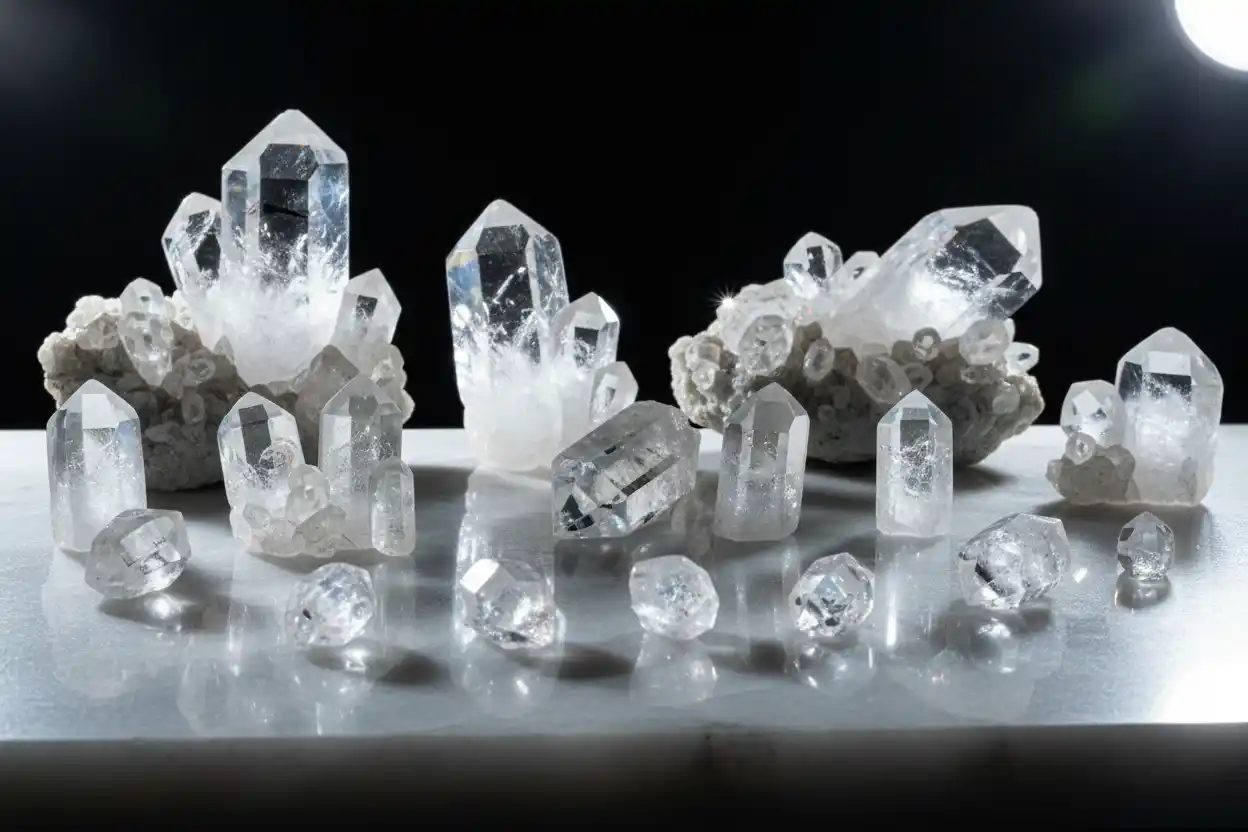
Herkimer Diamond Meaning: Properties, Uses & Symbolism
Herkimer diamond meaning begins with a correction that makes the material more interesting rather than less: a Herkimer diamond is not diamond. It is exceptionally clear, lustrous quartz, SiO₂, traditionally associated with cavities in dolostone in and around Herkimer County in New York. Many classic crystals are naturally double terminated, meaning both ends of the crystal developed terminations because the quartz grew freely within an open cavity rather than remaining attached to a substrate at one end. Mindat describes Herkimer diamonds as clear, doubly terminated, highly lustrous quartz crystals from dolostone cavities in the Herkimer region, while the New York State Museum explicitly identifies Herkimer “diamonds” as quartz whose diamond nickname reflects their clarity and bright sparkle.
The word diamond is therefore a geographic and historical nickname, not a mineralogical classification. Herkimer quartz retains the physical properties of quartz: Mohs hardness 7, refractive index approximately 1.544–1.553, specific gravity near 2.66, trigonal symmetry, vitreous luster, and no true cleavage. GIA’s quartz data support those standard gemological properties. A genuine Herkimer specimen can nevertheless look unusually diamond-like because sharply formed natural faces, strong transparency, double termination, and compact proportions create intense reflections without cutting or polishing.
Its symbolic reputation developed on top of that visual character. Modern sources may associate Herkimer diamonds with clarity, awareness, amplification, intention, dreams, relationships, meditation, or spiritual insight. Those interpretations can be used personally, but they should remain separate from the measurable properties of quartz. Readers exploring other material-first references can browse the Gemstone Guides, while this page focuses specifically on Herkimer identity, geological context, inclusions, naming history, symbolism, and responsible ownership.
Herkimer Diamond Meaning at a Glance
| Property or question | Evidence-aware summary |
|---|---|
| True mineral species | Quartz |
| Formula | SiO₂ |
| Is it diamond? | No |
| Crystal system | Trigonal |
| Typical habit | Short, clear, doubly terminated quartz with strong natural faces |
| Mohs hardness | 7 |
| Specific gravity | Approximately 2.66 |
| Refractive index | Approximately 1.544–1.553 |
| Optical character | Uniaxial positive |
| Cleavage | No true cleavage |
| Fracture | Conchoidal |
| Typical color | Colorless; some crystals are smoky or darkened by inclusions |
| Classic locality | Herkimer County and nearby central Mohawk Valley, New York |
| Main host rock | Little Falls Dolostone; some regional occurrences also occur in related units |
| Common associated material | Dolomite, calcite, pyrobitumen/anthraxolite, iron sulfides and other cavity minerals |
| Common inclusions | Hydrocarbon solids, petroleum/brine-related fluids, gases, mineral crystals, negative crystals |
| Historical name | Earlier “Little Falls diamonds” terminology preceded the modern Herkimer name |
| Main naming caution | Similar double-terminated quartz from elsewhere is better described as Herkimer-style quartz when locality is not Herkimer |
| Modern symbolism | Clarity, focus, perspective, amplification, deliberate intention |
| Scientific status of symbolism | Interpretive rather than demonstrated medical or supernatural effect |
| Primary collector value | Natural crystal form, transparency, luster, inclusions, locality, condition, provenance |
The distinction between true locality terminology and visual resemblance is particularly important. Double termination is characteristic, but it does not make every double-terminated quartz crystal a Herkimer diamond.
What Is a Herkimer Diamond?
A Herkimer diamond is quartz whose traditional name is tied to a particular New York occurrence rather than to the diamond mineral species. Mindat treats Herkimer Diamond as synonymous with “Herkimer-style” quartz while explaining that the local name originally refers to exceptionally clear, doubly terminated quartz from cavities in dolostones in Herkimer County and surrounding areas.
The crystals frequently develop a compact form in which prism faces and rhombohedral terminations are both prominent. Fine specimens can appear almost naturally faceted because every exposed plane formed as a crystal face rather than through lapidary cutting.
GIA’s review of specialist literature describes classic Herkimer crystals as brilliant, water-clear quartz commonly displaying a characteristic 18-faced doubly terminated form. That appearance is one reason the diamond nickname persisted.
Mineralogically, however, no ambiguity exists. Diamond is carbon with a cubic structure and extreme hardness. Herkimer quartz is SiO₂ with quartz’s trigonal structure and hardness 7.
Herkimer Diamond Identity Table
| Characteristic | Herkimer diamond |
|---|---|
| Formal mineral | Quartz |
| Chemical formula | SiO₂ |
| Trade/locality name | Herkimer diamond |
| Crystal system | Trigonal |
| Typical natural form | Doubly terminated, often short prismatic |
| Common total-face appearance | Frequently described as 18-sided in classic crystals |
| Hardness | Mohs 7 |
| Specific gravity | Approximately 2.66 |
| RI | 1.544–1.553 |
| Birefringence | About 0.009 |
| Optic sign | Uniaxial positive |
| Luster | Vitreous |
| Typical transparency | Transparent to translucent |
| Common color | Colorless; smoky variants and inclusion-darkened examples occur |
| Host setting | Open cavities or vugs in dolostone |
| Diagnostic priority | Establish quartz identity and locality separately |
| Major naming risk | Calling visually similar quartz from another region “Herkimer diamond” |
A laboratory can establish quartz readily. Establishing that a crystal is specifically from the Herkimer region is a provenance question and cannot normally be proved from standard quartz properties alone.
Why Are Herkimer Diamonds Double Terminated?
A quartz crystal normally develops freely only where space is available. If one end is attached firmly to matrix during growth, the attached end cannot form a complete termination.
Herkimer crystals often grew suspended or relatively free inside pre-existing cavities in dolostone. With open space surrounding much of the growing quartz, natural crystal faces could develop at both ends.
Double termination therefore records growth environment.
It is not evidence that the crystal contains “double energy,” emits from both ends, or possesses twice the physical power of ordinary quartz.
A single-terminated quartz and a double-terminated quartz remain the same mineral species.
Does Every Herkimer Diamond Have Two Perfect Terminations?
No.
Double termination is characteristic of the classic material, but natural specimens may be contacted, broken, intergrown with other crystals, partially attached to cavity walls, or damaged during extraction.
A crystal with one contacted end can still be genuine quartz from a Herkimer locality.
Condition affects collector description and value, but imperfect morphology does not automatically erase provenance.
Conversely, perfect double termination does not prove New York origin.
Herkimer Diamond Versus Herkimer-Style Quartz
This is one of the most important terminology boundaries.
Similar clear double-terminated quartz occurs in several parts of the world. Mindat notes that comparable quartz crystals form in other sedimentary settings and that sellers sometimes use the Herkimer name for non-New York material, a practice that many locality collectors reject.
The most transparent naming approach is:
| Situation | Best description |
|---|---|
| Documented quartz from Herkimer County or recognized surrounding New York locality | Herkimer diamond |
| Double-terminated quartz from a different documented country or region | Double-terminated quartz or Herkimer-style quartz |
| Unknown-location double-terminated quartz | Double-terminated quartz, locality unknown |
| Seller calls foreign material “Herkimer diamond” | Treat as trade usage, not proof of provenance |
| Quartz merely resembles Herkimer material | Visual resemblance only |
This prevents a shape from being mistaken for an origin.
Original Information Gain: Herkimer Name and Claim Audit
| Claim or label | Evidence-aware interpretation | What should not automatically be assumed | Stronger evidence when needed |
|---|---|---|---|
| Herkimer diamond | Locality/trade name for distinctive quartz | Actual diamond | Quartz identification |
| “Diamond quartz” | Informal marketing language | Carbon diamond content | Mineral testing |
| Double-terminated quartz | Morphological description | Herkimer County origin | Provenance |
| Herkimer-style quartz | Useful for similar morphology from elsewhere | New York origin | Locality records |
| Little Falls diamond | Historical regional terminology | Different mineral species | Historical context |
| 18-faced quartz | Classic morphology | Every genuine specimen must show all faces perfectly | Crystal examination |
| “Water-clear Herkimer” | High transparency description | Treatment-free or inclusion-free | Gemological examination |
| Smoky Herkimer | Smoky quartz from the locality | Hydrocarbon is necessarily the cause | Color/inclusion analysis |
| “Black Herkimer” | Could describe hydrocarbon-rich or dark quartz | A formal quartz variety | Identify host and dark material |
| Petroleum-included Herkimer | Plausible and documented | Every bubble contains petroleum | Inclusion analysis |
| Anthraxolite inclusion | Carbonaceous solid historically reported with Herkimer quartz | Every black inclusion is anthraxolite | Analytical identification |
| “Record keeper” markings | Modern metaphysical interpretation of surface geometry | Encoded information | Remains symbolism |
| “Amplifier crystal” | Contemporary spiritual language | Measurable amplification of intentions | No established physical mechanism |
| “High-vibration diamond” | Metaphysical/marketing language | Diamond physics or measurable healing field | Mineralogical testing |
| “Healing diamond” | Wellness terminology | Treatment of disease | Clinical evidence would be required |
The strongest naming rule is simple: diamond describes appearance; quartz describes mineral identity; Herkimer describes locality tradition.
Where Genuine Herkimer Diamonds Form
The classic New York crystals occur principally within cavities in the Little Falls Dolostone. New York State geological mapping describes the formation as a thick sequence of dolostone beds containing vugs with quartz crystals called Herkimer diamonds, frequently accompanied by black bituminous material.
USGS geologic nomenclature identifies the Little Falls Dolostone as Late Cambrian host rock and notes its exceptional clear double-terminated quartz crystals. The same geological summary reports that the quartz crystals are inferred to have formed much later than deposition of the host dolostone.
This time separation matters. Saying “the host rock is Late Cambrian” does not mean the quartz necessarily crystallized when the carbonate sediment itself was deposited.
The detailed fluid pathways, cavity development, burial history, silica source, organic matter, timing debate, and deposit comparisons belong in the Herkimer Diamond Formation and Deposit Geology.
What Are the Cavities?
The crystals occur in open spaces commonly described as vugs.
These cavities provided the room necessary for sharply terminated quartz crystals to grow without being completely enclosed by solid matrix. Dolomite, calcite, carbonaceous material, sulfides, and other minerals can occupy the same cavity systems.
New York State Museum geological material illustrates vugs containing quartz above black anthraxolite-like material and records crystals enclosing bubbles and carbonaceous-coated phantom structures.
Those cavity relationships are geological evidence.
They should not be translated into claims that the hollow space “programmed” the crystal energetically.
How Did the Quartz Get There?
The exact geological history is more nuanced than a simple statement that silica-filled water entered an empty hole.
The host rock contains sedimentary carbonate material, quartz-bearing components, organic matter, and later fractures and cavities. Geological models involve burial, thermal evolution, movement of mineralizing fluids, silica transport, and slow crystallization within open spaces.
GIA’s review of the specialist Herkimer literature describes a model involving burial and heating of the host sequence, mobilization of silica, organic components, and eventual slow quartz growth in cavities, producing unusually clear crystals.
Because published models differ in details, it is more responsible to describe Herkimer formation as a low-temperature cavity-hosted quartz mineralization system rather than claim one universally settled chemical sequence.
Why Are Many Herkimer Diamonds So Clear?
High clarity reflects growth conditions that allowed quartz to crystallize slowly and cleanly within open cavities without trapping overwhelming amounts of foreign material.
That does not mean every Herkimer crystal is flawless.
Many contain fractures, phantom growth, hydrocarbon solids, mineral crystals, fluid inclusions, gas bubbles, or surface contact marks. Some of the inclusions are scientifically interesting precisely because the host quartz is transparent enough for them to be observed readily.
GIA notes that solids, liquids, gases, two- and three-phase inclusions, and negative crystals are all known from classic Herkimer material.
Fluid and Hydrocarbon Inclusions
Herkimer inclusions are one of the strongest reasons not to reduce the material to “clear quartz.”
GIA’s summary of Herkimer literature identifies salt-water or petroleum-bearing liquid inclusions, carbon dioxide as a common gas component, hydrocarbon solids, and multiple mineral inclusions. Mindat locality data likewise associate Herkimer quartz with pyrobitumen, dolomite, and calcite.
A visible bubble does not by itself identify the trapped fluid. A dark solid does not automatically prove anthraxolite.
Professional fluid-inclusion analysis can use microscopy, spectroscopy, heating/freezing behavior, and chemistry to determine what an inclusion actually contains.
Detailed inclusion interpretation belongs in the Herkimer Diamond Microscope Inclusion Notebook.
Are Black Inclusions Always Anthraxolite?
No.
Anthraxolite is a historically used name for carbonaceous or bituminous material associated with classic Herkimer cavities, and the term appears throughout older collecting literature. Mindat locality records today commonly use pyrobitumen terminology for associated black material.
Black features inside quartz can also include other opaque minerals, fracture fillings, surface deposits, or unidentified carbonaceous matter.
A seller should therefore distinguish between:
“black inclusion,” which is an observation,
and
“anthraxolite inclusion,” which is an identification claim.
The second requires stronger evidence.
Can Herkimer Diamonds Contain Petroleum?
Hydrocarbon-bearing fluid inclusions in quartz are geologically real, and GIA documents petroleum inclusions in quartz from several global deposits. Such inclusions can contain petroleum, gas, water, and solid bituminous material in the same microscopic cavity.
Classic Herkimer literature also reports liquid petroleum among the recognized inclusion types.
The existence of petroleum inclusions should not be generalized to every Herkimer specimen. Many crystals contain no visible petroleum at all.
A fluorescent internal droplet can be a useful clue, but spectroscopy or specialist microscopy is needed when exact inclusion identity matters.
Phantom Herkimer Diamonds
Some quartz crystals show earlier growth outlines inside later transparent quartz. These internal forms are called phantoms.
In Herkimer material, an earlier crystal surface can become coated by dark carbonaceous material or another phase, after which additional quartz grows around it. The preserved coated outline then appears as a phantom inside the finished crystal.
New York State geological documentation illustrates quartz with an internal phantom coated by black carbonaceous material.
A phantom is therefore a growth-history feature.
It is not evidence that another spiritual entity or “older soul” is physically trapped inside the crystal.
What Causes Smoky Herkimer Quartz?
Smoky coloration in quartz generally arises from radiation-related color centers associated with aluminum substituting for silicon in the quartz lattice. Natural irradiation can remove an electron from an oxygen near the aluminum defect, creating broad visible absorption and a smoky appearance. GIA describes this mechanism for smoky quartz generally.
A Herkimer crystal can also look dark because of abundant black or brown hydrocarbon inclusions.
These are different phenomena.
A uniformly smoky transparent quartz body should not automatically be described as “colored by anthraxolite,” while a colorless crystal filled with black inclusions should not automatically be classified as smoky quartz.
The detailed separation between lattice color, included material, transparency, reflections, and fluorescence belongs in Herkimer Diamond Optical Properties and Color Behavior.
Diagnostic Characteristics
The first identification question is straightforward: is the object quartz?
Quartz properties include Mohs hardness 7, RI approximately 1.544–1.553, SG near 2.66, uniaxial positive optical character, no true cleavage, and conchoidal fracture.
The second question is harder: is it actually from a Herkimer-region locality?
Standard quartz testing cannot answer that reliably because Herkimer-style quartz elsewhere has the same host species. The distinction rests principally on provenance—where the crystal was collected, how that history was documented, and whether the specimen can be traced to a recognized locality.
Morphology can support the story.
It cannot replace provenance.
Original Specimen and Photo Checklist
| Observation | Photograph can often support | Photograph cannot reliably prove |
|---|---|---|
| Double termination | Natural-looking morphology | Herkimer County origin |
| Strong transparency | Relative clarity | Treatment history |
| Short prism | Herkimer-compatible habit | Geographic provenance |
| Complete natural faces | Growth form | Mineral species without testing |
| Contact mark | Where another surface interfered with growth | Exact extraction history |
| Phantom | Internal growth outline | Identity of coating material |
| Black inclusion | Presence and distribution | Anthraxolite composition |
| Fluid cavity | Visible liquid/gas relationship | Petroleum versus brine |
| Smoky body color | Color distribution | Color-center mechanism |
| Dolostone matrix | Host-rock appearance | Specific mine |
| Old locality label | Historical claim | Chain of custody by itself |
| “Herkimer from Pakistan” | Seller terminology | Authentic Herkimer locality |
| “Diamond clarity” | Appearance description | Diamond identity |
| “Healing energy” | Nothing objectively measurable | Medical or supernatural effect |
For transparent specimens, photograph against both light and dark neutral backgrounds. Use side lighting to reveal faces and transmitted light to show internal inclusions. Keep white balance restrained because aggressive sharpening and contrast can make ordinary quartz appear unnaturally diamond-like.
Photograph old labels separately rather than discarding them. Provenance can matter more than another close-up.
Locality Is Part of the Name
The geographic component differentiates Herkimer diamond from other unusually clear double-terminated quartz.
The New York State Museum places the characteristic occurrence in and around Herkimer County, and Mindat’s locality records include well-known sites around Middleville and neighboring parts of the Mohawk Valley.
The term therefore works somewhat like a locality collector name.
Using it for a crystal from another continent may communicate visual style in retail language, but it weakens provenance precision.
“Double-terminated quartz from Pakistan” is more informative than “Pakistani Herkimer diamond.”
Documented Naming History
Mindat records that the crystals were earlier known as “Little Falls diamonds” before the Herkimer name became standard.
The diamond comparison arose from their unusually bright, transparent, naturally faceted appearance—not because historical collectors believed the stones were chemically identical to diamond.
The New York State Museum also notes that the stones are called diamonds for their clarity and sparkle.
This gives the name a documented historical and geographic explanation without needing a metaphysical origin story.
Are Herkimer Diamonds Naturally Faceted?
They possess natural crystal faces rather than lapidary facets.
A crystal growing freely in a cavity can develop geometrically flat prism and rhombohedral faces governed by quartz crystallography. When those faces are exceptionally smooth and lustrous, the crystal can appear as if it has already been cut.
That is one of the strongest aesthetic characteristics of fine Herkimer quartz.
Actual faceting by a lapidary is a separate process.
Should a Herkimer Diamond Be Cut?
Sometimes, but not automatically.
A damaged fragment or gem-quality piece of rough can be faceted into an attractive quartz gem. An intact, sharply terminated crystal with good provenance may lose collector value if its natural morphology is removed.
The decision should therefore compare specimen value with potential lapidary value before alteration.
The technical considerations belong in Herkimer Diamond Cutting, Orientation and Polish.
Herkimer Diamond in Jewelry
Quartz hardness makes Herkimer crystals usable in many jewelry forms, but natural points create engineering problems that ordinary faceted quartz does not have. Terminations can chip, protruding crystals can catch on clothing, and surface-reaching fractures can weaken an otherwise clear specimen.
A protected pendant may tolerate a natural point better than an exposed everyday ring.
The specialized relationship between prongs, cages, impact, protruding points, fracture placement, and wear belongs in Herkimer Diamond Setting and Wear Engineering.
Herkimer Diamond Versus Heliodor
Heliodor Meaning concerns yellow beryl rather than quartz.
Heliodor has higher refractive index and greater Mohs hardness, typically forms hexagonal beryl prisms, and owes its yellow appearance to iron-related absorption. Herkimer quartz is usually colorless or faintly smoky and has quartz’s lower RI and hardness 7.
Both can look unusually brilliant when transparent.
Brilliance alone does not place them in the same mineral family.
Herkimer Diamond Versus Harlequin Quartz
Harlequin Quartz Meaning also concerns quartz, which makes the comparison more subtle.
Both materials share the same fundamental SiO₂ host properties. Harlequin quartz is primarily an appearance-based trade name for quartz containing conspicuous contrasting mineral inclusions, while Herkimer diamond is a locality-linked name centered on characteristic cavity-grown morphology and transparency.
One classification emphasizes inclusions.
The other emphasizes locality and crystal habit.
Herkimer Diamond Versus Hessonite Garnet
Hessonite Garnet Meaning concerns orange-to-brownish grossular garnet rather than quartz.
Hessonite is denser, has a higher refractive index, lacks quartz’s uniaxial optical behavior, and normally appears warm orange to cinnamon-colored.
A transparent pale Herkimer crystal and hessonite are unlikely to be difficult look-alikes in good conditions, but the comparison emphasizes how misleading the generic word “crystal” can become when actual species are ignored.
Herkimer Diamond Versus Heulandite
Heulandite Meaning concerns a zeolite-group mineral rather than quartz.
Heulandite is much softer and cleavage-prone, commonly occurs in white, peach, pink, or colorless tabular crystals, and develops under different geological conditions.
A crystal’s transparency or cavity-grown occurrence does not determine its species.
Structure and measurable properties do.
Modern Herkimer Diamond Meaning
Modern Herkimer diamond meaning commonly centers on clarity, amplification, awareness, meditation, intention, perspective, creativity, and communication.
Some of those associations are easily understood from appearance. An exceptionally transparent crystal naturally suggests clarity. Double termination can inspire symbolism around exchange or two-way communication. Internal phantoms can become metaphors for memory or layered experience.
Those connections can be meaningful.
They are not measurements of quartz transferring intentions or information.
Herkimer Diamond and Clarity
Clarity is perhaps the most direct modern symbolic theme.
A transparent Herkimer crystal can serve as a reminder to distinguish what is known from what is assumed.
A practical reflection exercise might divide a problem into three columns: confirmed facts, interpretations, and missing information.
The crystal does not provide the answers.
It acts as a visual cue for clearer reasoning.
Herkimer Diamond and Amplification
Quartz is widely described in metaphysical literature as an amplifier, and the unusually brilliant Herkimer form often receives even stronger versions of that claim.
Quartz has genuine piezoelectric properties under defined mechanical and electrical conditions. Those properties support important technological applications.
They do not establish that a loose crystal amplifies thoughts, wishes, emotions, another gemstone’s metaphysical properties, or a person’s biological energy field.
Using “amplification” as symbolic language is different from using it as a physics claim.
Herkimer Diamond and Double-Termination Symbolism
The two natural terminations are often interpreted as representing exchange, communication, balance, giving and receiving, or movement in two directions.
As metaphor, that can support useful reflection.
For example: Am I communicating as carefully as I expect others to communicate with me? Am I listening as well as speaking?
Crystal morphology provides the visual cue.
It does not scientifically transmit messages between people.
Herkimer Diamond and Dreams
Herkimer diamonds are frequently associated with dreams, dream recall, or lucid-dream practice in contemporary crystal culture.
A person can place a crystal near a journal as a reminder to write down dreams immediately after waking.
That habit can improve the amount of dream content recorded because the journal and object cue the behavior.
The quartz has not been demonstrated to produce dreams, induce lucid dreaming, alter REM physiology, or treat sleep disorders.
Herkimer Diamond and Relationships
Double-ended crystals are sometimes described as relationship stones because the shape appears to connect two directions.
A grounded relationship practice can use that symbolism to focus on reciprocity, listening, consent, communication, and boundaries.
A Herkimer diamond cannot force reconciliation, guarantee loyalty, attract a specific person, reveal hidden intentions, or alter another person’s decisions.
Symbolism should respect autonomy.
Herkimer Diamond and Meditation
A transparent natural crystal can function effectively as a visual focus during meditation because its faces, reflections, inclusions, and internal structures provide a stable object for attention.
The benefit does not require a claim that quartz emits a measurable meditation frequency.
A practitioner can observe reflections, notice breathing without forcing it, and return attention to the object when distracted.
That is a legitimate contemplative use regardless of metaphysical belief.
Herkimer Diamond Healing Claims
There is no established scientific evidence that wearing or holding Herkimer quartz treats disease, anxiety, depression, neurological disorders, pain, hormonal conditions, cardiovascular disease, fertility issues, immune dysfunction, infections, sleep disorders, or other medical conditions.
Quartz is SiO₂.
Its silicon and oxygen are components of a mineral lattice, not evidence that contact with the stone provides nutritional silicon, oxygen therapy, detoxification, or physiological “frequency correction.”
The site’s broader boundary between gemstone symbolism and medical claims is stated in the Gems Lore Disclaimer.
Herkimer Diamond and “High Vibration”
“High vibration” is commonly used in contemporary metaphysical writing, but it does not correspond to a standardized gemological measurement.
Quartz atoms do participate in lattice vibrations, as all crystalline solids do. Quartz also has measurable resonant and piezoelectric behavior under engineered conditions.
Those physical facts do not establish a scale on which a hand specimen possesses a higher spiritual vibration than ordinary quartz.
If the phrase is used, it should be understood as spiritual terminology rather than laboratory mineralogy.
Safe Ownership
Quartz is reasonably durable at Mohs 7, but natural Herkimer crystals often have pointed terminations and internal fractures. Dropping a crystal can chip a point, while storing it loose with harder materials can damage surfaces.
Warm soapy water is a conservative cleaning choice for ordinary quartz when the specimen has no fragile matrix or sensitive associated material. GIA’s quartz care guidance identifies warm soapy water as a safe cleaning method and warns that sudden temperature changes can fracture quartz.
A matrix specimen containing carbonaceous material, sulfides, calcite, or delicate cavity coatings may need more conservative treatment than a loose clean quartz crystal.
Intact Quartz Versus Processing Dust
Handling an intact Herkimer crystal is different from cutting, drilling, grinding, sanding, or crushing quartz.
Mechanical processing can generate respirable crystalline silica dust, a significant occupational hazard. Appropriate lapidary work should use engineering controls, wet processes where suitable, eye protection, controlled cleanup, and properly selected respiratory protection when required.
There is no reason to grind Herkimer quartz into powder for spiritual practice.
Do Not Ingest Herkimer Quartz
Herkimer crystals should not be powdered, swallowed, placed in supplements, or deliberately soaked in drinking water to create mineral elixirs.
Natural specimens can contain petroleum-related inclusions, carbonaceous material, mineral inclusions, surface contaminants, cleaning residues, or matrix fragments in addition to quartz.
The ideal SiO₂ formula is not a drinking-water safety certificate.
Symbolic use does not require ingestion.
Preserve Locality and Specimen History
For Herkimer diamonds, provenance has unusual importance because locality is part of the name.
An old handwritten mine label, collection card, acquisition note, photograph of the crystal in matrix, or documented collecting locality can become more useful than generic claims such as “AAA grade.”
Record dimensions, weight where useful, complete versus contacted terminations, damaged faces, inclusions, matrix, locality, mine name, previous collection, and any analytical information before cleaning or modifying an important specimen.
The Herkimer Diamond Specimen Conservation Record provides the dedicated framework for preserving those details.
Buying and Locality Verification
A buyer evaluating Herkimer quartz should ask two separate questions:
Is it actually quartz?
And is the claimed New York locality documented?
Most transparent double-terminated quartz is easy to identify as quartz using standard gemological methods. Locality is the harder part because non-New York quartz can have extremely similar physical properties and morphology.
Seller reputation, original mine labels, collection history, documentation, and credible sourcing therefore matter.
Those purchase-level questions belong in Where to Buy Herkimer Diamond rather than turning this meaning page into a seller guide.
Evidence and Technical Limits
This article does not claim first-hand collecting at New York mines, unpublished fluid-inclusion analysis, private laboratory testing, or direct authentication of a reader’s specimen. The wider sourcing approach used by Gems Lore is explained on About Gems Lore.
Exact inclusion chemistry, quartz-growth temperature, fluid composition, timing of crystallization, origin of smoky coloration in a specific specimen, identity of black carbonaceous material, and geographic provenance can require petrography, spectroscopy, microthermometry, chemical analysis, geological context, or specialist review.
Even a perfect-looking double-terminated quartz crystal cannot prove its locality solely through appearance.
Readers with documented locality records, analytical corrections, stronger geological evidence, or specimen data can submit them through Contact Gems Lore.
Frequently Asked Questions About Herkimer Diamond Meaning
What is Herkimer diamond meaning?
Herkimer diamond meaning commonly combines the crystal’s clear double-terminated quartz identity with modern themes such as clarity, awareness, amplification, communication, meditation, and intentional action. Those themes are symbolic rather than scientifically demonstrated therapeutic effects.
Is a Herkimer diamond a real diamond?
No. A Herkimer diamond is quartz, SiO₂, not carbon diamond. The diamond name comes from its exceptional clarity and naturally brilliant crystal faces.
Why is it called a Herkimer diamond?
The name is associated with the New York region where the famous quartz crystals occur, particularly Herkimer County and nearby parts of the Mohawk Valley. The diamond comparison refers to their sparkle and clarity.
What were Herkimer diamonds called historically?
Mindat records earlier “Little Falls diamonds” terminology before the modern Herkimer name became established.
What is a Herkimer diamond made of?
It is quartz with the formula SiO₂.
How hard is a Herkimer diamond?
Because it is quartz, its Mohs hardness is 7.
What is the refractive index of Herkimer quartz?
Quartz has refractive indices approximately 1.544–1.553.
Why are Herkimer diamonds double terminated?
They commonly grew with open space around both ends inside cavities in dolostone, allowing crystal faces to develop at both terminations.
Does every double-terminated quartz count as a Herkimer diamond?
No. Double-terminated quartz occurs elsewhere. “Herkimer-style quartz” or a locality-specific quartz description is more precise for specimens from outside the Herkimer region.
Where do genuine Herkimer diamonds occur?
Classic material comes from Herkimer County and neighboring parts of central New York, especially cavities in the Little Falls Dolostone.
What are the black inclusions inside Herkimer diamonds?
Carbonaceous material such as pyrobitumen/anthraxolite is well documented, but not every black inclusion should be assigned that identity without analysis.
Can Herkimer diamonds contain petroleum?
Petroleum-bearing fluid inclusions are documented within Herkimer literature, along with brine, gases, solid hydrocarbons, and mineral inclusions.
Are bubbles in a Herkimer diamond proof of petroleum?
No. Fluid inclusions can contain different liquid and gaseous phases. Exact identification requires appropriate microscopic or analytical evidence.
Why are some Herkimer diamonds smoky?
Smoky quartz coloration generally results from radiation-related color centers involving aluminum defects in quartz. Dark hydrocarbon inclusions can separately make a Herkimer crystal appear darker.
Are Herkimer diamonds naturally faceted?
They have natural crystal faces that can resemble faceting. Those surfaces grew crystallographically rather than being cut by a lapidary.
Are Herkimer diamonds rare?
Fine crystals with exceptional transparency, complete natural terminations, attractive inclusions, strong luster, good condition, and reliable locality can be much more desirable than ordinary quartz, but the material is still quartz rather than a fundamentally rare diamond species.
Do Herkimer diamonds have healing properties?
There is no established scientific evidence that Herkimer quartz treats disease or causes specific physiological healing effects.
Do Herkimer diamonds amplify energy?
Amplification is modern metaphysical terminology. Quartz has genuine piezoelectric properties in defined physical systems, but those properties do not demonstrate amplification of intentions, emotions, or spiritual energy.
Can Herkimer diamonds help with dreams?
They can be used as symbolic cues in dream journaling or meditation, but there is no established evidence that quartz causes lucid dreaming or medically changes sleep physiology.
Can Herkimer diamonds go in drinking water?
Collector quartz should not be powdered, ingested, or deliberately used to make gemstone drinking-water preparations, especially because Herkimer specimens can contain hydrocarbons and other natural inclusions.
Can a photograph prove a crystal is a genuine Herkimer diamond?
A photograph can support quartz morphology and show double termination, clarity, inclusions, and matrix. It cannot prove New York provenance. Locality documentation remains essential.
Final Perspective
Herkimer diamond meaning becomes substantially richer once the misleading part of the name is clarified. The material is quartz, SiO₂—not diamond—and it shares quartz’s Mohs hardness of 7, RI around 1.544–1.553, specific gravity near 2.66, and trigonal crystal structure. What distinguishes classic Herkimer material is the combination of locality, cavity-grown morphology, exceptional transparency, strong natural luster, frequent double termination, and an unusually interesting inclusion record.
Its geology also deserves more attention than the nickname alone receives. The crystals occur principally in cavities of the Little Falls Dolostone and can coexist with dolomite, calcite, carbonaceous material, sulfides, brines, petroleum-related fluids, gases, and other minerals. Geological evidence indicates that the quartz mineralization need not be the same age as the host sedimentary rock, making the crystals records of later fluid activity within much older dolostone.
Modern associations with clarity, amplification, communication, dreams, awareness, and meditation can still form a responsible Herkimer diamond meaning when they remain clearly symbolic. The material-first approach is straightforward: call the mineral quartz, preserve Herkimer as a locality-linked name, do not use double termination as proof of provenance, distinguish smoky lattice color from dark inclusions, identify petroleum or anthraxolite only when evidence supports the claim, preserve old locality records, and keep medical or supernatural promises separate from what these remarkable New York quartz crystals actually demonstrate.