Hyalite Opal Meaning: Properties, Uses & Symbolism
Hyalite opal meaning begins with an unusual form of hydrated silica rather than with the rainbow play-of-color most people associate with opal. Hyalite is the traditional name for a transparent to translucent, glass-like variety of Opal-AN, an amorphous silica material represented broadly as SiO₂·nH₂O. The “A” denotes amorphous structure and the “N” refers to its network-like silica-glass arrangement. Modern mineralogical references describe Opal-AN as containing roughly several percent water in both molecular form and silanol groups, with hyalite commonly appearing as colorless, white, cream, pale yellow, or occasionally orange globular crusts and botryoidal masses.
Unlike precious opal, typical hyalite does not owe its identity to an orderly array of silica spheres capable of producing strong diffraction-based play-of-color. GIA’s structural review distinguishes hyalite as Opal-AN, an amorphous-network form of common opal, from the sphere-organized structures responsible for precious opal phenomena. That difference is why a fine hyalite specimen may be remarkably transparent and glassy yet show no rainbow flashes at all.
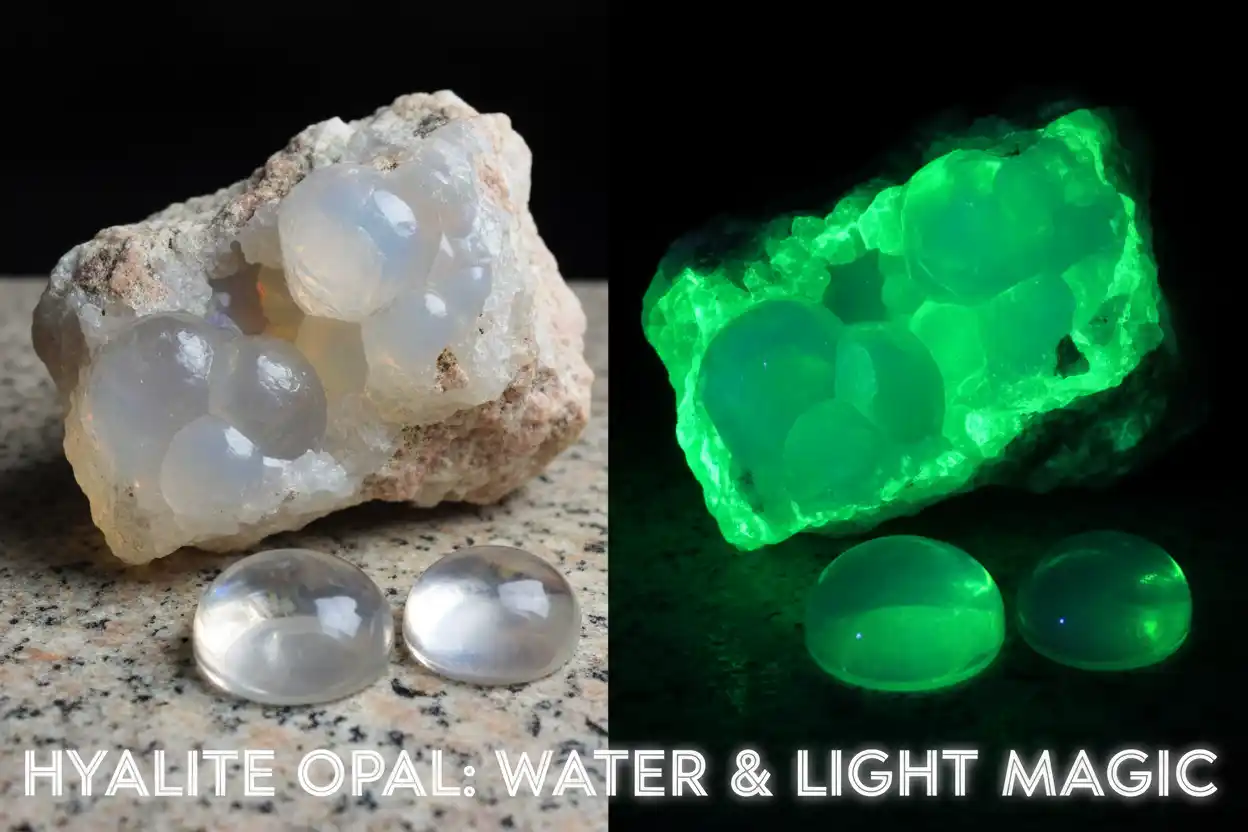
The most famous optical surprise is instead fluorescence. Many—but importantly not all—hyalite specimens can glow intense yellow-green or green under ultraviolet radiation when uranyl species are present. Some exceptional material can fluoresce strongly enough under ordinary daylight for luminescence to influence apparent body color. GIA has documented Mexican hyalite whose daylight-excited green luminescence is related to the uranyl ion, and Smithsonian collections include transparent Mexican hyalite displaying conspicuous daylight and UV fluorescence.
Those measurable facts should remain separate from contemporary symbolism. Modern crystal traditions may associate hyalite with clarity, perspective, illumination, adaptability, curiosity, creativity, or self-observation. Those meanings can function as personal metaphors. They do not demonstrate that amorphous silica, structural water, fluorescence, or trace uranium produces psychological healing, supernatural perception, or medical effects.
Readers exploring other material-first references can browse Gemstone Guides. This page keeps hyalite opal meaning centered on identity, formation, fluorescence, diagnostic traits, documented history, symbolic interpretation, and safe ownership.
Hyalite Opal Meaning at a Glance
| Property or question | Evidence-aware summary |
|---|---|
| Material | Hyalite, traditionally classed as a variety of Opal-AN |
| General composition | SiO₂·nH₂O |
| Structural character | Amorphous hydrated silica, network-like rather than crystalline |
| Typical water content | Commonly several percent; Opal-AN references often cite about 3–8% |
| Typical natural color | Colorless, white, cream, pale yellow, sometimes orange |
| Luster | Vitreous to sub-vitreous |
| Transparency | Transparent to translucent |
| Mohs hardness | Approximately 5.5–6.5 |
| Specific gravity | Approximately 2.0–2.2, varying partly with water content |
| Refractive index | Roughly 1.44–1.46 |
| Optical behavior | Essentially isotropic; strain birefringence may occur |
| Cleavage | None observed |
| Fracture | Conchoidal |
| Typical habit | Globular, botryoidal, irregular crusts and coatings |
| Play-of-color | Normally absent in typical hyalite |
| Famous optical phenomenon | Green or yellow-green UV fluorescence in many uranium-bearing specimens |
| Does every hyalite fluoresce? | No |
| Main fluorescence activator | Uranyl species in many fluorescent specimens |
| Common geological settings | Volcanic cavities, fractures, pegmatitic environments and other low-temperature silica-deposition systems |
| Historical name | Derived from Greek terminology for glass |
| Modern symbolism | Clarity, perspective, curiosity, illumination, adaptability |
| Scientific status of symbolism | Personal interpretation rather than demonstrated biological effect |
| Main ownership concern | Opal can scratch, fracture or craze under unfavorable heat, dryness or temperature change |
Mindat gives hyalite hardness around 5.5–6.5, density around 2.0–2.2 and RI roughly 1.44–1.46, while also emphasizing its transparent glass-like appearance and absence of ordinary precious-opal play-of-color.
What Is Hyalite Opal?
Hyalite is best understood as glass-like common opal with Opal-AN structure.
Opal occupies an unusual position in mineral nomenclature. It remains a historically accepted mineral name, but because its atomic structure lacks long-range crystalline order, it is also commonly described as a mineraloid. Modern structural classifications separate amorphous Opal-A from more ordered Opal-CT and Opal-C, then divide Opal-A further into Opal-AG and Opal-AN according to nanoscale organization. Hyalite corresponds to the network-like Opal-AN end of that framework.
The difference matters because the word opal covers materials that can look profoundly different from one another.
A precious opal may flash red, green, blue and orange because organized silica structures interact with visible wavelengths.
A hyalite specimen may instead resemble frozen water, clear glass droplets or transparent bubbles.
Both are opal.
Their internal textures are not identical.
Hyalite Opal Identity Table
| Characteristic | Hyalite / Opal-AN |
|---|---|
| General formula | SiO₂·nH₂O |
| Structural classification | Amorphous network opal |
| Conventional status | Opal variety / amorphous silica material |
| Crystal system | None in the conventional crystalline sense |
| Common habit | Globular, botryoidal, crust-like, irregular coatings |
| Typical body color | Colorless to cream, yellow or orange |
| Luster | Vitreous, glass-like |
| Transparency | Transparent to translucent |
| Hardness | About 5.5–6.5 |
| Density | About 2.0–2.2 |
| RI | About 1.44–1.46 |
| Optical behavior | Isotropic, sometimes with strain effects |
| Cleavage | None |
| Fracture | Conchoidal |
| Normal play-of-color | Absent |
| Possible luminescence | Strong green/yellow-green in some specimens |
| Main fluorescence relationship | Uranyl species can act as luminescent centers |
| Typical collector interest | Transparency, globular habit, fluorescence, locality, matrix and growth texture |
| Main identification caution | Glass-like appearance alone is not enough to establish hyalite |
The combination of low RI, low density, amorphous Raman/XRD response, glassy rounded habit and suitable spectroscopic evidence can separate hyalite from crystalline quartz and manufactured glass much more confidently than visual appearance alone.
Hyalite Is Not Quartz
Hyalite and quartz are both silica-rich, but they are structurally different.
Quartz is crystalline SiO₂ with ordered trigonal structure, Mohs hardness 7, density near 2.65 and refractive indices around 1.544–1.553.
Hyalite is hydrated amorphous silica with lower density and lower RI.
A clear droplet-like specimen can therefore resemble quartz visually while producing very different physical and analytical results.
This distinction becomes especially important when hyalite occurs on volcanic matrix without obvious crystal faces. A transparent glassy blob is not automatically quartz merely because it is silica-rich.
Hyalite Is Not Ordinary Glass
The opposite mistake also occurs.
Because hyalite looks glass-like and its name itself refers to glass, collectors may dismiss a natural specimen as melted or manufactured glass.
Natural hyalite commonly develops botryoidal coatings, interconnected globules, cavity linings and irregular deposition textures that reflect geological silica precipitation. Its water-bearing chemistry and analytical spectra distinguish it from ordinary soda-lime or borosilicate manufactured glass.
Visual resemblance is not identity.
A convincing glass-versus-opal determination should use physical and spectroscopic properties rather than whether the surface simply “looks melted.”
Why Does Hyalite Usually Lack Play-of-Color?
Play-of-color in precious opal depends on nanoscale organization capable of diffracting visible light.
Hyalite’s Opal-AN structure is network-like and more homogeneous. Mindat specifically notes that this structural difference prevents the ordinary opalescent play-of-color associated with precious opal.
That does not make hyalite optically uninteresting.
Its transparency, curved growth bands, inclusions, strain patterns and luminescence can produce equally distinctive phenomena, just through different mechanisms.
This is why “no rainbow” should never be interpreted as “not opal.”
Why Can Hyalite Glow Green?
Green fluorescence in many hyalites is associated with uranyl species, the oxidized U(VI) form commonly represented through the uranyl ion UO₂²⁺.
Spectroscopic research on uranium-bearing opals has directly assigned characteristic green fluorescence to uranyl groups trapped or sorbed within amorphous silica. The emission occurs through electronic transitions associated with the uranyl unit and can preserve information about the geochemical environment in which the opal formed.
GIA research likewise identifies uranyl-related emission peaks in opal and recognizes uranium-related luminescence as the cause of the remarkable green response seen in some hyalite.
This is genuine photoluminescence.
It should not be described as mystical green energy.
Does Every Hyalite Contain Uranium?
No.
This is one of the most important corrections in hyalite identification.
GIA laboratory work on hyalite from different localities found enormous variation in uranium content. Some analyzed Japanese pegmatitic hyalite showed strong fluorescence and substantial measurable uranium, while other spherical Japanese hyalite samples were inert and had no detected uranium in the reported analysis.
Therefore:
Hyalite does not equal uranium-bearing hyalite.
A colorless opal can be genuine hyalite without producing green fluorescence.
Failure to glow is not a disqualifying test.
Does Green Fluorescence Prove Hyalite?
Also no.
Uranyl luminescence occurs in other minerals, glasses and geological materials. GIA has demonstrated comparable uranyl emission patterns across multiple hosts.
Green fluorescence can strongly support a uranium-bearing silica interpretation when the host is already identified as Opal-AN.
It cannot establish the host material by itself.
The correct diagnostic order is:
identify the silica material,
characterize its structure,
then interpret fluorescence.
Daylight-Fluorescent Hyalite
Some Mexican hyalite produces an optical effect rare enough to look almost impossible: green luminescence can become visible under ordinary daylight.
GIA reported yellow gem hyalite from Mexico whose apparent daylight color was dominated partly by intense uranium-related green luminescence. Gemological research on Zacatecas material describes near-colorless to yellow opal that changes to vivid greenish-yellow or yellowish-green under indirect sunlight because uranyl emission contributes visibly to the perceived color.
Smithsonian specimens from Mexico document the same phenomenon, including material that appears light yellow under incandescent conditions and far greener under fluorescent or daylight illumination.
This is fluorescence contributing to visible appearance.
It is not conventional color change caused by switching between two absorption spectra.
Body Color Versus Luminescent Color
A useful hyalite description should distinguish three different observations:
Body color is what the material transmits or reflects without fluorescence dominating.
Fluorescence is emitted light produced when the material absorbs higher-energy radiation.
Perceived daylight color can contain both effects simultaneously when daylight provides enough excitation to trigger strong luminescence.
A Mexican specimen can therefore have a pale yellow inherent appearance while looking vivid yellow-green in daylight because emitted green light is added to the observed color.
This distinction is covered in greater optical detail in Hyalite Opal Optical Properties and Color Behavior.
Is Fluorescent Hyalite Radioactive?
Some fluorescent hyalite contains uranium, so the question is legitimate.
The correct answer is specimen-specific.
Fluorescence intensity is not a radiation dosimeter, and a bright green glow does not tell you directly what external radiation dose a specimen produces. Uranium concentration varies substantially among hyalites, as demonstrated by laboratory analyses of different materials.
For an ordinary small specimen, the presence of trace uranyl fluorescence is a mineralogical observation rather than an automatic emergency.
For unusually uranium-rich material, large collections, powdered material, or specimens with documented high uranium content, proper radiation measurement and sensible mineral-collection hygiene are more appropriate than guesswork.
Do not infer safety or danger from glow brightness alone.
UV Examination Safety
Ultraviolet lamps are useful for observing hyalite, but the light source itself requires ordinary UV safety.
Do not stare directly into high-output UV emitters.
Avoid unnecessary skin exposure, especially with powerful short-wave equipment.
Use properly enclosed or filtered mineral lamps and appropriate eye protection for the wavelength and intensity involved.
A crystal’s beautiful fluorescence is not a reason to expose eyes directly to ultraviolet radiation.
How Hyalite Forms
Hyalite can form when silica-bearing fluids, vapors or altered-rock systems reach conditions that cause amorphous hydrated silica to precipitate onto cavity walls, fractures and existing mineral surfaces.
Mindat describes classic hyalite as forming globular and irregular crusts, particularly in volcanic environments, and also records volcanic vugs, pegmatite pockets and fumarolic settings for Opal-AN.
Modern GIA reviews of opal formation provide a broader framework in which meteoric and groundwater dissolve silica from rocks and later precipitate amorphous silica in fractures and cavities.
Those pathways are complementary rather than mutually exclusive. Hyalite from one deposit should not automatically be assigned the identical fluid source, temperature or deposition mechanism as material from another.
The wider geological principles can be explored through How Are Gemstones Formed?, while the deposit-specific geochemistry belongs in Hyalite Opal Formation and Deposit Geology.
Volcanic Hyalite
Volcanic environments provide some of the most recognizable hyalite specimens.
Silica-rich fluids move through cavities, vesicles and fractures in volcanic rocks, depositing thin translucent coatings, rounded globules or thicker botryoidal crusts.
Mexican uranium-bearing hyalite studied gemologically occurs as botryoidal coatings in fractures and cavities within rhyolitic volcanic material.
In such systems, trace uranium can move with groundwater or hydrothermal fluids and become incorporated into or adsorbed by the amorphous silica during growth.
The result can preserve both silica-deposition history and uranium geochemistry.
Hyalite in Pegmatitic Environments
Not all hyalite is tied to the same volcanic setting.
Opal-AN also occurs in pegmatitic cavities and alteration environments. GIA’s comparison of Japanese hyalites is particularly informative because pegmatitic samples could show strong fluorescence while spherical material from another setting did not.
This means habit and fluorescence should not be assigned one universal formation story.
The same structural variety can form under different geological circumstances.
Growth Bands and Curved Deposition Marks
Botryoidal hyalite grows by repeated deposition of silica onto surfaces.
That process can produce curved internal bands, layered hemispherical structures and flow-like textures visible under magnification.
Research on Mexican daylight-fluorescent material documented curved deposition marks and two-phase fluid inclusions inside faceted stones.
These features can preserve useful growth information.
They are not proof of “energy waves.”
The detailed microscopic interpretation belongs in the Hyalite Opal Microscope Inclusion Notebook.
Fluid Inclusions
Transparent hyalite can contain fluid inclusions and other internal features that record conditions during silica precipitation.
Two-phase inclusions reported in Mexican gem hyalite demonstrate that clear Opal-AN can preserve microscopic fluid evidence despite its amorphous structure.
A visible bubble should not be assumed to contain pure water.
Fluid inclusions can contain liquid, vapor, dissolved salts, carbon dioxide and other components depending on the geological environment.
Exact composition requires analytical work.
Diagnostic Traits of Hyalite
A practical identification should combine several observations.
| Evidence | Hyalite-compatible result | Diagnostic weight |
|---|---|---|
| Appearance | Glassy, clear or translucent globular coating | Supporting |
| Habit | Botryoidal, globular, crust-like | Strong visual clue |
| Crystal faces | Typically absent because material is amorphous | Supporting |
| Hardness | About 5.5–6.5 | Useful |
| SG | About 2.0–2.2 | Useful |
| RI | About 1.44–1.46 | Strong |
| Cleavage | None | Supporting |
| Fracture | Conchoidal | Supporting |
| Play-of-color | Usually absent | Useful classification clue |
| UV fluorescence | Often green, but may be absent | Supporting only |
| Raman spectrum | Amorphous silica-compatible broad bands | Strong |
| XRD | Amorphous pattern | Strong structural evidence |
| Uranium analysis | May explain green fluorescence | Does not define all hyalite |
The key rule is that no one characteristic should carry the full identification.
A clear globule that fluoresces green is promising.
A combination of physical and structural evidence is stronger.
Original Information Gain: Hyalite Claim-Audit Table
| Claim or label | Evidence-aware interpretation | What should not automatically be assumed | Stronger evidence when needed |
|---|---|---|---|
| Hyalite | Traditional name for glass-like Opal-AN | Precious opal play-of-color | Structural identification |
| Opal-AN | Amorphous network opal | Every transparent opal is Opal-AN | Raman/XRD |
| Water opal | Historical/trade wording that may overlap hyalite | Literal reservoir of free drinking water | Mineral analysis |
| Müller’s glass | Historical synonym | Manufactured glass | Historical/mineral context |
| “Crystal opal” | Trade wording can be broader than hyalite | Opal-AN specifically | Structural analysis |
| Colorless hyalite | Common natural appearance | Fluorescence must be present | None required for color description |
| Green fluorescent hyalite | Common in uranyl-bearing material | All hyalite contains uranium | Uranium analysis |
| Daylight-green hyalite | Can reflect intense uranyl luminescence | Permanent green body color | Spectroscopy under controlled illumination |
| “Uranium opal” | May describe uranium-bearing specimen | Radiation level from name alone | Instrument measurement |
| “No fluorescence means fake” | Incorrect | Every hyalite fluoresces | Host identification independent of UV |
| “Bright fluorescence means high radioactivity” | Unsupported shortcut | Fluorescence intensity equals dose | Radiation measurement |
| “Opal energy amplifier” | Modern symbolism | Physical amplification of thought | No established mechanism |
| “Clarity stone” | Reflective symbolism | Neurological effect | Remains personal interpretation |
| “Detoxifying silica” | Unsupported wellness claim | Physiological detoxification | Clinical evidence required |
| “Hydrating crystal” | Confuses structural water with biology | Water transfer to body | No demonstrated pathway |
This table provides a useful hierarchy: a trade name can describe appearance, a spectroscopy result can describe fluorescence mechanism, and a radiation instrument can describe radiation. None should be substituted for another.
Original Specimen and Photo Checklist
| Observation | Photograph can often support | Photograph cannot reliably prove |
|---|---|---|
| Glassy globular habit | Hyalite-compatible morphology | Opal-AN structure |
| Botryoidal coating | Deposition texture | Exact formation mechanism |
| Colorless transparency | Body appearance | Water percentage |
| Pale yellow body color | Visible hue | Uranyl content |
| Green UV fluorescence | Luminescence exists | Uranium concentration |
| Daylight green appearance | Strong luminescent contribution may be visible | Exact emission spectrum |
| Curved bands | Growth/deposition texture | Formation temperature |
| Fluid inclusions | Internal cavities/phases | Fluid chemistry |
| Conchoidal break | Amorphous/glassy fracture clue | Species alone |
| Matrix | Host-rock appearance | Exact locality |
| Seller “uranium hyalite” label | Claim | Measured radiation |
| Seller “Mexico” label | Provenance claim | Mine/locality |
| “Healing glow” | Nothing measurable beyond fluorescence | Medical effect |
A strong hyalite photo record should include ordinary neutral daylight and a separate UV image taken with the same specimen orientation. The two images should not be merged into one saturated fantasy representation.
For daylight-fluorescent specimens, a third image under warm incandescent or low-UV illumination can demonstrate how much apparent green is produced by luminescence rather than inherent body color.
Original Source-Comparison Framework
| Source type | Best question it answers | Main limitation |
|---|---|---|
| Modern opal structural research | Is hyalite Opal-AN and how does its structure differ from precious opal? | Does not identify one seller specimen |
| Mineral database | Hardness, RI, density, name, habit | Summarizes literature rather than directly testing your stone |
| GIA spectroscopy | What causes fluorescence in analyzed material? | Applies directly to studied specimens |
| Uranium-geochemistry research | What uranyl species produce luminescence? | Specialized deposits may differ |
| Museum specimen record | What unusual material exists in a documented collection? | One specimen does not define all hyalite |
| UV photograph | Does this specimen visibly fluoresce? | Cannot quantify uranium or radiation dose |
| Geiger/dosimetry measurement | What radiation is measurable from the specimen? | Does not identify the mineral by itself |
| Metaphysical source | What symbolism do practitioners use? | Cannot establish mineralogy or medicine |
The strongest article uses each source only for the question it can actually answer.
Documented History of the Hyalite Name
The word hyalite was introduced into mineralogical usage by Abraham Gottlob Werner and derives from Greek terminology associated with glass, an obvious reference to the material’s transparent vitreous appearance. Mindat records the naming by Werner and links the term directly to the Greek word for glass.
Historical literature also used names such as Müller’s glass and water opal for transparent glass-like opal.
The history is therefore visual and mineralogical.
The name does not mean illumination, psychic vision, purity, awakening or healing in an ancient spiritual language.
Those are later symbolic interpretations.
Hyalite Versus Precious Opal
The most important difference is structural appearance.
Precious opal develops play-of-color through ordered or partly ordered nanoscale silica arrangements capable of diffracting visible wavelengths.
Typical hyalite has an Opal-AN network-like structure and lacks that conventional play-of-color.
Hyalite can nevertheless produce a spectacular green response through luminescence.
One phenomenon comes primarily from structural diffraction.
The other can come from uranyl emission.
Calling both simply “opal fire” hides the underlying physics.
Hyalite Versus Iceland Spar
Iceland Spar Meaning concerns exceptionally transparent calcite rather than amorphous hydrated silica.
Iceland spar shows extreme double refraction and has perfect rhombohedral cleavage. Hyalite lacks calcite’s cleavage and strong birefringence, has lower density and RI, and usually develops rounded coatings rather than crystalline rhombohedra.
Both can look strikingly water-clear.
The optical mechanisms are completely different.
Hyalite Versus Honey Calcite
Honey Calcite Meaning concerns golden to honey-colored calcite, CaCO₃.
Pale yellow hyalite can resemble transparent honey calcite in a photograph, especially when photographed against a dark background. Calcite is softer, much more birefringent and strongly cleavage-prone, while hyalite is amorphous and generally shows conchoidal fracture.
A yellow color description does not connect the minerals structurally.
Hyalite Versus Hypersthene
Hypersthene Meaning concerns a dark orthopyroxene-series mineral historically associated with iron- and magnesium-rich silicate compositions.
Hypersthene is crystalline, typically brown, gray or dark, significantly denser than hyalite and optically very different.
The comparison is useful mainly because gemstone names alone give little information about physical relationship.
Hyalite’s glassy transparency and hypersthene’s dark crystalline appearance arise from entirely different mineral systems.
Why Some Hyalite Is Faceted
Most classic hyalite forms thin crusts or rounded coatings that are more compelling as mineral specimens than as cutting rough.
Exceptionally thick, transparent material can nevertheless be faceted. Smithsonian documents faceted Mexican daylight-fluorescent hyalite, and specialist gemological research records transparent pieces suitable for finished stones.
Faceting such material presents several challenges: thin botryoidal growth, fractures, curved deposition zones, variable transparency and the ordinary durability limitations of opal.
The detailed decisions belong in Hyalite Opal Cutting, Orientation and Polish.
Jewelry Wear and Durability
Hyalite inherits opal’s moderate hardness rather than quartz-like resistance.
GIA places opal roughly between Mohs 5 and 6.5 and describes its toughness as poor to fair. High heat, sudden temperature change and unfavorable environmental conditions can create cracking or crazing in susceptible material.
A protected pendant or occasional-wear design is therefore more forgiving than a highly exposed everyday ring.
Natural globular crystals and thin crusts are particularly vulnerable because the attractive surface itself may be the most fragile part.
Setting pressure, exposed edges and matrix condition deserve individual evaluation through Hyalite Opal Setting and Wear Engineering.
Heat, Dryness and Crazing
Opal contains structural and molecular water.
Some material remains stable for long periods, while other specimens develop networks of fractures called crazing when moisture balance changes or when exposed to excessive heat, strong light or sudden temperature changes. GIA specifically warns that heat and abrupt temperature changes can fracture opal and identifies crazing as a meaningful stability problem.
This does not mean every hyalite needs to be stored underwater.
GIA notes that water storage has not been demonstrated to prevent drying in a universal way, and long-term immersion can create its own practical problems in collections.
Stable temperature and conservative handling are preferable to dramatic home remedies.
Cleaning Hyalite
Warm soapy water is the conservative cleaning method GIA recommends for opal.
Avoid steam, high heat, sudden temperature changes and harsh chemical experiments.
Matrix specimens may require even more caution because associated minerals can respond differently from the opal coating.
A beautiful fluorescent crust should not be scrubbed simply because quartz-looking surfaces appear hard.
Safe Ownership of Uranium-Bearing Hyalite
When uranium-bearing fluorescence has been established, sensible collector practice is more useful than either panic or dismissal.
Keep specimens intact.
Avoid grinding, drilling or crushing them unnecessarily.
Wash hands after handling mineral specimens, particularly if surfaces are dusty or friable.
Do not store unidentified mineral powders in living spaces.
For unusually uranium-rich or large specimens, use appropriate radiation instrumentation if exposure is a practical concern.
The crucial rule is that fluorescence is an optical phenomenon and does not substitute for radiation measurement.
Do Not Make Hyalite Elixirs
Hyalite should not be powdered, swallowed, added to supplements or deliberately soaked in drinking water for metaphysical consumption.
Even apparently pure Opal-AN can contain trace uranium, inclusions, matrix minerals, surface contamination, polishing residues or other geological material.
Structural water in opal is not drinking water.
Silica chemistry is not a detox treatment.
A fluorescent mineral is particularly inappropriate for improvised ingestion experiments.
The site’s broader safety and health-claim boundary is stated in the Gems Lore Disclaimer.
Specimen Conservation
Hyalite specimens can preserve delicate globular surfaces, layered deposition textures, fluorescence zoning, matrix relationships, cavity geometry, locality history and old collection labels.
Polishing or removing the material from matrix can destroy much of that evidence.
A classic fluorescent specimen may have greater mineralogical value intact than as a small faceted stone.
Photograph the specimen under ordinary light and UV before alteration, and record dimensions, matrix, visible growth layers, fractures, reported locality and any analytical or radiation measurements.
The Hyalite Opal Specimen Conservation Record provides the dedicated framework for preserving those details.
Modern Hyalite Opal Meaning
Modern hyalite opal meaning commonly centers on clarity, illumination, perspective, curiosity, adaptability, creativity and seeing what was previously unnoticed.
These themes fit the material unusually well as metaphor.
Under ordinary light, a specimen can appear nearly invisible against its matrix.
Under UV, hidden luminescent behavior may suddenly become obvious.
At microscopic scale, curved bands and fluid inclusions can reveal a growth history invisible to the unaided eye.
The stone therefore lends itself naturally to symbolism about looking more carefully.
None of that requires describing fluorescence as spiritual radiation.
Hyalite and Clarity
Transparent hyalite can symbolize separating observation from assumption.
A useful reflective practice could divide a difficult question into:
what is directly observed,
what has been inferred,
what remains unknown,
and what evidence would resolve the uncertainty.
That method mirrors good mineral identification.
A clear specimen does not biologically improve thought.
It can serve as a visual reminder to think more clearly.
Hyalite and Illumination
Illumination is perhaps the strongest material-based metaphor because fluorescent hyalite literally emits visible light when appropriately excited.
The symbolism should preserve the physics rather than overwrite it.
UV radiation excites luminescent centers.
The emitted green light is real.
The conclusion that the crystal therefore reveals hidden truths or activates spiritual sight is an additional belief rather than a measured optical result.
A person can appreciate both categories without confusing them.
Hyalite and Perspective
The appearance of some daylight-fluorescent hyalite changes profoundly with illumination.
A specimen that looks pale yellow under one light source may appear vivid greenish-yellow under another because the balance between transmitted light and emitted luminescence changes.
That makes perspective an intuitive metaphor.
What appears to be one fixed color can depend on the conditions under which it is observed.
The crystal does not guarantee psychological flexibility.
It illustrates why context matters.
Hyalite and Curiosity
Hyalite rewards questions.
Why does it look like glass?
Why does it lack opal fire?
Why does one specimen fluoresce while another does not?
Why can daylight change its appearance?
What is uranyl luminescence?
The material naturally encourages evidence-seeking rather than passive acceptance.
A responsible modern hyalite opal meaning can therefore treat curiosity itself as the symbolism: look closer before deciding what something is.
Hyalite and Creativity
Transparent rounded surfaces, fluorescent zoning and curved internal bands can make hyalite compelling for mineral photography, microscopy, jewelry design and scientific visualization.
That is a real creative use.
A photographer can compare visible-light and UV images.
A lapidary can orient a transparent piece around luminescence.
An educator can demonstrate amorphous silica and fluorescence with one specimen.
No claim about neurologically increasing creativity is necessary.
Hyalite and “Energy”
The word energy becomes ambiguous quickly in crystal discussions.
Hyalite genuinely interacts with electromagnetic energy: ultraviolet photons can excite uranyl centers, which then emit visible photons.
That is measurable photophysics.
“Spiritual energy,” “high vibration” and “auric amplification” are different metaphysical concepts without a standardized gemological measurement.
Using the same word for both does not make the mechanisms equivalent.
Hyalite Healing Claims
There is no established scientific evidence that hyalite treats anxiety, depression, neurological disease, hormonal conditions, cardiovascular disease, immune dysfunction, fertility problems, pain, sleep disorders, infections or other medical conditions.
Its silica, water and trace-element chemistry do not create a demonstrated treatment mechanism through ordinary skin contact.
Uranium-related fluorescence certainly does not imply beneficial radiation exposure.
Modern symbolism should remain separate from medicine.
Original Decision Framework: What Does a Hyalite Claim Require?
| Claim | Appropriate evidence |
|---|---|
| “This looks like hyalite” | Compatible glassy globular appearance |
| “This is opal” | Gemological/structural identification |
| “This is Opal-AN” | Raman, XRD or equivalent structural evidence |
| “This contains uranium” | Chemical analysis or appropriate elemental measurement |
| “The green fluorescence is uranyl-related” | Characteristic luminescence spectroscopy or well-supported analysis |
| “This has high uranium content” | Quantitative analysis |
| “This specimen emits significant radiation” | Appropriate radiation measurement |
| “This came from Zacatecas” | Provenance documentation |
| “This is daylight fluorescent” | Controlled visible-light observation |
| “This heals anxiety” | Appropriate clinical evidence would be required |
| “This helps me remember to examine assumptions” | Personal experience is sufficient for the personal claim |
Matching evidence to the exact statement prevents both overclaiming and unnecessary skepticism.
Evidence and Technical Limits
Gems Lore does not claim first-hand collection at hyalite deposits, unpublished uranium analysis, private spectroscopy or direct radiation measurement of reader specimens. The broader evidence approach is described on About Gems Lore.
Difficult specimens may require Raman spectroscopy, X-ray diffraction, refractive-index testing, fluorescence spectroscopy, LA-ICP-MS, XRF or other analytical methods. Radiation exposure questions require radiation instrumentation rather than photographs of fluorescence.
Locality attribution likewise depends on provenance, not simply color or glow.
Readers with documented analytical corrections, locality information or stronger technical evidence can submit it through Contact Gems Lore. Information submitted through site channels is handled according to the Privacy Policy.
Frequently Asked Questions About Hyalite Opal Meaning
What is hyalite opal meaning?
Hyalite opal meaning commonly combines the material’s glass-like transparency and occasional dramatic fluorescence with modern symbolic themes such as clarity, illumination, curiosity, perspective and adaptability. Those themes are interpretations rather than demonstrated medical effects.
What is hyalite opal?
Hyalite is a transparent to translucent glass-like variety of Opal-AN, an amorphous hydrated silica material represented broadly as SiO₂·nH₂O.
Is hyalite a real opal?
Yes. Modern opal classifications identify hyalite with the Opal-AN structural category.
Is hyalite crystalline?
No in the ordinary mineralogical sense. Opal-AN is amorphous and lacks the long-range atomic order of quartz.
How hard is hyalite?
Typical references place hyalite around Mohs 5.5–6.5.
What is hyalite’s refractive index?
The RI commonly lies around 1.44–1.46 and varies somewhat with water content.
Does hyalite show play-of-color?
Typical hyalite does not show the diffraction-based play-of-color characteristic of precious opal because its nanoscale structure is different.
Why does hyalite fluoresce green?
In many fluorescent specimens, uranyl species produce characteristic green or yellow-green photoluminescence. Spectroscopic studies directly support that mechanism.
Does every hyalite fluoresce?
No. GIA has analyzed hyalite specimens that fluoresced strongly and others that were inert, with uranium content differing substantially between them.
Does non-fluorescent hyalite mean it is fake?
No. Fluorescence is variable and is not required for hyalite identity.
Can hyalite glow in daylight?
Some exceptional uranium-bearing Mexican material produces luminescence strong enough to affect visible color under ordinary daylight.
Is daylight fluorescence the same as color change?
Not exactly. In daylight-fluorescent hyalite, emitted luminescent light can combine with normal transmitted or reflected light, changing perceived color.
Does green fluorescence mean the specimen is dangerously radioactive?
Not by itself. Fluorescence intensity does not quantify radiation dose. Uranium concentration varies greatly, and radiation must be assessed with appropriate instrumentation.
Where does hyalite form?
Hyalite commonly forms as globular or botryoidal silica deposits in cavities, fractures and coatings, particularly in volcanic environments, although pegmatitic and other settings also occur.
Why is it called hyalite?
The name derives from Greek terminology for glass and reflects the material’s glass-like transparency and luster.
Is hyalite the same as quartz?
No. Quartz is crystalline SiO₂, while hyalite is hydrated amorphous silica with lower RI and density.
Is hyalite safe for jewelry?
It can be used in jewelry, but opal is softer and less tough than many common gems and can scratch, fracture or craze under unfavorable conditions.
Can heat damage hyalite?
Yes. Like other opals, susceptible material can fracture or craze under high heat, intense drying or sudden temperature change.
Should hyalite be stored in water?
There is no universal evidence that permanent water storage prevents opal deterioration. Stable environmental conditions and specimen-specific conservation are preferable to assuming every opal needs immersion.
Does hyalite have healing properties?
There is no established scientific evidence that wearing or carrying hyalite treats disease or produces specific physiological healing effects.
Can hyalite go in drinking water?
Hyalite should not be powdered, ingested or deliberately used to prepare gemstone drinking-water elixirs, especially because some specimens contain uranium-bearing luminescent species and natural geological impurities.
Final Perspective
Hyalite opal meaning becomes more compelling when its real optical behavior is allowed to lead the story. Hyalite is glass-like Opal-AN: hydrated amorphous silica with a network structure, RI around 1.44–1.46, relatively low density, globular or botryoidal growth and normally no precious-opal play-of-color. Its apparent simplicity conceals a more complex nanoscale and geochemical record.
Fluorescence adds another genuine layer. Uranium-bearing specimens can contain uranyl species that emit intense green or yellow-green light under UV, and some Mexican material fluoresces strongly enough for daylight to alter its apparent color. Yet fluorescence is not universal: laboratory analyses show that some hyalite contains substantial measurable uranium while other genuine material can contain none detectable in the reported analysis and remain inert.
That evidence provides a better foundation for symbolism than unsupported claims ever could. Hyalite can reasonably symbolize clarity because of its glass-like transparency, illumination because fluorescence reveals behavior invisible under ordinary conditions, perspective because lighting can change apparent color, and curiosity because proper identification requires asking what the eye alone cannot answer.
The responsible boundary remains clear. Hyalite is not precious opal merely because it carries the opal name. Green glow does not automatically quantify uranium or radiation. A bright UV reaction is not spiritual energy. Structural water is not hydration therapy. Silica is not a detox treatment. Opal’s moderate hardness and sensitivity to heat and crazing should govern ownership, while uranium-bearing specimens deserve evidence-based collection practices rather than either fear or casual dismissal.
Once those boundaries are respected, hyalite needs very little mythology added to it. A nearly invisible glass-like silica coating that can suddenly radiate vivid green light under the right illumination is already one of the more remarkable natural expressions of opal.