Hypersthene Meaning: Properties, Uses & Symbolism
Hypersthene meaning begins with an unusual nomenclature problem: hypersthene remains a familiar name in mineral collections, lapidary shops, gemstone listings, older geology books, and metaphysical crystal culture, yet it is no longer an accepted standalone mineral species under modern International Mineralogical Association pyroxene nomenclature. The term historically described intermediate iron-bearing orthopyroxene within the enstatite–ferrosilite solid-solution series. Modern classification instead assigns material to enstatite or ferrosilite according to composition, and the former intermediate subdivision name hypersthene was formally discarded. Mindat consequently lists hypersthene as a discredited species name and notes that much material carrying the label is more appropriately described as ferroan enstatite.
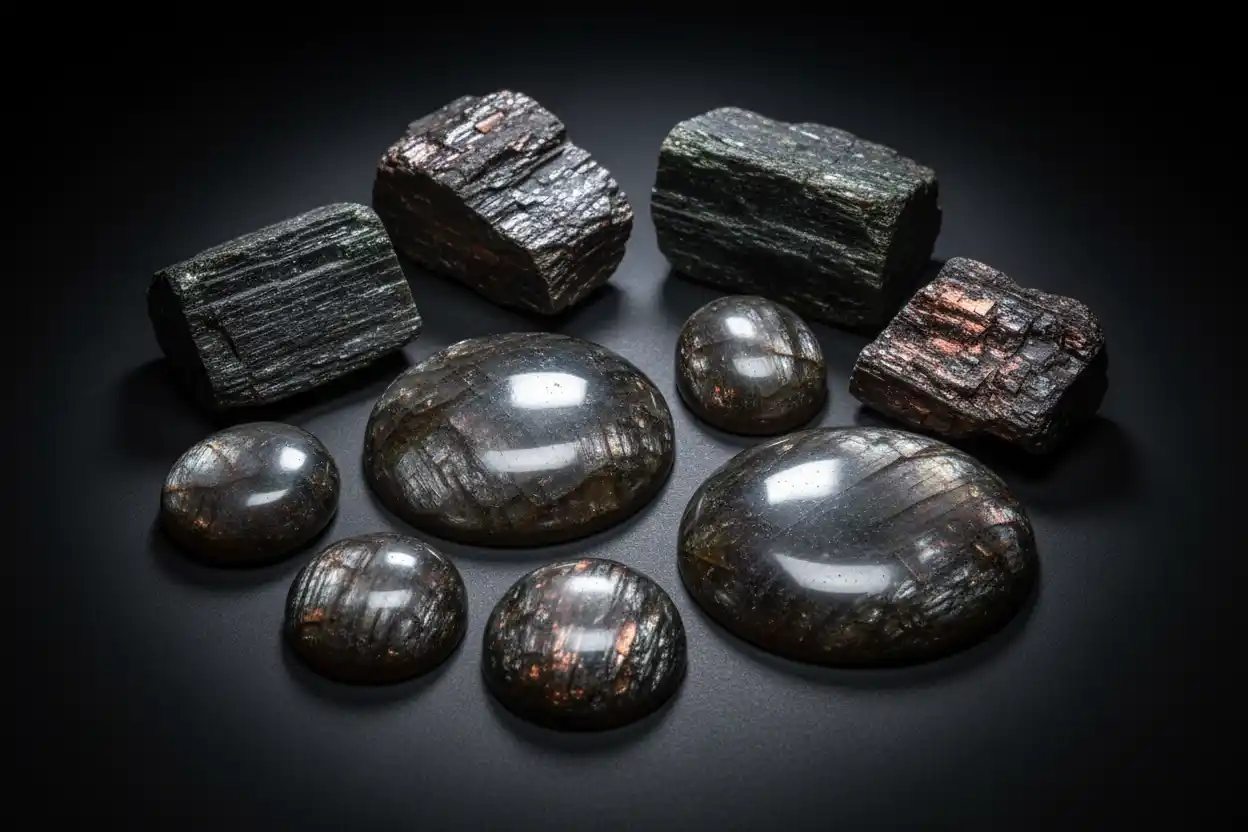
That does not make every old specimen label or modern lapidary use meaningless. “Hypersthene” still communicates a recognizable historical and commercial material: generally dark gray, brown, olive-green, greenish-black, or black-looking orthopyroxene, often with iron substantial enough to raise refractive index and density above magnesium-rich enstatite and sometimes polished to reveal a bronze, copper-red, silvery, or subdued metallic internal sheen. Gemological references for material traded under the old name place hardness around Mohs 5–6, specific gravity commonly around 3.45–3.55, and RI broadly around 1.673–1.731, while emphasizing biaxial-negative optical behavior and potentially strong pleochroism in suitable transparent material.
The best modern way to interpret hypersthene meaning is therefore layered. At the mineralogical level, establish what orthopyroxene is actually present rather than pretending hypersthene remains a precisely bounded species. At the historical level, preserve the older name because it documents how mineral classification developed and because collectors may possess legitimate historical labels. At the symbolic level, contemporary associations with reflection, restraint, perspective, grounded decision-making, boundaries, or deliberate action can be treated as human interpretations rather than as scientifically measured properties of magnesium-iron silicate.
Readers exploring other material-first references can browse Gemstone Guides. This page focuses narrowly on hypersthene meaning, nomenclature, physical evidence, diagnostic traits, geological context, history, symbolism, and ownership rather than duplicating separate pages devoted to optics, inclusions, cutting, settings, or specimen conservation.
Hypersthene Meaning at a Glance
| Property or question | Evidence-aware summary |
|---|---|
| Modern mineral status | Hypersthene is a discredited standalone species name |
| Modern mineral family | Orthopyroxene subgroup of the pyroxene group |
| Composition represented historically | Intermediate Mg-Fe orthopyroxene between enstatite and ferrosilite |
| Common shorthand formula | (Mg,Fe)SiO₃, equivalently expressed on the doubled pyroxene formula basis |
| Current preferred naming | Enstatite or ferrosilite according to composition |
| What is much commercial “hypersthene”? | Commonly ferroan enstatite; individual material requires analysis |
| Crystal system | Orthorhombic for ordinary enstatite–ferrosilite orthopyroxene |
| Typical colors | Gray, brown, olive, greenish black, brownish black |
| Typical commercial luster | Vitreous to silky; polished material may show bronze/copper/silver schiller |
| Legacy hardness range | About Mohs 5–6, commonly 5.5–6 in mineral references |
| Legacy commercial SG range | Roughly 3.45–3.55 for many gems sold as hypersthene |
| Legacy commercial RI range | Roughly 1.673–1.731, composition dependent |
| Optical character | Biaxial, commonly negative in material historically grouped as hypersthene |
| Pleochroism | Can be strong, including greenish, brownish and reddish directions |
| Cleavage | Two pyroxene cleavages meeting close to 90° |
| Typical geological role | Rock-forming orthopyroxene in mafic, ultramafic and high-grade metamorphic systems |
| Main naming confusion | Enstatite, ferrosilite, bronzite and visually similar commercial orthopyroxene |
| Main optical feature in polished material | Directional internal reflection or schiller in some specimens |
| Modern symbolism | Reflection, restraint, perspective, grounded action, discernment |
| Scientific status of symbolism | Interpretive rather than demonstrated physiological or supernatural effect |
The key line in the table is the first one. A specimen can legitimately have been collected, cataloged, bought, or inherited as “hypersthene,” yet a modern chemical analysis may identify it as enstatite with substantial Fe or as ferrosilite rather than return hypersthene as the accepted species name.
What Is Hypersthene?
Historically, hypersthene referred to intermediate members of the enstatite–ferrosilite solid solution. Enstatite represents the magnesium-rich end of ordinary orthopyroxene, while ferrosilite represents the iron-rich end. The ideal end-member formulas can be written Mg₂Si₂O₆ for enstatite and Fe₂Si₂O₆ for ferrosilite. Natural grains contain mixtures of these components, together with smaller amounts of calcium, manganese, aluminum and other substitutions depending on geological setting.
Modern pyroxene nomenclature applies formal compositional rules rather than retaining names for every intermediate interval. The IMA pyroxene nomenclature report explicitly discarded former subdivision names such as bronzite, hypersthene and eulite in the enstatite–ferrosilite series while retaining the accepted species names at the end-member sides of the compositional divide.
Mindat reflects that modern treatment by calling hypersthene an unnecessary name within the enstatite–ferrosilite series and stating that much so-called hypersthene is ferroan enstatite.
For a contemporary article, the most accurate sentence is therefore:
Hypersthene is a historical and still widely used trade or collector name for intermediate iron-bearing orthopyroxene, not a currently accepted standalone mineral species.
That preserves both modern nomenclature and real-world usage.
Hypersthene Identity Table
| Characteristic | Material traditionally called hypersthene |
|---|---|
| Mineral subgroup | Orthopyroxene |
| Structural family | Pyroxene |
| Simplified chemistry | (Mg,Fe)SiO₃ |
| Modern compositional endpoints | Enstatite ↔ ferrosilite |
| Historical status | Intermediate-series name |
| Current species status | Discredited as a standalone species |
| Crystal system | Orthorhombic |
| Typical habit | Prismatic crystals, grains, foliated or massive aggregates |
| Common body colors | Gray, brown, olive, dark green, black-green |
| Hardness | Commonly around 5.5–6 |
| Commercial SG | Often around 3.45–3.55, increasing broadly with iron |
| Commercial RI | Approximately 1.673–1.731 in common gem references, composition dependent |
| Birefringence | Moderate, variable with composition |
| Optical character | Biaxial |
| Cleavage | Two prismatic directions close to 90° |
| Pleochroism | Frequently visible in transparent iron-bearing material |
| Common polished effect | Bronze, copper, reddish or silvery directional schiller |
| Main modern identification task | Determine actual orthopyroxene composition |
| Best evidence | Optical properties plus chemical/structural analysis where exact naming matters |
Gemdat’s historical gemological treatment gives hardness 5–6, SG around 3.45–3.55, RI around 1.673–1.731 and strong pleochroism in some green material. Mindat records even broader RI values across specimens historically placed under the name, reflecting the compositional variability of iron-bearing orthopyroxene.
That variability is itself evidence that hypersthene should not be treated as though it possessed one immutable composition.
Hypersthene, Enstatite and Ferrosilite
The easiest way to understand the nomenclature is to imagine a compositional line.
At one end is enstatite, Mg₂Si₂O₆.
At the other is ferrosilite, Fe₂Si₂O₆.
Natural orthopyroxene can contain both Mg and Fe. Older systems divided portions of that line into additional named intervals, including bronzite and hypersthene. Modern IMA nomenclature simplified the scheme and uses accepted species names based on compositional dominance rather than preserving those intermediate names as formal mineral species.
Therefore, a polished stone sold as hypersthene may be chemically:
- ferroan enstatite;
- sufficiently iron-rich material to fall under ferrosilite;
- an orthopyroxene whose exact composition has not been measured;
- or, less ideally, another dark rock or mineral mislabeled through visual similarity.
The trade word does not answer the compositional question.
Is “Ferroan Enstatite” a Better Name?
Often, yes.
Mindat explicitly notes that most material historically described as hypersthene is ferroan enstatite.
However, “ferroan enstatite” should not become a new visual shortcut. A dark bronze-sheened stone cannot be declared ferroan enstatite solely because it resembles commercial hypersthene.
The term ferroan indicates meaningful Fe substitution within enstatite.
That is a chemical statement.
Where exact mineral identity matters—for a scientific specimen, locality record, museum catalog, unusual price premium or technically precise article—chemical analysis is stronger than commercial appearance.
What About Bronzite?
Bronzite is another historic name within iron-bearing enstatite terminology.
Modern mineral databases generally treat bronzite as an iron-bearing variety of enstatite rather than a separate accepted species. Mindat specifically describes bronzite as an Fe-bearing enstatite variety and points to obsolete hypersthene as a former intermediate-series term.
Commercial practice is less tidy.
A polished brown orthopyroxene with golden-bronze reflections may be called bronzite.
A darker gray-green stone with silver, copper or reddish reflection may be called hypersthene.
Those appearance conventions can be useful for lapidary communication, but they do not establish a sharp compositional line.
A seller’s bronzite-versus-hypersthene label should therefore be treated as trade classification unless supported by mineralogical analysis.
Why Does Hypersthene Look Dark?
Increasing iron content generally raises absorption in orthopyroxene and can push appearance from pale enstatite toward darker brown, greenish, reddish-brown or almost black tones.
Optical constants also tend to rise as Fe increases. Historical gemological references consequently report higher RI and SG for hypersthene-type material than for magnesium-rich enstatite. Older GIA laboratory discussions recognized this progression by observing that stones with higher RI and SG than enstatite fell into what was then called the hypersthene range.
Modern nomenclature changes the name, not the underlying compositional trend.
Iron content still influences optical absorption, density and refractive behavior.
The deeper relationship between Fe/Mg ratio, pleochroism, absorption, polishing direction and reflected sheen belongs in Hypersthene Optical Properties and Color Behavior.
What Is the Bronze or Copper Sheen?
Many polished stones marketed as hypersthene show a narrow directional flash that can appear bronze, copper-red, golden, silvery or smoky metallic as the specimen rotates.
Gemologists commonly use the term schiller for a sudden strong internal reflection produced by oriented platy inclusions or lamellar textures. GIA’s modern treatment of phenomenal gemstones defines schiller in precisely this broad structural sense rather than as a body color.
Gemdat specifically describes hypersthene as capable of showing a brilliant copper-red metallic sheen and also records tabular hematite and goethite inclusions in material grouped under the name.
The safest specimen-specific wording is therefore:
The sheen in commercial hypersthene is produced by oriented internal reflectors—such as lamellae or inclusions—but the exact reflector should be identified rather than assumed from appearance.
Not every bronze flash should automatically be assigned to hematite.
Not every silvery flash should automatically be called an exsolution lamella.
Microscopy matters.
Schiller Is Directional
A stone can look almost uniformly black under diffuse front lighting and then produce a broad metallic flash under one narrow oblique angle.
That does not mean the surface has changed color.
The lighting direction has aligned with internal reflectors.
Rotate the stone or light source away from that geometry and the reflection weakens or disappears.
This directional behavior has practical consequences for photography and cutting. A polished cabochon can be visually impressive from one orientation and dull from another even though its mineral chemistry is unchanged.
Hypersthene Is Not Labradorite
Both materials can be dark and show conspicuous moving reflections, but the mechanisms and host minerals differ.
Labradorite is feldspar and commonly shows labradorescence related to submicroscopic exsolution structures that create interference colors.
Commercial hypersthene is orthopyroxene and normally shows a more subdued bronze, copper, silver or reddish directional reflection rather than broad blue-green-rainbow labradorescence.
A dark stone with a blue sheet-like feldspar flash should not be reclassified as hypersthene because both effects move with light.
Phenomenon names should follow the structure producing them.
Pleochroism
Transparent or translucent iron-bearing orthopyroxene can show different colors along different crystallographic directions.
Gemdat records strong pleochroism in some green material, including combinations of dark bluish green, brownish red and yellowish tones.
A GIA enstatite specimen from Madagascar showed yellowish-brown to reddish-brown pleochroism and parallel growth tubes, demonstrating how directional color and internal growth features occur within the same orthopyroxene mineral family.
Most opaque polished commercial “hypersthene” does not display textbook transparent-gem pleochroism clearly to the unaided eye.
Its reflective schiller can dominate the face-up appearance.
Inclusions and Internal Textures
Material sold as hypersthene can contain mineral inclusions, alteration products, growth tubes, cleavage-related features, exsolution textures, fractures and reflective plates.
These features need to be interpreted individually.
A dark platy inclusion may be hematite or another oxide.
A fine oriented lamella may record exsolution during cooling.
A parallel tube may be a growth feature.
A brown film along a fracture may represent alteration rather than the original orthopyroxene.
The detailed specimen-scale work belongs in the Hypersthene Microscope Inclusion Notebook.
The important point for hypersthene meaning is that the polished sheen is not proof of one universal inclusion population.
Exsolution and Cooling History
Orthopyroxenes can preserve exsolution textures created as high-temperature solid solutions become less stable during cooling.
USGS spectroscopy documentation of enstatite records exsolution lamellae as one microscopic characteristic consistent with orthopyroxene. Experimental and petrographic literature likewise documents pyroxene exsolution relationships as compositions reorganize during cooling.
This gives some orthopyroxene a genuine internal record of thermal history.
The presence of a lamellar texture does not mean the stone was manufactured or layered artificially.
It can represent solid-state mineral reorganization occurring after the original crystal formed.
Two Cleavages Near 90 Degrees
Pyroxenes are famous in introductory mineralogy for two prismatic cleavage directions meeting close to a right angle.
Orthopyroxene follows that general pattern. Optical-mineral references describe the cleavage intersection near 87° and 93°, one of the practical distinctions from amphiboles, whose two prominent cleavages intersect at very different angles.
This is a useful rough-specimen clue.
It is not a reason to break a polished stone intentionally.
A pre-existing chip, natural fracture or thin section can reveal the structure without deliberately damaging jewelry or a collection piece.
How Hypersthene Forms
Because hypersthene is a historical label for iron-bearing orthopyroxene, its geology is fundamentally orthopyroxene geology.
Orthopyroxene is an important rock-forming mineral in mafic and ultramafic igneous rocks such as norite, gabbro, peridotite and pyroxenite. It also occurs in high-grade metamorphic rocks, including granulite-facies assemblages, where pressure, temperature and bulk-rock chemistry stabilize Mg-Fe pyroxene. USGS geochemical work treats enstatite and ferrosilite as the Mg and Fe orthopyroxene end members and analyzes natural grains compositionally between them.
That geological role explains why decorative hypersthene material can occur as large granular or foliated masses rather than isolated transparent gem crystals.
A piece may be part of an orthopyroxene-rich rock.
Another may be a single large grain.
A third may contain substantial feldspar, oxide minerals or alteration products.
Readers wanting the broad distinctions among magmatic, metamorphic and fluid-driven mineral formation can use How Are Gemstones Formed?. The detailed orthopyroxene petrology, host rocks, crystallization sequence, metamorphic conditions and deposit context belong in Hypersthene Formation and Deposit Geology.
Hypersthene in Mafic Igneous Rocks
Mafic magmas are comparatively rich in magnesium and iron.
As such magmas cool, minerals including pyroxenes, olivine, calcium-rich feldspar and oxide phases can crystallize depending on composition and pressure.
Orthopyroxene becomes particularly characteristic in rocks such as norite, where it can be a principal dark mineral.
Slow cooling can also allow internal compositional reorganization and exsolution textures to develop.
That is a geological explanation for internal structure—not a spiritual explanation for layered “energy.”
Hypersthene in Ultramafic Rocks
Peridotites and pyroxenites can contain abundant orthopyroxene.
These rocks are important components of the upper mantle and deep crustal igneous systems. Orthopyroxene in them commonly coexists with olivine, clinopyroxene, spinel and later alteration products.
When such rocks reach surface conditions, weathering and hydration can modify pyroxene. Serpentine, talc, amphibole, carbonates and iron oxides may develop depending on the environment.
A black or bronze-polished object may therefore include both original orthopyroxene and alteration features.
Hypersthene in High-Grade Metamorphism
Orthopyroxene also forms or recrystallizes in high-temperature metamorphic rocks.
Granulite-facies systems can contain orthopyroxene together with quartz, feldspar, garnet, ilmenite and other phases depending on bulk composition.
USGS experimental work uses orthopyroxene–ilmenite–quartz relationships precisely because Fe-Mg partitioning between these minerals responds to high-temperature and high-pressure conditions.
This is another reminder that “hypersthene” is not one deposit type.
The historical name can apply to orthopyroxene formed in more than one geological environment.
Color Is Not Enough for Identification
Dark greenish-black color with bronze sheen is strongly associated with commercial hypersthene.
It is still weak evidence by itself.
Several pyroxenes, amphiboles, feldspars, oxide-rich rocks and composite ornamental materials can look dark and reflective when polished.
The more reliable route combines:
- orthopyroxene-compatible RI and density;
- biaxial optical behavior where measurable;
- cleavage near 90°;
- pleochroism in transparent material;
- microscopy of internal textures;
- spectroscopy or X-ray diffraction where necessary;
- chemical analysis when the precise enstatite–ferrosilite composition matters.
A visual label should be considered provisional.
Original Information Gain: Hypersthene Name and Claim Audit
| Name or claim | Evidence-aware interpretation | What should not automatically be assumed | Stronger evidence when needed |
|---|---|---|---|
| Hypersthene | Historic/trade term for intermediate Fe-bearing orthopyroxene | Currently accepted mineral species | Modern pyroxene classification |
| Ferroan enstatite | Enstatite containing significant Fe | Every dark orthopyroxene | Chemical composition |
| Ferrosilite | Fe-dominant orthopyroxene species | Same thing as every hypersthene-labeled stone | Chemical composition |
| Bronzite | Traditional iron-bearing enstatite variety/trade term | Sharp formal boundary from hypersthene by appearance | Chemistry |
| Orthopyroxene | Structural/mineral subgroup description | One exact composition | Composition required |
| “Black hypersthene” | Appearance terminology | Separate variety | Identify material |
| “Velvet hypersthene” | Commercial luster description | Formal mineral variety | Examine surface/internal reflectors |
| “Silver hypersthene” | Appearance-based trade term | Silver content | Optical/microscopic evidence |
| “Golden hypersthene” | Reflective-color description | Gold content | Mineral chemistry |
| “Copper flash” | Visual reflection | Copper inclusion automatically | Microscopy/analysis |
| “Hematite schiller” | Possible mechanism in some material | Universal cause of sheen | Inclusion analysis |
| “Hypersthene crystal” | May refer to orthopyroxene crystal | Accepted hypersthene species | Determine modern species |
| “Grounding stone” | Modern symbolism | Measurable electrical grounding | No established mechanism |
| “Psychic protection” | Metaphysical interpretation | Guaranteed external protection | Remains symbolic |
| “Calming stone” | Modern reflective use | Treatment of anxiety or neurological conditions | Clinical evidence required |
| “Detoxifying pyroxene” | Unsupported wellness claim | Toxin removal | Clinical evidence required |
This table illustrates why hypersthene meaning is unusually dependent on naming discipline. Even the mineral name itself is partly historical, so stronger claims about composition, inclusion species or health effects require correspondingly stronger evidence.
Original Specimen and Photo Checklist
| Observation | Photograph can often support | Photograph cannot reliably prove |
|---|---|---|
| Dark gray or green-black body | Color and tone | Exact Mg/Fe ratio |
| Bronze/copper schiller | Directional reflection | Reflector mineral species |
| Silver sheen | Reflective appearance | Silver content |
| Broad moving flash | Orientation of internal reflection | Exact exsolution texture |
| Cleavage planes | Near-90° pyroxene geometry may be visible | Exact species |
| Brown-red edge color | Possible pleochroic or transmitted-light tone | Iron percentage |
| Fine plates | Internal reflector morphology | Hematite versus another oxide |
| Parallel lamellae | Oriented internal texture | Formation temperature |
| Granular rock texture | Orthopyroxene-rich rock possibility | Percentage of orthopyroxene |
| Feldspar association | Rock relationship | Exact locality |
| Old “hypersthene” label | Historical identification | Modern species assignment |
| Seller “untreated” label | Disclosure claim | Composition |
| “Healing energy” | Nothing objectively measurable | Medical effect |
A useful photograph should include one diffuse-light image that shows body color and one oblique-light image that reveals schiller. Using only the flash angle can make the entire stone appear metallic and hide the actual body color.
A third transmitted-light image can be useful for thinner or translucent specimens because reddish-brown, greenish or yellow-brown directional tones may become visible.
How to Photograph Schiller Without Exaggerating It
Schiller-bearing stones are easy to misrepresent.
A narrow spotlight placed directly at the reflection angle can make a modest copper sheen look like a continuous metallic coating. Strong contrast can erase the darker host. Sharpening can turn fine internal lamellae into harsh artificial lines.
For a documentary image, photograph the stone first under broad neutral illumination, then move one controlled light source until the reflection appears.
Show both images.
That tells the reader that the optical effect is directional.
Original Evidence Hierarchy for Hypersthene Identification
| Evidence level | What it can establish |
|---|---|
| Dark bronze-sheened appearance | Commercial hypersthene is one possibility |
| Near-90° cleavage and orthopyroxene-like habit | Orthopyroxene becomes more plausible |
| RI/SG consistent with Fe-bearing orthopyroxene | Stronger support |
| Pleochroism and biaxial optical behavior | Further orthopyroxene evidence |
| Raman/XRD | Strong structural identification |
| Electron microprobe or equivalent chemistry | Enstatite–ferrosilite composition can be determined |
| Chemistry plus structural data | Modern species assignment |
| Provenance plus analysis | Strongest collector documentation |
The hierarchy also explains why an old label should not simply be thrown away after analysis. “Hypersthene” may remain historically meaningful even when a modern report gives ferroan enstatite.
The Name Hypersthene
The word hypersthene comes from Greek roots interpreted as “over strength” or “exceeding strength.” Gemdat explains that the name alluded to its greater hardness compared with hornblende, a mineral with which it was historically confused.
The etymology therefore describes a physical comparison.
It does not mean inner strength, psychic strength, emotional strength or spiritual power in the original mineralogical naming context.
Modern symbolism may reasonably adopt strength as a metaphor.
It should not be presented as the historical definition of the name.
Why the Name Was Discarded
The problem was not that hypersthene material suddenly ceased to exist.
The problem was classification.
The enstatite–ferrosilite series is chemically continuous. Creating formal species names for arbitrary intermediate composition ranges complicated nomenclature without representing truly distinct crystal structures. The IMA pyroxene committee therefore applied compositional naming rules and formally discarded numerous older subdivision terms, including hypersthene.
This is a good example of science becoming more precise by using fewer names.
The specimen remains.
Its label changes.
Should Collectors Relabel Old Hypersthene?
Usually, preserve both pieces of information.
If a historic specimen has an original hypersthene label, that label is part of the collection record and should not be discarded merely because nomenclature changed.
A modern annotation can add something such as:
“Historic label: hypersthene. Current nomenclature: orthopyroxene; likely ferroan enstatite unless composition has been analyzed.”
If laboratory chemistry establishes the modern species, record the result beside the historical label.
The dedicated Hypersthene Specimen Conservation Record provides a more detailed framework for preserving old labels, provenance, condition, photographs and analytical results.
Hypersthene Versus Iceland Spar
Iceland Spar Meaning concerns highly transparent calcite rather than orthopyroxene.
Iceland spar is soft, strongly cleavage-prone and famous for enormous double refraction. Hypersthene-type orthopyroxene is harder, denser, darker and commonly biaxial, with much lower birefringence.
Both can teach useful optical lessons.
One dramatically splits transmitted images.
The other can display directional pleochroism and schiller.
They are not mineralogically related.
Hypersthene Versus Hyalite Opal
Hyalite Opal Meaning concerns amorphous hydrated silica.
Hyalite is usually colorless to translucent, glass-like, relatively low in density and sometimes spectacularly fluorescent. Hypersthene-type material is crystalline orthopyroxene, significantly denser and generally dark.
A glossy surface is therefore a very weak mineral identifier.
Glass-like luster, metallic-looking sheen and fluorescence all have to be interpreted through the correct host material.
Hypersthene Versus Ilmenite
Ilmenite Meaning concerns FeTiO₃, an iron-titanium oxide.
Ilmenite is much denser and opaque, commonly has metallic to submetallic luster and can occur beside orthopyroxene in igneous and metamorphic rocks. That association creates a potential identification trap when dark granular rocks contain both phases.
A black metallic grain inside orthopyroxene-rich material is not automatically part of the pyroxene.
Likewise, a bronze flash from inside a polished orthopyroxene does not prove the entire stone is ilmenite.
Host and inclusion must be separated conceptually.
Cutting and Orientation
Material sold as hypersthene is often cut as cabochons, beads, slabs or carvings because the optical appeal depends less on faceted brilliance than on directing the broad reflective sheen toward the viewer.
A cutter must first locate the internal reflective plane.
If the cabochon dome is oriented poorly, the stone may remain dull face-up even though the rough contains strong schiller from another direction.
Cleavage, fractures, grain boundaries and mixed-rock texture further complicate the work.
These lapidary decisions belong in Hypersthene Cutting, Orientation and Polish.
The mineral name alone does not tell a cutter where the best sheen lies.
Jewelry Wear
A hardness around 5.5–6 gives hypersthene-type orthopyroxene moderate resistance to scratching, but that does not make it an ideal unprotected everyday ring material.
Pyroxene cleavage, brittle behavior, internal fractures, grain boundaries and large polished faces can all contribute to damage.
A protected pendant or bead may tolerate wear more easily than a large exposed ring.
The detailed relationship between cleavage orientation, bezel protection, prongs, impact, bead holes and daily use belongs in Hypersthene Setting and Wear Engineering.
Hardness is only one part of durability.
Cleaning and Ordinary Ownership
For ordinary intact polished orthopyroxene, gentle cleaning with mild soap, lukewarm water and a soft cloth is a conservative approach when the object has no sensitive adhesives, coatings or composite construction.
Avoid assuming that a metallic-looking sheen means the stone can be polished aggressively with metal-cleaning compounds.
The reflection is often internal or structural.
Abrasive cleaning can dull the actual surface needed to see it.
High heat and harsh chemicals are unnecessary for routine ownership.
Intact Stone Versus Cutting Dust
Handling an intact polished specimen is different from sawing, grinding, drilling, sanding or crushing mineral material.
Mechanical processing creates fine silicate dust and may also release particles from oxide inclusions, feldspar, alteration products or other phases present in the rock.
Lapidary work should use suitable wet methods where appropriate, local dust extraction, eye protection, safe machine guarding and correctly selected respiratory protection when required.
Do not intentionally grind hypersthene-type material into powder for spiritual use.
Do Not Ingest Hypersthene
Hypersthene-type orthopyroxene should not be powdered, swallowed, added to supplements or deliberately soaked to prepare mineral drinking-water elixirs.
Natural material can contain iron-bearing oxides, alteration phases, mixed rock components, polishing compounds, adhesives or other substances beyond the simplified Mg-Fe pyroxene composition.
Magnesium and iron inside an orthopyroxene lattice are not dietary supplements.
Mineral chemistry is not dosage guidance.
Modern Hypersthene Meaning
Modern hypersthene meaning commonly centers on reflection, grounded thought, restraint, discernment, boundaries, self-observation and deliberate action.
Several of these themes fit the material metaphorically.
Its dark body can look visually quiet until a narrow change of angle reveals a hidden bronze or silver reflection.
Its naming history requires separating an old familiar label from a more precise modern identification.
Its composition lies along a continuum rather than inside the rigid category implied by the old name.
Those facts naturally support themes involving perspective and avoiding overconfident first impressions.
They do not demonstrate a metaphysical field.
Hypersthene and Reflection
Reflection is perhaps the most material-based symbolic use.
A polished stone may seem uniformly dark until it is rotated into the correct lighting geometry.
A reflective practice could use that behavior as a reminder to ask:
What becomes visible when I change perspective?
What information am I ignoring because I am looking from only one angle?
What would change my conclusion?
The mineral provides a physical metaphor.
It does not provide the answer.
Hypersthene and Discernment
The nomenclature itself creates an unusually strong discernment lesson.
A seller says hypersthene.
A mineralogist says the species name is obsolete.
An older collection card says hypersthene.
A chemical analysis may say ferroan enstatite.
All four statements can make sense in different contexts.
Discernment means identifying which level of description is actually relevant.
This is more useful than claiming the stone grants supernatural judgment.
Hypersthene and Grounding
Grounding is commonly associated with dark stones in modern crystal practice.
A responsible interpretation can make grounding behavioral: identify concrete facts, notice physical surroundings, finish one immediate task, or separate a problem into controllable and uncontrollable parts.
The stone can act as a tactile reminder.
It has not been demonstrated to electrically ground the human body, remove electromagnetic fields or discharge a measurable reservoir of “negative energy.”
Hypersthene and Boundaries
The subdued, directional nature of hypersthene’s sheen can also support boundary symbolism.
A practical boundary exercise might ask:
What am I responsible for?
What belongs to someone else?
What am I willing to do?
What am I unwilling to continue?
Those questions turn an abstract symbolism into an actionable framework.
The mineral cannot force another person to respect the boundary.
Hypersthene and Decision-Making
Hypersthene is sometimes marketed as a stone for clearer choices or intuition.
A stronger use is to connect the stone to a repeatable decision process:
state the decision precisely,
list known evidence,
identify assumptions,
estimate consequences,
choose a reversible next step where possible,
and define what new evidence would cause reconsideration.
That process may improve decisions.
Orthopyroxene does not alter probability or reveal hidden future events.
Hypersthene and “Psychic Protection”
Protection language is common around dark gemstones.
There is no established evidence that hypersthene blocks supernatural attack, malicious intention, electromagnetic radiation, illness, crime or financial loss.
If protection symbolism is personally meaningful, convert it into practical action: secure accounts, check equipment, leave unsafe environments, establish boundaries, verify information or seek qualified help when needed.
The symbolism remains intact without promising an invisible shield.
Hypersthene Healing Claims
There is no established scientific evidence that wearing or carrying hypersthene treats anxiety, depression, neurological conditions, cardiovascular disease, hormone disorders, infertility, immune dysfunction, chronic pain, sleep disorders or other medical conditions.
The magnesium and iron in orthopyroxene are structural mineral components.
They do not become nutritional supplements through skin contact.
The broader separation between gemstone symbolism and medical claims is stated in the Gems Lore Disclaimer.
A person can find a dark polished stone calming to look at.
That subjective response is different from proving treatment of an anxiety disorder.
Hypersthene and Sleep
Some modern descriptions associate hypersthene with quiet thought or sleep.
A person can incorporate a stone into a bedtime routine as a reminder to stop work, reduce stimulation, prepare the room, journal or follow another established personal routine.
The usefulness comes from the repeated behavior.
There is no established evidence that orthopyroxene changes melatonin, sleep stages or neurological sleep regulation through proximity.
Hypersthene and Confidence
The historical name’s “over strength” etymology can easily inspire modern confidence symbolism.
That is a legitimate metaphor as long as the history is represented accurately.
The original naming reference concerned comparative mineral hardness, not emotional self-confidence.
Someone can still use the stone as a reminder to prepare carefully and act despite uncertainty.
The symbolic meaning is modern.
The mineralogical etymology is historical.
Original Source-Comparison Framework
| Source type | Best question it answers | Main limitation |
|---|---|---|
| IMA pyroxene nomenclature | Is hypersthene an accepted modern species name? | Does not identify a specific commercial stone |
| Mineral database | What status, optical ranges and historical usage are recorded? | Aggregates information from varied material |
| Gemological database | How has gem-quality material sold as hypersthene been characterized? | Uses historical/trade terminology where appropriate |
| GIA specimen data | What properties occur in analyzed orthopyroxene gems? | One specimen does not define the whole series |
| USGS chemistry | How are Mg-Fe orthopyroxenes analyzed compositionally? | Geological sample may not represent ornamental trade material |
| Microscope | What inclusions and lamellae occur in this stone? | Appearance may not identify exact inclusion chemistry |
| Electron microprobe | What is the Mg/Fe/Ca composition? | Requires analytical access |
| Old collection label | What was the specimen historically called? | May not match modern nomenclature |
| Metaphysical source | What symbolism is practiced today? | Cannot establish mineralogy or medicine |
The framework allows an old mineral label, modern chemical analysis and contemporary spiritual interpretation to coexist without pretending they answer the same question.
Evidence and Technical Limits
This article does not claim first-hand mine visits, unpublished electron-microprobe data, private X-ray diffraction, direct identification of a reader’s stone or specialist examination of every material sold as hypersthene. The broader evidence approach used by Gems Lore is described on About Gems Lore.
Exact placement within the enstatite–ferrosilite series can require quantitative chemical analysis. Identifying reflective lamellae or dark inclusions can require microscopy, Raman spectroscopy, SEM-EDS or related methods. Mixed ornamental rock can require more than one test because an attractive cabochon may contain several mineral phases.
Readers with documented analytical corrections, locality records, historic labels or stronger mineralogical evidence can submit them through Contact Gems Lore. Information submitted through site channels is handled according to the Privacy Policy.
Frequently Asked Questions About Hypersthene Meaning
What is hypersthene meaning?
Hypersthene meaning combines a historical name for iron-bearing orthopyroxene with modern symbolic themes such as reflection, restraint, perspective, discernment, boundaries and grounded action. The symbolic themes are interpretations rather than scientifically demonstrated physiological effects.
Is hypersthene a real mineral?
The material is real, but hypersthene is no longer an accepted standalone mineral species name. Modern IMA nomenclature discarded the intermediate name within the enstatite–ferrosilite orthopyroxene series.
What is hypersthene called now?
Depending on composition, material historically called hypersthene is classified principally as enstatite or ferrosilite. Much commercial and historical hypersthene is described as ferroan enstatite.
What is hypersthene made of?
Historically, hypersthene represents Mg-Fe orthopyroxene and is commonly summarized as (Mg,Fe)SiO₃. Exact natural compositions vary between the enstatite and ferrosilite components.
Is hypersthene the same as enstatite?
Not exactly in historical usage. Hypersthene was an intermediate Fe-bearing subdivision of the enstatite–ferrosilite series. Under modern nomenclature, much of that material falls within enstatite or ferrosilite according to composition.
Is hypersthene the same as bronzite?
No precise modern species boundary separates the old commercial appearance terms. Bronzite is generally treated as iron-bearing enstatite, while hypersthene is an obsolete intermediate-series name. Chemical analysis is stronger than appearance when exact classification matters.
Why was the name hypersthene discredited?
Modern pyroxene nomenclature eliminated several intermediate subdivision names and classified the enstatite–ferrosilite solid solution using accepted end-member species and compositional rules.
What color is hypersthene?
Material sold under the name is commonly gray, dark brown, olive, greenish black or nearly black. Some specimens show brown, reddish or green pleochroic tones.
Why does hypersthene have a bronze or silver flash?
Many polished specimens contain oriented internal reflectors that produce directional schiller. These can include lamellar textures or platy inclusions. The exact reflector should be determined specimen by specimen rather than assumed.
Is the flash on the surface?
Often the strongest effect is produced by internal structures interacting with light rather than by a metallic coating on the surface. Surface polish still controls how clearly the internal reflection can be seen.
How hard is hypersthene?
Historical mineral references commonly place it around Mohs 5.5–6, while gem references often summarize the range as 5–6.
What is hypersthene’s specific gravity?
Commercial gemological references commonly give about 3.45–3.55 for material traded as hypersthene, but density varies with composition.
What is hypersthene’s refractive index?
Gem references for material historically called hypersthene commonly give RI around 1.673–1.731, while broader mineral datasets span wider values because iron content varies.
Does hypersthene show pleochroism?
Yes, transparent iron-bearing orthopyroxene can show conspicuous directional colors, including greenish, brownish and reddish tones.
Where does hypersthene form?
The material represented by the historical name occurs as orthopyroxene in mafic and ultramafic igneous rocks and in high-grade metamorphic assemblages. Enstatite and ferrosilite form the principal Mg-Fe orthopyroxene compositional series.
Is hypersthene rare?
Orthopyroxene itself is an important rock-forming mineral and is not inherently rare. Attractive lapidary-grade material with strong directional schiller, good polish, useful block size or documented specimen provenance can be less common than ordinary geological orthopyroxene.
Should an old hypersthene label be thrown away?
No. Historical labels can carry provenance value. Preserve the original label and add a modern nomenclature note or analytical result rather than replacing the historical record.
Does hypersthene have healing properties?
There is no established scientific evidence that hypersthene treats disease or produces specific physiological healing effects.
Does hypersthene help anxiety?
Someone may use it as a symbolic cue for slowing down or reflecting before acting, but it has not been established as a treatment for anxiety disorders.
Does hypersthene protect against negative energy?
Protection is a modern metaphysical association. There is no established evidence that orthopyroxene produces an invisible protective field.
Can hypersthene go in drinking water?
Collector material should not be powdered, ingested or deliberately used to prepare gemstone drinking-water elixirs. Natural orthopyroxene can contain other mineral phases, inclusions, alteration products and processing residues.
Final Perspective
Hypersthene meaning is unusually dependent on understanding that a familiar name can survive long after mineral nomenclature changes. The dark bronze-sheened material sold and collected as hypersthene is genuine geological material, but hypersthene itself is no longer an accepted standalone mineral species. Modern pyroxene classification places those Mg-Fe orthopyroxenes within the enstatite–ferrosilite series, with much historical hypersthene better described as ferroan enstatite.
Its physical character remains distinctive. Material traded under the old name commonly has moderate hardness, substantial density, relatively high refractive indices for a silicate, two pyroxene cleavages near 90°, directional pleochroism and—in selected polished material—a bronze, copper, red or silver internal schiller produced by oriented reflective structures. Those are measurable mineralogical and gemological features, not evidence of metaphysical force.
Its geological setting adds another layer. Orthopyroxene is an important constituent of mafic and ultramafic rocks and also occurs in high-grade metamorphic environments. Cooling can preserve exsolution textures, alteration can introduce new mineral phases, and mixed rocks can place orthopyroxene beside feldspar, ilmenite, olivine or other dark minerals. The polished object therefore records a petrological history more complicated than its trade name suggests.
Modern associations with reflection, grounding, boundaries, discernment and deliberate action can still form a responsible hypersthene meaning. In fact, the mineral’s nomenclature offers an unusually good metaphor: appearance and familiar labels are useful starting points, but neither should be confused with complete evidence.
The responsible approach is therefore simple. Preserve the historical name where it carries collection or trade context. Use modern orthopyroxene terminology when chemical precision matters. Do not identify reflective inclusions from sheen alone. Treat darkness and bronze flash as clues rather than proof. Respect cleavage and moderate hardness in jewelry. Keep mineral dust out of ritual use. And allow personal symbolism to remain an interpretation built on top of the material rather than a substitute for understanding what the material actually is.