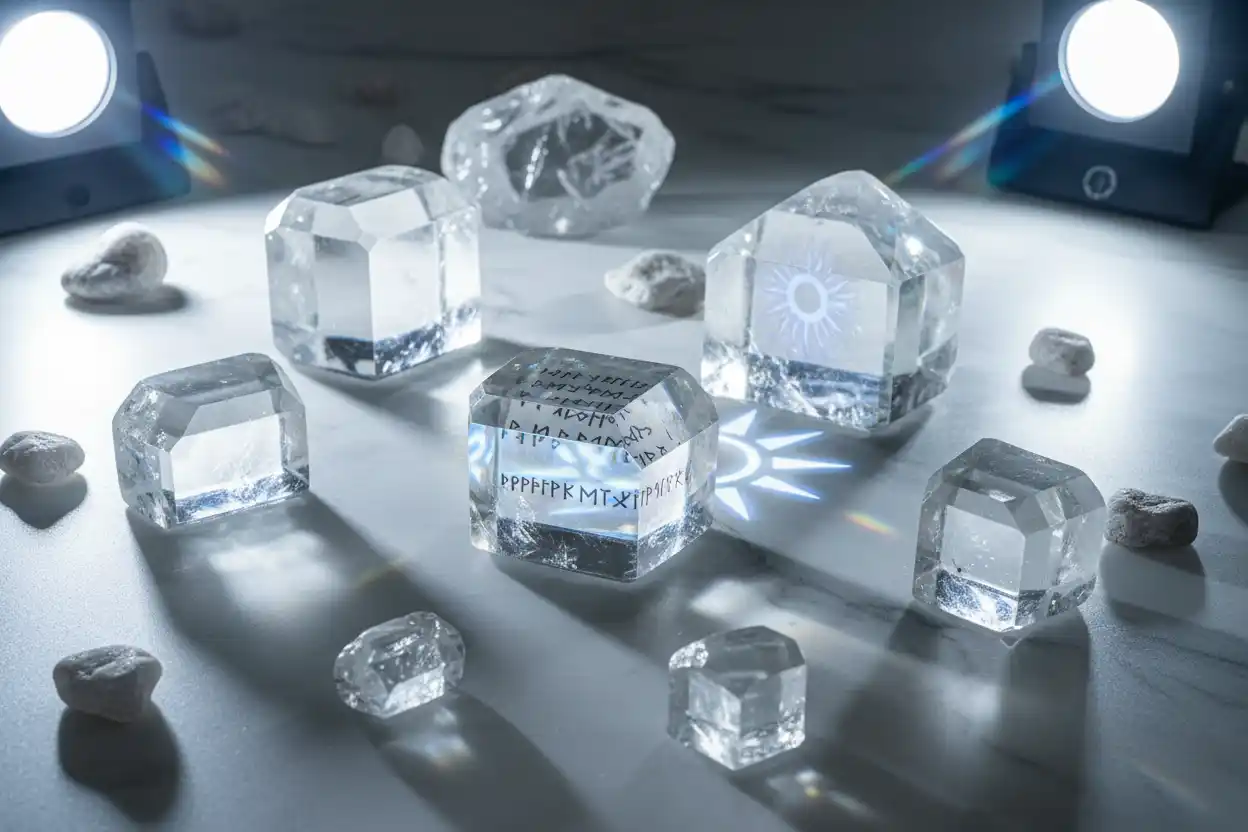
Iceland Spar Meaning: Properties, Uses & Symbolism
Iceland spar meaning begins with calcite, CaCO₃. Iceland spar is not a separate mineral species and does not have a special chemical formula distinct from calcite. It is the traditional name for exceptionally transparent optical-quality calcite, particularly material capable of displaying calcite’s dramatic double refraction with unusual clarity. Mindat defines Iceland spar as an optically clear form of calcite, originally associated with Iceland but capable of occurring elsewhere.
Its defining visual demonstration is remarkably simple. Place a clear rhombohedral piece over a printed line, dot, letter, or other small object and two images may become visible. Calcite is uniaxial negative, with principal refractive indices of approximately 1.658 and 1.486. The difference of about 0.172 is exceptionally large and produces conspicuous birefringence, commonly called double refraction in this context.
That property turned transparent calcite from eastern Iceland into far more than an attractive mineral specimen. Material from the classic Helgustadir occurrence became important in the development of wave optics, crystallography, crystal physics, polarizing instruments, mineral microscopy, and other fields that depended on controlled polarized light. University of Iceland research describes Helgustadir Iceland spar as an important material in the development of several branches of physical science and in the manufacture of Nicol prisms used in optical instruments.
Modern symbolism developed on top of that remarkable optical history. Iceland spar is now associated in crystal traditions with clarity, perspective, truth, duality, decision-making, focus, and seeing more than one side of a situation. Those associations can be meaningful as metaphors because the stone literally produces two visible paths for light. They should not, however, be confused with evidence that calcite grants clairvoyance, medically improves vision, alters neurological processing, or reveals hidden truths supernaturally.
Readers exploring other mineral-first references can browse Gemstone Guides. This page keeps Iceland spar meaning centered on material identity, geological context, diagnostic traits, documented scientific history, disputed claims, symbolism boundaries, and responsible ownership.
Iceland Spar Meaning at a Glance
| Property or question | Evidence-aware summary |
|---|---|
| Mineral species | Calcite |
| Formula | CaCO₃ |
| Status of Iceland spar | Transparent optical-quality variety/form of calcite |
| Classic locality | Helgustadir area of eastern Iceland |
| Can it occur outside Iceland? | Yes; the term is also used for optically clear calcite from other localities |
| Crystal system | Trigonal |
| Typical color | Ideally colorless and water-clear |
| Mohs hardness | 3 |
| Specific gravity | Approximately 2.71–2.72 |
| Refractive indices | Approximately 1.486 and 1.658 |
| Birefringence | Approximately 0.172 |
| Optical character | Uniaxial negative |
| Cleavage | Perfect rhombohedral cleavage |
| Fracture | Conchoidal where cleavage does not dominate |
| Most famous optical effect | Strong double refraction |
| Historical scientific role | Polarization studies, crystal optics, Nicol prisms and optical instruments |
| Main identification challenge | Separating optical-quality calcite from ordinary transparent calcite, glass and other clear minerals |
| Famous disputed historical claim | Possible use as a navigational “sunstone” |
| Status of Viking sunstone hypothesis | Physically plausible in experiments, but archaeological evidence remains lacking |
| Modern symbolism | Clarity, perspective, discernment, focus, examining alternatives |
| Scientific status of symbolism | Interpretive rather than demonstrated physiological or supernatural effect |
| Main ownership issue | Very soft and easily split along perfect cleavage |
The physical data are calcite data rather than special properties added by Icelandic origin. Mindat records calcite hardness at Mohs 3, measured density close to 2.71, perfect rhombohedral cleavage, uniaxial-negative optics, and RI values of 1.658 and 1.486.
What Is Iceland Spar?
Iceland spar is exceptionally clear calcite suitable for demonstrating or exploiting calcite’s optical properties. The original name came from famous material recovered in eastern Iceland, particularly the Helgustadir locality. Mindat describes the variety as clear optical calcite and records Helgustadir as the original reported locality.
The word spar historically appears in names for minerals that split readily along prominent cleavage planes. Calcite is an excellent example because it has three equivalent directions of perfect rhombohedral cleavage. A large natural crystal can therefore be broken into smaller rhombohedral blocks whose faces repeat the characteristic calcite geometry.
An Iceland spar cleavage rhomb can look almost artificially cut because the cleavage faces are flat and geometrically regular. In reality, those surfaces can be produced naturally by the mineral’s crystal structure.
The optical-quality designation is the important part. Ordinary calcite can be white, cloudy, opaque, yellow, pink, gray, brown, blue, green, or heavily included. Iceland spar traditionally refers to material transparent enough that its birefringence can be observed clearly through a substantial thickness.
Iceland Spar Identity Table
| Characteristic | Iceland spar |
|---|---|
| Mineral | Calcite |
| Ideal formula | CaCO₃ |
| Variety basis | Exceptional transparency and optical quality |
| Crystal system | Trigonal |
| Common specimen form | Natural crystal or rhombohedral cleavage block |
| Typical body color | Colorless |
| Transparency | Transparent |
| Luster | Vitreous; cleavage surfaces may appear pearly |
| Hardness | Mohs 3 |
| Density | Approximately 2.71 |
| RI ordinary ray | Approximately 1.658 |
| RI extraordinary ray | Approximately 1.486 |
| Maximum birefringence | Approximately 0.172 |
| Optical character | Uniaxial negative |
| Cleavage | Perfect rhombohedral |
| Acid response | Calcite reacts readily with weak acids |
| Main visual test | Doubling of a viewed object in suitable orientation |
| Main provenance distinction | “From Iceland” and “Iceland spar” are not necessarily identical claims |
| Main analytical identity | Calcite first; optical clarity second |
These properties explain why Iceland spar is so recognizable to mineralogy students. Calcite combines low hardness, strong rhombohedral cleavage, easy acid reaction, and extraordinarily strong birefringence in one readily observable material.
Why Does Iceland Spar Show Two Images?
Light entering calcite does not propagate identically in every crystallographic direction.
Because calcite is anisotropic, an incoming light ray can separate into an ordinary ray and an extraordinary ray. Each travels according to a different refractive index and, except along special directions, follows a different path through the crystal.
The result is two emerging images.
This is not a surface reflection.
Both images arise because light has traveled through the calcite along two optical paths.
The effect becomes especially obvious in Iceland spar because the material is sufficiently transparent for the two rays to remain visible rather than being lost in cloudiness or internal scattering.
The underlying optics, polarization geometry, extinction directions, interference colors, orientation effects, and quantitative birefringence belong in the dedicated Iceland Spar Optical Properties and Color Behavior reference.
Why the Doubling Changes as the Crystal Rotates
The separation of the two images depends on crystal orientation.
Rotate a cleavage rhombohedron over a printed dot and the extraordinary image moves relative to the ordinary image. At particular orientations the separation can become easier to see; along the optic axis the two rays are not separated in the same way.
That directional dependence is part of calcite’s crystallographic optical behavior.
It is also why Iceland spar became so useful for understanding polarized light. The phenomenon is controlled by crystal structure rather than by random surface geometry.
A photograph of one doubled letter is therefore a demonstration of birefringence, not a complete map of how every direction through the crystal behaves.
Does Every Clear Calcite Qualify as Iceland Spar?
Not necessarily under a strict optical-quality interpretation.
Clear calcite can contain enough fractures, inclusions, strain, zoning, cleavage disturbance, or surface damage to interfere with demanding optical applications while still appearing transparent to the unaided eye.
Historically, Iceland spar became valuable because unusually large, clean cleavage pieces could be obtained with sufficient clarity for scientific optical work. University of Iceland research emphasizes the importance of transparent Helgustadir material for optical instruments.
In modern collecting, the term is often used more broadly for transparent calcite that shows strong double refraction.
That broader usage is understandable.
It should not automatically be interpreted as a claim that the specimen meets historical instrument-grade optical standards.
Does Iceland Spar Have to Come From Iceland?
No under common modern mineral usage.
Mindat explicitly defines Iceland spar as optically clear calcite that was originally known from Iceland but can occur elsewhere. Transparent optical-grade calcite from Mexico, Madagascar, China, Brazil, and other sources is frequently described by collectors as Iceland spar.
That creates a useful terminology distinction:
“Iceland spar” can describe a calcite variety or optical quality.
“Icelandic Iceland spar” describes the same type of material with geographic provenance from Iceland.
“Helgustadir Iceland spar” is an even more specific locality claim.
Those statements should not be treated as interchangeable when provenance affects scientific or collector interest.
Color Causes and the Meaning of “Clear”
Classic Iceland spar is clear.
Mindat gives its defining color simply as clear, while ordinary calcite can occur in a wide range of colors.
Perfectly pure calcite is effectively colorless in ordinary visible-light observation. Colored calcite can result from trace-element substitution, defects, inclusions, microscopic coatings, organic material, irradiation-related centers, or other specimen-specific mechanisms.
A pale yellow or faintly violet transparent calcite may still be called Iceland spar informally if its optical clarity is excellent.
However, color should not be treated as part of the classic definition.
The traditional material is prized precisely because little interferes with the transmission of light.
Why Optical Clarity Matters More Than Color Alone
Imagine two pieces of calcite.
The first is colorless but filled with dense fractures and cloudy inclusions.
The second has a faint pale tint yet is sufficiently transparent for sharp optical doubling.
The second may be more useful for demonstrating Iceland-spar behavior despite being slightly less colorless.
This distinction shows why transparency, homogeneity, internal strain, and orientation matter more than an arbitrary “pure white” label.
Optical quality is functional.
Color is only one part of it.
Inclusions in Iceland Spar
Even extremely transparent calcite can contain fluid inclusions, healed fractures, twinning, cleavage planes, tiny mineral crystals, growth zones, or other microscopic features.
A GIA-documented transparent calcite specimen showed several planes of fluid inclusions while retaining strong calcite optical properties, demonstrating that a crystal can remain highly transparent without being microscopically flawless.
These features can be scientifically valuable because they preserve information about the fluids and conditions present during mineral growth.
A visible bubble should not automatically be described as water.
A black grain should not automatically receive a mineral name.
The specimen-scale interpretation belongs in the Iceland Spar Microscope Inclusion Notebook.
How Iceland Spar Forms
Iceland spar forms through ordinary calcite crystallization under conditions that produce unusually transparent material.
Calcite can precipitate from hydrothermal fluids, groundwater, cave waters, sedimentary pore fluids, metamorphic reactions, and many other geological systems. The classic Iceland occurrence is distinctive because extraordinarily clear calcite developed within a cavity in basalt. Historical and mineralogical descriptions of the locality emphasize the large cavity and the exceptional transparent crystalline masses it contained.
The silica-rich volcanic character of basalt does not mean the calcite itself is silicate.
Calcite remains calcium carbonate.
Its formation required calcium- and carbonate-bearing fluids capable of depositing CaCO₃ inside open space in the rock.
The deposit-specific fluid evolution, basalt alteration, cavity development, growth stages, associated minerals, and comparison with optical calcite from other regions belong in Iceland Spar Formation and Deposit Geology.
Why Open Cavities Help Produce Large Clear Calcite
Open cavities allow crystals to grow without being mechanically confined on every side.
When calcite-rich fluids repeatedly enter such a space, crystals can develop well-defined faces or thick masses. If precipitation occurs slowly enough and the fluid chemistry remains favorable, portions of the resulting calcite can be remarkably transparent.
Clarity does not mean the geological process was simple.
Fluid composition can change.
Earlier calcite can dissolve.
Later calcite can overgrow it.
Fractures can open and reseal.
Associated minerals can coat crystal surfaces.
The final water-clear cleavage rhomb may therefore represent only the clearest part of a much more complicated mineralizing system.
Diagnostic Traits of Iceland Spar
The first diagnostic question is whether the specimen is calcite.
The second is whether it has the exceptional transparency associated with Iceland spar.
| Test or observation | Expected result |
|---|---|
| Mohs hardness | About 3 |
| Specific gravity | About 2.71 |
| Cleavage | Perfect rhombohedral |
| RI | Approximately 1.486 and 1.658 |
| Birefringence | Approximately 0.172 |
| Optical character | Uniaxial negative |
| Double refraction | Strong in favorable transparent orientations |
| Acid response | Calcite reacts readily |
| Streak | White |
| Typical Iceland-spar transparency | Water-clear to very transparent |
These properties create a much stronger identification than simply saying that a transparent crystal “looks optical.”
The Printed-Line Test
One of the least destructive demonstrations is also one of the best known.
Place a clear calcite cleavage rhomb over a narrow black line, printed dot, or small letter.
If orientation and thickness are suitable, two images should appear.
Rotate the crystal and observe how the relative position of the images changes.
This is an excellent educational demonstration because it uses the specimen without scratching, dissolving, or breaking it.
The test demonstrates strong birefringence.
It does not establish geographic origin.
Hardness Testing Is Usually Unnecessary
Calcite’s Mohs hardness of 3 is highly diagnostic, but intentionally scratching a fine optical specimen can permanently damage a surface.
If the specimen is already polished, historically labeled, or optically useful, destructive hardness testing should be avoided when non-destructive optical and physical evidence is available.
The same principle applies to cleavage.
Do not strike a fine Iceland spar specimen simply to confirm that calcite cleaves.
Existing natural or historical cleavage surfaces already show the property.
Acid Testing Can Destroy the Surface
Calcite reacts readily with even relatively weak acids.
That chemical reaction is useful in geological field identification but inappropriate as a casual test on a valuable transparent specimen. Acid can etch calcite, dull an optical face, damage polish, and permanently reduce transparency.
If carbonate confirmation genuinely requires chemical testing, an expendable fragment is preferable to the best surface of an optical specimen.
A collector should never pour vinegar or stronger acid over a historical Iceland spar rhomb merely to see bubbles.
Iceland Spar Versus Ordinary Calcite
All Iceland spar is calcite.
Not all calcite is Iceland spar.
Ordinary calcite can be cloudy, opaque, colored, fibrous, massive, granular, stalactitic, included, strongly twinned, or otherwise unsuitable for clear optical demonstrations.
Iceland spar refers to a particularly transparent expression of the same species.
This makes the term more comparable to an optical-quality designation than to a separate mineral chemistry.
Iceland Spar Versus Hyalite Opal
Hyalite Opal Meaning concerns transparent amorphous hydrated silica rather than crystalline calcium carbonate.
Both can look almost water-clear.
Hyalite has much lower birefringence and does not display calcite’s rhombohedral cleavage or extreme doubling. It commonly forms rounded, globular or botryoidal surfaces rather than calcite rhombohedra and may show spectacular uranium-related fluorescence in some specimens.
Transparent appearance alone therefore tells very little about mineral identity.
Iceland Spar Versus Imperial Topaz
Imperial Topaz Meaning concerns an aluminum fluorosilicate gemstone rather than calcium carbonate.
Topaz is much harder, considerably denser, has very different cleavage behavior, and lacks calcite’s extraordinary birefringence.
A pale transparent topaz crystal can look clean enough to suggest “optical crystal,” but it will not duplicate a printed line in the characteristic Iceland-spar manner.
Mineral identity should precede aesthetic comparisons.
Iceland Spar Versus Hypersthene
Hypersthene Meaning concerns the historical trade and collector name for intermediate iron-bearing orthopyroxene.
Hypersthene-type material is commonly dark, significantly harder than calcite, and may show bronze or silver directional schiller. Iceland spar is transparent optical calcite with extreme birefringence.
The comparison demonstrates how differently minerals can manipulate light.
One separates transmitted rays dramatically.
The other can produce directional internal reflection.
Iceland Spar Versus Ilmenite
Ilmenite Meaning concerns FeTiO₃, a dense opaque iron-titanium oxide.
Ilmenite is essentially the opposite of classic Iceland spar in visual behavior: dark and opaque rather than water-clear and strongly transmissive.
Both can occur within igneous geological contexts, but that geological overlap does not create a chemical relationship.
The mineral properties remain fundamentally different.
Original Information Gain: Iceland Spar Name and Claim Audit
| Name or claim | Evidence-aware interpretation | What should not automatically be assumed | Stronger evidence when needed |
|---|---|---|---|
| Iceland spar | Optically clear calcite | Separate mineral species | Calcite identification |
| Optical calcite | Clear calcite suitable for optical use/demonstration | Icelandic provenance | Provenance records |
| Icelandic spar | Could imply material from Iceland | Specific Helgustadir origin | Locality documentation |
| Helgustadir Iceland spar | Specific historical locality claim | Proven by appearance | Collection history |
| Doppelspat | Historical German “double spar” terminology | Different mineral | Same calcite optical phenomenon |
| Double-refracting spar | Descriptive historical terminology | Two minerals inside one crystal | Birefringence |
| Clear calcite | Transparent calcite | Automatically optical grade | Assess internal quality |
| “Viking sunstone” | Hypothesis involving polarizing minerals such as calcite | Archaeologically proven Viking use of Iceland spar | Archaeological evidence would be required |
| “Navigation crystal” | Physically plausible experimental use | Confirmed routine historical practice | Historical/archaeological documentation |
| “Clarity crystal” | Modern symbolism | Neurological improvement | Remains symbolic |
| “Truth stone” | Reflective/metaphysical wording | Guaranteed detection of lies | No established mechanism |
| “Vision healing crystal” | Unsupported wellness claim | Treatment of eye disease | Clinical evidence required |
| “Energy splitter” | Metaphysical interpretation of double refraction | Splitting of human energy | Optical rays are what split |
| “Calcium stone for bones” | Chemistry-to-health inference | Calcium supplementation through skin | Mineral contact is not nutrition |
The sunstone row is particularly important because Iceland spar sits at the intersection of legitimate experimental physics and unresolved historical interpretation.
The Viking “Sunstone” Hypothesis
Iceland spar is often presented online as though it were proven equipment carried routinely by Viking navigators.
The actual evidence is more nuanced.
Experiments show that birefringent calcite can be used to infer the direction of polarized skylight and can, under suitable conditions, help estimate the Sun’s position when it is obscured. Nature described the calcite-sunstone concept as physically plausible and supported by experiments.
Physical plausibility is not archaeological proof.
A separate Nature discussion explicitly notes that there is no archaeological evidence establishing such Viking use.
The responsible statement is therefore:
Iceland spar is a plausible candidate in experimental reconstructions of the legendary navigational sunstone, but routine Viking use of calcite has not been established archaeologically.
That conclusion preserves the fascinating optics without turning hypothesis into historical fact.
Why the Sunstone Idea Works Physically
Light scattered through the atmosphere has polarization patterns related to the Sun’s position.
A birefringent crystal can interact with that polarized light in a directional way.
By rotating a suitable calcite crystal and observing changes in the ordinary and extraordinary rays, an experienced user can theoretically infer useful directional information even when the Sun itself is obscured.
The experiment is real physics.
The unresolved question is whether historical navigators actually used the technique in the way modern reconstructions propose.
Those are two different claims.
Original Specimen and Photo Checklist
| Observation | Photograph can often support | Photograph cannot reliably prove |
|---|---|---|
| Water-clear transparency | Optical quality visually | Chemical identity conclusively |
| Rhombohedral form | Calcite-compatible geometry | Geographic origin |
| Doubled printed line | Strong birefringence | Icelandic provenance |
| Internal cleavage planes | Calcite structural behavior | Exact formation history |
| Fluid inclusions | Inclusion presence | Fluid chemistry |
| Pale tint | Body color | Exact chromophore |
| Basalt matrix | Volcanic host context | Helgustadir origin |
| Old handwritten Iceland label | Historical provenance claim | Authentic chain of custody alone |
| Nicol-prism component | Historical optical use may be plausible | Original instrument age from appearance |
| “Viking sunstone” label | Collector interpretation | Viking archaeological provenance |
| Acid-etched surface | Chemical sensitivity | Original specimen quality before damage |
| “Healing clarity” | Nothing objectively measurable | Medical or supernatural effect |
A particularly strong educational image places the specimen over a single thin black line and photographs the two transmitted images at several rotation angles.
Use a neutral background and restrained sharpening.
Excess contrast can exaggerate separation or hide internal fractures that matter to the specimen record.
Documented Scientific History
The classic Helgustadir deposit supplied unusually transparent calcite that became central to early investigations of light and crystals. Historical accounts document Rasmus Bartholin’s observation of the remarkable double refraction in Icelandic calcite, followed by major optical work by Christiaan Huygens and later development of polarizing equipment.
William Nicol subsequently used Iceland spar to create the optical device that carries his name. A Nicol prism exploits calcite’s two refractive indices so that one polarized ray is rejected while the other is transmitted. University of Iceland research notes that Iceland spar from Helgustadir became widely used in Nicol prisms for petrographic microscopes, polarimeters, and related optical instruments.
This history gives Iceland spar an unusually direct relationship with experimental science.
Its cultural importance does not need a mystical origin story.
Iceland Spar and Polarized-Light Microscopy
Polarizing microscopy transformed geology and mineralogy because minerals behave differently when observed between polarizing elements.
Iceland spar contributed to early polarizing devices that allowed scientists to control light entering such instruments. Those tools made optical properties—birefringence, extinction, interference colors, pleochroism, twinning, and orientation—systematically observable in thin mineral sections.
The importance of Iceland spar is therefore broader than one spectacular doubling trick.
It helped make crystal optics into an analytical method.
Modern Iceland Spar Meaning
Modern Iceland spar meaning commonly centers on clarity, perspective, discernment, focus, duality, truth, and examining more than one possible interpretation.
Few gemstone symbols map so neatly onto a real physical property.
One object viewed through a calcite rhomb can genuinely become two visible images.
A responsible symbolic interpretation can use that phenomenon as a reminder that one event may support more than one initial interpretation.
The stone does not decide which interpretation is correct.
Evidence still has to do that.
Iceland Spar and Clarity
Clarity symbolism begins with the material’s exceptional transparency.
A practical exercise can use Iceland spar as a cue to divide a difficult question into four categories: confirmed facts, reasonable interpretations, unsupported assumptions, and information still needed.
That process can make a problem clearer because it improves reasoning structure.
Calcite itself does not alter cognition chemically.
The transparent crystal functions as a visual prompt.
Iceland Spar and Perspective
Double refraction makes perspective an even stronger theme.
One object produces two apparent positions because two rays follow different optical paths.
A useful reflective question is therefore:
What are two plausible interpretations of what I am seeing?
Then ask a second question:
What evidence distinguishes them?
This keeps the symbolism connected to the stone’s actual science rather than claiming it reveals hidden truth automatically.
Iceland Spar and Discernment
Discernment is particularly appropriate because several claims surrounding Iceland spar require careful separation.
Iceland spar is calcite, but not every calcite is Iceland spar.
Iceland spar can come from outside Iceland.
A crystal can experimentally function as a polarizing navigation aid without proving ancient historical use.
Double refraction is real, while “splitting negative energy” is metaphorical.
These distinctions demonstrate discernment more effectively than vague claims that the crystal grants it.
Iceland Spar and Truth
“Truth stone” is a common modern expression.
No mineral can determine whether another person is lying, expose secret motives, reveal future events, or guarantee correct judgment.
A grounded truth practice can instead use the stone as a reminder to demand corroborating evidence before reaching a conclusion.
The crystal literally demonstrates that appearances can multiply depending on the path light takes.
That is an excellent reason to investigate rather than assume.
Iceland Spar and Decision-Making
Some crystal traditions associate Iceland spar with making choices.
A practical decision framework can mirror its two-image appearance: define option A and option B, identify likely benefits and costs, separate reversible from irreversible consequences, note missing information, and define what evidence would change the decision.
The stone provides the visual cue.
It does not calculate the answer.
Iceland Spar and Focus
Transparent calcite can also be used as a simple visual focus during meditation.
The user can observe one internal feature, cleavage reflection, or doubled dot and return attention to it when distracted.
That is an attentional exercise.
It does not require the claim that Iceland spar changes brain waves, strengthens eyesight, activates a gland, or produces a measurable spiritual frequency.
Iceland Spar Healing Claims
There is no established scientific evidence that holding or wearing Iceland spar treats eye disease, anxiety, depression, neurological disorders, cardiovascular conditions, bone disease, calcium deficiency, hormonal disorders, chronic pain, sleep disorders, fertility problems, or immune conditions.
Calcite contains calcium.
That does not make a cleavage rhomb a calcium supplement.
Double refraction affects light passing through the crystal.
It does not demonstrate double circulation, improved vision, enhanced neural processing, or any analogous biological mechanism.
The site’s wider evidence boundary around gemstone wellness claims is stated in the Gems Lore Disclaimer.
Double Refraction Does Not Improve Eyesight
The association is understandable.
Iceland spar dramatically changes what the eye sees.
That does not mean it improves the eye.
The crystal splits light before that light reaches the observer. The optical phenomenon occurs in the mineral, not as a therapeutic process inside the retina, lens, optic nerve, or visual cortex.
A person experiencing persistent vision problems needs appropriate eye-care evaluation rather than a mineral optical demonstration.
Calcium Carbonate Is Not Calcium Therapy
Calcite is CaCO₃, and manufactured calcium carbonate is used in some regulated nutritional and pharmaceutical products.
A natural mineral specimen is not automatically equivalent to those products.
Purity, dosage, formulation, contaminants, processing, intended use, and route of exposure are entirely different.
Wearing Iceland spar does not deliver a controlled calcium dose through the skin.
Mineral chemistry should not be converted into improvised treatment advice.
Do Not Ingest Iceland Spar
Iceland spar should not be powdered, swallowed, added to supplements, or deliberately dissolved into drinking preparations for metaphysical use.
Acid dissolves calcite, which also destroys the specimen.
Natural material may contain fluid inclusions, trace elements, associated minerals, surface contamination, polishing residues, or conservation materials that are not represented by the simplified CaCO₃ formula.
Symbolic ownership does not require ingestion.
Safe Ownership: Hardness 3 Matters
Calcite is very soft by gemstone standards.
Quartz dust, harder jewelry stones, steel tools, abrasive cloths, and many ordinary surfaces can scratch it.
An optically polished face can lose its usefulness quickly if stored loose with harder specimens.
Wrap fine optical pieces individually or keep them in a protected compartment.
Do not treat water-clear appearance as evidence of glass-like hardness.
Perfect Cleavage Matters Even More
Calcite can split readily along its rhombohedral cleavage directions.
That is why beautiful geometric cleavage blocks exist.
It is also why hard knocks are dangerous.
A specimen can remain nearly free of scratches yet break suddenly along a structural plane after impact.
The detailed mechanical issues associated with jewelry design, mounting pressure, exposed corners, and impact belong in Iceland Spar Setting and Wear Engineering.
Cutting Iceland Spar
Optical calcite can be cut, polished, faceted, or fashioned into specialized optical components, but cleavage makes the process demanding.
Orientation also matters because the behavior of the ordinary and extraordinary rays depends on crystallographic direction.
A lapidary cutting for beauty may prioritize different geometry from someone producing an optical demonstration component.
Historically significant or locality-documented material may also have greater value intact than after cutting.
The specialized workmanship belongs in Iceland Spar Cutting, Orientation and Polish.
Specimen Conservation
Fine Iceland spar can preserve much more than transparency.
A specimen may retain original crystal surfaces, cleavage history, fluid inclusions, old mine labels, instrument history, collection provenance, locality information, associated minerals, and evidence of historical optical use.
Before polishing, cutting, separating matrix, or removing old labels, photograph the specimen and document its condition.
An old Helgustadir label can be more scientifically valuable than a perfectly polished new face.
The Iceland Spar Specimen Conservation Record provides the dedicated framework for preserving those details.
Optical Demonstration Versus Specimen Preservation
A large historical cleavage rhomb does not need to be repeatedly handled by dozens of people to prove that calcite shows double refraction.
Once the optical effect has been photographed and documented, a valuable specimen can be protected from unnecessary scratching, fingerprints, impact, and accidental acid exposure.
Teaching collections can reserve less historically significant pieces for hands-on demonstrations.
Preservation and education do not have to conflict.
Original Source-Comparison Framework
| Source type | Best question it answers | Main limitation |
|---|---|---|
| Mineral database | What is Iceland spar mineralogically? | Does not establish provenance of one specimen |
| Modern calcite data | What are hardness, cleavage, density and RI? | Applies to calcite broadly |
| GIA gem record | What measured optical properties occur in transparent calcite? | One specimen does not define every locality |
| University historical research | How did Helgustadir material affect optical science? | Historical role does not authenticate another specimen |
| Experimental navigation research | Could calcite function as a sky-polarization aid? | Plausibility is not archaeological proof |
| Archaeological literature | Is actual historical Viking use established? | Absence of evidence cannot test every hypothetical use |
| Old locality label | What provenance was recorded historically? | Label authenticity must still be assessed |
| Photograph of doubled text | Does the specimen show strong birefringence? | Does not establish locality |
| Metaphysical source | What modern symbolism is practiced? | Cannot establish mineralogy or medical effects |
The framework demonstrates why evidence should be matched to the exact claim. Optical physics can establish what calcite can do. Archaeology is required to establish what a historical population actually did.
Evidence and Technical Limits
This article does not claim first-hand collecting at Helgustadir, unpublished fluid-inclusion analysis, private optical-grade certification, laboratory provenance determination, or direct testing of a reader’s specimen. The broader evidence approach used by Gems Lore is described on About Gems Lore.
Exact color causes, inclusion identities, fluid chemistry, growth conditions, locality provenance, optical strain, or historical instrument use can require microscopy, spectroscopy, chemical analysis, archival research, or specialist review.
The phrase Iceland spar itself may be used more strictly or more broadly depending on mineralogical, historical, educational, or commercial context. That variation should be stated rather than hidden.
Readers with documented corrections, historical labels, analytical results, or stronger technical evidence can submit them through Contact Gems Lore. Information submitted through site channels is handled according to the Privacy Policy.
Frequently Asked Questions About Iceland Spar Meaning
What is Iceland spar meaning?
Iceland spar meaning combines its identity as exceptionally clear calcite with modern symbolic themes such as clarity, perspective, discernment, focus, truth, and examining alternative interpretations. Those meanings are symbolic rather than scientifically demonstrated medical effects.
What is Iceland spar?
Iceland spar is optically clear calcite, CaCO₃, historically associated with exceptional material from Iceland but also used as a name for transparent optical calcite from other localities.
Is Iceland spar a separate mineral?
No. Its mineral species is calcite.
Does Iceland spar have to come from Iceland?
No under common modern usage. The name originated from Icelandic material but is also used for optically clear calcite found elsewhere.
Why does Iceland spar show two images?
Calcite has extremely strong birefringence. Incoming light separates into ordinary and extraordinary rays traveling according to different refractive indices, producing two apparent images in favorable orientations.
What are the refractive indices of Iceland spar?
Because Iceland spar is calcite, typical principal RI values are approximately 1.486 and 1.658.
What is Iceland spar’s birefringence?
Calcite’s maximum birefringence is approximately 0.172, which is why its double refraction is so conspicuous.
How hard is Iceland spar?
Calcite has Mohs hardness 3. It therefore scratches much more easily than quartz, topaz, garnet, sapphire, or diamond.
Does Iceland spar have cleavage?
Yes. Calcite has perfect rhombohedral cleavage. This makes it easy to produce geometric cleavage rhombs but also vulnerable to impact.
Why is it called Iceland spar?
The name developed from exceptionally clear calcite obtained in Iceland, especially the famous eastern Iceland occurrence that became a major source of optical material.
Why was Iceland spar important to science?
Its exceptional double refraction made it central to early studies of polarization and crystal optics. Transparent Icelandic calcite was later used widely in Nicol prisms and other optical instruments.
What is a Nicol prism?
A Nicol prism is a polarizing optical device constructed from specially cut calcite so that one of the two polarized rays is rejected and the other transmitted. Iceland spar was historically an important material for making these instruments.
Did Vikings use Iceland spar for navigation?
Experiments show that calcite could plausibly be used with polarized skylight to estimate the hidden Sun’s direction, but archaeological evidence establishing routine Viking use of Iceland spar as a sunstone is lacking.
Is every transparent calcite Iceland spar?
Not necessarily under a strict optical-quality definition. Iceland spar generally implies unusually clear material suitable for demonstrating or exploiting calcite’s optical properties.
Can Iceland spar be colored?
Classic Iceland spar is clear and colorless. Transparent calcite can occur with faint coloration, and the term may be used loosely for optically clear tinted material, but color is not part of the classic definition.
How can I identify Iceland spar at home without damaging it?
A non-destructive first demonstration is to place a transparent rhombohedral piece over a printed line or dot and look for strong image doubling. This supports calcite birefringence but does not prove locality.
Should I use acid to test Iceland spar?
Acid reaction is diagnostic for calcite, but acid can permanently etch an optical surface. It is a poor first test for a valuable or historical specimen.
Does Iceland spar have healing properties?
There is no established scientific evidence that carrying or wearing Iceland spar treats disease or produces specific physiological healing effects.
Does Iceland spar improve eyesight?
No established evidence shows that calcite’s double refraction improves human vision. The optical effect occurs in light traveling through the mineral.
Does Iceland spar reveal truth?
It can be used symbolically as a reminder to compare evidence and consider more than one interpretation. It does not scientifically detect lies or reveal hidden information.
Can Iceland spar go in drinking water?
Collector Iceland spar should not be powdered, ingested, or deliberately dissolved into gemstone drinking-water preparations. Mineral composition does not make a geological specimen a nutritional product.
Final Perspective
Iceland spar meaning becomes far more compelling once the material’s real optical behavior replaces generic crystal mythology. Iceland spar is exceptionally transparent calcite, CaCO₃, with Mohs hardness 3, specific gravity close to 2.71, perfect rhombohedral cleavage, uniaxial-negative optical character, RI values near 1.486 and 1.658, and extraordinary birefringence of approximately 0.172.
Those numbers produce something immediately visible: one printed line can become two when observed through a properly oriented cleavage rhomb. That phenomenon made transparent Icelandic calcite an important material in the development of crystal optics, polarization studies, and scientific instruments. Helgustadir material was particularly influential because large pieces of exceptional transparency could be obtained and fashioned into polarizing components.
Its history also rewards careful evidence boundaries. The idea that calcite could function as a navigational sunstone has genuine experimental support because birefringent minerals can interact with polarized skylight in useful ways. That physical demonstration does not establish routine Viking use, for which archaeological evidence remains absent.
Modern associations with clarity, perspective, truth, focus, duality, and discernment can still form a responsible Iceland spar meaning. In fact, the science makes those metaphors unusually strong. The stone literally demonstrates that one object can produce two apparent images depending on the path light takes.
The evidence-aware lesson is equally useful: two appearances do not mean two truths. They mean the observer needs to understand the mechanism.
That principle captures Iceland spar better than any promise of supernatural certainty. Identify the material as calcite first, distinguish optical quality from geographic provenance, protect its soft surfaces and perfect cleavage, preserve important historical labels, treat the Viking sunstone story as a plausible hypothesis rather than settled archaeology, avoid medical and ingestion claims, and let the crystal’s remarkable physics provide the foundation for whatever personal symbolism follows.