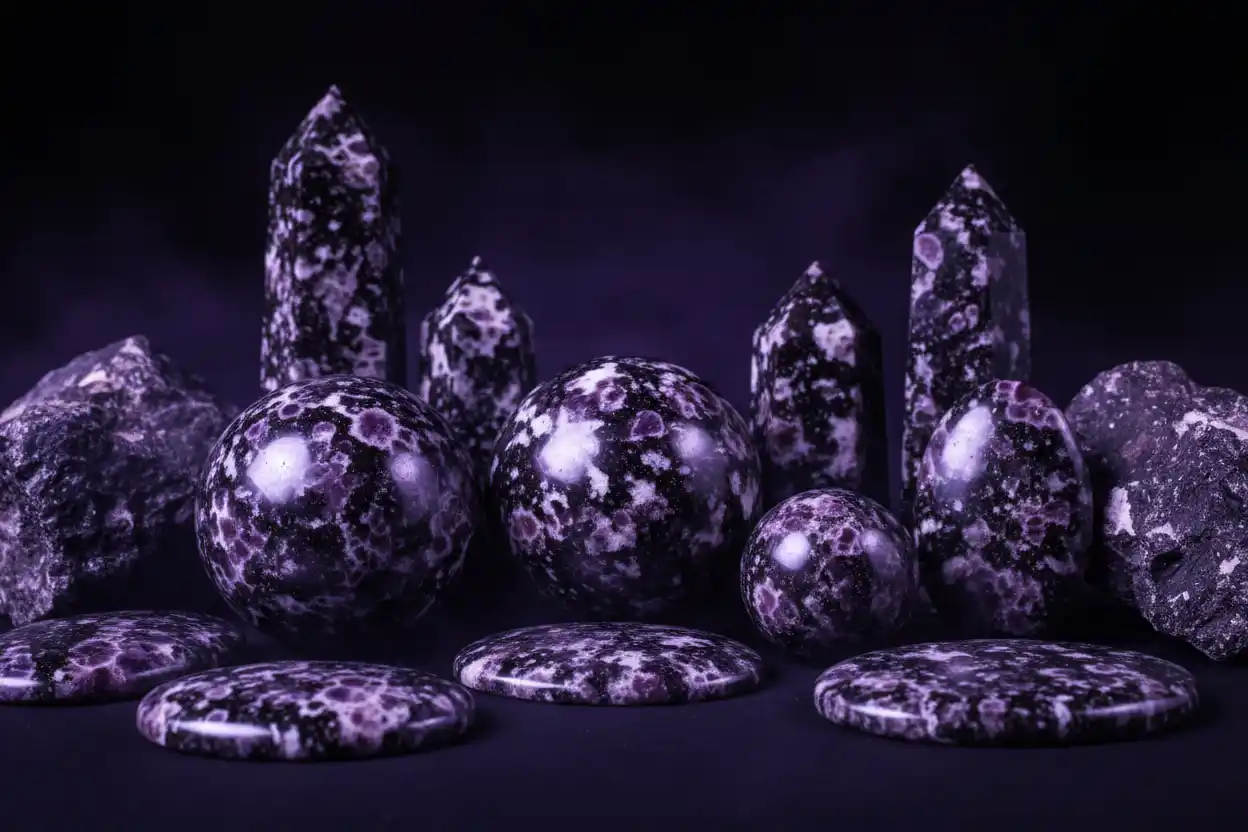
Indigo Gabbro Meaning: Properties, Uses & Symbolism
Indigo gabbro meaning should begin with one distinction that is frequently lost in crystal-shop descriptions: indigo gabbro is a rock name used commercially for a mottled ornamental material, not a single mineral species with one chemical formula, one crystal system, or one fixed set of optical constants. A rock is an aggregate of minerals. Gabbro itself is a coarse-grained plutonic igneous rock defined mineralogically by abundant calcium-dominant plagioclase together with clinopyroxene; olivine, orthopyroxene, amphibole, magnetite, ilmenite, apatite, and other phases can occur depending on the particular gabbro. Mindat summarizes gabbro as a dark intrusive rock composed principally of basic plagioclase and clinopyroxene and describes it as the coarse-grained intrusive equivalent of basalt.
That definition immediately places limits on what can responsibly be said about indigo gabbro. A polished stone containing lilac-gray, blue-gray, cream, charcoal, and black patches does not have a meaningful single formula such as SiO₂ or KAlSi₃O₈ unless testing shows that the object is actually a single mineral rather than the mixed rock being marketed under the indigo gabbro name. Yet public commercial descriptions are inconsistent. One Madagascar supplier describes its material as a multi-mineral gabbro and says it comes from a Madagascar indigo-gabbro quarry, while another page from the same business identifies a product sold as indigo gabbro as a variety of microcline feldspar with the microcline formula. Those statements cannot both function as a rigorous petrological characterization of the same rock category.
This conflict is important evidence rather than an inconvenience to hide. It means the exact mineralogy of a particular indigo gabbro specimen should be established from the specimen itself when technical precision matters. Petrographic microscopy, Raman spectroscopy, X-ray diffraction, SEM-EDS, or electron-microprobe work can distinguish feldspars, pyroxenes, amphiboles, oxides, alteration minerals, and other phases far more reliably than color photographs or crystal-shop ingredient lists.
The symbolic layer comes later. Modern indigo gabbro meaning commonly centers on integration, balance, reflection, acceptance of complexity, grounded action, perspective, boundaries, intuition, or bringing apparently opposite qualities together. Those themes fit a visibly multi-mineral rock well as metaphors. They are not demonstrated physiological effects of plagioclase, pyroxene, magnetite, iron, magnesium, or purple-gray coloration.
Readers exploring other material-first references can browse Gemstone Guides. This page owns the identity, formation overview, observable color, diagnostic reasoning, naming history, symbolism boundary, and safe-ownership framework for indigo gabbro.
Indigo Gabbro Meaning at a Glance
| Property or question | Evidence-aware summary |
|---|---|
| Material type | Ornamental rock/trade material |
| Is indigo gabbro one mineral? | No |
| Does it have one chemical formula? | No |
| General geological family claimed by the trade name | Gabbroic / mafic intrusive rock |
| Standard gabbro essentials | Calcium-rich plagioclase plus clinopyroxene |
| Common gabbro accessories | Olivine, orthopyroxene, amphibole, magnetite, ilmenite, apatite and others |
| Typical commercial appearance | Mottled black, charcoal, gray, lilac-gray, blue-gray or cream |
| Exact cause of every purple/indigo patch | Not established from color alone |
| Crystal system | Not applicable to the whole rock; individual minerals have their own systems |
| Hardness | Variable because different mineral grains are present |
| Specific gravity | Variable with mineral proportions |
| Transparency | Usually opaque in polished commercial material |
| Texture | Commonly visibly crystalline/granular if truly gabbroic |
| Formation class of gabbro | Intrusive/plutonic igneous |
| Volcanic compositional counterpart | Basalt |
| Frequently associated commercial name | Mystic Merlinite |
| Is Mystic Merlinite a mineral species? | No |
| Main identification problem | Confirming that a commercial object is petrographically gabbro and determining its actual mineral assemblage |
| Modern symbolism | Integration, balance, reflection, grounded perspective, complexity |
| Scientific status of symbolism | Interpretive rather than demonstrated medical or supernatural action |
The most important entries are the ones that refuse false precision. Indigo gabbro does not have one Mohs hardness in the mineralogical sense because the stone is an aggregate. A feldspar grain, pyroxene grain, oxide inclusion, altered patch, and fracture filling can respond differently to scratching and polishing.
What Is Indigo Gabbro?
Indigo gabbro is a commercial name applied to a mottled dark ornamental rock, strongly associated in the contemporary stone trade with material from Madagascar.
The adjective indigo refers to visual appearance rather than an internationally standardized igneous-rock classification. The geological word gabbro, by contrast, has a technical meaning. USGS defines gabbro within the QAPF framework as a plutonic rock dominated by calcic plagioclase among its feldspars and containing very little quartz or feldspathoid material under the strict definition.
Mindat provides a complementary mineralogical description: gabbro is a basic intrusive rock composed principally of calcium-rich plagioclase such as labradorite or bytownite and clinopyroxene such as augite, with possible olivine and orthopyroxene and common accessories including magnetite and ilmenite.
This matters because many online explanations of indigo gabbro list quartz as a major component or give one feldspar formula for the entire stone.
Some individual ornamental material could contain quartz-bearing veins, secondary silica, feldspathic patches, alteration products, or components that move its technical rock classification away from strict gabbro. Without a representative petrographic mode, the phrase “indigo gabbro” should be treated first as a commercial rock name rather than as a complete IUGS classification.
Indigo Gabbro Identity Table
| Characteristic | Evidence-aware interpretation |
|---|---|
| Object type | Multi-mineral rock |
| Trade name | Indigo gabbro |
| Common alternate commercial name | Mystic Merlinite |
| Geological term involved | Gabbro |
| One fixed formula | None |
| One fixed crystal system | None |
| Expected essential minerals if true gabbro | Ca-rich plagioclase + clinopyroxene |
| Possible additional primary minerals | Olivine, orthopyroxene, amphibole |
| Possible opaque accessories | Magnetite, ilmenite and other oxides |
| Possible secondary phases | Chlorite, amphibole, serpentine, epidote, mica or other alteration products depending on original rock and fluid history |
| Typical texture expected for gabbro | Coarse/interlocking crystalline |
| Typical body appearance in trade | Dark mottled rock with pale gray-to-lilac patches |
| Hardness | Grain-dependent rather than one mineral value |
| Density | Mineral-proportion dependent |
| Optical character | Aggregate; individual grains have separate optical properties |
| Most reliable classification route | Petrographic examination plus chemistry/structure where necessary |
| Main evidence warning | Color pattern alone cannot establish a complete mineral assemblage |
The rock-level distinction is crucial. A formula belongs naturally to a mineral species such as plagioclase, augite, magnetite, or quartz. It does not describe an entire heterogeneous gabbro accurately.
Why Gabbro Is a Rock, Not a Crystal Species
A single crystal has a coherent crystallographic structure.
A gabbro contains many crystals growing together.
Imagine a polished surface with pale plagioclase grains, darker clinopyroxene, opaque magnetite or ilmenite, and altered zones. Each grain retains its own chemistry and crystal structure. The rock name describes the proportions and relationships among those minerals.
This is why statements such as “indigo gabbro’s crystal system is triclinic” are incomplete at best. Plagioclase feldspar is triclinic, but clinopyroxene is monoclinic, magnetite is cubic, and other associated phases have their own structures.
The entire rock does not inherit one of those systems.
The same rule applies to chemical formula.
How Gabbro Forms
Gabbro is plutonic.
Molten rock of broadly basaltic composition remains beneath Earth’s surface long enough for relatively large mineral grains to develop. USGS explains the general contrast clearly: magma that cools slowly underground can form a coarse-grained plutonic rock, and plutonic rocks of basaltic composition are called gabbro.
During cooling, minerals do not necessarily crystallize simultaneously.
Early crystals can change the composition of the remaining melt. Plagioclase, pyroxene, olivine, and Fe-Ti oxides can appear in different proportions according to temperature, pressure, oxygen conditions, bulk chemistry, and magmatic evolution.
Some gabbros are relatively uniform.
Others are layered, altered, veined, metamorphosed, or mixed with later minerals.
USGS petrographic descriptions demonstrate this variability directly: documented gabbros can contain plagioclase and pyroxene as major phases with hornblende, olivine, magnetite, chlorite, biotite, or secondary alteration products in varying amounts.
That variability is exactly why a commercial ingredient list cannot be universalized to every indigo gabbro specimen.
The dedicated Indigo Gabbro Formation and Deposit Geology page owns the deeper petrogenetic question, including intrusive cooling, mineral sequence, alteration, host-rock relationships, and the evidence required to connect trade material to a specific Madagascar geological body.
Slow Cooling and Visible Grain Size
A coarse granular texture is not decorative coincidence.
If the material is truly gabbro, its visible interlocking grains reflect cooling slow enough for crystals to grow to millimeter or larger scale.
Basalt can have broadly similar bulk chemistry but cools rapidly at or near the surface and therefore develops much finer grain size. Mindat calls gabbro the approximate coarse-grained intrusive equivalent of basalt.
This gives a useful first observation:
a visibly crystalline coarse rock supports a plutonic interpretation more strongly than a uniformly fine-grained black groundmass.
However, weathering, polishing, grain size, and secondary alteration can make texture difficult to read.
Is Every Dark Madagascar Ornamental Rock Gabbro?
No.
Geographic source and color do not establish rock classification.
Madagascar contains a wide variety of igneous, metamorphic, sedimentary, pegmatitic, and altered rocks.
Calling a dark purple-black ornamental stone “Madagascar stone” provides almost no petrological information.
Even a quarry selling material under the indigo gabbro name does not substitute for thin-section petrography.
The correct question is:
Does the specimen’s mineral mode and texture meet a recognized gabbro classification?
That requires mineral proportions, not branding.
The Madagascar Source Claim
A commercial supplier states that its indigo gabbro is mined from a named Madagascar quarry and sells rough, spheres, carvings, slices, and other ornamental products from that source.
That is useful evidence for commercial provenance.
It is not equivalent to a peer-reviewed petrographic characterization.
The distinction matters because the supplier’s own published “scientific properties” are inconsistent across pages, with one page treating indigo gabbro as a multi-mineral gabbro and another treating it as microcline feldspar.
A strong technical description should therefore record the commercial source claim while remaining transparent that a representative published modal/mineralogical analysis of the ornamental material is needed before asserting one exact assemblage for all pieces sold under the name.
What Causes the Indigo, Purple, Gray and Black Pattern?
The safest answer is that the pattern is mineralogically heterogeneous.
A rock’s visible color can come from different grains, grain sizes, alteration zones, microscopic inclusions, opaque oxides, weathering products, and the optical interaction of adjacent phases.
Standard gabbro commonly contains light-to-gray plagioclase beside darker pyroxene and opaque Fe-Ti oxides.
That gives a plausible broad explanation for mottling.
It does not establish what makes a specific lavender, indigo, blue-gray, or violet-looking patch in Madagascar trade material.
Those zones could involve feldspar coloration, alteration, inclusions, surface effects, mixed grains, or another phase.
Assigning one mineral purely from color would be speculation.
The specialized Indigo Gabbro Optical Properties and Color Behavior reference owns the deeper question of reflected color, grain-scale optical behavior, and what spectroscopy or microscopy can establish.
Purple Does Not Automatically Mean Amethyst or Lepidolite
Purple is visually memorable, so commercial stone descriptions often leap from color to mineral identity.
That is weak reasoning.
Amethyst is purple quartz.
Lepidolite is a lithium-bearing mica-group mineral.
A lilac-gray grain inside indigo gabbro should not be called either one simply because a polished photograph looks purple.
The same warning applies to charoite, sugilite, fluorite, or other familiar purple materials.
Color is an observation.
Mineral species is an analytical conclusion.
Black Does Not Automatically Mean Magnetite
Magnetite is a common gabbro accessory, so a black opaque grain may reasonably raise magnetite as a candidate.
Ilmenite is another common accessory.
Pyroxene can also appear nearly black in hand specimen, as can amphiboles and mixed fine-grained aggregates.
A magnet test can help with sufficiently magnetic grains, but a polished multi-mineral surface complicates interpretation because several phases may occur within the test area.
Exact identification can require reflected-light microscopy, Raman spectroscopy, XRD, or electron microscopy.
Original Information Gain: Indigo Gabbro Source-Claim Audit
| Claim encountered in the market | Evidence-aware assessment | Better wording |
|---|---|---|
| “Indigo gabbro is one crystal” | Misleading for a rock | Indigo gabbro is a multi-mineral ornamental rock |
| “Chemical formula: SiO₂” | Cannot describe a gabbro as a whole | Individual minerals have separate formulas |
| “Indigo gabbro is microcline feldspar” | Conflicts with the commercial gabbro description | Verify the actual specimen petrographically |
| “Every piece contains quartz” | Not demonstrated universally and strict gabbro has little quartz by definition | Quartz may occur in some material or secondary features; test specimen |
| “Purple areas are mineral X” | Unsupported from color alone | Describe purple-gray grain/patch until identified |
| “Black areas are magnetite” | Possible but not universally proven | Opaque mafic/oxide grain pending analysis |
| “The material is from Madagascar” | Strong commercial association; individual provenance still needs records | Seller-stated or documented Madagascar origin |
| “Mystic Merlinite is a mineral” | Incorrect | Commercial/trade name |
| “Mystic Merlinite is currently a registered U.S. trademark” | A U.S. application existed but the retrieved record shows it was abandoned | Treat trademark status cautiously and verify current legal records |
| “Indigo gabbro is rare because of one exact mineral recipe” | No standardized recipe established | Discuss rarity only for documented source/material |
| “Its purple proves high vibration” | Metaphysical inference | Purple is an observable color; spiritual meaning is interpretive |
| “Magnetite makes it EMF-protective” | Unsupported biological/protective claim | Magnetic or oxide content requires testing; shielding requires engineering measurement |
| “Iron-bearing minerals help the blood” | Chemistry-to-health error | Mineral iron is not nutritional iron through ordinary handling |
| “The stone detoxifies the body” | Unsupported medical claim | No established detoxification mechanism |
| “All specimens have hardness 6–6.5” | Oversimplifies a mixed rock | Surface response varies with mineral assemblage |
The trademark row deserves a narrow clarification. Public records show that a U.S. application for MYSTIC MERLINITE was filed for semi-precious stones, but the retrieved trademark record lists that application as abandoned.
Whatever commercial use continues today, Mystic Merlinite should not be treated as a mineralogical species.
Indigo Gabbro Versus “Mystic Merlinite”
Mystic Merlinite is a commercial name encountered for material sold as indigo gabbro.
It does not identify a recognized mineral species, chemical formula, or formal rock classification.
This matters because the word merlinite is also used elsewhere in the crystal trade for visually different dendritic materials.
A consumer searching one name can therefore encounter more than one geological material.
The safest listing format is explicit:
Indigo gabbro ornamental rock, commercially sold under the Mystic Merlinite name.
That wording tells the reader which object is physically present without treating branding as petrology.
What About “Merlinite”?
The broader name merlinite has been used commercially for dendritic agate, dendritic opal, or related black-and-white ornamental materials.
Those are silica-rich materials and are not automatically equivalent to a coarse mafic intrusive rock.
This is one reason adding the word mystic can create more confusion rather than less.
Similar spiritual branding does not establish geological relationship.
Diagnostic Traits: Start With Rock Texture
A useful indigo gabbro identification begins at rock scale.
Look for visibly interlocking grains rather than a homogeneous glassy mass.
Identify whether pale grains resemble plagioclase in shape or cleavage.
Examine dark grains separately rather than calling the entire dark portion one mineral.
Look for alteration rims, veins, weathering, and fractures.
Assess whether the grain size is consistent with a plutonic rock.
Then move to analytical methods.
A petrographic thin section is particularly powerful because mineral proportions and relationships can be observed across the rock rather than tested one isolated grain at a time.
Original Diagnostic Evidence Ladder
| Evidence level | What can reasonably be concluded |
|---|---|
| Purple-black mottled polished appearance | Compatible with commercial indigo gabbro |
| Coarse interlocking grains | Supports plutonic crystalline rock |
| Plagioclase-like grains plus dark mafic grains | Supports gabbroic interpretation |
| Magnetic opaque grains | Magnetite may be present |
| Petrographic microscopy | Mineral proportions and textures can be characterized |
| Raman spectroscopy | Individual grains can be identified |
| X-ray diffraction | Bulk crystalline phases can be constrained |
| SEM-EDS | Grain chemistry can be screened |
| Electron microprobe | Quantitative mineral chemistry |
| Modal petrography + chemistry | Strong rock classification |
| Provenance records + analysis | Strongest material/source documentation |
The ladder prevents one of the most common errors in the crystal trade: jumping from a photograph directly to a precise ingredient list.
Original Specimen and Photo Checklist
| Observation | Photograph can often support | Photograph cannot reliably establish |
|---|---|---|
| Black/lilac mottling | Pattern and relative colors | Exact mineral species |
| Coarse grain size | Plutonic-compatible texture | Formal gabbro classification |
| Pale feldspar-like grains | Candidate mineral morphology | Plagioclase composition |
| Dark mafic grains | Mafic component exists | Pyroxene versus amphibole |
| Opaque black grains | Oxide/sulfide candidate | Magnetite or ilmenite specifically |
| Purple-gray zones | Color distribution | Chromophore |
| Veins | Later cross-cutting features | Vein mineral chemistry |
| Green alteration | Alteration likely | Chlorite, epidote, serpentine, amphibole or another phase |
| Natural rough surface | Rock fabric | Madagascar origin |
| Polished slab | Pattern continuity | Treatment history |
| Seller “Mystic Merlinite” label | Commercial name in use | Mineral identity |
| Seller “Madagascar” label | Provenance claim | Exact quarry without documentation |
| UV reaction | Luminescence exists | Whole-rock composition |
| Magnetic response | Magnetic phase exists | Percentage or identity by itself |
| “Healing energy” | Nothing objectively measurable | Medical effect |
For a strong record, photograph both the polished and unpolished surfaces.
Polish can make dark minerals look deeper and pale grains look more saturated than they appear on a fresh break. A rough face reveals grain boundaries and alteration much more clearly.
The specialized Indigo Gabbro Microscope Inclusion Notebook can be used when grain-scale textures require more systematic documentation.
How to Photograph Indigo Gabbro Accurately
Use neutral daylight or a calibrated daylight-balanced source.
Warm lighting can turn gray-lilac zones toward reddish purple.
Cool LED lighting can exaggerate blue or indigo.
High saturation can transform subtle violet-gray feldspathic areas into electric purple that does not exist in the physical specimen.
Photograph the same surface dry and, if appropriate for an expendable sample, under controlled surface reflection rather than digitally deepening every color.
Include a scale.
For scientific comparison, preserve at least one minimally processed image.
Hardness: Why One Number Is Misleading
Gabbro is an aggregate.
A plagioclase grain and a pyroxene grain have different hardnesses.
Secondary mica, chlorite, serpentine, altered feldspar, oxide minerals, and fracture fillings can add further variation.
A polished rock may therefore scratch or undercut unevenly.
Commercial sources sometimes assign indigo gabbro one aggregate hardness near 6, which can be useful as a rough lapidary expectation but should not be mistaken for a formal species constant.
A scratch crossing three grains can produce three responses.
Density Is Also Variable
The same principle applies to specific gravity.
Ordinary gabbro containing abundant plagioclase will be less dense than an otherwise similar rock enriched in Fe-Ti oxides or dense mafic minerals.
Weathering and fractures can reduce bulk density.
A single commercial number should therefore be considered an approximate specimen or product value unless the method and material are defined.
For identification, measured bulk SG can still be useful when combined with texture and mineralogy.
It simply does not identify every grain.
Indigo Gabbro Versus Iolite
Iolite Meaning concerns cordierite, a single mineral species capable of strong pleochroism.
Its blue-violet appearance can superficially overlap with the indigo name used for this rock, but the materials are completely different.
Iolite can be transparent and faceted.
Indigo gabbro is normally an opaque, multi-mineral ornamental rock.
The word indigo therefore describes color association, not mineral relationship.
Indigo Gabbro Versus Indicolite
Indicolite Meaning concerns blue tourmaline.
Indicolite is typically a transparent-to-translucent gem variety within the tourmaline group and owes much ordinary blue color to iron-related absorption.
Indigo gabbro is a rock composed of multiple mineral grains.
A blue-purple commercial name does not place them in the same chemical family.
One requires mineral-species identification.
The other requires rock classification.
Indigo Gabbro Versus Iris Agate
Iris Agate Meaning concerns finely banded chalcedony capable of producing spectral colors under favorable transmitted-light conditions.
Indigo gabbro’s mottling is fundamentally a rock-texture problem rather than an iris diffraction phenomenon.
A polished gabbro may show attractive mineral reflections, but a purple patch should not be described as iris effect merely because several colors are visible.
Optical phenomenon names should be tied to demonstrated mechanisms.
Indigo Gabbro Versus Imperial Topaz
Imperial Topaz Meaning concerns transparent warm-colored topaz, an aluminum fluorosilicate mineral.
Imperial topaz has one mineral structure and can be assigned physical properties such as Mohs hardness 8 and characteristic refractive indices.
Indigo gabbro cannot be treated the same way because its properties depend on its mineral mixture.
This contrast is useful for understanding why the word gemstone can refer either to a mineral, a mineraloid, or an ornamental rock.
Cutting and Polishing
Indigo gabbro is popular as a lapidary material because mottling becomes more conspicuous on polished surfaces.
However, mixed-mineral texture can produce differential abrasion.
A softer altered grain may undercut while a harder grain remains proud.
Fractures can open during sawing.
Opaque minerals may take a different polish from adjacent feldspar or pyroxene.
The exact approach depends on the specimen’s mineral assemblage rather than on the trade name alone.
The dedicated Indigo Gabbro Cutting, Orientation and Polish page owns the lapidary workflow rather than repeating detailed cutting instructions here.
Jewelry Wear
A polished indigo gabbro pendant or bead can be practical, but durability must be assessed as a rock.
A coarse-grained specimen can contain cleavage-prone feldspar, fractures, altered patches, grain boundaries, softer secondary minerals, and brittle opaque phases.
A large exposed ring therefore faces different mechanical risks from a protected pendant.
Hardness alone cannot predict whether a particular slab will chip along a grain boundary.
The engineering relationship among thickness, fracture position, drill holes, settings, and impact belongs in Indigo Gabbro Setting and Wear Engineering.
Intact Rock Versus Cutting Dust
Ordinary handling of a polished rock differs from sawing, grinding, drilling, sanding, or crushing it.
If the material contains feldspar, pyroxene, silica-bearing alteration products, oxides, mica, or unidentified accessory phases, processing can create a mixed mineral dust.
The exact health profile depends partly on what phases are actually present.
Lapidary work should therefore use appropriate wet methods where suitable, local dust control, eye protection, machine guarding, cleanup practices, and correctly selected respiratory protection when required.
Do not intentionally create indigo gabbro powder for metaphysical use.
Do Not Ingest Indigo Gabbro
Indigo gabbro should not be powdered, swallowed, added to supplements, or deliberately soaked to create gemstone drinking-water preparations.
A multi-mineral rock can contain phases and trace constituents that are not identified from the commercial name.
Polished objects can also carry wax, adhesives, abrasives, dyes, oils, or environmental contamination.
The presence of iron, magnesium, calcium, or other familiar elements in rock-forming minerals does not make the rock a nutritional source.
The broader health-claim boundary used across Gems Lore is stated in the Gems Lore Disclaimer.
Magnetite Does Not Make Indigo Gabbro an EMF Shield
Some commercial descriptions connect possible magnetite content with electromagnetic protection.
That conclusion does not follow automatically.
A rock containing dispersed magnetic grains is not equivalent to an engineered electromagnetic shield designed around measured permeability, conductivity, thickness, frequency, geometry, and field conditions.
Meaningful shielding claims require instrumental testing under defined conditions.
A refrigerator magnet reacting to one area of a stone does not establish protection from phones, Wi-Fi, household wiring, or other electromagnetic sources.
Iron in the Rock Is Not a Blood Treatment
If iron-bearing pyroxene, magnetite, ilmenite, or another Fe-containing phase is present, the iron is part of a mineral structure.
Wearing the rock does not provide a controlled therapeutic iron dose.
Its dark color is not evidence of blood-related action.
Likewise, magnesium in mafic silicates does not become a transdermal magnesium supplement.
Element names should not be turned into treatment mechanisms.
Documented History of the Gabbro Name
The geological name gabbro has Italian roots and became established through European geological usage, including work by Christian Leopold von Buch on Italian rocks. Historical literature connects the term with the locality named Gabbro in Tuscany.
That history concerns rock classification.
The word indigo is a later descriptive addition used for the ornamental trade material.
Mystic Merlinite is later commercial language again.
These three names therefore belong to three different levels:
gabbro — geological classification,
indigo gabbro — commercial/descriptive rock name,
Mystic Merlinite — branding/trade terminology.
Treating them as equivalent scientific names obscures rather than clarifies the material.
Is Indigo Gabbro an Ancient Spiritual Stone?
The rock minerals themselves are geologically ancient.
The modern commercial identity “indigo gabbro,” however, should not be projected automatically into ancient spiritual traditions.
There is no basis for assuming that historical cultures used the modern trade name or attached today’s integration, shadow-work, third-eye, or psychic symbolism specifically to this Madagascar ornamental material.
Modern symbolism can still be meaningful.
It should simply be identified as modern.
Modern Indigo Gabbro Meaning
Modern indigo gabbro meaning commonly emphasizes integration, balance, self-reflection, perspective, acceptance of complexity, grounded intuition, boundaries, and bringing different parts of experience into one coherent whole.
Of those themes, integration is especially intuitive because the object itself is visibly a rock assembled from multiple mineral grains.
One polished surface can contain light and dark phases, coarse and fine zones, primary igneous minerals and later alteration.
The rock remains one object without becoming one mineral.
That gives integration a genuine material metaphor.
Indigo Gabbro and Integration
A practical integration exercise can separate a situation into different components:
What do I think?
What do I feel?
What does the evidence show?
What action is actually available?
What remains unresolved?
The goal is not to force every answer into agreement.
Integration can mean allowing different pieces of information to coexist while deciding what to do next.
That mirrors a multi-mineral rock more accurately than claiming the stone merges invisible energies.
Indigo Gabbro and Balance
Balance is commonly associated with the contrasting light and dark pattern.
A useful symbolic interpretation does not require equal amounts of everything.
In geology, a rock can remain stable while its mineral proportions are unequal.
Likewise, personal balance may mean allocating time and effort according to actual need rather than dividing everything equally.
The rock can serve as a reminder.
It does not regulate hormones, neurotransmitters, blood pressure, or emotional state automatically.
Indigo Gabbro and “Shadow Work”
Modern crystal culture frequently connects indigo gabbro with shadow work, meaning reflection on uncomfortable emotions, habits, assumptions, or parts of oneself that are usually avoided.
That is a psychological or spiritual practice, not a mineralogical property.
A grounded approach might use the stone only as a journaling cue:
What am I avoiding?
What evidence supports my interpretation?
What responsibility belongs to me?
What would constructive action look like?
For significant psychological distress, a gemstone should not replace appropriate professional support.
Indigo Gabbro and Intuition
Intuition can be treated responsibly as an initial impression.
A person may notice something before being able to explain why.
The next step is verification.
This is particularly fitting for indigo gabbro because the rock itself tempts appearance-based assumptions: a purple patch seems to invite a familiar mineral name, but analysis may reveal something else.
The symbolic lesson is therefore not “trust every intuition.”
It is “notice the intuition, then test it.”
Indigo Gabbro and Perspective
A polished slab can look different depending on orientation, lighting, polish, wetness, grain size, and which part of the mottled pattern is visible.
This naturally supports perspective symbolism.
One small cabochon may be mostly pale gray.
Another cut from the same block may be nearly black.
Neither alone represents the whole rock.
A useful reflective question is:
What part of the larger pattern am I currently seeing?
That is metaphor.
It does not require supernatural perception.
Indigo Gabbro and Grounding
Dense, dark rocks are often described as grounding.
A practical grounding use can focus on immediate observable facts:
name five things in the environment,
identify the next necessary task,
distinguish controllable from uncontrollable problems,
and act on one concrete item.
The rock provides a physical reminder.
There is no established mechanism by which indigo gabbro electrically grounds a person, neutralizes an aura, or removes an invisible accumulation of negative energy.
Indigo Gabbro Healing Claims
There is no established scientific evidence that indigo gabbro treats anxiety, depression, neurological disease, cardiovascular conditions, hormonal disorders, chronic pain, infertility, immune dysfunction, sleep disorders, infections, or other medical conditions.
There is also no scientifically established basis for assigning one physiological action to the entire rock because its mineral assemblage itself can vary.
The appropriate evidence standard is even more obvious here than with a single mineral:
first determine what the rock contains,
then distinguish those mineralogical facts from biological claims.
Specimen Conservation
A rough indigo gabbro specimen can preserve grain relationships, weathering, alteration, natural fractures, veins, quarry markings, matrix contacts, and evidence useful for petrographic study.
Polishing produces an attractive decorative surface but can remove some of that geological information.
If a specimen has reliable locality documentation or unusual textures, photograph the natural surface before cutting.
Record weight, dimensions, provenance, grain pattern, fractures, alteration, magnetic response if tested, and any analytical results.
The Indigo Gabbro Specimen Conservation Record provides the dedicated structure for keeping those observations together.
Original Source-Comparison Framework
| Source type | Best question it answers | Main limitation |
|---|---|---|
| USGS rock classification | What qualifies technically as gabbro? | Does not identify commercial indigo material |
| Mindat gabbro reference | What minerals normally define and accompany gabbro? | General rock definition, not quarry-specific analysis |
| Petrographic thin section | What minerals and textures occur in this specimen? | Requires sample preparation and expertise |
| Raman/XRD | What individual or bulk phases are present? | Sampling and mixtures can complicate interpretation |
| Commercial quarry/seller page | Where is material claimed to be mined and how is it marketed? | Not independent petrographic evidence |
| Product photograph | What pattern and color are visible? | Cannot identify most grains reliably |
| Trademark record | What commercial mark application was filed? | Legal-status evidence, not geology |
| Metaphysical source | What modern symbolic interpretations exist? | Cannot establish mineral composition or health effects |
This framework explains why no single source should be asked to answer every question.
A geological classification source can define gabbro.
A quarry seller can document what it calls its product.
A laboratory can identify phases.
A metaphysical writer can describe a symbolic practice.
Confusion begins when one category is treated as proof of another.
Evidence and Technical Limits
This article does not claim first-hand collecting at a Madagascar indigo-gabbro quarry, unpublished thin-section petrography, private Raman testing, X-ray diffraction, electron-microprobe chemistry, or direct authentication of a reader’s specimen.
The central technical limitation is significant: publicly accessible commercial descriptions of the material contain conflicting mineralogical statements. Until a representative specimen is petrographically and analytically characterized, precise ingredient lists should be treated cautiously.
The broader evidence approach used by the site is described on About Gems Lore.
Readers with thin-section data, Raman results, XRD patterns, quarry documentation, corrected provenance, or published petrographic analysis of the commercial Madagascar material can submit that evidence through Contact Gems Lore. Information submitted through site channels is handled according to the Privacy Policy.
Frequently Asked Questions About Indigo Gabbro Meaning
What is indigo gabbro meaning?
Indigo gabbro meaning commonly combines the material’s mottled multi-mineral appearance with modern symbolism involving integration, balance, perspective, reflection, intuition, grounding, and acceptance of complexity. These meanings are interpretive rather than established medical effects.
Is indigo gabbro a mineral?
No. Indigo gabbro is sold as an ornamental rock. Gabbro itself is a rock composed primarily of calcium-rich plagioclase and pyroxene rather than one mineral species.
Does indigo gabbro have a chemical formula?
No single formula correctly describes an entire multi-mineral gabbro. Each mineral grain has its own composition.
What minerals are normally in gabbro?
Standard gabbro contains abundant calcium-rich plagioclase and clinopyroxene. Olivine, orthopyroxene, amphibole, magnetite, ilmenite, and apatite can also occur.
Is quartz a major mineral in normal gabbro?
Strict gabbro contains very little quartz under standard rock-classification schemes. Quartz-rich material may fall into another classification or contain later quartz-bearing features.
Why is indigo gabbro purple?
There is no sufficiently established universal answer for every commercial specimen. Purple-gray appearance may reflect particular mineral grains, inclusions, alteration, or optical mixing. Exact phase identification requires specimen-specific evidence.
Is the purple material amethyst?
It should not be called amethyst merely from color. Amethyst is quartz, and a purple-gray grain inside a mixed rock requires identification before receiving that name.
Is the black material magnetite?
Magnetite is a common gabbro accessory and is one possibility, but pyroxenes, amphiboles, ilmenite, other oxides, and mixed grains can also look black. Testing is required for exact identification.
Where does indigo gabbro come from?
The contemporary ornamental trade strongly associates indigo gabbro with Madagascar, and a commercial supplier states that its material comes from its Madagascar quarry. That establishes a supplier provenance claim rather than an independent petrological classification.
Is indigo gabbro the same as Mystic Merlinite?
Mystic Merlinite is a commercial name used for material sold as indigo gabbro. It is not a recognized mineral species.
Is Mystic Merlinite a registered trademark?
A U.S. trademark application for MYSTIC MERLINITE was filed, but the retrieved record lists the application as abandoned. Current legal status should always be checked separately from mineralogical usage.
Is indigo gabbro the same as merlinite?
The trade can use overlapping names, but “merlinite” has also been applied to visually different dendritic silica materials. The exact physical material should therefore be identified rather than inferred from branding.
How does gabbro form?
Gabbro forms when basaltic-composition magma cools slowly beneath Earth’s surface, allowing a coarse-grained plutonic texture to develop.
Is indigo gabbro volcanic?
Gabbro is intrusive/plutonic rather than extrusive volcanic rock. Basalt is its finer-grained volcanic compositional counterpart.
How hard is indigo gabbro?
There is no single mineralogical hardness for the whole rock because different grains can have different hardnesses. Commercial aggregate estimates can be useful operationally but should not be treated as a species constant.
Is indigo gabbro magnetic?
A specimen may respond to a magnet if magnetite or other magnetic phases are present. Magnetic response varies with mineral proportions and does not identify the entire rock by itself.
Can indigo gabbro block EMF?
There is no established evidence that an ordinary piece of indigo gabbro provides meaningful electromagnetic shielding. Engineering shielding requires measurements specific to material properties, geometry, thickness, and frequency.
Does indigo gabbro have healing properties?
There is no established scientific evidence that carrying or wearing indigo gabbro treats disease or produces specific physiological healing effects.
Does indigo gabbro contain iron?
Gabbroic rocks commonly contain iron-bearing mafic minerals and Fe-bearing accessory oxides, but the amount and phase distribution depend on the individual rock.
Does the iron in indigo gabbro help the blood?
No demonstrated therapeutic iron delivery occurs through ordinary contact with iron-bearing rock. Mineral iron is not equivalent to a regulated nutritional iron supplement.
Can indigo gabbro go in drinking water?
Indigo gabbro should not be powdered, ingested, or deliberately used to prepare gemstone drinking-water elixirs because it is a potentially variable multi-mineral rock whose complete composition and treatments may not be known.
Final Perspective
Indigo gabbro meaning becomes more credible when the material’s complexity is treated as a geological fact rather than converted into a fabricated single-mineral identity. Gabbro is a plutonic igneous rock defined by a mineral assemblage dominated by calcium-rich plagioclase and clinopyroxene, often accompanied by olivine, orthopyroxene, amphibole, magnetite, ilmenite, and other phases. A rock built from those components cannot be represented honestly by one chemical formula or one crystal system.
The commercial indigo material requires additional caution. Madagascar provenance is well represented in the ornamental trade, yet accessible seller descriptions conflict sharply about composition—one treating the material as multi-mineral gabbro and another presenting a product under the same broad name as microcline feldspar. That inconsistency is a reason to demand better petrographic evidence, not a reason to select whichever ingredient list sounds most attractive.
Its lilac-gray, blue-gray, cream, charcoal, and black mottling should likewise be documented before it is explained. Standard gabbro mineralogy makes mixtures of feldspar, pyroxene, opaque oxides, and alteration phases entirely plausible, but the exact identity of each colored patch must follow testing rather than intuition.
Modern symbolism can still work within that evidence boundary. Integration is an especially fitting indigo gabbro meaning because the object genuinely contains different minerals joined into one rock. Perspective fits because one small polished section never displays the entire pattern. Reflection fits because the stone itself rewards looking past a commercial label and asking what the evidence actually shows.
That symbolism does not require claims that the stone detoxifies the body, regulates emotion, transfers nutritional iron, blocks electromagnetic fields, activates a chakra, or emits a scientifically measurable spiritual vibration. The natural material is already complex enough.
The strongest interpretation is therefore also the simplest: treat indigo gabbro as a multi-mineral rock first, preserve uncertainty where its exact Madagascar petrography remains inadequately documented, distinguish commercial names from geological classifications, protect significant specimens and their provenance, avoid ingestion and dust-generating ritual use, and let its visible mixture of different phases provide a human metaphor for complexity and integration without asking geology to prove metaphysics.