Garnet Meaning: Healing Properties, Uses & Symbolism
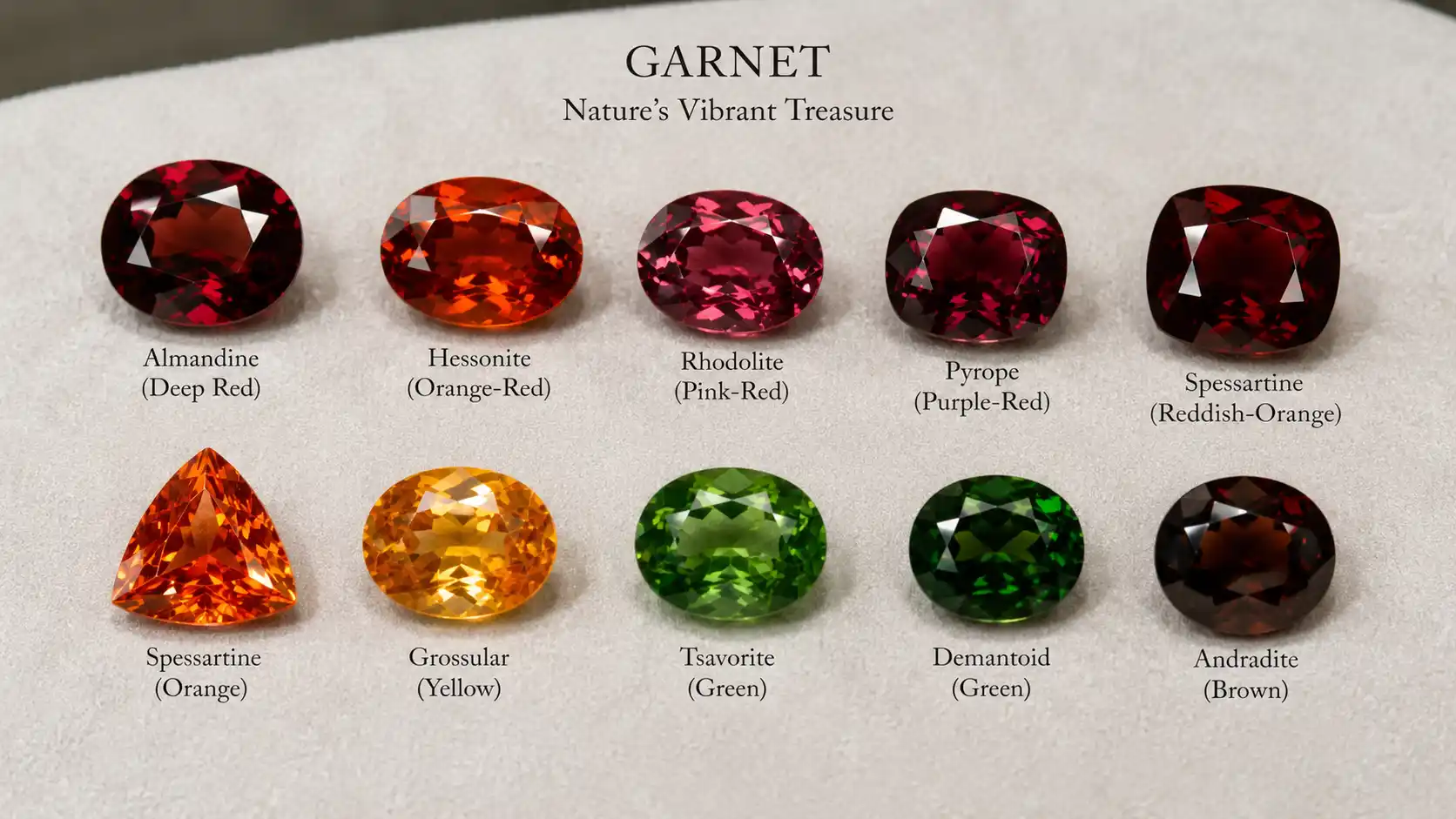
Garnet meaning begins with a mineral group rather than one red gemstone. Garnets are closely related silicate minerals built around the same general crystal structure but containing different combinations of elements such as magnesium, iron, manganese, calcium, aluminum, chromium and ferric iron. The familiar deep red material commonly associated with the word garnet represents only part of this group. Natural garnets also occur in orange, yellow, brown, green, purplish red, pinkish red, nearly black and color-changing varieties, with transparency ranging from gem-quality crystals to opaque rock-forming material.
This distinction matters because many popular descriptions treat every garnet as chemically and visually identical. Almandine, pyrope, spessartine, grossular, andradite and uvarovite are major garnet species, while many gem garnets occupy compositional positions between end members rather than matching a perfectly pure formula. Rhodolite, hessonite, tsavorite, demantoid and many other familiar names describe particular garnet compositions, varieties, colors or commercial categories rather than creating one universal set of properties for the entire group.
A grounded garnet meaning therefore starts with identification. Mineral-group composition, crystal system, hardness, density, refractive behavior, inclusions and geological occurrence can be examined. Historical uses can be documented. Modern themes involving commitment, courage, motivation, vitality, protection or emotional strength can be discussed as symbolism. Claims that garnet medically changes circulation, hormones, reproductive function, mood disorders or other biological processes require evidence that crystal symbolism does not provide.
Readers who use stones within personal reflective traditions can explore related material in the broader Healing Crystal collection while keeping measurable gemology separate from interpretive belief.
Garnet Meaning at a Glance
| Feature | Grounded reference |
|---|---|
| Material identity | Group of related silicate minerals sharing the garnet structure |
| General structural formula | Commonly expressed as X₃Y₂(SiO₄)₃, with different elements occupying X and Y sites |
| Major species | Pyrope, almandine, spessartine, grossular, andradite and uvarovite |
| Crystal system | Cubic / isometric |
| Common colors | Red, purplish red, orange, yellow, brown, green and nearly black; some material changes color |
| Mohs hardness | Commonly about 6.5–7.5 depending on species and composition |
| Cleavage | None in ordinary gemological description |
| Fracture | Conchoidal to uneven |
| Luster | Vitreous to resinous in some material |
| Transparency | Transparent to opaque |
| Typical crystal forms | Dodecahedral, trapezohedral and combinations of isometric forms |
| Geological settings | Metamorphic rocks, skarns, igneous rocks, pegmatites, placer deposits and other environments depending on species |
| Gem use | Faceted stones, cabochons, beads and collector specimens |
| Historical use | Jewelry, seals, ornament and abrasive applications among other uses |
| Symbolic associations | Modern themes such as commitment, strength, motivation and protection |
| Medical evidence boundary | No established evidence that wearing garnet treats disease or provides physiological healing |
The first practical lesson behind garnet meaning is therefore simple: identify which garnet you have before assuming that a property associated with one variety applies to every garnet.
Garnet Is a Mineral Group, Not a Single Composition
The garnet structure can accommodate several elements, creating a family of minerals with related crystallography but different chemistry. Six end-member species are especially important in gemology.
| Garnet species | Idealized formula | Typical visual association |
|---|---|---|
| Pyrope | Mg₃Al₂(SiO₄)₃ | Deep red to purplish red |
| Almandine | Fe₃Al₂(SiO₄)₃ | Dark red, brownish red, purplish red |
| Spessartine | Mn₃Al₂(SiO₄)₃ | Orange to reddish orange |
| Grossular | Ca₃Al₂(SiO₄)₃ | Colorless, yellow, orange, brown, green and other colors |
| Andradite | Ca₃Fe₂(SiO₄)₃ | Yellow, brown, green to nearly black |
| Uvarovite | Ca₃Cr₂(SiO₄)₃ | Characteristically vivid green |
Natural garnets frequently occur as solid solutions. A red gem may contain substantial proportions of both pyrope and almandine components, for example, rather than behaving like a laboratory-perfect end member. This is why many gemological variety names cannot be understood from color alone.
Rhodolite is commonly associated with attractive purplish-red pyrope-almandine garnet. Hessonite is a grossular variety known for warm yellow-orange to reddish-brown colors and characteristic internal appearance. Tsavorite is green grossular colored principally by chromium and/or vanadium. Demantoid is green andradite, prized for unusually strong dispersion. These names communicate useful gemological distinctions, but all remain within the wider garnet group.
How Garnet Forms
Garnet forms in several geological environments because its structure remains stable across a broad range of chemical and pressure-temperature conditions. Metamorphic rocks provide some of the best-known examples. As shale, mudstone or other rocks experience increasing temperature and pressure, minerals react and reorganize. Garnet can crystallize during those reactions, sometimes growing as conspicuous red or brown porphyroblasts within mica-rich schist.
The composition of metamorphic garnet can change from core to rim as the surrounding rock evolves. A crystal may therefore preserve chemical zoning that records changing conditions during growth. Geologists use suitable garnet chemistry, together with associated minerals and appropriate models, to reconstruct parts of a rock’s metamorphic history.
Calcium-rich garnets frequently occur in skarns, where hot fluids and intrusive magmas chemically interact with carbonate rocks. Grossular-andradite series garnets can develop in these environments, sometimes producing green, yellow or brown gem material. Other garnets occur in igneous rocks, pegmatitic systems and ultramafic rocks, while weathering can release resistant crystals into river gravels and placer deposits.
This geological diversity explains why one universal garnet formation story is inadequate. The deeper relationship among host rock, metamorphic reactions, skarn development, magmatic environments and chemical zoning belongs in garnet formation and deposit geology rather than being repeated across every garnet page.
Why Garnet Comes in So Many Colors
Garnet color reflects the interaction between composition, trace elements, oxidation state and crystal structure. Iron is particularly important in many red and brown garnets, manganese contributes strongly to orange spessartine, while chromium and vanadium can contribute green coloration in certain calcium garnets.
Yet color is not a one-element lookup table. Two garnets can appear similarly red while occupying different positions in the pyrope-almandine-spessartine compositional system. Green garnet can represent grossular, andradite or uvarovite-related material depending on composition. Yellow and orange stones likewise cross several garnet categories.
Some garnets exhibit color change under different light sources because their absorption patterns interact differently with daylight-like and incandescent illumination. Such behavior is physically measurable and should not be confused with claims that the gem changes color in response to mood or energy.
The complete relationship between composition, absorption, tone, saturation, color change and named varieties belongs in garnet color meaning and garnet optical properties and color behavior. This page keeps the broader garnet meaning centered on group identity rather than reproducing a color-by-color catalog.
Diagnostic Traits That Help Identify Garnet
Garnet identification becomes strongest when several observations agree. Most garnets crystallize in the cubic system and can form dodecahedral or trapezohedral crystals. They lack cleavage, are typically harder than ordinary glass, and often have relatively high refractive indices and densities compared with quartz.
Because garnets are cubic, they are ordinarily singly refractive under ideal gemological conditions. However, some natural garnets can display anomalous optical effects associated with strain, zoning or structural complexities, so one unusual observation should not override the entire evidence set.
Refractive index can help distinguish garnet groups, although some garnets have values above the useful range of conventional refractometers. Specific gravity, spectroscopy, magnetic response, microscopic features and chemical analysis can provide additional information depending on the identification problem.
Magnification may reveal mineral crystals, needles, healed fractures, growth features, rounded grains, fingerprints or variety-associated inclusion patterns. Certain inclusions can be highly suggestive—demantoid’s famous fibrous “horsetail” inclusions are one example—but no inclusion should be treated as an infallible species or locality test in isolation.
The garnet microscope inclusion notebook provides a dedicated framework for documenting internal features without forcing every red or green stone into an identification based on photographs alone.
An Original Garnet Name and Claim Audit
Because the garnet group supports many varieties and trade names, labels should be tested against what they actually establish.
| Name or claim | What it can reasonably mean | What it does not prove |
|---|---|---|
| Garnet | Member of the garnet mineral group | Red color or one fixed composition |
| Red garnet | Garnet with red body color | Almandine specifically |
| Pyrope | Magnesium-aluminum garnet end-member/species terminology | Pure Mg end-member composition in a natural gem |
| Almandine | Iron-aluminum garnet | That every dark red garnet is almandine |
| Spessartine | Manganese-aluminum garnet | That every orange garnet is spessartine |
| Hessonite | Gem variety of grossular, typically warm yellow-orange to brownish | Any orange-brown garnet |
| Tsavorite | Green grossular variety associated with chromium/vanadium coloration | Every green garnet |
| Demantoid | Green andradite garnet | Green grossular or uvarovite |
| Uvarovite | Chromium-rich calcium garnet species, commonly vivid green | Facetable green garnet in general |
| Rhodolite | Commercial/gemological name commonly applied to purplish-red pyrope-almandine material | One exact fixed composition |
| Color-change garnet | Garnet showing material color shift under different illuminants | Mood-responsive or energy-responsive color |
| Star garnet | Garnet displaying asterism under suitable lighting | Artificially engraved or surface-drawn star |
| Bohemian garnet | Historically and commercially associated with garnet traditions from Bohemia, especially pyrope | Proven geographic origin from dark red color |
| Mozambique garnet | Geographic/commercial provenance claim | Origin without documentation |
| Natural untreated garnet | Disclosure claim about enhancement | Absence of all modification based only on appearance |
| Healing garnet | Metaphysical wording | Medical efficacy |
This audit resolves several recurring problems in garnet meaning content. “Green garnet” is not automatically tsavorite. “Orange garnet” is not automatically spessartine. “Rhodolite” is not a separate species with one immutable formula. And a dark red stone should not be assigned a famous geographic name simply because its appearance resembles known material.
Red Garnet Is Not One Variety
The classic garnet image is dark red, but even within red material the group is chemically diverse. Almandine is extremely common and frequently contributes brownish-red to purplish-red tones. Pyrope contributes deeper red composition, while mixtures among pyrope, almandine and spessartine can generate attractive intermediate colors.
That compositional continuum matters when a seller calls a stone “pyrope” based entirely on a rich red color. A gemological identification may support pyrope-dominant material, but appearance alone does not reveal exact end-member proportions.
Rhodolite creates the same issue. The name is useful for appealing purplish-red garnet material commonly within the pyrope-almandine compositional range, yet it should not be treated as a seventh major garnet species.
The broader lesson is that garnet meaning should not flatten a mineral group into “the red crystal.”
Green Garnet Can Mean Several Different Things
Green garnets provide an even clearer illustration of why identification must come before symbolism.
Tsavorite is green grossular, while demantoid is green andradite. Uvarovite is another green garnet species, frequently occurring as small vivid crystals coating matrix rather than as conventional large faceted gems. Other garnet compositions may also show greenish colors.
These stones can differ in dispersion, refractive properties, inclusions, chemistry, geological environment, rarity and market behavior.
Calling every transparent green garnet “tsavorite” is therefore inaccurate. Calling every green garnet “demantoid” because it shows fire is equally unreliable.
Material identity should come from a combination of gemological observations, not whichever variety name commands the highest price.
Garnet History Is Broader Than Modern Crystal Symbolism
Garnets have been valued as decorative stones for a very long period because suitable material combines attractive color, useful hardness and strong polish. Garnet objects appear in jewelry, carved pieces, inlays and historical adornment across multiple cultures.
The word garnet itself has been linked historically to terms associated with seeds or grain-like forms, often connected in popular explanation with the resemblance between red garnets and pomegranate seeds. Whether discussing etymology or historical symbolism, however, specific cultural claims should remain tied to evidence rather than expanded into universal ancient beliefs.
Garnet has also served practical non-jewelry roles. Hard garnet grains are used as abrasives in applications such as coated abrasive products, blasting media and waterjet cutting. That industrial use arises from hardness and fracture behavior—not from symbolic “strength.”
Documented history therefore gives garnet meaning several real layers: mineral collecting, jewelry, ornament, geology and industrial material science. Modern metaphysical interpretations are another layer, but they should not be projected backward as though every historical garnet owner subscribed to the same contemporary crystal system.
Garnet Meaning in Modern Symbolism
Modern garnet meaning often centers on commitment, motivation, courage, stability, persistence, passion and purposeful action. The deep red varieties contribute obvious cultural associations with warmth, blood, fire or vitality, while the stone’s durability and long history in jewelry encourage ideas of endurance.
A grounded symbolic practice can use these themes without making biological claims. Someone might keep a garnet near a long-term project as a reminder to distinguish temporary enthusiasm from sustained commitment. A person could associate the stone’s interlocking geological growth with the idea that progress depends on conditions, structure and time rather than intention alone.
Another useful metaphor comes from the garnet group itself. Garnet looks like one category from a distance, yet mineralogical examination reveals substantial chemical diversity within a shared structural framework. That can become a reflective reminder that people or situations sharing one label may still differ materially beneath the surface.
These interpretations remain chosen meanings. Garnet does not need to emit courage, passion or commitment physically for a person to use it as a meaningful object.
Garnet “Healing Properties”: What Can and Cannot Be Claimed
The phrase garnet healing properties is common in crystal traditions, where garnet may be associated with vitality, emotional strength, circulation, sexuality, confidence or energetic protection. These associations should be understood as metaphysical or symbolic traditions rather than established medical effects.
There is no reliable scientific evidence that wearing, carrying or meditating with garnet treats anemia, blood disorders, cardiovascular disease, infertility, hormonal disorders, sexual dysfunction, depression, anxiety, neurological conditions or another medical problem.
The mineral group’s chemistry does not change this. An almandine garnet contains iron within a stable silicate structure, but wearing it does not supply a controlled nutritional dose of iron. Pyrope contains magnesium, yet skin contact with pyrope is not magnesium supplementation. Grossular can contain calcium without becoming a calcium treatment.
A dedicated discussion of traditional claims and evidence boundaries belongs in garnet healing properties rather than being repeated as medical-sounding promises here.
Garnet Is Not a Substitute for Iron, Magnesium or Calcium
Element names create one of the easiest pathways from mineralogy into unsupported wellness claims.
Almandine’s iron is structurally bound within a silicate mineral. Pyrope’s magnesium is likewise part of a crystalline lattice. Grossular’s calcium is mineral chemistry. None becomes a clinically controlled nutrient merely because the stone touches skin.
Mineral formulas describe the material. Nutrition depends on chemical form, dose, absorption, metabolism and safety.
Garnet should therefore not be powdered for consumption or used as a substitute for dietary supplements, medication or professional healthcare.
Safe Ownership of Garnet
Finished garnet jewelry and intact mineral specimens are generally practical to own when used normally. The group has useful hardness, no cleavage and often good resistance to routine wear, although individual stones can contain fractures, inclusions or structural weaknesses that reduce toughness.
Processing creates a different exposure situation. Sawing, grinding, sanding, drilling or crushing garnet and associated host rock can create mineral dust. Appropriate wet methods, extraction, eye protection, respiratory protection and controlled cleanup are more sensible than uncontrolled dry processing.
The composition of matrix material also matters. A garnet embedded in schist, skarn or ore-bearing rock can be accompanied by minerals with different handling considerations. The commercial word garnet does not constitute a complete chemical analysis of everything attached to a specimen.
Specialized lapidary choices involving orientation, inclusions, fractures, color zoning and polishing behavior belong in garnet cutting, orientation and polish.
Garnet in Jewelry
Garnet’s hardness and absence of cleavage make many gem-quality varieties practical for jewelry, but design still matters. Rings receive more impact and abrasion than earrings or protected pendants. Thin facet junctions can chip, heavily included stones can fracture, and some larger cabochons contain healed cracks that deserve consideration before setting.
The intended use should determine the jewelry format rather than symbolism alone. Readers considering an everyday hand-worn piece can evaluate construction and setting choices through the dedicated garnet ring guide. Bead construction, drill-hole condition, cord selection and fit belong in garnet bracelet, while drop protection, post construction and weight are addressed separately for garnet earrings and garnet necklace designs.
Those distinctions prevent a broad garnet meaning reference from becoming four repetitive jewelry buying guides.
Cleaning Garnet Without Treating Every Specimen Identically
Many garnets are durable enough for routine jewelry use, but safe cleaning should consider fractures, settings, attached minerals and any known treatments or repairs.
A simple polished garnet in sound jewelry presents a different cleaning problem from a mineral specimen embedded in fragile matrix. Likewise, an antique setting may be more vulnerable than the stone itself.
Practical cleaning procedures belong in how to clean garnet jewelry. Symbolic practices described as “cleansing” are a separate subject and are addressed in how to cleanse garnet so physical cleaning and metaphysical ritual are not confused.
Value Depends on Variety and Quality, Not the Word Garnet
The garnet group spans abundant commercial material and much scarcer gem varieties. Price can be influenced by species or variety, color, saturation, tone, clarity, cut, size, optical phenomena, provenance and market demand.
A dark commercial almandine cabochon and a fine transparent green demantoid should not be valued using the same assumptions simply because both are garnets. Tsavorite, color-change garnet, fine spessartine and other specialized materials can occupy very different market positions.
This page does not duplicate transaction-specific valuation criteria. Readers evaluating monetary value can use the dedicated garnet price reference, while acquisition questions belong in buy garnet.
An Original Garnet Specimen and Photo Checklist
Before assigning a precise variety, locality or quality claim to a garnet, record the evidence visible in the specimen.
| Observation | Useful interpretation | Limit |
|---|---|---|
| Dodecahedral or trapezohedral crystal | Strongly compatible with garnet-group crystallography | Does not determine species |
| Deep red body color | Compatible with several garnet compositions | Does not prove almandine |
| Purplish-red transparent gem | May fit pyrope-almandine/rhodolite material | Exact composition needs more evidence |
| Bright orange gem | Compatible with spessartine-rich material | Orange alone does not prove spessartine |
| Honey-brown “treacly” internal appearance | Can support hessonite interpretation | Does not replace gemological testing |
| Vivid green transparent stone | Could represent tsavorite, demantoid or another garnet | Green alone is insufficient |
| Strong dispersion in green garnet | Compatible with demantoid | Not proof by itself |
| Fibrous horsetail-like inclusion | Strongly associated with some demantoid | Not universal and not sufficient locality proof |
| Color change between light sources | Supports color-change garnet description | Does not imply mood or energy response |
| Star under point light | Supports asterism if produced internally | Must be distinguished from surface effects |
| Very dark stone | May be almandine-rich or another dark garnet | Darkness does not determine species |
| “Bohemian garnet” label | Preserves provenance or historical trade claim | Geographic origin from color alone |
| “Natural untreated” label | Records seller/laboratory representation | Treatment status from appearance alone |
| Famous mine or country name | Useful provenance claim | Requires records if value depends on it |
| “Healing garnet” description | Documents a modern belief system | Does not establish physiological effect |
The checklist intentionally separates observation from interpretation. It can be applied to photographs, seller listings or specimens in hand and helps prevent a broad color description from becoming an unsupported mineralogical or geographic claim.
What Garnet Meaning Can Reliably Tell You
A grounded garnet meaning reference can establish that garnet is a mineral group rather than one red gem, explain how several major species share the same structural framework, describe the range of geological environments in which garnets grow, and show why chemistry creates colors extending far beyond red.
It can also establish the limitations of visual identification. Color alone cannot reliably separate pyrope from almandine, identify every orange stone as spessartine, distinguish tsavorite from all other green garnets or authenticate a geographic provenance. Detailed variety identification may require refractive measurements, specific gravity, spectroscopy, microscopy, chemical analysis or other specialist methods depending on the specimen.
No first-hand mine visit, laboratory analysis, treatment determination or specialist verification is implied where supporting evidence has not actually been obtained. The purpose of the material-first approach is to keep a defensible boundary between what a stone shows, what testing can establish and what a commercial or symbolic label merely suggests.
FAQ
What is the basic garnet meaning?
The basic garnet meaning starts with a diverse group of silicate minerals that includes red, orange, green, yellow and other varieties. Modern symbolism often associates garnet with commitment, motivation, courage, passion and stability, but those ideas are personal or cultural interpretations rather than measurable mineral effects.
Is garnet always red?
No. Red garnet is common and historically prominent, but natural garnets also occur in orange, yellow, green, brown, purple-toned and nearly black material. Some garnets also show color change under different light sources.
Is garnet one mineral?
Garnet is a mineral group. Major species include pyrope, almandine, spessartine, grossular, andradite and uvarovite. Natural gems frequently contain mixtures of end-member components.
What is rhodolite garnet?
Rhodolite is a widely used gemological and commercial name for attractive purplish-red garnet generally within the pyrope-almandine compositional range. It is not a separate major garnet species with one fixed end-member formula.
What is the difference between tsavorite and demantoid?
Tsavorite is green grossular garnet, whereas demantoid is green andradite garnet. Their chemistry, optical properties, characteristic inclusions and market behavior differ even though both can be vivid green.
What causes garnet’s red color?
Iron-related absorption is important in many red garnets, but exact color depends on species composition and multiple chemical factors. There is no single red-garnet chemistry that applies to every specimen.
Is garnet durable enough for jewelry?
Many gem garnets are suitable for jewelry because they have useful hardness and no cleavage. Individual durability still depends on fractures, inclusions, cut, setting and wear conditions.
Does garnet have scientifically proven healing properties?
No. There is no established scientific evidence that wearing or holding garnet treats physical or mental-health conditions. Healing associations belong to modern crystal traditions rather than clinical medicine.
Does iron in garnet improve blood health?
No. Iron bound within the crystal structure of an iron-bearing garnet is not a controlled nutritional source delivered through the skin. Garnet should not be treated as an iron supplement or medical therapy.
Can garnet improve passion or relationships?
There is no scientific evidence that garnet directly changes another person’s emotions or relationship outcomes. It may be used symbolically as a reminder of commitment or intentional behavior, but practical results depend on people and circumstances.
Is every green garnet tsavorite?
No. Green garnet can include tsavorite grossular, demantoid andradite, uvarovite and other compositions. Identification should not rely on color alone.
Can garnet change color?
Some natural garnets show a genuine color-change phenomenon under different illuminants because of their optical absorption characteristics. This is a physical optical effect and is unrelated to mood, health or metaphysical energy.
Garnet Meaning Is More Accurate When the Group Stays Diverse
Garnet meaning becomes richer when the familiar red-stone stereotype is replaced by the actual mineral group. Magnesium, iron, manganese, calcium, aluminum and chromium can occupy different structural positions while the garnet framework remains recognizable. That chemistry produces pyrope, almandine, spessartine, grossular, andradite, uvarovite and numerous intermediate compositions, along with colors ranging from dark red to vivid green.
The diversity also provides a more grounded source of symbolism. A shared structure can accommodate substantial chemical variation. A crystal can preserve changing conditions as it grows. Two stones can belong to the same mineral group while differing strongly in color, density, inclusions and geological history. Those are real observations from which a person may choose metaphors about commitment, development or identity.
The evidence boundary remains clear. Garnet does not become medicine because some species contain iron, magnesium or calcium. Red color does not establish one species, green color does not automatically mean tsavorite, and a geographic trade name requires provenance rather than visual resemblance.
That separation gives garnet meaning its strongest form: a scientifically diverse mineral group with a substantial geological and human history, plus a modern symbolic tradition that can remain meaningful without being presented as medical fact.