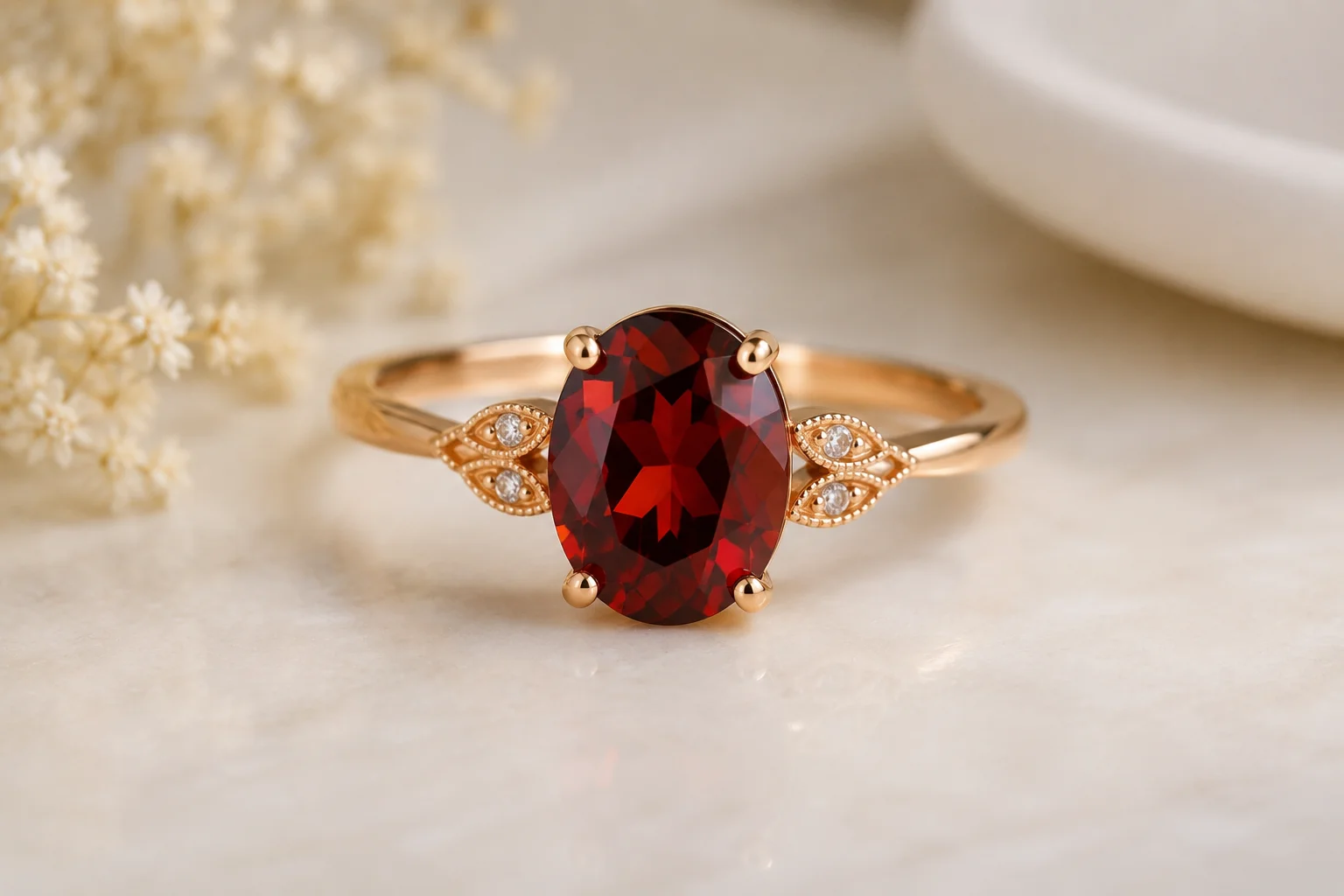
Garnet Rings: Styles and Buying Tips
Garnet rings extend far beyond the familiar dark-red January birthstone. The garnet group includes red, purplish red, orange, yellow and vivid green gems, along with rarer color-change material, giving buyers considerably more design freedom than the name “garnet” might suggest.
Durability also varies across the group. Garnets generally fall around Mohs 6.5–7.5 with fair-to-good toughness, making many varieties practical for rings when the setting matches the gemstone and the ring is protected from hard impacts and unnecessary abrasion.
Garnet Rings at a Glance
| Feature | Garnet Ring Consideration |
|---|---|
| Material | Group of closely related mineral species |
| Common colors | Red, purple-red, orange, yellow, green |
| Mohs hardness | About 6.5–7.5 depending on type |
| Toughness | Fair to good |
| Common red types | Almandine, pyrope, rhodolite |
| Popular green types | Tsavorite and demantoid |
| Popular orange type | Spessartine |
| Common settings | Solitaire, halo, bezel, three-stone, cluster |
| Main quality factor | Color |
| Birthstone | January |
| Treatment prevalence | Most garnets are typically untreated; fracture filling is rare |
| Safe routine cleaning | Warm soapy water |
Garnet Is a Group, Not One Gemstone
“Garnet” describes a group of closely related minerals that share a similar crystal structure but differ chemically.
Commercially important garnets include pyrope, almandine, spessartine, grossular and andradite. Rhodolite is a familiar purple-red mixture within the pyrope-almandine series, while tsavorite is green grossular and demantoid is green andradite.
That variety matters when choosing a ring because color, rarity, hardness, clarity expectations and price can differ significantly.
The parent Garnet: Meaning, Healing Properties & Uses page owns the broad family profile, while Types of Garnet distinguishes individual varieties.
Are Garnets Durable Enough for Rings?
Generally, yes.
Depending on type, garnet hardness ranges from roughly 6.5 to 7.5 on the Mohs scale. Toughness is fair to good.
That is sufficient for many ring styles, including jewelry worn regularly.
However, garnet is not as scratch-resistant as sapphire or ruby and should not be treated like diamond.
The exact variety matters as well.
Several almandine, pyrope, spessartine and grossular-family gems sit toward the harder end of the garnet range, while demantoid is somewhat softer.
The completed Is Garnet Durable Enough for Everyday Wear? provides the fuller durability analysis rather than duplicating it here.
Red Garnet Rings
Red remains the classic garnet-ring color.
Almandine and pyrope are common components of traditional red garnets, while rhodolite adds a more purplish or raspberry-red appearance.
Some red garnets are very dark.
A stone that looks richly red beneath strong display lighting may show large black-looking areas in an ordinary room.
Therefore, evaluate the ring under normal diffuse lighting rather than choosing the deepest color automatically.
For many buyers, a medium-dark red with visible internal life is more attractive than a nearly opaque-looking dark stone.
Rhodolite Garnet Rings
Rhodolite is popular for rings because its purplish-red to raspberry hues can look brighter than conventional dark-red garnet.
It also pairs effectively with both white and yellow metals.
For buyers attracted specifically to this variety, the separate Rhodolite cluster owns its variety-specific jewelry and valuation intent rather than this general garnet-ring page replacing it.
A general garnet ring should therefore be judged first by the actual stone’s color and identity rather than by assumptions that all red garnets behave identically.
Tsavorite Garnet Rings
Tsavorite is a vivid green grossular garnet.
Fine stones can rival emerald visually while offering a different inclusion profile and durability context.
Tsavorite is rarer than ordinary red garnet, particularly in larger sizes, so ring prices can rise substantially with quality and carat weight.
Green color should be lively and attractive rather than overly dark.
Because tsavorite can carry significant value, a secure setting and appropriate documentation become more important as the center stone’s price rises.
Demantoid Garnet Rings
Demantoid is green andradite garnet and is known for high dispersion, which can create colorful fire.
It is also somewhat softer than several other garnet types.
For a frequently worn ring, a protective setting can therefore make sense.
Famous horsetail inclusions may appear in demantoid and can sometimes add collector interest rather than simply reducing clarity.
Those inclusions do not by themselves prove Russian origin.
A demantoid ring should be evaluated according to demantoid-specific standards rather than generic red-garnet expectations.
Spessartine Garnet Rings
Spessartine is associated with orange and yellow-orange colors.
Bright, saturated orange stones can create highly distinctive rings and work especially well in yellow gold.
Clarity expectations differ from many red garnets because some spessartine contains visible inclusions.
A highly attractive color can therefore remain desirable despite inclusions that would be more distracting in a conventional eye-clean red garnet.
Solitaire Garnet Rings
A solitaire keeps attention on one center gemstone.
This is an effective format when the garnet has strong individual color.
Ovals, cushions and rounds are widely used.
For red garnets, avoid cuts that create excessive darkness in the center.
Green and orange varieties may justify more elaborate custom cutting depending on value.
Setting height should remain proportional to gemstone size. A deep garnet mounted too high can catch on clothing and increase the risk of impact.
Halo Garnet Rings
A halo adds a border of accent stones, usually diamonds.
This creates strong contrast around red, green and orange garnets.
With dark red material, a bright halo can make the center appear even darker by comparison. Consequently, center-stone tone deserves careful evaluation before choosing this format.
Green tsavorite and demantoid can look particularly striking against colorless diamonds.
A halo also increases the number of settings that require inspection, so long-term maintenance should be considered part of the design.
Bezel-Set Garnet Rings
Bezels surround the gemstone perimeter with metal.
This makes them particularly useful for everyday rings because vulnerable edges receive more protection.
A low-profile bezel also reduces snagging.
For darker garnets, however, the design should allow the stone to remain visually open enough that it does not appear unnecessarily heavy.
A well-cut garnet does not require light to enter through the pavilion from below to show color, but overall setting proportions still affect appearance.
Three-Stone Garnet Rings
Three-stone designs can use three garnets or combine a garnet center with diamonds.
Matching three colored stones requires consistency in tone, saturation and apparent size.
Red garnets are relatively available in calibrated dimensions, so closely matched sets can be assembled more easily than with some rarer gems.
Mixed-color garnet designs are another possibility.
For example, a green center with smaller orange or red garnets creates a deliberately multicolored composition while remaining within the same broader mineral group.
Garnet Engagement Rings
Garnet can serve as an engagement-ring center stone, especially when color and symbolism matter more than maximum scratch resistance.
Red garnets have long associations with love, devotion and commitment in jewelry lore.
Green and orange garnets provide less traditional alternatives.
For daily engagement-ring wear, setting protection matters.
A bezel, protective halo or low-profile prong mounting can reduce impact risk.
Someone who works heavily with their hands may want to remove the ring during rough activities.
Garnet is durable enough for jewelry, but it should not be expected to tolerate every condition that a diamond ring can.
Choosing Garnet Color
Color is the most important quality factor across the garnet group.
That does not mean the same color standard applies to every variety.
For red garnet, attractive saturation without excessive darkness is usually desirable.
For tsavorite, vivid green attracts strong demand.
Demantoid is appreciated for green color combined with exceptional dispersion.
Spessartine ranges through orange and yellow-orange.
Before purchasing, identify the garnet variety rather than assuming “garnet” alone is a sufficient quality description.
The completed Garnet Quality and Grading Explained owns the detailed quality framework.
Clarity Depends on Garnet Type
Red almandine, pyrope and rhodolite are commonly available without obvious eye-visible inclusions.
Other garnets follow different expectations.
Spessartine may contain more visible internal features, while demantoid can contain distinctive horsetail inclusions prized by some collectors.
Therefore, clarity should be judged within the correct variety.
An inclusion that lowers value in one garnet may have neutral or even positive collector relevance in another.
Choosing the Cut
Many garnets are available in standard calibrated shapes because common varieties are sufficiently abundant for commercial jewelry production.
Rounds, ovals, cushions and pears are all familiar.
Cut quality should distribute light across the gemstone rather than leaving a large dead or black-looking center.
Dark red garnets especially benefit from cutting that prevents excessive extinction.
Higher-value tsavorite, demantoid and fine spessartine may justify custom cuts intended to maximize both color and brilliance.
Carat Weight and Ring Size
Garnet availability varies by species.
Common red garnets occur in substantial sizes, while fine tsavorite and demantoid become much rarer as size increases.
Therefore, two five-carat garnet rings may belong to completely different price categories.
Face-up dimensions remain useful because deep stones can carry considerable carat weight without looking correspondingly large.
The completed Garnet Price Per Carat Explained provides the size-and-value relationship separately.
Garnet Ring Prices
A general garnet ring may cost relatively little or become a major fine-jewelry purchase depending on variety.
Commercial red almandine and pyrope can be affordable.
Fine rhodolite occupies a different level, while top tsavorite and demantoid can become substantially more expensive.
Precious-metal weight, diamonds, craftsmanship and designer premiums also affect the finished ring.
For current valuation rather than ring design, Garnet Price Guide: Value and Cost in 2026 owns the market-pricing intent.
Best Metals for Garnet Rings
Yellow Gold
Yellow gold creates a traditional combination with red garnet and works particularly well with orange spessartine.
Rose Gold
Rose gold can blend attractively with raspberry and purplish-red rhodolite.
White Gold
White gold gives strong contrast around red and orange garnets and provides a neutral setting for green varieties.
Platinum
Platinum works particularly well for high-value tsavorite and demantoid settings where robust fine-jewelry construction is desirable.
Metal selection should complement the actual garnet rather than the group name alone.
Ring Fit and Setting Height
A top-heavy garnet ring can rotate if it is too loose.
That exposes the gemstone to more accidental contact.
Wide bands also fit differently from thin shanks, so nominal ring size alone may not predict comfort.
High-profile cocktail designs are visually dramatic but receive more knocks.
For everyday wear, moderate height and a secure fit usually improve practicality.
If the ring will be stacked with another band, check that hard accent stones cannot repeatedly rub against the garnet.
Natural Garnet and Imitations
Most natural garnets are not routinely subjected to major treatments.
However, fracture filling can occur rarely, and imitation red stones can be confused with garnet.
Glass and other gemstones may resemble dark red garnet visually.
When material identity is uncertain, Real vs Fake Garnet owns the dedicated identification workflow.
For an expensive green or unusual-color garnet, independent gemological documentation can provide additional confidence.
Cleaning a Garnet Ring
Warm soapy water with gentle cleaning is the safest general method.
Use a soft brush beneath the setting where skin oils and lotions collect.
Ultrasonic cleaners are usually suitable for garnet unless the gemstone has fractures or fracture filling.
Steam cleaning is not recommended.
The complete maintenance procedure is covered in How to Clean Garnet Jewelry Safely.
January Birthstone Rings
Garnet is January’s birthstone.
That makes rings a common birthday, anniversary and milestone gift.
The tradition should not be reduced to red alone because the garnet group offers a much broader color range.
The completed January Birthstone page owns the birthstone history and wider meaning.
For a gift, establish ring size before focusing on gemstone carat weight. A beautifully chosen ring that cannot be worn comfortably provides little practical value.
Coordinating Garnet Jewelry
A garnet ring does not need to match another garnet piece perfectly.
Different garnet varieties can vary substantially in hue.
A red ring can still coordinate with a slightly different red pendant when metal and overall design remain consistent.
The completed Garnet Bracelets, Garnet Earrings and Garnet Necklaces guides preserve each jewelry format’s separate fit and construction considerations.
Frequently Asked Questions
1. Is garnet good for rings?
Yes. Garnets generally range from about Mohs 6.5–7.5 with fair-to-good toughness, making many varieties suitable for rings with proper care.
2. Can a garnet ring be worn every day?
Many can, although frequent wear will expose the stone to abrasion and impacts. Protective settings and removal during rough activities improve longevity.
3. Which garnet is best for a ring?
There is no single best variety. Red pyrope, almandine and rhodolite are practical and widely available, while tsavorite, demantoid and spessartine offer distinctive colors at different price levels.
4. Is garnet suitable for an engagement ring?
Yes, provided the wearer accepts that garnet is less scratch-resistant than sapphire or diamond and gives the ring appropriate care.
5. What setting protects garnet best?
A low-profile bezel offers strong perimeter protection. Secure prong settings are also suitable when maintained properly.
6. Are all garnet rings red?
No. Garnets can be green, orange, yellow, purplish red and other colors, with some rare stones even showing color change.
7. Is tsavorite a garnet?
Yes. Tsavorite is a vivid green variety of grossular garnet.
8. Is demantoid a garnet?
Yes. Demantoid is green andradite garnet and is especially known for high dispersion and, in some stones, horsetail inclusions.
9. Are garnet rings expensive?
Some red garnet rings are very affordable, while fine tsavorite, demantoid and other rare varieties can be expensive. Finished jewelry cost also depends heavily on metal and craftsmanship.
10. Are garnets normally treated?
Most garnets are generally sold without routine treatments, although fracture filling can occur rarely.
11. Can garnet go in an ultrasonic cleaner?
Ultrasonic cleaning is usually safe for unfractured garnet, but stones with fractures or fracture filling should be cleaned only with warm soapy water. Steam cleaning is not recommended.
12. How should I store a garnet ring?
Store it separately from harder gems such as diamond, ruby and sapphire that could scratch it, while also keeping garnet away from softer stones that it could scratch.
Conclusion
Garnet is unusually versatile for ring design because it represents an entire mineral group rather than one dark-red gemstone. Traditional red almandine and pyrope offer accessible classics, rhodolite adds raspberry and purplish tones, spessartine brings orange, while tsavorite and demantoid provide vivid green options.
The best ring begins with correct variety identification. Color, clarity expectations, durability and value all change depending on which garnet you are buying.
Once the gemstone is understood, setting height, edge protection, secure fit and sensible care determine how well the ring performs. With those considerations in place, garnet can work successfully in everything from affordable birthstone rings to high-value engagement and collector jewelry.