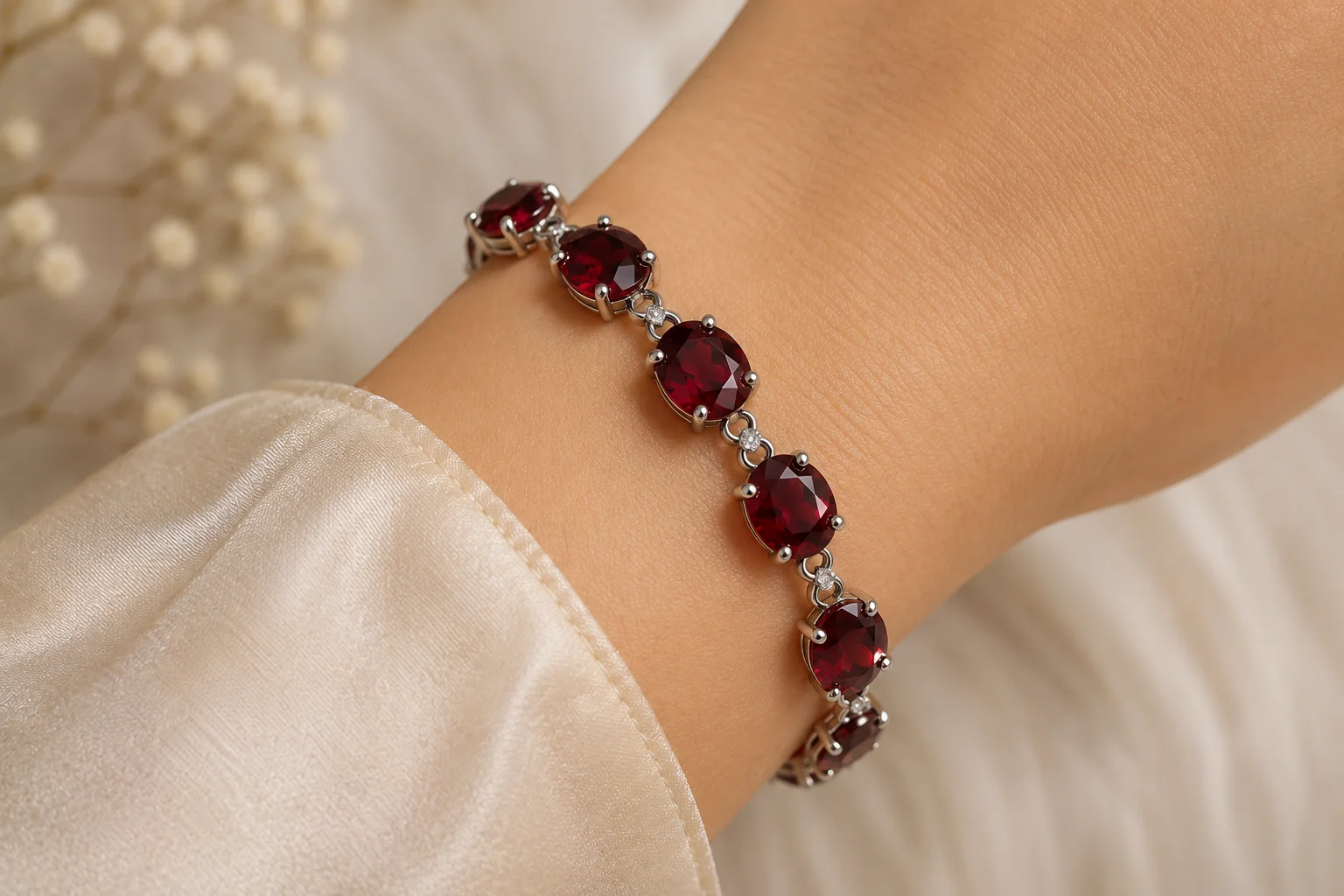
Garnet Bracelets: Styles, Quality and Buying Guide
A garnet bracelet can range from an affordable strand of deep-red beads to a fine line bracelet set with rhodolite, tsavorite or demantoid. Because garnet is a mineral group rather than one single gemstone, color, hardness, rarity and price can differ considerably between varieties.
Most gem garnets fall around 6.5 to 7.5 on the Mohs scale and have fair-to-good toughness, making them suitable for bracelets when the construction is secure and the wearer avoids hard impacts. The best purchase combines attractive stones with a comfortable fit, strong clasp or stringing, and a style appropriate to the specific garnet variety.
Garnet Bracelets at a Glance
| Factor | What to look for |
|---|---|
| Gem identity | Specific garnet variety when possible |
| Color | Lively, attractive color rather than maximum darkness |
| Matching | Consistent size, tone and brightness in repeated designs |
| Cut | Good light return with minimal windowing |
| Setting | Low-profile, secure and smooth |
| Bead quality | Clean drill holes and durable stringing |
| Bracelet fit | Comfortable without excessive sliding |
| Clasp | Positive closure appropriate to bracelet value |
| Hardness | Usually about 6.5–7.5 depending on garnet type |
| Best everyday types | Almandine, pyrope, rhodolite and other durable garnets |
| More delicate option | Demantoid needs additional abrasion protection |
| Main care concern | Hard blows, surface abrasion and worn settings |
Garnet Is More Than a Dark-Red Gemstone
Many commercial bracelets use dark-red almandine or pyrope-almandine mixtures, but the garnet group includes much more color diversity.
The completed guide to types of garnet explains the mineral species and varieties in detail.
Bracelets may contain deep-red almandine, fiery pyrope, purple-red rhodolite, orange garnet, green grossular varieties or brilliant green demantoid.
That variety means the word garnet on a product description is often too broad for a significant purchase.
Ask which garnet the bracelet contains when species or variety affects value.
Almandine Garnet Bracelets
Almandine garnet is one of the most widespread gem garnets.
It commonly appears in deep red to brownish-red bracelets, including faceted beads, polished rounds and mounted stones.
Almandine can offer excellent value because attractive material is broadly available.
Very dark stones may look almost black away from bright illumination, so inspect the bracelet under ordinary room light.
For beads, look for smooth polish, clean drill holes and color that remains attractive across the entire strand.
Pyrope Garnet Bracelets
Pyrope garnet traditionally shows deep red coloration and may occur in mixtures with almandine.
Fine pyrope can produce a rich red appearance that works particularly well with yellow gold.
As with almandine, darkness matters.
A bracelet should show recognizably red flashes rather than appearing opaque black during normal wear.
Small faceted pyrope stones may provide good brilliance when cutting is strong.
Rhodolite Garnet Bracelets
Rhodolite is generally a pyrope-almandine garnet with attractive pinkish-red, raspberry, purple-red or wine-like color.
Its comparatively bright appearance makes it especially suitable for faceted line and station bracelets.
The completed rhodolite garnet bracelet guide covers that variety’s jewelry-specific buying factors.
When several rhodolites form one bracelet, examine color matching carefully.
One brownish or much darker stone can interrupt an otherwise lively row.
Grossular Garnet Bracelets
Grossular garnet occurs in several colors.
Its gem varieties include green tsavorite and orange-to-brown hessonite.
Tsavorite bracelets can be highly valuable because fine green material is comparatively rare, particularly as stone size increases.
Hessonite creates a warmer orange-brown or cinnamon-colored appearance.
A seller should identify the variety rather than using green garnet or orange garnet as the complete description for a high-value piece.
Demantoid Garnet Bracelets
Demantoid is green andradite garnet and is famous for unusually strong dispersion.
The drafted demantoid garnet meaning guide explains its mineralogical identity and optical fire.
Demantoid sits toward the softer end of gem garnets, so a bracelet requires particularly thoughtful protection from abrasion and impact.
Fine matched demantoids can also be costly.
For most buyers, a bracelet using smaller secure stones makes more practical sense than an exposed design containing several large gems.
Beaded Garnet Bracelets
Beaded bracelets are among the most accessible garnet formats.
Round polished beads may be strung on elastic, cord or wire and finished with a clasp.
Inspect every drill hole because fractures commonly develop at points where drilling removed material.
A valuable strand benefits from stronger professional stringing rather than very thin elastic.
Uniform beads create a formal appearance, while slightly varied natural color can suit a more organic design.
Extremely bright identical red color at a suspiciously low price deserves questions about identity and treatment.
Stretch Garnet Bracelets
Elastic stretch bracelets are convenient because they do not require a clasp.
However, elastic is a consumable component.
Repeated stretching, skin oils, heat and age gradually weaken the cord.
Avoid pulling the bracelet far beyond the width of the hand. Instead, roll it gently over the fingers and wrist.
Inspect the elastic for whitening, fraying, looseness or visible cracking.
Restring the bracelet before failure rather than waiting until beads scatter.
Garnet Tennis Bracelets
A tennis-style garnet bracelet uses a flexible continuous line of mounted stones.
Bright rhodolite, red garnet and green varieties can all create striking versions.
The links should articulate smoothly around the wrist without twisting.
Examine the settings from the underside as well as the front.
A strong box clasp with a secondary safety mechanism is especially useful when the gemstones carry substantial value.
The stones should remain aligned when the bracelet curves naturally.
Garnet Station Bracelets
Station bracelets use individual garnets separated by chain.
They provide visible color with less total gemstone weight and often feel lighter than full line bracelets.
Bezel-set stations give strong protection and reduce snagging.
Check whether the garnets remain face-up rather than flipping continually toward the wrist.
The chain between stations should be proportional to the stone weight.
An extremely delicate chain can become the weakest element in an otherwise valuable bracelet.
Garnet Bangles and Cuffs
A rigid bangle may contain garnets across the top or around the complete circumference.
Hinged designs should close positively without lateral movement in the hinge.
Cuffs should fit without requiring repeated bending.
Constantly squeezing or spreading metal to put the bracelet on can fatigue the structure and disturb stone settings.
Low-set garnets are more practical than stones projecting high above the metal.
A substantial cuff can also be heavy, so comfort matters alongside appearance.
Choosing Garnet Color
Color is the most important quality factor for many garnets.
Red garnet should remain visibly red rather than appearing nearly black. Rhodolite should look lively rather than gray or muddy, while green garnets benefit from attractive saturation and brightness.
Orange garnet should show clean warm color without excessive brown when a vivid appearance is desired.
There is no single best garnet color.
The bracelet should suit the wearer’s style and budget rather than conform to the stereotype that garnet must be dark red.
Choosing Clarity
Clarity expectations differ by garnet variety.
Many red garnets are available with few eye-visible inclusions.
Some varieties may contain characteristic inclusions that collectors accept or even appreciate.
For bracelets, severe fractures reaching the girdle or drill holes deserve greater concern than tiny internal features that do not affect appearance.
The stones should look consistently transparent or intentionally translucent according to the design.
Avoid paying a clarity premium that is invisible during normal wear unless collector quality matters to the purchase.
Choosing Cut Quality
Faceted garnets should return light evenly.
Check for a large transparent window through the center or extensive dead-looking dark zones.
Bracelet stones also need consistent dimensions and setting height.
A row of well-matched smaller gems often looks more refined than several larger stones with uneven cutting.
Rounds are common because they match easily, while ovals, cushions and rectangular shapes can produce more distinctive designs.
Cut quality deserves attention even when the gemstones themselves are inexpensive.
Garnet Bracelet Fit
The bracelet should allow natural wrist movement without sliding excessively across the hand.
Too much looseness increases repeated impact against desks and door frames.
An overly tight bracelet places tension on links, stringing and skin.
Measure the wrist close to the skin, then allow an appropriate amount of ease for the specific design.
A heavy tennis bracelet generally needs less excess movement than a lightweight chain.
Adjustable styles should still remain secure at their chosen length.
Choosing the Clasp
Box clasps work well for line bracelets, particularly when they include an additional safety latch.
Lobster clasps suit many station and chain designs.
Toggle clasps can be attractive but may not provide the same reassurance for expensive stones unless their dimensions prevent accidental opening.
Test the mechanism several times.
A clasp should engage positively without feeling loose or requiring excessive force.
Also inspect the links connecting the clasp to the bracelet because failure often occurs beside the closure rather than inside it.
Yellow Gold, White Gold or Silver?
Yellow gold complements traditional red and orange garnets.
White gold and platinum create stronger contrast around red stones and work especially well with green garnet.
Sterling silver offers an accessible option for many red-garnet bracelets.
Rose gold can complement rhodolite’s pink or purple-red tones.
The metal should be selected according to appearance, durability and budget rather than the assumption that an expensive gemstone always requires the most expensive alloy.
Secure construction matters more than prestige.
Garnet Bracelets as January Birthstone Jewelry
Garnet is January’s principal modern birthstone.
The completed January birthstone guide explains how the gemstone became associated with the month.
A January bracelet does not need to use conventional dark-red garnet.
Green, orange and purple-red varieties belong to the same broader mineral group and can offer a more individualized interpretation.
For gifts, consider the recipient’s preferred color and bracelet habits before choosing a traditional shade.
How Much Should a Garnet Bracelet Cost?
Price varies enormously according to garnet variety.
Common red material can be relatively affordable, while fine tsavorite and demantoid can carry substantial premiums.
Stone size, color, clarity, cut, matching, metal and craftsmanship all contribute.
The completed garnet price guide provides detailed value context.
A higher total carat weight does not automatically mean a better bracelet.
Compare the quality and identity of the stones first.
How to Buy a Garnet Bracelet
Begin with gemstone identification.
The completed garnet buying guide explains broader quality and authenticity checks.
For the bracelet itself, verify length, clasp, metal and treatment disclosure.
Inspect every stone rather than only the center.
Ask whether photographs show the exact piece.
For an expensive green garnet bracelet, laboratory documentation may be appropriate when identity, treatment or claimed origin materially affects the price.
Return rights are particularly useful when buying online because fit is difficult to judge from photographs.
Can Garnet Bracelets Be Worn Every Day?
Many garnets are suitable for regular jewelry wear, but bracelets remain a relatively exposed format.
The completed guide to garnet durability explains the differences between varieties.
Remove the bracelet before weight training, gardening, housework, contact sports or tasks involving hard surfaces.
Wear it on the non-dominant wrist when practical to reduce repeated impacts.
Demantoid deserves greater abrasion caution than harder garnet varieties.
Cleaning a Garnet Bracelet
Warm water, mild soap and a soft brush provide the safest general method for most intact garnets.
Clean over a bowl rather than an open drain.
Support the bracelet rather than pulling on one link or stretch cord.
The completed guide to cleaning garnet jewelry safely explains how settings and fracture filling can alter the process.
Steam should be avoided, while ultrasonic cleaning is unsuitable for fractured or fracture-filled stones.
Water and Sunlight
Most garnets tolerate brief water exposure, but the complete bracelet may include metal, elastic, glue or other components with different limitations.
The completed guide on whether garnet is safe in water and sunlight provides material-specific care.
Do not soak bracelets unnecessarily.
Likewise, permanent strong-sun display adds no practical benefit.
Normal daylight wear is different from leaving jewelry on a hot windowsill for extended periods.
Storage
Fasten clasp bracelets before storage and lay them flat.
Keep garnet away from diamonds, sapphires and other harder jewelry that can scratch its surface.
Beaded bracelets should not be compressed beneath heavy pieces.
Do not leave elastic jewelry stretched around bottles or display stands for long periods.
A padded compartment protects both gemstones and metal.
For valuable pieces, keep laboratory reports, receipts and appraisals separately.
Professional Inspection
Have a bracelet checked when:
- A stone moves
- A prong catches
- A link becomes stiff
- The clasp opens unexpectedly
- Elastic becomes loose
- A drill hole develops a visible fracture
Repairing one weak component early can prevent losing several stones.
Professional inspection becomes more important as value and wear frequency increase.
Conclusion
Garnet bracelets offer much more variety than the familiar dark-red birthstone strand. Almandine and pyrope provide classic reds, rhodolite adds brighter purple-red color, while grossular and andradite varieties introduce green and orange options.
Choose stones that look lively in normal lighting, then give equal attention to fit, settings, stringing and clasp quality. Most garnets have enough durability for regular wear, although bracelets still require protection from hard impacts and abrasive contact.
A secure, comfortable bracelet made with accurately identified garnet will generally provide more lasting value than one selected by total carat weight or an unstandardized quality label alone.
Frequently Asked Questions
1. Are garnet bracelets durable?
Most gem garnets are durable enough for regular bracelet wear with care, although hardness varies from roughly 6.5 to 7.5.
2. Which garnet is best for a bracelet?
Almandine, pyrope and rhodolite are practical options. Demantoid can also be used but requires greater abrasion protection.
3. Are all garnet bracelets dark red?
No. Garnet occurs in red, orange, green, purple-red and several additional colors.
4. Are stretch garnet bracelets safe?
They can be practical, but elastic wears out and should be replaced when it becomes loose, cracked or frayed.
5. How should a garnet bracelet fit?
It should move comfortably without sliding excessively over the hand or placing constant tension on the wrist.
6. Which clasp is best for a garnet tennis bracelet?
A secure box clasp with an additional safety feature is a strong choice for valuable line bracelets.
7. Can garnet bracelets be worn every day?
Many can be worn regularly, but they should be removed during rough work, exercise and activities involving hard impacts.
8. Is green garnet more valuable than red garnet?
Fine tsavorite and demantoid can be substantially more expensive than common red garnet, although quality determines individual value.
9. Can garnet bracelets get wet?
Many garnets tolerate brief water exposure, but long soaking can affect metal, stringing, treatments or adhesives.
10. How should a garnet bracelet be cleaned?
Use warm mild soapy water and gentle brushing, then rinse briefly and dry thoroughly.
11. Can garnet scratch?
Yes. Garnet can be scratched by harder materials such as sapphire and diamond.
12. Is garnet a good January birthstone bracelet?
Yes. Garnet is January’s principal modern birthstone and offers many color choices beyond traditional dark red.