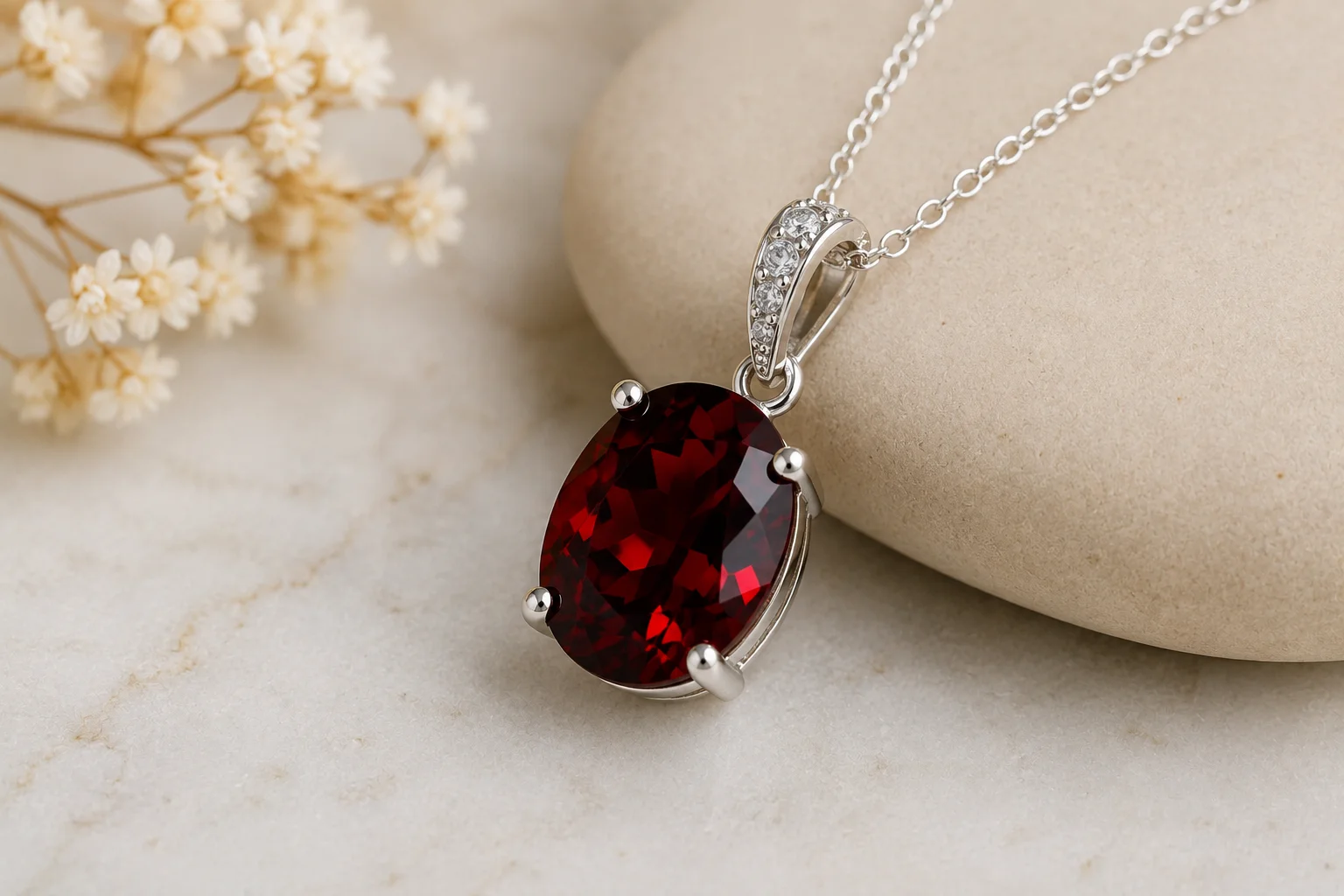
Garnet Necklaces and Pendants: Styles and Buying Guide
Garnet necklaces can range from simple dark-red birthstone pendants to high-value pieces featuring vivid green tsavorite or demantoid. Because necklaces receive fewer impacts than rings and bracelets, they are one of the most practical formats for displaying both common and rarer garnet varieties.
A good necklace depends on more than gemstone quality. The setting, bail, chain, articulation and clasp must all suit the weight and value of the stones. For multi-garnet designs, color matching becomes especially important.
Garnet Necklaces at a Glance
| Factor | What to look for |
|---|---|
| Garnet identity | Specific variety when value depends on it |
| Color | Lively color under normal lighting |
| Cut | Even brightness without major windowing |
| Multi-stone matching | Compatible hue, tone and dimensions |
| Pendant setting | Secure bezel or sturdy prongs |
| Bail | Smooth, strong and appropriate for chain |
| Chain | Proportional to pendant weight and value |
| Clasp | Secure and easy to inspect |
| Best everyday style | Low-profile solitaire or bezel pendant |
| Best statement style | Cluster, graduated or line necklace |
| Main care issue | Setting, bail and chain failure |
| Cleaning | Warm mild soapy water for most intact garnets |
Why Garnet Works Well in Necklaces
Most gem garnets fall between about 6.5 and 7.5 on the Mohs scale.
That provides useful jewelry durability, and necklaces further reduce abrasion because they remain away from most work surfaces.
A pendant can therefore showcase demantoid, which needs more abrasion care, more safely than a bracelet or exposed ring.
Likewise, large red garnets can create substantial visual presence without becoming impractical to wear.
The drafted garnet meaning guide explains the mineral group and its color diversity.
Garnet Solitaire Pendants
A solitaire pendant uses one principal gemstone.
Round and oval garnets provide classic symmetry, while cushion, pear and rectangular cuts create different visual proportions.
The stone should remain bright under ordinary light.
Deep red garnet can become nearly black when cut too deeply or when its tone is excessively dark.
A solitaire cannot rely on surrounding gems to create visual interest, so cut and color deserve close attention.
Low-profile settings generally provide the best balance of visibility and protection.
Bezel-Set Garnet Pendants
A bezel surrounds the gemstone’s girdle with metal.
This creates a smooth profile and strong edge protection.
Bezel pendants work particularly well for regular wear and for softer garnet varieties such as demantoid.
The metal should follow the stone evenly without covering an unnecessary amount of the face.
A poorly made bezel can make the garnet appear crooked or reduce visible size.
Open-backed construction may improve cleaning access when it remains structurally sound.
Prong-Set Garnet Pendants
Prong settings expose more of the gemstone.
Four-prong arrangements are common around rounds, ovals and cushions, although the exact number should match size and shape.
Pear and marquise stones need adequate protection around points.
Inspect every prong for smooth contact.
A garnet should not click or move inside the setting.
If a prong begins catching clothing, stop wearing the pendant until a jeweler checks it.
Red Garnet Necklaces
Red garnet remains the classic necklace choice.
Almandine garnet frequently provides deep burgundy or brownish-red color, while pyrope garnet contributes rich red shades.
Large stones are often available at accessible prices compared with many other colored gems.
That makes red garnet particularly suitable for substantial pendants.
However, avoid choosing size at the expense of color.
A smaller bright-red garnet may appear more attractive than a large stone that looks black in normal lighting.
Rhodolite Garnet Necklaces
Rhodolite offers raspberry, wine and purplish-red colors.
The completed rhodolite garnet necklace guide covers this variety in detail.
Its brighter coloration works especially well in pendants and station necklaces.
Rhodolite can also be matched into graduated designs.
When several stones are used, compare both saturation and undertone.
One garnet that appears substantially browner than the others can disrupt the necklace’s visual continuity.
Orange Garnet Necklaces
Orange garnet creates a warmer, less conventional necklace.
Spessartine may show vivid mandarin-like orange, while hessonite produces softer cinnamon and honey tones.
The completed spessartite garnet necklace guide owns the variety-specific jewelry intent.
Yellow gold often complements orange garnet naturally.
White metal creates stronger contrast.
A vivid orange stone should remain bright enough that brown or dark extinction does not dominate the face-up appearance.
Green Garnet Necklaces
Tsavorite and demantoid are the most important fine-jewelry green garnets.
Tsavorite offers saturated green and good brilliance.
Demantoid combines green color with exceptionally strong dispersion.
Because fine stones can be expensive, pendants provide a practical way to protect one significant gem.
The drafted demantoid garnet necklace guide covers bail construction, setting protection and demantoid-specific buying factors.
For valuable green garnets, accurate variety identification matters substantially.
Garnet Halo Pendants
A halo surrounds the center garnet with smaller accent stones.
Diamonds are common because their white brilliance provides strong contrast.
A halo can make a relatively small red, orange or green center appear larger.
However, the center stone should still be attractive independently.
Closely packed halo settings contain many tiny prongs and can trap residue.
Inspect the accent stones and clean the piece gently rather than assuming the harder diamonds determine the appropriate care method.
Garnet Cluster Pendants
Cluster pendants combine several garnets into one larger design.
Red garnet clusters became especially important historically because small stones could create a rich continuous color field.
Modern clusters may use floral, geometric or asymmetrical arrangements.
Check stone matching and setting consistency.
A cluster can use deliberate color variation, but the pattern should look intentional.
Open-backed designs usually provide easier cleaning access than completely enclosed construction.
Garnet Station Necklaces
Station necklaces space garnets along a chain.
Bezel-set stations work particularly well because they protect the gemstone edges and reduce snagging.
The stones should remain reasonably face-up during normal movement.
Poorly balanced settings may flip continuously.
Inspect every connection between chain and gemstone.
A thin chain can become the weakest component in a necklace whose gemstones themselves are durable.
Garnet Tennis and Line Necklaces
A line necklace places numerous garnets along an articulated setting.
Color matching becomes critical.
Lay the necklace flat and inspect for:
- Abrupt color changes
- Crooked stones
- Uneven gaps
- Stiff sections
- Mismatched dimensions
Then curve it gently as it would sit on the neck.
Links should move smoothly without causing neighboring stones to collide.
A valuable line necklace needs a secure clasp, often with an additional safety mechanism.
Garnet Bead Necklaces
Beaded garnet necklaces commonly use almandine, pyrope mixtures or other more included material.
Beads may be polished rounds, faceted shapes or irregular forms.
Inspect drill holes carefully.
Cracks around holes can expand as the strand flexes.
Knotted construction can limit stone loss if the string breaks.
Extremely uniform bright color at an unexpectedly low price deserves questions about identity or artificial enhancement.
Natural variation is common in bead-quality material.
Garnet Cabochon Pendants
Cabochons use a polished domed surface rather than conventional faceting.
They can suit heavily included, translucent or star garnet particularly well.
A bezel provides strong protection and complements the smooth outline.
Cabochon jewelry should still be inspected for fractures and good polish.
An attractive cabochon is not inherently lower quality than a faceted garnet; it represents a different use of the material.
Garnet Necklace Color Matching
Multi-stone necklaces should have compatible appearance.
Matching includes:
- Hue
- Tone
- Saturation
- Transparency
- Cut
- Face-up dimensions
Exact uniformity is not always necessary.
A graduated design may intentionally shift from lighter to darker stones.
However, random mismatching generally lowers visual coherence.
View the necklace under neutral room light rather than evaluating only under concentrated retail illumination.
Choosing Cut Quality
Garnet can absorb considerable light, especially in darker red varieties.
Therefore, cut has a major effect on brightness.
Look for even light return across the face.
A large transparent center may indicate windowing.
Extensive dark areas can indicate extinction, overly deep cutting or simply poor lighting.
The completed garnet buying guide explains these quality factors in more detail.
Do not assume greater carat weight compensates for weak cutting.
Choosing Clarity
Many red garnets are available without obvious eye-visible inclusions.
Other varieties can show characteristic inclusions while remaining valuable.
Clarity requirements therefore depend on the type.
In a necklace, structural fractures deserve more concern than tiny internal inclusions that do not affect appearance.
For repeated-stone designs, overall consistency matters.
A single cloudy stone can look obvious beside brighter neighbors.
Choosing the Bail
The bail connects a pendant to its chain.
It deserves close inspection because failure can result in losing the entire pendant.
The opening must accommodate both the chain and its end fitting.
Fixed bails maintain orientation, while articulated bails allow greater movement.
Hidden bails create a cleaner front appearance but can be harder to examine.
Check solder seams and attachment points carefully.
Choosing the Chain
| Chain style | Character | Good use |
|---|---|---|
| Cable | Classic and versatile | Small to medium garnet pendants |
| Rolo | Rounded and substantial | Medium or heavier pendants |
| Wheat | Flexible and refined | Valuable pendants |
| Box | Structured and smooth | Modern designs |
| Curb | Flat interlocking links | Contemporary pendants |
| Snake | Smooth continuous appearance | Lightweight pendants; avoid sharp kinks |
Chain thickness should correspond with pendant weight.
A very fine chain may look elegant but create unnecessary risk beneath a heavy garnet.
Garnet Necklace Length
| Approximate length | Typical placement | Suitable use |
|---|---|---|
| 14–16 inches | High neck | Chokers and very small pendants |
| 18 inches | Collarbone area | Versatile solitaire length |
| 20 inches | Upper chest | Medium pendants |
| 22–24 inches | Lower upper chest | Larger statement pieces |
| 30+ inches | Lower chest | Long stations and layering |
Actual placement depends on body proportions.
An extender adds flexibility but creates another connection point that must remain secure.
Yellow Gold and Garnet
Yellow gold is a traditional partner for red and orange garnet.
Its warmth can make burgundy and mandarin tones appear especially rich.
It also suits antique-inspired jewelry.
Green garnet produces strong contrast against yellow gold.
Metal choice should still follow the wearer’s preference rather than an assumed rule.
A securely constructed 14K or 18K setting is more important than choosing one specific gold color.
White Gold and Platinum
White metals create sharp contrast around red garnets.
They also complement vivid green tsavorite and demantoid.
Platinum is dense and naturally white, while white gold may be rhodium plated.
White-metal settings can also integrate seamlessly with diamond halos.
For buyers with metal sensitivities, ask about alloy composition rather than assuming all white gold is identical.
Garnet Necklaces as January Gifts
Garnet is January’s principal modern birthstone.
The completed January birthstone guide explains its historical association.
A necklace works particularly well as a gift because exact ring or wrist sizing is unnecessary.
Red is traditional, but a January-born recipient can choose green, orange or raspberry garnet according to taste.
Birthstone symbolism should support personal preference rather than override it.
Symbolic Garnet Necklaces
Modern traditions associate garnet with commitment, vitality and grounding.
A pendant can therefore carry personal symbolism without requiring a specific jewelry placement.
The drafted garnet benefits guide explains the difference between symbolic uses and measurable gemstone properties.
Wearing garnet near the chest does not medically affect the heart or circulation.
The meaning comes from the wearer’s interpretation and the occasion attached to the jewelry.
Garnet Necklace Prices
Cost varies enormously by garnet type.
Common red-garnet pendants may be comparatively accessible, while fine tsavorite and demantoid necklaces can reach high-jewelry price levels.
The completed garnet price guide provides current market context.
When comparing necklaces, separate gemstone value from:
- Metal weight
- Accent diamonds
- Chain quality
- Craftsmanship
- Brand premiums
Total necklace price cannot be converted directly into a meaningful loose-gem per-carat number.
Buying a Garnet Necklace Online
Confirm:
- Garnet variety
- Gem dimensions
- Carat weight
- Natural or synthetic/imitation disclosure
- Treatment disclosure
- Metal fineness
- Chain length
- Chain thickness
- Bail dimensions
- Clasp style
- Return policy
Photographs are frequently enlarged.
Use millimeter dimensions to understand actual scale.
Video helps reveal how a pendant hangs and whether a multi-stone necklace articulates correctly.
Wearing Garnet Necklaces Safely
Put the necklace on after applying perfume, lotion and cosmetics.
Remove it before sleeping, swimming, exercise and activities where the chain can catch.
Long necklaces deserve extra caution around machinery and equipment.
Large pendants can also swing against hard surfaces when bending forward.
The gemstone may survive an impact while the bail or chain fails, so treat the complete piece as one system.
Cleaning Garnet Necklaces
Warm water, mild soap and a soft brush provide the safest general approach for most intact garnets.
Support the necklace rather than pulling on the chain while cleaning.
The completed garnet jewelry cleaning guide provides detailed treatment and setting precautions.
Avoid steam.
Ultrasonic cleaning may be inappropriate for fractured or fracture-filled gems.
Rinse carefully and dry both gemstone and chain completely.
Storage
Fasten the necklace before storage.
Lay it flat or hang it appropriately so the chain does not knot.
Keep garnet away from harder gemstones such as sapphire and diamond.
Do not allow a heavy pendant to rest directly against delicate chains or soft gemstones.
A padded travel case should prevent movement.
Store reports, receipts and appraisals separately from the jewelry itself.
Professional Inspection
Seek professional inspection if:
- The garnet moves
- A prong catches
- The bail opens
- A chain link stretches
- A clasp becomes loose
- A station stops articulating normally
Do not continue wearing a high-value pendant after noticing structural damage.
A garnet can remain perfectly intact while the surrounding metal approaches failure.
Conclusion
Garnet necklaces offer extraordinary variety, from traditional deep-red birthstone pendants to raspberry rhodolite, orange spessartine and rare green garnets.
Necklaces are among the safest ways to wear the group because they limit direct impact, but construction remains critical. A secure bail, appropriate chain and dependable clasp protect the gemstone as effectively as the setting itself.
Choose a garnet whose color remains lively in normal light, identify the variety when value depends on it and prioritize complete-jewelry craftsmanship over carat weight alone.
Frequently Asked Questions
1. Is garnet good for necklaces?
Yes. Necklaces are one of the safest garnet jewelry formats because they receive comparatively little abrasion and impact.
2. What garnet is best for a pendant?
Red almandine, pyrope, rhodolite, spessartine, tsavorite and demantoid can all work when the setting suits their durability.
3. What color garnet necklace should I buy?
Choose according to personal preference. Garnet occurs in red, orange, raspberry, green and other colors.
4. What is the safest garnet pendant setting?
A well-made bezel provides excellent edge protection, while sturdy low-profile prongs also work well.
5. What chain is best for a garnet pendant?
Cable, rolo, wheat and box chains can all work when their thickness is appropriate for the pendant’s weight.
6. What necklace length is most versatile?
Around 18 inches is a common versatile length, although actual placement varies by wearer.
7. Are green garnet necklaces expensive?
Fine tsavorite and demantoid can be substantially more expensive than common red garnet.
8. Is garnet a good January birthstone necklace?
Yes. Garnet is January’s principal birthstone and offers much more color variety than red alone.
9. Can garnet necklaces be worn every day?
Many can be worn regularly with care, particularly low-profile pendants on sturdy chains.
10. Can a garnet necklace get wet?
Brief appropriate cleaning is generally fine for many intact garnets, but unnecessary prolonged soaking should be avoided.
11. How should a garnet necklace be cleaned?
Use warm mild soapy water and gentle brushing, then rinse carefully and dry completely.
12. Should an expensive garnet pendant have a laboratory report?
Independent documentation may be appropriate when variety, treatment or claimed origin materially affects the price.