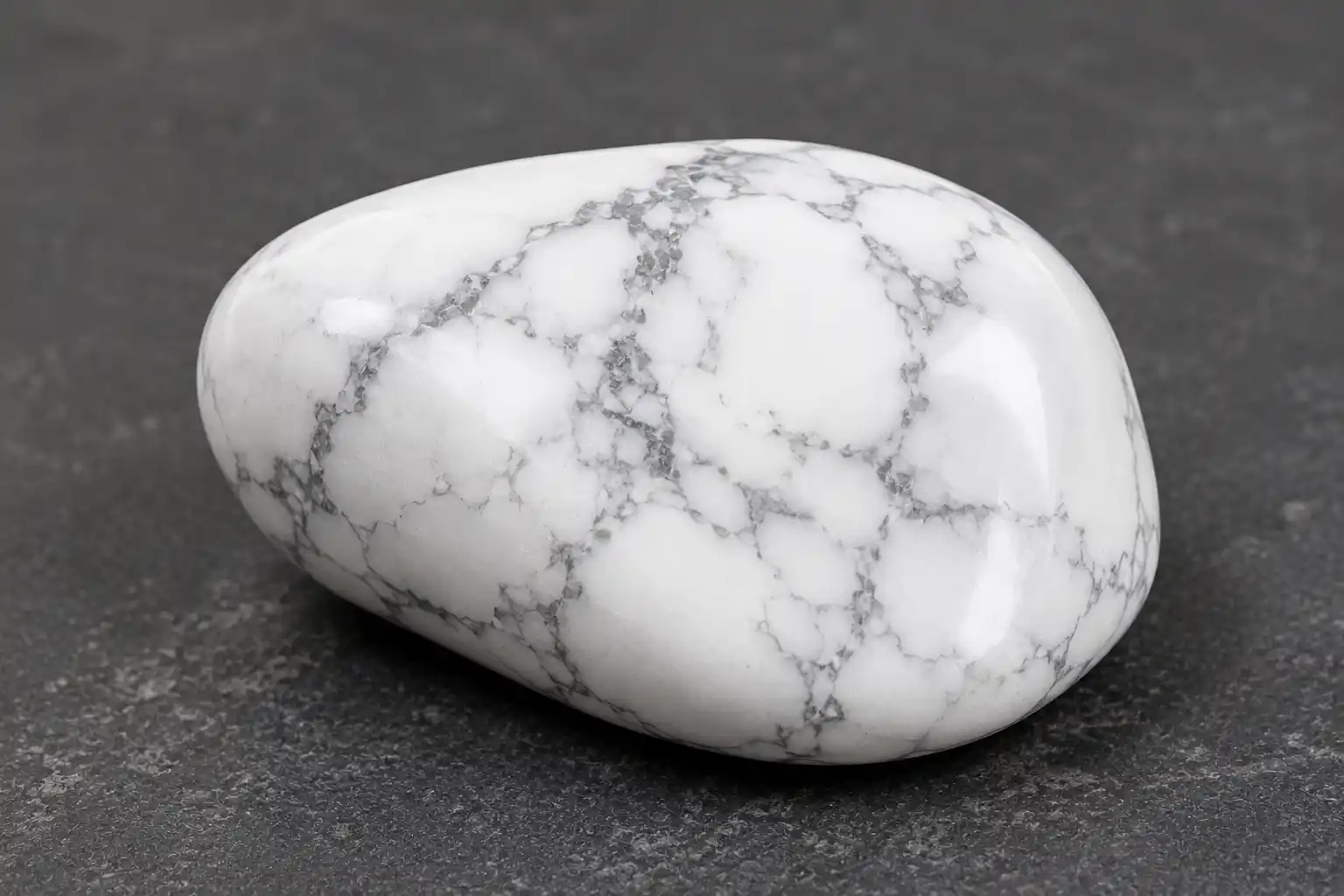
Howlite Meaning: Healing Properties, Uses & Symbolism
Howlite meaning begins with a calcium silicoborate mineral, not with a white “healing crystal” or a substitute for turquoise. Howlite has the formula Ca₂B₅SiO₉(OH)₅, crystallizes in the monoclinic system, has measured density close to 2.62 g/cm³, and naturally occurs most commonly as white to cream-colored compact nodules or massive material. Well-formed crystals are rare. Mindat records individual howlite crystals at approximately Mohs 6.5 but explains that the familiar massive aggregate commonly behaves closer to roughly 3.5 because its fine grains separate much more readily.
That hardness distinction is important because most howlite encountered in jewelry and crystal shops is not a large single crystal. It is the compact, porcelain-like aggregate that can be cut into beads, cabochons, carvings, palm stones, and other ornamental objects. Treating the textbook crystal hardness of 6.5 as the practical durability of every polished howlite object creates a misleading picture of how the material actually wears.
Howlite is also unusually important in the gem trade for a reason unrelated to symbolism: its pale body color and porous aggregate texture allow it to accept dye readily. GIA has documented howlite dyed turquoise blue, and modern GIA treatment references continue to list howlite among natural gem materials commonly dyed to imitate more valuable ornamental stones. FTIR spectroscopy can distinguish dyed howlite from genuine turquoise when visual examination is insufficient.
Those measurable facts give howlite meaning a useful evidence framework. Mineral identity, structure, hardness, density, formation, porosity, dye penetration, and treatment belong to mineralogy and gemology. Its discovery and naming belong to documented mineral history. Modern associations with calm, patience, reflection, sleep, emotional restraint, communication, or intentional action belong to symbolic practice. Medical claims require medical evidence and should not be inferred from the mineral’s calcium, boron, silicon, or white coloration.
Readers exploring the wider symbolic category can browse Healing Crystal. This page keeps its focus on what howlite is, what its physical evidence can establish, why color and hardness are frequently misunderstood, and how modern symbolism can be used without turning metaphor into medicine.
Howlite Meaning at a Glance
| Property or question | Evidence-aware summary |
|---|---|
| Mineral species | Howlite |
| Formula | Ca₂B₅SiO₉(OH)₅ |
| Mineral class | Borate / calcium silicoborate |
| Crystal system | Monoclinic |
| Natural color | Usually white or colorless; brownish material also occurs |
| Common commercial appearance | White to cream massive nodules, often with irregular gray or darker markings |
| Crystal hardness | Approximately Mohs 6.5 |
| Practical massive-material hardness | Commonly around 3.5 because the fine aggregate separates more easily |
| Specific gravity | Approximately 2.62 |
| Luster | Sub-vitreous; massive material can look porcelain-like |
| Transparency | Crystals can be transparent; common massive material is opaque |
| Typical habit | Compact nodules, earthy or porcelain-like masses; rare small crystals |
| Important treatment issue | Frequently dyed because pale porous material takes color readily |
| Common imitation use | Dyed blue to imitate turquoise; other colors may imitate ornamental gems |
| Famous occurrence style | Borate and evaporite-related deposits |
| Type locality | Gypsum/anhydrite setting in Nova Scotia |
| Main diagnostic challenge | Distinguishing natural white howlite from dyed material, magnesite, carbonate imitations, and turquoise substitutes |
| Modern symbolism | Calm, patience, reflection, restraint, deliberate communication |
| Scientific status of symbolism | Personal or cultural interpretation, not established physiological action |
| Main ownership concern | Common massive howlite is relatively soft and may be dyed or otherwise modified |
The distinction between crystal hardness and aggregate hardness deserves emphasis. Mindat lists howlite crystals at Mohs 6.5 while noting that massive earthy material commonly yields a much lower practical figure because grains separate. This explains why a mineral can appear relatively hard in a species table yet still acquire scratches and surface wear quickly when fashioned from common massive material.
What Is Howlite?
Howlite is a naturally occurring calcium silicoborate hydroxide. Its ideal composition contains calcium, boron, silicon, oxygen, and hydrogen, with sodium and potassium recorded among possible minor impurities. The mineral is monoclinic and structurally distinct from turquoise, magnesite, calcite, quartz, jade, and the other pale ornamental materials with which it can be confused.
Natural howlite is usually encountered as compact nodules or dense massive material rather than as attractive large crystals. Mindat describes massive forms as compact, earthy, chalk-like, scaly, or structured, while rare crystals can be flattened prisms with pointed terminations. At California’s well-known Tick Canyon borate occurrence, howlite is documented both as tabular microcrystals or rosettes and as cauliflower-like masses and nodules.
That difference between microscopic crystal habit and commercial massive material is central to howlite meaning. A polished white bead may show almost none of the crystallography visible in a mineralogical description, yet it is still composed of howlite.
Howlite Identity Table
| Characteristic | Howlite |
|---|---|
| Formula | Ca₂B₅SiO₉(OH)₅ |
| Crystal system | Monoclinic |
| Natural crystal habit | Flattened prismatic, elongated, pointed terminations |
| Common aggregate habit | Nodular, massive, porcelain-like, earthy, cauliflower-like |
| Natural colors | White, colorless, brown |
| Streak | White |
| Crystal hardness | About 6.5 |
| Massive aggregate behavior | Often about 3.5 in practical scratching/separation |
| Density | About 2.62 g/cm³ |
| Optical character | Biaxial negative |
| RI range | Approximately 1.583–1.600 |
| Birefringence | Approximately 0.014–0.017 |
| Luster | Sub-vitreous |
| Common fashioned use | Beads, cabochons, carvings, tumbled pieces |
| Main treatment | Dyeing |
| Frequent imitation role | Turquoise substitute |
| Typical geological association | Borate-rich evaporitic and related deposits |
| Type setting | Gypsum and anhydrite containing borate minerals |
| Main identification principle | Establish white host material first; investigate color separately |
The optical data are useful for specialists because a polished specimen can produce refractive-index measurements distinct from genuine turquoise and from many carbonate substitutes. Mindat gives howlite principal refractive indices around 1.583–1.600 and biaxial-negative behavior.
The Howlite Hardness Problem
Many websites simply state “howlite hardness is 3.5,” while some mineralogical sources give 6.5. Both figures can appear contradictory until the physical form of the material is considered.
Well-formed howlite crystals are genuinely much harder than the familiar massive aggregate. Mindat specifically notes that crystals give hardness near 6.5, whereas the massive material’s approximately 3.5 behavior reflects separation of its fine grains rather than the intrinsic hardness of a perfect single crystal.
For a buyer wearing ordinary commercial howlite beads, the lower practical figure is more relevant.
For a mineralogist describing a rare isolated crystal, the higher figure is more relevant.
This distinction should replace the false choice that one published hardness value must be “wrong.”
Why Is Natural Howlite Usually White?
The ideal howlite structure is not strongly colored, so common massive material is characteristically white, cream, or pale. Mindat also records colorless and brown natural material.
Gray, black, or brownish lines visible in commercial nodules can reflect impurities, associated material, staining, fractures, boundaries between fine aggregates, or other specimen-specific features. They should not automatically be assigned to one exact mineral without analysis.
The same caution applies to unusually vivid natural-color claims.
Blue, green, violet, red, or intensely black howlite sold commercially should trigger a treatment question because dyeing is well documented.
The deeper relationship among natural color, coatings, dyes, absorption, fluorescence, and optical properties belongs in the Howlite Optical Properties and Color Behavior guide.
Is Blue Howlite Natural?
Blue-dyed howlite is extremely common.
GIA documented a blue bead whose creamy white interior and shallow dye penetration established dyed howlite rather than turquoise. In the examined bead, color penetrated only around the outer portion, while the interior remained pale.
Modern GIA references likewise identify howlite as one of the natural materials commonly dyed to imitate turquoise.
This does not mean naturally occurring howlite can never show any subtle non-white tone. It means that strong turquoise-blue commercial howlite should not be presumed naturally blue.
A transparent seller description would say “blue-dyed howlite.”
Howlite Is Not Turquoise
Howlite and turquoise are unrelated minerals.
Howlite is Ca₂B₅SiO₉(OH)₅.
Turquoise is a hydrated copper-aluminum phosphate whose physical properties include RI approximately 1.610–1.650, SG near 2.76 with a broad tolerance, and Mohs hardness 5–6.
Their similarities are largely commercial and visual after treatment. White howlite can contain irregular darker markings, and when the pale mass is dyed blue or blue-green, those markings can resemble matrix in turquoise.
That resemblance is precisely why howlite became a useful turquoise imitation.
Calling dyed howlite “turquoise howlite” can therefore be ambiguous. The wording should make clear that howlite is the mineral and turquoise describes the imitated color, not the species.
Howlite Is Not “White Turquoise”
The phrase white turquoise appears in some commercial descriptions of pale veined material.
Howlite should not be classified as a white variety of turquoise.
The chemical systems are different, their crystal structures are different, and their gemological properties differ. A white polished bead with gray veining might be howlite, magnesite, another carbonate, reconstructed material, or something else.
Identification should precede marketing terminology.
A higher price should never be justified solely because a seller adds the word turquoise to natural white howlite.
Howlite Versus Magnesite
Magnesite is one of the most important howlite look-alikes because it is also commonly white, porous, easily dyed, and used to imitate turquoise.
The similarity is strong enough that trade labels can be wrong. GIA examined violetish-blue cabochons sold as “howlite lapis” and found physical properties inconsistent with howlite; X-ray diffraction identified the material as magnesite instead.
That case illustrates why visual assumptions are weak.
A stone can be sold as dyed howlite yet actually be dyed magnesite.
The treatment description and mineral identity must be verified independently.
Dye Does Not Prove the Base Is Howlite
This is an important practical lesson.
Seeing blue concentrated in pores or along drill holes may demonstrate dyeing.
It does not tell you automatically which pale mineral was dyed.
Howlite, magnesite, calcite, dolomite, chalcedony, and manufactured materials have all been encountered as colored ornamental substitutes in different contexts. GIA reports multiple natural materials used as turquoise imitations.
The correct sequence is:
first identify treatment,
then identify host material.
Do not infer one from the other.
How Howlite Forms
Howlite is strongly associated with borate-rich geological environments.
Its type material was described from borates occurring within anhydrite and gypsum in Nova Scotia. The original occurrence is documented at a quarry where gypsum and howlite occur together, and the original mineral description explicitly concerned borate minerals in gypsum and anhydrite.
Canadian occurrences also include howlite and ulexite within Carboniferous gypsum and anhydrite beds, reinforcing the evaporitic and borate-related association.
In California, major howlite occurrences are associated with borate deposits. At Tick Canyon, howlite occurs with minerals including bakerite, colemanite, and veatchite and forms characteristic white nodules and microcrystals.
USGS spectroscopy documentation describes Californian howlite as porcelain-like nodules in shale or, less commonly, silty sandstone, as well as massive veins several centimeters thick.
Those environments are geological evidence.
Howlite does not literally form by “absorbing calm energy” from dry landscapes.
The deeper evaporite chemistry, boron concentration, host-rock relationships, nodular growth, and deposit comparisons belong in Howlite Formation and Deposit Geology.
Why Borate Deposits Matter
Boron is relatively uncommon in many ordinary rocks but can become concentrated in specialized geological systems, especially where volcanic input, groundwater, closed basins, evaporation, and chemically unusual brines interact.
As water evaporates or reacts with sediments and older minerals, boron-bearing compounds can precipitate into a suite of borate minerals.
Howlite is one member of that larger chemical story.
Its occurrence alongside gypsum, anhydrite, colemanite, ulexite, and other borates can therefore record a highly specialized evaporitic or secondary mineral environment rather than an ordinary quartz vein.
Howlite Nodules
Commercial white howlite frequently comes from compact nodular material.
At Tick Canyon, the nodules are described as cauliflower-like masses, with rare small crystals occurring on some surfaces. USGS documentation likewise describes porcelain-like nodules as a characteristic occurrence.
A broken nodule may reveal a dense white interior that looks markedly different from weathered external surfaces.
This texture explains why the material can be attractive after polishing: the interior can produce a smooth pale field interrupted by irregular darker markings.
It also explains why massive howlite behaves mechanically differently from a single well-formed crystal.
Rare Howlite Crystals
Large, attractive free-standing howlite crystals are not the norm.
Mindat states that the mineral is usually found as compact earthy masses and is very rarely crystalline in obvious individual forms. Tick Canyon is notable for tiny tabular crystals and rosettes occurring on massive nodules.
This provides a useful collector distinction.
A centimeter-scale polished white bead is common ornamental howlite.
A sharp, well-documented natural crystal specimen occupies a different collector category and should not be evaluated solely as cutting rough.
Diagnostic Characteristics
Howlite identification should combine several properties rather than depend on gray veining.
The mineral has measured density near 2.62, biaxial-negative optical behavior, RI values around 1.583–1.600, and a white streak. Its rare crystals are significantly harder than the massive commercial aggregate.
In massive material, the aggregate structure, porcelain-like appearance, porosity, density, drill-hole behavior, dye penetration, fluorescence, and spectroscopy can all contribute.
FTIR is particularly useful in difficult turquoise-imitation cases because GIA notes that its spectra clearly distinguish howlite from turquoise.
X-ray diffraction provides even stronger structural identification when a sample can be tested.
Original Information Gain: Howlite Name and Claim Audit
| Name or claim | Evidence-aware interpretation | What should not automatically be assumed | Stronger evidence when needed |
|---|---|---|---|
| Howlite | Valid mineral species Ca₂B₅SiO₉(OH)₅ | One commercial color or appearance | Mineral identification |
| Silicoborocalcite | Original historical name | Separate modern species | Historical synonym context |
| White howlite | Natural common appearance | Turquoise relationship | Establish howlite |
| Blue howlite | Usually dyed commercial material | Naturally blue howlite | Inspect treatment |
| Turquoise howlite | Usually dyed howlite intended to resemble turquoise | Genuine turquoise | Gemological testing |
| White turquoise | Ambiguous trade wording | Howlite is a turquoise variety | Identify material |
| Howlite turquoise | Ambiguous commercial phrase | Natural hybrid mineral | Clarify host and treatment |
| “Howlite lapis” | Trade wording for blue material | Base mineral necessarily howlite | GIA has documented mislabeled magnesite |
| Black-veined howlite | Appearance description | One specific matrix mineral | Analyze veins if important |
| Crystal hardness 6.5 | Correct for true crystals | Every massive bead behaves at 6.5 | Consider aggregate texture |
| “Howlite hardness 3.5” | Useful practical value for massive material | Intrinsic hardness of single crystal | Distinguish material form |
| “Calming stone” | Modern symbolic language | Sedative pharmacological effect | Remains symbolic |
| “Sleep stone” | Contemporary metaphysical practice | Treatment for insomnia | Clinical evidence required |
| “Calcium stone for bones” | Chemistry-to-health inference | Transdermal calcium delivery | Mineral contact is not supplementation |
| “Boron healing stone” | Unsupported health inference | Nutritional boron delivery | No established pathway |
| “Detox crystal” | Wellness marketing claim | Physiological toxin removal | Clinical evidence required |
This table exposes two common errors at once: trade names can misstate mineral identity, and mineral chemistry can be misused to imply health effects.
Original Specimen and Photo Checklist
| Observation | Photograph can often support | Photograph cannot reliably prove |
|---|---|---|
| White body color | Hue and uniformity | Howlite species |
| Gray/brown irregular markings | Pattern and distribution | Exact vein mineral |
| Porcelain-like broken interior | Aggregate texture | Chemical formula |
| Cauliflower-like nodule | Characteristic habit | Exact locality |
| Tiny surface crystals | Crystal morphology | Mineral identity without testing |
| Blue outer color | Dyed appearance may be suspected | Dye chemistry or host species |
| White interior visible in drill hole | Supports surface dyeing | Howlite versus magnesite |
| Uneven color penetration | Supports treatment suspicion | Specific dye process |
| Surface scratches | Practical softness | Single-crystal hardness |
| Old locality label | Provenance claim | Chain of custody by itself |
| “Natural blue howlite” seller label | Claim being made | Natural color |
| “Healing frequency” | Nothing objectively measurable | Medical or supernatural action |
The most useful howlite photo set includes an untreated white specimen, a broken or naturally exposed interior, and a close view of any colored drill hole or abrasion on dyed material.
Do not intentionally damage valuable jewelry merely to reveal a white core.
Existing wear or non-destructive spectroscopy should be used where possible.
Original Evidence Hierarchy for Howlite Identification
| Evidence level | What it can support |
|---|---|
| White veined appearance | Howlite is one possibility |
| Porcelain-like massive nodule | Stronger visual compatibility |
| Dye penetration visible in existing drill hole | Treatment evidence |
| Density around 2.6 | Supports howlite among candidates |
| RI around 1.58–1.60 where measurable | Stronger gemological evidence |
| Optical behavior | Additional support |
| FTIR | Strong separation from turquoise and several imitations |
| X-ray diffraction | Direct mineral structural identification |
| Chemistry plus XRD | Strongest basis for difficult cases |
| Provenance plus analytical result | Strong collector documentation |
This hierarchy is especially valuable because “white stone with gray lines” is a visual category shared by many unrelated materials.
Documented History of Howlite
Howlite was first scientifically described in Nova Scotia in the nineteenth century by chemist, geologist, and mineralogist Henry How. He originally introduced the mineral under the name silicoborocalcite after studying borates occurring in gypsum and anhydrite. James Dwight Dana renamed the mineral howlite in honor of How shortly afterward.
The type locality is associated with a gypsum quarry in Windsor, Nova Scotia, where borate minerals accompanied gypsum and anhydrite.
This naming history is specific and documented.
The word howlite does not historically mean peace, sleep, wisdom, moon energy, patience, or spiritual attunement.
Those associations belong to much later metaphysical interpretation.
Modern Howlite Meaning
Modern howlite meaning commonly centers on patience, calm, thoughtful communication, emotional restraint, sleep routines, self-observation, and reducing impulsive reactions.
The white appearance naturally encourages symbolism involving simplicity, quiet, blank space, and reflection.
The material’s dye history also provides an unusually useful metaphor: the external appearance of howlite can change dramatically without changing the underlying mineral species.
That makes howlite a fitting symbol for distinguishing surface presentation from underlying identity.
This symbolism can be meaningful without claiming the mineral chemically changes emotion.
Howlite and Calm
Howlite is perhaps best known in modern crystal culture as a calming stone.
A responsible interpretation can translate calm into behavior.
A person might keep a howlite object near a workspace and use it as a cue to slow down before replying to an upsetting message, take several ordinary comfortable breaths, reread what was actually written, and decide whether an immediate response is necessary.
That routine can influence behavior because the person performs it.
There is no established evidence that howlite emits a sedative field or pharmacologically suppresses stress.
Howlite and Patience
Patience symbolism works particularly well when defined as delaying unnecessary reaction rather than passivity.
A howlite bead or palm stone can represent a simple rule:
Do not answer while angry.
Gather missing information first.
Wait until a decision is actually required.
This turns modern howlite meaning into an intentional reminder.
The mineral does not force patience on the wearer.
Howlite and Communication
White howlite is frequently associated with calmer or more thoughtful communication.
A practical version of that symbolism might ask three questions before speaking:
What do I know?
What am I assuming?
What result am I trying to achieve?
Those questions can improve communication because they structure the thought process.
Howlite itself has not been demonstrated to alter speech centers, vocal physiology, or interpersonal behavior biologically.
Howlite and Sleep
Howlite is widely marketed as a sleep crystal.
A mineral can certainly become part of a bedtime ritual. Someone may place a stone beside a journal, use it as a reminder to stop working, dim the room, avoid stimulating activity, or begin a consistent wind-down routine.
The ritual may be personally useful.
There is no established scientific evidence that howlite treats insomnia, changes melatonin, alters sleep architecture, cures sleep apnea, or produces a medically meaningful sedative effect.
A persistent sleep problem should not be reduced to crystal imbalance.
Howlite and Emotional Reflection
Howlite’s plain white appearance can provide an uncluttered visual focus for journaling or meditation.
A useful reflective exercise could divide a difficult event into four categories:
what happened,
what I felt,
what I assumed,
and what I can actually do next.
This gives emotional reflection a concrete structure.
The stone is a cue for the process rather than its biological cause.
Howlite and “Absorbing Anger”
Some metaphysical descriptions claim that howlite absorbs anger or negative emotion.
As literal physics, that statement lacks an established mechanism.
A more useful symbolic interpretation is that the stone marks a behavioral pause. When irritation rises, touching or seeing the object can remind someone to avoid acting impulsively.
The anger is not transferred into the mineral.
The person changes how they respond to it.
Howlite Healing Properties: Evidence Boundary
There is no established scientific evidence that carrying or wearing howlite treats anxiety disorders, depression, insomnia, cardiovascular disease, hormonal conditions, neurological disorders, chronic pain, infertility, immune dysfunction, calcium deficiency, bone disease, or other medical conditions.
The dedicated Jade Healing Properties page illustrates the same broader principle with another mineral tradition: symbolic wellness claims must remain separate from physiological treatment evidence.
Howlite contains calcium and boron.
That does not make a polished bead a calcium or boron supplement.
Calcium in Howlite Is Not a Bone Treatment
Howlite’s formula includes calcium.
That fact describes crystal chemistry.
It does not demonstrate that biologically useful calcium moves through intact skin from a bead into bones or bloodstream.
A mineral lattice and a formulated dietary or pharmaceutical calcium product are different exposure systems.
A person concerned about bone health or calcium deficiency should not substitute jewelry for appropriate nutritional or medical guidance.
Boron in Howlite Is Not a Supplement
Boron is also present in the mineral’s formula.
Again, mineral presence is not dosage.
Howlite does not provide a controlled nutritional dose through handling, wearing, meditation, or ordinary skin contact.
Grinding a specimen in an attempt to obtain boron would also create an uncontrolled mineral exposure and destroy the object.
Mineralogy should not be converted into improvised supplementation.
Do Not Ingest Howlite or Make Mineral Elixirs
Howlite should not be powdered, swallowed, added to supplements, or deliberately soaked in drinking water for metaphysical consumption.
Commercial material may be dyed, polished, waxed, coated, stabilized, repaired, or contaminated during cutting and handling.
The specimen may also contain natural associated material and impurities not represented in the ideal formula.
Symbolic practice does not require ingestion.
The broader safety boundary is stated in the Gems Lore Disclaimer.
Dyed Howlite Needs Different Ownership Assumptions
A white untreated piece and a strongly dyed blue bead can share the same mineral host but behave differently in use.
Dye may concentrate near drill holes, pores, cracks, or surfaces. Strong solvents, prolonged soaking, abrasion, skin products, or cleaning methods can affect some dyed objects differently from untreated material.
Detailed cleaning procedures belong in How to Cleanse Howlite rather than being duplicated here.
The key point for this meaning page is simply to establish treatment status before assuming the object’s color is permanent or natural.
Cutting and Polishing
Massive howlite can be cut and polished into ornamental objects because its dense white aggregate accepts a smooth finish and its dark markings can produce attractive patterns.
Lapidaries need to account for the softer behavior of massive material, variable porosity, cracks, nodule structure, potential dyeing, and the possibility of undercutting or surface wear.
Rare well-formed crystals belong to a different category and may be more valuable intact than after cutting.
The specialized workmanship belongs in Howlite Cutting, Orientation and Polish.
Jewelry Wear
Howlite beads, pendants, cabochons, and carvings are common, but massive howlite should not be treated as though it had quartz-like durability.
Scratching, abrasion, impact, drilled-hole wear, and surface dulling can accumulate relatively easily in ordinary massive material.
Rings expose the stone to more impact and abrasion than pendants or earrings.
The mechanical relationship between setting design, impact protection, bead holes, edges, and routine wear belongs in Howlite Setting and Wear Engineering.
Microscopic Examination
Magnification can reveal aggregate texture, pores, fractures, dye concentrations, surface coatings, drill-hole color penetration, and associated mineral material.
These observations can be valuable because howlite is frequently marketed after treatment.
A blue bead whose surface color concentrates around pores or fails to penetrate a worn drill hole deserves a different interpretation from naturally blue turquoise.
However, microscopy cannot always identify the base mineral conclusively.
The deeper specimen work belongs in the Howlite Microscope Inclusion Notebook.
Buying Howlite
Natural white howlite is not inherently difficult to find, but buyers can still encounter incorrect labels.
Questions worth resolving include whether the material is genuine howlite, whether it has been dyed, whether a turquoise-style name is merely descriptive, and whether another pale mineral such as magnesite is being sold under the howlite name.
Purchase-specific seller evaluation belongs in Where to Buy Howlite rather than turning this page into a shopping guide.
A low price does not prove imitation.
A high price does not prove authenticity.
Howlite Versus Garnet in Symbolic Use
Howlite is often used symbolically for slowing reactions, while garnet is frequently associated with activity, commitment, or purposeful action.
Readers exploring practical rather than medical symbolism can compare that contrast through How to Use Garnet.
The two minerals are physically unrelated.
Combining them in a personal ritual does not create a measurable mineral interaction.
The value lies in the meanings a person assigns and the behaviors connected with those meanings.
Specimen Conservation
Natural howlite nodules can preserve original external texture, rare surface crystals, geological contacts, matrix, color variation, and locality information.
Aggressive polishing can remove those features.
A well-documented nodule from a classic borate occurrence may therefore be more useful intact than as a carved ornamental object.
Before altering an important piece, record all sides, dimensions, weight where useful, broken surfaces, crystal growth, matrix, locality, labels, acquisition history, and any analytical results.
The Howlite Specimen Conservation Record provides the mapped framework for preserving those details.
Original Decision Framework: What Does Your Howlite Claim Actually Require?
| Claim being made | Minimum useful evidence |
|---|---|
| “This looks like howlite” | Visual compatibility only |
| “This is howlite” | Physical/gemological or structural identification |
| “This is natural white howlite” | Howlite identification plus no contrary treatment evidence |
| “This is naturally blue howlite” | Strong analytical evidence needed because dyeing is common |
| “This is dyed howlite” | Evidence of dye plus confirmation that base mineral is howlite |
| “This is turquoise” | Turquoise-specific gemological identification |
| “This is North American howlite” | Credible provenance |
| “This came from Tick Canyon” | Locality record or reliable chain of custody |
| “The black veins are mineral X” | Analysis of vein material |
| “This howlite improves sleep” | Appropriate clinical evidence would be required |
| “This howlite supplies calcium” | Appropriate biological exposure evidence would be required |
| “This stone helps me remember to slow down” | Personal experience is sufficient for the personal claim |
The final row matters because evidence standards should match the type of statement.
Personal meaning does not require laboratory proof.
Universal medical claims do.
Evidence and Technical Limits
This article does not claim first-hand collection at Nova Scotia or California borate deposits, unpublished X-ray diffraction, private chemical testing, or direct authentication of a reader’s stone. The broader evidence approach used by Gems Lore is described on About Gems Lore.
Exact host identification, dye chemistry, coatings, vein composition, unusual natural coloration, locality, or difficult howlite-versus-magnesite cases may require refractometry, FTIR, Raman spectroscopy, X-ray diffraction, microscopy, or chemical analysis. GIA’s work demonstrates directly that a piece sold as dyed howlite can instead prove to be another mineral after proper testing.
Readers with documented corrections, analytical results, locality records, or stronger technical evidence can submit them through Contact Gems Lore. Information submitted through site channels is handled according to the Privacy Policy.
Frequently Asked Questions About Howlite Meaning
What is howlite meaning?
Howlite meaning commonly combines the mineral’s white, quiet appearance with modern symbolic themes such as patience, calm, reflection, thoughtful communication, emotional restraint, and intentional routines. Those themes are interpretations rather than established medical effects.
What is howlite made of?
Howlite is a calcium silicoborate hydroxide with formula Ca₂B₅SiO₉(OH)₅.
Is howlite a real mineral?
Yes. Howlite is a valid mineral species first scientifically described from Nova Scotia and later named in honor of Henry How.
What color is natural howlite?
Natural howlite is usually white or colorless, with brown also recorded. Strong blue commercial material is commonly dyed.
Is blue howlite natural?
Most strongly turquoise-blue howlite in the ornamental trade should be treated as dyed unless evidence shows otherwise. GIA has documented blue-dyed howlite used as a turquoise imitation.
Is howlite the same as turquoise?
No. Howlite is a calcium silicoborate, while turquoise is a hydrated copper-aluminum phosphate. Their chemistry and physical properties are different.
Why is howlite dyed blue?
Its pale body color and porous aggregate texture make it suitable for accepting dye, and the resulting blue material can resemble turquoise.
Can howlite be dyed other colors?
Yes. GIA notes howlite among gem materials commonly treated with dyes, and historical gemological reports document imitation use beyond turquoise-blue coloration.
Is howlite hardness 3.5 or 6.5?
Both figures can be relevant. Individual howlite crystals are approximately Mohs 6.5, while common massive aggregate material often behaves around 3.5 because its fine grains separate much more easily.
What is howlite’s specific gravity?
Measured density is approximately 2.62 g/cm³.
What is howlite’s refractive index?
Mindat gives principal RI values approximately 1.583–1.600, with biaxial-negative optical character.
How does howlite form?
Howlite is strongly associated with borate-rich environments. Its type material occurred with borates in gypsum and anhydrite, while major California occurrences are associated with borate deposits containing minerals such as colemanite and bakerite.
Why does howlite have dark veins?
Dark markings can arise from specimen-specific impurities, staining, fractures, aggregate boundaries, or associated material. The exact composition should not be assigned from appearance alone.
Is howlite the same as magnesite?
No. Both can be white, porous and dyeable, which creates confusion. GIA has documented material sold as dyed howlite that laboratory testing identified as magnesite.
How can you tell dyed howlite from turquoise?
Visual clues can include dye concentration and pale interiors, but professional methods such as FTIR can distinguish howlite from turquoise more reliably.
Does howlite have healing properties?
There is no established scientific evidence that wearing or carrying howlite treats disease or produces specific physiological healing effects.
Does howlite reduce anxiety?
A person may use howlite as a symbolic cue during calming or reflective routines, but it has not been established as a treatment for anxiety disorders.
Does howlite help with sleep?
Howlite can be incorporated into a personal bedtime ritual, but there is no established evidence that the mineral treats insomnia or medically changes sleep physiology.
Does howlite provide calcium or boron?
Wearing howlite is not a demonstrated method of calcium or boron supplementation. Elements inside the mineral lattice are not automatically transferred to the body in a therapeutic dose.
Can howlite go in drinking water?
Collector howlite should not be powdered, ingested, or deliberately used to prepare gemstone drinking-water elixirs, particularly because commercial pieces may be dyed or otherwise treated.
Final Perspective
Howlite meaning becomes more useful when the familiar white-and-gray ornamental stone is understood as a specific borate mineral rather than as generic “white turquoise.” Howlite is Ca₂B₅SiO₉(OH)₅, monoclinic, relatively low in density, and most commonly found as compact porcelain-like nodules rather than large transparent crystals. Its unusual hardness story is particularly instructive: true individual crystals reach roughly Mohs 6.5, while the massive aggregate used for most beads and carvings commonly behaves much softer because fine grains separate.
Its geological history is equally concrete. The mineral was first described from borate-bearing gypsum and anhydrite in Nova Scotia, while important California material occurs in specialized borate deposits where cauliflower-like nodules and tiny crystals develop with other boron minerals.
Its gem-trade history provides perhaps the most practical lesson. Pale porous howlite readily accepts dye and has long been used to imitate turquoise. GIA has documented dyed howlite directly and also demonstrated the opposite problem: material sold as howlite can turn out to be magnesite after proper testing. Appearance, treatment, and mineral identity therefore need to be evaluated separately.
Modern associations with patience, calm, sleep routines, reflection, communication, and emotional restraint can still form a responsible howlite meaning when they remain clearly symbolic. The stone can act as a cue to slow down, reconsider a reaction, write down assumptions, or create a consistent bedtime routine. What it cannot responsibly be presented as is a sedative, treatment for anxiety or insomnia, calcium supplement, boron supplement, detox agent, or guaranteed emotional regulator.
The evidence-aware approach is straightforward: establish howlite identity first, distinguish rare crystal hardness from massive aggregate behavior, treat vivid colors as potential treatment until verified, separate howlite from turquoise and magnesite, preserve significant natural nodules and crystals, avoid ingestion, and allow personal symbolism to remain a human interpretation rather than a substitute for mineralogy or medicine.