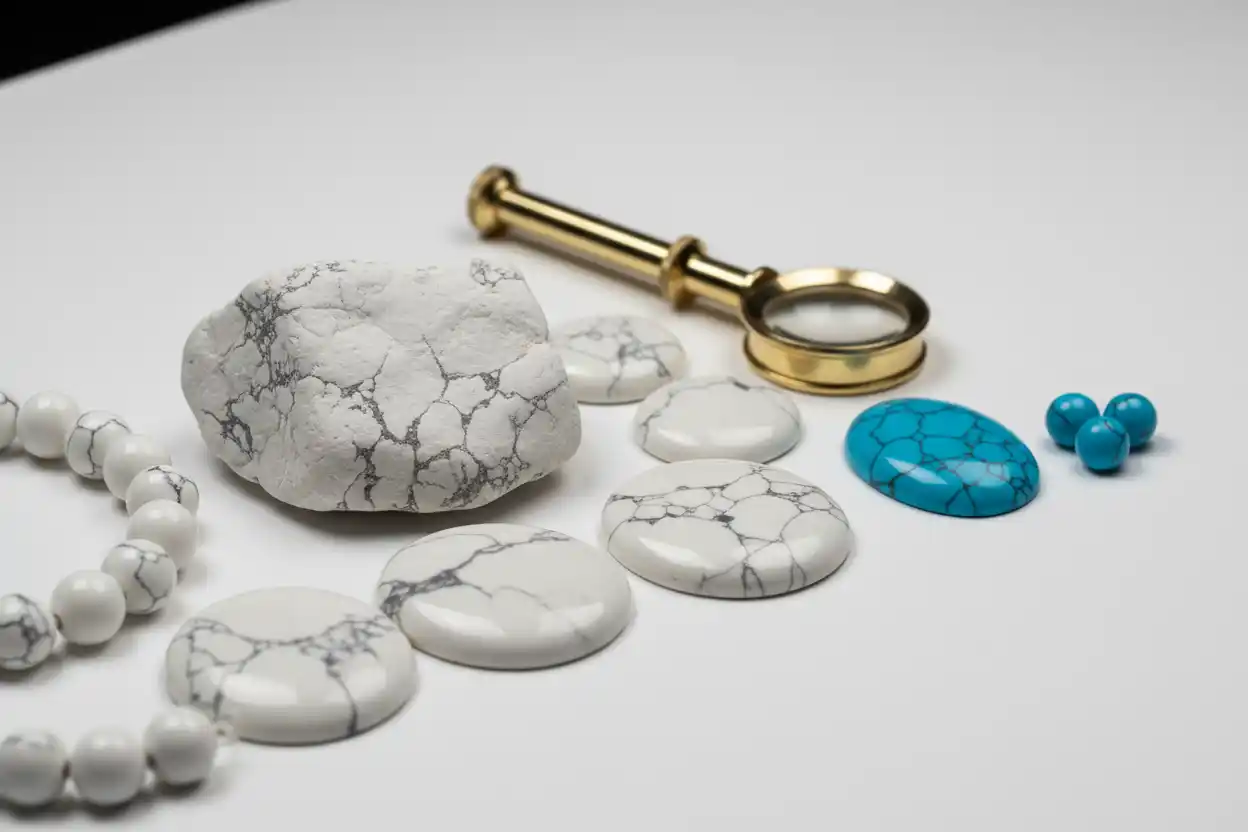
Where to Buy Real Howlite and Avoid Dyed or Magnesite Fakes
Real Howlite is naturally white, gray-white or cream and commonly displays irregular gray, brown or black veining. It usually occurs as nodules and compact massive material rather than large transparent crystals.
Howlite is inexpensive, so sellers rarely need to imitate it with an expensive substance. Nevertheless, much of the white veined material sold under the name may be Magnesite, dyed carbonate, reconstructed stone, ceramic or resin.
The more common deception works in the opposite direction: real Howlite or similar pale material is dyed blue and sold as Turquoise. Dyed Howlite can be an honest product when labeled correctly, but it is not natural Turquoise and should not receive Turquoise pricing.
The Howlite meaning and properties guide covers its identity and traditional symbolism. This page focuses on buying genuine white Howlite, distinguishing it from Magnesite and recognizing dyed products, coatings, composites and misleading Turquoise names.
What Howlite Actually Is
Howlite is a calcium borosilicate hydroxide with the chemical formula Ca2B5SiO9(OH)5.
It was named after Henry How, who described material from Nova Scotia, Canada. The mineral commonly develops in evaporite-related borate deposits and may form nodules resembling cauliflower heads.
Large, well-formed crystals are rare. Most lapidary and retail Howlite consists of fine-grained massive nodules.
That structural distinction affects hardness descriptions. Rare individual crystals can test significantly harder than the earthy, porous aggregates used for beads and carvings. Consequently, retail Howlite commonly behaves as a relatively soft, absorbent material despite the higher hardness measured for rare crystalline forms.
Choose the Product Form First
| Howlite product | Best source | Main buying concern |
|---|---|---|
| Natural nodule | Mineral dealer | Correct identification, stability and locality |
| Rough block | Lapidary supplier | Howlite versus Magnesite and internal fractures |
| White cabochon | Independent cutter | Natural veining, coating and resin |
| White bead strand | Established bead supplier | Magnesite substitution and pressed material |
| Blue dyed bead | Seller with full disclosure | Whether it is labeled dyed Howlite rather than Turquoise |
| Tumbled stone | Reputable crystal retailer | Ceramic, resin and surface paint |
| Carving | Skilled stone seller | Composite construction, dye and coating |
| Pendant | Jeweler with treatment disclosure | Glue, drill-hole fractures and color stability |
| Turquoise imitation | Costume-jewelry supplier | Accurate Howlite or Magnesite disclosure |
| Collector crystal | Specialist mineral dealer | Genuine rare crystal form and laboratory confirmation |
The product’s value lies more in accurate composition and workmanship than rarity.
Where to Buy Genuine Howlite
Specialist mineral dealers
A mineral dealer is the strongest source for natural nodules, locality specimens and unusual crystals.
Listings should identify the mineral, dimensions, weight, locality, matrix and condition. Request photographs of the underside and any broken surfaces.
Natural nodules can be chalky or fractured. Ask whether the specimen was consolidated with resin or coated to prevent shedding.
For a rare crystal specimen, laboratory confirmation is reasonable because most commercial Howlite does not form visible crystals.
Lapidary suppliers
A lapidary supplier should distinguish Howlite from Magnesite instead of treating both names as interchangeable.
Request dry photographs of rough and sawn surfaces. Water can deepen gray veins and conceal the porous nature of the material.
Ask whether the supplier has tested the rough through Raman spectroscopy, X-ray diffraction or another mineralogical method. Visual identification alone can be unreliable because massive Howlite and Magnesite overlap strongly.
Gem and mineral shows
Shows allow direct comparison with Magnesite, white Marble, dyed Turquoise substitutes and ceramic.
Use a loupe to inspect vein boundaries, pores, resin and dye. Natural veining should enter the material rather than sitting like paint on the surface.
Do not apply acetone, bleach, acid or scratch tests to merchandise. Solvents can remove dye or coating, while acids can damage Magnesite and other carbonate lookalikes.
Established online shops
The online gemstone buying guide explains payment protection, seller identity and return policies.
For white Howlite, request photographs against neutral backgrounds and close-ups of several veins. Repeated black patterns across multiple beads can indicate printing or molding.
For blue material, insist on explicit wording such as “dyed Howlite” or “Howlite Turquoise imitation.” A listing that simply says “Turquoise Howlite” remains ambiguous.
Independent jewelry makers
A maker may know whether beads were purchased as Howlite, Magnesite or generic white stone.
Ask to see drill holes and chipped areas. These locations often reveal whether color penetrates deeply or exists only near the surface.
For blue jewelry, request written confirmation that the seller is not representing dyed Howlite as natural Turquoise.
What Genuine White Howlite Looks Like
Natural Howlite is commonly white, chalk white, cream or pale gray. Gray, brownish or black lines may create irregular web-like or marble-like patterns.
The veining should vary in width and direction. It may branch, fade, reconnect or disappear into the pale body.
Some pieces contain very little dark veining. Therefore, a mostly white stone can still be genuine.
The surface ranges from dull and porous in rough material to waxy or moderately glossy after polishing. A thick glassy shine can indicate coating or resin, although skilled polishing may also improve luster.
Howlite is commonly opaque. Thin edges can show limited translucency, but transparent faceted Howlite is not a normal commercial product.
Natural nodules may have an irregular cauliflower-like exterior. Their interiors can contain fractures and changes in porosity.
Howlite Versus Magnesite
Magnesite is magnesium carbonate and is the most important Howlite lookalike.
Massive Magnesite can be white, porous and crossed by gray veins. It can accept dye readily and is frequently sold as either Howlite or imitation Turquoise.
Howlite and Magnesite differ in chemistry, crystal structure, hardness and spectroscopic response. However, polished beads can look nearly identical.
Magnesite is generally a carbonate and reacts with suitable acids under controlled conditions, while Howlite is a borosilicate hydroxide. Buyers should not perform acid testing because it damages the material.
Raman spectroscopy or X-ray diffraction provides a safer distinction. When a seller cannot verify the composition, “white veined stone” is more accurate than an absolute Howlite claim.
Howlite Versus White Marble and Calcite
White Marble consists largely of Calcite or Dolomite. It may show gray veins and can be carved or dyed.
Calcite-rich material is softer and has prominent carbonate cleavage. Howlite generally has a more porcelain-like massive texture without Calcite’s rhombohedral structure.
However, a finished carving can hide those differences. Instrumental testing remains preferable to scratching or acid.
A seller should not rely on appearance alone when purchasing large wholesale parcels.
Howlite Versus Porcelain and Ceramic
White ceramic can be printed with gray or black veins to imitate Howlite.
A ceramic object may show mold seams, a uniformly fine body and repeated pattern. Chipped edges can reveal a homogeneous fired interior beneath a surface design.
Some ceramic products are sold under decorative “stone” names without identifying their manufacture. Ask whether the object was mined, pressed or fired.
Porcelain can feel hard and cool, so touch alone does not prove natural stone.
Howlite Versus Resin
Resin can be molded with gray swirls, pigment and stone powder.
Casting seams, rounded bubbles, soft scratches and repeated internal patterns support polymer construction.
Some reconstructed products contain crushed Howlite or Magnesite held together with resin. The product contains natural mineral but is not one solid natural piece.
The fake-crystal buyer’s guide explains broader resin, ceramic and composite checks.
Dyed Howlite Sold as Turquoise
Turquoise is a copper-bearing aluminum phosphate mineral. Howlite is chemically and structurally different.
Because white Howlite is porous and often has dark veining, blue dye can create a convincing Turquoise-like appearance.
Dyed Howlite is sometimes marketed under names such as Turquenite or imitation Turquoise. Those descriptions are acceptable when they state clearly that the base mineral is treated Howlite or Magnesite.
The completed Turquoise buying guide explains natural Turquoise quality, while the real-versus-fake Turquoise guide owns the direct authenticity workflow.
The treated-Turquoise guide covers stabilization, dye, impregnation and reconstructed Turquoise itself.
A seller should not combine those markets by calling dyed Howlite “stabilized genuine Turquoise.”
How to Recognize Dyed Howlite
Artificial blue may concentrate around veins, pores, pits and drill holes. Chipped edges can reveal a white interior.
Some dye penetrates deeply enough that the entire bead appears blue. Therefore, a white core is useful evidence when present, but its absence does not prove Turquoise.
An unnaturally uniform bright-blue strand with identical dark veining deserves scrutiny. However, natural Turquoise can also be uniform, so the mineral identity must be considered.
Do not rub the stone with solvents. Acetone or alcohol can damage dye, lacquer, adhesive and jewelry settings.
Professional microscopy, spectroscopy and compositional testing provide safer answers.
Dyed Howlite in Other Colors
Howlite can be dyed red, purple, green, pink, orange or black as well as blue.
A treated color does not make the base mineral artificial. Nevertheless, the listing should state that the color was introduced.
Green dyed material may be sold as jade or Chrysoprase, while red material can imitate coral or other decorative gems.
Purple or rainbow Howlite should be treated as a dyed product unless strong evidence establishes an unusual natural occurrence.
Coating and Polymer Impregnation
A clear coating may improve polish and reduce porosity. Colored coatings can deepen dye or conceal a pale surface.
Polymer impregnation can strengthen chalky material and make it more suitable for beads and carvings.
Inspect drill holes and worn edges. A resin film may appear glossy, pool inside pits or scratch differently from the stone.
The gemstone treatments guide explains the distinction among surface coating, fracture filling, impregnation and composite construction.
Painted Veins
A manufacturer can add black or gray lines to plain white stone, ceramic or resin.
Under magnification, paint may sit over scratches or cross the surface without entering the body. It can also form a slight ridge.
Natural veins should appear integrated and continue into exposed edges when the cut intersects them.
Do not scrape the vein to test it. The return policy and professional examination provide safer protection.
Reconstituted Howlite
Howlite fragments or powder can be mixed with binder and molded into beads, skulls, towers and other shapes.
Mold seams, identical veining, resin-rich chips and repeated patterns can reveal reconstruction.
The material may be marketed as “pressed Howlite” or “reconstituted Howlite.” Those names are acceptable when disclosed.
It should not receive the same price as a carving cut from one natural nodule.
How to Evaluate Rough and Nodules
Request natural-surface and broken-face photographs.
A genuine nodule should show irregular internal texture and vein continuity rather than a printed surface pattern.
Look for fractures that divide the usable material. Porous, chalky zones may require consolidation before cutting.
Ask whether the rough has been dyed, waxed or resin-treated. Even white material may contain clear polymer.
If exact species matters, request testing that separates Howlite from Magnesite.
How to Judge Cabochons and Carvings
A cabochon should have an even dome, stable girdle and smooth polish without thick coating.
Natural veining should enhance the shape rather than appear mechanically repeated.
Inspect the back for filler, paint and lighter material beneath dyed color. A dark backing can change the appearance and must be disclosed.
Carvings should avoid very thin projections because massive Howlite can fracture or abrade around weak zones.
Buying Beads and Bracelets
Inspect several drill holes. They often reveal dye concentration, resin, chips and the underlying body color.
Natural white strands should show variation in vein placement. Identical web patterns across every bead strongly suggest printing or molding.
Ask whether the beads are solid Howlite, Magnesite, dyed Howlite, reconstructed material or ceramic.
The gemstone hardness chart provides durability context, while the toughness-versus-hardness guide explains why porous aggregates and drill holes can fail despite mineral-hardness claims.
Buying Blue Howlite Jewelry
Blue Howlite jewelry can be an affordable costume-jewelry option when it is sold honestly.
The invoice should say dyed Howlite rather than natural Turquoise. The Turquoise price guide provides market context for why the distinction matters financially.
Dye may fade after exposure to chemicals, sweat, perfume or strong light. Clear coatings can also wear away.
Avoid assuming that care instructions for untreated white Howlite apply to every dyed and coated item.
Price and Value
Natural Howlite is generally inexpensive. Price reflects size, vein pattern, polish, carving skill, matching, treatment and accurate identification.
A large natural nodule or rare crystal specimen may have collector value. However, ordinary white beads should not receive a rarity premium.
Dyed Howlite should cost substantially less than fine natural Turquoise. Elaborate jewelry can still be expensive because of metalwork and design, but the stone description must remain accurate.
Reconstructed and ceramic products should be priced as manufactured materials rather than rare minerals.
The gemstone pricing guide explains the difference between material value and finished-object workmanship.
Questions to Ask the Seller
Ask whether the item was identified as Howlite through testing or only visual appearance.
Request a clear comparison with Magnesite. Then ask about dye, polymer, coating, lacquer, wax, paint and binder.
For blue pieces, obtain written confirmation that the material is dyed Howlite rather than natural Turquoise.
For beads, request drill-hole close-ups. For nodules, ask for broken or sawn surfaces. For carvings, obtain a complete rotation.
Finally, confirm whether the return policy allows professional identification.
Professional Identification
Raman spectroscopy and X-ray diffraction can distinguish Howlite from Magnesite, Calcite, ceramic and resin.
Microscopy can reveal pores, dye concentrations, paint, coatings and composite boundaries.
Infrared spectroscopy may assist in detecting polymer. Chemical analysis can identify calcium, boron and silicon consistent with Howlite while separating magnesium-carbonate substitutes.
Testing should identify both the base material and treatment. Confirming Howlite does not prove that blue or green color is natural.
Ethical Sourcing and Care
The ethical crystal sourcing guide provides practical questions about legal extraction, manufacturing and lapidary labor.
Clean untreated white Howlite with a soft dry or slightly damp cloth. Avoid prolonged soaking because porous material can retain moisture.
Dyed, coated and impregnated pieces require gentler care. Keep them away from solvents, bleach, perfume and strong household chemicals.
For traditional practices, the completed Howlite cleansing and charging guide offers non-destructive options.
Store beads so they do not strike harder stones or metal components repeatedly.
Frequently Asked Questions
1. What color is natural Howlite?
Natural Howlite is usually white, cream or pale gray with gray, brown or black veining.
2. Is blue Howlite natural?
Blue Howlite is usually dyed. Naturally blue Howlite is not the standard commercial material.
3. Is dyed Howlite fake?
It is genuine Howlite with treated color when the identification is correct. It becomes deceptive when sold as natural Turquoise.
4. Is Howlite the same as Turquoise?
No. Howlite is a calcium borosilicate hydroxide, while Turquoise is a copper-bearing aluminum phosphate.
5. Is Howlite the same as Magnesite?
No. They are different minerals, although massive white material can look very similar.
6. How can I distinguish Howlite from Magnesite?
Visual inspection is often insufficient. Raman spectroscopy or X-ray diffraction provides a safer answer than acid or scratch testing.
7. Does every genuine piece have black veins?
No. Some natural Howlite is mostly white with little visible veining.
8. Can Howlite be resin-treated?
Yes. Porous or fractured material may be coated, impregnated or reconstructed with polymer.
9. Can Howlite be made from ceramic?
Ceramic can imitate Howlite, especially when gray veins are printed over a white body.
10. Is Howlite suitable for everyday bracelets?
It can be worn with care, although drill holes, dye and coatings may wear or fracture over time.
11. Do ordinary beads need laboratory reports?
Usually not. Testing becomes useful for wholesale parcels, expensive carvings or disputes involving Turquoise claims.
12. What is the biggest warning sign in a listing?
Be cautious when vivid blue beads are sold as natural Turquoise while the seller avoids identifying the white porous base material.
Buy Howlite for What It Is
White Howlite has its own distinctive nodular structure and veining. It does not need a Turquoise name to be attractive.
The H crystal directory, H gemstone directory and visual gemstone guide provide wider comparison points. Choose the seller who distinguishes Howlite from Magnesite and describes every introduced color plainly.
Safety note: Avoid inhaling dust from Howlite, Magnesite, ceramic or unidentified composite material. Do not dry-cut, drill, sand or grind it. Lapidary processing requires wet methods, effective extraction and appropriate eye and respiratory protection.