How to Use Garnet: A Practical Guide
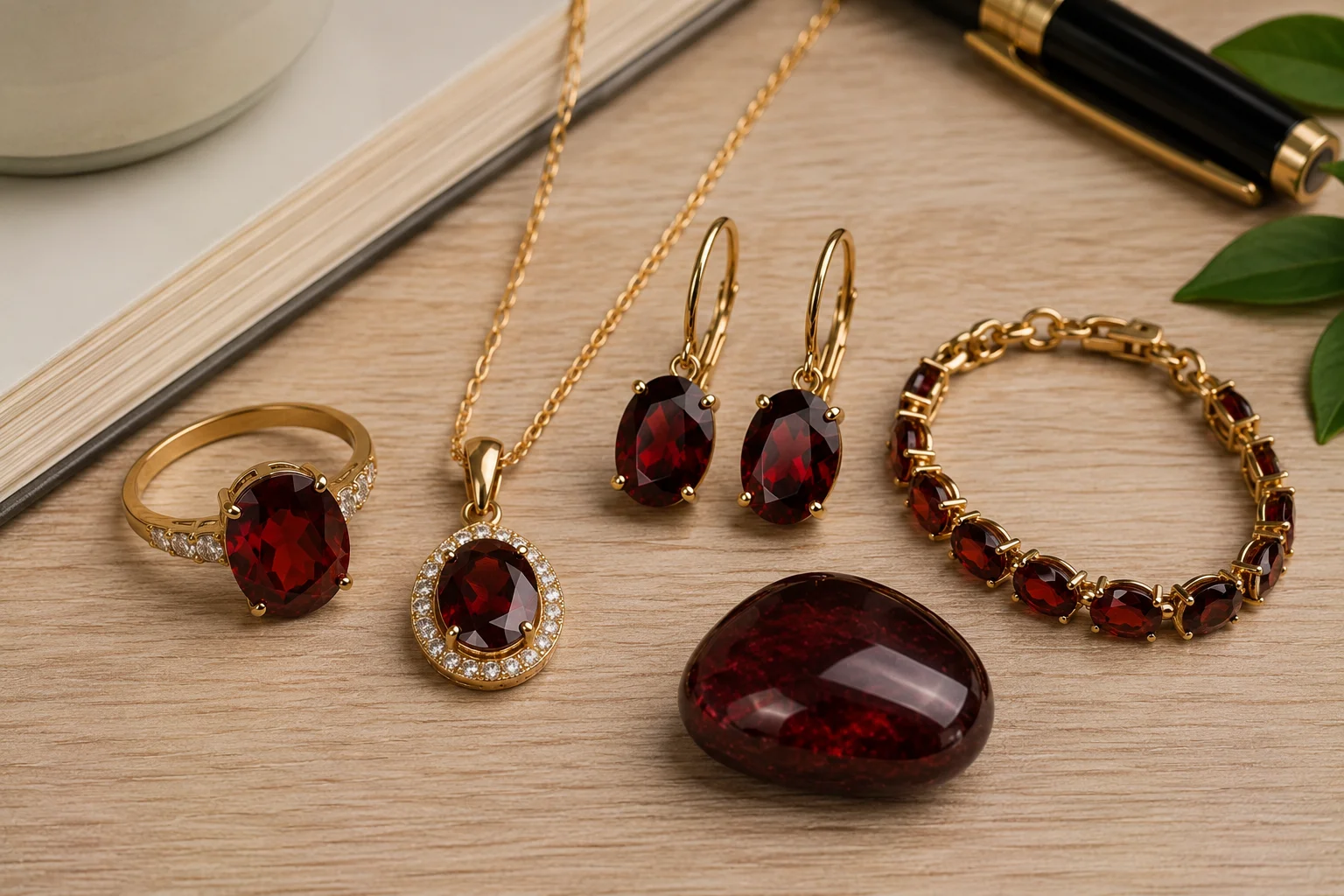
Garnet can be used as wearable jewelry, a pocket stone, a visual reminder on a desk, a meditation object, a journaling prompt, or a meaningful gift. The most useful approach is to connect the stone with a specific action or value rather than expecting it to produce an automatic result.
For example, a Garnet ring might remind you to follow through on commitments, while a loose polished stone could mark the beginning of a focused work session. These uses are personal and symbolic. Garnet has no scientifically established ability to improve health, attract wealth, change relationships, or alter a person’s energy.
The mineral family, historical background, colors, and broad symbolism belong to the main Garnet guide. This article focuses on what to do with Garnet in daily life.
Begin with the Type of Garnet You Have
Garnet is a mineral group rather than one uniform stone.
Red almandine and pyrope are the most familiar varieties, but Garnet can also appear orange, green, pink, purple, yellow, brown, or nearly colorless. Rhodolite, Spessartine, Hessonite, Tsavorite, Demantoid, Grossular, and Uvarovite all belong within the wider family.
The complete mineral and color structure appears in Types of Garnet.
Different Garnets can carry different personal associations because their colors, rarity, crystal forms, jewelry uses, and cultural histories differ. Nevertheless, the same practical principle applies across the group: choose a use that suits the physical form of the stone.
A polished red Garnet may work well as a pocket object. A fine faceted Tsavorite or Demantoid deserves a protected jewelry setting. A fragile Uvarovite druse should remain in a display case rather than being carried loosely.
Practical Ways to Use Garnet
| Intended use | Suitable Garnet format | Practical action | Main care point |
|---|---|---|---|
| Daily reminder | Ring, pendant, or pocket stone | Connect it with one habit or commitment | Avoid impact and loose storage |
| Focused work | Desk stone or specimen | Place it beside one defined task | Keep away from shelf edges |
| Meditation | Smooth stone or secured jewelry | Hold loosely or place nearby | Do not grip crystal points |
| Journaling | Loose stone beside a notebook | Use it as a prompt for reflection | Keep pens and clips from scratching it |
| Relationship symbolism | Pendant, matched pair, or gift | Associate it with a specific shared value | Avoid unsupported promises |
| Exercise motivation | Stone placed near—not on—the body | Use it before or after training | Do not wear during contact sports |
| Home display | Crystal or mineral specimen | Place it in a stable lit display | Protect matrix and fragile faces |
| Birthstone use | January jewelry or keepsake | Mark a birthday or anniversary | Match care to treatment and setting |
Use Garnet as a Daily Intention Reminder
Choose one action that you can realistically perform.
A Garnet might remind you to finish one important task before opening social media, maintain a weekly budgeting habit, follow through on a promise, or respond directly rather than avoiding a difficult conversation.
Hold the stone briefly or touch the jewelry at the start of the day. State the intention in one sentence, then identify the first practical step.
The object does not perform the action for you. Its usefulness comes from creating a repeated cue.
The tracker’s Garnet Affirmations page contains belief-based phrases and daily ritual language. This guide instead emphasizes linking Garnet with observable behavior.
Wear Garnet as Jewelry
Garnet is well suited to jewelry because most varieties fall between approximately 6.5 and 7.5 on the Mohs scale and have fair-to-good toughness.
The gemstone hardness chart explains its relative scratch resistance. However, scratch resistance is not identical to resistance against chipping, bending, or impact, as discussed in Gemstone Toughness vs Hardness.
Garnet has no pronounced cleavage, although existing fractures, thin facet edges, and delicate settings remain vulnerable. The broader structural distinction belongs to Gemstone Cleavage Explained.
Garnet Rings
A Garnet ring keeps the stone visible and makes it easy to use as a behavioral cue.
A ring may represent consistency, loyalty, a professional milestone, or a personal commitment. Touching the ring can serve as a reminder to pause before making a decision or to complete a planned action.
However, rings receive more impacts than pendants and earrings. Remove Garnet rings before weight training, contact sports, gardening, mechanical work, or handling hard tools.
Setting styles, protection, and buying considerations belong to Garnet Rings.
Garnet Necklaces and Pendants
A pendant places Garnet away from many of the impacts received by rings.
It can be worn as a discreet personal reminder or selected for its red, orange, green, or purple color rather than a metaphysical purpose.
The chain, bail, and setting matter as much as the stone. Check periodically for thinning jump rings, bent prongs, worn wire, and loose connections.
Styles and selection factors appear in Garnet Necklaces and Pendants.
Garnet Bracelets
Bracelets are easy to notice during the day, which can make them effective habit cues.
However, beads repeatedly strike desks, doors, watches, and one another. Elastic can also stretch, while drill holes may chip.
Lay the bracelet flat during storage and restring it when the cord becomes fuzzy, loose, or discolored.
Do not stack Garnet beads against substantially harder stones or metal-edged bracelets.
Carry Garnet in a Pocket or Pouch
A smooth tumbled Garnet can be carried in a separate fabric pouch.
Avoid placing it loose beside keys, coins, tools, or harder gemstones. Metal can scratch the polish, while a faceted stone can damage softer objects.
Choose a single purpose for the carried stone. For example, it might represent completing a difficult phone call, remaining consistent with a plan, or returning attention to the current task.
Touching the pouch can provide the reminder without taking the stone out repeatedly.
Crystal clusters, druses, sharp rough pieces, and matrix specimens should not be carried in a pocket. Friction may chip crystal faces or release fragments.
Use Garnet During Meditation
Place the Garnet on a folded cloth in front of you or hold a smooth piece loosely.
Begin by selecting a practical theme, such as persistence, responsibility, relationship boundaries, or readiness for change.
Notice the stone’s color, weight, transparency, inclusions, and temperature. Then return attention to your breathing.
When thoughts wander, use the Garnet as a visual point for refocusing.
Meditation can support relaxation and attention as a personal practice, but the Garnet itself should not be presented as a treatment for anxiety, depression, trauma, circulation problems, sexual dysfunction, or any other medical condition.
Traditional wellness associations are covered separately in Garnet Healing Properties.
Use Garnet in Journaling
Place Garnet beside your notebook rather than directly on the paper.
Select one prompt connected with the stone’s intended role:
“What commitment needs a specific next step?”
“Where am I relying on motivation instead of a repeatable routine?”
“What conversation am I postponing?”
“Which relationship boundary needs clearer wording?”
“What can I finish before beginning something new?”
Write without trying to produce a mystical message from the stone. The Garnet functions as a structured prompt.
Spiritual and historical interpretations can be explored in Garnet Spiritual Meaning and Symbolism.
Use Garnet in a Work or Study Space
Place a stable Garnet specimen or polished stone beside one active project.
Avoid turning the desk into an undifferentiated collection of symbolic objects. One stone associated with one action is easier to use consistently.
For example, Garnet may mark a block of uninterrupted work. When it is placed beside the keyboard, silence nonessential notifications and begin the defined task. Remove or relocate it when the session ends.
Keep the stone away from drinks, moving desk drawers, computer ventilation, and shelf edges.
A heavy specimen should sit on a padded base so it cannot scratch furniture or be knocked onto the floor.
Use Garnet as a Relationship Symbol
Garnet has longstanding cultural associations with loyalty, friendship, protection during travel, vitality, and enduring bonds.
A couple or family may assign a Garnet to a specific value such as honest communication, consistency, mutual support, or respect for boundaries.
A matched pair of stones can represent two people without implying that the stones control the relationship.
When giving Garnet, explain the personal reason for the gift rather than promising that it will secure loyalty, increase attraction, restore intimacy, or prevent conflict.
Broad traditional associations belong to Garnet Benefits and How to Use It, while this page keeps the practice tied to deliberate actions.
Use Garnet with Chakra or Energy Practices
Modern crystal traditions frequently associate red Garnet with the root chakra and sometimes connect orange, green, or purple Garnets with other energy centers.
These associations are belief-based rather than scientifically measurable.
Someone following a chakra practice may place Garnet nearby, hold a smooth stone, wear jewelry, or use it as a meditation focus. Avoid placing heavy or sharp crystals directly on the body, particularly near the face, throat, or abdomen.
The complete belief-based framework belongs to Garnet Chakra.
A stone does not diagnose, open, balance, or heal an anatomical structure in a medically established sense.
Use Garnet with Color-Based Intentions
Color can guide a personal ritual without determining the mineral’s scientific effect.
Red Garnet is commonly associated with commitment, endurance, courage, and grounded action.
Orange Spessartine or Hessonite may be connected with creativity and initiative. Green Tsavorite, Grossular, Demantoid, or Uvarovite may represent growth, renewal, or generosity.
Purple-pink Rhodolite may be used as a symbol of emotional honesty or self-respect.
These meanings are interpretive, not inherent forces produced by wavelength or chemistry.
Choose the Garnet whose appearance feels relevant, but verify the species and treatment when price or authenticity matters.
Use Garnet as a January Birthstone
Garnet is the traditional birthstone for January.
It may be worn to mark a birthday, anniversary, graduation, professional achievement, family connection, or personal milestone.
The historical and gifting context belongs to the January Birthstone guide.
A birthstone does not have to be red. Green Tsavorite, orange Spessartine, purple Rhodolite, and other Garnets can create a more individualized gift.
Consider lifestyle before selecting the format. A protected pendant may be more practical than a high-set ring for someone who works extensively with their hands.
Use Garnet Before Exercise—Not During Impact Activities
Garnet may serve as a visual cue before exercise, particularly when connected with consistency or endurance.
Place it beside training shoes, a written program, or a water bottle before beginning. Then leave the stone in a secure place.
Do not carry a loose crystal during running, cycling, climbing, contact sports, or swimming.
Likewise, remove Garnet rings and bracelets before lifting weights. A metal band can trap or pinch a finger, while the stone can chip against equipment.
The object can support the routine as a reminder without being physically present during the hazardous part of the activity.
Use Garnet in a Home Display
Garnet crystals and mineral specimens can form attractive displays because they occur in several crystal habits, colors, and host rocks.
Place a specimen on a stable padded stand away from shelf edges and direct handling.
Demantoid may occur on matrix with fragile crystals. Uvarovite commonly forms small green crystals coating another rock. Almandine can form robust-looking crystals that still have chips and matrix weaknesses.
Do not clean a specimen by soaking it simply because a polished Garnet tolerates water. Matrix minerals may impose stricter limits.
The environmental comparison belongs to Is Garnet Safe in Water and Sunlight?.
Cleanse Garnet Without Confusing Ritual and Maintenance
Some practitioners cleanse Garnet before first use, after lending it, or when assigning a new intention.
Sound, visualization, intention, indoor moonlight, and brief water contact are among the available methods.
The complete ritual procedure belongs to How to Cleanse and Charge Garnet.
Physical cleaning is a separate process. Fingerprints, soap, cosmetics, and dirt require appropriate gem and jewelry care, covered in How to Clean Garnet Jewelry Safely.
Do not use steam as a ritual or maintenance shortcut. Fracture-filled stones require particularly gentle care.
Store Garnet According to Its Form
Place loose faceted Garnet in a divided gem box or soft individual pouch.
Store rings so their stones do not touch one another. A Garnet can scratch softer gems, while harder stones such as Sapphire and Diamond can scratch Garnet.
Lay necklaces flat or hang them where the pendant cannot strike a wall or another jewel.
Keep matrix specimens in stable containers with padding around—but not pressing against—the crystals.
Normal room light is generally suitable. Avoid extreme heat, uncontrolled chemicals, and locations where the stone can fall.
The wider wearability decision belongs to Is Garnet Durable Enough for Everyday Wear?.
Buy Garnet for the Use You Actually Have Planned
Before purchasing, decide whether the stone will be worn, carried, displayed, gifted, or used only as a symbolic object.
The Garnet Buying Guide covers color, cut, clarity, variety, treatment, and seller disclosure.
Market costs vary dramatically across common red material, fine Rhodolite, vivid Spessartine, Tsavorite, Demantoid, and rare collector crystals. Those differences belong to the Garnet Price Guide.
When identity is uncertain, use Real vs Fake Garnet before paying a premium.
A spiritual purpose does not require the most expensive Garnet. A modest, accurately described stone can serve the same reminder as a rare gem.
Uses to Avoid
Do not make drinking water by soaking Garnet unless every component and treatment has been evaluated for that use. Direct-soak crystal elixirs are unnecessary.
Do not place loose stones in a child’s crib, pet enclosure, food container, or bath.
Avoid sleeping while wearing Garnet rings, bracelets, or necklaces. Jewelry can catch on bedding, strain settings, or create entanglement.
Do not use Garnet as a replacement for medical treatment, relationship counseling, financial planning, exercise programming, or mental-health care.
Finally, do not strike, heat, scratch, or expose the stone to chemicals to intensify its supposed effects.
Frequently Asked Questions
1. What is the simplest way to use Garnet?
Assign a polished stone or piece of jewelry to one specific action, then touch or look at it when it is time to perform that action.
2. Can Garnet be worn every day?
Many Garnets are durable enough for regular jewelry, although rings should be removed during impact-prone work, sports, and heavy lifting.
3. Which hand should a Garnet ring be worn on?
There is no scientifically required hand. Choose according to comfort, ring fit, personal symbolism, and the activities performed with each hand.
4. Can Garnet be kept in a pocket?
Yes, when it is a smooth stable stone stored in a separate cloth pouch away from keys, coins, and harder gems.
5. Can Garnet be used during meditation?
Yes. Hold it loosely or place it nearby as a visual focus, while treating any spiritual interpretation as a personal belief.
6. Can Garnet be placed under a pillow?
A small smooth stone may still create pressure, become lost, or damage bedding. Keeping it on a bedside table is safer.
7. Can Garnet be used for manifestation?
It can function as a reminder of a goal, but it does not replace planning, skill, work, or external conditions.
8. Does Garnet attract love?
No scientific evidence shows that Garnet attracts a partner or changes another person’s feelings. It may symbolize commitment or honest communication.
9. Can Garnet help with motivation?
The stone can serve as a consistent behavioral cue, but motivation and performance depend on sleep, health, planning, environment, and action.
10. Can Garnet be used with other crystals?
Yes, but keep stones physically separated when their hardness, edges, or care requirements differ.
11. How often should Garnet be cleansed?
There is no required schedule. Clean it physically when dirty and perform a symbolic ritual when changing its intended role.
12. Does the Garnet variety change how it should be used?
The personal symbolism may change with color and appearance, while the physical format, treatment, inclusions, and matrix determine safe handling.
Conclusion
Garnet becomes most useful when it is assigned a clear role: a reminder to follow through, a marker for focused work, a meaningful piece of jewelry, or a symbol attached to a relationship or milestone. Choose a format that fits the activity, protect the stone from impact, and let the ritual point toward an action you can actually take.
Garnet symbolism and crystal-healing practices are matters of personal or cultural belief. They are not scientifically established treatments for physical or psychological conditions.