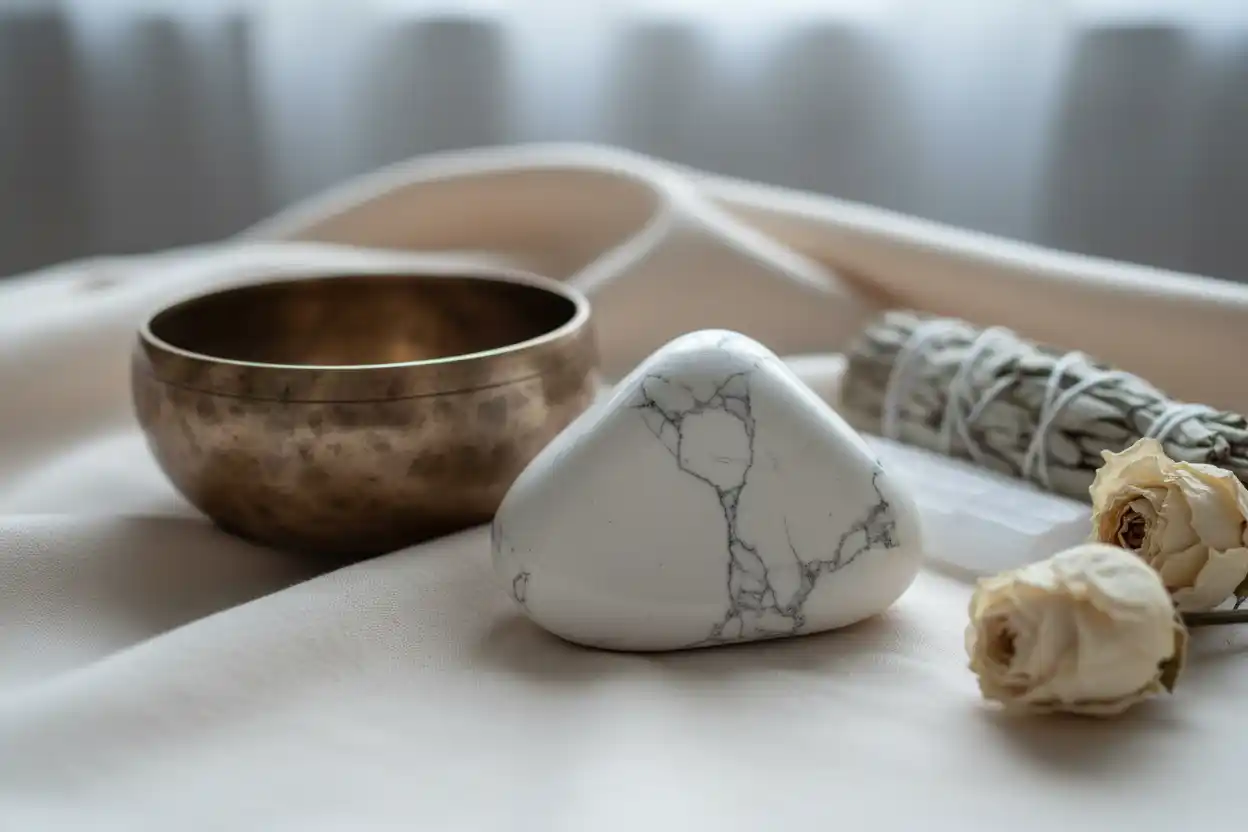
How to Cleanse and Charge Howlite
The safest ways to cleanse and charge Howlite are sound, intention, visualization, gentle breath, indirect indoor moonlight, a written dedication, and a careful dry-cloth ritual. A brief damp wipe may be appropriate for sound natural-white Howlite, but soaking is unnecessary because the mineral is soft and commercial pieces are frequently dyed to imitate Turquoise or other colored stones.
Avoid prolonged water exposure, salt burial, harsh chemicals, essential oils, direct contact with harder crystals, steam, ultrasound, and abrasive polishing. These methods can scratch Howlite, weaken stringing, damage glue, or cause unstable dye to fade or transfer.
What Cleansing and Charging Mean
Cleansing is a personal or spiritual ritual used to mark a new beginning, release previous associations, or prepare an object for meditation.
Charging generally means dedicating the object to a purpose, habit, value, memory, or personal reminder.
Neither process is required to maintain Howlite as a mineral. No established scientific evidence shows that cleansing alters its chemistry, color, health effects, or measurable physical energy.
The mineral’s geology, white color, dark veining, symbolic uses, and history belong to the broader Howlite guide.
This article remains focused on safe ritual methods rather than repeating the general material profile.
Why Howlite Needs Gentle, Dye-Aware Care
Howlite is a calcium borosilicate hydroxide found principally in borate deposits.
It commonly forms white nodules with gray, black, or brown vein-like markings. In massive form, its surface can range from chalky to porcelain-like.
| Property | Ritual implication |
|---|---|
| Composition | Calcium borosilicate hydroxide |
| Natural color | White to creamy white with gray or dark veining |
| Mohs hardness | Approximately 3.5 |
| Common form | Nodular, massive, chalky, or porcelaneous |
| Typical fashioned forms | Beads, cabochons, tumbles, carvings, and imitation-Turquoise pieces |
| Safest ritual methods | Sound, intention, visualization, breath, and protected moonlight |
| Water exposure | Prefer dry methods; use only a brief damp wipe when suitable |
| Main risks | Scratches, dye transfer, porosity, glue, elastic, drill holes, and hard contact |
The gemstone hardness chart explains why Quartz, glass, steel, ceramic, and many popular crystals can scratch Howlite.
Its surface condition and jewelry construction matter as much as hardness. Those broader distinctions appear in Gemstone Toughness vs Hardness and Gemstone Cleavage Explained.
Natural Howlite Is White
Natural Howlite is white or creamy white, commonly crossed by gray, dark gray, brown, or black veining.
Bright turquoise blue, cobalt blue, purple, red, green, or other strongly saturated colors usually indicate dye or another treatment.
Dyed Howlite is widely used as a Turquoise imitation because its dark veins can resemble matrix.
The tracker’s How to Spot Dyed Crystals page owns the broader dye-detection workflow.
The complete treatment framework appears in Gemstone Treatments Explained.
Color treatment does not prevent personal symbolic use, but it changes how much moisture, friction, light, and solvent exposure the object should receive.
Inspect the Howlite First
Examine the stone under bright, indirect light.
Look for scratches, chipped edges, open fractures, faded areas, dye concentrated inside cracks, color transfer, cloudy glue, damaged drill holes, stretched elastic, and lifting coatings.
Dark veins are normally part of natural Howlite and should not be scrubbed away.
A pale patch on blue Howlite may indicate abrasion or dye loss rather than dirt.
Do not scratch the surface to test whether the color penetrates. A destructive test lowers the object’s condition and may expose white material beneath the dye.
When color or construction is uncertain, use a completely dry, non-contact method.
Test Dyed Howlite Conservatively
Dampen a white cotton swab or small corner of a white cloth with clean water.
Touch a hidden area briefly, such as the back of a cabochon or the edge of a drill hole.
Stop if blue, green, purple, red, or another color transfers.
Do not repeat the test with alcohol, acetone, sanitizer, vinegar, bleach, or essential oil. These substances may remove dye or damage glue and coatings.
A negative damp-cloth test does not prove that the Howlite is naturally colored. Some commercial dyes are more stable than others.
Physical Cleaning Is Separate
Symbolic cleansing does not remove skin oil, cosmetics, or dust.
A natural-white polished Howlite can be wiped gently with a dry microfiber cloth.
When necessary, use a cloth barely dampened with lukewarm water and dry the stone immediately.
Do not soak beads, elastic bracelets, glued cabochons, coated pieces, dyed material, or antique jewelry.
Avoid steam, ultrasonic equipment, abrasive compounds, toothpaste, chemical dips, alcohol, and oil.
The general method-selection framework belongs to How to Cleanse Crystals.
Method 1: Cleanse Howlite with Sound
Place the Howlite on a folded cloth or padded tray.
Ring a bell, chime, tuning fork, or singing bowl nearby. You may also hum, chant, clap gently, or play calm music.
Do not place the stone inside a metal bowl while striking it. Direct contact can scratch the soft surface or chip an edge.
Sound is suitable for natural-white, dyed, glued, beaded, coated, and uncertain material.
Several gentle tones are sufficient.
Method 2: Use Intention
Leave the Howlite on its padded support or hold it loosely above a cloth.
Choose one clear purpose. The stone might serve as a reminder to pause before replying, maintain a consistent bedtime, approach frustration more calmly, or create quiet time away from devices.
State the intention silently or aloud.
This method requires no water, salt, light exposure, or other crystals.
The ritual can remain simple while still creating a clear association between the object and the intended behavior.
Method 3: Use Visualization
Place the Howlite where it cannot roll or fall.
Imagine previous associations fading while its white surface and dark veins become linked with your chosen purpose.
Some practitioners visualize white, gray, blue, or neutral light. The image is symbolic rather than a physical emission from the stone.
Continue for several slow breaths or a few minutes.
Visualization is particularly suitable for dyed Howlite because it does not test the stability of the color.
Method 4: Use Breath Carefully
Keep the stone on a soft cloth.
Take several slow breaths and exhale gently toward it once or twice.
Avoid creating visible condensation around drill holes, glue seams, or porous areas.
Do not hold a bead strand by one end while performing the ritual. Leave it supported flat.
State the intention afterward.
Method 5: Use Indirect Moonlight Indoors
Place Howlite indoors near a window on a padded tray or inside an open lined jewelry box.
An hour, an evening, or overnight indoor placement may be used.
Outdoor placement is unnecessary. Dew, rain, dirt, animals, theft, and temperature changes create practical risks.
Indirect indoor light is also preferable for dyed material because it avoids prolonged ultraviolet exposure and heat.
The wider light-safety framework belongs to Which Crystals Can and Can’t Go in the Sun.
Method 6: Use a Written Dedication
Write one concise statement and place it beside the Howlite.
A practical statement might focus on reducing late-night screen use, listening without interrupting, responding more patiently, or preserving time for rest.
Keep pens, clips, staples, and metal objects away from the polished surface.
The note may remain beside the stone for several minutes or an evening.
A written ritual is useful for dyed beads because the object remains dry and undisturbed.
Method 7: Use a Mindful Dry-Cloth Ritual
Place a stable polished Howlite on a padded surface.
Wipe it once or twice with a very soft dry microfiber cloth while focusing on the intended purpose.
Use minimal pressure and stop if the cloth catches on a crack, rough area, or damaged drill hole.
Do not use paper towels, polishing compounds, silver cloths, or abrasive fabric.
This method is unsuitable when dye transfers or the surface appears chalky.
Method 8: Use a Companion Object with Separation
Some practitioners place Howlite near Selenite, Clear Quartz, Turquoise, a written note, or a photograph.
Use separate soft cloths and leave physical space between the objects.
Clear Quartz is substantially harder and can scratch Howlite. Metal chains, earring posts, and crystal points can also cause damage.
Direct contact is not required for symbolic charging.
The tracker’s White Gemstones and Blue Gemstones guides provide broader visual context for natural and dyed forms.
Howlite and Turquoise Are Different Minerals
Howlite is a calcium borosilicate hydroxide, while Turquoise is a hydrated copper aluminum phosphate.
Their natural colors, chemistry, hardness, porosity, treatments, value, and geological formation differ.
Dyed Howlite may imitate Turquoise visually, but it does not become Turquoise because it has absorbed blue dye.
The Turquoise material profile belongs to the Turquoise guide.
The complete authentication workflow appears in Real vs. Fake Turquoise, while treatment distinctions belong to How to Spot Treated or Synthetic Turquoise.
Apply Turquoise Care Conservatively to Blue Howlite
When a blue bead or cabochon has been sold as Turquoise but may be dyed Howlite, choose the gentler care method until identity is confirmed.
The tracker’s How to Clean Turquoise Jewelry Safely page recommends avoiding ultrasound, steam, harsh chemicals, and prolonged moisture.
The symbolic counterpart is How to Cleanse and Charge Turquoise.
Those restrictions are also sensible for dyed Howlite because dye, glue, backing, stringing, and porous surfaces may be present.
The Turquoise buying guide and Types of Turquoise own market terminology and genuine variety distinctions.
Howlite and Magnesite
Howlite and Magnesite are both commonly dyed blue and used as Turquoise imitations.
Magnesite is magnesium carbonate, while Howlite is a calcium borosilicate hydroxide.
Their hardness, veining, porosity, reaction to acids, and internal structures differ.
The Magnesite material profile belongs to the Magnesite guide.
Do not use vinegar, scratching, or destructive chemical tests to distinguish the two in finished jewelry.
Professional examination is safer than damaging a polished bead.
Avoid Prolonged Water Exposure
A brief damp wipe may be acceptable for stable natural-white Howlite.
Soaking creates greater uncertainty because commercial pieces may contain dye, glue, coatings, resin, elastic, stringing, or backing.
Water may carry color from unstable dye or leave pale patches after uneven drying.
The wider water-selection framework belongs to Which Crystals Can and Can’t Go in Water.
Sound, intention, visualization, and moonlight provide lower-risk ritual alternatives.
Avoid Salt and Saltwater
Salt grains can scratch Howlite and lodge in veins, drill holes, cracks, and jewelry settings.
Saltwater adds prolonged moisture and may cause dye transfer or affect elastic, metal, glue, and coatings.
Do not bury beads or cabochons directly in salt.
When salt has symbolic importance, keep it inside a separate bowl while the Howlite remains on a lined dish nearby.
Avoid Soil Burial
Soil contains Quartz grains, mineral debris, moisture, microorganisms, fertilizers, and organic acids.
These materials can scratch the soft surface, stain white Howlite, or alter dyed areas.
Outdoor burial also risks loss and damage to bead stringing.
A nature-based alternative places Howlite near a plant while keeping it dry and separated from soil.
Avoid Smoke Residue and Essential Oils
A brief cool-smoke ritual may be used cautiously, but smoke can leave soot and oily residue on white or dyed surfaces.
Essential oils, perfume, sanitizer, and fragrance sprays may stain natural Howlite or disturb dye.
Keep the stone away from flame, hot ash, incense coals, and heated bowls.
Sound and visualization are cleaner alternatives.
Buying and Disclosure Context
The Where to Buy Real Howlite guide covers natural white color, veining, scratches, dye, imitation, construction, and seller disclosure.
A seller should identify blue Howlite as dyed Howlite rather than natural Turquoise.
Low price alone does not prove an imitation, but extremely uniform blue color, dye concentration in cracks, white drill-hole interiors, and surface wear can raise concerns.
The ritual method should reflect the object’s actual material and treatment, not the name printed on a tag.
Safety During Ritual Use
Do not lick, grind, burn, drill without controls, or place Howlite directly in water intended for drinking.
Commercial material may contain dye, resin, glue, polishing compound, or other substances not evaluated for ingestion.
Ordinary intact handling differs from generating dust or consuming mineral-soaked water.
The broader safety distinction belongs to the Toxic Crystals safety list.
Frequently Asked Questions
1. What is the safest way to cleanse Howlite?
Use sound, intention, visualization, gentle breath, a written dedication, a dry cloth, or indirect indoor moonlight.
2. Can Howlite be cleansed in water?
A natural-white stable stone may receive a brief damp wipe, but soaking is unnecessary and unsuitable for dyed, glued, coated, or strung pieces.
3. Can Howlite be left in moonlight overnight?
Yes, when kept indoors on a padded dry surface.
4. Can Howlite be charged in sunlight?
Indirect indoor light is safer, particularly when dye stability is unknown.
5. Can Howlite be cleansed with salt?
No. Salt can scratch the soft surface and enter drill holes, cracks, and veins.
6. Can Howlite be cleansed with smoke?
A brief cool-smoke ritual is possible, but sound or visualization avoids soot and fragrance residue.
7. Is blue Howlite natural?
Howlite is naturally white or creamy white. Bright blue Howlite has generally been dyed.
8. Is dyed Howlite the same as Turquoise?
No. They are different minerals even when dyed Howlite resembles Turquoise.
9. Can Clear Quartz charge Howlite?
Some practitioners use it symbolically, but Quartz is much harder and should be separated from Howlite by a soft cloth.
10. Can essential oils be applied to Howlite?
No. Oils may stain natural material, affect dye, attract dirt, or weaken glue.
11. How long should Howlite charge?
A few minutes or an evening is sufficient. There is no scientifically required duration.
12. Does cleansing change Howlite scientifically?
No established evidence shows that cleansing changes its chemistry, health effects, color, or measurable physical energy.
Conclusion
Howlite’s white surface and dark veining make it visually distinctive, while its ability to accept dye has made it one of the most familiar Turquoise imitations. Sound, intention, visualization, and protected moonlight avoid testing that dye or abrading the soft mineral. A safe ritual respects what the object actually is—natural-white Howlite, dyed material, or a constructed piece—while keeping its personal purpose clear.
Crystal cleansing and charging are spiritual or personal practices, not scientifically established methods for changing health, energy, or the physical properties of Howlite.