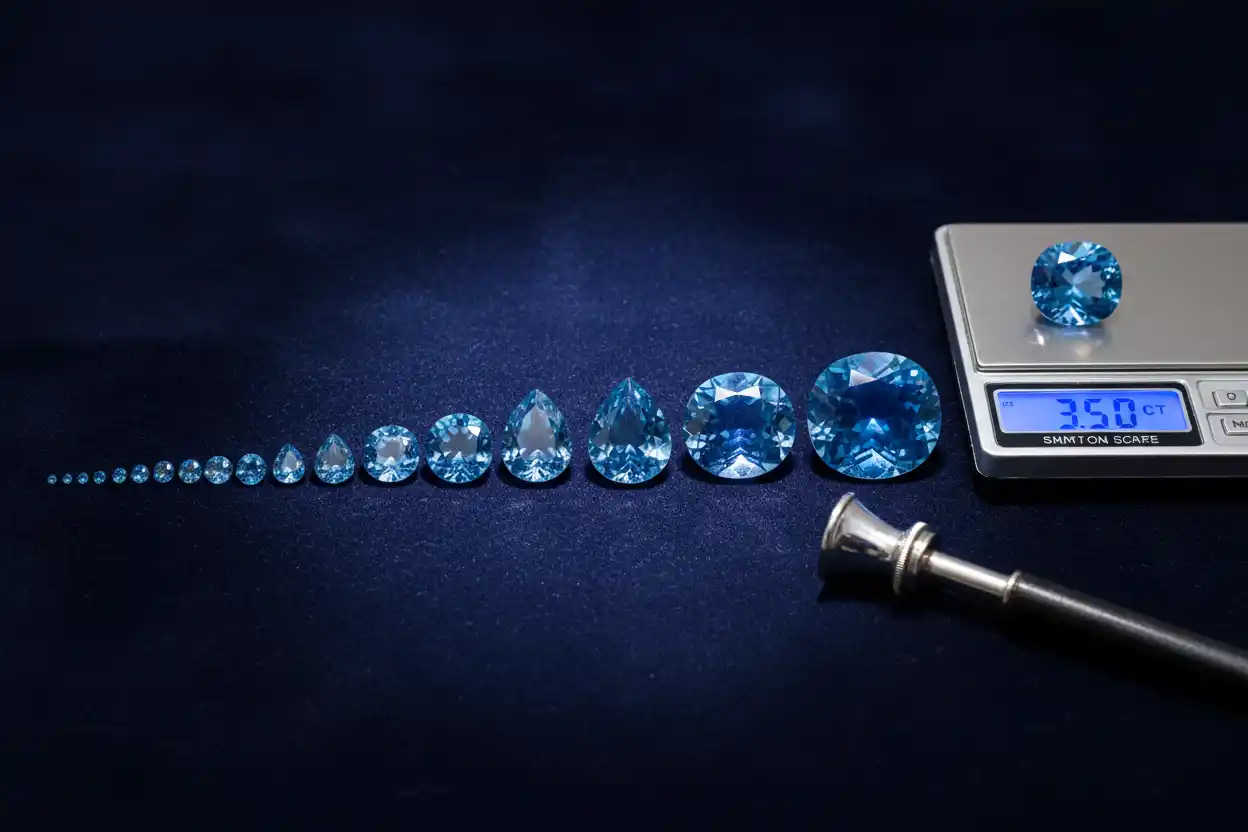
Benitoite Price: How Value Is Judged, Quality, Size & Origin
Benitoite price is shaped by an unusual combination of genuine geological scarcity, small typical faceted sizes, blue color, transparency, cutting quality, condition, documentation, provenance, and collector demand. GIA identifies benitoite as a barium titanium silicate and reports that commercial quantities of gem-quality material are associated with the Benitoite Gem mine in California’s New Idria district. Its research on colored-stone value also specifically notes that benitoite is rarely encountered above a couple of carats.
Those facts explain why fine stones can command substantial premiums, but they do not produce one universal benitoite price per carat. A small vivid blue, transparent, beautifully cut stone may be worth more per carat than a heavier stone with weak color, obvious inclusions, damage, poor proportions, or uncertain provenance. Anyone moving from valuation research toward an actual purchase should begin with the Gems Lore guide on how to buy benitoite, which covers identity, seller verification, documentation, and buying red flags in greater detail.
Benitoite Price At a Glance
| Value Factor | What Matters | Typical Effect on Benitoite Price |
|---|---|---|
| Identity | Confirmed natural benitoite versus another material | Correct identification is the foundation of any valuation |
| Color | Strength, attractiveness, evenness of blue | Fine blue appearance can materially increase desirability |
| Size | Carat weight plus face-up dimensions | Larger fine stones become especially scarce |
| Clarity | Transparency and distracting inclusions | Cleaner transparent material generally attracts stronger faceted-gem demand |
| Cut | Brilliance, dispersion, proportions, polish | Strong cutting can enhance benitoite’s distinctive optical performance |
| Condition | Chips, abrasion, repairs, repolishing | Damage can reduce value even in rare material |
| Provenance | Credible California locality or historic documentation | Strong provenance can increase collector interest |
| Treatment | Accurate disclosure and laboratory findings | Undisclosed enhancement can undermine comparability and confidence |
| Laboratory Documentation | Reliable identification and report verification | Reduces uncertainty but does not itself set price |
| Market Type | Specialist retail, auction, private sale, dealer offer | Different channels produce different figures |
| Appraisal Basis | Replacement, fair market, liquidation, other purpose | Appraisal numbers should not be confused with cash resale value |
Why Benitoite Can Be Expensive
Benitoite belongs to a small group of gems whose market story is closely tied to one exceptionally important locality. GIA reports commercial quantities of gem-quality material from the Benitoite Gem mine in the New Idria district of San Benito County, and its historical review notes that California produced the greatest number and best-quality crystals despite smaller occurrences elsewhere.
The California Geological Survey similarly describes gem-quality benitoite as occurring within a small area of San Benito County and recognizes it as the official California state gemstone. Restricted supply creates a genuine scarcity component, particularly for transparent faceting material with attractive blue color.
Scarcity is only the starting point. A pale included stone and a vivid transparent gem do not belong to the same quality tier merely because both are rare benitoite. Mineral specimens create yet another market, where crystal form, matrix, associated minerals, aesthetics, locality labels, and collection history may matter more than faceted-gem criteria.
Size Can Have an Outsized Effect on Benitoite Price
Size is one of the most significant benitoite value factors because larger faceted stones are uncommon. GIA’s research on colored gemstones explicitly cites benitoite among materials rarely seen above a couple of carats. GIA has also discussed a 5.06-carat trillion-cut benitoite as an exceptionally large example and noted that commercially available finished stones from the historic California source were typically much smaller.
This scarcity can create a nonlinear relationship between weight and price. If two benitoites have comparable color, clarity, cutting, condition, and documentation, the larger stone may command both a higher total price and a substantially higher price per carat because fine material of that size is much more difficult to find.
The relationship reverses when quality changes. A two-carat gem with weak saturation, a large window, heavy inclusions, or damaged facets can be less desirable than a one-carat stone with exceptional color and cutting. Carat weight therefore measures mass; it does not independently measure quality.
Millimeter Dimensions Matter Alongside Carat Weight
Rare rough creates strong incentives to retain weight during cutting. A cutter may choose deeper proportions to preserve valuable material, and that decision can produce a stone that weighs more without looking proportionately larger from the top.
Two benitoites of equal weight can consequently have different face-up dimensions. One may present a broad attractive outline, while the other hides substantial weight below the girdle. The deeper stone is not automatically inferior, because cutting decisions must respond to the rough, inclusions, and color orientation, but buyers should understand the visible size they receive for the quoted price.
Always compare weight with length, width, and depth when a premium is being charged for size.
Blue Color Is a Major Value Driver
Benitoite’s famous blue appearance is a major part of its desirability. GIA documents material ranging from colorless to blue and highlights the strong optical impact of properly cut blue benitoite.
Fine color should be evaluated for hue, tone, saturation, and evenness rather than by a promotional label. A seller may use terms such as “electric blue,” “royal blue,” or “sapphire blue,” but those expressions are not universal benitoite laboratory grades.
Strong color can raise price substantially when the stone remains transparent and lively. Excessive darkness, grayness, uneven zoning, or extinction can reduce face-up appeal. Neutral-light photographs and video become particularly useful when color is responsible for a large premium.
Clarity Influences Beauty and Brilliance
Transparent faceted benitoite generally attracts greater jewelry demand than heavily included material, although collector preferences can vary. GIA has documented neptunite occurring as an inclusion in benitoite, illustrating that natural internal features can also be mineralogically interesting.
The commercial effect of an inclusion depends on its size, location, contrast, and impact on brilliance or durability. A small feature near the edge may have little consequence, whereas a highly visible reflective inclusion beneath the table can dominate the stone.
Do not confuse clarity with condition. An internal crystal is not the same as a chip, scratch, abrasion, or polishing defect created after the stone was cut.
Cut Quality Can Add Considerable Value
Benitoite is notable for strong dispersion and high refractive indices. Those properties can produce lively brilliance and colored flashes when cutting and lighting allow them to show.
A fine cut should balance weight retention with optical performance. Buyers should examine windowing, extinction, symmetry, polish, girdle condition, face-up spread, and overall pattern. Poor cutting can suppress an otherwise attractive piece of rough, while precision or artistic cutting can create additional desirability.
A heavier stone is therefore not automatically more valuable if the extra weight results mainly from unnecessary depth. The market ultimately values what the finished gem looks like as well as how much it weighs.
California Origin and Provenance Can Influence Collector Demand
San Benito County is the defining commercial locality for gem benitoite, so credible provenance can be valuable. Historic mine labels, old collection records, documented ownership, photographs, or specialist dealer records may add confidence and collector interest.
Seller-stated origin must nevertheless be separated from independently documented provenance. GIA’s current colored-stone service information does not list benitoite among the gem types for which it offers its standard geographic-origin report. A buyer should therefore read laboratory paperwork carefully instead of assuming an identification report verifies California origin.
The stronger the price premium attached to a historical or locality story, the stronger the supporting evidence should be.
Mineral Specimen Prices Should Not Be Compared With Loose-Gem Prices
Natural benitoite crystals on matrix can command significant collector prices for reasons that differ from faceted-stone valuation. Specimen collectors examine crystal aesthetics, size, completeness, matrix contrast, associated minerals, damage, repair, preparation, locality, and collection history.
A specimen containing several attractive blue crystals may be extremely desirable without yielding equivalent faceting rough. Conversely, a small piece of rough capable of producing a fine transparent gemstone may be valuable for completely different reasons.
Do not calculate a specimen’s worth by estimating the combined carat weight of visible crystals and applying a loose-gem price-per-carat number. The markets overlap, but their quality systems are not interchangeable.
A Historical Auction Result Shows Why Context Matters
One useful public market example comes from Heritage Auctions, which sold a two-stone benitoite lot totaling 2.35 carats for $8,125. The lot contained a 1.10-carat round stone and a 1.25-carat modified octagonal stone, and the auction house described the material as fine quality.
That result is evidence of what bidders paid for those particular stones in that particular sale. It is not a universal benitoite price benchmark. Converting $8,125 into a simple per-carat figure and applying it to every benitoite would ignore the lot’s quality, two-stone format, cutting, clarity, condition, California association, auction competition, buyer’s premium structure, and market conditions.
Auction comparables become useful only when the item being valued resembles the sold lot closely enough for the comparison to make sense.
Asking Prices and Realized Prices Are Different
A retailer’s asking price represents the amount the seller seeks. It may incorporate acquisition cost, gemological expertise, photography, inventory holding time, insurance, marketing, return rights, staff, overhead, and desired margin.
A realized auction price records an actual transaction but remains specific to one sale. A private seller may accept a negotiated price. A dealer buying from an owner needs enough margin to cover testing, repair, inventory risk, marketing, and eventual resale.
These distinctions explain why apparently conflicting benitoite prices can all be legitimate. The number must always be interpreted together with the type of transaction.
Appraisal Value Is Not Automatically Resale Value
An appraisal must be read according to its stated purpose. Insurance replacement value, fair market value, estate value, and liquidation value answer different questions and can generate very different numbers.
An insurance appraisal might estimate what it would cost to obtain a reasonably comparable replacement from an appropriate retail source. That amount is not necessarily what a dealer would pay the owner in cash.
A high appraisal therefore does not guarantee profit, while a low resale offer does not automatically invalidate an insurance appraisal. The valuation basis must be identified before the numbers can be compared.
Laboratory Identification Can Support Marketability Without Setting Price
Independent identification can reduce uncertainty about what the gemstone actually is and document detectable treatments within the scope of the laboratory service. GIA explains that its colored-stone reports identify and describe materials and provide information including weight, measurements, shape, cutting style, color, natural or laboratory-grown status where applicable, and detectable treatments.
The report does not establish the retail value of the stone. A documented benitoite can still be overpriced, while an undocumented benitoite can still be genuine. Documentation affects confidence and marketability rather than mechanically assigning a price.
For significant stones, report verification is particularly important. The seller should allow the buyer to confirm the report with the laboratory and compare the document’s measurements, weight, shape, and photograph with the actual gem.
Treatment Disclosure Can Affect Comparability
Natural origin and untreated status are separate questions. A stone can be natural yet enhanced, so sellers should disclose known treatments rather than using the word “natural” as a substitute for treatment information.
When two benitoites carry significantly different prices, treatment status should be included in the comparison. The buyer should determine what the laboratory detected, what the seller knows, and whether treatment information appears in writing on the invoice.
Treatment should not automatically be treated as good or bad. Its influence on benitoite price depends on the type of enhancement, its stability, market acceptance, detectability, rarity, and quality of disclosure.
Condition Can Reduce Value Even in Very Rare Material
Chips, abrasions, scratches, worn facet junctions, repolishing, damaged girdles, and setting wear can all affect benitoite value. A historically important stone may remain desirable despite minor wear, but damage should still be described honestly.
Mounted stones deserve extra attention because the setting can conceal the girdle and parts of the pavilion. The stated carat weight may also be estimated rather than measured directly. Buyers should ask how the weight was obtained and whether the gemstone has ever been examined loose.
Condition becomes especially important when comparing an older collectible stone with a newly cut gem. Their histories may justify different expectations, but the physical state of each piece remains part of the valuation.
Retailer Grades Such as AAA Are Not Universal Benitoite Grades
A seller can create internal categories such as AAA, top gem, collector grade, museum grade, or investment grade. Those terms may help organize one merchant’s inventory, but they should not be treated as internationally standardized gemological grades unless a recognized methodology is clearly defined.
Instead of paying for the label, identify the physical characteristics behind it. Ask about color, transparency, cut, weight, dimensions, damage, treatment, report status, and provenance.
“Investment grade” deserves particular skepticism because no gemological label can guarantee future appreciation or liquidity.
What Usually Raises Benitoite Price?
Several characteristics can combine to create a strong premium:
Attractive vivid blue face-up color.
High transparency and limited distracting inclusions.
Larger size while retaining fine quality.
Good face-up dimensions for the weight.
Strong cutting, polish, brilliance, and dispersion.
Excellent condition.
Credible independent identification.
Clear treatment disclosure.
Documented California or historic provenance where relevant.
Desirable craftsmanship or important maker context in finished jewelry.
Strong seller reputation and meaningful inspection rights.
The most valuable stones tend to combine several favorable qualities rather than relying on rarity alone.
What Usually Lowers Benitoite Price?
Factors that can reduce desirability include weak or uneven color, prominent inclusions, poor transparency, excessive windowing, overly deep cutting, surface damage, questionable repair, weak documentation, uncertain identity, unsupported origin claims, inaccurate photography, or unfavorable seller terms.
A lower price is not automatically a problem. Some buyers deliberately accept minor inclusions, pale color, or an older cut to acquire genuine benitoite within a lower budget. The key is that the compromise should be visible, understood, and reflected honestly in the price.
How to Compare Benitoite Prices Correctly
The most useful comparison matches stones according to:
Natural identity.
Carat weight.
Millimeter dimensions.
Face-up color.
Transparency and inclusions.
Cut quality and optical performance.
Condition.
Treatment disclosure.
Laboratory documentation.
Provenance evidence.
Seller services and return rights.
Type of transaction.
Once those variables are reasonably aligned, price per carat becomes more informative. Before that point, it can create false precision.
This same principle underlies Gems Lore’s alexandrite price guide and andalusite price guide: rare colored gemstones must be compared according to their quality characteristics before a numerical benchmark becomes useful.
Benitoite Rarity Does Not Guarantee Appreciation
Benitoite is unquestionably scarce in fine gem quality, but rarity alone does not guarantee rising prices. Collector preferences change, economic conditions shift, transaction costs reduce resale proceeds, and thin markets can make it difficult to find the right buyer quickly.
The distinction between rarity and price is explored more broadly in Gems Lore’s guide to the rarest gemstones in the world. Record-setting market behavior is covered separately in most expensive gemstones. Neither concept should be converted into a promise that an individual benitoite will appreciate.
Buy for verified rarity, beauty, quality, history, and collecting interest rather than guaranteed financial return.
Conclusion
Benitoite price cannot be reduced responsibly to one universal dollar figure per carat. Its value comes from the interaction of restricted gem-quality supply, color, unusual size scarcity, transparency, cutting, condition, documentation, provenance, treatment disclosure, seller context, and the type of transaction. GIA’s research supports both the exceptional importance of the California source and the scarcity of larger faceted material.
The best valuation method is therefore comparative rather than formulaic. Establish what the gem is, examine its actual quality, document its size and condition, verify relevant provenance claims, distinguish laboratory identification from appraisal, and determine whether the quoted number is retail, auction, appraisal, or resale. Only then does a benitoite price become meaningful.
Frequently Asked Questions
How much is benitoite worth per carat?
There is no universal benitoite price per carat. Size, blue color, clarity, cutting, condition, documentation, provenance, and transaction type can cause major differences between stones of the same weight.
Why is benitoite so expensive?
Gem-quality benitoite has an unusually restricted commercial source, and fine larger faceted stones are scarce. GIA reports commercial quantities of gem-quality material from California’s New Idria district and specifically notes that benitoite is rarely seen above a couple of carats.
Does benitoite become more expensive as it gets larger?
Fine larger stones can command disproportionately higher prices because size becomes increasingly scarce. The effect applies only when other quality factors remain strong. A poorly cut, damaged, or weakly colored large stone may be less desirable than a finer smaller gem.
What color benitoite is most valuable?
Strong attractive blue is generally the color most associated with fine gem benitoite. The best value comparison also considers transparency, tone, cutting, brilliance, size, and evenness rather than judging hue alone.
Does California origin affect benitoite price?
Credible California provenance can increase collector interest because San Benito County is the historically important source of commercial gem-quality benitoite. The premium should be supported by evidence rather than an unsupported seller claim.
Can an auction result tell me what my benitoite is worth?
An auction result can provide a comparable when the sold stone is genuinely similar. Heritage Auctions recorded an $8,125 sale for two benitoites totaling 2.35 carats, but that result belongs to those specific stones and should not be converted into a universal per-carat benchmark.
Does a laboratory report determine benitoite value?
No. A gemological report can establish identity and other characteristics within the laboratory’s scope, but it is not automatically an appraisal. Market value still depends on quality, rarity, provenance, condition, demand, and transaction type.
Is an appraisal the same as resale value?
No. An appraisal may estimate insurance replacement value or another defined value basis, while actual resale depends on the buyer, seller, market, fees, timing, and liquidity. Dealer offers and auction results can be lower or higher than an appraisal depending on circumstances.
Is benitoite an investment gemstone?
Benitoite can be a valuable collectible, but no responsible seller can guarantee appreciation. Buy based on documented quality, rarity, provenance, condition, and personal collecting value rather than promises of future profit.
What is the safest way to evaluate a high benitoite price?
Confirm identity, compare color and transparency, check weight against dimensions, inspect cut and condition, verify laboratory documentation, separate locality claims from documented provenance, and compare the stone with genuinely similar material in the same type of market.