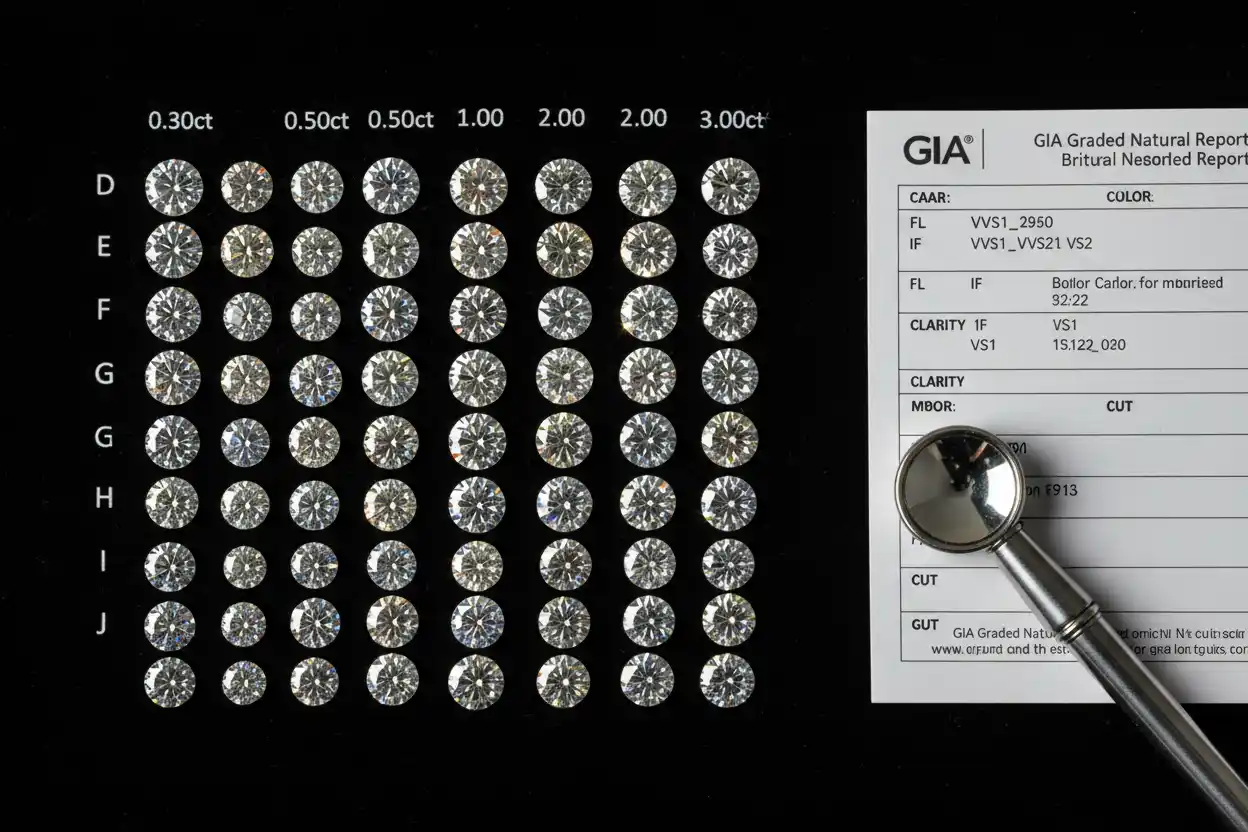
Diamond Price: Value Drivers, Grade, Supply & Demand
Diamond price is not determined by a single per-carat number. Natural diamonds are valued through the interaction of cut, color, clarity, carat weight, shape, fluorescence, treatment, condition, documentation, market demand, retail channel, and—in some transactions—provenance or geographic origin. GIA describes the 4Cs as the standardized language used to evaluate diamond quality and notes that the value of an individual finished diamond depends on how those characteristics combine rather than on weight alone.
Carat weight has an especially nonlinear effect because larger fine diamonds are rarer, and consumer demand concentrates around popular weight thresholds. GIA notes that a larger diamond can cost more per carat than a smaller one of otherwise equivalent quality and that so-called magic sizes such as 1.00, 1.50, and 2.00 carats can produce material price jumps despite very small differences in visible size. Anyone preparing to purchase should read the Gems Lore buy diamond guide first, because understanding report type, natural versus laboratory-grown status, treatments, cut, and seller terms is essential before comparing diamond price.
Diamond Price At a Glance
| Value Factor | What Usually Raises Price | What Can Lower Price |
|---|---|---|
| Cut | Strong brightness, fire, scintillation, polish, symmetry | Poor proportions, windowing, excess depth, weak light return |
| Color | Higher colorless grades in D-to-Z natural diamonds | More visible yellow or brown tint in ordinary colorless-diamond market |
| Clarity | Rarer high grades with less visible inclusions | Obvious or durability-relevant inclusions |
| Carat Weight | Larger stones, especially above popular thresholds | Smaller weight or hidden weight that adds little face-up size |
| Shape | Strong market demand or efficient visual spread | Less popular shapes can trade differently despite equivalent 4Cs |
| Fluorescence | Can be neutral or occasionally beneficial visually | Rare hazy effect or market discount in certain high-color stones |
| Treatment | Untreated material generally occupies standard natural market | HPHT color treatment, laser drilling, filling, or other treatment can alter market category |
| Natural/Lab-Grown Status | Natural supply carries different scarcity economics | Laboratory-grown diamonds follow a separate production and pricing market |
| Report | Independent recognized grading reduces uncertainty | Weak, unverifiable, or inconsistent documentation |
| Origin/Provenance | Credible chain-of-custody or notable provenance can add value | Unsupported origin story adds little defensible value |
| Condition | Crisp polish, intact girdle, no damage | Chips, abrasion, repolishing, repair |
| Retail Channel | Service, selection, warranty, financing, branding | Dealer offers and private resale usually reflect different economics |
The 4Cs Establish Quality but Do Not Produce One Fixed Price
GIA created the modern standardized language of cut, color, clarity, and carat weight so that diamonds could be described consistently across the global trade. Those grades give buyers a structured way to compare physical quality, but they do not generate one universal retail value because commercial price also depends on supply, demand, shape, transaction costs, brand, availability, and current market conditions.
Two diamonds with the same carat weight can differ dramatically in value because one has better color, clarity, or cut. GIA gives the simple example that weight alone cannot explain why diamonds of equal carat size carry different values and stresses that all 4Cs need to be evaluated together.
This is why generic online tables should be treated as rough context rather than appraisal tools. The more expensive the stone, the more important it becomes to compare an exact grade combination, shape, measurements, fluorescence, treatment status, and report rather than using one average price per carat.
Cut Can Affect Price Through Beauty and Yield
Cut determines how effectively a polished diamond handles light. GIA’s cut system considers brightness, fire, scintillation, weight ratio, durability, polish, and symmetry for standard round brilliants. A stone that achieves an attractive balance of these properties can command stronger market demand than one with inefficient proportions, even when the rough material began with similar potential.
Cut also affects manufacturing economics because every polished diamond represents a trade-off between retaining carat weight and creating attractive proportions. Removing more rough can improve light performance but reduce the final weight, while retaining extra depth may move the polished stone above a valuable carat threshold at the cost of face-up spread.
This interaction means two one-carat diamonds can differ not only in sparkle but also in visible diameter. A heavier-looking price tag does not guarantee a larger-looking gem if substantial weight is hidden below the girdle.
GIA Cut Grade Has the Strongest Standardization for Round Brilliants
Standard round brilliant diamonds are the only shapes currently assigned an overall GIA cut grade. GIA does not issue equivalent overall cut grades for ovals, pears, cushions, emerald cuts, princess cuts, and other fancy shapes because their facet arrangements and visual behavior vary more widely.
This difference can influence diamond price because round-brilliant buyers can compare one standardized cut grade directly, while fancy-shape buyers must rely more heavily on dimensions, outline, bow-tie effect, brightness pattern, symmetry, polish, and visual preference.
A seller advertising a fancy shape as “Excellent Cut” may be using an internal grade or simplifying separate polish and symmetry information. The actual laboratory report should determine what was officially graded.
Color Affects Price Through Rarity
Within the normal D-to-Z system, diamonds closer to colorless are rarer than diamonds carrying more yellow or brown tint, so higher color grades generally command stronger prices when other factors remain similar. GIA explicitly links rarity and value in its discussion of diamond color.
The visual effect of grade differences depends on size, shape, setting, and viewing environment. An emerald cut can reveal bodycolor differently from a round brilliant, and a yellow-gold setting may make slight warmth less important to some buyers than it would be in platinum.
This gives buyers room to optimize. Moving down one or two color grades can sometimes free budget for better cut, larger face-up dimensions, or a higher-quality setting without producing a visual sacrifice the buyer personally notices.
Clarity Price Differences Reflect Rarity More Than Everyday Visibility
GIA’s clarity scale distinguishes grades from Flawless through Included based on internal and external characteristics observed under 10× magnification. High grades are rarer and therefore more expensive, but the visible difference between adjacent grades may be minimal to the unaided eye.
This creates one of the most important diamond price trade-offs. A buyer can pay substantially more for technical rarity without gaining a noticeable visual improvement in ordinary wear. Another diamond with a lower clarity grade may appear equally clean face-up but carry a more favorable price because the inclusions become visible only under magnification.
The inclusion type and location still matter. A centrally located dark crystal can affect appearance more than a similarly graded feature near the girdle, while certain feathers or other features may deserve durability review before purchase.
Carat Weight Produces Nonlinear Price Increases
Larger diamonds are rarer, so all else equal, price rises faster than weight alone. GIA specifically explains that a larger diamond can be worth more per carat than several smaller diamonds totaling the same combined weight. A two-carat diamond therefore should not be expected to cost merely twice as much as a comparable one-carat diamond.
Consumer demand amplifies that effect at specific thresholds. GIA identifies 1.00, 1.50, and 2.00 carats among popular magic sizes and notes that moving just above a threshold can create a substantial price difference even when the physical size increase is difficult to see.
This can create value opportunities just below the threshold. A 0.90- to 0.99-carat stone with excellent proportions may provide nearly the visual presence of a one-carat diamond while avoiding part of the demand premium attached to the round number.
Millimeter Size Matters Because Carat Is Only Weight
A poorly proportioned diamond can carry extra weight in depth or girdle thickness that contributes little to the visible face-up area. GIA warns that greater carat weight does not necessarily mean a diamond looks bigger and illustrates how hidden weight can accumulate below the girdle.
Price comparisons should therefore include dimensions. A one-carat round with efficient proportions can present a broader diameter than another one-carat round with excessive depth. The same principle applies to fancy shapes, where length-to-width ratio and outline further affect apparent size.
Paying for carats that do not translate into visible beauty can be one of the least efficient uses of a diamond budget.
Shape Creates Its Own Supply-and-Demand Pricing
Round brilliants and fancy shapes do not always trade at equivalent prices for the same carat, color, and clarity combination. Differences in cutting yield, demand, rough suitability, inventory availability, and visual spread all contribute.
A fancy shape may allow the cutter to retain more of the original rough than a round brilliant, potentially changing production economics. Consumer demand can also shift over time among ovals, cushions, emerald cuts, pears, and other styles.
No universal shape discount should be assumed. Compare current stones with similar reports rather than relying on a historical rule that one shape must always cost a fixed percentage less than another.
The Natural and Laboratory-Grown Diamond Prices Belong to Separate Markets
Natural and laboratory-grown diamonds may share fundamental diamond properties, but their supply economics differ substantially. Natural diamonds depend on mining and geological rarity, while laboratory-grown production can expand through manufacturing capacity. GIA now maintains distinct reporting systems for laboratory-grown diamonds so that the categories remain clearly differentiated.
This distinction is crucial in price research. A laboratory-grown diamond listing should not be used as a direct comparable for a natural diamond simply because the 4Cs appear similar. The same warning applies to cubic zirconia, which is not diamond at all. Gems Lore’s buy cubic zirconia guide and cubic zirconia price guide explain why simulant pricing follows an entirely different supply structure.
Buyers should decide which origin category they want before comparing prices.
Fluorescence Can Affect Market Price More Than Appearance
GIA reports that fluorescence is relatively common and that the overwhelming majority of fluorescent diamonds show no broadly noticeable negative appearance effect. Only a very small portion of fluorescent stones exhibit the hazy or oily look sometimes associated with very strong fluorescence.
Market pricing can nevertheless reflect buyer preferences. Strong fluorescence may be discounted in some high-color diamonds even when the stone looks perfectly attractive, while blue fluorescence can make warmer diamonds appear visually whiter under UV-containing light.
This disconnect can create opportunities for buyers willing to inspect the actual stone rather than following blanket rules. Fluorescence should be treated as one price factor to evaluate visually, not an automatic defect.
Treatment Can Move a Diamond Into a Different Price Category
HPHT processing, annealing, irradiation, laser drilling, and fracture filling can alter a diamond’s color or apparent clarity. GIA documents these processes and distinguishes between treatments it can grade and those that prevent standard grading, such as foreign fracture-filling material.
A treated natural diamond should therefore be compared with other treated diamonds of similar characteristics rather than with untreated material simply because both are natural diamonds. Treatment can provide an attractive appearance at a lower cost, but the representation must be explicit.
An untreated claim also needs context. GIA grading can disclose detected treatments, but no laboratory report should be misrepresented as a financial guarantee or a promise that every future analytical method will produce identical findings.
Independent Grading Reduces Pricing Uncertainty
Diamond price can change sharply with a small difference in grade, making laboratory documentation particularly important. GIA recommends grading reports because subtle color and clarity differences can be difficult to judge consistently without standardized analysis.
A report provides measurements, carat weight, color, clarity, cut where applicable, proportions, finish, fluorescence, and treatment information. It does not tell the buyer whether the asking price is fair, but it establishes the factual quality variables needed for an informed market comparison.
Always verify the report through the issuing laboratory and ensure that its measurements and other identifying details correspond to the physical diamond being sold.
Grading Reports Do Not Contain Appraisal Values
GIA expressly states that its reports are not appraisals and do not assign monetary value. An appraisal uses grading information alongside market data and a defined valuation purpose to estimate a financial figure.
An insurance replacement appraisal can be much higher than the amount a dealer would pay to buy the diamond from an owner. A retail asking price can also differ from auction value or private-sale value.
This distinction prevents a common marketing problem in which a seller presents an inflated appraisal figure as proof that a discounted selling price is automatically a bargain.
Country of Origin Can Add Provenance but Requires Special Documentation
GIA’s Diamond Origin Report includes a country-of-origin determination through a specific process that begins with rough submitted directly from participating mining sources and later matches the polished diamond back to that documented rough.
A standard diamond grading report does not automatically provide that information. Retailer provenance records can still be meaningful, but they should be described as seller or supply-chain documentation rather than independent laboratory origin analysis.
Origin may affect consumer preference and, in some cases, market demand. It should remain an additional value factor rather than a substitute for the diamond’s measurable quality.
Supply and Demand Explain Why Similar Grades Can Still Trade Differently
Diamond prices operate in a real marketplace where inventory, fashion, economic conditions, geographic demand, retailer stock, and availability all change. A particular combination such as a popular carat threshold, shape, color, and clarity grade may be scarce in one seller’s inventory while another quality combination has abundant stock.
This is why laboratory grades should be viewed as product specifications rather than fixed price tags. The 4Cs describe what the diamond is; the market decides what buyers are currently prepared to pay for that combination.
The same separation between rarity and monetary value appears throughout Gems Lore’s rarest gemstones in the world and most expensive gemstones guides. Scarcity can support price, but buyer demand and market structure determine how strongly that scarcity is monetized.
Retail Markup and Seller Service Affect the Final Price
A diamond retailer’s price can include acquisition cost, financing, inventory holding risk, grading expenses, insurance, photography, staff, showroom costs, return policies, resizing, warranties, shipping, upgrade programs, and profit margin.
Two identical diamonds can therefore have different asking prices from different sellers without one necessarily being misrepresented. The buyer needs to decide whether the additional services justify the premium.
An online specialist with lower overhead may price differently from a luxury jewelry house whose ring includes a recognized design, branded setting, and extensive after-sale service.
Finished Jewelry Price Is Not the Loose Diamond Price
A diamond ring or necklace may include substantial value in gold, platinum, accent diamonds, engraving, pavé work, setting labor, designer provenance, and brand reputation. Dividing the total jewelry price by the center diamond’s carat weight produces a meaningless gemstone benchmark.
This becomes even more important in antique or signed jewelry, where historical design and maker value can exceed the value of the loose stones considered separately.
When comparing diamond price, determine whether you are comparing loose stones, complete rings, branded jewelry, estate pieces, or auction lots.
Resale Value Is Different From Retail Value
A consumer retail price includes services and margin that a future buyer does not automatically reimburse. A dealer purchasing a previously owned diamond must account for verification, inventory risk, capital tied up in the stone, possible repolishing, sales costs, and profit margin.
Private resale can sometimes produce a higher price than a dealer offer but may require more time, expertise, and transaction risk. Auctions introduce commissions and uncertainty about bidder competition.
A diamond should therefore never be marketed as having a guaranteed resale figure merely because its grading report or appraisal looks impressive.
Diamond Price Is Not the Same as “Investment Grade”
“Investment grade” is not one of GIA’s 4Cs and does not represent a standardized diamond quality category. A rare large natural diamond with exceptional color, clarity, provenance, or historical importance may attract collector or investment interest, but that does not turn ordinary retail diamonds into guaranteed appreciating assets.
The most expensive gemstones discussed by Gems Lore occupy exceptional markets in which rarity, provenance, fame, and elite buyer competition can create extraordinary results. Those sales should not be used as evidence that a routine engagement diamond will follow the same trajectory.
Buy for documented quality and personal value rather than a guarantee of financial return.
What Usually Raises Diamond Price?
Stronger prices generally occur when desirable characteristics coincide: excellent visible cut performance, higher color and clarity grades, larger size, efficient face-up dimensions, untreated natural status where that category is desired, strong documentation, good condition, and a shape with robust market demand.
Price can rise especially sharply when a stone crosses a popular carat threshold while maintaining the same quality. Provenance, designer jewelry, historic ownership, or exceptional fancy color can add separate premiums.
The key is combination. One exceptional characteristic does not automatically overcome serious weaknesses elsewhere.
What Usually Lowers Diamond Price?
Poor cut, excessive depth, visibly undesirable tint within the normal colorless market, prominent inclusions, chips, abrasion, treatment, unclear documentation, weak seller protection, or unpopular quality combinations can reduce price.
Fluorescence can also produce a market discount in some situations even when appearance remains attractive, while fancy shapes can trade differently according to current demand.
A lower price does not automatically mean a bad diamond. It can represent an intelligent compromise when the discounted characteristic does not negatively affect what the buyer actually sees or values.
How to Compare Diamond Prices Fairly
Compare diamonds within the same origin category and align:
- Natural versus laboratory-grown status.
- Shape and cutting style.
- Carat weight and millimeter dimensions.
- Cut grade where applicable.
- Polish and symmetry.
- Color grade.
- Clarity grade and inclusion characteristics.
- Fluorescence.
- Treatment.
- Condition.
- Laboratory report type and verification.
- Provenance if it materially affects price.
- Loose stone versus finished jewelry.
- Retail, auction, appraisal, or resale context.
A numerical price-per-carat comparison becomes useful only after these variables are brought reasonably close together.
Conclusion
Diamond price reflects both gemological quality and market structure. GIA’s 4Cs establish a standardized way to describe cut, color, clarity, and carat weight, but market price also reacts to shape, fluorescence, treatment, natural versus laboratory-grown origin, documentation, carat thresholds, supply, demand, retail service, and provenance.
Carat weight deserves particular caution because it creates nonlinear pricing and does not guarantee visual size or beauty. A diamond just above a magic threshold may command considerably more than a nearly identical stone just below it, while excessive depth can hide weight that adds little face-up impact. Buyers who compare like with like, verify reports, and separate retail price from appraisal and resale value can understand diamond price far more reliably than anyone relying on a single universal per-carat figure.
Frequently Asked Questions
How much does a diamond cost per carat?
There is no universal diamond price per carat. Cut, color, clarity, carat weight, shape, treatment, fluorescence, natural or laboratory-grown status, documentation, and current market demand all affect price. Larger natural diamonds can also cost more per carat because they are rarer.
Why does a one-carat diamond sometimes cost much more than a 0.90-carat diamond?
One carat is an important magic-size threshold. GIA notes that demand rises around popular round-number weights, so diamonds just over those thresholds can carry significant price premiums even when the visible size difference is small.
Does a bigger diamond always cost more?
All else equal, larger natural diamonds generally cost more because larger stones are rarer, but quality can override weight. A smaller diamond with much better cut, color, and clarity can cost more than a larger lower-quality stone.
Which C affects diamond price the most?
No single C controls every diamond’s price, but cut has an especially strong effect on visible beauty, while carat weight can produce steep rarity-driven and demand-driven price increases. GIA emphasizes that value comes from the combination of all 4Cs.
Does fluorescence reduce diamond price?
It can influence market pricing, particularly in certain high-color diamonds, but fluorescence does not automatically reduce beauty. GIA reports that the overwhelming majority of fluorescent diamonds show no widely noticeable negative appearance effect.
Are laboratory-grown diamonds priced the same as natural diamonds?
No. They belong to different supply and reporting categories. GIA maintains separate laboratory-grown diamond services specifically to distinguish them from natural diamonds. Comparable 4Cs do not make their market economics identical.
Does a GIA report state a diamond’s price?
No. GIA does not appraise diamonds and does not state financial value on grading reports. A separate appraisal or market analysis is required.
Does Russian, Canadian, or African origin automatically increase diamond value?
Not automatically. Country-of-origin information can matter to particular buyers, but the diamond’s 4Cs and market demand still drive core quality valuation. GIA country-of-origin reporting requires a special rough-to-polished tracking process rather than a routine seller statement.
Do diamond treatments affect price?
Yes. HPHT color treatment, irradiation, laser drilling, fracture filling, and other treatments can move a diamond into a different market category. GIA identifies and reports applicable treatments within its services.
Is retail diamond price the same as resale value?
No. Retail price includes dealer services, overhead, margin, and consumer protections, while resale value depends on the buyer, condition, market liquidity, verification costs, and transaction channel.
Is a diamond guaranteed to appreciate?
No. Natural diamonds can hold significant value, but future price depends on quality, rarity, demand, market conditions, transaction costs, and liquidity. A grading report describes gemological characteristics; it does not guarantee future financial performance.