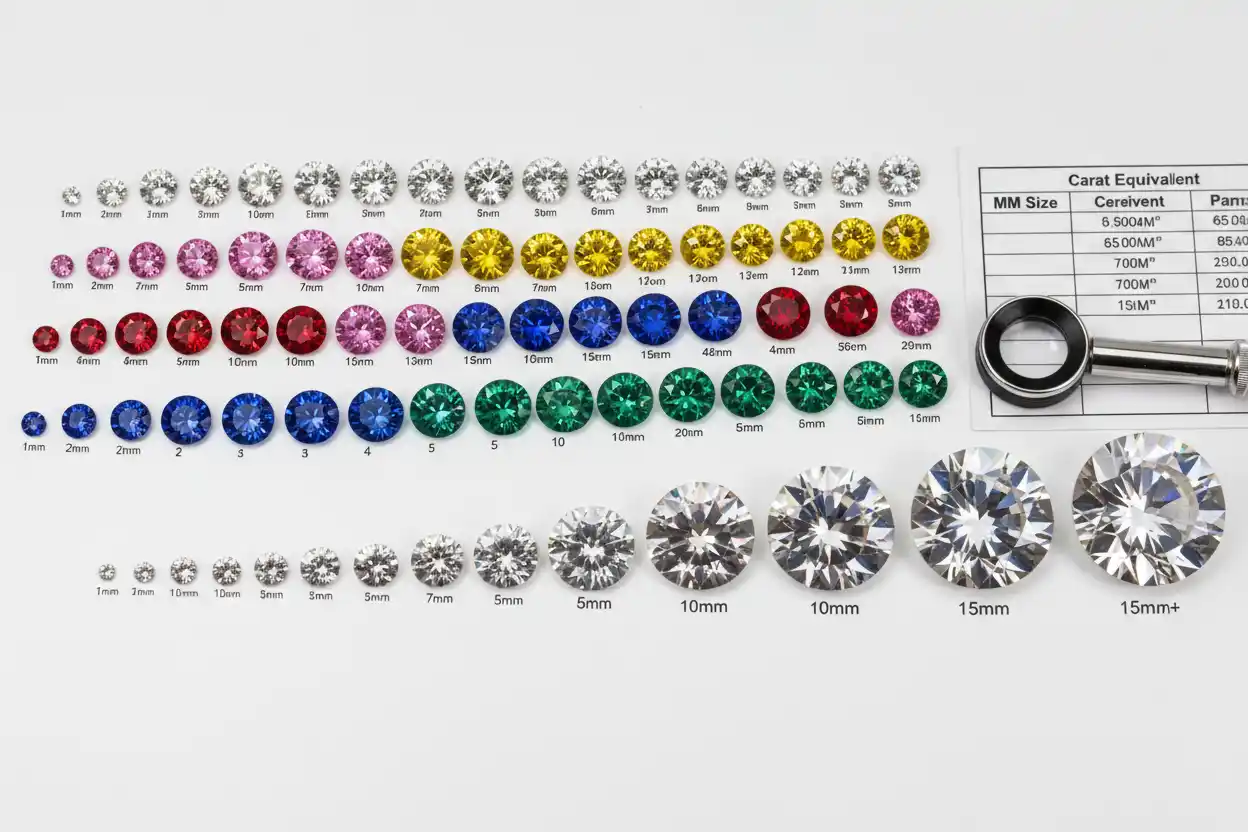
Cubic Zirconia Price: What Buyers Pay For, Condition, Quality & Rarity
Cubic zirconia price is driven far less by geological rarity than the prices of natural gemstones because cubic zirconia, or CZ, is a manufactured zirconium-oxide material that can be produced in large quantities, large sizes, high clarity, and many colors. GIA identifies synthetic cubic zirconia as one of the most widely used man-made diamond simulants and notes that it can be grown in very large sizes while remaining highly affordable. The loose material itself is consequently inexpensive in ordinary commercial qualities, while much of the retail price of finished CZ jewelry can come from cutting, polishing, precious metal, setting labor, design, branding, coatings, warranty, and seller margin.
That distinction is essential when comparing listings. A loose round CZ and a handcrafted gold engagement ring containing a CZ are not economically equivalent products even if the center stones have the same millimeter diameter. Likewise, a mass-produced stone should not command a major rarity premium simply because it weighs many carats. Buyers researching cubic zirconia price should first understand the material itself through the Gems Lore guide on how to buy cubic zirconia, then separate the value of the stone from the value of the finished jewelry around it.
Cubic Zirconia Price At a Glance
| Value Factor | What Buyers Are Paying For | Typical Effect on Cubic Zirconia Price |
|---|---|---|
| Material Identity | Genuine CZ versus glass, moissanite, diamond, or another simulant | Correct identification prevents misleading comparisons |
| Cut Quality | Proportions, symmetry, polish, facet precision | Better cutting can create a meaningful premium over mass-cut stones |
| Color | Colorless appearance or intentional fancy color | Attractive color matters visually, but manufactured color is not geological rarity |
| Clarity | Absence of chips, bubbles, polish defects, obvious flaws | High clarity is normal in CZ, so “flawless” alone should not justify a large premium |
| Size | Millimeter dimensions and carat weight | Large CZ is easy to manufacture, so size adds material and labor cost rather than major rarity |
| Coating | Diamond-like, color, or specialty surface film | Coatings can raise retail price but may introduce durability concerns |
| Condition | Scratches, abrasion, facet-edge wear, chips | Worn CZ generally commands less than crisp new material |
| Setting Metal | Base metal, sterling silver, gold, platinum | Metal can contribute far more value than the CZ itself |
| Craftsmanship | Prong work, pavé, finishing, custom design | Strong workmanship can justify higher finished-jewelry pricing |
| Brand | Designer name, retailer positioning, warranty | Brand and service can create substantial premiums |
| Seller Grade | AAA, 5A, 6A, AAAAA or similar | Usually seller-defined rather than a universal gemological standard |
| Resale Context | Private sale, dealer offer, branded resale | Loose CZ usually has limited scarcity-based resale demand |
The Cubic Zirconia Is Manufactured, So Rarity Works Differently
Cubic zirconia should not be priced using the same logic applied to naturally rare gemstones. GIA explains that CZ is created by melting zirconium oxide and growing crystals as the melt solidifies, allowing manufacturers to produce substantial quantities without depending on the discovery of scarce gem-quality rough underground. GIA also illustrates faceted CZ stones weighing dozens of carats, confirming that large crystal size itself is not extraordinary for this material.
A large CZ can still cost more than a small one because the larger stone uses more material, takes longer to cut and polish, and may require a more substantial mounting. That is an ordinary production-cost difference rather than a geological rarity premium. A seller describing a large loose CZ as exceptionally rare should therefore explain what is actually scarce: perhaps a particular precision cut, recognized artist, proprietary coating, difficult custom shape, or limited designer edition. Size by itself is weak evidence.
This is very different from many stones discussed in Gems Lore’s rarest gemstones in the world guide, where geological availability can place hard limits on how often large fine examples reach the market. CZ is intentionally produced to provide an affordable alternative to rarer transparent gems, which is one of its commercial strengths rather than a disadvantage.
High Clarity Is Normal in Cubic Zirconia
GIA notes that most CZ has very high clarity, commonly with minute or no visible imperfections. A seller who advertises “flawless CZ” is therefore describing a characteristic that can be attractive but is not exceptionally scarce. Buyers should not assume that a flawless claim carries the same rarity implications it might in a naturally formed gemstone whose inclusions reflect geological growth.
The more useful quality questions concern manufacturing and finishing defects. Uneven facet junctions, polish lines, chips, small cavities, bubbles, abrasion, scratched tables, or damaged girdles can reduce the visual quality of an otherwise clean stone. Inspection under magnification is especially helpful for pre-owned CZ because years of wear can soften facet edges and make a stone look less crisp even when it began as highly polished material.
Clarity grades printed by a retailer should also be interpreted cautiously. Terms borrowed from diamond grading can create the impression that CZ has an internationally standardized clarity scale equivalent to diamond’s, but GIA does not issue diamond grading reports for simulants such as CZ.
Cut Quality Can Matter More Than the Raw CZ Material
Cutting is one of the most defensible reasons for two loose CZ stones of similar dimensions to have different prices. CZ has strong dispersion, producing colorful flashes, but GIA notes that it has somewhat less brilliance than diamond while showing slightly more fire. Careful facet design can manage these properties effectively, while poor proportions can make the stone look flat, excessively glassy, dark, or visually unbalanced.
A precision-cut CZ may therefore cost substantially more than a mass-produced stone even though both are made from the same basic material. The buyer is paying for lapidary skill, design, facet accuracy, polishing time, yield loss, and sometimes the reputation of a particular cutter. Those are craftsmanship premiums rather than rarity premiums.
Inspect symmetry, face-up pattern, facet alignment, polish, windowing, girdle finish, and overall brightness. Fancy shapes such as pears, marquises, emerald cuts, cushions, and hearts should also have balanced outlines. A large poorly cut CZ can be less attractive than a smaller precision-cut one even if the heavier stone carries a higher nominal carat weight.
Carat Weight Can Mislead When Comparing CZ With Diamond
Cubic zirconia has a different density from diamond, so equal carat weights do not translate directly into equal face-up dimensions. GIA’s research on diamond simulants documents meaningful physical-property differences between CZ and diamond, including density, which allows trained gemologists to distinguish the materials.
For jewelry buyers, millimeter dimensions are often more useful than carat weight when the goal is a particular visual size. If someone wants the appearance of an approximately 6.5 mm round center stone, the diameter communicates that look more directly than a “one-carat” marketing comparison.
Retailers sometimes use “diamond equivalent weight” to describe visual size. That can be useful if clearly explained, but actual CZ weight and diamond-equivalent appearance should not be treated as the same measurement.
Colorless CZ Is Common, and Fancy Colors Can Be Manufactured
Colorless appearance is normal in CZ, and GIA also documents manufactured CZ in pink, yellow, blue, green, red, purple, black, and other colors. Fancy color can make a piece visually distinctive, but it does not automatically indicate the scarcity associated with naturally colored diamond, sapphire, or another geological gem.
The value question is therefore mainly aesthetic and manufacturing-based. A beautifully cut saturated blue CZ can justifiably cost more than a poorly finished colorless stone because of design, cutting, brand, and production quality, but the blue color itself should not be marketed as a naturally rare occurrence.
Some colors are produced throughout the crystal during manufacture, while others may involve surface coatings or additional processing. Buyers should ask how the appearance was created when durability or long-term color stability matters.
Coated Cubic Zirconia Can Cost More but May Require More Care
Specialty coatings have been applied to CZ in attempts to modify appearance or promote more diamond-like surface characteristics. GIA studied colorless CZ marketed with very thin carbon-containing coatings and found through durability testing that the coating did not completely withstand typical cleaning and handling procedures.
A coating can therefore add manufacturing cost without transforming the underlying stone into diamond or giving the entire CZ diamond’s physical properties. If a retailer charges a premium for coated CZ, the buyer should ask exactly what coating is present, which surfaces are treated, whether the finish can wear, and what cleaning procedures the manufacturer recommends.
Condition is particularly important in pre-owned coated CZ. Uneven appearance around facet junctions, girdles, or frequently touched areas can indicate coating wear even when the underlying stone remains intact.
Mohs Hardness Does Not Mean CZ Is Wear-Proof
GIA gives cubic zirconia a Mohs hardness of approximately 8.5, making it hard enough for many jewelry applications but noticeably less scratch-resistant than diamond. Rings receive constant contact with desks, tools, bags, doors, countertops, and abrasive dust, so facet edges can eventually show wear.
Hardness should also be distinguished from toughness. A hard stone can still chip when struck sharply at an exposed corner or girdle. Pears, marquises, princess cuts, and other pointed shapes deserve protective settings when worn frequently.
Wear matters to cubic zirconia price because replacement stones are usually inexpensive. A heavily abraded loose CZ generally has limited resale value unless its cut, provenance, or setting is unusual enough to justify restoration. In many ordinary pieces, replacing the worn stone may cost less than attempting extensive repolishing.
Condition Matters More in the Secondary Market
New CZ typically reaches the consumer with crisp facets and high polish. A used stone may accumulate scratches, rounded facet junctions, chipped edges, surface residue, coating damage, or apparent cloudiness. These issues can make two otherwise similar pieces look dramatically different.
Cleaning should come before judging permanent condition because skin oils, soap film, lotion, and dust can suppress brilliance. GIA identifies warm soapy water as safe for common CZ and notes that uncoated CZ generally tolerates ultrasonic and steam cleaning, although specialty coatings can change the appropriate care.
After cleaning, permanent abrasion or chips should influence the resale comparison. The original seller’s “5A” or “premium” description does not override visible wear.
Most Loose CZ Value Comes From Workmanship Rather Than Scarcity
For a standard commercial round stone, the underlying material contributes relatively little to retail price. Precision cutting, complex fantasy faceting, matched calibrated suites, specialty coatings, or custom work can raise the price because they require additional labor and quality control.
This helps explain why generic online CZ can be inexpensive while artisan-cut CZ may cost many times more. The premium is analogous to paying for skilled craftsmanship in other materials: a custom-cut piece of abundant quartz can cost more than ordinary quartz because the cutter’s labor has economic value.
A buyer should therefore ask what part of the cubic zirconia price belongs to material and what part belongs to workmanship. The answer becomes especially important when sellers use rarity language for a product whose real distinction is excellent manufacturing.
The Setting Can Be Worth Far More Than the CZ
Finished CZ jewelry often derives most of its intrinsic material value from the mounting. Solid gold, platinum, diamonds used as side stones, intricate pavé, hand engraving, custom fabrication, and recognized designer work can all make a piece expensive even when the center CZ is inexpensive.
This distinction prevents misleading per-carat comparisons. A $2,000 gold designer ring containing a CZ does not imply that the CZ itself is worth anything close to $2,000. Much of the price may belong to gold weight, design, labor, brand, retailer overhead, and after-sale service.
Base-metal and plated settings occupy a different market. Their low production cost can make visually large CZ jewelry extremely affordable, but plating wear and construction quality may limit longevity.
Seller Grades Such as 5A and AAAAA Are Not Universal Standards
CZ sellers commonly use terms such as AAA, 5A, AAAAA, 6A, premium, Russian quality, or diamond cut. These labels can help one merchant organize its inventory, but they do not represent a universal GIA-style grading system. GIA explicitly distinguishes CZ from diamond and does not issue diamond grading reports for simulants.
A buyer should translate the grade into actual features. Does “5A” mean the stone is colorless, well polished, precisely cut, free of obvious internal defects, or merely part of the seller’s highest-priced category? Without defined criteria, comparing one merchant’s AAAAA CZ with another merchant’s 6A CZ is meaningless.
Visible workmanship and written specifications provide a stronger basis for price than the grade label alone.
Brand and Warranty Can Create Legitimate Retail Premiums
A branded CZ jewel may cost more because the company provides proprietary designs, consistent cutting standards, stronger settings, replacement guarantees, lifetime cleaning, resizing, packaging, customer service, or a recognized fashion identity. These benefits can have real economic value even though they do not make the CZ itself rare.
The buyer should decide whether those services matter personally. Someone purchasing inexpensive fashion jewelry may prioritize low price, while someone choosing a daily-wear ring may place greater value on a replacement warranty or strong gold setting.
Brand premium and gemstone value should remain conceptually separate so that a future resale expectation remains realistic.
Retail Price Is Not the Same as Resale Value
CZ usually has limited scarcity-driven resale demand because new material can be manufactured readily and inexpensively. In a secondhand ring, the gold, platinum, designer brand, antique significance, or workmanship may carry more resale value than the CZ center stone.
A dealer purchasing a used CZ jewel must consider metal value, condition, labor to refurbish the piece, market demand, and resale margin. The original retail markup, packaging, and service package generally do not transfer fully to the next owner.
An insurance appraisal can differ again because it may estimate replacement cost rather than immediate cash value. Retail asking price, appraisal value, and dealer resale offer should therefore never be treated as interchangeable.
Cubic Zirconia Is Affordable by Design, Not Because It Is “Low Quality”
Calling CZ inexpensive should not be confused with calling it useless or unattractive. GIA describes it as a durable, affordable simulant capable of strong fire and high clarity. It gives buyers access to large, clean, colorful stones without the geological scarcity premiums associated with many natural gems.
The Gems Lore guide to the most expensive gemstones illustrates the opposite market structure, where exceptional natural rarity, provenance, size, and demand can push individual gems into extreme price categories. CZ serves a different purpose: visual impact, flexibility, replaceability, and accessibility.
Neither market logic is inherently superior. Buyers simply need to understand which product they are purchasing.
What Usually Raises Cubic Zirconia Price?
Higher CZ prices can be justified by exceptional precision cutting, custom or fantasy facet designs, recognized lapidary work, specialty coatings, complex matching requirements, solid precious-metal settings, designer craftsmanship, extensive pavé work, brand reputation, or strong warranties.
Excellent condition also matters in pre-owned jewelry. Crisp facets, secure prongs, undamaged coating, and well-maintained metal support stronger resale appeal than a heavily worn piece.
Large size alone usually provides a much weaker reason for a dramatic premium because GIA documents CZ being produced readily in very large crystals.
What Usually Lowers Cubic Zirconia Price?
Mass-produced cutting, poor symmetry, visible polish defects, scratched surfaces, chipped facet edges, worn coatings, low-quality settings, loose prongs, plating loss, misleading grade claims, or ambiguous material disclosure can all reduce value.
A lower price may still represent excellent value if the buyer wants affordable fashion jewelry. The important point is that the product should be priced according to its real materials and workmanship rather than being presented as a scarce gemstone investment.
Conclusion
Cubic zirconia price is primarily a manufacturing and jewelry-design question rather than a geological-rarity question. CZ can be produced in large sizes, high clarity, many colors, and large quantities, which keeps the underlying material affordable. The strongest legitimate premiums therefore come from cutting quality, coatings, craftsmanship, precious-metal settings, design, branding, warranty, and condition rather than from size or supposed natural scarcity.
Buyers should distinguish CZ from diamond, laboratory-grown diamond, moissanite, and natural zircon; treat AAA and 5A labels as seller-defined unless clearly explained; compare millimeter dimensions rather than relying on carat-equivalent marketing; and separate retail price from resale or appraisal value. Following those principles makes cubic zirconia price much easier to understand without undervaluing good workmanship or overpaying for manufactured rarity claims.
Frequently Asked Questions
How much should cubic zirconia cost per carat?
There is no useful universal cubic zirconia price per carat because standard CZ is manufactured in large quantities and large sizes. Cut quality, specialty coatings, craftsmanship, setting metal, brand, and retail service often matter more than raw carat weight. GIA describes CZ as very affordable and documents very large manufactured examples.
Is large cubic zirconia rare?
No in the geological sense. Manufacturers can produce CZ crystals large enough to cut stones weighing dozens or even hundreds of carats. A large stone can cost more to cut and set, but size alone should not create the type of scarcity premium seen in many rare natural gems.
Does flawless cubic zirconia cost much more?
Usually not solely because it is flawless. High clarity is common in CZ because it is manufactured under controlled conditions. Better faceting, polish, coating, and design are often more meaningful reasons for a premium.
Why can two CZ rings have dramatically different prices?
The difference may come from solid gold or platinum versus plated metal, custom versus mass-produced setting work, precision-cut versus commercial CZ, designer branding, accent diamonds, warranty, and retail service. The center CZ itself may represent only a small fraction of the finished jewelry price.
Does 5A cubic zirconia have an official meaning?
No universal gemological definition applies across sellers. GIA does not issue diamond grading reports for CZ or other diamond simulants. A 5A or AAAAA label should be treated as a retailer’s internal description unless measurable criteria are provided.
Is coated CZ worth more?
A specialty coating can increase production cost or alter appearance, but value depends on the specific coating and its durability. GIA testing of one carbon-containing CZ coating found that it did not fully withstand normal cleaning and handling. Buyers should ask what coating is present and how it should be cared for.
Does cubic zirconia have good durability?
CZ has a Mohs hardness of about 8.5, which is suitable for jewelry but lower than diamond. It can accumulate scratches and facet wear during prolonged daily use and can chip if struck sharply.
Is cubic zirconia worth much when resold?
Loose commercial CZ generally has limited scarcity-based resale value because new material can be manufactured inexpensively. In finished jewelry, precious-metal content, designer name, craftsmanship, and condition may contribute more to resale value than the CZ itself.
Is an expensive CZ ring necessarily overpriced?
Not necessarily. A ring may contain substantial gold or platinum, high-quality craftsmanship, intricate pavé, custom work, or designer value. The correct question is how much of the price belongs to the stone and how much belongs to the finished jewelry.
Is cubic zirconia an investment gemstone?
CZ is generally purchased for appearance, affordability, design flexibility, and replaceability rather than geological scarcity. Its manufactured abundance makes guaranteed appreciation or rarity-based investment claims difficult to justify.