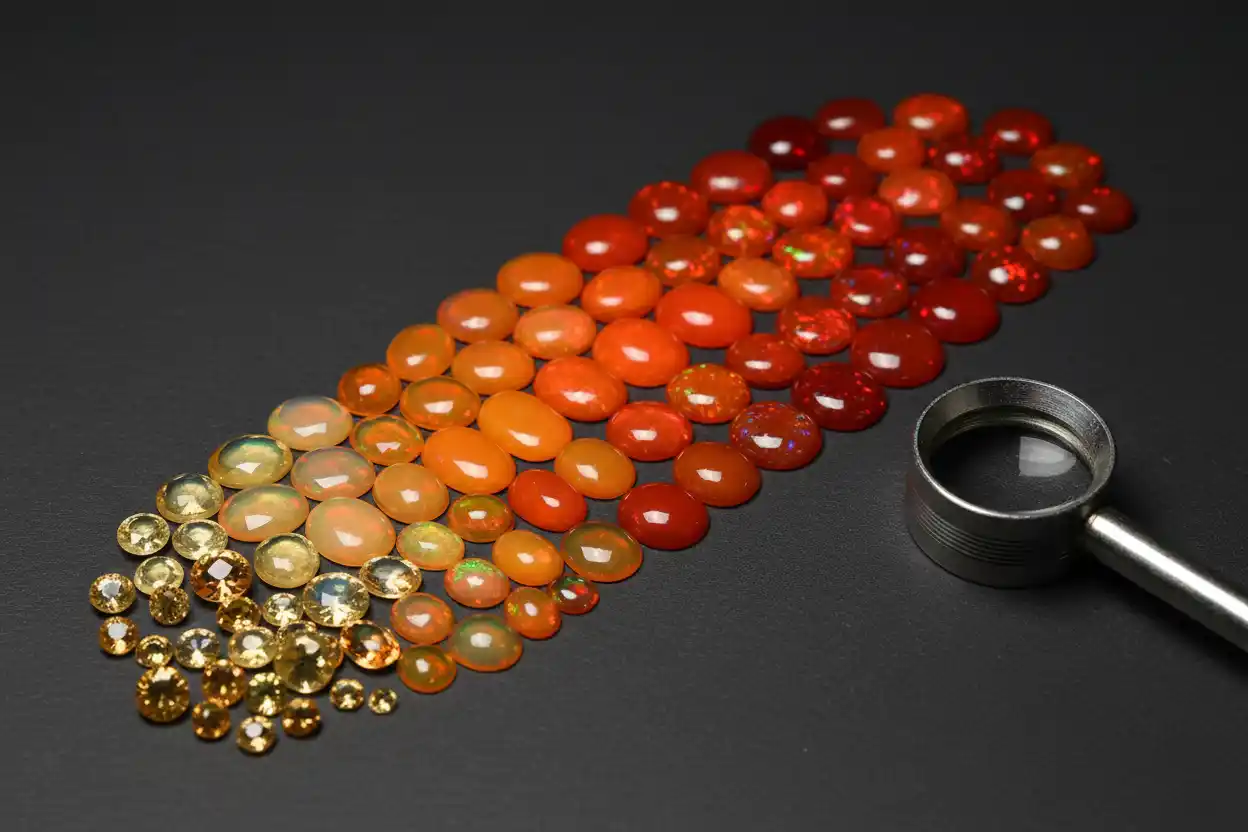
Fire Opal Price: Cost Drivers, Quality, Size & Origin
Fire opal price depends on bodycolor, transparency, clarity, cut, size, play-of-color when present, treatment status, origin, stability, condition, and market demand rather than one fixed price-per-carat number. Fire opal differs from many other precious opals because its commercial identity is based primarily on warm yellow, orange, or red bodycolor; it can be valuable even when it shows no rainbow play-of-color. GIA defines fire opal as transparent to translucent opal with a usually yellow, orange, or red bodycolor and specifically notes that the material may or may not display play-of-color.
This distinction is essential when evaluating fire opal price. A transparent, strongly saturated reddish-orange faceted gem may command a premium principally because of its bodycolor, clarity, size, and cutting, while another fire opal may derive additional value from vivid spectral flashes. Mexican fire opal is especially important commercially, but country of origin should never substitute for assessment of the individual gem. Buyers preparing to purchase rather than simply research value should first review the Gems Lore guide on how to buy fire opal so identity, treatment, construction, condition, and seller claims are established before numerical comparisons begin.
Fire Opal Price At a Glance
| Value Factor | Stronger Value Signals | Factors That Can Lower Value |
|---|---|---|
| Bodycolor | Attractive saturated yellow, orange, reddish orange, or red | Pale, muddy, excessively brown, uneven, or artificial-looking color |
| Transparency | Bright transparent to translucent appearance appropriate to the cut | Cloudiness, dullness, or poor light transmission |
| Play-of-Color | Bright, well-distributed spectral flashes when present | Weak or isolated color that contributes little visually |
| Clarity | Clean transparent appearance with limited distracting features | Fractures, pits, clouding, crazing, prominent inclusions |
| Cut | Good brilliance, proportions, polish, and useful face-up spread | Large window, excessive depth, weak symmetry, poor polish |
| Size | Larger fine stone retaining excellent color and transparency | Additional weight accompanied by weaker quality |
| Treatment | Natural appearance with clear treatment disclosure | Undisclosed coating, impregnation, dye, or other enhancement |
| Natural/Synthetic Status | Natural opal when sold in the natural-gem market | Synthetic material represented ambiguously |
| Origin | Credible Mexican or other provenance where relevant | Unsupported prestigious-origin claim |
| Stability | No crazing, major cracks, or structural weakness | Existing craze lines or fractures |
| Condition | Crisp facets, polished surfaces, intact girdle | Chips, scratches, abrasion, coating wear |
| Documentation | Independent identification and treatment findings | Seller certificate presented as independent laboratory evidence |
Bodycolor Is the Core Fire Opal Value Factor
Unlike black, white, or many crystal opals, fire opal can be desirable without play-of-color because the warm bodycolor itself creates the gem’s identity. GIA describes the category as transparent to translucent opal ranging through brown, yellow, orange, and red bodycolors and notes that play-of-color is often absent. A buyer should therefore evaluate hue, tone, saturation, brightness, and color distribution before applying rules designed primarily for black or white precious opal.
Rich orange and reddish-orange material can attract strong demand when the color remains lively rather than excessively dark or brown. A very saturated stone is not automatically superior if the tone becomes so deep that transparency and brilliance disappear, while pale yellow material may be attractive but generally creates a different commercial impression. The strongest fire opals balance saturation with enough brightness to look luminous rather than closed.
Color comparison should take place under neutral lighting whenever possible. Warm jewelry-store lamps can intensify orange and red dramatically, while cameras and editing software can increase saturation further. A significant purchase deserves unedited video or inspection under more than one normal lighting environment.
Transparency Can Matter More in Fire Opal Than in Many Other Opal Types
Mexican fire opal is notable because substantial quantities can be sufficiently transparent for faceting. GIA market reporting specifically describes Mexican material as ranging from colorless to dark red and notes that clear material can be faceted, something less common across many other opal categories.
Transparency becomes particularly important in faceted stones because the buyer expects light to pass through the gem and return from the facet arrangement. Cloudiness, internal fractures, poorly polished surfaces, or excessive extinction can reduce the visual effect even when the bodycolor is attractive.
A translucent cabochon should not automatically be considered lower quality than a transparent faceted stone because the cutting style and optical goal may differ. Material that combines warm bodycolor with play-of-color may perform beautifully as a cabochon even when it would not make an attractive faceted gem.
Play-of-Color Can Add a Separate Premium
Fire opal does not require play-of-color, but when vivid spectral flashes occur they create an additional value component. GIA’s general opal evaluation system considers the proportion and intensity of play-of-color, dominant hues, range of color, pattern, transparency, clarity, and cut.
A transparent reddish-orange fire opal with no spectral effect and an orange stone with broad green and red flashes should therefore not be treated as direct substitutes merely because their weights are similar. The first may appeal to buyers seeking saturated transparent color, while the second offers both bodycolor and an optical phenomenon.
When play-of-color is present, rotate the stone slowly and determine how much of the face remains active. A single strong flash from one narrow viewing angle should not receive the same premium as vivid, well-distributed color that remains visible through ordinary movement.
Carat Weight Becomes More Valuable Only When Quality Continues
Fire opal can occur in substantial sizes. GIA illustrates very large examples and notes more generally that opal occurs across a broad range of carat weights, while its relatively low density allows even larger stones to remain wearable.
Larger fine stones can command stronger prices because maintaining attractive color, transparency, stability, and cutting across increasing size becomes more difficult. Yet large size by itself should not be interpreted as elite quality. GIA’s Mexican-market reporting notes that nonphenomenal fire opal has been mined in significant quantities and can even be cut to calibrated sizes, which demonstrates that size and availability behave differently here than in some scarce crystalline gems.
A large pale or heavily included stone may therefore be less desirable than a smaller richly colored, transparent, finely cut gem. Carat weight becomes a meaningful value multiplier only after the underlying quality is strong.
Millimeter Dimensions Should Be Compared With Weight
Carat weight measures mass rather than visible size. A deeply cut fire opal can carry substantial weight beneath the girdle without appearing proportionately larger face-up, while a well-proportioned stone may achieve a more impressive visual spread at a lower weight.
This matters particularly with faceted fire opal because cutters may preserve rough to avoid inclusions, fractures, or valuable color zones. The extra depth can be legitimate, but the buyer should understand what is being purchased.
Compare length, width, and depth together with total carats. Price-per-carat figures are less informative when one stone contains far more hidden depth than another.
Cut Quality Can Produce Major Price Differences
Fire opal can appear as faceted stones, cabochons, freeforms, and specialty cuts, with the correct choice depending on transparency, rough shape, play-of-color, and structural condition. GIA’s broader opal guidance identifies cut as a major appearance factor and emphasizes symmetry, thickness, polish, sizing, and how effectively the finished gem presents its optical qualities.
For faceted fire opal, look for brightness, good polish, balanced proportions, attractive outline, and limited windowing. A large transparent region through the center can make the stone appear washed out, while excess pavilion depth can add carat weight without corresponding beauty.
Cabochons should have a pleasing dome and enough thickness for structural security without carrying excessive unnecessary mass. Stones with play-of-color should be oriented so the strongest spectral effect faces the viewer.
Mexican Origin Has Market Recognition but Is Not a Quality Grade
Mexico, particularly Querétaro, has a long-standing association with fine fire opal. GIA research on Querétaro material describes unusually high transparency, reddish-orange bodycolor, vivid red and green play-of-color in some examples, and the ability to facet sufficiently transparent stones.
This provenance can add commercial recognition, especially for collectors who value classic source material. It does not automatically make every Mexican stone fine. Weak color, poor cutting, fractures, treatment, or instability can still reduce value significantly.
A country name should therefore function as provenance rather than as a substitute for gemological quality. The same broader rule appears across opal: GIA’s buyer guidance states that opal value depends on quality rather than locality alone.
Fire Opal Outside Mexico Can Still Be Valuable
Warm-bodied opal occurs outside Mexico, including in Ethiopian deposits and other geological environments. Fire opal should therefore be understood as a type defined by its bodycolor and transparency rather than an exclusive geographical designation.
This becomes particularly important when comparing Mexican material with Ethiopian orange hydrophane opal. The Gems Lore guides to buy Ethiopian opal and Ethiopian opal price explain why hydrophane porosity, liquid absorption, and treatment susceptibility need additional attention in much Wollo material.
Origin can influence market demand, but a bright stable non-Mexican fire opal can still be preferable to a mediocre Mexican example. Buyers should pay for the individual gem rather than the country name alone.
Natural and Synthetic Fire Opal Must Be Priced Separately
Synthetic fire opal exists and can resemble natural material closely enough to create identification challenges. GIA documented a manufactured synthetic fire opal marketed as Mexifire, noting that its appearance could resemble natural fire opal even though gemological properties allowed laboratory separation.
Synthetic opal should not be described as imitation glass when it has been produced as synthetic opal, but it also should not be sold as natural mined fire opal. These categories have different origins, supply structures, collector appeal, and market values.
A low price can therefore reflect synthetic origin rather than an extraordinary bargain on natural Mexican material. For expensive stones, an independent identification report reduces this uncertainty.
Coated Fire Opal Belongs in a Different Comparison Category
GIA has documented natural fire opal with an acrylic surface coating used to modify appearance. In the reported case, Raman analysis confirmed the coating on a translucent orange stone with play-of-color.
A coated stone can still be visually attractive, but surface treatment changes how it should be priced and cared for. The coating may wear or scratch differently from the underlying opal, and future repolishing can affect it.
Undisclosed coating is therefore a meaningful pricing problem. A buyer comparing treated and untreated stones should place them in different categories rather than assuming equivalent value because the face-up photographs look similar.
Other Opal Treatments Can Influence Fire Opal Price
GIA notes that opal can be treated through impregnation with oil, wax, or plastic and through surface modification. Depending on the specific fire opal, treatments may alter apparent color, transparency, clarity, or durability.
Treatment does not automatically eliminate commercial value. A treated gem can be a sensible purchase when disclosure is clear, stability is acceptable, and the price reflects the modification.
The problem arises when treated material is represented as naturally equivalent to untreated fire opal. Written disclosure is much more useful than vague terms such as “genuine” or “natural,” which address identity but may not answer the treatment question.
Clarity Has a Larger Visual Role in Faceted Fire Opal
GIA defines opal clarity in terms of transparency and the presence of inclusions and notes that experts expect different levels of clarity from different opal types. In transparent fire opal, clarity receives special attention because inclusions, clouds, and fractures can interfere directly with brilliance and color.
A small natural feature away from the center may have little effect, while a prominent fracture or cloudy zone can reduce visual quality substantially. Surface-reaching cracks require additional caution because they can influence both durability and long-term setting security.
Clean transparent material can therefore command a meaningful premium when bodycolor and cut are also strong.
Crazing Can Reduce Value Sharply
Crazing is a network of fine cracks that can develop when opal loses moisture or experiences unfavorable conditions. GIA notes that crazed opal has poor durability in jewelry and generally commands lower wholesale and retail prices than undamaged material.
Inspect transparent fire opal carefully because small crack networks may become less obvious against a strong orange or red bodycolor in seller photographs. Magnification around facet junctions, the girdle, and exposed surfaces is particularly useful.
Existing crazing should be treated as structural damage rather than as an attractive natural inclusion pattern.
Condition Matters in Pre-Owned Fire Opal
Opal has a Mohs hardness of approximately 5 to 6.5 and requires more care than harder common jewelry stones. Faceted fire opal can develop scratches, worn facet junctions, chipped girdles, and damaged corners, while cabochons can lose polish through abrasion.
Existing wear should influence resale value separately from natural clarity characteristics. A once-fine transparent fire opal with heavily rounded facets may require repolishing, which can reduce weight and alter original proportions.
Condition can therefore matter significantly even when color remains excellent.
GIA Does Not Issue an Overall Fire Opal Grade
GIA evaluates opal but does not assign an overall quality grade. Its Colored Stone Identification Report can document weight, measurements, shape, cutting style, color, natural versus laboratory-grown status, and detectable treatments.
Terms such as AAA, AAAA, premium Mexican, investment grade, or collector grade belong to sellers unless the merchant clearly defines a separate grading methodology.
A more reliable valuation translates those labels into observable characteristics: bodycolor, transparency, play-of-color, cut, size, condition, treatment, and documentation.
Retail Asking Price, Appraisal, and Resale Value Are Different
A specialist retailer’s fire opal price can include sourcing, cutting, sorting, photography, laboratory work, insured shipping, return rights, jewelry setting, inventory risk, and profit margin. An appraisal may estimate replacement value for insurance or another stated purpose, while a dealer buying from an owner must leave room for verification, recutting risk, holding time, and resale margin.
These values can differ substantially without contradiction. An expensive retail purchase should not be interpreted as a guaranteed future cash value.
For broader context, Gems Lore’s most expensive gemstones demonstrates why exceptional collector sales should not be converted into everyday retail benchmarks, while the rarest gemstones in the world guide separates geological scarcity from monetary value.
Fire Opal Price Versus Black Opal Price
Black opal usually derives much of its market strength from a dark background that increases contrast with play-of-color, whereas fire opal can be prized solely for transparent yellow, orange, or red bodycolor. GIA treats these as separate opal categories.
The Gems Lore black opal price guide explains why body tone, spectral brightness, pattern, and solid-versus-assembled status dominate that market. A fire opal should not be treated as cheaper or more expensive merely because it belongs to another type.
Compare quality within each category first.
Fire Opal Price Versus Ethiopian Opal Price
Some Ethiopian opal can qualify visually as fire-colored material, but much Ethiopian Wollo opal is hydrophane and follows additional treatment and stability considerations. The Gems Lore Ethiopian opal price guide explains how hydrophane behavior, dye susceptibility, and stability can affect those stones.
Mexican fire opal is often valued heavily for transparent warm color and faceting potential, while Ethiopian opal markets frequently emphasize play-of-color and hydrophane characteristics. Overlap exists, but price-per-carat comparisons should remain material-specific.
What Usually Raises Fire Opal Price?
Stronger prices are generally easiest to justify when a stone combines vivid attractive bodycolor, good transparency, clean appearance, skilled cutting, useful face-up size, stable structure, excellent condition, and clear natural-versus-synthetic and treatment disclosure. Play-of-color can add another premium when it is bright and broadly distributed.
Fine larger stones can command more when all of those qualities survive the increase in size. Credible Mexican provenance may provide additional collector appeal, but the source name should enhance rather than replace visible quality.
What Usually Lowers Fire Opal Price?
Pale or muddy bodycolor, excessive darkness, weak transparency, cloudiness, large windows, poor proportions, crazing, fractures, chips, surface abrasion, synthetic origin represented ambiguously, undisclosed coating, impregnation, or unsupported locality claims can all reduce value.
A treated or synthetic stone can still be an attractive purchase at an appropriate price. The issue is accurate category and disclosure, not the assumption that every modified material has no value.
How to Compare Fire Opal Prices Fairly
Before comparing numerical prices, align the stones according to:
- Natural versus synthetic identity.
- Geographic origin when relevant.
- Bodycolor hue, tone, and saturation.
- Transparency.
- Play-of-color presence and quality.
- Clarity and structural stability.
- Carat weight and millimeter dimensions.
- Faceted versus cabochon cutting style.
- Cut proportions and polish.
- Treatment or coating.
- Chips, scratches, crazing, and repairs.
- Laboratory documentation.
- Loose gemstone versus finished jewelry.
- Retail, appraisal, auction, or resale context.
Only then does price per carat become a useful secondary metric.
Conclusion
Fire opal price is driven primarily by warm bodycolor, transparency, cutting, clarity, size, stability, treatment, and condition, with play-of-color adding an additional value component when present. Fire opal differs fundamentally from opal types that require spectral play for their commercial identity because transparent yellow, orange, or red material can be valuable on bodycolor alone.
Mexico remains the classic market source, particularly for transparent material suitable for faceting, but provenance should never override the individual gem. GIA research also confirms that synthetic and coated fire opals occur in the marketplace, reinforcing the need to separate identity and treatment before comparing prices.
A useful fire opal valuation therefore starts with the stone’s real physical and gemological characteristics rather than a universal price chart. Buyers who compare equivalent material, verify treatment, inspect stability, and separate retail price from resale value can judge fire opal price far more accurately.
Frequently Asked Questions
How much is fire opal worth per carat?
There is no universal fire opal price per carat. Bodycolor, transparency, clarity, cut, size, play-of-color, treatment, origin, stability, condition, and documentation can create major differences between stones of identical weight.
What color fire opal is usually most valuable?
Strong saturated orange, reddish-orange, and red can attract substantial demand when the stone remains bright and transparent. No single hue automatically outranks every other stone because clarity, cutting, size, treatment, and overall appearance still matter.
Does fire opal need play-of-color to be valuable?
No. GIA defines fire opal principally by its transparent-to-translucent yellow, orange, or red bodycolor and notes that it may or may not display play-of-color.
Does play-of-color increase fire opal price?
It can. Bright, broad, attractive spectral flashes introduce another visual quality factor beyond the warm bodycolor. The actual premium depends on brightness, coverage, color range, pattern, and the rest of the stone’s quality.
Is Mexican fire opal always worth more?
No. Mexico has important historic and commercial provenance, but opal value ultimately depends on individual quality. GIA explicitly states more generally that opal value is based on quality rather than locality alone.
Are large fire opals rare?
Large fire opals exist, including very substantial examples, so size alone does not establish extraordinary rarity. Larger stones become more valuable when strong bodycolor, transparency, stability, and cutting are maintained.
Can fire opal be synthetic?
Yes. GIA has documented synthetic fire opal, including material marketed as Mexifire. Synthetic material should be priced and represented separately from natural mined fire opal.
Can fire opal be coated?
Yes. GIA documented a natural fire opal with an acrylic coating in the commercial market. Coating should be disclosed because it can affect durability, care, and value comparison.
Does GIA grade fire opal AAA?
No. GIA evaluates opal but does not issue an overall opal quality grade. AAA and similar labels are retailer-defined.
Is fire opal durable enough for rings?
It can be worn in rings with care, but opal has a Mohs hardness of about 5 to 6.5 and is vulnerable to scratches and chips. Protective settings are sensible for valuable daily-wear pieces.
Is fire opal a guaranteed investment?
No. Fine fire opal can be collectible and valuable, but future resale depends on quality, condition, treatment, provenance, demand, market liquidity, and transaction costs. No locality or retailer grade guarantees appreciation.