
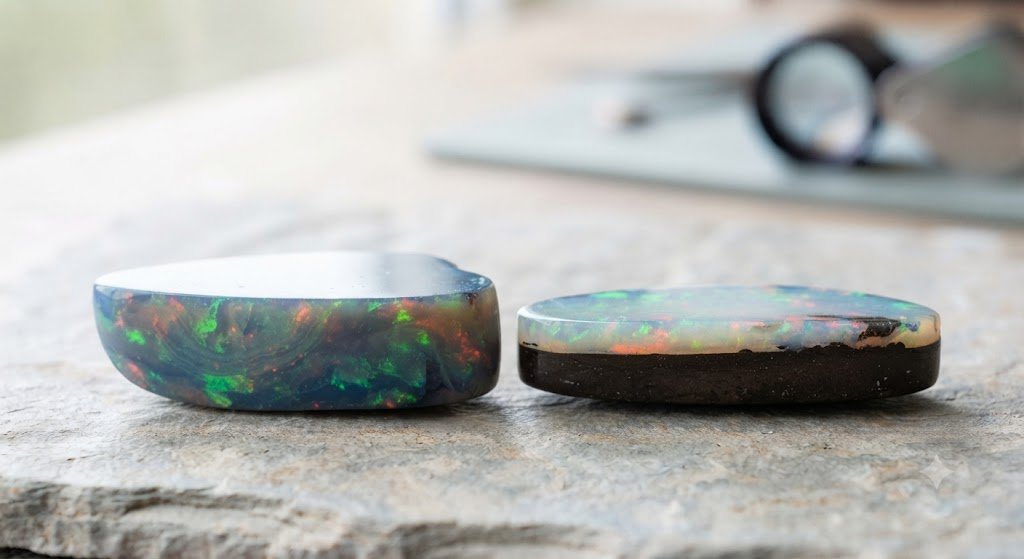

Natural opal is hydrated silica that may display play-of-color, a mobile spectral effect created when light interacts with ordered microscopic silica structures. Common opal lacks play-of-color but remains natural opal.
A solid natural opal consists of one continuous natural opal piece, although boulder opal may retain naturally attached ironstone or another host rock. A doublet uses a thin opal layer cemented to a backing. A triplet places a thin opal layer between a dark backing and a transparent protective cap.
Doublets and triplets can contain genuine natural opal. They are assembled gems rather than solid opals, and their construction must be disclosed because durability, care, value, and appearance differ.
Other market materials include laboratory-grown synthetic opal, manufactured opal simulants, plastic imitations, foil-backed glass, resin, coated stone, dyed common opal, smoke-treated hydrophane opal, and reconstructed products.
This page owns the direct solid-versus-assembled-versus-imitation workflow. The completed treated and synthetic opal guide retains the detailed treatment, synthetic-growth, dyeing, smoke, impregnation, and laboratory boundaries.
Natural Solid Opal vs Doublets, Triplets and Imitations
| Feature | Solid natural opal | Opal doublet | Opal triplet | Synthetic opal | Glass or plastic imitation |
|---|---|---|---|---|---|
| Construction | One continuous natural opal piece | Thin opal layer glued to a backing | Thin opal layer between a clear cap and dark backing | Laboratory-grown or manufactured opal material | Unrelated manufactured material |
| Side view | Body and play-of-color continue through one natural piece | One visible join between opal and backing | Two joins, with a clear dome above the opal | Pattern may continue in columns or regular structures | Foil, flakes, bubbles, or molded patterns |
| Surface | Natural opal itself | Natural opal surface | Quartz, glass, plastic, or synthetic-corundum cap | Synthetic material surface | Glass or polymer surface |
| Back | Natural opal, potch, or naturally attached matrix | Obsidian, chalcedony, glass, plastic, potch, or matrix | Dark backing | Synthetic material or chosen backing | Manufactured material |
| Pattern | Irregular natural play-of-color | Natural opal pattern within a thin layer | Magnified or intensified opal layer | May show regular chicken-wire, snakeskin, lizard-skin, or columnar patterns | Repeated foil, glitter, scale, or molded pattern |
| Water risk | Depends strongly on opal type | Water can affect adhesive and joins | Water can enter joins or affect cap adhesive | Product-dependent | Product-dependent |
| Value | Based on opal type and quality | Lower than comparable solid opal | Generally lower than comparable doublet or solid | Separate synthetic market | Decorative imitation value |
| Best confirmation | Side inspection, microscopy, RI, density, and spectroscopy | Join-plane examination | Cap and backing examination | Microscopy and spectroscopy | Standard material testing |
A natural-looking play-of-color pattern does not prove that the entire cabochon is one solid opal.
What Is Natural Opal?
The completed opal meaning guide owns formation, symbolism, localities, and general properties.
Opal is hydrated silica rather than crystalline quartz. Its structure ranges from poorly ordered common opal to the organized microscopic sphere arrangements responsible for precious opal’s play-of-color.
Natural bodycolors include white, gray, black, blue, green, yellow, orange, red, brown, and nearly colorless.
The completed types-of-opal guide owns white, black, crystal, boulder, fire, Ethiopian, matrix, common, and other variety boundaries.
Not every genuine opal flashes rainbow colors. Pink opal, blue common opal, dendritic opal, and many fire opals can lack play-of-color.
What Is Play-of-Color?
Precious opal contains microscopic silica structures arranged with enough regularity to diffract visible light.
Different sphere sizes and viewing geometries produce red, orange, yellow, green, blue, and violet flashes.
The colors move, appear, and disappear as the stone, viewer, or light changes position.
Pattern describes the arrangement of those flashes. Pinfire, broad flash, rolling flash, flagstone, and harlequin-like patterns are among the many descriptive terms.
Glass foil and plastic structures can imitate moving spectral colors. Play-of-color confirms an optical phenomenon, not automatically natural opal.
Common Opal Is Still Real Opal
Common opal lacks visible play-of-color.
It may be transparent, translucent, or opaque and occur in white, pink, blue, yellow, green, brown, or other colors.
Some common opals display dendrites, moss-like inclusions, fluorescence, or attractive bodycolor.
A seller should not call common opal fake simply because it lacks rainbow flashes.
Conversely, a manufactured object with strong flashes is not automatically precious opal.
Solid Opal
A solid opal is fashioned from one continuous natural opal piece.
The back may show natural potch, color zoning, or material without play-of-color. These features are part of the same opal body rather than a separately glued backing.
Inspect the side. Bodycolor, translucency, inclusions, and pattern should continue naturally through the thickness.
A black-painted setting or closed metal back can make a pale opal look darker. The stone should be examined loose when the construction materially affects value.
Boulder Opal Is Not a Doublet
Boulder opal forms naturally as seams or patches of opal within ironstone or another host rock.
Cutters intentionally retain part of the natural host as support.
The boundary can resemble an opal doublet, but it should be irregular and geologically integrated rather than a flat glue plane.
Natural matrix may enter the opal as fingers, channels, or uneven transitions.
The completed boulder-opal buying guide owns quality and matrix assessment.
A perfectly straight backing line, trapped adhesive bubbles, or uniform separation suggests assembly rather than natural boulder construction.
Opal Doublets
A doublet consists of a thin precious-opal layer cemented to a dark backing.
Backing materials include black chalcedony, obsidian, black glass, plastic, natural potch, or matrix.
The backing makes the opal layer look darker and can intensify play-of-color. It also supports material too thin to use alone.
Viewed from the side, the join may appear as a straight line. Glue bubbles, an abrupt texture change, or a uniform black underside can provide additional clues.
A well-made doublet is legitimate jewelry material when disclosed. It should not be represented or priced as a solid black opal.
The completed gemstone doublets-and-triplets guide owns general composite construction.
Opal Triplets
A triplet adds a transparent cap above a very thin opal layer and dark backing.
The cap may be quartz, glass, plastic, synthetic corundum, or another transparent material.
Its dome protects the opal and magnifies the play-of-color. The result can look bright and deep despite containing very little opal.
Side examination may reveal three distinct layers and two join planes.
From the front, the clear cap can create a glassy high dome, reflections unlike natural opal, or scratches inconsistent with the apparent opal layer.
Triplets are generally less valuable than comparable doublets because the natural opal layer is thinner and the visible surface belongs to the cap.
How to Examine the Side
Use a 10× loupe and neutral lighting.
Rotate the cabochon so the girdle and lower profile become visible. Search for straight horizontal boundaries, glue lines, bubbles, and abrupt changes in luster.
A doublet normally has one principal join. A triplet normally has two.
Natural opal zoning can also create straight-looking lines. The distinction depends on whether color, inclusions, and texture continue through the boundary.
Closed bezel settings can hide the profile. Do not accept a solid-opal premium when the construction cannot be examined or documented.
Examining the Back
A solid light or crystal opal may have a white, pale, translucent, or opalescent back.
Black opal may show dark natural bodycolor. Boulder opal has attached natural matrix.
A doublet or triplet often has a flat dark back made from another material.
Uniform black plastic, polished glass, or dyed chalcedony can be visible beneath the opal layer.
Some sellers paint the back of a pale opal or its setting to intensify color. Paint wear and color concentration at edges can expose the alteration.
Natural Black Opal
Black opal has a naturally dark body tone that strengthens contrast with play-of-color.
A dark body alone does not establish high quality. Brightness, color range, pattern, coverage, stability, and treatment matter.
Smoke treatment, dye, backing, or paint can make a pale opal appear black.
The completed black-opal buying guide owns body tone and value assessment.
An expensive black-opal claim should be examined from the side and back and may justify independent testing.
Ethiopian Hydrophane Opal
Ethiopian opal commonly includes hydrophane material capable of absorbing water.
Water absorption may temporarily change transparency, bodycolor, weight, and visibility of play-of-color.
Hydrophane behavior does not mean the stone is fake. However, its porosity makes dye, smoke, sugar, oil, and other treatment possible.
Do not soak an opal as a home authentication test. Repeated absorption and drying can alter appearance, expose treatment, or contribute to cracking.
The completed Ethiopian-opal buying guide owns hydrophane quality and treatment risks.
Fire Opal
Fire opal is valued principally for yellow, orange, or red bodycolor.
It may be transparent to translucent and may or may not show play-of-color.
Orange glass, synthetic material, and dyed opal can imitate it.
The completed fire-opal buying guide owns color, clarity, cut, and play-of-color evaluation.
A transparent orange faceted gem is not automatically fire opal; refractive index and spectroscopy may be required.
Synthetic Opal
Synthetic opal is manufactured material intended to reproduce natural opal’s composition, structure, and optical behavior.
Products vary by manufacturer. Some contain silica-sphere arrangements and water consistent with synthetic-opal terminology, while others marketed with opal-like names may be better classified as simulants.
Traditional synthetic patterns can look more regular than natural play-of-color. Under magnification, chicken-wire, snakeskin, lizard-skin, or repeating cellular structures may appear.
Viewed from the side, some synthetic opals display columnar color structures extending through the material.
Modern synthetic material can be more subtle. Absence of a classic pattern does not prove natural origin.
The completed laboratory-grown versus natural gemstone guide explains synthetic-versus-imitation terminology.
Chicken-Wire and Snakeskin Patterns
Some synthetic opals show networks of similarly sized color cells separated by dark lines.
The effect may resemble chicken wire, snakeskin, scales, or a regular mosaic.
Natural opal can also show organized patterns, including harlequin-like blocks. The important clue is excessive repetition and uniformity at microscopic scale.
A single photograph can exaggerate regularity. Examine several parts of the gem and view the structure from the side.
Newer synthetics may avoid the textbook appearance.
Columnar Structure
Certain synthetic opals show vertical columns of color when viewed from the side.
These structures reflect manufactured silica-sphere organization and growth direction.
Natural opal can contain directional color bars and layers, so columnar appearance must be interpreted carefully.
A repeated pattern that extends uniformly through the full depth is more suspicious than irregular natural zoning.
Plastic Imitation Opal
Plastic can produce convincing play-of-color through embedded structures, films, or particles.
It may feel light and warm, but temperature remains subjective.
Magnification can reveal casting bubbles, mold seams, soft scratches, repeated flakes, or a polymer matrix.
Some plastic imitations have refractive index and optical effects close enough to natural opal to defeat casual visual inspection.
A hot-needle test should not be used. It damages the object and can release harmful fumes.
The completed opalite guide explains why the opalite trade name may refer to manufactured glass or other imitation products rather than natural opal.
Glass and Foil Imitations
Glass may contain colorful foil, metallic flakes, dichroic layers, or interference films.
The flashes can be vivid and move during rotation, but they may look flat, sharply reflective, or repeated.
Round bubbles, curved flow lines, and molded seams suggest glass.
A backing layer or embedded foil may become visible from the side.
Sophisticated glass can contain few bubbles, so optical and spectroscopic testing may still be needed.
Slocum Stone and Other Simulants
Slocum stone is a glass-based opal imitation containing thin metallic or iridescent structures.
Gilson and other commercial names have been associated with manufactured play-of-color products, but exact composition and correct synthetic-versus-simulant terminology depend on the specific material.
Marketing names should not replace material identification.
A report should state natural opal, synthetic opal, glass imitation, plastic imitation, or another precise category.
Dyed Opal
Pale or porous opal can be dyed black, blue, purple, red, orange, or other colors.
Dye may concentrate in surface pits, fractures, drill holes, column boundaries, and porous regions.
Some Ethiopian hydrophane opals accept dye deeply and appear evenly colored.
A vivid unusual bodycolor should prompt treatment questions, especially when the material is inexpensive.
Dyed natural opal remains opal as its base material, but its color is treated.
Smoke and Sugar Treatments
Smoke treatment darkens porous opal by introducing fine carbonaceous material.
Sugar-and-acid treatment can deposit dark carbon within pores, historically creating a black-opal-like appearance in suitable matrix material.
Both treatments improve contrast rather than creating the opal’s spectral structure.
Dark color may concentrate near the surface or within porous columns and cracks.
The completed treatment page owns detailed microscopic and spectroscopic identification.
Resin Impregnation
Porous or fractured opal may be filled with polymer to improve durability, transparency, or polish.
A filler can reduce the visibility of cracks and stabilize material that would otherwise be difficult to fashion.
Bubbles, differences in luster, unnatural fluorescence, or organic infrared absorptions may expose polymer.
Impregnated natural opal is not solid untreated opal, and heat or chemicals can affect the filler.
Reconstructed Opal
Small opal particles, chips, or powder can be bonded with resin.
The product may display real opal play-of-color while lacking one continuous natural structure.
Magnification can reveal fragment boundaries, transparent binder, bubbles, and a mosaic unlike natural growth.
Reconstructed opal should be identified as composite or reconstituted material.
Natural Pattern Variation
No two natural opals need display the same arrangement.
Broad flash, pinfire, rolling flash, floral, ribbon, flagstone, and other patterns can all occur.
A regular-looking pattern is not automatically synthetic. Geological opal can develop surprisingly organized color patches.
Examine whether the pattern varies in scale, brightness, color, and direction rather than repeating mechanically.
Laboratory evidence should override simplistic visual rules.
Refractive Index and Density
Natural opal commonly has refractive index around 1.37–1.47.
Specific gravity is highly variable because water content, porosity, host material, and construction differ.
Synthetic opal and simulants can overlap selected measurements.
Doublets and triplets produce mixed results because the tester may contact the transparent cap, natural-opal layer, or backing.
A refractometer reading from a triplet’s quartz cap identifies quartz rather than the thin opal beneath it.
Ultraviolet Fluorescence
Natural opal fluorescence varies by locality, bodycolor, trace elements, and treatment.
Some opals fluoresce white, blue, green, or yellow and may show phosphorescence. Others remain weak or inert.
Synthetic products, plastic, glue, fillers, and glass may also react.
Different fluorescence across layers can reveal a doublet or triplet, but one UV color cannot prove natural origin.
Raman, FTIR, and Microscopic Testing
Raman spectroscopy can help identify opal, quartz caps, glass, plastic, and associated minerals.
FTIR provides information about water, silica structure, polymers, dyes, and fillers.
Microscopy reveals assembly planes, bubbles, synthetic patterns, pigment, foil, and reconstructed material.
X-ray and chemical analysis may be useful in difficult synthetic-versus-simulant cases.
The completed gemstone-certification guide explains laboratory reports. Use how to read a gem-lab report to determine whether the report identifies solid, assembled, synthetic, or treated material.
Tests to Avoid
Do not soak an opal to test whether it is hydrophane.
Avoid hot needles, flame, deliberate scratching, solvents, acids, and abrupt heating.
Do not freeze or dehydrate a stone to see whether it crazes.
These tests can damage natural opal, adhesives, polymer, backing, coatings, and settings.
The gemstone-treatment guide provides safer context for unknown material.
A Safe Home Inspection Sequence
Clean the surface gently without prolonged soaking.
Inspect the side and back under neutral light. Look for join planes, a clear cap, a flat black backing, glue bubbles, paint, and natural matrix.
Move the stone slowly to examine whether play-of-color has natural variation or a repeated manufactured pattern.
Use a 10× loupe to inspect cell structure, columns, foil, pigment, bubbles, and resin.
Compare the seller’s description with the construction. Solid, doublet, triplet, synthetic, treated, and imitation are distinct categories.
Stop before destructive testing. Obtain independent analysis when the stone is valuable.
Buying Genuine Opal
The completed opal buying guide owns play-of-color, body tone, pattern, transparency, cutting, and seller evaluation.
Detailed market ranges remain within the opal price guide.
Request exact-item videos under movement and photographs of the side and back.
The listing should state solid opal, boulder opal, doublet, triplet, synthetic, reconstructed, or imitation clearly.
For remote transactions, follow how to buy gemstones online and retain sufficient time for professional inspection.
Opal Jewelry and Care
An opal ring requires a protective setting and deliberate wear.
Opal earrings and an opal necklace generally receive less impact than an opal bracelet.
Use the completed opal jewelry cleaning guide for ordinary pieces.
Separate procedures apply to black opal, boulder opal, and fire opal because construction, matrix, treatment, and porosity differ.
Doublets and triplets should not be soaked because water can enter join planes and affect adhesive.
Frequently Asked Questions
1. What is a solid natural opal?
It is one continuous natural opal piece rather than a thin layer glued to another material.
2. Is boulder opal a doublet?
No. Its host rock formed naturally with the opal and remains attached through a geological boundary rather than glue.
3. Is an opal doublet fake?
No. It normally contains a genuine opal layer, but it is assembled and must not be sold as solid opal.
4. Is an opal triplet real opal?
It usually contains a very thin opal layer between a clear cap and dark backing. The construction is genuine assembled jewelry, not a solid opal.
5. How can I spot a doublet?
Inspect the side for one flat join between a thin opal layer and a dark backing.
6. How can I spot a triplet?
Look for a transparent domed cap, a thin central opal layer, a dark backing, and two join planes.
7. Does chicken-wire pattern always prove synthetic opal?
It is a common clue in some synthetic products, but natural patterns and newer synthetics require broader examination.
8. Is opalite genuine opal?
Opalite is usually manufactured glass or another imitation product rather than natural opal.
9. Can common opal be real without rainbow colors?
Yes. Common opal lacks play-of-color but remains natural opal.
10. Can natural opal be dyed or smoke-treated?
Yes. Porous opal can accept dye, smoke, sugar treatment, or polymer, particularly in hydrophane and matrix material.
11. Should I soak opal to test whether it is genuine?
No. Water can alter hydrophane opal and damage adhesives, backing, fillers, or coatings.
12. When should opal receive laboratory testing?
Testing is worthwhile for valuable black opal, disputed solid-versus-assembled construction, unusual colors, synthetic concerns, and significant untreated claims.
Opal authentication begins with construction. A natural play-of-color layer can belong to a solid opal, a doublet, or a triplet, while convincing synthetic and plastic products can display moving colors of their own. Examining the side, back, pattern, and microscopic structure usually exposes obvious assemblies. Important stones deserve a report that identifies not only opal, but whether the object is solid, assembled, synthetic, treated, or an imitation.
Opal appears in Crystals That Start With O and Gemstones That Start With O.