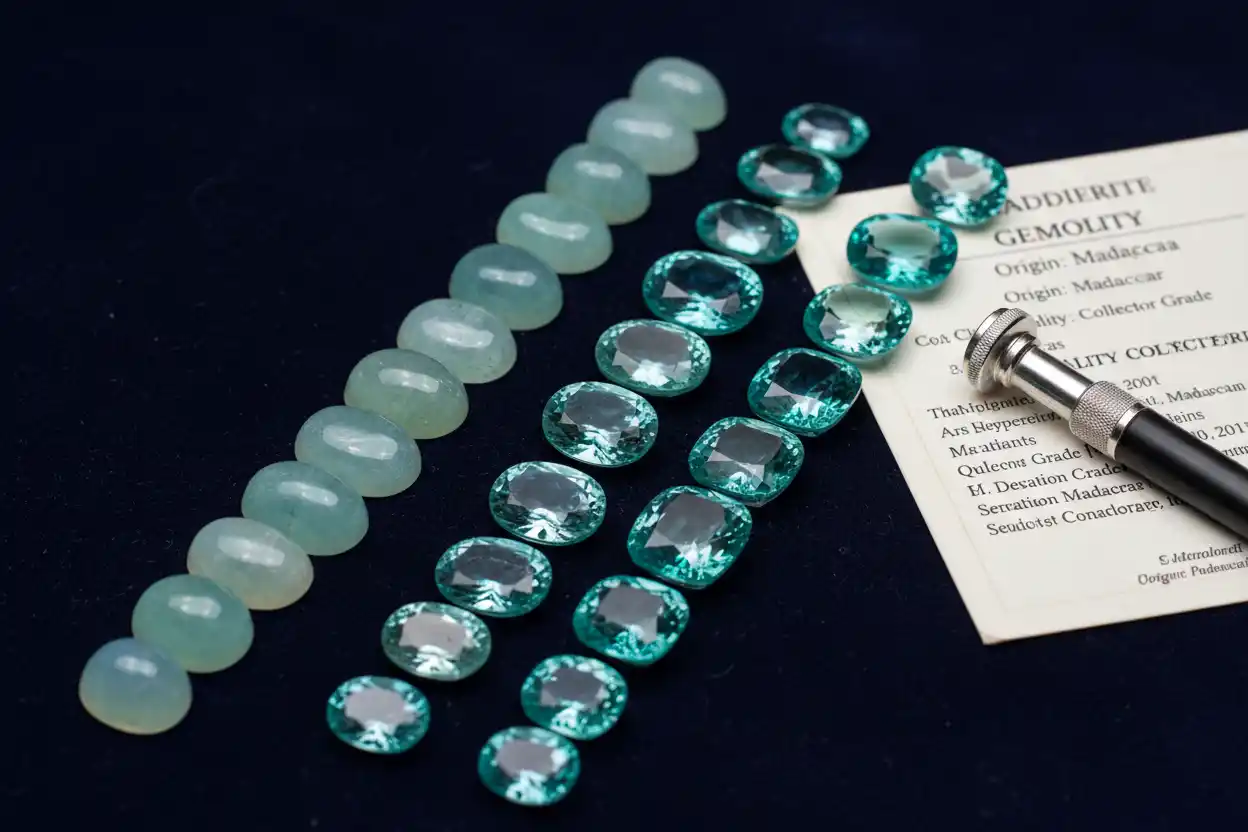
Grandidierite Price: What Buyers Pay For, What Raises or Lowers Cost
Grandidierite price reflects a highly specialized market in which material identity, transparency, color, pleochroism, clarity, size, cutting, condition, provenance, and documentation matter far more than a generic price-per-carat figure. Grandidierite is an exceptionally rare orthorhombic magnesium-iron aluminous borosilicate, and fine transparent faceting material represents only a small portion of known grandidierite production. In GIA’s detailed study of the Tranomaro deposit in southern Madagascar, most crystals were translucent rather than transparent, about 60 grams of eye-clean crystal were recovered from roughly 800 kilograms of rough specimens during the documented early production period, and fewer than ten of the faceted stones examined exceeded one carat. Those figures describe that specific deposit and historical production interval rather than the entire modern market, but they show why transparent jewelry-quality material occupies a much rarer category than ordinary translucent grandidierite.
For buyers, that rarity creates both opportunity and risk. A transparent stone with attractive bluish-green color can deserve a substantial premium, but the rare mineral name does not make every specimen equally valuable. Weak transparency, poor cutting, excessive depth, fractures, cleavage damage, uninspiring color, or inadequate identification can reduce desirability sharply. Anyone preparing to buy rather than merely research should first review the Gems Lore buy grandidierite guide because the price only becomes meaningful after identity, transparency class, condition, and seller claims have been established.
Grandidierite Price At a Glance
| Value Factor | What Usually Raises Grandidierite Price | What Can Lower Grandidierite Price |
|---|---|---|
| Identity | Independently confirmed natural grandidierite | Unverified blue-green stone or ambiguous identification |
| Transparency | Transparent, jewelry-quality material | Translucent or opaque material priced as fine faceting grade |
| Color | Attractive bluish green to greenish blue | Weak, washed-out, overly pale, or unattractive orientation |
| Pleochroism | Face-up orientation showing appealing blue-green color | Poor orientation dominated by pale or nearly colorless direction |
| Clarity | Eye-clean or minimally included transparent material | Heavy fractures, clouds, distracting crystals, structural weakness |
| Size | Larger fine stone retaining transparency and color | Additional weight accompanied by weak quality |
| Cut | Strong brightness, symmetry, polish, limited windowing | Large window, excessive depth, poor polish, weak outline |
| Condition | Crisp facets, intact girdle, no chips | Cleavage damage, scratches, abrasion, fractures |
| Provenance | Credible Madagascar or other locality documentation | Unsupported origin story |
| Treatment | Clear treatment disclosure and laboratory findings | Unsupported “untreated” claim used to create a premium |
| Documentation | Independent laboratory identification | Seller certificate presented as equivalent to independent testing |
| Transaction Type | Comparable specialist-retail or realized-market evidence | Mixing appraisal, asking price, and resale offer |
Transparent Grandidierite Belongs to a Different Market From Translucent Material
One of the most important grandidierite price distinctions is transparency. GIA’s Tranomaro study found that crystals were generally translucent and only rarely transparent, while thick material could become opaque. The small subset suitable for eye-clean faceting represented an exceptionally limited fraction of the rough studied.
This makes it misleading to compare every grandidierite by carat weight alone. A five-carat translucent cabochon and a one-carat transparent faceted gem can be genuine examples of the same mineral yet occupy very different commercial categories. The transparent gem requires rough that transmits light sufficiently well, contains manageable inclusions and fractures, survives cutting, and presents attractive face-up color after orientation.
Translucent grandidierite can still have collector and jewelry value. Cabochons, beads, carvings, crystal specimens, and matrix pieces may be attractive, especially when color is rich or provenance is strong. The distinction is not genuine versus inferior; it is a difference in rarity, optical performance, use, and buyer demand.
Color Is Important, but Pleochroism Makes the Evaluation More Complex
Grandidierite is characteristically bluish green to greenish blue. GIA documents pronounced pleochroism, with individual crystal directions capable of showing pale yellow to almost colorless, greenish blue, and deeper blue-green appearances.
This directional color means a grandidierite cannot be valued solely from the saturation visible in one still photograph. The cutter’s orientation determines which pleochroic direction dominates when the stone is viewed face-up. A larger gem cut with its palest direction toward the observer may be less attractive than a smaller stone whose orientation reveals a stronger greenish-blue face.
Video can therefore be especially useful in online valuation. Slow rotation reveals whether the dominant color remains appealing, whether areas wash out, whether extinction becomes prominent, and how strongly pleochroism affects the finished appearance.
Pleochroism Should Not Be Marketed as Conventional Color Change
Grandidierite’s directional variation is caused by pleochroism rather than the classic light-source-dependent color change associated with alexandrite or diaspore. Different colors become stronger when the viewing direction through the crystal changes; the phenomenon does not require switching from daylight-equivalent illumination to incandescent-style lighting.
A seller who describes the stone as “color change grandidierite” without explaining the mechanism can therefore make the material sound more like alexandrite than it really is. Strong pleochroism is a legitimate and attractive characteristic, but it should be described accurately.
The buyer should pay for the actual face-up color and directional visual effect rather than an exaggerated phenomenon label.
Eye-Clean Transparent Material Can Command a Significant Premium
Clarity becomes particularly important because eye-clean transparent grandidierite is scarce. In the documented Tranomaro production, only about 60 grams of eye-clean crystal were identified within a much larger quantity of rough specimens.
That does not mean every internal feature destroys value. Natural crystals can contain mineral inclusions, fluid inclusions, fractures, and other growth evidence. A small inclusion away from the center may have little visible effect, while a reflective fracture cutting across the face can reduce transparency and durability substantially.
The correct comparison therefore asks how inclusions affect the finished gem rather than whether any inclusion exists. A slightly included stone with excellent color and cutting can be more desirable than a cleaner stone whose orientation or proportions produce weak visual performance.
Larger Fine Stones Deserve More Verification
The historical production documented by GIA illustrates how unusual larger faceted grandidierite once was at Tranomaro: fewer than ten of the early faceted stones were above one carat. GIA also reported faceted Madagascar submissions ranging roughly from 0.9 to 2.3 carats when gem-quality material began entering the market in greater visibility.
These figures should not be turned into a permanent modern size limit because additional material can enter the market and production conditions change. They do, however, provide useful rarity context.
A several-carat stone advertised as transparent, eye-clean, vividly blue-green, and natural deserves stronger documentation precisely because the combination of size and high quality is commercially important. The more extraordinary the claim, the less appropriate it is to rely on an unverifiable seller card.
Carat Weight Must Be Compared With Face-Up Dimensions
Rare rough creates an understandable incentive to preserve weight during cutting. A cutter may retain extra depth to avoid fractures, preserve color, or save expensive material, but those decisions can make two equal-weight stones look very different in size.
Compare length, width, and depth together with carat weight. A lighter grandidierite with a broad attractive face-up spread can look more impressive in jewelry than a heavier stone carrying much of its mass below the girdle.
This distinction becomes increasingly important as the price per carat rises because hidden weight can represent a meaningful portion of the total purchase cost.
Cut Quality Can Raise or Lower Cost Dramatically
A fine grandidierite cut must balance rarity of rough, pleochroic orientation, transparency, structural weakness, and optical performance. That makes cutting a major value factor rather than an afterthought.
Inspect whether the stone has a large window through which the background is plainly visible, whether dark extinction covers significant areas, whether the outline looks balanced, and whether the facet junctions meet cleanly. Polish should be crisp enough to support the gem’s vitreous appearance.
A precision cut may legitimately cost more because skilled cutting involves additional labor and potentially greater rough loss. That premium is craftsmanship value and should be separated conceptually from the geological rarity of the grandidierite itself.
Cleavage and Fractures Affect Both Durability and Price
GIA’s Madagascar study records cleavage along {100} and visible fractures in grandidierite crystals. Those structural characteristics matter in valuation because an expensive transparent stone with a vulnerable surface-reaching fracture may face greater setting and wear risk than a sound example.
Inspect the girdle, corners, and areas around prongs under magnification. A small pre-existing chip can spread or require repolishing, while a cleavage-related fracture may be difficult to repair without removing significant material.
Condition therefore deserves its own line in the valuation rather than being hidden inside a broad clarity description.
Madagascar Provenance Has Historical and Commercial Importance
Grandidierite was first described from southern Madagascar, and the Tranomaro deposit studied by GIA lies near the original Andrahomana locality. Madagascar consequently carries exceptional historical importance for the mineral and remains strongly associated with gem-quality material.
GIA also notes that transparent facetable grandidierite has been reported from Sri Lanka, although gem-quality production has historically been exceptionally limited.
A credible Madagascar provenance can therefore add collector interest, but locality must remain separate from physical quality. A poorly cut translucent Madagascar specimen does not automatically outrank a fine transparent stone merely because of the country name.
Seller Origin Claims and Laboratory Geographic-Origin Reports Are Different
Current GIA colored-stone services provide a general Identification Report for polished loose or mounted material, but the standard Identification & Origin Report is restricted to a defined list of gem types that currently includes alexandrite, demantoid, emerald, jade, opal, Paraíba tourmaline, peridot, red spinel, ruby, and sapphire. Grandidierite is not on that list.
This means a GIA identification report can establish that a polished gem is grandidierite and describe detectable treatments, but it should not be presented as a standard GIA Madagascar-origin report.
Mine records, supplier invoices, field provenance, and specialist documentation can still be useful. Buyers simply need to distinguish those forms of evidence from a laboratory geographic-origin service that is not currently offered for grandidierite.
Independent Identification Can Be Worth the Cost
GIA currently offers Colored Stone Identification Reports for polished loose or mounted materials. The report identifies the gemstone, states natural or synthetic status where applicable, records detectable treatments, and includes measurements, weight, cutting style, color, and an image.
Grandidierite’s rarity makes such confirmation particularly useful for expensive stones. A seller can mistakenly or deliberately confuse a blue-green gem with another material, and photographs alone cannot establish chemical identity.
For a low-cost translucent bead, the economics of a major laboratory report may not make sense. For a rare transparent several-carat stone, independent identification can represent a relatively small cost compared with the financial risk of misidentification.
GIA Does Not Issue a Universal Grandidierite Quality Grade
There is no broadly accepted universal grading system for colored stones, and GIA does not provide overall quality grades for them.
AAA, AAAA, museum grade, investment grade, top gem, exceptional grade, and similar grandidierite labels are therefore seller-defined rather than standardized laboratory grades.
An informed valuation replaces those labels with specific evidence: transparency, color, pleochroism, clarity, cut, size, dimensions, condition, identification, provenance, and treatment disclosure.
Treatment Should Be Addressed Without Making Unsupported Assumptions
Authoritative GIA research on Madagascar grandidierite primarily focuses on mineral identity, geology, chemical composition, inclusions, rarity, and faceting potential rather than describing a routine treatment market.
That is not the same as proving that every grandidierite offered anywhere is untreated. Modern gem markets can include coatings, fillings, composites, or other modifications that deserve detection when present.
A seller charging an untreated premium should explain what evidence supports the claim. Current GIA identification services include testing for detectable treatments, which gives buyers an independent route when the value justifies it.
Mineral Specimens and Faceted Gems Should Not Share One Price Benchmark
A large grandidierite crystal specimen can be valuable for completely different reasons from a transparent faceted stone. Mineral collectors may pay for crystal form, termination, matrix association, locality, specimen aesthetics, size, condition, and collection history even when the material would produce little useful transparent faceting rough.
A cut gemstone market emphasizes face-up color, transparency, pleochroism, clarity, cutting, dimensions, and wearability.
Dividing a specimen’s total price by its weight and comparing that result with a faceted gemstone price therefore produces a misleading benchmark.
Retail Asking Price Is Not the Same as Resale Value
A specialist dealer’s grandidierite price can include sourcing difficulty, travel, laboratory testing, cutting losses, insurance, photography, inventory risk, customer returns, and the cost of holding a rare item until an appropriate collector appears.
A dealer buying the same gem back from a consumer has different economics. Verification, market risk, capital tied up in inventory, possible repolishing, and resale margin can all reduce the cash offer.
Rarity does not automatically create liquidity. Grandidierite can be genuinely rare while still having a narrower pool of buyers than emerald, sapphire, or diamond.
Appraisal Value Is a Separate Concept
A gemological identification report establishes what the material is and describes detectable treatments. An appraisal assigns monetary value for a specific purpose such as insurance replacement, estate planning, fair market value, or liquidation.
An insurance replacement figure can exceed what a dealer would pay in cash. A retail asking price can exceed a likely auction result. A private collector may pay more for a particular stone because of provenance or personal preference.
These numbers should therefore never be combined into one supposedly objective grandidierite price.
Rare Does Not Automatically Mean Expensive at Every Quality Level
Grandidierite is genuinely rare, but rarity and monetary value are not identical. A heavily fractured opaque specimen can be geologically rare while having limited demand as jewelry material.
The Gems Lore rarest gemstones in the world guide explains this distinction broadly, while most expensive gemstones shows how the highest prices generally require rarity to coincide with exceptional beauty, quality, size, provenance, and buyer competition.
A grandidierite premium should therefore reflect the rarity of the particular quality represented, not simply the rarity of the mineral name.
What Usually Raises Grandidierite Price?
The strongest grandidierite price premiums generally occur when a stone combines verified identity, transparent jewelry quality, appealing bluish-green or greenish-blue color, effective pleochroic orientation, minimal distracting inclusions, larger size, good face-up spread, high-quality cutting, intact condition, and credible documentation.
Additional premiums can come from noteworthy Madagascar provenance, important collection history, exceptional crystal specimens, recognized precision cutters, or unusual size within a genuinely fine transparent category.
The rarest and most valuable stones usually combine several favorable characteristics rather than dominating one variable while compromising all others.
What Usually Lowers Grandidierite Price?
Translucency when transparent quality is being advertised, weak or pale face-up color, poor pleochroic orientation, heavy fractures, chips, cleavage damage, excessive depth, large windows, poor polish, weak seller disclosure, uncertain identity, unsupported Madagascar claims, or seller-defined grades can all reduce value.
A lower-priced translucent specimen can still be an excellent purchase for someone who prioritizes color or mineral rarity over faceted brilliance. The important question is whether the price matches the actual category.
How to Compare Grandidierite Prices Fairly
Before comparing numerical prices, align:
- Confirmed grandidierite identity.
- Transparent versus translucent material.
- Face-up hue, tone, and saturation.
- Strength and orientation of pleochroism.
- Eye-visible clarity.
- Fractures and cleavage-related risks.
- Carat weight.
- Length, width, and depth.
- Face-up spread.
- Cut quality and polish.
- Condition.
- Treatment disclosure.
- Madagascar or other provenance evidence.
- Independent laboratory documentation.
- Loose gem versus mineral specimen.
- Retail, appraisal, auction, or resale context.
Only after these variables are reasonably aligned does price per carat become useful.
Conclusion
Grandidierite price reflects one of the clearest examples of why gemstone rarity must be qualified by quality. GIA considers grandidierite an extremely rare gem mineral, yet its Madagascar research also demonstrates that most available rough at the studied deposit was translucent, while eye-clean transparent faceting material represented only a tiny fraction of production.
Transparent material with attractive bluish-green color, strong face-up orientation, high clarity, fine cutting, larger size, and sound condition therefore belongs to a very different market from ordinary translucent specimens. The best valuation also distinguishes laboratory-confirmed identity from seller provenance, because GIA currently offers general colored-stone identification for grandidierite but not its standard geographic-origin report for the species.
A buyer who pays for the complete stone—rather than the rare name alone—has the strongest basis for judging whether a grandidierite price is justified.
Frequently Asked Questions
How much is grandidierite worth per carat?
There is no universal grandidierite price per carat. Transparent versus translucent quality, color, pleochroism, clarity, size, cutting, condition, provenance, and documentation can create enormous differences between stones.
Why is transparent grandidierite expensive?
Transparent facetable material is exceptionally scarce. In GIA’s historical Tranomaro study, most material was translucent, only about 60 grams of eye-clean crystal occurred within roughly 800 kilograms of rough specimens, and fewer than ten early faceted stones exceeded one carat.
Is every large grandidierite extremely valuable?
No. Large weight creates a premium mainly when transparency, attractive color, clarity, cutting, and condition remain strong. A large translucent or heavily fractured stone can be worth less than a much smaller fine transparent gem.
Does blue-green color increase grandidierite value?
Usually, provided the color is attractive and presented well face-up. Grandidierite naturally ranges from bluish green to greenish blue and can show strong pleochroism.
Is grandidierite from Madagascar more valuable?
Madagascar has exceptional historical importance and produces important gem-quality material, so credible provenance can add collector interest. Origin still does not replace transparency, color, clarity, cut, or condition.
Can GIA identify grandidierite?
Yes. GIA Colored Stone Identification Reports are available for polished colored-stone material and state material identity and detectable treatments.
Can GIA confirm Madagascar origin for grandidierite?
Grandidierite is not currently among the gemstones eligible for GIA’s standard Colored Stone Identification & Origin Report. Seller provenance should therefore be distinguished from a standard GIA country-of-origin conclusion.
What does AAA grandidierite mean?
AAA is seller-defined. GIA states that no broadly accepted universal colored-stone grading system exists and does not issue overall colored-stone quality grades.
Is a translucent grandidierite worthless?
No. Translucent material can be attractive in cabochons, carvings, beads, or mineral specimens. It simply belongs to a different category from rare transparent faceting-quality grandidierite.
Does a laboratory report tell me the grandidierite price?
No. A laboratory report establishes gemological identity and related characteristics. Monetary appraisal and market valuation are separate processes.
Is grandidierite guaranteed to appreciate?
No. Genuine rarity does not guarantee future price growth. Resale depends on quality, size, condition, provenance, documentation, buyer demand, transaction costs, and liquidity.