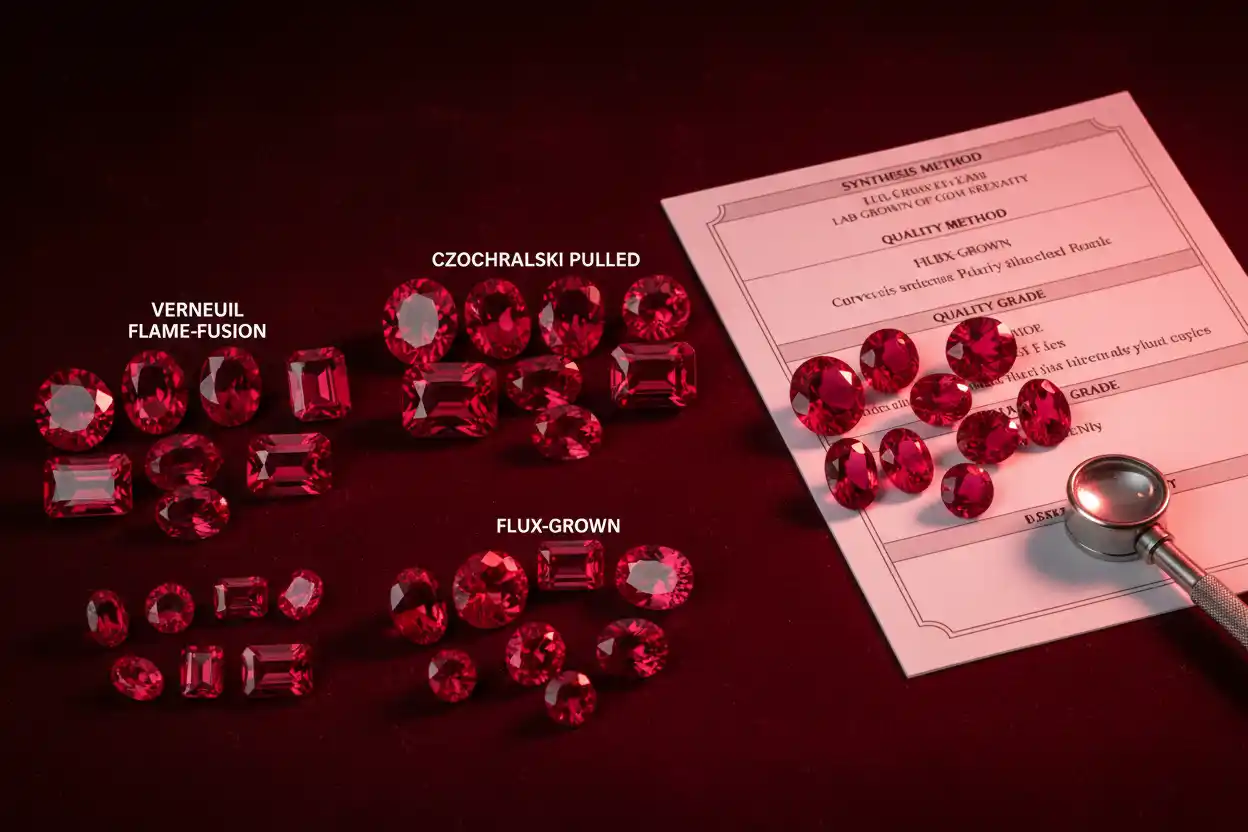
Lab Ruby Price: What Buyers Pay For, Size, Grade & Provenance
Lab ruby price varies widely because synthetic corundum can be manufactured by several processes ranging from highly scalable flame fusion to slower and more specialized flux and hydrothermal growth. GIA describes synthetic corundum as widely available at many price levels precisely because ruby and sapphire can be produced using more growth methods than most other synthetic gem families. This broad manufacturing spectrum explains why a large flame-fusion ruby can cost surprisingly little while a smaller flux-grown or historically important synthetic can command a substantially higher price.
The strongest valuation mistake is to compare laboratory-grown ruby directly with fine natural ruby. Natural ruby pricing is driven partly by geological rarity, and GIA notes that fine natural rubies above one carat are rare enough for per-carat value to increase dramatically with size. Synthetic growth breaks that geological size constraint by allowing manufacturers to create substantial corundum crystals or boules under controlled conditions. A lab ruby can therefore match or exceed a natural stone visually while following a completely different scarcity model. Buyers should first use Gems Lore’s buy lab ruby guide to determine growth category and quality before judging whether the lab ruby price is reasonable.
Lab Ruby Price At a Glance
| Value Factor | What Usually Raises Lab Ruby Price | What Can Lower Lab Ruby Price |
|---|---|---|
| Identity | Verified laboratory-grown ruby/corundum | Unverified red material or simulant |
| Growth Method | Slow specialty flux or hydrothermal production, documented producer | Common mass-market flame-fusion material |
| Color | Vivid pure red to slightly purplish red | Brownish, orangy, weak, overly dark, or uneven color |
| Transparency | Bright transparent appearance | Cloudiness or dense inclusions |
| Clarity | Attractive clean face-up appearance | Distracting growth features or fractures |
| Cut | Strong brightness, symmetry, polish, color orientation | Windowing, extinction, excess depth |
| Size | Larger high-quality specialty synthetic | Large size alone in abundant flame-fusion material |
| Phenomenon | Sharp well-centered star in synthetic star ruby | Weak, diffuse, off-center star |
| Manufacturer | Recognized historic or specialist producer | Generic untraceable manufacture |
| Historical Provenance | Vintage documented synthetic in period jewelry | Modern mass production |
| Post-Growth Treatment | Clear disclosure and stable condition | Undisclosed filling, flux healing, coating, or modification |
| Documentation | Independent natural/synthetic identification | Seller-only paperwork |
| Condition | Crisp facets and sound structure | Chips, scratches, repairs, damaged filler |
| Setting | Fine craftsmanship and valuable metal | High markup from weak jewelry construction |
| Resale Context | Specialist collector demand for certain synthetics | Natural-ruby investment assumptions |
Growth Method Can Be One of the Largest Lab Ruby Price Drivers
Synthetic ruby production is unusually diverse. GIA identifies flame fusion, flux growth, pulled methods, and hydrothermal techniques among the technologies capable of producing synthetic corundum.
These processes do not have identical production costs. Flame fusion can manufacture synthetic corundum efficiently in substantial quantities, while flux and hydrothermal growth require more complex conditions and can be much slower.
As a result, “lab ruby” is too broad a category for one useful price-per-carat benchmark. The buyer needs to know what kind of synthetic ruby is actually being valued.
Flame-Fusion Ruby Usually Defines the Accessible End of the Market
Flame fusion revolutionized synthetic ruby production because it could produce corundum boules efficiently and at scale. GIA notes that most synthetic ruby and sapphire encountered in the market has historically been flame-fusion material and that curved growth banding is a classic identifying feature.
Because supply is broad, carat weight does not create a strong rarity premium in ordinary flame-fusion ruby.
A large clean flame-fusion ruby can therefore be an excellent jewelry value without being scarce or expensive by collector-gem standards.
Flux-Grown Ruby Can Carry a Higher Manufacturing Premium
Flux-grown synthetic ruby crystallizes slowly from a solution in molten flux, and manufacturers can produce internal features that differ substantially from flame-fusion material. GIA documents flux-grown products with characteristic flux inclusions and examples whose internal scenes can look surprisingly natural.
Slow production, specialized equipment, lower output, manufacturer reputation, and collector interest can all support a higher lab ruby price.
The premium should still be justified by the actual stone and producer rather than by the word flux alone.
Hydrothermal Ruby Can Occupy a Specialty Segment
Hydrothermal growth uses high-pressure autoclaves and water-based supercritical fluids, seed crystals, mineralizers, and carefully controlled temperature gradients. GIA confirms that this technique can produce synthetic ruby as well as emerald and sapphire.
Hydrothermal synthetic ruby can therefore command a different price from common flame-fusion material because manufacturing requirements and market availability differ.
No universal percentage premium applies because producer, size, color, cut, documentation, and retail positioning all vary.
Manufacturer Provenance Can Matter More Than Generic Growth Method
Two flux-grown rubies can have different values if one comes from a recognized historic producer and the other from an unknown contemporary source.
Certain synthetic ruby brands have become collectible because of technological importance, characteristic inclusions, historical jewelry use, or limited production.
Manufacturer provenance can therefore function somewhat like maker provenance in decorative arts: it does not make the stone natural, but it can give a synthetic gemstone a more distinctive history and collector market.
Vintage Synthetic Ruby Can Be Worth More Than Modern Material
Synthetic ruby has been used in jewelry for more than a century. Antique and vintage pieces can possess value from design, age, maker, period setting, historical technology, and preservation.
A documented early flame-fusion ruby in original Art Nouveau or Art Deco jewelry can therefore be worth substantially more than a modern loose flame-fusion stone of equal weight.
The extra value belongs to the complete object and provenance rather than to the raw laboratory-grown ruby alone.
Color Remains the Strongest Visual Value Factor
GIA identifies pure vibrant red to slightly purplish red as the finest ruby color, with strong saturation and balanced tone. That framework remains useful for synthetic ruby even though manufactured color does not possess the same geological rarity.
A bright vivid lab ruby can command more than an orangy, brownish, grayish, overly dark, or weakly saturated synthetic from the same process.
The strongest color should remain attractive under ordinary illumination rather than depending on intense backlighting.
“Pigeon Blood” Does Not Create Natural Ruby Provenance
Sellers sometimes use pigeon-blood color to describe a vivid red synthetic ruby. As a visual comparison, that wording can communicate color preference, but it should not be interpreted as Myanmar mine origin or as conferring the natural-ruby rarity associated with exceptional unheated stones.
A laboratory-grown ruby can be colored beautifully by chromium under controlled growth conditions without duplicating natural geological scarcity.
The lab ruby price should therefore reflect synthetic manufacturing, not a natural-origin prestige label.
Clarity Is Usually Easier to Achieve Than in Natural Ruby
Natural rubies commonly contain silk, crystals, fingerprints, color zoning, and fractures, and GIA notes that inclusion-free natural ruby is extraordinarily rare. Synthetic growth can yield much cleaner material.
This changes the scarcity of eye-clean ruby dramatically. A clean synthetic ruby may be ordinary within its production method even though a similarly clean natural ruby would be rare and expensive.
Pay for visual clarity, but do not assume that flawless-looking synthetic material should receive the natural-ruby clarity premium.
Inclusions Can Increase Collector Interest in Some Synthetic Ruby
Flux residues, characteristic growth structures, gas bubbles, curved striae, seed features, or unusual experimental structures can identify a particular production method or manufacturer.
Collectors of gem synthesis may value a stone partly because those features are diagnostic and historically interesting.
This is very different from mainstream jewelry valuation, where obvious inclusions usually reduce transparency and beauty.
Natural-Looking Inclusions Do Not Prove Natural Origin
GIA has documented synthetic ruby with inclusions resembling natural clouds, fingerprints, and other internal structures.
Some flame-fusion synthetic ruby has even been quench-crackled and flux-healed to create natural-looking fingerprint patterns.
A rare-looking internal scene therefore should not be used to justify a natural-ruby price without proper laboratory confirmation.
Size Works Very Differently From Natural Ruby
Fine natural ruby can become dramatically more expensive per carat as size rises because nature rarely produces large transparent crystals with fine color and manageable inclusions.
Synthetic ruby manufacturers can produce large boules and crystals directly, so large size alone is not a strong rarity argument.
A twenty-carat flame-fusion ruby may cost less than a much smaller specialty flux-grown stone because growth method and market category can matter more than weight.
Large Specialty Synthetic Ruby Can Still Be Expensive
Manufactured supply does not mean every large laboratory-grown ruby is cheap. A large flux-grown or hydrothermal crystal with strong red color, good clarity, attractive cutting, recognized producer provenance, and documentation can require significant time and production cost.
Precision cutting can add another premium.
The correct principle is not that size has no value, but that size should be priced according to synthetic manufacturing scarcity rather than natural geology.
Face-Up Dimensions Matter With Carat Weight
A deep lab ruby can retain substantial weight but appear small from above. This is especially relevant when rough itself is inexpensive enough that cutters may not optimize every stone for spread.
Compare length, width, and depth as well as weight.
A smaller but better-proportioned synthetic can provide more visual impact for the money.
Star Synthetic Ruby Has Its Own Pricing Structure
Manufacturers can create synthetic star ruby by inducing aligned inclusions that produce asterism. GIA identifies star synthetic corundum as an established product.
Lab ruby price for star material depends on bodycolor, sharpness, centering, strength, movement, number and continuity of rays, cabochon shape, size, and manufacturer.
A strong crisp star can command more than a weak diffuse one even when both are synthetic and equal in weight.
Cut Quality Still Matters in Low-Cost Synthetic Material
A common flame-fusion ruby can be inexpensive enough that mass-market cutters prioritize speed and yield over perfect symmetry or light return. The buyer can therefore find large variation in cutting quality within low-cost synthetic jewelry.
Windowing, flat pavilions, thick girdles, uneven facets, weak polish, and asymmetrical outlines all reduce visual quality.
A carefully precision-cut synthetic ruby may command many times the loose-material cost because the added value comes from lapidary workmanship.
Precision Cutting Can Dominate the Finished Gem Price
Synthetic rough can be inexpensive while skilled cutting is labor-intensive. A precision cutter may spend hours designing, orienting, faceting, and polishing one stone.
The result can cost substantially more than mass-market synthetic ruby even though both originated from similar material.
This is legitimate craftsmanship value rather than evidence that the synthetic itself is geologically rare.
Post-Growth Modification Can Affect Price and Care
Synthetic ruby can receive additional treatment after growth, including quench crackling, flux healing, filling, coating, or other processes. GIA has documented flame-fusion material altered to create more natural-looking internal features.
A filled synthetic ruby should not automatically be priced like solid, unfilled corundum if the filler changes durability or appearance.
Treatment disclosure should remain separate from growth-method disclosure.
Lead-Glass Filling Creates a Distinct Product Category
GIA notes that lead-glass-filled ruby can contain significant amounts of glass and requires special care because chemicals can damage the filler.
FTC guidance also warns against describing products made with gemstone material and significant filler in a way that falsely implies they have the same characteristics as ordinary ruby.
A composite or heavily filled product should therefore not be benchmarked directly against solid laboratory-grown ruby.
Durability Supports Jewelry Demand
Solid synthetic ruby shares corundum’s Mohs hardness of 9, excellent toughness, and lack of cleavage.
This durability gives lab ruby practical value even when material supply is abundant. It can provide a vivid red gemstone suitable for frequent-wear jewelry at a fraction of natural-ruby prices.
That functional benefit is one reason laboratory-grown ruby remains commercially relevant despite inexpensive manufacturing methods.
Manufacturing Origin Is Not Mine Provenance
A lab ruby produced in a factory has manufacturer provenance, not Burmese, Mozambique, Tanzanian, Vietnamese, or other mine origin.
GIA’s origin reporting service applies geographic conclusions to eligible natural ruby, while its general Identification Report can determine whether a stone is synthetic.
Seller language should make this distinction explicit.
Report Value Depends on the Stone’s Price
For inexpensive flame-fusion jewelry, obtaining an individual high-level laboratory report can cost enough to be economically unnecessary.
For an expensive specialty synthetic, historic producer, unusual star ruby, large flux-grown gem, or stone being sold as a valuable vintage synthetic, independent identification can be more useful.
The report adds confidence, not monetary value by itself.
AAA, AAAA, and Investment Grade Are Seller Terms
No universal GIA overall quality grade applies to lab ruby. The phrase AAA can mean one seller’s best category and another seller’s middle tier.
Replace the grade with actual characteristics: growth method, color, transparency, clarity, cut, dimensions, phenomenon, treatment, manufacturer, condition, and documentation.
The more expensive the lab ruby price, the less useful an undefined grade becomes.
Lab Ruby Price Versus Natural Ruby Price
Natural ruby belongs to a geological rarity market in which exceptional color, clarity, size, origin, and treatment status can create extraordinary per-carat values. Synthetic ruby belongs to a manufacturing market in which production process and supply dominate scarcity.
A laboratory-grown ruby can provide nearly identical visual color and corundum durability without possessing the same origin rarity.
The two price structures should therefore remain separate.
Lab Ruby Price Versus Lab Emerald Price
The Gems Lore lab emerald price guide covers synthetic beryl produced mainly by flux and hydrothermal methods, where vivid green color, transparency, and growth-process differences drive price.
Synthetic ruby has a broader production range, including extremely scalable flame fusion, which can make the accessible end of the lab ruby market especially inexpensive.
Both are genuine synthetic counterparts of natural gems, but their manufacturing economics are different.
Lab Ruby Price Versus Lab Diamond Price
The Gems Lore lab diamond price guide reflects CVD and HPHT diamond production, standardized diamond-quality assessment, intense competition, and rapid changes in manufacturing capacity.
Synthetic ruby has a much longer history of industrial-scale production and a very broad range from inexpensive flame-fusion stones to specialized collector synthetics.
No single rule about laboratory-grown gemstone depreciation should be applied equally to ruby, emerald, and diamond.
Brand and Jewelry Setting Can Dominate Retail Price
A synthetic ruby mounted in platinum with natural diamonds can cost far more than the loose ruby itself. Designer name, metal, craftsmanship, antique provenance, side stones, and service may represent most of the finished value.
This is particularly true with inexpensive flame-fusion center stones.
Before comparing lab ruby price per carat, isolate what portion of the purchase price actually belongs to the ruby.
Retail Price and Resale Value Are Different
A retailer’s lab ruby price includes inventory, cutting, setting, labor, marketing, returns, packaging, and profit. A secondhand dealer must account for re-verification, current synthetic supply, condition, demand, and resale margin.
Common flame-fusion material may have weak resale value because equivalent new stones are readily available.
Rare vintage flux-grown or historically important synthetic ruby can behave differently if specialist collectors actively seek that producer or period.
What Usually Raises Lab Ruby Price?
Lab ruby price usually rises with vivid balanced red color, high transparency, attractive clarity, excellent cutting, recognized specialty growth method, large size within a genuinely scarce manufacturing category, sharp star phenomenon, historic producer provenance, vintage jewelry significance, independent documentation, and fine craftsmanship.
Flux-grown or hydrothermal stones from respected manufacturers can command stronger premiums than generic flame-fusion material, especially when documentation and historical relevance are present.
What Usually Lowers Lab Ruby Price?
Generic mass-market flame-fusion production, weak color, overly dark tone, cloudiness, poor cutting, excessive depth, visible bubbles, heavy fractures, weak star effects, uncertain manufacturer, undisclosed post-growth modification, poor jewelry construction, or inflated seller grades can all lower value.
Abundant supply is not a defect; it simply means the price should reflect availability.
How to Compare Lab Ruby Prices Fairly
Compare synthetic rubies by confirmed material identity, growth method, manufacturer, color, transparency, clarity, carat weight, dimensions, cut, phenomenon, post-growth treatment, historical provenance, laboratory documentation, condition, and setting. A generic ten-carat flame-fusion ruby, a two-carat flux-grown collector gem, a synthetic star ruby, and a vintage synthetic in signed jewelry belong to distinct market segments even though all are laboratory-grown corundum.
Conclusion
Lab ruby price spans an unusually wide range because synthetic corundum can be produced through many different methods and at very different manufacturing costs. GIA describes synthetic corundum as widely available at many price levels, with flame fusion representing a major mass-market category and flux, hydrothermal, and other methods creating additional specialty products.
Color remains the most important visual factor, but synthetic production removes the extreme geological size and clarity rarity seen in fine natural ruby. A large eye-clean flame-fusion stone can therefore remain inexpensive, while a smaller flux-grown gem from an important producer may cost significantly more because manufacturing process, provenance, and collector demand are different.
The most useful lab ruby price comparison separates ordinary flame-fusion jewelry from specialty synthetics, star material, historic production, and finished designer jewelry. Growth method, manufacturer, color, cut, treatment, documentation, and condition matter more than an undefined AAA label or comparison with an exceptional natural ruby.
Frequently Asked Questions
How much is a lab ruby worth per carat?
There is no universal lab ruby price per carat. Flame-fusion, flux-grown, hydrothermal, star synthetic, vintage, and branded rubies can occupy very different market levels.
Why is some lab ruby extremely inexpensive?
Flame fusion can produce synthetic corundum efficiently and at scale, making large clean ruby widely available. GIA describes synthetic corundum as widely available at many price levels.
Why can flux-grown lab ruby cost more?
Flux growth can involve slower, more specialized production and some manufacturers have collector recognition. The premium can reflect manufacturing difficulty, low output, provenance, and historical interest rather than geological rarity.
Is hydrothermal ruby expensive?
It can occupy a higher specialty tier than basic flame-fusion material, but no universal premium applies. Manufacturer, color, size, transparency, cut, and documentation determine the actual price.
Does larger lab ruby become much more valuable?
Not in the same way as fine natural ruby. Manufacturers can produce large synthetic corundum, so size alone is not a strong rarity indicator. Large specialty flux or hydrothermal material can still command premiums when supply is limited.
What color lab ruby is most valuable?
Buyers generally favor pure vibrant red to slightly purplish red with strong saturation and balanced tone, following the same visual preferences GIA describes for ruby quality.
Is a flawless lab ruby rare?
Not necessarily. Synthetic production can create much cleaner ruby than nature commonly does, so eye-clean clarity does not have the same rarity premium as eye-clean natural ruby.
Can synthetic ruby have natural-looking inclusions?
Yes. GIA has documented flux-grown synthetic ruby with inclusions and clouds that can resemble natural features, as well as flame-fusion material altered to create fingerprint-like patterns.
Are synthetic star rubies real corundum?
Yes. Manufacturers can create synthetic corundum with induced inclusions that produce asterism. The star is evaluated for sharpness, centering, movement, and bodycolor.
Can GIA identify lab ruby?
Yes. GIA Colored Stone Identification Reports determine gemstone identity, state whether the material is natural or synthetic, and list detectable treatments.
Does AAA lab ruby have a standard price meaning?
No. AAA and similar labels are seller-defined rather than universal GIA grades. Compare actual growth method, color, clarity, cut, size, treatment, and provenance.
Is lab ruby resale value equal to retail price?
Usually not. Common new synthetic ruby can be manufactured readily, while retail prices also include setting, labor, service, and margin. Specialist vintage or historic synthetics may follow different collector markets.
Is lab ruby a guaranteed investment?
No. Manufacturing supply, producer reputation, collector demand, condition, jewelry craftsmanship, and secondary-market liquidity can all change. Synthetic ruby should normally be purchased for jewelry, technological interest, or collecting rather than guaranteed appreciation.