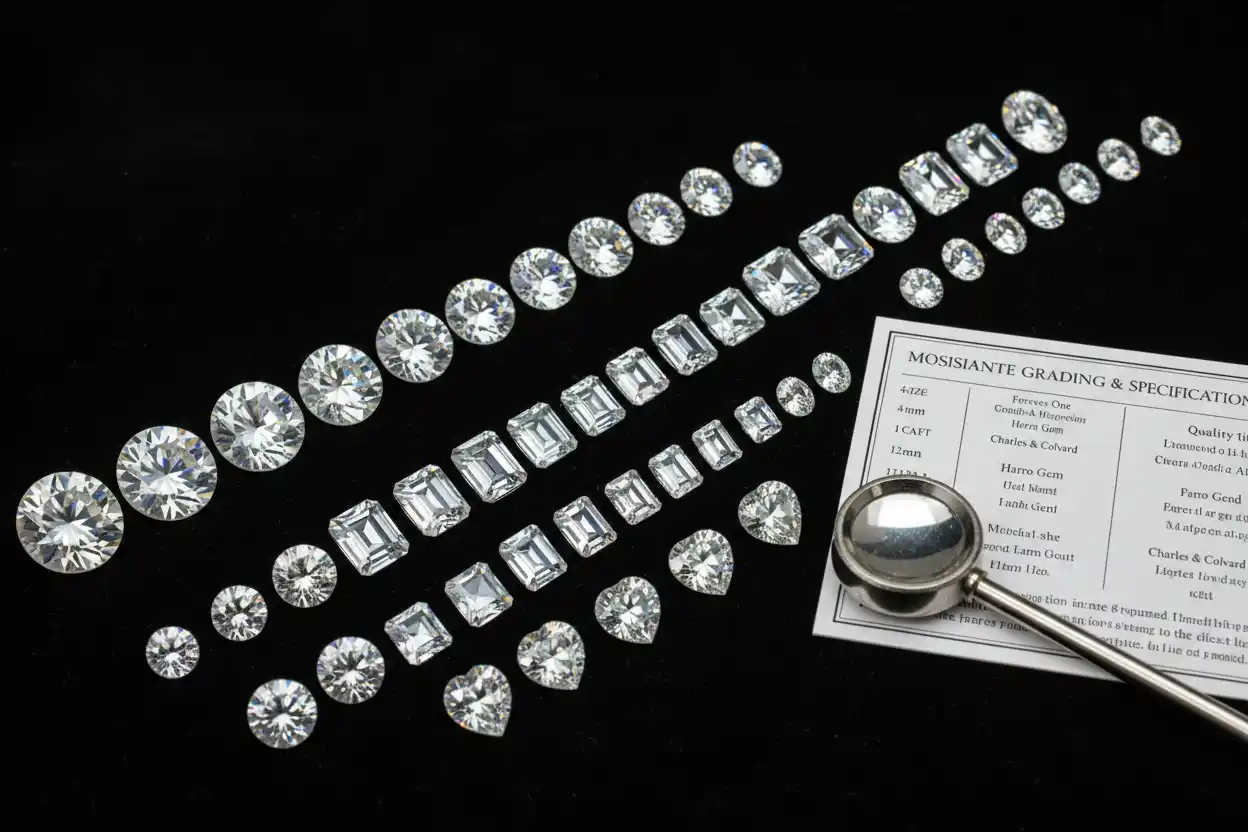
Moissanite Price: Cost Drivers, Size, Grade & Provenance
Moissanite price is shaped by manufacturing supply, degree of colorlessness, cut quality, shape, size, brand, clarity, proprietary faceting, colored coatings or other modification, jewelry craftsmanship, warranty, retail service, and current competition rather than by geological scarcity. Natural moissanite is extraordinarily rare, but the jewelry market is supplied by synthetic silicon carbide, and GIA notes that natural gem-quality moissanite is not the source of ordinary faceted jewelry stones. The high retail availability of synthetic material means that a large stone does not carry the geological size premium associated with a large natural diamond, ruby, or alexandrite.
Manufacturing capacity also matters because the economics of synthetic moissanite have changed as production has expanded. GIA’s recent coating research notes that increased production capacity has caused the market price of colorless synthetic moissanite to fall substantially over time, while specialty colored material initially carried stronger premiums. This relationship makes moissanite price fundamentally different from natural-gem pricing: technological improvements can increase supply, lower production costs, improve colorlessness, and make larger high-quality stones easier to obtain without any change in geological discovery.
Moissanite Price At a Glance
| Price Factor | What Usually Raises Moissanite Price | What Can Lower Moissanite Price |
|---|---|---|
| Identity | Verified synthetic moissanite/silicon carbide | Uncertain or misrepresented material |
| Color | Colorless or attractive near-colorless appearance | Yellow, gray, green, or unwanted tint |
| Cut | Strong brilliance, balanced fire, symmetry, attractive pattern | Bow tie, windowing, poor polish, dead zones |
| Size | Larger stone with excellent color and cutting | Large common stone without corresponding quality |
| Shape | Well-executed popular or proprietary shape | Poorly proportioned fancy cut |
| Clarity | Eye-clean material | Visible dark inclusions, needles, stringers, surface-reaching features |
| Brand | Proven consistency, warranty, proprietary cut, customer service | Brand premium unsupported by product differences |
| Coating | Disclosed specialty color when desired | Undisclosed or worn coating |
| Bulk Color | Stable color within the crystal | Artificial surface color represented as intrinsic |
| Documentation | Clear material identification and treatment disclosure | Vague seller certificate |
| Setting | High-quality gold/platinum and workmanship | Weak construction or excessive mounting markup |
| Side Stones | Clearly identified moissanite, lab diamond, natural diamond, or other gems | Ambiguous side-stone disclosure |
| Resale Terms | Useful trade-up or warranty policy | Assumption that retail price equals cash resale |
| Manufacturing Supply | Specialty low-volume product | Highly abundant generic production |
Colorlessness Is One of the Strongest Price Drivers
GIA states directly that the value of synthetic moissanite often depends on its degree of colorlessness. Colorless and high near-colorless stones generally receive stronger demand because many buyers want a diamond-like white appearance, while noticeable yellow, gray, or green undertones can lower commercial desirability.
The color premium should be evaluated visually rather than accepted entirely from a manufacturer label. Different brands can use proprietary grades such as colorless, near colorless, premium, forever white, or similar terminology without sharing one universal independent standard.
A slightly tinted stone can still represent excellent value in yellow or rose gold, where warmth may be less visible. Paying a substantial premium for the whitest possible moissanite makes most sense when the difference remains noticeable in the chosen size, shape, and metal.
Modern Production Has Reduced Color-Related Scarcity
Early jewelry moissanite was more likely to show yellowish or greenish tint, while manufacturing improvements have produced much whiter material. This technological change reduces the scarcity premium that once accompanied very colorless synthetic silicon carbide.
GIA’s research on the evolving market notes that increased production capacity has pushed colorless moissanite prices down significantly over time. The implication is important for valuation: an older retail receipt does not necessarily represent current replacement value if comparable material has become easier and cheaper to manufacture.
This dynamic market should encourage buyers to compare present inventory rather than treating historical branded pricing as a permanent benchmark.
Cut Can Create More Visible Value Than Brand Grade
Synthetic moissanite has high refractive index and dispersion, but those physical properties still depend on competent faceting to produce attractive jewelry. Poorly proportioned stones can show weak centers, excessive darkness, windowing, prominent bow ties, asymmetry, or an unbalanced mix of white light and rainbow fire.
A well-cut round brilliant generally emphasizes intense brilliance and fire, while antique cushions, crushed-ice styles, radiants, ovals, emerald cuts, and proprietary faceting patterns create very different visual personalities. A precision-cut unbranded stone can therefore be more attractive than a poorly executed branded stone despite costing less.
The strongest price comparison examines real videos, symmetry, face-up dimensions, bow-tie behavior, and overall optical balance instead of assuming every stone carrying the same shape name performs identically.
Fire Is a Feature Buyers Either Value or Moderate
GIA reports that moissanite has more than twice the fire of diamond and slightly more brilliance. That high dispersion can justify strong consumer demand because the gemstone looks exceptionally lively under spot lighting and sunlight.
The same feature can reduce appeal for buyers who want a restrained diamond-like appearance. Large stones can display such powerful rainbow flashes that the material becomes immediately recognizable as moissanite, especially in brilliant cuts.
Some proprietary cuts and elongated shapes aim to balance or reduce the rainbow effect, and those design choices can contribute to brand or lapidary premiums. The added price should be evaluated against actual visual preference rather than treated as an objective upgrade.
Double Refraction Influences Certain Shapes More Than Others
Synthetic moissanite’s anisotropic structure produces double refraction, which can make facet junctions appear doubled when viewed in certain directions. GIA identifies this as one of the classic diagnostic differences from diamond.
The effect can be less distracting in highly scintillating brilliant cuts and more obvious in broad step facets, especially in larger stones. An emerald-cut moissanite can therefore have a different commercial appeal from a round brilliant even when both have similar color and size.
A buyer paying a premium for a step cut should inspect crispness carefully because the visual character is a matter of taste and not every cutter handles double refraction equally well.
Clarity Affects Price Mostly When Inclusions Are Visible
Synthetic moissanite can contain needles, stringers, pinpoints, and other growth features, though modern jewelry-quality material is commonly quite clean. GIA’s foundational work identified characteristic internal inclusions while also showing that many faceted samples were attractive enough for jewelry use.
Once the stone is eye-clean from normal viewing distance, higher proprietary clarity labels may have limited visible benefit.
Large emerald cuts and other open faceting styles may reveal internal features more readily, making clarity more commercially important there than in smaller brilliant rounds.
Size Has a Different Meaning Than Diamond Size
Because synthetic moissanite can be manufactured rather than mined, manufacturers can expand large-stone supply as crystal-growing capability improves. This prevents size from creating the same exponential rarity premium found in exceptional natural diamonds.
Moissanite also has lower density than diamond. GIA’s measured specific gravity for synthetic moissanite is around 3.22, while diamond is denser, meaning stones with similar dimensions do not share the same weight. Many retailers therefore use millimeter dimensions or diamond-equivalent visual-size terminology.
The buyer should determine whether a listing’s stated “2 carat” refers to actual moissanite weight or the visual size of a two-carat diamond.
Larger Stones Can Have Lower Incremental Manufacturing Scarcity
A large moissanite uses more crystal and may involve greater cutting loss, but production scale means additional size does not necessarily multiply price in the way fine natural-diamond weight can.
A two-carat-equivalent moissanite may therefore cost only modestly more than a smaller stone within the same brand or manufacturing tier, particularly when supply is abundant.
This makes size upgrades accessible but also limits the logic of paying an extreme premium merely because the stone crosses a round-number threshold.
Shape Can Affect Both Manufacturing Yield and Consumer Demand
Round brilliants are highly popular and benefit from familiar jewelry proportions, while ovals, cushions, radiants, pears, marquises, emerald cuts, and antique-inspired shapes each create different spread, fire, facet pattern, and cutting yield.
An elongated shape can look larger on the finger at the same approximate visual weight, but poor cutting can introduce bow ties or weak light return.
Price should therefore be compared within the same shape and similar millimeter range whenever possible.
Brand Premium Can Be Legitimate but Should Be Identified Correctly
A branded moissanite may cost significantly more than unbranded synthetic silicon carbide because the brand provides proprietary crystal production, strict color selection, distinctive cutting, laser inscription, warranty, replacement programs, consistent inventory, marketing, packaging, and customer service.
Those services can be valuable.
They should not be confused with geological rarity. A premium branded stone remains synthetic silicon carbide, and the buyer should decide whether the additional quality control and service justify the difference from competent generic alternatives.
Proprietary Cut Can Carry a Craftsmanship Premium
Some manufacturers design facet arrangements specifically for moissanite rather than copying diamond patterns exactly. These designs may reduce visible doubling, balance white brilliance and fire, alter the crushed-ice effect, or improve elongated shapes.
If the result is visibly more attractive, the added price can be justified as intellectual property and cutting craftsmanship.
A proprietary name alone is not enough. Compare the stone with less expensive alternatives and judge whether the optical improvement is real.
Colored Moissanite Requires Treatment Awareness
Synthetic moissanite can be produced in some colors through crystal composition or doping, but GIA research demonstrates that pink and light-blue stones can also obtain their color from nanoscale surface coatings. GIA has separately documented pink coated material where surface wear and uneven coloration exposed the treatment.
This distinction can affect moissanite price because bulk crystal color and coated color have different durability implications.
A coated pink or blue stone can still be attractive and suitable for jewelry when disclosed honestly, but it should be compared with similar coated products rather than priced as though the color is inherently stable throughout the crystal.
Coating Can Wear or Scratch
Surface color is inherently more exposed to abrasion than color distributed through the bulk crystal. GIA’s examination of coated pink moissanite revealed uneven surface color and scratches through the film, demonstrating a practical wear consideration.
Settings that protect the pavilion and facet edges can reduce direct abrasion, but refinishing or repolishing may alter a coated stone significantly.
Treatment disclosure should therefore become part of long-term ownership value, not merely an academic gemological detail.
Fraud Risk Makes Clear Identification Important
Synthetic moissanite has optical and thermal properties close enough to diamond to mislead consumers when sellers act dishonestly. GIA has documented moissanite carrying fraudulent diamond inscriptions, and ordinary thermal testers can react as though moissanite were diamond.
This does not make moissanite itself problematic. It makes disclosure essential.
A correctly represented moissanite is a legitimate durable gemstone product; the problem begins when it is passed off as natural or laboratory-grown diamond.
FTC Disclosure Rules Protect the Category Distinction
FTC guidance requires truthful representation of gemstone type, origin, manufacturing, treatment, price, value, and other important characteristics. The FTC also explains that terminology should clearly tell buyers whether a product is laboratory-created or simulated rather than mined diamond, and it warns against descriptions likely to confuse an imitation or simulant with laboratory-grown diamond.
Clear disclosure supports proper moissanite price comparison because consumers can then compare silicon carbide with silicon carbide instead of unknowingly comparing it with lab-grown carbon diamond.
Moissanite Does Not Have a Universal GIA Quality Grade
GIA can identify colored gemstone material and detectable treatments through its Colored Stone Identification Report, but this service is not a moissanite equivalent of the natural-diamond grading report.
Manufacturer labels such as D color, VVS, premium, forever colorless, excellent, ideal, or super premium should therefore be read according to the seller’s own definitions unless supported by an independent laboratory methodology specifically stating how the terms were assigned.
The absence of a universal standard does not mean quality cannot be compared. It means actual appearance and clearly defined measurements matter more than letter combinations.
Setting Cost Can Dominate the Finished Jewelry Price
A moissanite center stone mounted in platinum or heavy gold with natural diamonds, laboratory-grown diamonds, hand engraving, custom prongs, or designer fabrication can have a finished retail price many times the loose-stone cost.
Consumers comparing moissanite price should isolate center-stone value from setting value.
A cheap center stone in a well-made custom ring can produce an expensive finished piece without implying that the moissanite itself is unusually valuable.
Side-Stone Identity Should Be Disclosed
Halo, pavé, and three-stone moissanite rings may use side stones made from moissanite, laboratory-grown diamond, natural diamond, cubic zirconia, or another material.
Those choices affect total cost and potentially resale.
A listing should state what the accent stones actually are rather than relying on the center-stone description to imply the identity of the entire ring.
Moissanite Price Versus Lab Diamond Price
The Gems Lore lab diamond price guide covers manufactured diamond whose market is driven by CVD or HPHT production, diamond quality assessment, cutting, color, clarity, and rapidly expanding supply. Moissanite is a separate manufactured material whose price reflects silicon-carbide production, colorlessness, proprietary cuts, brand, and retail positioning.
The Gems Lore buy lab diamond guide also explains why laboratory-grown diamond is not a simulant.
A lower moissanite price relative to lab-grown diamond is therefore a comparison between materials, not evidence that the moissanite is the same stone sold at a discount.
Moissanite Price Versus Cubic Zirconia Price
Gems Lore’s cubic zirconia price guide covers a different manufactured simulant with a much lower-cost production market and different durability. Moissanite’s Mohs hardness around 9.25 gives it greater scratch resistance for everyday jewelry and helps support a higher retail price than ordinary CZ.
The comparison should include durability, optical style, long-term surface wear, brand, and setting rather than merely the initial stone price.
Production Scale Can Put Downward Pressure on Generic Prices
GIA’s current research notes that increasing synthetic moissanite production capacity has caused colorless material prices to fall substantially. This is one of the most important market characteristics for buyers considering long-term value.
A manufactured gemstone can become less expensive to produce as equipment, yields, crystal quality, and competition improve.
This does not mean every proprietary brand or precision-cut stone must fall in price, because craftsmanship, branding, warranty, and retailer services remain separate components. It does mean generic material should not be priced using scarcity claims that ignore expanding supply.
Retail Price and Resale Value Should Be Separated
Retail moissanite pricing includes manufacturing, cutting, sorting, brand marketing, setting, returns, warranty, shipping, staff, customer acquisition, and retailer profit. A secondhand buyer must compare the used stone with readily available new synthetic supply.
That structure can produce weak resale value for common loose moissanite even when the stone remains physically excellent.
A strong retailer trade-up or replacement policy can provide practical value, but store credit is not equivalent to an open-market cash resale guarantee.
What Usually Raises Moissanite Price?
Moissanite price generally rises with high colorlessness, excellent cut, desirable shape, clean appearance, larger size within a premium production category, proprietary faceting, reputable brand, strong warranty, specialty bulk color, disclosed and attractive coating when deliberately chosen, precise matching in pairs or suites, and high-quality setting craftsmanship.
The strongest premiums usually come from manufacturing consistency and retail service rather than from scarcity of silicon carbide itself.
What Usually Lowers Moissanite Price?
Noticeable yellow, gray, or green tint, weak cutting, poor bow-tie performance, excessive internal doubling, visible inclusions, worn coating, generic mass production, unverifiable grades, ambiguous actual-versus-equivalent weight, damaged condition, low-quality setting construction, and rapidly available comparable inventory can all reduce price.
A lower price does not automatically mean poor material. Competitive manufacturing can produce highly attractive unbranded stones at prices below older branded benchmarks.
How to Compare Moissanite Prices Fairly
Compare stones by synthetic moissanite identity, colorlessness, manufacturer, shape, millimeter dimensions, actual weight, diamond-equivalent size if used, cut pattern, fire, double refraction, clarity, coating, brand services, documentation, setting quality, side-stone identity, warranty, return policy, and current market availability. Avoid comparing a loose generic round to a designer platinum ring, a coated pink moissanite to a colorless bulk-crystal stone, or moissanite to lab-grown diamond using carat weight alone.
Conclusion
Moissanite price is primarily a manufacturing-and-quality price rather than a geological-rarity price. Natural moissanite is extraordinarily rare and is not the source of ordinary jewelry stones, while the commercial market consists of synthetic silicon carbide whose production can expand as technology improves. GIA’s modern research directly notes that expanded manufacturing capacity has driven down colorless synthetic moissanite prices, demonstrating why historical retail levels should not be treated as permanent intrinsic value.
The individual stone still matters. Colorlessness, cut, fire, double refraction, size, clarity, shape, coating, manufacturer, brand services, setting quality, and accurate disclosure can create major retail differences between products that share the same silicon-carbide identity. Colored material deserves particular attention because GIA has documented nanoscale coatings on commercial pink and blue moissanite.
A fair moissanite price is therefore one supported by current comparable synthetic moissanites with similar dimensions, visual quality, production characteristics, and retailer services—not by the price of an unrelated natural diamond or by an undefined proprietary grade.
Frequently Asked Questions
How much is moissanite worth per carat?
There is no reliable universal moissanite price per carat because synthetic supply, brand, colorlessness, cut, size, shape, proprietary faceting, coating, setting, and retailer services vary substantially. Millimeter dimensions are also important because moissanite and diamond have different density, making simple carat comparisons misleading.
Why is some moissanite much cheaper than branded moissanite?
Generic synthetic silicon carbide can be produced in substantial quantities, while branded products may add proprietary crystal selection, specialized cutting, warranties, inscriptions, replacement programs, marketing, and customer service. The premium can be legitimate, but it reflects manufacturing consistency and retail benefits rather than geological rarity.
Has moissanite become cheaper to produce?
GIA research reports that increasing production capacity has caused the price of colorless synthetic moissanite to fall substantially. Manufacturing technology and competition can therefore affect market prices more quickly than geological supply changes affect many natural gems.
Is colorless moissanite more expensive?
Colorlessness is a major value factor. GIA notes that moissanite value often depends on its degree of colorlessness, while visible yellow, gray, or green tint can reduce demand.
Does large moissanite become rare like large diamond?
No in the same geological sense. Jewelry moissanite is manufactured, so manufacturers can expand supply of larger crystals as production technology improves. Larger stones can cost more, but their price increase reflects manufacturing and cutting rather than natural geological scarcity.
Why is moissanite sold by millimeters or diamond-equivalent weight?
Moissanite has lower density than diamond, so an equally sized moissanite weighs less than a diamond with similar dimensions. GIA measured synthetic moissanite around specific gravity 3.22. Millimeter dimensions often provide the clearest comparison of visible size.
Are colored moissanites more expensive?
Some specialty colors can command premiums, but buyers should determine whether color exists throughout the crystal or comes from a surface coating. GIA has documented nanoscale coatings on pink and blue synthetic moissanites.
Does coating lower moissanite value?
The market effect depends on disclosure and buyer preference, but coating introduces a surface-dependent color mechanism that can wear or scratch. GIA has documented damaged and uneven color on coated pink moissanite.
Does GIA grade moissanite like diamond?
No. GIA’s colored-stone services can identify material and detectable treatment, but moissanite does not receive the standard natural-diamond grading report. Retailer color and clarity labels should therefore be understood within the seller’s own system.
Does moissanite hold its retail value?
There is no guaranteed retention percentage. Expanding synthetic production, competing new inventory, brand policy, setting value, condition, and secondhand demand can all affect resale.
Is expensive moissanite automatically better?
No. Higher price can reflect superior color, cutting, proprietary design, warranty, branding, or setting quality, but it can also reflect retail markup. Compare actual appearance and services rather than assuming the highest price means the highest gem quality.
Is moissanite a good investment?
Moissanite should generally be evaluated as a durable jewelry product rather than an investment asset. Manufacturing capacity can expand and generic prices can fall, so no seller grade, brand, or carat size can guarantee appreciation.