Moissanite Price Guide: Value and Cost in 2026
Moissanite prices in 2026 commonly range from approximately $50 to $800 for a loose stone with the visual size of a one-carat Diamond. Generic stones may cost below $150, while premium branded or precision-cut one-carat-equivalent Moissanite can reach $500 to $800 or more.
Larger stones remain comparatively affordable. A two-carat-equivalent center commonly costs about $150 to $1,300, while a three-carat-equivalent stone may range from approximately $250 to $1,800 depending on brand, cutting, color and retailer.
Moissanite Prices by Diamond-Equivalent Size in 2026
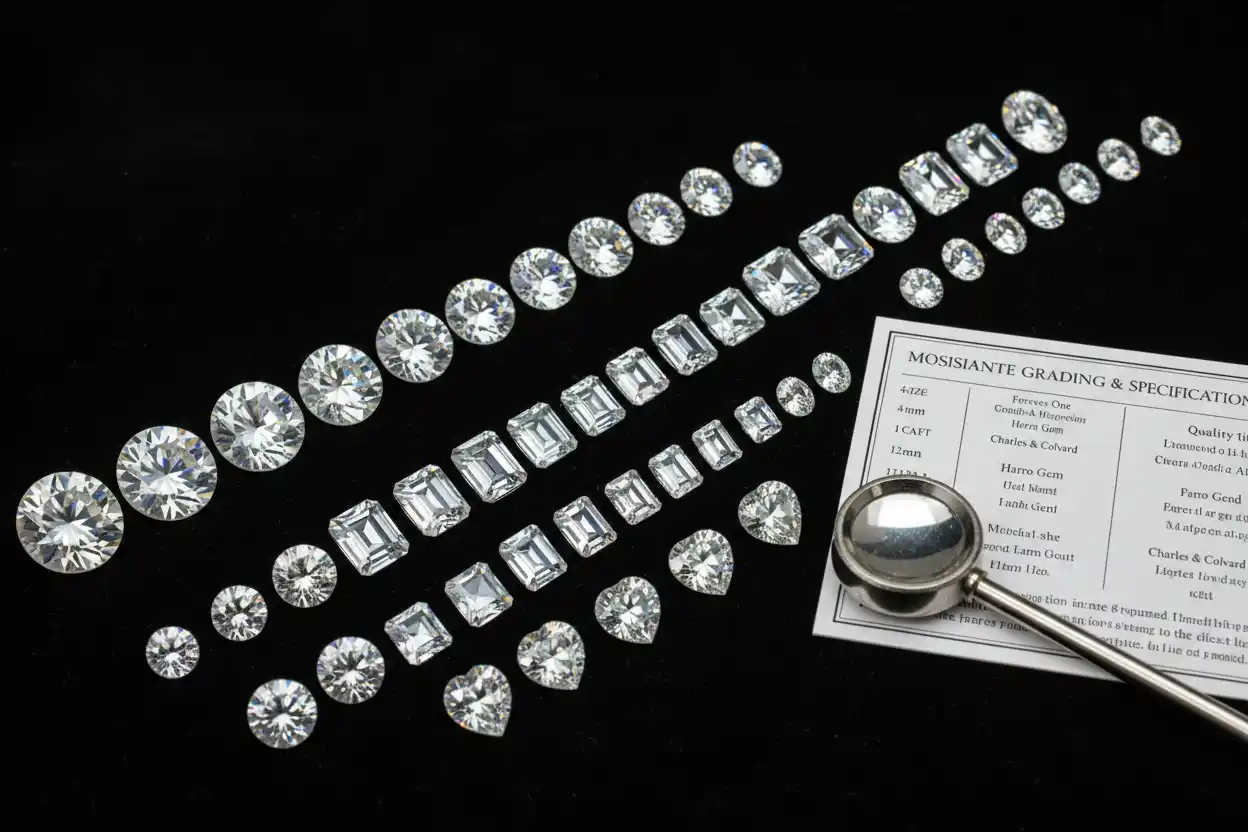
Moissanite is often sold by millimeter dimensions or diamond-equivalent weight rather than actual carat weight. This approach helps shoppers compare its visible size with a Diamond.
| Approximate visual size | Common dimensions | Broad 2026 loose-stone price |
|---|---|---|
| 0.50 ct Diamond equivalent | About 5 mm round | $25–$250 |
| 1.00 ct Diamond equivalent | About 6.5 mm round | $50–$800 |
| 1.50 ct Diamond equivalent | About 7.5 mm round | $100–$1,000 |
| 2.00 ct Diamond equivalent | About 8 mm round | $150–$1,300 |
| 3.00 ct Diamond equivalent | About 9–9.5 mm round | $250–$1,800 |
| 4.00 ct Diamond equivalent | About 10–10.5 mm round | $350–$2,500 |
| 5.00 ct Diamond equivalent | About 11 mm round | $500–$3,000+ |
The bottom of each range represents high-volume generic material, promotional inventory or direct-to-consumer sellers. Premium pricing may include proprietary cutting, stricter color selection, warranties, trade-in programs and established branding.
The broader relationship among appearance, supply, cutting and market demand appears in How Gemstone Prices Are Determined.
Moissanite Is Usually Priced by Size, Not Weight
A carat is a unit of weight rather than visual size. Moissanite is less dense than Diamond, so two round stones with the same diameter do not weigh the same.
For this reason, retailers commonly use diamond-equivalent weight, abbreviated as DEW or CTDEW. An 8 mm round may be advertised as a two-carat-equivalent Moissanite even though its actual scale weight is lower than two carats.
Equivalent weight is useful for estimating visual size, but it can also confuse buyers. Product pages should state the actual millimeter dimensions rather than relying exclusively on a carat-equivalent description.
A seller who describes a 9 mm stone simply as “three carats” should clarify whether that figure represents actual weight or Diamond-equivalent size.
The complete stone-selection process belongs to the Moissanite Buying Guide.
What Is Moissanite?
Moissanite is silicon carbide. Natural crystals occur, but they are exceptionally rare and generally too small for a meaningful commercial jewelry supply.
Almost all Moissanite used in modern jewelry is laboratory-created. Manufacturers grow silicon-carbide crystals that cutters shape into colorless, near-colorless and colored gemstones.
Laboratory-created Moissanite is not a laboratory-grown Diamond. The two materials have different chemical compositions, crystal structures, optical behavior and market values.
The completed Moissanite guide owns the material’s composition and physical properties. The complete variety discussion appears in Types of Moissanite.
Why Generic Moissanite Is Inexpensive
Moissanite production is no longer restricted to one major manufacturer. Multiple producers now supply colorless and near-colorless silicon carbide in commercial quantities.
Greater competition has reduced the scarcity premium once associated with early jewelry-grade Moissanite. Large stones and fancy shapes are now available from many online sellers.
Generic rough can also be cut and distributed through low-cost manufacturing networks. A seller with minimal branding, simple packaging and limited after-sales service may offer a large stone for a few hundred dollars.
A low price does not automatically mean the stone is fake. However, it may indicate weaker cutting, less consistent color, limited quality control or an unreliable return policy.
Why Premium Moissanite Costs More
Premium brands charge for more than the raw silicon carbide. Their prices may include proprietary facet designs, controlled color ranges, laser inscriptions, warranties and replacement services.
Some brands also sort stones more strictly for transparency, polish and undesirable gray, green or yellow modifiers.
Established retail channels typically carry higher operating and customer-service costs. Consequently, a branded one-carat-equivalent stone can cost several times more than a generic stone with similar measurements.
That premium does not guarantee that every buyer will prefer the branded stone. A well-cut independent Moissanite may outperform a more expensive product whose facet pattern or rainbow fire does not suit the buyer’s taste.
The strongest comparison uses side-by-side videos, exact dimensions and return terms rather than brand reputation alone.
Cut Has the Greatest Effect on Appearance
Moissanite has a high refractive index and more dispersion than Diamond. These properties can create intense brilliance and rainbow-colored fire.
Cutting determines how that optical potential appears. A well-cut stone should return light across most of its face rather than showing a washed-out center or dark bow tie.
Poor proportions can create:
- A transparent central window
- Dark extinction beneath the table
- Uneven brightness
- A prominent bow tie in elongated shapes
- A splintery or disorganized facet pattern
Round brilliant Moissanite is widely available and relatively consistent. Ovals, cushions, pears, radiants and emerald cuts require more individual inspection because facet patterns vary significantly.
The fuller comparison with Diamond belongs to Moissanite vs Diamond vs Lab Diamond, not this price page.
Brilliant Cut vs Crushed-Ice Moissanite
Traditional brilliant cuts produce distinct facet reflections and strong fire. They can look crisp and lively, especially in rounds and classic cushions.
Crushed-ice cuts divide the internal reflections into many smaller flashes. The style can resemble certain Diamond fancy cuts, but poor examples may appear hazy or watery.
Hybrid designs attempt to combine broad brilliance with smaller splintered reflections. Their quality depends heavily on execution.
A crushed-ice label should not automatically increase price. The stone must remain bright in ordinary light and avoid a cloudy central area.
Buyers should compare both close-up and normal-distance videos. Extreme magnification can make an unattractive cut appear more complex than it looks when worn.
Moissanite Color and Price
Modern colorless Moissanite is commonly marketed using Diamond-like terms such as D–F or G–H. These descriptions are useful for communication but are not governed by one universal Moissanite grading standard.
| Commercial color category | Typical appearance | General price position |
|---|---|---|
| Colorless | Minimal visible yellow, green or gray | Highest mainstream price |
| Near-colorless | Slight warmth visible in some lighting | Mid-market |
| Faint-color commercial | Noticeable yellow, gray or green modifier | Lower price |
| Fancy color | Blue, green, yellow, gray, black or other appearance | Depends on treatment and demand |
Larger near-colorless stones may reveal warmth more readily than small stones. Elongated and step-cut shapes can also concentrate color at their ends or corners.
Some buyers deliberately prefer warm Moissanite for yellow- or rose-gold settings. Therefore, a lower commercial color category is not automatically unattractive.
Cultural interpretations of color do not belong in this price article. The varieties and commercial color categories remain assigned to Types of Moissanite.
Clarity and Internal Features
Most jewelry-grade Moissanite is expected to appear eye-clean. Laboratory production makes highly transparent material readily available, so obvious inclusions should reduce the price.
Possible internal features include needles, crystals, growth remnants and reflective platelets. Surface scratches, cavities and polish marks can also affect appearance.
A seller-created clarity grade such as VVS or flawless may not be directly comparable with a Diamond laboratory grade. The more practical question is whether any feature can be seen at ordinary viewing distance.
Magnified videos should be interpreted carefully. A tiny feature that dominates a screen at 30× may be invisible in a ring.
Conversely, a diffuse cloud or surface haze can affect brilliance even when no single inclusion looks large.
Moissanite Shape and Pricing
Round Moissanite is usually the easiest shape to compare because production volume is high and pricing is competitive.
Ovals and elongated cushions have become popular for engagement rings. They can provide greater face-up length, although poorly cut examples may show bow ties or uneven ends.
Emerald and Asscher cuts display broad flashes rather than intense crushed sparkle. They may show body color more easily and require clean, precise faceting.
Pears and marquises can appear large for their weight-equivalent size but need protection at pointed ends.
Custom antique cuts, portrait cuts and elongated specialty shapes may command stronger prices. In those cases, the premium comes from limited cutting availability rather than the rarity of silicon-carbide rough.
Color-Coated Moissanite
Some blue, pink, purple and other fancy-color Moissanites receive surface coatings. Coatings can produce colors that are difficult or expensive to create throughout the entire crystal.
A coating may wear, scratch or change during jewelry repair. Therefore, its presence should be disclosed.
Other fancy colors may originate throughout the grown material or result from post-growth treatment. Their durability can differ from that of a surface film.
A coated stone should not be priced like a durable through-color product without clear disclosure. The dedicated How to Spot Treated or Synthetic Moissanite page owns color-treatment and coating details.
Moissanite vs Lab Diamond Price
Lab Diamond prices have fallen substantially, narrowing the gap between the two materials.
A one-carat Lab Diamond commonly costs several hundred dollars, placing it within the upper range of premium one-carat-equivalent Moissanite. At two and three carats, competitively priced Lab Diamonds can also overlap with luxury Moissanite brands.
The comparison is no longer simply “Moissanite is much cheaper.” Generic Moissanite remains inexpensive, but premium branded stones may compete directly with lower-priced Lab Diamonds.
A Lab Diamond offers Diamond’s optical character and composition. Moissanite provides stronger dispersion, lower typical cost and highly durable silicon carbide.
Current Lab Diamond pricing appears in the Lab Diamond Price Guide. The direct identification comparison belongs to Lab Diamond vs Moissanite.
Moissanite vs Natural Diamond Price
Natural Diamond remains substantially more expensive at comparable visual sizes.
A one-carat natural Diamond commonly costs several thousand dollars, while a one-carat-equivalent Moissanite normally costs hundreds or less.
The gap grows with size because natural Diamonds receive steep scarcity premiums above one, two and three carats. Moissanite size responds to manufacturing capacity rather than geological rarity.
Current natural pricing belongs to the Diamond Price Guide.
Moissanite should not be represented as a Diamond merely because the two stones share a colorless appearance. The materials require clear and separate product descriptions.
Moissanite vs Cubic Zirconia Price
Cubic Zirconia is generally cheaper than Moissanite. A one-carat-equivalent CZ may cost only a few dollars, while even generic Moissanite normally costs more.
Moissanite has greater hardness and typically retains its polish better during frequent wear. CZ can develop surface abrasion and a duller appearance over time.
CZ also has different optical behavior and greater density. The complete distinction belongs to Moissanite vs Cubic Zirconia.
Current CZ pricing appears in the Cubic Zirconia Price Guide.
Moissanite Ring Prices in 2026
| Ring type | Broad U.S. retail range |
|---|---|
| Silver ring with generic Moissanite | $50–$300 |
| 10K or 14K gold solitaire, about 1 ct equivalent | $400–$1,800 |
| 14K gold solitaire, about 2 ct equivalent | $700–$3,000 |
| 14K or platinum halo or side-stone ring | $1,000–$5,000 |
| Premium branded or designer ring | $2,000–$8,000+ |
The setting may account for most of the price. Gold, platinum, accent stones, custom labor and retail service can cost more than the center Moissanite.
Engagement-ring design and setting selection belong to the Moissanite Engagement Ring Guide. Broader style considerations appear in the Moissanite Ring Guide.
Other formats belong to the Moissanite Earrings Guide, Moissanite Necklace Guide and Moissanite Bracelet Guide.
Certificates and Grading Cards
Moissanite is frequently sold with manufacturer cards or reports using Diamond-like color, clarity and cut terminology.
These documents are not automatically equivalent to a report from a major independent Diamond laboratory. Some cards merely repeat information supplied by the seller.
Fraudulent inscriptions also exist. A laser inscription by itself does not establish that a stone is Diamond, Moissanite or linked to a genuine report.
Buyers should verify the issuing organization, report number and exact measurements. Expensive purchases may justify independent testing.
The broader laboratory framework appears in Gemstone Certification Labs Compared. Authenticity checks belong to Real vs Fake Moissanite.
Durability and Care
Moissanite is highly resistant to scratching and is suitable for daily-wear jewelry. It can still chip if struck sharply at an exposed girdle or pointed corner.
Oil, soap and cosmetic residue can create a cloudy film that reduces sparkle. This buildup does not normally mean the stone has permanently changed.
Regular gentle cleaning and prong inspection help maintain its appearance. The complete procedure belongs to How to Clean Moissanite Jewelry Safely.
Coated fancy-color stones may require additional caution because strong polishing or repair heat can affect the surface treatment.
Does Moissanite Hold Its Value?
Moissanite generally has weak loose-stone resale value. New stones remain readily available, and production competition keeps replacement prices low.
Premium brands may retain somewhat stronger recognition, particularly when the stone remains in an original signed setting with documentation. Even then, resale usually depends more on metal, accent Diamonds and design than on the center stone.
A dealer may offer little for a used generic Moissanite because a new replacement can be purchased inexpensively.
Moissanite therefore provides visual and practical value rather than investment scarcity. The broader resale framework appears in Do Gemstones Hold Their Value?.
Price Guide vs Buying Guide
This page owns Moissanite’s 2026 prices, brand tiers and value factors. The detailed process for comparing cuts, dimensions and sellers belongs to the dedicated buying guide.
Online buyers should verify millimeter size, return terms, treatment disclosure and whether the listed carat figure is actual weight or Diamond equivalent. The broader fraud-prevention process appears in How to Buy Gemstones Online Without Getting Scammed.
The Buying & Value hub connects this guide with Diamond, Lab Diamond, CZ, certification and resale content.
Frequently Asked Questions
1. How much does a one-carat Moissanite cost in 2026?
A one-carat-Diamond-equivalent loose Moissanite commonly costs approximately $50 to $800. Generic stones sit near the lower end, while premium brands occupy the upper range.
2. How much is a two-carat Moissanite?
A two-carat-equivalent loose stone generally costs about $150 to $1,300, depending on cutting, color, shape, brand and seller.
3. How much is a three-carat Moissanite?
Most three-carat-equivalent stones range from approximately $250 to $1,800. Luxury branded or specialty-cut products may cost more.
4. Why is Moissanite sold by Diamond-equivalent weight?
Moissanite has a different density from Diamond. Equivalent weight describes the Diamond size with similar millimeter dimensions rather than the stone’s actual scale weight.
5. Is expensive Moissanite better?
Not automatically. Premium pricing may include stronger quality control, warranties and proprietary cuts, but the stone should still be judged visually.
6. Is generic Moissanite fake?
No. Generic Moissanite can be genuine laboratory-created silicon carbide. Its lower price may reflect production volume, branding and retailer overhead.
7. Is Moissanite cheaper than Lab Diamond?
Generic Moissanite usually is, although premium branded Moissanite can overlap with competitively priced Lab Diamonds.
8. Which Moissanite shape costs the most?
Custom and specialty cuts can command the strongest premiums. Round stones are usually the most price-competitive because supply is broad.
9. Does colorless Moissanite cost more?
Colorless material generally receives a premium over stones with noticeable gray, yellow or green modifiers.
10. Does Moissanite need a certificate?
An expensive stone may benefit from independent identification, but many seller grading cards are manufacturer documents rather than independent laboratory reports.
11. Does Moissanite have resale value?
Loose-stone resale is generally weak. Finished jewelry may retain value through gold, platinum, accent stones and brand.
12. Is Moissanite worth buying in 2026?
It offers strong value for buyers who prioritize durability, large visual size and intense fire rather than natural rarity or resale potential.
Moissanite Value Depends on Cut and Price Discipline
Moissanite is no longer one narrowly priced product. It ranges from inexpensive generic stones to luxury branded gems whose prices can overlap with Lab Diamond.
In 2026, the strongest value typically lies below $300 for a generic one-carat-equivalent stone and below $800 for a premium example. Buyers should pay for visible cutting quality, accurate dimensions and dependable service—not for Diamond-like grading language that implies manufactured silicon carbide is scarce.