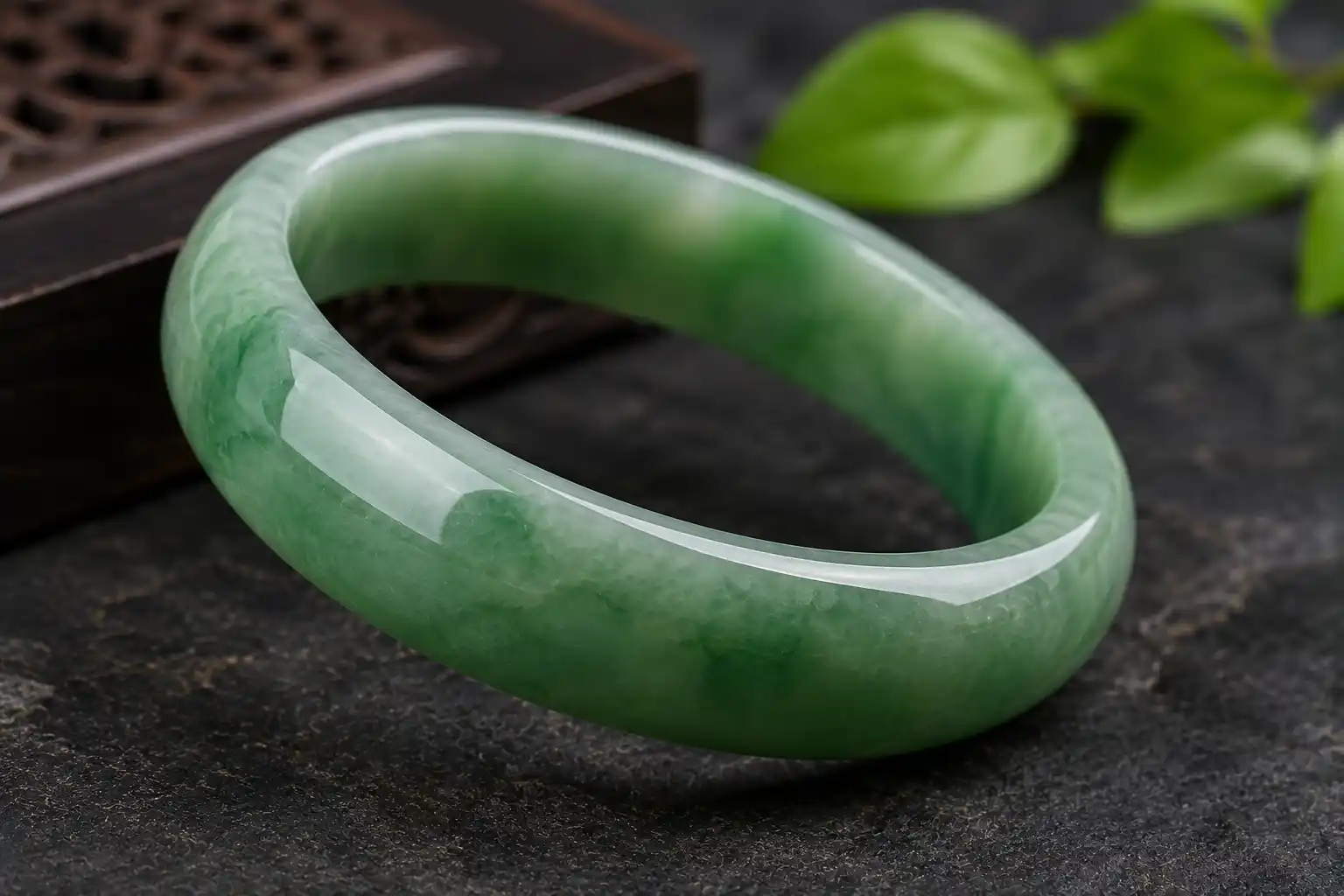
Jade Meaning: Healing Properties, Benefits & Uses
Jade meaning is difficult to explain accurately until one basic misconception is removed: jade is not a single mineral with one chemical formula. In modern gemology, “jade” is a generic material name most commonly applied to jadeite jade and nephrite jade, with some green omphacite also falling within the term under particular gemological conditions. Jadeite is a sodium-aluminum pyroxene, while nephrite is an exceptionally tough rock composed mainly of tightly intergrown tremolite-actinolite amphibole fibers. GIA emphasizes that these materials can look similar and share extraordinary toughness, yet they differ in mineralogy, density, refractive index, hardness, geological origin, color mechanisms, and commercial treatment concerns.
That material distinction matters because cultural traditions developed around objects called jade long before modern mineralogy separated jadeite from nephrite. Historical jade objects have served as tools, ornaments, ceremonial objects, status symbols, burial objects, artistic media, and embodiments of moral or spiritual ideas across several cultures. In China especially, jade became deeply connected with virtue, rank, ritual, beauty, durability, and ideas about heaven and the human character. Nephrite dominated the earlier Chinese jade tradition, while jadeite entered that artistic world much later and became highly prized in its own right. GIA and the British Museum both document jade’s long cultural importance while treating historical beliefs as part of cultural history rather than evidence of medical effects.
Modern crystal-healing language adds a third layer. Contemporary descriptions frequently associate jade with calm, harmony, prosperity, protection, emotional balance, luck, or personal growth. Those meanings may function as cultural symbols or personal metaphors, but they are not scientifically demonstrated effects of jade’s crystal structure. This article therefore separates measurable material facts, documented cultural use, and modern symbolic interpretation throughout. Readers looking specifically at contemporary wellness claims can continue to the mapped jade healing properties guide, while this page owns the broader material-and-symbolism reference within the Healing Crystal category.
Jade at a Glance
| Question | Evidence-based answer |
|---|---|
| Is jade one mineral? | No. The term primarily covers jadeite jade and nephrite jade, with certain green omphacite also recognized as jade in modern gemological usage. |
| What is jadeite? | A jade material dominated by jadeite, a sodium-aluminum pyroxene. |
| What is nephrite? | A tough, fine-grained material composed mainly of interlocking tremolite-actinolite amphibole. |
| Is all jade green? | No. Jade can be white, gray, black, yellow, orange, lavender, brown, and many shades of green. |
| Why is jade so durable? | Its microscopic interlocking structure gives exceptional toughness, even though its hardness is moderate by gem standards. |
| Is green always natural? | No. Jade, particularly jadeite, can be dyed or otherwise treated. |
| Does jade have proven healing powers? | No medical or psychological treatment effect has been established from wearing or holding jade. |
| Does jade have historical symbolism? | Yes. Jade has extensive documented cultural symbolism, especially in Chinese traditions and several Indigenous American and Pacific traditions. |
| Is every object sold as “jade” real jade? | No. Many unrelated green materials have historically been marketed with jade-like trade names. |
| Can visual inspection prove identity? | Not always. Some cases require gemological or laboratory testing. |
| Is jade safe to handle? | Ordinary intact handling is generally straightforward; cutting and grinding create a different exposure situation and require proper dust controls. |
What Jade Actually Means as a Material Name
Gemological jade is unusual because the name groups materials by a combination of structure, appearance, toughness, historical usage, and commercial convention rather than by one mineral species. GIA describes jadeite and nephrite as metamorphic rocks made from tightly interlocking microscopic crystals, a texture that contributes greatly to their durability. Jadeite-dominant jade belongs to the pyroxene mineral family, whereas nephrite consists primarily of amphibole minerals in the tremolite-actinolite series. Under certain circumstances, green omphacite can also be classified within the jade terminology used by modern gemologists.
That nuance immediately explains why statements such as “jade has a hardness of X,” “jade has one refractive index,” or “jade always forms in one environment” can be misleading unless the writer specifies which jade material is being discussed. GIA lists jadeite jade around Mohs 6.5–7 and nephrite around 6–6.5. Approximate specific gravities are about 3.34 for jadeite and 2.95 for nephrite, while their typical refractive-index ranges are also measurably different.
The two materials nonetheless share a feature that helps explain their extraordinary cultural persistence: toughness. Hardness measures resistance to scratching, while toughness describes resistance to breaking, chipping, or fracturing. The fine interlocking aggregate structure of jade can make it extremely resistant to impact compared with many materials of similar hardness. That combination allowed early craftspeople to fashion jade into axes, blades, ritual pieces, ornaments, and later extraordinarily elaborate carvings.
Jade Identity Table
| Property | Jadeite jade | Nephrite jade |
|---|---|---|
| Principal mineral family | Pyroxene | Amphibole |
| Main composition | Dominantly jadeite, NaAlSi₂O₆ | Mainly tremolite-actinolite, Ca₂(Mg,Fe)₅Si₈O₂₂(OH)₂ |
| Typical structure | Fine interlocking granular aggregate | Fine interlocking fibrous/felted aggregate |
| Common colors | Green, white, lavender, yellow, orange, brown, gray, black | White, cream, yellowish, brown, gray, black, pale to dark green |
| Approximate Mohs hardness | 6.5–7 | 6–6.5 |
| Approximate specific gravity | 3.34 | 2.95 |
| Typical refractive-index context | About 1.666–1.680 | About 1.606–1.632 |
| Exceptional toughness | Yes | Yes, especially notable |
| Important treatment concern | Dyeing, bleaching, polymer impregnation and other enhancements | Dyeing and other alteration can occur; treatment context differs from jadeite |
| Visual separation always reliable? | No | No |
| Main historical association | Especially important in later Chinese jade traditions and Mesoamerican jade traditions | Dominant material in much early Chinese jade working and many other historic jade traditions |
These values are useful for orientation, not as a substitute for specimen-specific testing. Mixed mineralogy, surface coatings, mounting, weathering, treatments, and the presence of omphacite or other minerals can make identification more complicated than a two-column table suggests. GIA notes that Raman spectroscopy may be required to distinguish some green omphacite from visually and gemologically similar jadeite-rich material.
How Jade Forms
Jadeite jade and nephrite jade form through different geological pathways, so there is no single “jade formation process.” Jadeite-rich material is strongly associated with high-pressure, relatively low-temperature geological environments at convergent plate boundaries. GIA describes jadeite formation in subduction-zone settings where cold oceanic crust descends and fluid-rock reactions occur within high-pressure serpentinite mélanges. Geological research on jadeitite from Guatemala likewise supports formation through fluid-driven metasomatic processes deep within subduction environments.
Nephrite generally forms through metasomatic reactions involving amphibole growth. Important deposits occur where serpentinite interacts with more silica-rich rocks in the presence of calcium-bearing hydrous fluids, while another formation pathway involves reactions between intrusive rocks and carbonate rocks such as dolomite or limestone. GIA’s research on nephrite deposits emphasizes that several geological configurations exist rather than one universal deposit model.
This geological difference matters when a seller uses “jade” as though every piece must share the same origin story. It does not. A jadeite boulder from a high-pressure metamorphic environment and nephrite formed along a metasomatic contact can both legitimately be called jade even though their mineral constituents and formation conditions differ substantially. Readers who want the geological detail without repeating it here can use the dedicated jade formation and deposit geology reference.
Why Jade Comes in So Many Colors
Green is culturally dominant in popular ideas about jade, but natural jade occupies a much wider palette. GIA documents jadeite in green, white, lavender, reddish orange, yellow, brown, gray, black, and related variations. Nephrite can likewise occur in white, cream, gray, brown, black, yellowish, and numerous greens. The color is not one universal “jade pigment”; different minerals, trace elements, inclusions, structural effects, and mineral mixtures can produce different appearances.
Pure jadeite mineral is essentially colorless. In massive jadeite jade, white appearance can result partly from light scattering at grain boundaries, fractures, inclusions, and mineral interfaces. Saturated green jadeite can be colored strongly by chromium, while iron can contribute to other green shades. GIA research has confirmed manganese as an important chromophore in lavender jadeite, with titanium-iron interactions also contributing to some violet and blue components in particular material.
Nephrite’s colors reflect a different mineral system. Its green tones commonly involve iron and, in some material, chromium substitutions within its amphibole chemistry. Low-iron nephrite may be pale green, cream, or nearly white, while high iron content and inclusions can produce much darker appearances. Because color chemistry varies by material and deposit, a single explanation such as “green jade contains chromium” is too broad to apply to every jade specimen.
Color also has a commercial treatment dimension. Dyed jade can look convincingly saturated, and jadeite may be bleached and polymer impregnated to improve apparent color and transparency. The scientific causes, observation conditions, zoning, and cultural interpretations of jade color are treated more fully in the jade color meaning guide and the more technical jade optical properties and color behavior reference.
Original Jade Name and Claim Audit
The word jade has accumulated so many commercial, cultural, and historical extensions that terminology itself becomes an identification problem. The following comparison separates defensible material names from labels that need more evidence.
| Name or claim | Evidence status | What it actually tells you |
|---|---|---|
| Jadeite jade | Established gemological material | Indicates jade dominated by jadeite or qualifying related pyroxene composition |
| Nephrite jade | Established gemological material | Indicates jade formed mainly from tightly intergrown tremolite-actinolite amphibole |
| Green omphacite jade | Conditionally accepted in modern gemological usage | Requires compositional context; not every omphacite specimen is automatically commercial jade |
| Fei cui | Trade/cultural terminology whose scope varies | Can encompass jadeite and related pyroxene materials in some Asian usage; not always identical to a narrow mineral-species label |
| Imperial jade | High-quality commercial description for exceptional green jadeite | Not a separate mineral species |
| A jade | Jadeite classification associated with natural material or material receiving only traditional surface waxing | Does not independently state quality or value |
| B jade | Treated jadeite that has undergone bleaching and polymer impregnation | Treatment category, not a mineral species |
| C jade | Commercial treatment category involving added color | Does not mean naturally saturated color |
| “Mountain jade” | Ambiguous trade name | May refer to unrelated materials depending on seller |
| “Mexican jade” | Potentially misleading without mineral identification | GIA notes many geographic “jade” names actually refer to other minerals |
| “New jade” | Trade term, not reliable mineral identity | Frequently applied to materials other than jadeite or nephrite |
| “Healing jade” | Metaphysical or commercial wording | Does not establish medical efficacy, mineral species, treatment, or quality |
| “Lucky jade” | Cultural or marketing expression | May describe symbolism, not a measurable physical property |
| “Natural jade” | Incomplete without material and treatment disclosure | Should prompt the questions: jadeite or nephrite, and what treatments were detected? |
This audit is important because an object can be genuinely green, genuinely natural, and genuinely attractive while still not being jade. GIA specifically warns that names such as pink jade, Mexican jade, Alaska jade, Transvaal jade, and Japanese jade can refer to other minerals rather than jadeite or nephrite.
Diagnostic Traits: What Jade Identification Actually Requires
Jade’s compact texture, smooth polish, toughness, translucency, and characteristic surface appearance can provide useful clues, but visual inspection is not enough in every case. Jadeite and nephrite can overlap in color, while serpentine, quartz varieties, glass, prehnite, dyed stones, and other materials can imitate aspects of jade’s appearance. Treatment adds another layer because dyed or polymer-impregnated jadeite can preserve the basic visual character of jade while significantly changing its commercial description.
A gemological examination may incorporate refractive index, specific gravity, microscopic structure, spectroscopy, fluorescence behavior, absorption features, and other analytical methods. GIA notes that advanced Raman testing can be necessary when some omphacite-rich material overlaps closely with jadeite in conventional properties. Treatment identification can likewise require infrared spectroscopy or other advanced techniques, particularly for polymer impregnation.
For readers examining a specimen rather than studying general jade meaning, the jade microscope inclusion notebook concentrates on observed internal and surface features. Identification should avoid destructive home experiments: scratching a polished object, applying acids, burning surfaces, striking the material, or heating it can permanently damage genuine jade while providing less certainty than appropriate non-destructive testing.
Original Specimen and Photo Checklist
A reproducible jade record is more informative than a seller grade because it documents what can actually be observed and what remains uncertain.
| Observation | Record this | Why it matters |
|---|---|---|
| Material name supplied | Jade, jadeite, nephrite, fei cui, or trade name | Reveals whether the description is mineralogically specific |
| Ordinary-light color | Hue, tone, saturation and mottling | Establishes appearance without backlighting |
| Transmitted light | Degree and distribution of translucency | Can reveal internal texture and color concentration |
| Surface luster | Waxy, greasy, glassy, dull or mixed | Useful supporting clue, though not diagnostic alone |
| Texture | Fine, medium, coarse, fibrous-looking or granular | Important because jade is an aggregate material |
| Color boundaries | Diffuse, granular, fracture-following or unusually concentrated | Can flag questions about natural color or dye |
| Fractures | Location, filling, staining and visibility | Important for durability and treatment assessment |
| Dimensions and weight | Measured rather than estimated | Enables density or construction analysis where appropriate |
| UV reaction | Wavelength and reaction, if tested | Supporting observation only; not proof by itself |
| Photographic conditions | Light source, white balance, backlighting and editing | Prevents photographic enhancement from becoming “evidence” |
| Treatment disclosure | Waxed, dyed, bleached/polymer impregnated, unknown | Essential to commercial interpretation |
| Provenance claim | Documented, seller-stated or unknown | Keeps origin claims separate from identity |
| Laboratory report | Issuer, report number and exact conclusion | Stronger than a vague statement that a stone is “certified” |
No single row in this checklist establishes jade identity. The goal is to preserve observations so that claims can be compared with laboratory evidence instead of gradually turning assumptions into facts.
Treatments Change the Meaning of “Natural-Looking”
Treatment is one of the most important boundaries in jade identification. GIA documents bleaching, dyeing, waxing, impregnation, and other processes used to alter jade’s appearance. In the widely used A/B/C terminology for jadeite, A jade generally describes natural jadeite or material receiving only traditional wax polishing; B jade refers to jadeite that has undergone chemical bleaching followed by polymer impregnation; C terminology is associated with added color.
That treatment framework does not mean B or C jade stops being jadeite mineralogically. It means the material has been altered in a commercially important way. A visually appealing green bangle can therefore be genuine jadeite and simultaneously be treated. The question “Is it real jade?” is incomplete without asking whether the material has been enhanced.
This page does not duplicate treatment-identification procedures because they belong in treated jade. The point relevant to jade meaning is that cultural or symbolic value should not be used to bypass ordinary disclosure. A statement such as “natural energy proves authenticity” has no diagnostic value, while spectroscopy and other gemological methods can produce evidence about treatment.
Documented History: Jade Before Modern Gemology
Human relationships with jade are far older than the scientific distinction between jadeite and nephrite. GIA describes prehistoric people in several regions shaping nephrite into tools, weapons, ornaments, and ritual objects because of its extraordinary toughness. Over time, jade working developed into sophisticated artistic and ceremonial traditions rather than remaining purely utilitarian.
Chinese jade culture is particularly extensive. The British Museum describes jade as a material of exceptional value from ancient periods onward, used for ornaments, ceremonial weapons, ritual objects, plaques, sculptures, pendants, and other works. Its physical combination of toughness, translucency, polish, and tactile character became intertwined with ideas about virtue, status, spirituality, heaven, and moral refinement.
The familiar perforated bi disc is one example of an object whose significance extended beyond decoration. GIA notes its association with heaven in Chinese symbolic traditions, while historical texts and museum collections demonstrate that jade symbolism was embedded in larger systems of ritual, rank, artistic convention, and philosophy.
Mesoamerican jade traditions developed independently. Maya and Aztec cultures prized jadeite for ornaments, ritual objects, and symbolic purposes. Historical accounts also document medicinal beliefs associated with jade, including the European name’s connection with the Spanish expression for a “stone of the side,” based on observed Indigenous uses for bodily complaints. That history records what people believed and practiced; it is not modern clinical evidence that jade treats pain or disease.
The distinction is important. Historical use proves historical use. It does not automatically prove physiological efficacy.
Jade Symbolism in Chinese Traditions
Jade’s symbolism in Chinese history cannot be reduced responsibly to “good luck.” Museum and gemological sources document a much richer network of meanings involving virtue, moral character, purity, endurance, rank, heaven, ritual order, protection, prosperity, and artistic refinement. Specific carved motifs also acquired culturally recognizable associations: dragons, bats, butterflies, peaches, bi discs, and other forms could carry distinct symbolic meanings depending on period and context.
The physical material contributed to those associations. Jade can feel smooth and cool, take a fine polish, withstand extensive abrasion during carving, and survive as an object for very long periods when preserved well. Cultural thinkers could therefore use its visible and tactile characteristics metaphorically when discussing durability, virtue, restraint, purity, or refinement.
That does not mean a mineralogical property such as toughness literally transfers moral strength to the wearer. Historical symbolism uses material characteristics as metaphor. Treating metaphor as measurable physical causation changes the nature of the evidence.
Jade Meaning in Modern Crystal Practice
Modern crystal traditions commonly describe jade as a stone of harmony, serenity, prosperity, good fortune, confidence, protection, emotional balance, generosity, or personal growth. These associations can be used as reflective prompts, especially when someone already values jade’s historical and artistic context. A person might keep a jade object as a reminder to act patiently, make measured financial decisions, value relationships, or pursue a personally meaningful goal.
Those are uses of symbolism rather than demonstrated effects emitted by the material. There is no established scientific evidence that wearing jade treats anxiety or depression, improves cardiovascular health, regulates hormones, increases fertility, strengthens immunity, relieves neurological disorders, detoxifies the body, cures pain, improves sleep disorders, or changes another person’s behavior. Jade also cannot guarantee wealth, business success, romantic outcomes, manifestation, or protection from ordinary life risks.
A symbolic practice becomes more responsible when the causal language is removed. “I use this jade piece as a reminder to slow down before making a decision” is a statement about personal behavior. “Jade energy changes my nervous system and guarantees good choices” is a physiological and causal claim requiring evidence that mineralogical research does not provide.
Jade and the Idea of Prosperity
Prosperity symbolism is among jade’s most familiar modern associations, particularly because jade has carried prestige, value, gift-giving significance, and auspicious imagery in several cultural contexts. Historical and modern cultural symbolism can explain why a jade object represents prosperity to someone without implying that the stone itself generates money.
That boundary is especially important because high-quality jadeite can itself have substantial market value. The existence of an expensive jade market can make symbolic prosperity language sound like investment advice even when it began as cultural symbolism. Actual jade valuation depends on material identity, color, transparency, texture, treatment status, workmanship, condition, provenance, size, market context, and other factors. GIA identifies color, transparency, texture, clarity, cut, and related quality characteristics as major factors in jadeite evaluation.
Readers evaluating monetary value rather than symbolism should use the dedicated jade price page. No jade purchase should be presented as guaranteeing appreciation, liquidity, profit, or future resale value.
Jade in Jewelry and Everyday Ownership
Jade’s toughness makes it unusually suitable for objects that would be risky in more brittle gemstones, including bangles, beads, pendants, earrings, rings, carvings, and other substantial forms. Toughness does not mean indestructibility, however. Both jadeite and nephrite can be scratched, surface polish can wear, fractures can weaken an object, and treatment history can affect care requirements. GIA recommends warm soapy water and a soft cloth as conservative cleaning methods for jade jewelry.
Construction matters just as much as mineral hardness. A solid jade bracelet has different mechanical risks from drilled beads; jade earrings introduce matched-pair, post, backing, and weight considerations; a jade necklace depends on cord, chain, drill-hole, clasp, and pendant balance; and a jade ring experiences much greater impact and abrasion exposure than a pendant.
Those pages own their respective jewelry decisions rather than this meaning reference. Likewise, cleaning procedures and treatment-sensitive maintenance belong in how to clean jade jewelry, not in symbolic claims about purification or “clearing energy.”
Is Jade Beneficial to Wear?
Jade can provide perfectly real benefits without requiring medical claims. It can function as jewelry, cultural heritage, personal symbolism, art, a family heirloom, tactile material, or an object associated with a memory or intention. Its exceptional toughness also gives it practical advantages for many carved and wearable forms.
What cannot be established from mineralogy is a direct therapeutic effect produced merely by skin contact. Jade’s chemical elements are locked within mineral structures; wearing a jade bangle does not turn those elements into nutrients, pharmaceuticals, or transdermal supplements. A person’s emotional response to a meaningful object can be genuine while remaining psychologically and culturally different from a proven medical treatment.
For someone interested specifically in purchasing jade, quality, treatment disclosure, identity, workmanship, and seller documentation are more useful criteria than supernatural claims. Those commercial questions belong in buy jade rather than being turned into claims that “strong energy” proves a specimen is better.
Safe Ownership
Ordinary handling of intact jade jewelry or specimens is generally different from industrial or lapidary processing. A polished bangle, cabochon, bead, or carving does not create the same exposure conditions as cutting, grinding, sanding, drilling, or crushing mineral material. Those mechanical processes can create fine particulate dust and require appropriate professional ventilation, respiratory controls, eye protection, and safe workshop practices.
Jade should not be powdered for ingestion, added to food, placed in drinking water to make a gemstone elixir, or treated as a source of minerals for the body. A chemical element appearing in a mineral formula does not establish bioavailability, dosage, purity, or medical safety.
Care also depends on treatment. Polymer-impregnated, dyed, waxed, repaired, glued, or otherwise altered objects may respond differently to heat, solvents, ultrasonic equipment, or aggressive cleaning. When treatment history is unknown, conservative handling is preferable to experimental cleaning or destructive authenticity tests.
What Jade Meaning Does Not Tell You
A symbolic description cannot determine whether a jade object is jadeite or nephrite. It cannot establish whether color is natural, whether polymer is present, whether a claimed locality is correct, or whether an object is ancient. Those are questions for material analysis, treatment testing, provenance research, and appropriate specialist examination.
Meaning also cannot determine value. A culturally meaningful family bangle may be personally irreplaceable while having modest commercial value, whereas an exceptional untreated jadeite carving can be commercially significant without having any personal symbolic importance to its owner. Cultural value, emotional value, historical importance, artistic quality, and market price can overlap, but they are not identical measures.
For technical preparation questions, jade’s aggregate structure creates specific lapidary opportunities and limitations discussed in jade cutting, orientation, and polish. This page remains focused on material identity, documented historical meaning, modern symbolism, and evidence boundaries.
A Practical Evidence Hierarchy for Jade Claims
The strongest claim that can be made about jade depends on the type of evidence available. Laboratory mineral identification and spectroscopy can support material and treatment conclusions. Archaeological context, museum catalogues, inscriptions, documented objects, and historical sources can support statements about cultural use. Modern interviews, publications, and community practices can document contemporary symbolism. Personal statements can establish what jade means to one individual.
Those evidence categories should not be exchanged. A museum record showing that jade was used symbolically in a ritual culture does not demonstrate a medical effect. A gemological report identifying natural jadeite does not prove that a modern prosperity belief is historically ancient. A person’s meaningful experience with jade does not establish a reproducible physiological mechanism.
This separation is especially important for a material whose commercial name, cultural history, and mineral identities overlap as deeply as jade’s do.
Frequently Asked Questions
What is the meaning of jade?
Jade has multiple layers of meaning. Materially, it refers primarily to jadeite jade and nephrite jade, with certain green omphacite also included in modern gemological usage. Historically, jade has carried cultural associations with virtue, rank, ritual, beauty, durability, heaven, protection, and prosperity in different traditions. Modern crystal practices add personal themes such as harmony or growth, but these should be understood as symbolic interpretations rather than scientifically demonstrated powers.
Is jade a mineral?
Not exactly. “Jade” is a gem-material name covering more than one mineralogical material. Jadeite jade is dominated by a pyroxene mineral, while nephrite consists mainly of tremolite-actinolite amphibole. GIA also recognizes certain green omphacite material under jade terminology.
Is jadeite the same as jade?
Jadeite is one major type of jade, but it is not the only one. Nephrite is also jade. The difference is important enough that readers comparing the terminology directly should use jade vs jadeite rather than assuming that the two words are interchangeable.
What color is real jade?
Real jade can be many colors, including green, white, gray, black, yellow, brown, orange, and lavender. Color alone cannot establish authenticity. Jadeite and nephrite have different color mechanisms, and treatments such as dyeing can alter appearance.
Why is green jade important?
Green has acquired exceptional commercial and cultural importance, especially in fine jadeite. Chromium can produce the vivid green associated with some of the most valued jadeite, while iron and other compositional factors contribute to other green shades. Green also has extensive cultural symbolism, but mineral chemistry and symbolism should be treated separately.
Does jade have healing properties?
There is no established scientific evidence that wearing or holding jade treats disease or psychological disorders. Historical cultures and modern crystal communities have attributed healing meanings to jade, but documented belief is not equivalent to demonstrated clinical efficacy.
Can jade bring money or good luck?
Jade has long-standing prosperity and auspicious symbolism in some cultural contexts, but there is no scientific evidence that a jade object causes wealth, guarantees business success, changes probability, or produces favorable financial outcomes.
Why was jade so important historically?
Its beauty, exceptional toughness, tactile character, capacity for fine polish, and ability to survive demanding carving processes made jade suitable for tools, ornaments, ceremonial pieces, prestige objects, and art. Those physical properties became intertwined with cultural ideas about status, virtue, ritual, durability, and spirituality.
What is A jade?
A jade is a jadeite treatment classification generally used for natural jadeite or jadeite that has received only traditional surface waxing. The term concerns treatment status rather than automatically indicating top quality.
What is B jade?
B jade refers to jadeite that has undergone chemical bleaching followed by polymer impregnation. It remains jadeite material, but its treatment status is commercially significant and should be disclosed.
How can I tell whether jade is real?
Start with observable characteristics and provenance, but do not assume color, temperature to the touch, sound, or a scratch test proves identity. Refractive index, density, microscopy, spectroscopy, and other laboratory techniques may be needed, especially where treatments or closely related pyroxenes complicate identification.
Is jade very hard?
Jade is moderately hard rather than exceptionally hard. GIA places jadeite around Mohs 6.5–7 and nephrite around 6–6.5. Their exceptional reputation for durability comes largely from toughness created by tightly interlocking microscopic structures rather than unusually high scratch hardness.
Is jade safe for everyday jewelry?
Jade’s toughness makes it suitable for many jewelry formats, but scratching, impacts, existing fractures, construction, and treatments still matter. Conservative cleaning and sensible wear remain appropriate even for a material known for toughness.
Can jade go in drinking water?
Jade should not be placed in drinking water for the purpose of creating a gemstone elixir or health preparation. Mineral composition does not establish medicinal benefit, safe dosage, or suitability for ingestion.
What is the most responsible way to use jade symbolically?
Use the object as a personal, cultural, artistic, or reflective symbol without assigning it unsupported medical or guaranteed supernatural effects. Jade can represent patience, virtue, continuity, prosperity, resilience, heritage, or another personally meaningful idea while remaining first and foremost a real geological material with a complex human history.