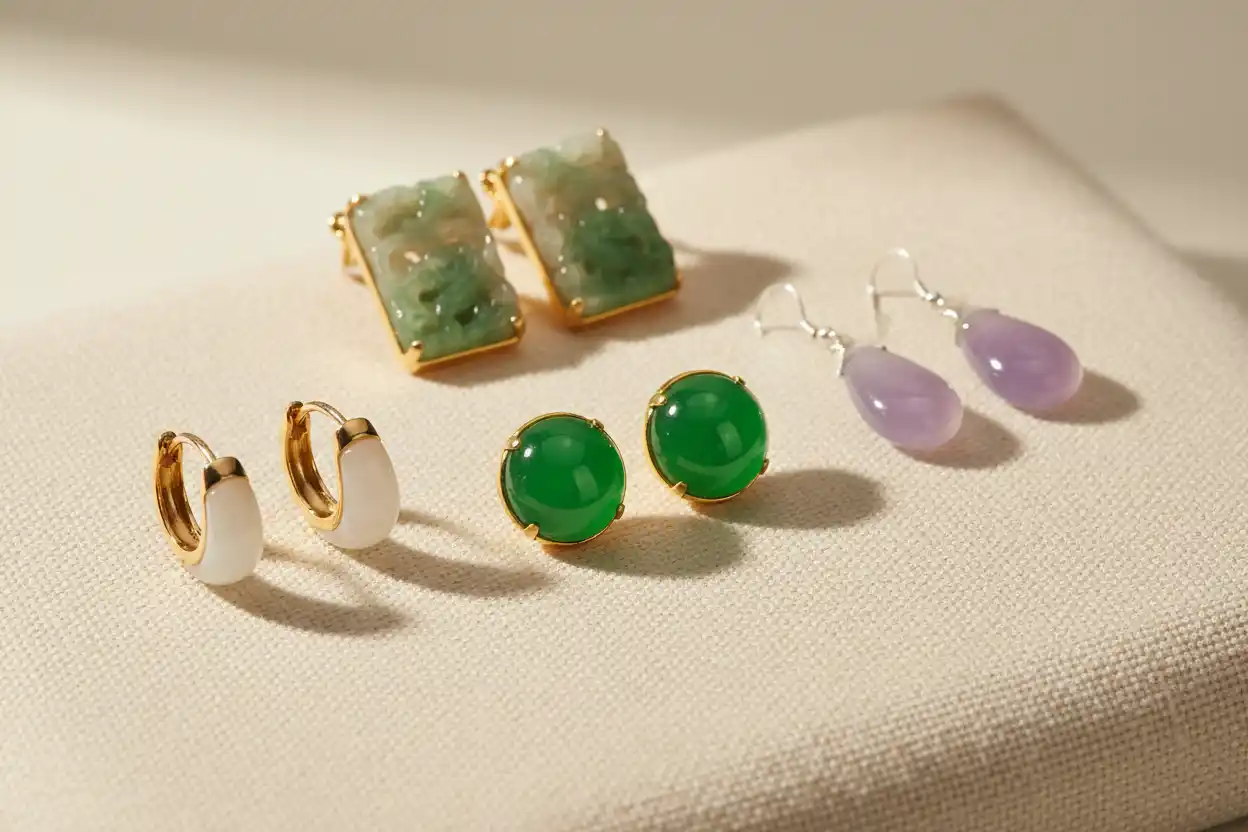
Jade Earrings: A Style Guide
Jade earrings place color close to the face, where translucency, surface polish, carving, and metal tone become immediately visible. Small cabochon studs can look restrained and modern, while carved drops, hoops, disks, beads, and articulated pendants draw on jewelry traditions that have developed around both jadeite and nephrite.
A good pair depends on more than attractive green color. Buyers should confirm which jade material is present, whether it has been dyed or impregnated, how well the two pieces match, whether the posts and backs are comfortable, and whether the design protects thin carved sections.
The family-level jade meaning guide covers history and symbolism. This page stays with earring-specific choices: style, matching, construction, wearability, treatment, and buying checks.
Jadeite, Nephrite and the Meaning of “Jade Earrings”
Jade is a traditional gem name covering jadeite and nephrite. They are distinct mineral materials, even though both can take a smooth polish and resist breakage unusually well.
Jadeite can produce vivid green, lavender, white, yellow, orange-red, gray, black, and mottled earrings. Its interlocking granular structure may also create a soft internal glow in fine semitransparent material. The separate jadeite guide explains its mineral identity.
Nephrite has a dense fibrous structure and an especially smooth, waxy appearance. It commonly appears in white, cream, gray-green, spinach green, brown, and black. The nephrite guide covers its own geology and trade characteristics.
The direct guide to jadeite versus nephrite should be used when the species distinction matters more than the earring design. For shopping, the seller should identify the material rather than using “jade” as a vague color label.
Popular Jade Earring Styles
| Style | Visual effect | Practical advantage | Main buying concern |
|---|---|---|---|
| Cabochon studs | Clean, polished color close to the ear | Low movement and low impact | Secure setting and matched domes |
| Bead studs | Rounded, classic profile | Light and easy to coordinate | Drill quality or glued post |
| Drop earrings | Visible movement and color | Suits carved plaques and beads | Connector and bail wear |
| Dangle earrings | Longer, more dramatic line | Displays multiple components | Weight, snagging and thin sections |
| Jade hoops | Continuous carved or segmented form | Strong graphic shape | Fragility of thin hoops |
| Huggies with jade charms | Compact modern style | Secure closure | Charm abrasion and hinge strength |
| Carved disks or bi earrings | Symbolic geometric form | Broad surface for color and polish | Thin inner rim and edge chips |
| Floral or figurative carvings | Decorative, traditional character | Uses color zoning creatively | Fragile projections and repairs |
| Jade and diamond earrings | High contrast and sparkle | Formal or bridal appeal | Treatment disclosure and setting quality |
| Mismatched jade earrings | Contemporary, artistic effect | Uses different colors or carvings | Intentional design versus poor matching |
Jade Stud Earrings
Studs are the most practical form for regular wear. A cabochon sits close to the ear, receives relatively few impacts, and allows the viewer to judge polish, symmetry, color, and translucency without distraction.
The pair should match in face-up color and apparent size. Perfect mineral uniformity is not essential, especially in natural mottled jade, but one stud should not look markedly duller, darker, or coarser than the other unless the design is intentionally asymmetric.
Inspect the side profile. Both cabochons should have similar dome height, outline, and thickness. Uneven backs may cause one earring to tilt differently on the ear.
Some bead studs use a metal post glued into a drilled hole rather than a surrounding setting. That construction can work, although the adhesive may age. Ask whether the post is drilled, glued, pinned, or mechanically set.
Jade Drop and Dangle Earrings
Drops allow more light to pass through translucent jade and reveal movement as the wearer turns. Common forms include beads, teardrops, cabochons, plaques, disks, leaves, gourds, flowers, and small figurative carvings.
Articulation should move freely without allowing jade components to strike one another. Jump rings must close completely, and drilled holes should sit far enough from the edge to avoid creating a thin weak wall.
Long earrings can pull on the lobe, so request the weight of each earring rather than the pair only. A visually delicate jadeite drop may still be heavy because of its thickness and metal fittings.
Jade Hoop Earrings
Jade hoops may be carved as continuous hololiths, cut as partial arcs with metal findings, or assembled from small segments. Continuous jade hoops provide a striking uninterrupted form, but their thin cross-section demands careful handling.
Never bend a stone hoop to insert it through the ear. The opening and post mechanism should operate through metal hardware rather than forcing the jade.
Examine the inner curve for repaired breaks, chips, or rough polish. A metal cap can be decorative, but it can also conceal an old fracture. Matching is difficult because each hoop must be carved to nearly identical dimensions and color.
Carved Jade Earrings
Carving turns a small amount of material into a distinct design. Butterflies, flowers, bamboo, leaves, dragons, coins, gourds, peaches, animals, and pierced disks appear frequently.
Good carving should look intentional from both sides. Thin projections, deeply pierced areas, and narrow bridges are more vulnerable than a solid cabochon. The carving should not rely on thick resin, glue, or a metal cap to hold a damaged area together.
Color zoning can enhance a design. A carver might place green in a leaf and pale material in the surrounding background. Such variation can increase artistry even when the pair is not uniformly colored.
The guide to types of jade helps decode trade terms used for carved material without duplicating the earring-style discussion.
Choosing Jade Color Near the Face
Green jade reflects color onto nearby skin and hair, while lavender, white, black, yellow, and mixed jade create different levels of contrast.
Vivid green jadeite stands out strongly in small studs. Pale icy jadeite can look luminous in drops, especially when light passes through thinner sections. White nephrite offers a softer, warmer appearance, while dark green or black jade creates a graphic outline.
The separate page on jade color meaning explains traditional symbolism associated with different colors. A buyer should still judge the physical color under neutral lighting because symbolic labels do not establish quality or treatment.
The directory of green gemstones can help compare jade with emerald, tsavorite, peridot, chrysoprase, aventurine, and other green earring materials.
Matching a Pair
Matched jade earrings are harder to assemble than they first appear. The cutter or jeweler must coordinate:
- Hue and saturation
- Color distribution
- Translucency
- Texture
- Shape and dimensions
- Dome or carving depth
- Polish
- Weight
- Drilling or setting orientation
A small mismatch may disappear once the earrings sit on opposite sides of the face. However, obvious differences in brightness, opacity, or size reduce visual balance.
Ask for photographs of both earrings side by side, swapped left to right, and viewed from the back. This helps reveal whether one piece has a darker backing, thicker body, or less even polish.
Transparency, Texture and Thickness
Thin jade can look more translucent than thicker jade of the same quality. Therefore, sellers should not compare a delicate drop directly with a thick cabochon without acknowledging the effect of thickness.
Fine texture supports a smooth polish and clean reflection. Coarse material can show granular or cloudy areas. In earrings, texture differences become conspicuous because two stones are viewed as a pair.
Backlighting can be informative, but it should not replace face-up examination. An aggressively backlit photograph may make ordinary material appear much more vivid and transparent than it looks in normal wear.
Metal Choice
Yellow gold warms green and lavender jade and often complements traditional carved designs. White gold and platinum produce a cooler contrast, while rose gold can soften pale green, lavender, and white material.
Sterling silver keeps larger earrings accessible, but lightweight findings can bend or tarnish. Gold-plated or vermeil components require clear disclosure because the coating will wear differently on posts, hooks, and friction points.
For sensitive ears, metal composition matters more than the jade. The guide to gemstones and metals for sensitive skin explains nickel, plating, titanium, platinum, and suitable gold alloys.
Posts should be straight and securely joined. Butterfly backs need enough tension to support the earring without pinching. Leverbacks and hinged hoops should close positively, while fishhooks benefit from silicone stoppers.
Comfort and Earring Weight
Heavy earrings can stretch piercings, tilt forward, or become uncomfortable within hours. Large carved jade drops may weigh more than their open design suggests.
Request the weight per earring and compare it with a pair you already wear comfortably. A broad earring can distribute visual mass without requiring great thickness. Conversely, a compact but very thick nephrite carving may be unexpectedly heavy.
Studs need backs large enough to stabilize the front. For heavier pieces, supportive disk backs can improve posture on the ear.
Everyday Wearability
Jadeite has a Mohs hardness around 6.5 to 7, while nephrite is approximately 6 to 6.5. Both are extraordinarily tough because their interlocking structures resist chipping and breakage.
Earrings expose jade to less impact than rings and many bracelets, making them one of the safest jewelry forms for valuable or delicate jade. Even so, thin hoops, narrow carved bridges, glued posts, and drilled drops remain vulnerable.
The guide to best gemstones for everyday wear explains why toughness and hardness should be evaluated separately.
Remove jade earrings before sleeping, showering, swimming, exercising, styling hair with heated tools, or changing tight clothing. Long drops can catch in scarves, headphones, and seat belts.
Treatments and Disclosure
Jadeite can be waxed, dyed, bleached, polymer impregnated, coated, heated, or assembled. Traditional surface waxing can be present on otherwise untreated Type A jadeite. Type B jadeite has been bleached and polymer impregnated, while Type C material has been dyed.
The dedicated guide to treated jade explains A, B, C, and B+C terminology. For broader context, gemstone treatments explained covers impregnation, dyeing, coating, bleaching, and their care implications.
Treatment matters even in small earrings. Dye can concentrate around drill holes or surface-reaching fractures, while polymer may respond poorly to heat, solvents, and repair work. A low price does not excuse missing disclosure.
Nephrite may also be dyed, coated, bleached, assembled, or replaced with imitation material. The A/B/C shorthand should not be applied carelessly to every stone sold as jade.
Real Jade, Imitations and Seller Claims
Glass, serpentine, quartz, aventurine, calcite, and composite materials can be sold under jade-like names. Color and smoothness alone cannot confirm identity.
The guide to real versus fake jade covers imitation clues and professional testing. When green aventurine is a possibility, aventurine versus jade provides a direct material comparison.
For valuable earrings, request a report from an independent laboratory rather than relying on a generic seller certificate. The page on gemstone certification explains how to match a report’s photograph, dimensions, weight, and description with the actual pair.
Buying Jade Earrings Online
The jade buying guide covers general quality factors and disclosure. For earrings, request additional pair-specific evidence:
| Buying check | What to verify |
|---|---|
| Species | Jadeite or nephrite |
| Treatment | Wax, dye, bleaching, polymer, coating, heat, glue, or repair |
| Matching | Color, translucency, texture, size, shape, and weight |
| Measurements | Length, width, thickness, drop length, and weight per earring |
| Metal | Alloy, hallmark, plating, post material, and back type |
| Construction | Prong, bezel, drilling, adhesive, cap, hinge, or wire |
| Condition | Chips, fractures, worn posts, loose findings, and repaired carvings |
| Lighting | Neutral-light photographs and movement video |
| Returns | Time to inspect both pieces without destructive testing |
The jade price guide provides market context. Pair matching, carving labor, metalwork, and treatment can make two earrings cost much more than two roughly equivalent loose pieces.
Coordinating Jade Earrings
Small green or white studs work with business clothing and understated everyday jewelry. Longer carved drops suit formal, cultural, and artistic styling. Lavender jadeite pairs naturally with cool neutrals, while yellow gold emphasizes warm green and cream tones.
For a coordinated set, a jade bracelet can repeat color at the wrist without requiring an exact match. A jade necklace should share either material, motif, or metal rather than trying to imitate every color variation. A jade ring receives more impact, so its setting and treatment condition require greater scrutiny.
Jade also works in bridal jewelry when its symbolism, color, and family significance suit the wearer. The broader guide to gemstones for wedding jewelry places it among other durable colored options.
Cleaning and Storage
Warm soapy water and a soft cloth or brush are the safest default, especially when treatment status is uncertain. Avoid strong acids, household chemicals, cosmetics during wear, and direct heat from styling tools.
Although untreated jade can tolerate steam or ultrasonic cleaning, earring construction may not. Glue, polymer treatment, thin carvings, antique solder, plating, and loose findings make gentle hand cleaning preferable.
Follow the full process in How to Clean Jade Jewelry Safely. Store each earring separately so posts and harder accent stones do not scratch the jade or the matching earring.
Repair and Maintenance
Check posts, hinges, jump rings, prongs, bezels, and adhesive joints before wearing a valuable pair. A loose drop should be repaired before it detaches.
Tell the jeweler that the material is jade and disclose any known treatment. Torch heat can harm jade, while polymers, dyes, coatings, and glue require additional precautions.
A chipped carving may sometimes be repolished, recut, or capped with metal. However, repair can alter symmetry and matching, so both earrings should be evaluated together.
Frequently Asked Questions
1. Are jade earrings suitable for everyday wear?
Yes. Earrings expose jade to relatively little impact, and both jadeite and nephrite are exceptionally tough. Thin hoops, long drops, and delicate carvings still require careful handling.
2. Which is better for earrings, jadeite or nephrite?
Jadeite suits buyers seeking vivid green, lavender, or translucent material. Nephrite suits creamy white, muted green, and smooth carved styles. A sound, well-disclosed pair in either material can be an excellent choice.
3. How can I tell whether two jade earrings are well matched?
Compare them side by side under neutral light for hue, saturation, translucency, texture, outline, thickness, polish, and apparent size. Also check that their weights and hanging lengths are similar.
4. Are jade stud earrings usually glued?
Some bead studs use adhesive-set posts, while cabochons may be bezel- or prong-set. Ask the seller to describe the construction because glue affects repair and cleaning choices.
5. Are jade hoops fragile?
They are tougher than many stone hoops, but thin continuous circles can still crack if bent, dropped, or struck. Metal-hinged designs should place movement in the hardware rather than the jade.
6. Why does one jade earring look darker?
Differences in thickness, texture, color distribution, backing, lighting angle, or treatment can change appearance. A severe mismatch may indicate that the pair was assembled from unrelated material.
7. Can dyed jade earrings fade?
Yes. Some dyes can change with light, heat, chemicals, or time. Dyed material should be disclosed and cleaned conservatively.
8. Are lavender jade earrings natural?
Natural lavender jadeite exists, but dyed and treated lavender material also occurs. Color alone cannot establish natural origin or treatment status.
9. Can jade earrings contain nickel?
The jade does not supply the metal allergen, but posts, hooks, backs, solder, or plating may contain nickel. Check the exact alloy when sensitivity is a concern.
10. Do jade earrings need a laboratory report?
A report becomes worthwhile when natural identity and treatment materially affect the price. Small inexpensive earrings may not justify individual reports, although the seller still owes accurate disclosure.
11. Can I sleep in jade studs?
It is better to remove them. Posts can press into the skin, backs can loosen, and the setting can catch on bedding or hair.
12. What should I do if a jade drop becomes loose?
Stop wearing the earring and store both pieces together in a padded box. A jeweler familiar with jade should inspect the connector, drill hole, setting, and treatment before repair.
The strongest jade earrings combine honest material disclosure with balanced matching and dependable construction. Choose the style according to how the pair will actually be worn: low studs for routine use, articulated drops for movement, or carved designs for visual and cultural character. When color, weight, metal, and treatment are considered together, jade can deliver a distinctive pair without sacrificing comfort or durability.