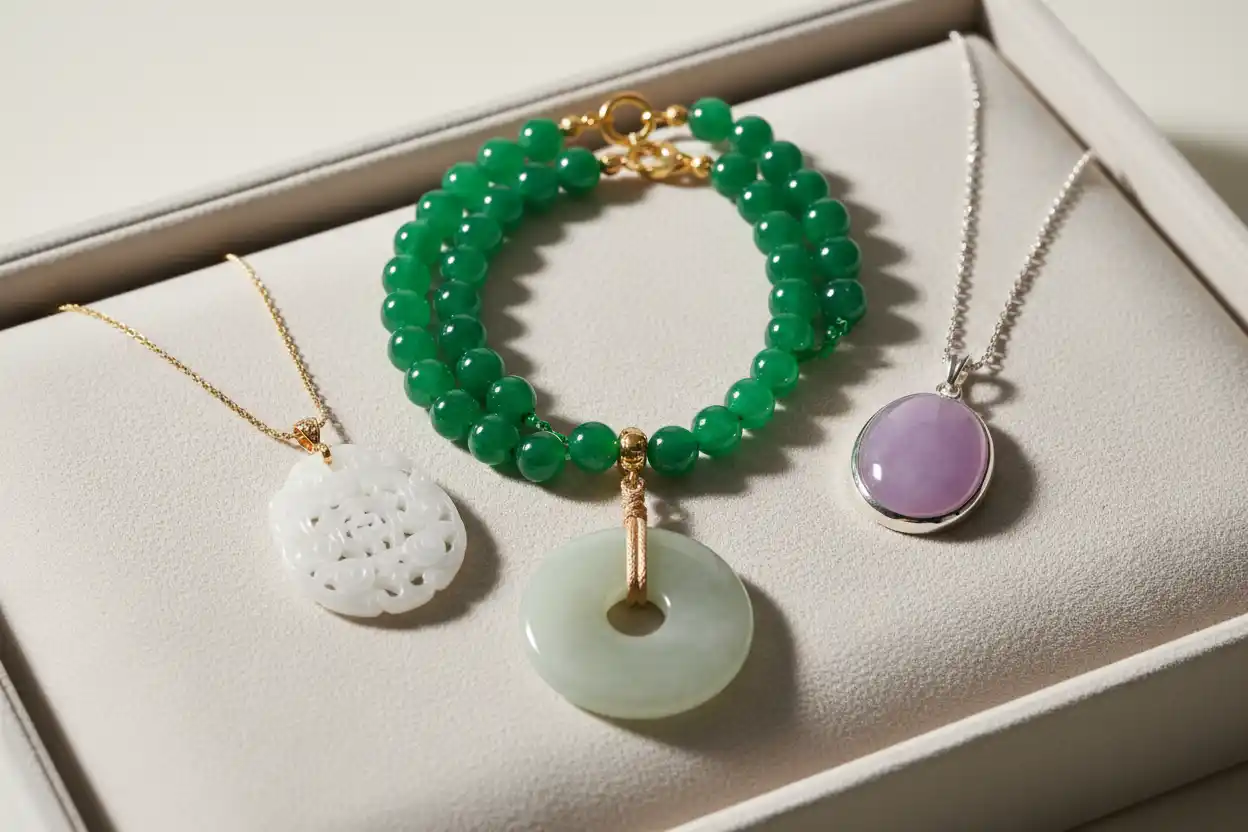
Jade Necklaces and Pendants Guide
Jade necklaces range from restrained cabochon pendants to graduated bead strands, carved plaques, bi disks, symbolic motifs, articulated collars, and contemporary metal-set designs. Because necklaces sit away from the hands, they generally protect jade from the repeated impact faced by rings and bracelets. Nevertheless, drill holes, cords, clasps, thin carvings, treatment, and metal construction can still determine whether a piece lasts.
A buyer should begin by identifying the material. The word jade can refer to jadeite or nephrite, but it is also misused for serpentine, quartz, glass, aventurine, calcite, and composite materials.
The broader jade meaning guide explains the material’s identity and history. This guide focuses specifically on necklace styles, pendant construction, bead matching, sizing, comfort, quality, treatment, and purchase checks.
Jadeite or Nephrite?
Jadeite and nephrite can both make excellent necklaces, although their visual strengths differ.
Jadeite can offer vivid green, lavender, white, yellow, orange-red, gray, black, and mottled colors. Fine semitransparent jadeite may appear luminous when a pendant is thin enough for light to enter.
Nephrite typically has a softer waxy appearance and more muted green, cream, white, gray, brown, or black color. Its exceptional toughness makes it especially suitable for carvings, beads, disks, and substantial pendants.
The direct Jadeite vs. Nephrite comparison covers their composition and identification. In a finished necklace, treatment, workmanship, color, and construction are often more important than choosing one species by name alone.
Main Jade Necklace Styles
| Necklace style | Construction | Best quality focus | Main risk |
|---|---|---|---|
| Single cabochon pendant | Jade set in metal | Color, translucency and setting | Loose bezel or prong |
| Carved pendant | Pierced, drilled or capped carving | Detail, polish and structural thickness | Thin projections and concealed repairs |
| Bi disk pendant | Circular disk with central opening | Symmetry, polish and sound edges | Chipping around the inner hole |
| Jade bead strand | Matched drilled beads | Matching, drill holes and stringing | Cord wear and bead abrasion |
| Graduated necklace | Beads increasing toward the center | Smooth progression and matching | Poorly balanced weight |
| Station necklace | Jade elements spaced along a chain | Secure links and even orientation | Connector wear |
| Articulated collar | Multiple jade plaques or cabochons | Flexibility and matching | Hinges, joints and weight |
| Jade charm necklace | Small removable jade motif | Bail strength and chain compatibility | Impact and loss |
| Hololith pendant | Carved entirely from one piece | Rough utilization and symmetry | Hidden fracture or fragile bridge |
| Jade and diamond pendant | Jade with harder accent stones | Setting quality and contrast | Diamond contact against jade |
Jade Cabochon Pendants
Cabochons display jade’s color, texture, translucency, and polish without the distraction of many facets. Oval, round, cushion, rectangular, teardrop, and irregular freeform cabochons are common.
Fine jadeite cabochons should have a balanced outline, sufficient thickness, smooth dome, attractive color distribution, and even polish. Excessively thin material may appear more translucent but can become vulnerable around the setting edge.
A bezel provides broad perimeter protection and suits both jadeite and nephrite. Prongs expose more of the stone, although they should not press against an existing fracture or leave the girdle unprotected.
Inspect the pendant from the back. A fully closed backing can strengthen the construction, but it can also conceal uneven color, a fracture, glue, foil, or a different material. High-value pieces should allow enough inspection to confirm the stone’s condition and treatment.
Carved Jade Pendants
Carved pendants may depict flowers, fruits, leaves, animals, dragons, guardian figures, abstract patterns, disks, coins, tablets, gourds, bamboo, or culturally specific motifs.
Good carving works with the material’s color zoning. A green patch may become foliage, while paler material forms the background. Tooling should remain controlled, with no rough hidden cavities or unnecessarily thin bridges.
The guide to Types of Jade helps identify material and trade varieties, while Best Gemstones for Carving and Cabochons explains why toughness and texture matter in carved work.
Before buying, inspect:
- Narrow loops and suspension points
- Pierced sections
- Deep undercut areas
- The base of projecting elements
- Drill holes and bails
- Metal caps that may conceal repair
- Glue lines and filled cavities
A detailed carving can be artistically valuable, but complexity should not distract from fractures or weak construction.
Bi Disk Necklaces
A bi-style pendant is a circular or slightly convex disk with a central opening. Modern pieces range from simple polished disks to deeply carved interpretations.
The inner opening should be smooth and free from chips. When a cord passes directly through the hole, friction can gradually abrade both materials. A protective bail, knot arrangement, or replaceable cord can reduce wear.
The disk should hang flat rather than flip repeatedly. Very thin disks may feel light and translucent, yet they become more vulnerable to edge impact.
Symbolic meanings associated with bi forms vary across history and modern practice. The dedicated jade color meaning guide and jade healing properties guide provide the belief-based context without replacing material assessment.
Jade Bead Necklaces
Matched jade bead strands can require considerable cutting and sorting. Each bead must align in color, texture, translucency, diameter, polish, drill quality, and shape.
Larger beads consume more rough, while longer strands require a greater number of compatible pieces. Fine matching can therefore add substantial value even when each individual bead seems simple.
Inspect a strand laid straight and curved. Color differences that appear minor in a tray may become obvious once the necklace follows the neckline.
Round beads should be genuinely round rather than flattened near drill holes. Barrels, disks, tubes, carved beads, and irregular shapes should repeat consistently unless the design is intentionally graduated.
The matching standards used for bead strands differ from those of a jade bracelet, where stretch, wrist impact, and bead-to-bead pressure become more important.
Knotted, Wired and Elastic Construction
Fine bead necklaces are often knotted between beads. Knotting reduces contact, limits bead loss if the strand breaks, and gives the necklace controlled flexibility.
Silk provides a traditional drape but can stretch and absorb oils. Modern synthetic cords may offer greater resistance to moisture and abrasion. Flexible beading wire supports heavier strands but must be finished with suitable crimps and protectors.
Elastic is rarely ideal for a valuable necklace. It stretches, degrades, and offers limited security for heavy beads.
Ask when the necklace was last restrung. A strand can look excellent while its internal cord approaches failure.
Graduated Jade Necklaces
A graduated strand places the largest bead or component at the center and decreases size toward the clasp. Good graduation should appear smooth rather than stepping abruptly.
Weight distribution matters. A heavy central section should not pull the clasp forward or cause the necklace to rotate.
Color may also be graduated intentionally. A strand can move from pale to dark green, white to lavender, or opaque to translucent material. Such design should look deliberate rather than like random unmatched inventory.
Station Necklaces and Modern Designs
Station necklaces place jade beads, cabochons, carved elements, or plaques at intervals along a chain. They offer a lighter, more contemporary appearance than a full bead strand.
Each station should face consistently. Weak solder joints or oversized connector rings can allow components to flip or detach.
Metal chains can scratch jade when links strike exposed edges. The jeweler should leave enough separation or use protective cups and bezels.
Contemporary designs may also combine jade with diamonds, pearls, colored gemstones, enamel, wood, or other materials. The hardest component should never rub directly against the jade.
Necklace Length
Length determines where the pendant or bead strand rests and how often it contacts clothing, desks, zippers, and skin products.
| Approximate style | Typical placement | Jade-specific consideration |
|---|---|---|
| Collar | High around the neck | Must flex comfortably without sharp plaque edges |
| Choker | Base of the neck | Heavy beads need balanced stringing |
| Princess | Upper chest | Versatile for most pendants |
| Matinee | Mid-chest | Longer drops may strike desks |
| Opera | Lower chest | Weight and snagging become more important |
| Rope | Long or doubled | Beads and carvings can collide when layered |
Measurements vary with body size and design. Request the wearable length, pendant dimensions, and total weight rather than relying only on style names.
Pendant Bails
The bail connects the jade pendant to the chain or cord. It must accommodate the chain’s clasp and end fittings, not merely the chain thickness.
Common constructions include drilled holes, metal loops, glued caps, pin-and-bail systems, hinged bails, and carved jade loops.
A carved jade loop can provide visual continuity, yet it may be the pendant’s thinnest and most vulnerable part. Metal bails are easier to repair but may hide glue or a damaged upper edge.
Check for movement between the bail and stone. The pendant should articulate without grinding the metal against jade.
Chains, Cords and Clasps
Yellow gold complements warm green, white, yellow, and lavender jade. White gold and platinum create cooler contrast, while rose gold can soften pale green and lavender tones.
Sterling silver offers an accessible option but may tarnish. Plated chains should be disclosed because the coating wears fastest around clasps and contact points.
For skin sensitivity, consult Best Gemstones and Metals for Sensitive Skin. The stone may be suitable, while the chain, clasp, solder, plating, or base-metal finding causes irritation.
Heavy pendants need chains with adequate gauge. A delicate chain may look refined in photographs but fail under repeated movement.
Lobster clasps, box clasps, spring rings, toggles, and hooks should be evaluated according to necklace weight. Valuable strands benefit from a secondary safety mechanism.
Jade Color in a Necklace
Necklaces allow light to enter jade from different angles, especially in moving pendants and translucent beads. Green remains the best-known choice, but white, lavender, black, yellow, orange-red, brown, and mixed jade can all work.
The White Jade guide explains creamy nephrite and pale jadeite appearances. Color should be judged under neutral indoor light and daylight because warm photography can shift green and lavender tones significantly.
A pendant with concentrated green in one area may be artistically stronger than a uniformly pale piece. In a bead strand, however, abrupt color changes can reduce matching quality unless the progression is intentional.
Transparency, Texture and Polish
Fine jadeite may appear to glow because light penetrates below the polished surface. Nephrite often has a softer, waxier visual character.
A thin pendant naturally transmits more light than a thick bead. Therefore, transparency comparisons should consider dimensions.
Texture should remain even across matching components. Coarse grains, cloudy areas, polishing drag, orange-peel texture, and wax accumulation can change luster.
Inspect the back and sides as closely as the front. Lower-quality finishing often appears around drill holes, carving recesses, bead ends, and hidden surfaces.
Treatments
Jadeite can be waxed, bleached, polymer impregnated, dyed, coated, heated, filled, repaired, or assembled.
Type A jadeite has not undergone acid bleaching and polymer impregnation, although traditional surface waxing may be present. Type B material has been bleached and polymer impregnated, Type C has been dyed, and B+C combines those processes.
The dedicated treated jade guide explains the terminology and detection methods. Treatment changes value and care, especially when heat, solvents, adhesives, or repeated sunlight are involved.
Nephrite can also be dyed, coated, filled, glued, and imitated. Treatment disclosure applies regardless of whether the object carries the A/B/C shorthand.
Authentication
Glass, aventurine, serpentine, quartz, calcite, composite products, and other materials can imitate jade.
The guide to Real vs. Fake Jade covers safe observational clues. Cold feel, ringing sound, weight, and visual color cannot prove identity.
A laboratory report may be appropriate for a high-value pendant, fine bead strand, exceptional jadeite, or piece represented as untreated. The guide to gemstone certification laboratories explains how to match a report’s weight, dimensions, photograph, and description to the necklace.
Evaluating Price
Jade necklace prices reflect more than stone weight. Important factors include:
- Jadeite or nephrite identity
- Treatment status
- Color
- Translucency
- Texture
- Carving quality
- Bead matching
- Size
- Condition
- Metal value
- Construction
- Provenance and documentation
A single fine jadeite cabochon may cost more than a large commercial nephrite carving. Likewise, an exceptionally matched bead strand may exceed the value implied by its total weight.
Use the dedicated jade price guide for valuation. The Jade Buying Guide provides the broader quality framework.
Buying Jade Necklaces Online
Online images can exaggerate saturation, translucency, and surface quality. The safeguards in How to Buy Gemstones Online Without Getting Scammed apply directly to jade.
Request:
| Buying detail | Why it matters |
|---|---|
| Exact material | Separates jadeite, nephrite and imitation |
| Treatment disclosure | Determines value and care |
| Neutral-light video | Shows movement, transparency and color distribution |
| Dimensions | Establishes thickness and visual scale |
| Total weight | Indicates comfort and chain requirements |
| Metal details | Confirms alloy, plating and clasp construction |
| Stringing method | Reveals maintenance and loss risk |
| Condition report | Identifies fractures, repairs and drill-hole damage |
| Laboratory report | Supports high-value identity and treatment claims |
| Return policy | Allows non-destructive inspection |
Avoid sellers who rely only on spiritual promises, locality stories, sound tests, or dramatic flashlight photographs.
Wearing a Jade Necklace
A short cabochon pendant can work for routine wear. Long carved drops should be removed during exercise, cooking, childcare, workshop activity, and any situation where the pendant may strike a hard surface.
Apply perfume, hairspray, sunscreen, and cosmetics before putting on the necklace. Skin oils and products collect around bails, bead holes, and metal settings.
Do not layer jade directly against diamond chains or hard-edged metal pieces. Repeated rubbing can scratch polish and wear thin carved edges.
Coordinate a necklace with jade earrings by repeating one feature—color, material, carving motif, or metal—rather than demanding a perfect match. A future jade ring or bracelet should be evaluated separately because hand and wrist jewelry receive more impact.
Cleaning and Storage
Use warm water, mild soap, and a soft cloth or brush. Avoid strong acids, household chemical dips, repair heat, and aggressive cleaning when treatment or construction is uncertain.
Do not soak strung beads unnecessarily. Water can remain within knots, drill holes, silk, and metal components.
Follow the full process in How to Clean Jade Jewelry Safely. Allow the necklace to dry flat, then store it in a fabric-lined box or pouch.
Lay heavy bead strands in a broad curve instead of hanging them permanently from a clasp. Separate jade from harder gemstones and keep thin carvings away from chains that may tangle through openings.
Repair and Restringing
A bead necklace should be restrung before the cord fails. Warning signs include stretched gaps, frayed knots, discoloration, stiffness, exposed wire, loose crimps, and a clasp that rotates forward.
Carved pendants with damaged loops may require a custom cap or specialist repair. Household glue can discolor, spread into pores, and reduce resale value.
Tell the jeweler that the stone is jade and disclose any known treatment. Torch heat can harm treated material, worsen fractures, and damage adhesive joints.
Frequently Asked Questions
1. Is jade suitable for a necklace worn every day?
Yes, sound jade is exceptionally tough and necklaces receive less impact than rings. The chain, bail, stringing, treatment, and thin carved areas still require routine inspection.
2. Is a jadeite necklace better than a nephrite necklace?
Neither is universally better. Jadeite may offer brighter color and greater translucency, while nephrite offers a waxy appearance, exceptional toughness, and strong carving traditions.
3. Why are matched jade bead necklaces expensive?
The maker must find many beads with compatible color, texture, translucency, diameter, polish, and shape. Matching becomes much harder as bead size and strand length increase.
4. Should jade beads be knotted?
Knotting reduces bead contact and limits loss if the cord breaks. It is especially useful for valuable, heavy, or long strands.
5. Can a jade pendant be glued to its bail?
Yes, but glued construction should be disclosed and inspected periodically. Mechanical settings or pinned bails generally provide more repair options.
6. What necklace length works best for a jade pendant?
Princess length is versatile for many pendants, while heavier or larger carvings may sit better on a slightly longer substantial chain. Body proportions and pendant size matter more than a universal rule.
7. Can jade necklaces contain dyed stones?
Yes. Jadeite and nephrite may be dyed, and imitation materials are frequently colored. Ask for treatment disclosure rather than assuming natural color.
8. Does a jade necklace need a laboratory report?
A report is worthwhile when untreated identity materially affects a high price. Commercial necklaces may not justify the expense, although accurate seller disclosure remains essential.
9. Why does my jade pendant look brighter against skin?
Background color, transmitted light, skin tone, polish and thickness can change its appearance. This effect does not prove treatment or a change in the stone.
10. Can I sleep in a jade necklace?
It is better to remove it. Chains and cords can catch, pendants can press against the body, and clasps or links may weaken during sleep.
11. How often should a jade bead necklace be restrung?
Inspection should occur regularly, with restringing whenever knots stretch, cord frays, wire kinks, or the clasp loosens. Frequently worn strands may need service every few years or sooner.
12. Can a chipped jade pendant be repaired?
Minor edge damage may be repolished, while larger breaks may require recutting, metal caps, pins, or adhesive repair. Every repair should be disclosed during resale.
A well-chosen jade necklace balances the stone with everything supporting it. Material identity and treatment establish the starting value, but bead matching, carving thickness, bail construction, chain strength, clasp reliability, comfort, and repairability determine how successfully the piece functions. Examine the back, drill holes, connectors, and hidden surfaces with the same care given to the face-up color.