Moonstone Price: Buyer Value Guide, Authenticity, Rarity & Size
Moonstone prices range from around $1.30 per carat for low-cost commercial stones to roughly $15 per carat within much ordinary specialist inventory, while fine traditional moonstone with strong blue adularescence, high transparency, excellent orientation, and large size can exceed ordinary commercial ranges. Current untreated Indian retail examples reviewed for this article work out to approximately $2.74 to $8.76 per carat.
The reason for this wide range is simple: moonstone is not priced primarily by weight. The strength, color, mobility, and orientation of its adularescence are central to value. Body color, clarity, cut, size, provenance, treatment, condition, and authenticity also matter. A smaller gem with electric blue sheen can therefore be worth far more per carat than a much larger milky white cabochon with only a faint glow.
Current Moonstone Price Benchmarks
Live untreated retail listings provide practical benchmarks for ordinary white and colored moonstone.
| Current moonstone example | Weight | Asking price | Approx. price per carat |
|---|---|---|---|
| Warm white round | 2.98 ct | $8.17 | $2.74 |
| Warm white round pair | 4.24 ct total | $11.61 | $2.74 |
| Translucent white oval | 2.59 ct | $22.70 | $8.76 |
| White oval pair | 5.12 ct total | $16.90 | $3.30 |
| Transparent warm white pair | 5.79 ct total | $15.85 | $2.74 |
| Warm white round pair | 6.42 ct total | $17.59 | $2.74 |
| Warm white round pair | 6.91 ct total | $18.92 | $2.74 |
| Light brown carved pair | 10.66 ct total | $56.28 | $5.28 |
These examples mainly represent affordable Indian commercial stones rather than the rarest blue-sheen category. Current seller guidance places ordinary moonstone around $1.30 to $15 per carat, while cat’s-eye and star varieties can occupy higher ranges depending on quality.
The moonstone price per carat becomes much more informative once the exact variety and optical quality are known.
Blue Adularescence Creates the Strongest Premium
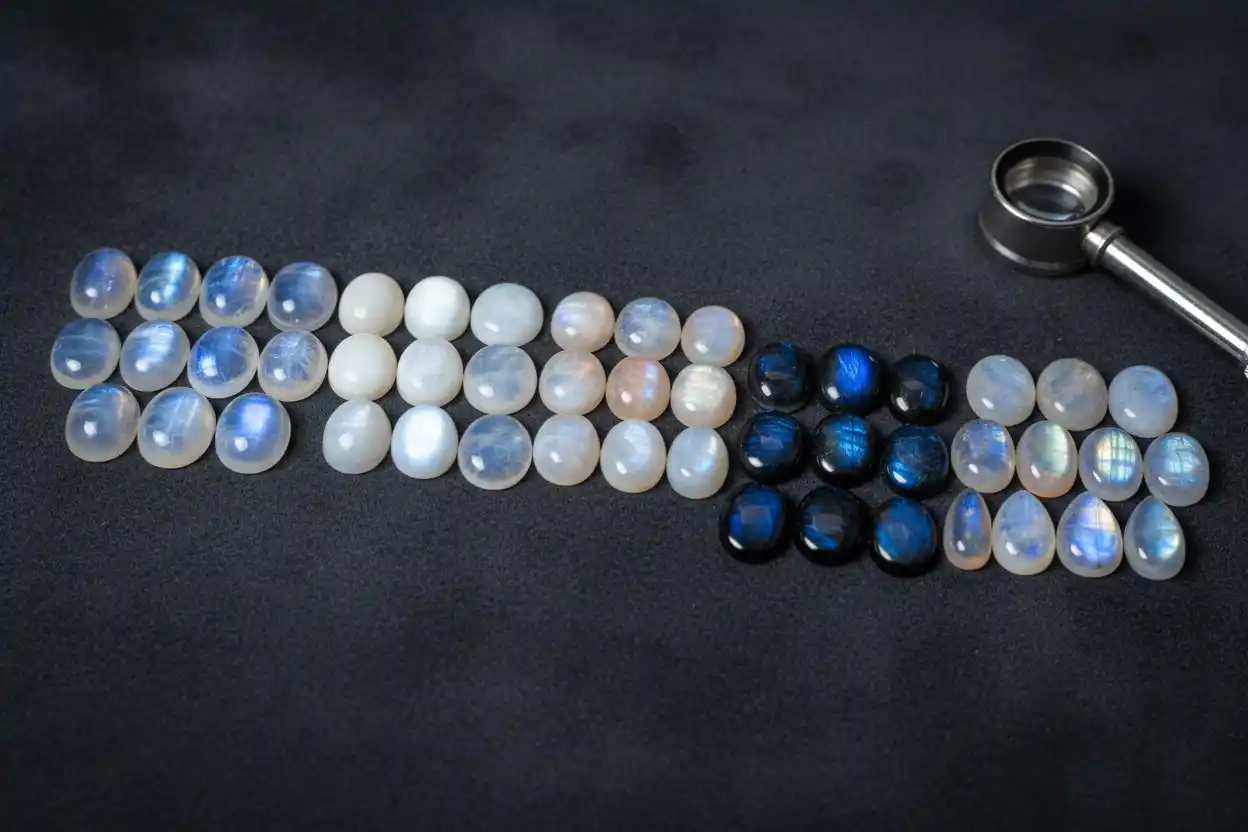
GIA identifies the classic top moonstone as nearly colorless, semitransparent to nearly transparent, relatively free from visible inclusions, and accompanied by a vivid mobile blue sheen.
The blue effect should ideally appear centered and move across the stone as it is tilted. When the sheen can be seen only from one restricted direction, value generally falls.
This optical performance can make price rise far faster than carat weight. Two 5-carat cabochons can occupy completely different price tiers if one shows a faint white cloud and the other displays a strong electric-blue glow.
The moonstone quality grading should therefore put adularescence ahead of simple size.
White Commercial Moonstone Is Relatively Affordable
The current untreated Indian listings above demonstrate how accessible ordinary white moonstone can be. Several examples cluster near $2.74 per carat, even when total weights reach 5 or 6 carats.
These stones can still be attractive in jewelry, particularly when the body is translucent and the white or silver sheen is visible. Their lower price reflects abundance and optical quality rather than a lack of genuine identity.
This also explains why extremely high asking prices for ordinary milky white moonstone deserve comparison with stronger examples before purchase.
Fine Blue-Sheen Moonstone Is Scarcer in Large Sizes
GIA notes that fine moonstone becomes scarcer as size increases. International Gem Society guidance similarly describes large high-quality blue-sheen examples as much less common than large white or silvery stones.
A large colorless cabochon with clean transparency and strong blue adularescence can therefore receive a disproportionately high premium.
The important qualifier is quality. A 20-carat cloudy stone with weak sheen does not become valuable simply because a fine 20-carat blue-sheen stone would be rare.
Size only creates a strong premium when the desirable optical properties remain intact.
Body Color Changes the Market Category
Moonstone can be colorless, white, green, peach, brown, gray, or dark. Different body colors attract different buyers and do not always follow the same price pattern.
Peach moonstone often sells as an affordable warm-toned jewelry choice. The peach moonstone meaning belongs to this separate color variety rather than the classic colorless blue-sheen category.
Dark stones marketed as black moonstone also occupy their own retail segment. The black moonstone meaning can help distinguish that trade category from ordinary white moonstone.
Price comparisons are most accurate when similar colors and optical effects are compared with each other.
Rainbow Moonstone Should Not Be Mixed Into Traditional Price Data
Rainbow moonstone is transparent labradorite rather than traditional orthoclase moonstone. GIA explicitly makes this distinction.
Current retail guides may list rainbow moonstone around $5 to $60 per carat, but that range belongs to a related feldspar trade category with multicolor iridescence rather than classic blue adularescence.
The rainbow moonstone meaning therefore relates to a separate identity that should not be silently merged with ordinary moonstone pricing.
Mixing the two can make market ranges appear much wider than they really are.
Cat’s-Eye and Star Moonstone Can Command Separate Premiums
Some moonstones display chatoyancy, producing a moving line of light, while rarer examples can show a four-rayed star.
Current seller guidance places cat’s-eye moonstone around $3 to $50 per carat and star moonstone around $2 to $30 per carat. These are general retail ranges rather than fixed values.
Sharpness and movement of the eye or star, body color, transparency, size, and overall condition all influence the actual price.
A weak cat’s-eye should not automatically cost more than an excellent traditional moonstone merely because it has a named optical effect.
Clarity Matters More in Premium Stones
Commercial moonstone can be translucent or cloudy, but the finest traditional blue-sheen pieces are often valued for a cleaner, glassier appearance.
Visible fractures, cloudy zones, and heavy inclusions can interrupt the moving glow. GIA identifies centipede-like tension cracks as characteristic inclusions, so their presence can be natural without being desirable in large amounts.
Clarity also affects durability. A heavily fractured cabochon may be more vulnerable to damage and should not be priced like a cleaner stone with equal color and sheen.
For expensive transparent examples, examine photographs from several directions rather than relying only on a bright face-up image.
Cut Orientation Can Change Value Dramatically
Moonstone needs correct orientation to display its adularescence. A well-oriented cabochon places the sheen across the top where it remains visible during normal movement.
A poorly oriented gem may contain attractive internal layering but fail to show the effect effectively once polished.
Cabochon shape is therefore not just a stylistic choice. Dome height, symmetry, orientation, and polish directly influence visual performance.
Very flat cabochons can display weak sheen, while an unnecessarily thick base can add carat weight without increasing face-up beauty. Price should reward effective cutting rather than hidden weight.
India and Sri Lanka Matter, but Origin Is Not Everything
GIA identifies India and Sri Lanka as major moonstone sources. Madagascar, Myanmar, Tanzania, Brazil, and several other regions also produce moonstone.
Sri Lanka has a long reputation for fine moonstone and includes the famous Meetiyagoda deposit. India supplies large quantities of affordable white, colored, carved, and cabochon stones.
Origin can support price when it is documented and associated with fine quality, but locality does not override appearance. A weak Sri Lankan cabochon can be worth less than a visually superior stone from another source.
Provenance is therefore a supporting value factor rather than a substitute for quality.
Treatments Can Affect Price and Disclosure
Many current moonstones are sold untreated, but GIA documents backing treatments that can intensify apparent color. Blue or black coatings may be placed on the base of a cabochon, and dichroic backing has also been reported.
A treated or backed stone can still be attractive, but buyers should know whether the effect comes entirely from the feldspar.
Treatment disclosure becomes more important as price rises. An enhanced cabochon should not receive the same premium as a naturally fine blue-sheen stone if the enhancement is responsible for much of the visual effect.
Inspect loose stones from the back whenever possible.
Authenticity Can Change Value Completely
Imitations range from relatively simple products to sophisticated assembled stones. GIA has documented a coated synthetic spinel imitating moonstone and an assembled imitation of rainbow moonstone using quartz, gypsum, cement, iridescent coating, and an outer clear layer.
A convincing imitation may have decorative value, but it should not carry natural moonstone pricing.
For expensive stones, gemological identification can establish whether the gem is the feldspar claimed by the seller. A reputable retailer should also offer a clear description, actual photographs, stated treatment status, and reasonable return protection.
Durability Influences Secondhand Condition
Moonstone has a Mohs hardness of 6 to 6.5 and poor toughness because of cleavage. Rings can accumulate scratches or edge chips, while hard impact can cause more serious damage.
Condition therefore matters in secondhand pricing. An otherwise attractive cabochon with chipped edges, deep scratches, or fresh cleavage damage should trade below a comparable intact stone.
Heat can also cause cracking. GIA recommends warm soapy water for cleaning and advises against ultrasonic and steam systems.
Fine blue-sheen moonstone deserves especially careful handling because replacing a closely matched premium stone may be difficult.
Retail Price and Resale Value Are Different
Retail prices include seller selection, photography, certification options, inventory cost, return service, marketing, and profit. A dealer purchasing a moonstone from a consumer will usually need room to resell it.
Common white and peach moonstones face strong competition from new inventory, which can limit secondhand value.
Exceptional large blue-sheen moonstones, rare optical examples, antique jewelry, signed pieces, or stones with strong provenance can attract more specialized interest. Even then, an original retail price does not guarantee the same resale figure.
Personal Associations Do Not Set Commercial Value
The moonstone benefits described in cultural or reflective traditions can carry personal significance, but they do not establish gemstone rarity or commercial grade.
The same applies to moonstone healing properties discussed in wellness traditions. Market value is better tied to authentic identity, adularescence, body color, clarity, cut, size, provenance, treatment, condition, and demand.
FAQs
How much is moonstone worth per carat?
Current ordinary moonstone guidance places many stones around $1.30 to $15 per carat. The untreated white examples reviewed here fall around $2.74 to $8.76 per carat.
Why is blue moonstone more expensive?
Vivid mobile blue adularescence over a nearly colorless, clean body is the most prized traditional appearance and is less common than ordinary white sheen.
Can fine moonstone cost more than $15 per carat?
Yes. The $1.30 to $15 range describes ordinary commercial inventory. Exceptional blue-sheen stones, large fine specimens, and rare optical examples can move above it.
Does larger moonstone cost more per carat?
Only when quality remains high. Large ordinary white stones can stay affordable, while large clean blue-sheen stones are significantly scarcer.
Is rainbow moonstone priced like normal moonstone?
It should be considered separately because rainbow moonstone is transparent labradorite rather than traditional orthoclase moonstone.
Is Sri Lankan moonstone more valuable?
Fine Sri Lankan moonstone has a strong reputation, but origin alone does not guarantee a premium. Optical quality and condition remain essential.
Does treatment lower moonstone value?
A backing or coating can affect value if it creates or strengthens the visible effect. Disclosure is important when comparing treated and naturally attractive stones.
What is the most valuable moonstone appearance?
The classic premium look is nearly colorless, transparent to semitransparent moonstone with vivid centered blue adularescence.
Does clarity affect moonstone price?
Yes. Strong clarity can make blue adularescence appear more vivid, while heavy fractures or inclusions can weaken appearance and durability.
Does moonstone hold its value?
Ordinary commercial stones usually have modest resale potential. Exceptional fine stones, unusual optical examples, and significant jewelry can perform differently.
Conclusion
Moonstone price is controlled first by the quality of its adularescence, followed by body color, clarity, cut, size, origin, treatment, and condition. Current ordinary untreated examples often sit between about $2.50 and $9 per carat, while general commercial guidance extends roughly from $1.30 to $15 per carat. Fine colorless stones with vivid blue sheen can exceed those ordinary ranges, especially when large and clean.
Current asking prices are reference points only. Actual transaction, appraisal, dealer-buy, and resale values can differ.