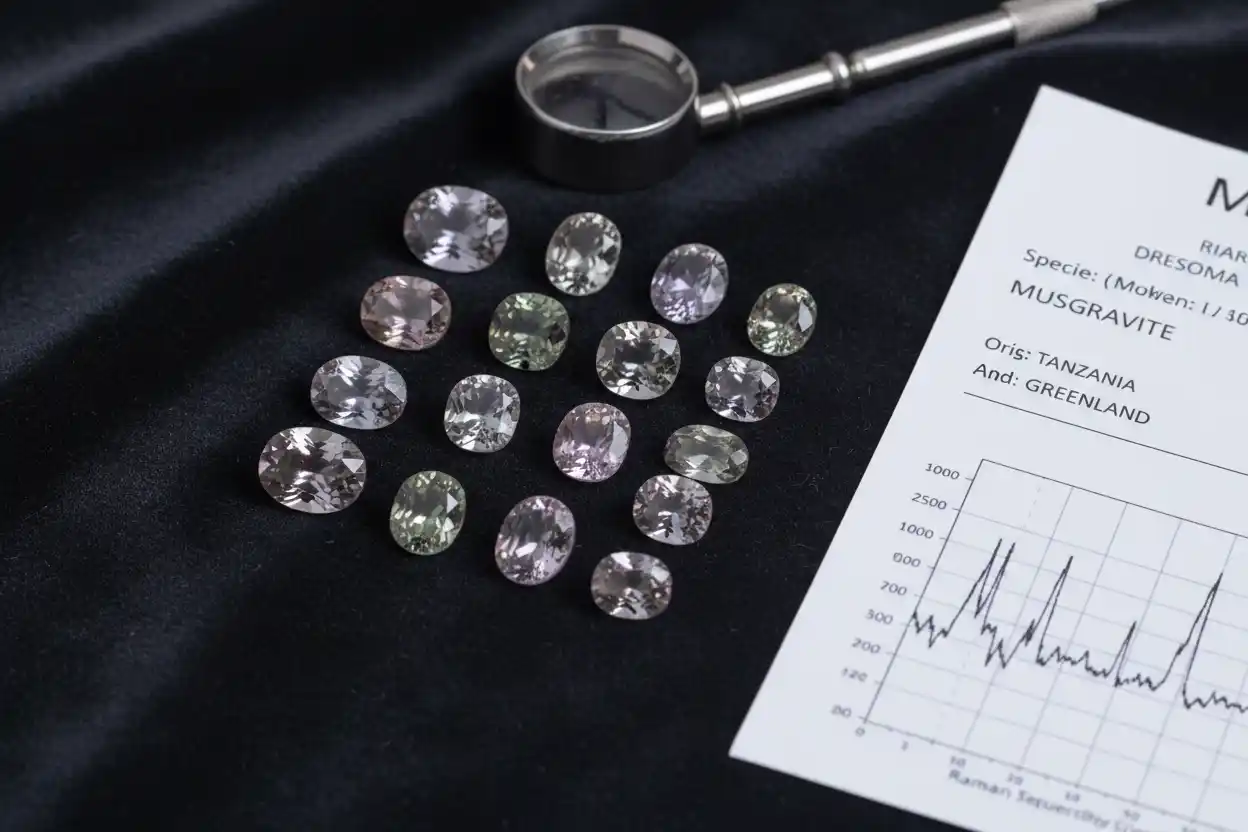
Musgravite Price: Buyer Value Guide, Condition, Quality & Rarity
Musgravite price cannot be reduced credibly to one universal dollars-per-carat figure because the market is exceptionally thin, authenticated stones are individually distinctive, and the first valuation question is whether the material has actually been confirmed as musgravite rather than closely related taaffeite. GIA’s study of Burmese material demonstrates the problem clearly: refractive index and specific gravity fell within ranges that overlapped both minerals, while Raman spectroscopy was required to identify the tiny stones conclusively as musgravite. GIA further noted that specimens submitted under the musgravite name had rarely been confirmed in its laboratory experience. A price based on an unverified seller label therefore cannot be compared directly with a price for a stone supported by advanced laboratory identification.
Modern mineral nomenclature also deserves attention when interpreting sales records. Material historically known as musgravite is associated with magnesiotaaffeite terminology in current mineral classification, while GIA still uses musgravite alongside magnesiotaaffeite in contemporary research. Buyers comparing older auction descriptions, laboratory reports, collector labels, and modern dealer listings should consequently focus on the underlying identification rather than assuming differences in terminology indicate different economic material automatically. Once identity is established, color, transparency, clarity, cut, weight, condition, provenance, unusual inclusions, report quality, and seller liquidity become the meaningful drivers of musgravite price.
Musgravite Price At a Glance
| Value Driver | What Usually Supports a Higher Musgravite Price | What Can Reduce or Undermine Value |
|---|---|---|
| Identity | Advanced laboratory confirmation | Seller-only identification |
| Mineral Terminology | Clear musgravite/magnesiotaaffeite identification | Ambiguous taaffeite-group wording with no conclusion |
| Color | Attractive gray-violet, greenish, unusual red or other desirable hue | Unattractive brownish or dull appearance |
| Transparency | Transparent faceted material | Strong cloudiness or poor transparency |
| Clarity | Eye-clean or attractively included stone | Large distracting fractures or dark inclusions |
| Unusual Inclusions | Documented iridescence or collector-interest features | Ordinary damage mistaken for rarity |
| Cut | Attractive face-up performance and good polish | Windowing, extinction, asymmetry, abrasion |
| Size | Larger authenticated stone with quality maintained | Weight without equivalent beauty or confirmation |
| Condition | Sharp facets, intact girdle, no major chips | Abrasion, chips, open fissures |
| Provenance | Credible locality or old collection history | Unsupported source story |
| Report | Reputable laboratory with appropriate analytical capability | Generic certificate lacking advanced confirmation |
| Treatment | Clear disclosure | Unsupported “always untreated” claim |
| Seller Market | Established rare-gem specialist | Anonymous seller with no return protection |
| Comparable Evidence | Authenticated stones of similar quality | Generic internet rarity list |
| Liquidity | Known collector demand for specific stone | Assuming rarity guarantees immediate resale |
Authentication Can Be the Largest Single Price Difference
A musgravite price premium exists because buyers believe they are acquiring one of the uncommon taaffeite-group gemstones rather than an unidentified stone with similar appearance. GIA has emphasized repeatedly that ordinary gemological properties can overlap with taaffeite and that advanced methods such as Raman spectroscopy may be required to separate them.
This means laboratory confirmation can change the economic category of a stone more dramatically than a minor difference in color or clarity. An undocumented “musgravite” may eventually prove genuine, but until that uncertainty is resolved, a buyer carries species-identification risk and should not value the stone as though the rare identity were already established.
The Gems Lore buy musgravite guide therefore belongs at the beginning of any valuation process: confirm what the gemstone is before debating what its carat weight should be worth.
Musgravite Price and Taaffeite Price Should Not Be Merged
The close relationship between the two minerals creates a temptation to treat taaffeite as a lower-grade musgravite or musgravite as a premium taaffeite label. That is inaccurate. They occupy related but distinct mineralogical categories, and the difficulty of separation is precisely why correct analytical work matters.
A taaffeite can itself be rare, beautiful, and collectible, but a buyer paying specifically for musgravite rarity needs confirmation of musgravite rather than a report stating only “taaffeite group.”
Price databases that aggregate the two materials without clarifying identification standards can therefore produce misleading averages.
Rarity Supports Price but Does Not Create a Transparent Market
Musgravite is described by GIA as rare and highly sought after by collectors, yet scarcity by itself does not produce a large efficient market with hundreds of comparable transactions. The opposite can occur: extremely rare stones trade infrequently, so individual asking prices can differ widely and completed sales may be difficult to verify.
This thin-market structure means an expensive listing is not automatically proof of market value, while a lower asking price is not automatically a bargain. The stone’s identification, quality, seller credibility, transaction terms, and availability of comparable authenticated material all need to be considered.
A practical valuation should use multiple credible rare-gem dealers, documented sales where available, and an experienced independent appraiser rather than one online listing.
Color Can Add a Collector Premium
Musgravite is often associated with grayish violet and subdued tones, but GIA research has documented gray, green, near-colorless, and unusual chromium-bearing red material, showing that the species can display a wider color range than simplified collector descriptions suggest.
An attractive unusual hue can command a premium when the stone is laboratory confirmed and the color remains pleasing face-up. Rare red or green material may attract specialist attention because both the species and the color combination are uncommon.
Color rarity should still be separated from color beauty. A technically unusual hue that looks muddy, excessively dark, or visually unattractive does not necessarily command the strongest market premium.
Transparency Shapes the Jewelry Market
Transparent musgravite suitable for faceting generally has stronger jewelry appeal than heavily cloudy material because transparency allows the stone’s luster, color, cut, and internal features to be observed clearly. GIA’s rare faceted specimens illustrate why even sub-carat transparent stones can become important gemological and collector objects.
Translucent crystals and mineral specimens can have separate scientific or locality value, especially when crystal form is preserved.
A price-per-carat average combining mineral specimens and faceted transparent gems would therefore be economically meaningless.
Eye-Clean Clarity Can Add Value but Is Not the Only Collector Standard
Visible fractures, clouds, dark inclusions, and heavy internal disruption can reduce conventional beauty. Yet rare gemstones can also become more interesting when inclusions are unusual enough to reveal growth history or create optical phenomena.
GIA’s 0.86 ct gray musgravite contained aligned etch tubes producing vivid iridescence under direct illumination, while Burmese specimens contained graphite platelets, needles, particulates, and roiled growth.
The market therefore contains both conventional clarity value and inclusion-collector value. A heavily fractured stone should not be marketed as premium simply because it is included, but a documented exceptional inclusion scene can create a specialist premium of its own.
Size Can Increase Musgravite Price Nonlinearly
Authenticated faceted musgravite is sufficiently uncommon that larger sizes with attractive color, transparency, and cutting can become much harder to replace. This can create a stronger-than-linear price increase as size rises, but no universal multiplier applies because the available inventory is too sparse and heterogeneous.
A larger stone also magnifies quality differences. Poor cut, dark extinction, visible fractures, or unattractive color become more obvious as size increases.
The best large-stone premium therefore belongs to authenticated gems whose quality remains strong rather than merely to any specimen crossing a particular carat threshold.
Weight Retention Can Produce Weak Cutting
Rare rough encourages cutters to conserve weight, which can lead to deeper pavilions, unusual outlines, or less standardized proportions. Some compromise is understandable when every fraction of material is scarce, but severe windowing or extinction still lowers visual quality.
Buyers should compare face-up dimensions with carat weight. A deep one-carat stone can look smaller than a better-proportioned 0.80 ct gem while costing more because of the psychological appeal of the round-number weight.
A visually superior smaller musgravite may therefore represent stronger collector value.
Condition Is Especially Important in a Hard-to-Replace Gem
Musgravite’s hardness around Mohs 8–8.5 provides good scratch resistance, but chips, abrasions, damaged girdles, and open fissures still affect value. In a scarce species, recutting may be particularly expensive because removing damage also sacrifices irreplaceable weight.
Inspect facet junctions under magnification, particularly in older jewelry where abrasion can soften the polish. A repaired chip or recut should be disclosed when it affects current weight or historical provenance.
Condition differences can matter substantially when two otherwise similar collector stones are being compared.
Provenance Can Strengthen a Thin-Market Valuation
A traceable chain of ownership can reduce uncertainty about how a rare gem entered the market, especially when an old laboratory report, respected dealer record, or collection label accompanies the stone.
Geographic provenance can also interest specialists. GIA has confirmed musgravite reportedly from Myanmar while distinguishing that supplier-reported locality from the laboratory’s species identification.
The same distinction should be maintained in valuation. A musgravite can be conclusively identified while its exact mining origin remains less certain.
Origin Premiums Should Remain Secondary to Identity
Unlike major ruby or sapphire markets, musgravite does not have a broadly standardized country-of-origin premium system with large public datasets.
A documented source can add collector interest, especially when connected with an unusual gem-producing district, but the first premium remains correct species identification.
A dealer should not charge a large locality premium from color or seller tradition alone.
Treatment Is Not a Major Published Value Framework
GIA’s musgravite literature focuses on identification, chemistry, inclusions, and rarity rather than on a widespread commercial treatment industry. This supports a cautious conclusion that routine enhancement is not a defining feature of the known musgravite market, but it does not justify claiming that treatment is impossible.
General gemstone treatment standards still require known modifications to be disclosed when they alter appearance, value, or durability.
An expensive musgravite should therefore receive both identity confirmation and appropriate treatment examination rather than relying on the rarity of the species as a substitute for disclosure.
“Investment Grade” Is Not a Gemological Classification
A seller may call an authenticated large musgravite investment grade because the gem is exceptionally rare, but that phrase does not establish future liquidity or appreciation.
Investment value requires more than scarcity. Buyers need willing future counterparties, transparent comparables, manageable transaction costs, trusted documentation, and a market deep enough to establish prices.
Musgravite’s very rarity can actually reduce liquidity because fewer consumers recognize the gem and fewer dealers actively trade it.
Retail Asking Price Is Not the Same as Transaction Value
Dealer retail prices incorporate sourcing difficulty, authentication, inventory holding time, rarity premium, marketing, warranty, return risk, and profit. A dealer making an immediate cash offer to buy the same stone back will normally require a margin below the expected resale price.
An insurance appraisal can differ again because it may estimate replacement cost rather than cash liquidation.
Comparing these numbers without identifying their purpose creates unrealistic expectations.
Musgravite Price Versus Jeremejevite Price
Gems Lore’s jeremejevite price guide covers another thin rare-gem market where verified identity, color, clarity, size, and documentation matter more than generic online charts, while buy jeremejevite emphasizes authentication before purchase.
The comparison is useful methodologically rather than numerically.
Each species has its own supply, color preferences, localities, collector base, and liquidity, so one gem’s per-carat asking price should not be used to calculate the other.
Musgravite Price Versus Grandidierite Price
The Gems Lore grandidierite price guide describes a market with different color expectations and different supply dynamics, while buy grandidierite covers identity and buying quality.
Musgravite may be rarer in authenticated faceted form, yet market price still depends on buyer recognition and available comparable stones.
Rarity ranking alone cannot determine which specimen should cost more.
Musgravite Price Versus Benitoite Price
The Gems Lore benitoite price guide and buy benitoite guide cover a collector gemstone with strong locality identity and a better-known blue-gem market.
Musgravite has a different appeal centered on extreme species rarity and gemological sophistication.
This distinction illustrates why rarity, locality, beauty, and market recognition must all be treated separately.
What Usually Raises Musgravite Price?
Musgravite price generally rises with indisputable advanced-laboratory identification, attractive color, transparency, eye-clean appearance or documented exceptional inclusions, competent cutting, larger size with quality maintained, excellent condition, credible provenance, unusual collector features, and strong documentation from a recognized laboratory.
A particularly unusual color or gemological phenomenon can create a specialist premium when the feature is both authentic and aesthetically appealing.
The strongest stone is therefore not necessarily the largest but the one whose rarity is accompanied by quality and certainty.
What Usually Lowers Musgravite Price?
Unverified identity, ambiguous taaffeite-group descriptions, weak color, poor transparency, heavy unattractive inclusions, open fractures, severe windowing, dark extinction, chips, abrasion, unsupported origin stories, seller-only certificates, inflated investment claims, and unrealistic asking prices unsupported by comparable authenticated stones can all weaken value.
A lower-quality genuine musgravite remains rare, but rarity does not eliminate quality differences.
How to Compare Musgravite Prices Fairly
Compare only authenticated stones and then align weight, dimensions, color, transparency, clarity, cut, condition, report issuer, exact mineral terminology, provenance, treatment disclosure, unusual inclusion features, retail versus auction context, and seller protections. Do not average an undocumented marketplace listing with a Raman-confirmed collector gem or compare a taaffeite sale directly with musgravite merely because the stones share related chemistry and appearance.
Conclusion
Musgravite price begins with identification certainty because the rare-gem premium is meaningless unless the material is genuinely musgravite. GIA shows that musgravite and taaffeite can overlap in refractive index, density, and other routine properties and that Raman spectroscopy may be necessary for conclusive separation. Modern nomenclature further connects historical musgravite with magnesiotaaffeite terminology, making technically precise reports more useful than simplified retail labels.
After identity is established, the economic hierarchy becomes familiar but highly individualized: color, transparency, clarity, unusual inclusions, cutting, size, condition, provenance, and report quality all influence what collectors will pay. Because trading volume is limited, there is no defensible universal musgravite price-per-carat chart that works across every authenticated stone.
The strongest valuation therefore relies on comparable laboratory-confirmed gems and keeps retail asking price, appraisal value, auction result, and dealer resale offer separate. Extreme rarity can support a premium, but it does not guarantee an investment return or immediate liquidity.
Frequently Asked Questions
How much does musgravite cost per carat?
There is no reliable universal musgravite price per carat because authenticated inventory is scarce and individual stones vary greatly in color, clarity, cut, size, condition, provenance, and documentation. The market is better approached through comparable confirmed stones.
Why is musgravite so expensive?
Its premium comes primarily from genuine rarity in facetable material and collector demand, but only when laboratory identification confirms the stone. GIA has noted that specimens submitted as musgravite have rarely been confirmed.
Is musgravite rarer than taaffeite?
Musgravite is generally regarded as exceptionally uncommon, but numerical rarity claims vary depending on definitions and discovered material. The practical buying issue is that the two can overlap enough in standard testing to require advanced identification.
Does larger musgravite cost more per carat?
Larger authenticated high-quality stones can command stronger premiums because they are difficult to replace, but no fixed multiplier applies. Cut, color, clarity, condition, and market demand remain important.
What musgravite color is most valuable?
No universal color ranking applies. Attractive gray-violet, greenish, unusual red, and other colors can appeal to different collectors, while rarity of a hue matters only after identity and overall beauty are established.
Do inclusions always reduce musgravite price?
No. Distracting fractures can reduce conventional value, while unusual documented inclusions can create gemological collector interest. GIA has described iridescent etch tubes and aligned graphite inclusions in authenticated musgravite.
Is musgravite usually treated?
A widespread routine treatment market is not a major feature of the authoritative musgravite literature reviewed here, but that should not be interpreted as proof that treatment is impossible. Known modifications should still be disclosed.
Does a musgravite laboratory report make the stone valuable automatically?
No. The report establishes identity and other gemological facts; market value still depends on color, clarity, cut, size, condition, provenance, and buyer demand.
Why are musgravite and taaffeite sometimes confused?
They have related chemistry and can show overlapping refractive index and specific gravity, so Raman spectroscopy, X-ray diffraction, or comparable advanced analysis may be necessary.
Is AAA musgravite an official grade?
No. AAA, AAAA, investment grade, and similar labels are seller-defined rather than universal laboratory standards.
Does rarity guarantee strong resale?
No. Extreme rarity can also make the market thin, leaving fewer buyers and fewer comparable sales. Immediate resale value may therefore be much lower than retail asking price.
Should I insure an expensive musgravite?
A high-value authenticated specimen may warrant insurance based on an appropriate independent appraisal, particularly because an equivalent replacement can be difficult to source. Insurance value should still be distinguished from cash resale value.
Is musgravite a guaranteed investment?
No. Rarity, authentication, quality, collector demand, market depth, transaction costs, and future discoveries all influence price. No gem can guarantee appreciation.