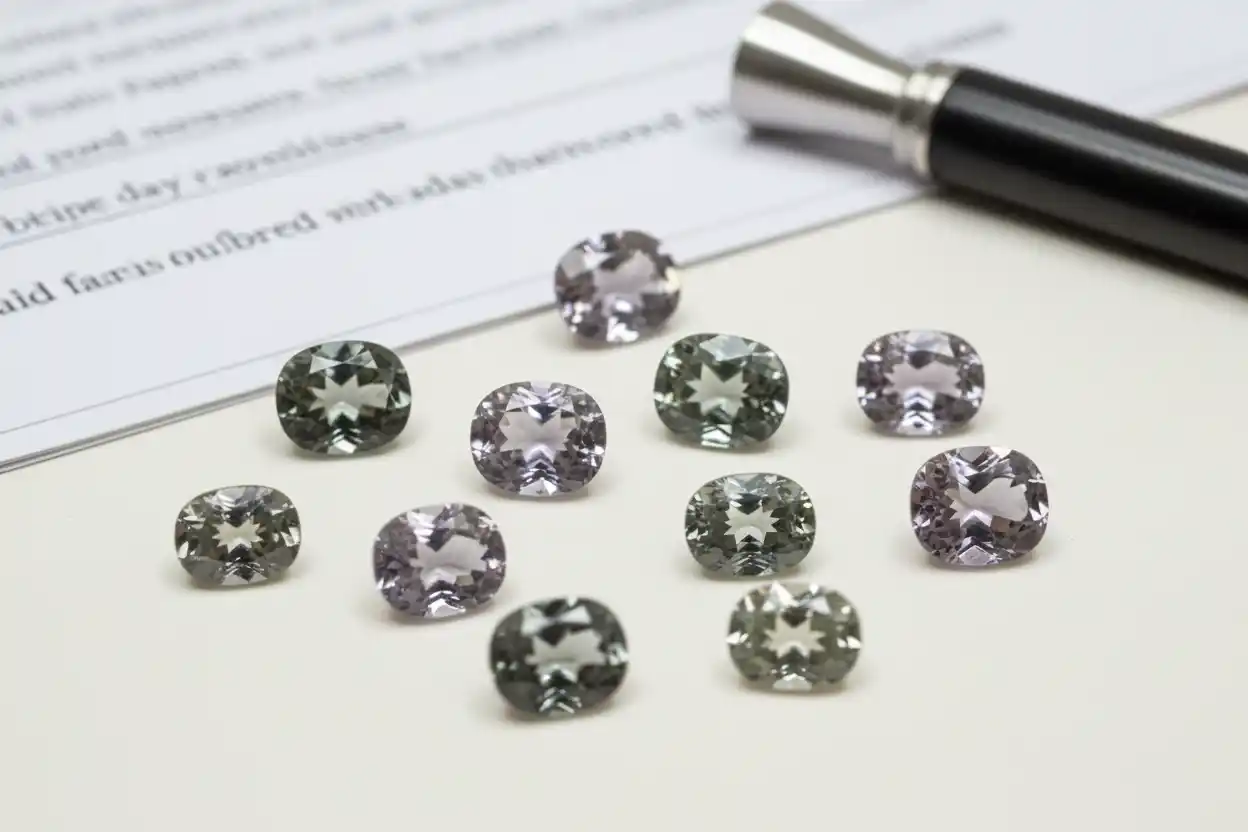
Buy Musgravite: Smart Buying, Treatments, Grading & Cost
To buy musgravite intelligently, make laboratory-confirmed identity the first requirement rather than relying on color, seller reputation, rarity language, or a handwritten gem card. Musgravite is an exceptionally uncommon member of the taaffeite mineral group and is closely related enough to taaffeite that ordinary refractive-index and specific-gravity measurements can overlap substantially. GIA has examined stones submitted as musgravite that ultimately required Raman spectroscopy for conclusive identification, and its researchers explicitly recommend qualified laboratory confirmation because the physical properties of musgravite and taaffeite can be too similar for confident separation through routine observations alone. Modern mineral nomenclature also adds a layer of complexity: material historically called musgravite is now associated with magnesiotaaffeite nomenclature, so a credible report may use both the familiar gem-trade name and a more formal mineralogical designation.
That identification problem has direct financial importance because musgravite’s collector premium is largely based on its genuine rarity. A visually attractive grayish-violet or near-colorless stone that proves to be taaffeite remains a legitimate rare gem, but it should not be priced simply as musgravite because the seller believed the two materials were interchangeable. GIA’s work on Burmese material illustrates this clearly: stones with refractive index and specific gravity within the overlapping musgravite-taaffeite range were confirmed as musgravite only after Raman analysis, and GIA noted that stones submitted to its laboratories under the musgravite name had rarely been confirmed. The smartest purchase therefore begins with a report from a laboratory capable of advanced mineral identification and then evaluates color, transparency, clarity, cutting, size, condition, provenance, and market comparables.
Buy Musgravite At a Glance
| Buying Factor | What to Check | Why It Matters |
|---|---|---|
| Identity | Advanced laboratory confirmation | Musgravite and taaffeite can overlap in routine gemological properties |
| Report Terminology | Musgravite, magnesiotaaffeite terminology, mineral identification | Modern mineral nomenclature can differ from older trade usage |
| Color | Grayish violet, violet, near-colorless, greenish, reddish or other documented colors | Color influences collector appeal but does not prove identity |
| Transparency | Transparent faceted material versus included or translucent stone | Fine transparent stones are more desirable for gem collectors |
| Clarity | Visible inclusions, graphite platelets, needles, particulates, fissures | Inclusions affect beauty and can support gemological study |
| Cut | Symmetry, polish, windowing, extinction, retained weight | Rare rough still needs competent cutting |
| Size | Weight together with confirmed identity and quality | Larger genuine faceted examples can be more selective |
| Condition | Chips, abrasions, open fractures, damaged facet junctions | Rare material loses practical and collector value when damaged |
| Provenance | Credible source history and old collection information | Useful in a thin collector market |
| Geographic Claim | Treat Myanmar, Sri Lanka, Tanzania or other source claims separately from identity | Seller provenance is not the same as laboratory mineral identification |
| Treatment | Ask specifically and require disclosure of known modification | No routine treatment should be assumed either present or impossible |
| Seller Grade | Ignore unsupported AAA or investment labels | No universal commercial quality scale exists |
| Price Evidence | Comparable authenticated stones rather than rarity headlines | The market is thin and individual stones differ sharply |
| Resale | Specialist dealer or collector demand | Retail asking price is not guaranteed liquidity |
| Internal Comparison | Compare with other verified ultra-rare gems | Rarity alone does not create identical value across species |
Understand the Name Before You Buy Musgravite
Musgravite entered gemological literature as a magnesium-rich beryllium aluminum oxide related to taaffeite, and the trade still widely recognizes the historical name. Modern mineral classification places the material within the taaffeite group under magnesiotaaffeite nomenclature, while GIA continues to use familiar musgravite terminology alongside magnesiotaaffeite in current research. GIA recently described musgravite as a trigonal member of the taaffeite group with the composition represented as (Mg,Fe,Zn)₂BeAl₆O₁₂ and confirmed an unusual green musgravite inclusion in sapphire through Raman spectroscopy.
This terminology should not alarm a buyer when a serious laboratory report uses language different from a dealer’s older certificate. Mineral names can evolve as crystallographic classification improves. The important question is whether the report clearly identifies the material represented by the trade as musgravite rather than whether every document uses the identical historical wording.
A seller who cannot explain why a laboratory document says magnesiotaaffeite while the sales invoice says musgravite should not automatically be considered dishonest, but the discrepancy deserves clarification before payment because the exact polytype and identification are precisely what create the collector premium.
Musgravite and Taaffeite Are Not Interchangeable Price Labels
Musgravite and taaffeite are closely related enough that routine testing can produce overlapping results, but they are not simply two marketing names for the same gemstone. GIA’s Burmese musgravite study found refractive index values of approximately 1.718–1.723 and a specific gravity around 3.66 in two tiny specimens, properties that overlapped the ranges of both musgravite and taaffeite and therefore required Raman spectroscopy for definitive separation.
This overlap makes seller-only identification unusually weak evidence for a high-value transaction. A jeweler may be fully competent in everyday colored stones yet lack access to Raman spectroscopy, X-ray diffraction, or other analytical methods needed for rare taaffeite-group material.
If the asking price contains a meaningful musgravite rarity premium, the cost of appropriate laboratory identification should be treated as part of the transaction rather than as an optional luxury.
Color Does Not Authenticate Musgravite
Musgravite has been documented in gray, grayish violet, near-colorless, greenish, and rarer unusual colors, including chromium-bearing red material studied by gemological laboratories. GIA’s current research has also documented green musgravite crystals as inclusions and previously examined a gray 0.86 ct faceted stone displaying iridescence from aligned etch tubes.
This variety means there is no single “musgravite color” that proves a gem is authentic. Grayish violet may be strongly associated with the material in collector literature, but taaffeite and other gemstones can occupy overlapping visual ranges.
A seller describing a stone as musgravite because “the color is exactly right” has not performed sufficient identification. Color becomes a quality factor only after the species and polytype have been established correctly.
Rare Red and Green Colors Need More, Not Less, Verification
Unusual color can increase collector demand, but extraordinary appearance also increases the financial consequences of misidentification. GIA’s recent work confirms that musgravite can occur in green and that chromium can contribute to unusual red coloration in studied specimens, demonstrating that the material’s color range is broader than older simplified descriptions suggest.
A rare-color premium should therefore be supported by both identification and a clear description of the color itself. The laboratory should establish what the material is, while the market decides how much the unusual hue adds.
Do not treat a rare color as an independent guarantee of rarity. A red gemstone can be spinel, ruby, garnet, synthetic material, or another species entirely unless testing establishes the identity.
Transparency Matters in a Collector Gem
Facetable transparent musgravite is the market category most jewelry-oriented collectors seek because transparency allows the finished stone to display color, luster, internal features, and faceting cleanly. GIA has described musgravite as highly sought after by rare-stone collectors and has studied faceted examples well below one carat as significant gemological specimens.
Translucent crystals and included rough can still be scientifically interesting or mineralogically collectible, especially when locality or crystal form is important, but they belong to a somewhat different market from transparent faceted gems.
A dealer should not compare a heavily included crystal directly with a transparent faceted stone solely on weight because the intended collector audience and use differ.
Inclusions Can Reduce Beauty While Increasing Gemological Interest
GIA’s study of Burmese musgravite recorded roiled growth, small colorless needles and particulates, and black hexagonal graphite platelets aligned within the host material. Another GIA musgravite contained numerous crystallographically aligned etch tubes that produced visible thin-film iridescence, making the inclusion scene unusual enough to merit dedicated gemological publication.
This creates an interesting collector tradeoff. A clean transparent musgravite may appeal more strongly as conventional jewelry, while an included stone containing a remarkable diagnostic or optical feature can interest inclusion collectors even when conventional clarity is lower.
The buyer should decide which market matters. An inclusion premium should be based on genuinely unusual, documented internal features rather than on the vague claim that “inclusions prove rarity.”
Musgravite Is Hard Enough for Jewelry but Rarity Encourages Caution
Modern mineralogical references place the material historically known as musgravite around Mohs 8–8.5, making it harder than quartz and many collector gems. Hardness provides useful scratch resistance, but it does not mean a faceted rarity should be treated casually because any gem can chip at thin facet junctions or along damaged edges after a strong impact.
The practical issue is replacement. A routine sapphire can often be replaced with a reasonably similar sapphire if an accident occurs; a documented musgravite of particular color, size, inclusions, and provenance may be impossible to duplicate.
Protective setting design therefore makes sense even when the material’s intrinsic hardness is high.
Cut Quality Still Matters Despite Extreme Rarity
Scarcity sometimes leads buyers to excuse weak cutting because preserving every fraction of a carat can seem more important than optical performance. Some weight retention is understandable in exceptionally rare rough, but a badly windowed, asymmetrical, poorly polished, or overly dark stone still delivers less beauty.
Examine the gem face-up rather than reading the carat weight first. Look for excessive transparent windowing, persistent extinction, uneven girdle thickness, abrasions, scratches, and chips along facet junctions.
A well-cut smaller genuine musgravite can represent a stronger collector gem than a heavier stone whose extra weight sits in an inefficient pavilion.
Size Should Be Evaluated Inside the Authentic Musgravite Market
Musgravite’s reputation for rarity means larger confirmed faceted examples can attract significant collector interest, but no universal carat threshold transforms a stone automatically into investment grade. GIA research includes tiny authenticated stones, sub-carat faceted specimens, and larger examples, illustrating that the species occurs across a range of gem sizes but remains rarely confirmed in laboratory submissions.
The market becomes too thin for a simple linear chart stating what every one-, two-, or three-carat musgravite should cost. Color, clarity, cut, provenance, and seller channel can produce large price differences even at similar weights.
A larger stone deserves a stronger premium only when its identification and overall quality support that premium.
Provenance Can Strengthen Confidence but Does Not Replace Testing
Musgravite has been reported from several gem-producing regions, including material studied by GIA from Myanmar and broader taaffeite-group occurrences associated with Sri Lanka and other metamorphic gem terrains. GIA’s Burmese study specifically reports two stones said to come from near Mogok while carefully distinguishing supplier-reported locality from laboratory identification.
This is the correct model for buyers. A laboratory can identify the mineral, while geographic provenance may rely partly on mining records, dealer chains, parcel history, or older labels unless a recognized scientific origin method exists.
A credible old collection card can add collector value, but it should never be used to override contradictory mineral identification.
There Is No Widely Standardized Musgravite Treatment Market
Authoritative GIA literature on musgravite focuses overwhelmingly on identification, crystal chemistry, inclusions, and separation from taaffeite rather than on a routine commercial treatment pipeline. That absence of a standard treatment narrative should not be turned into the absolute statement that musgravite can never be modified, however, because general gemstone practice requires disclosure of known treatments whenever they materially alter color, clarity, or durability.
A buyer should therefore ask directly whether the seller knows of heating, irradiation, filling, coating, fracture treatment, or any other modification and should obtain laboratory confirmation appropriate to the value of the gem.
The correct description is not “musgravite is always untreated,” but rather that routine enhancement is not a defining commercial feature in the authoritative musgravite literature reviewed for this guide.
Be Skeptical of AAA, AAAA and Investment Grades
No universal laboratory musgravite grading scale assigns AAA, AAAA, 5A, museum quality, or investment grade. These labels are marketing shorthand unless the seller defines transparent internal criteria.
A meaningful description instead states the exact weight, dimensions, color, transparency, inclusions, cut, condition, report laboratory, provenance, and whether the stone has any known treatment.
The rarer the gem, the less useful an unsupported superlative becomes because authenticity and detailed documentation matter far more than a retailer-created letter grade.
Separate Identification Reports From Appraisals
A gem identification report establishes what the stone is and may record measurements, color, weight, and detectable characteristics. An appraisal estimates monetary value for a stated purpose.
Those functions are not interchangeable.
A seller presenting a large insurance appraisal as proof that the asking price is a bargain is using a different valuation context from an actual dealer-to-dealer or collector resale transaction.
Musgravite Versus Jeremejevite
Both musgravite and jeremejevite occupy rare-gem collector markets where confirmed identity matters more than mass-market brand recognition. Gems Lore’s buy jeremejevite guide and jeremejevite price guide illustrate how rarity, color, clarity, size, documentation, and thin market liquidity interact in another uncommon gemstone.
The important difference is mineral identity. A buyer should never use the asking price of one rare species as a direct price-per-carat benchmark for another simply because both appear on “world’s rarest gemstones” lists.
Musgravite Versus Grandidierite and Benitoite
The Gems Lore buy grandidierite guide, grandidierite price guide, buy benitoite guide, and benitoite price guide cover other collector gems whose values depend on different combinations of color, locality, transparency, supply, and market recognition.
These comparisons are useful because they show why rarity cannot be reduced to one ranking. A rarer species can sell for less than a better-known gem when buyer demand, visual appeal, provenance, or liquidity differ.
Musgravite should therefore be purchased as musgravite, not as a position on an online rarity chart.
Common Red Flags When You Buy Musgravite
A musgravite purchase deserves extra scrutiny when the stone has no advanced laboratory report, the seller says taaffeite and musgravite are “basically the same,” identification rests only on refractive index, the certificate comes only from the seller, an ordinary-looking stone carries an extreme rarity premium without documentation, geographic origin is treated as proof of species, a large appraisal is presented as guaranteed resale value, an unsupported treatment-free claim is used to justify a premium, or the seller relies heavily on AAAA and investment terminology instead of mineralogical evidence. GIA’s repeated emphasis on Raman or comparable advanced testing makes unsupported identification the most serious warning sign.
How to Compare Musgravite Listings Fairly
Compare only stones whose identity is established to a similar level of confidence, then examine exact weight, dimensions, color, transparency, visible clarity, microscopic interest, cut, condition, report issuer, terminology, provenance, treatment disclosure, seller reputation, return policy, and actual comparable transactions where available. A 0.50 ct authenticated gray-violet musgravite, 0.50 ct taaffeite, undocumented “musgravite,” and unusual red laboratory-confirmed musgravite do not belong in one price-per-carat average merely because the listings use similar rarity language.
Conclusion
To buy musgravite successfully, pay first for certainty and then for beauty. The gemstone’s close relationship with taaffeite makes routine gemological properties insufficient in some cases, and GIA specifically reports that Raman spectroscopy or similarly advanced analysis can be necessary for conclusive separation. Modern nomenclature also connects the historical musgravite name with magnesiotaaffeite terminology, so serious buyers should expect technically precise reports rather than simplified retail labels.
Once identity is secure, color, transparency, clarity, unusual inclusions, cut, size, condition, and provenance determine which authenticated stone is more desirable. Musgravite’s rarity makes documentation exceptionally important, but scarcity should never excuse poor disclosure or weak valuation logic.
A well-bought musgravite is therefore not merely the rarest-looking stone or the highest carat weight. It is a correctly identified collector gem whose report, physical quality, provenance, and asking price make sense together.
Frequently Asked Questions
Is musgravite the same as taaffeite?
No. They belong to the same mineral group and can show overlapping routine gemological properties, but GIA notes that Raman spectroscopy or X-ray diffraction may be required for conclusive separation.
Why do some reports use magnesiotaaffeite terminology?
Modern mineralogical nomenclature has changed from the historical musgravite name, and current references connect musgravite with magnesiotaaffeite classification. The report should make the exact mineral identification clear.
Is musgravite genuinely rare?
Yes. GIA describes musgravite as a rare mineral highly sought after by rare-stone collectors and notes that stones submitted under the name have only rarely been confirmed in its laboratory experience.
What colors can musgravite show?
Documented material includes gray, grayish violet, near-colorless, greenish, and rarer unusual colors. GIA has examined gray musgravite and confirmed green musgravite as well as chromium-bearing red material in modern research.
Can color prove a stone is musgravite?
No. Color overlaps with taaffeite and many unrelated gems. Advanced laboratory identification is much stronger evidence.
How hard is musgravite?
Modern mineral references place the material historically known as musgravite around Mohs 8–8.5. It has good scratch resistance but should still be protected from hard impacts because replacement material is exceptionally uncommon.
Are musgravite inclusions bad?
Not always. Visible inclusions can lower conventional clarity, but unusual graphite platelets, etch tubes, and other diagnostic features can interest gemological collectors. GIA has documented both graphite inclusions and iridescent etch tubes in musgravite.
Is musgravite routinely treated?
Routine enhancement is not a defining feature of the authoritative musgravite literature reviewed here, but buyers should still request disclosure of any known treatment rather than assuming treatment is impossible.
Does musgravite have an official AAA grade?
No universal laboratory AAA or AAAA musgravite grade exists. Identification, color, transparency, clarity, cut, size, condition, provenance, and documentation are more meaningful.
Do I need a laboratory report to buy musgravite?
For a meaningful musgravite price premium, yes, because taaffeite and musgravite can overlap in ordinary gemological testing and may require Raman spectroscopy or another advanced method for confirmation.
Does a musgravite report give its market value?
An identification report establishes gemological facts, while an appraisal or market comparison estimates monetary value. The two functions should not be confused.
Is larger musgravite always more valuable?
Larger authenticated stones can be more selective, but color, transparency, clarity, cut, condition, provenance, and current collector demand also matter. Weight alone is not a complete valuation.
Is musgravite a guaranteed investment?
No. Extreme rarity can create collector interest, but thin trading, limited comparable sales, changing demand, transaction costs, and authentication risk prevent guaranteed appreciation or liquidity.